MICROORGANISMS: BUOYANT DENSITY
CENTRIFUGATION
See III / FOOD MICROORGANISMS: BUOYANT DENSITY CENTRIFUGATION
MICROWAVE-ASSISTED EXTRACTION:
ENVIRONMENTAL APPLICATIONS
G. N. LeBlanc, CEM Corporation, Matthews, NC, USA
Copyright^ 2000 Academic Press
Speed and efRciency are always prime
consider-ations of an analytical technique. In addition, we are
seeing environmental considerations } ‘greening’ of
methods}becoming another important factor. A
sol-vent extraction technique that reduces extraction
time, improves extraction efRciency and reduces
solvent consumption by a factor of 10 is an important one. The latter is critical since it is estimated that about 100 million litres of organic solvent are used annually in organic analytical laboratories world-wide. The use of microwave heating for the extrac-tion of compounds from a variety of sample matrices has been performed since 1985. This review article provides information on the development of the microwave-assisted extraction (MAE) technique, microwave instrumentation and its capabilities, and a perspective for extraction applications.
Development
Microwave heating wasRrst introduced
commercial-ly in 1947. It took some time to catch on but it is now a standard item in most kitchens for cooking uses. Its
use in the chemistry laboratory has signiRcantly lagged
behind domestic applications. Microwaves were Rrst
used in 1975 as a heating source for acid digestion under atmospheric conditions. The sample preparation
step was reduced from 1}2 h to under 15 min,
produ-cing an overall reduction in analysis time. This work initiated the use of microwave energy as a heating source for the chemistry laboratory. Other applica-tions include distillation, organic and inorganic syn-thesis, evaporation and solvent extraction.
The early applications for MAE were for the ex-traction of compounds with nutritional interest from
plant and animal tissues. From 1986 to 1990, Ganzler and co-workers published a series of four papers exploring the use of microwave energy to partition various compounds from soils, seeds, food and ani-mal feeds as a sample preparation method prior to chromatographic analyses. The extraction step was performed under atmospheric conditions. They ex-tracted a variety of compounds that included anti-nutritives, crude fat and pesticides. They used solvent schemes similar to their traditional Soxhlet technique to allow a direct comparison of the recoveries be-tween the two techniques. The heating programme consisted of multiple 30 s microwave heating cycles (up to seven cycles) followed by a cooling step. This approach allowed observation of the samples in the microwave cavity to prevent sample boil-over.
The microwave extracts gave recoveries that were
100}120% of the Soxhlet technique. However, the
MAE times were a factor of 100 less than the tradi-tional Soxhlet approach. The authors postulated that
improved extraction efRciency was due to the
polar nature of the extracted compounds or the water contained in the materials. They also noted a decrease
in extraction efRciency for the recovery of
non-polar compounds when a nonnon-polar solvent was used. The published work of Freitag and John in 1990 expanded the application and technique. These authors explored the use of microwave heating at elevated temperatures and pressure for the extraction
of additives from polyoleRns. The additives were
anti-oxidants, Irganox 1010 and Irgafos 168, and the light
stabilizer Chimassorb 81. The polyoleRn matrices
were polyethylene and polypropylene with a particle size of 20 mesh and a sample size of 1 g. The MAE was performed with 30 mL of 1,1,1-trichloroethane
or a mixture of acetone andn-heptane. They obtained
90}100% recoveries of the additives with extraction
times of 3}6 min without degradation of the analytes
compared favourably with the conventional 16 h
Soxhlet or 0.5}2 h reprecipitation techniques.
Pare et al. from the Ministry of Environment of Canada introduced the microwave-assisted process
(MAP2+) through a US patent in 1991. In this work,
Pare used microwave energy to extract a variety of essential components from natural products and foods, such as biologicals and consumer products. The primary examples are the extraction of essential oils from peppermint, garlic and cedar. The major feature of this work is the release mechanism for the compounds of interest from the substrate. The micro-wave energy was used to disrupt the glandular and vascular system of the tissue without damaging the surrounding tissue. The solvent was used to trap and dissolve the compounds released from the tissue.
In general, the mechanism involves localized heat-ing of the free water present in the sample. Once the water is at or above its boiling point, the water causes the cell membrane to rupture. This water, as steam, transports the target analyte from the solid to the nonabsorbing solvent. In this type of work, the sample is a good dielectric while the solvent is a poor dielectric. The microwave process gave higher yields than the traditional steam distillation process. The
authors postulated that the improved efRciency
was due to the lower bulk temperatures and shorter extraction times.
In 1992, Bichiet al. published work from the
phar-maceutical area based on MAE using closed-vessel technology with temperature-feedback control. They extracted pyrrolizidine alkaloids from dried plants
using 25}50 mL of methanol. The extractions were
performed over a temperature range of 65}1003C for
20}30 min. The MAE technique gave qualitatively
and quantitatively identical chromatographic results relative to the samples extracted by the Soxhlet
pro-cedure with a signiRcant reduction in extraction time
and solvent consumption. The temperature feedback control provided highly reproducible extractions.
In 1993, Onuska and Terry published theRrst data
on the use of MAE for pollutants from environmental samples. They successfully extracted organochlorine pesticide residues from soils and sediments using
a 1 : 1 mixture of isooctane}acetonitrile using sealed
vials. The samples were irradiated forRve 30 s
inter-vals. This produced faster and more reliable results than the conventional methods. They also studied the use of a nonpolar solvent, iso-octane, for the extrac-tion of wet sediment samples. Pesticide residue re-coveries increased as the moisture content increased to a maximum of 15% and then levelled off. This shows the importance of a polar co-solvent when using a nonpolar extracting solvent for MAE
tech-niques that are temperature-dependent. In 1994
Lopez-Avilaet al. published their work to expand the
use of MAE to 187 volatile and semivolatile organic compounds from soils. The compounds included polyaromatic compounds (PNA), phenols, organoch-lorine pesticides and organophosphorus pesticides. This work was performed using a temperature feed-back-controlled microwave heating system with closed vessels. This demonstrated the viability of the technique for the extraction of many compounds of interest to the US Environmental Protection Agency with relatively small volumes of solvent and extrac-tion times of only 10 min. This culminated in 1998 with the approval of the microwave extraction tech-nique by the SW-846 Organic Methods Workgroup of incorporation into SW-846 as the latest of the ‘green’ methods.
In 1997 there were a number of signiRcant
exten-sions of the technology. Incorvia-Mattinaet al.
inves-tigated the use of MAE to extract taxanes, used in ovarian and breast cancer research, from Taxus
bio-mass. MAE offered signiRcant time savings
ver-sus the standard shaking technique and improved
yields versus synthetic approaches. Stoutet al.
com-bined MAE with liquid chromatography}
electro-spray ionization}mass spectrometry for the
deter-mination of imidazolinones in soils at concentrations
of less than 1 p.p.b. McNairet al. reported the
combi-nation of MAE with solid-phase microextraction for
the analysis ofSavour ingredients at concentrations
of 2}10 p.p.b. in solid food samples. This technique
showed good selectivity for the target analytes in a variety of foods.
Instrumentation
MAE is the process of heating solid sample}solvent
mixtures with microwave energy and the subsequent partitioning of the compounds of interest from the sample to the solvent. The most common approach is to perform the extraction in a sealed vessel that is microwave-transparent. This allows a temperature
elevation signiRcantly above the atmospheric boiling
point of the solvent (Table 1) and hastens the
extrac-tion process.
The alternative approach is to perform the extrac-tion in an open vessel at atmospheric condiextrac-tions. This approach is common when the solvent is nonpolar or microwave-transparent and the sample is a biological or agriculture tissue that has a polar constituent, usually water. This is the basis for the patent issued to
Environment Canada for the MAP2+.
Table 1 Solvent boiling point}closed vessel temperature comparison
Solvent Boiling point (3C) Closed vessel temperature (3C)a
Acetone 56.2b 164
Acetone : Cyclohexane 7 : 3 vol/vol 52 160
Acetonitrile 81.6b 194
Dichloromethane 39.8b 140
Hexane 64.7b 162c
Methanol 68.7b 151
aAt 175 psig.
bLange’s Handbook of Chemistry, 14 edn. Dean JA (ed.) New York: McGraw-Hill, Inc., 1992: 11.10}11.12. cUsing carboflon heating insert.
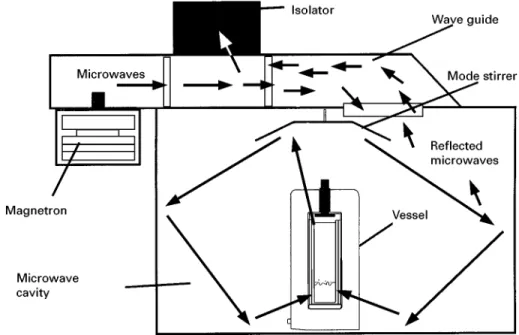
Figure 1 Microwave system components.
applications, it is Rrst necessary to understand the
analysts’ objectives. These objectives include:
1. Selection of the optimum solvent for the analytes of interest.
2. Minimization of any steps prior to the extraction step.
3. The use of a minimum amount of solvent for the extraction step.
4. Effective and reproducible extraction condi-tions.
5. High sample throughput. 6. Safe operation.
Considering these objectives, a microwave-assisted extraction system was designed that was a deriva-tive of the successful microwave acid digestion sys-tem. The key components are:
1. Microwave instrumentation 2. Solvent safety features
3. Vessel technology
4. Temperature control system
5. Indirect heating source (for heating nonpolar sol-vents)
6. Stirring mechanism
Each component is reviewed in terms of its tech-nical merit and how it assists in meeting the analysts’ objectives for the extraction step.
Microwave Instrumentation
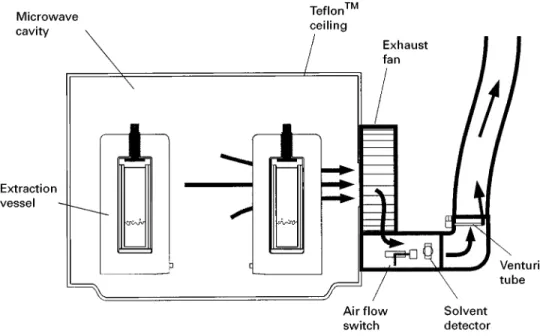
Figure 2 Safety exhaust and solvent detector.
reSected energy that would decrease its power
out-put. A good analogy is a one-way mirror}it allows
energy to go from the magnetron to the cavity but will not allow it to go from the cavity to the magnetron. A turntable can be used to rotate the sample load within the cavity to ensure even energy distribution.
Microwave heating is signiRcantly different
from conductive heating methods. Conductive heat-ing is sample-independent. All samples placed inside a conduction heating oven will equilibrate to the programmed temperature. This can take quite some time. Microwave heating is sample-dependent. The temperature rise rate of samples will depend on their microwave-absorbing characteristics. The microwave design provides the ability to heat uniformly a large number of samples in a short period of time based on the sample load characteristics.
Solvent Safety Features
Due to theSammable characteristics of many organic
solvents, there is a major safety issue when heating
a solvent in a microwave Reld. This safety issue is
magniRed when heating these solvents in sealed
vessels at temperatures up to 1003C above their
atmo-spheric boiling point. The microwave system should have redundant safety features, each acting as a
back-up to prevent possibleRre or explosion from
occur-ring inside the cavity. Instruments should be designed to eliminate possible ignition sources, to detect
sol-vent leaks and to remove leaking solsol-vent.Figure 2is
an illustration of the interior of a commercially avail-able microwave extraction system. The safety aspects are an exhaust fan which evacuates the cavity air
volume approximately once per second. If the ex-haust fan fails or there is a block downstream of the
fan, the airSow switch shuts down the system. The
solvent detector monitors the cavity for the presence of solvent. The detector shuts the system down if solvent concentrations reach one-tenth of the lower explosive limit for acetone, sets off an alarm and
posts a message for the operator. The cavity is TeS
on-coated to minimize the potential of high energy dis-charges. The system door is designed to withstand an event equivalent to the explosion of 1 g of TNT. It will partially open, allowing gases to escape, and then the compression springs will pull it closed. This will contain any of the contents associated with a vessel-related event inside the system’s cavity.
Vessel Technology
The closed vessels used for MAE are designed for
temperatures up to 2003C and pressures of 200 psi
(14 bar). The materials of construction for the
com-ponents that are in contact with the sample}solvent
mixture, either TeSon or glass, are inert to solvents.
However, since these materials are relatively weak,
an outer body is used that is much stronger}either
a reinforced thermoplastic or a frame of polypropy-lene, or both. In addition, these materials of construc-tion absorb a minimal amount of microwave energy.
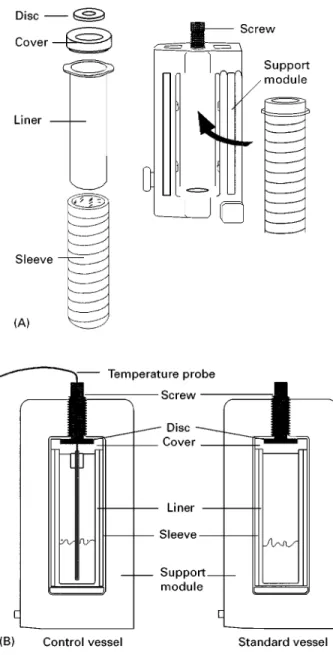
Figure 3illustrates a standard extraction vessel and a control extraction vessel. The vessels are composed
of glass or TeSon liners, TeSon, PFA seal cover,
polyetherimide load disc and sealing screw,
glass-Rlled polyetherimide sleeve and polypropylene
Figure 3 (A) Exploded view of a microwave extraction vessel. (B) Cut-away view of microwave extraction vessels.
mechanism for safety purposes. If the pressure inside the vessel exceeds the operating limits, the vessel will
automatically vent. The control vessel is modiRed to
accept a probe to monitor and control the extraction temperature. A turntable of 14 extraction vessels is placed into the instrument’s cavity for batch process-ing. The ability to rapidly achieve elevated solvent temperatures under controlled conditions for a large batch of samples is a major advantage of the MAE technique.
Temperature Control System
Temperature control is necessary to optimize the
ex-traction efRciency, prevent thermal degradation
of the target analytes, and to provide reproducible operating conditions. This is achieved with a temper-ature measurement system that is microwave-trans-parent so it does not cause any self-heating. The temperature probe is inserted directly into the con-trol vessel to measure the temperature of the
solvent}sample mixture. It is then used in a feedback
control loop to regulate the microwave power output to achieve and maintain the operator-selected extrac-tion temperature. This approach provides temper-ature control for one of the samples in the batch and assumes equivalent reaction conditions for all the other samples. This control technique is augmented with an indirect infrared temperature measurement system. The infrared sensor is located underneath the
cavity Soor. It monitors the temperature of each
vessel as it passes over the sensor. This temperature reading is correlated to the direct temperature reading from the control vessel to provide temperature data for all of the samples in the batch.
Indirect Heating Source
In some extraction applications, the solvent of choice for the target analytes is nonpolar and therefore does
not heat when exposed to the microwaveReld. This
would normally preclude the use of the MAE tech-nique unless the analyst is willing to alter the solvent scheme to include a polar co-solvent. This is not
desirable since it alters the extraction efRciency
(or selectivity). This problem is overcome with the use
of an insert that is a chemically inertSuoropolymer
Rlled with carbon black, a strong microwave
absorb-er. The insert is placed into the vessel with the
sol-vent}sample mixture. The insert absorbs microwave
energy and transfers the thermal energy it generates to the mixture. The performance characteristics of the
heating inserts for heating withn-hexane in a
micro-waveReld are seen inTable 2.The use of the heating
insert allows transfer of existing methods to the MAE technique without a change in the solvent scheme.
Stirring Mechanism
Stirring increases the surface area contact between
the sample and solvent. This offers the beneRt of
improved extraction efRciency and decreased
sol-vent consumption. Stirring is achieved with the use of
a rotating magnet below the cavity Soor and the
placement of a magnetic spinbar in the extraction
vessel. The magnet creates a rotating magneticReld
that couples with the spinbar in the vessel to create a stirring effect. The spinbars are either coated
with an unRlledSuoropolymer for applications using
polar solvents or a carbon blackRlledSuoropolymer
Table 2 MAE heating rate forn-hexane using heating insert
Temperature set point (3C) Time to temperature (min)
1 Vessel 6 Vessels 12 Vessels
100 1:45 2:45 3:45
125 2:30 4:15 6:15
150 3:35 6:15 9:30
Notes: Each vessel contained 50 mL ofn-hexane and 1 heating insert. The starting temperature was 253C. As a point of reference, 12 vessels containing 50 mL of acetone will reach 1253C in 5 min under equivalent conditions.
These components create a system to perform MAE. This technique has the capability to reduce extraction time, reduce solvent consumption and
im-prove extraction efRciency. However, it does not
come without a cost. The extraction step is but one of
many necessary steps to obtain the Rnal analytical
result. The analyst must take into account the dif-ferences in using the MAE technique versus their existing approach. The primary difference is the
Rnished sample form. It is the same sample}solvent
mixture originally placed into the vessel. The analyst needs to separate the sample from the solvent at the completion of the extraction step. If the analyst can work with an aliquot of the solvent for analysis, this objection can be overcome with the use of a syringe
Rltration technique. A secondary consideration is the
vessel manipulations used with MAE. These manip-ulations will be new for the analyst.
Applications
MAE has been applied to a wide variety of samples in which traditional Soxhlet extractions are performed.
Table 3 gives a performance comparison of MAE versus conventional extraction techniques for a var-iety of sample types. For the scope of this work, we will limit the application discussion to the extraction of plastics and polymers, pesticides and environ-mental samples.
Plastics and Polymers
The additive package used in the production of
poly-oleRns is designed to improve processing efR
cien-cy or to impart speciRc performance characteristics.
The package can contain antioxidants, antistatic agents, slip agents, anti-block agents, UV stabilizers or antifogging agents. It is important for production
efRciency and product quality that the
appropri-ate amount of each additive is present. A fast and reliable method is needed to determine the additive concentration level. The conventional extraction
ap-proach is a reSux technique with an appropriate
sol-vent for 1}48 h followed by high performance liquid
chromatography (HPLC) analysis. An alternative
ex-traction technique is sonication for 30}60 min, but
the gain in speed is offset by a loss in extraction
efRciency. MAE has the ability to address the
time and extraction deRciencies of the reSux and
sonication techniques. Freitag and JohnRrst
demon-strated the potential for MAE when they obtained excellent antioxidant recoveries from polypropylene and polyethylene.
Pesticides and Herbicides
Pesticides and herbicides are used to protect a wide variety of agricultural commodities. There is an inter-est in pinter-esticides, herbicides and their degradation product concentrations in plant and animal tissues and soil and sediment samples. The underlying as-sumption is that extractable compounds are labile in the environment and constitute a threat to the
envi-ronment if they are hazardous. SpeciRc examples are
from the work of Fish and Revesz on chlorinated pesticides from soils and the work of Stout’s group on imidazolinone herbicides in plant tissues. Fish and Revesz showed chlorinated pesticide recoveries from
a CertiRed Reference Soil greater than or equal to
those achieved using the standard Environmental Protection Agency Soxhlet technique, method 3540. This was achieved with extraction times of only
20 min and solvent volumes of 50 mL. Stout et al.
incorporated the use of MAE with liquid
chromato-graphy}electrospray ionization}mass spectrometry to
shorten the clean-up procedure and method develop-ment time of residue methodologies for determining the imidazolinones and their metabolites in crops. This application area is of concern not only to the traditional commercial testing laboratory, but to agro-chemical producers.
Environmental
as other organic molecular species, from solid sam-ples is a primary concern. The workload in the
envir-onmental laboratory is expected to increase signiR
-cantly and will thus require extraction techniques that offer increased throughput, reduced solvent
consumption, improved efRciency and
reproduci-bility. MAE has the potential to address these needs. McMillin of US Environmental Protection Agency-Region VI demonstrated this in a comparison of various soil extraction techniques for semivolatile analysis. He used an abbreviated MAE technique
consisting of a small modiRcation to regular MAE.
He worked with only 10 mL of solvent versus the conventional 30 mL. This eliminated the subsequent concentration step and allowed the sample to be injected straight from the extraction vessel into a GC. The abbreviated MAE provided better extraction
ef-Rciencies and reproducibility than the three
conven-tional techniques. The extraction time averaged 16 min per sample with a solvent use of 10 mL per sample.
One difRculty in the use of MAE for the
envir-onmental laboratory market is Envirenvir-onmental Protec-tion Agency approval. The methodology has been approved by the SW-846 Organic Methods Work-group for incorporation into SW-846. However, the method has not been promulgated and thus can only
be used when regulations do not speciRcally require
SW-846 methods.
Future Developments
The instrumentation for MAE will continue to evolve, as will its potential applications. There will be developments in the vessel technology to address the separation issue of the sample and solvent after the extraction step. This will allow the technique to be a true replacement for the Soxhlet. There is also a need for larger vessel sizes. The current vessel has a working volume of 100 mL. There is a need to in-crease this to 250 mL and even higher for bulky samples and the inevitable push for lower detection limits. Finally, the microwave system’s use should be extended to concentration of the sample after the extraction step. This will create a multi-tasking tool for the analytical laboratory.
MAE has focused on extraction applications from
solid matrices. However, its speed and efRciency
suggest that this technique will be used for isolating pharmaceutical compounds during the drug
dis-covery process. The recent addition of sample stirring
suggests that it can be extended to liquid}liquid
ex-traction applications. It could also be coupled with solid-phase microextraction to lower detection limits
signiRcantly. As MAE becomes more widely accepted
and instrumentation evolves, we should see a signiR
-cant increase in its applicability.
See also: II/Extraction: Microwave-Assisted Extraction. Environmental Applications: Soxhlet Extraction.
Further Reading
Bichi C, Beliarab F and Rubiolo P (1992) Extraction
of alkaloids from species of seneio. Lab 2000 6:
36}38.
Fish J and Revesz R (1996) Microwave solvent extraction
of chlorinated pesticides from soil. LC-GC 14(3):
230}234.
Freitag W and John O (1990) Fast separation of stabilizers
from polyoleRns by microwave heating. Die
Ange-wandte Makromo Lekulare Chemie175: 181}185.
Incorvia Mattina M, Iannucci Berger W and Denson C (1997) Microwave-assisted extraction of taxanes from
taxus biomass.Journal of Agricultural and Food
Chem-istry45: 4691}4696.
Kingston H and Haswell S (eds) (1997)
Microwave-enhanced Chemistry. Washington, DC: American
Chemical Society.
Kingston H and Jassie L (eds) (1988) Introduction to
Microwave Sample Preparation. Washington, DC:
American Chemical Society.
Lesnik B (1998) Method 3546: microwave extraction for
VOCs and SVOCs.Environmental Testing and Analysis
7(4): 20.
Lopez-Avila V, Young R and Beckert W (1994) Micro-wave-assisted extraction of organic compounds from
standard reference soils and sediments. Analytical
Chemistry66(7): 1097}1106.
McNair R, Wang Y and Bonilla M (1997) Solid phase microextraction associated with microwave assisted
extraction of food products.Journal of High Resolution
Chromatography20: 213}216.
Onuska F and Terry K (1993) Extraction of pesticides from
sediments using microwave technique.
Chromato-graphia36: 191}194.
Stout S, Dacunha` A and Safarpour M (1997)
Simpli-Red determination of imidazolinone herbicides in soil
at parts-per-billion level by liquid
chromato-graphy/electron ionization tendem mass spectrometry.