Heuristic Backtracking Algorithms for SAT
A. Bhalla, I. Lynce, J.T. de Sousa and J. Marques-Silva
IST/INESC-ID, Technical University of Lisbon, Portugal
ateet,ines,jts,jpms
@sat.inesc.pt
Abstract
In recent years backtrack search SAT solvers have been the subject of dramatic improvements. These improvements allowed SAT solvers to successfully replace BDDs in many areas of formal verification, and also motivated the devel-opment of many new challenging problem instances, many of which too hard for the current generation of SAT solvers. As a result, further improvements to SAT technology are ex-pected to have key consequences in formal verification. The objective of this paper is to propose heuristic approaches to the backtrack step of backtrack search SAT solvers, with the goal of increasing the ability of the SAT solver to search different parts of the search space. The proposed heuris-tics to the backtrack step are inspired by the heurisheuris-tics pro-posed in recent years for the branching step of SAT solvers, namely VSIDS and some of its improvements. The prelim-inary experimental results are promising, and motivate the integration of heuristic backtracking in state-of-the-art SAT solvers.
1. Introduction
Propositional Satisfiability is a well-known NP-complete problem, with theoretical and practical significance, and with extensive applications in many fields of Computer Sci-ence and Engineering, including Artificial IntelligSci-ence and Electronic Design Automation.
Current state-of-the-art SAT solvers incorporate sophis-ticated pruning techniques as well as new strategies on how to organize the search. Effective search pruning tech-niques are based, among others, on nogood learning and dependency-directed backtracking [15] and backjump-ing [4], whereas recent effective strategies introduce variations on the organization of backtrack search. Exam-ples of such strategies are weak-commitment search [16], search restarts [8] and random backtracking [9].
Advanced techniques applied to backtrack search SAT algorithms have achieved remarkable improvements [7, 11, 12], having been shown to be crucial for solving hard
instances of SAT obtained from real-world applications. Moreover, and from a practical perspective, the most effec-tive algorithms are complete, and so able to prove what lo-cal search is not capable of, i.e. unsatisfiability. Indeed, this is often the objective in a large number of significant real-world applications.
Nevertheless, it is also widely accepted that local search [14] can often have clear advantages with re-spect to backtrack search, since it is allowed to start the search over again whenever it getsstuck in a locally op-timal partial solution. This advantage of local search has motivated the study of approaches for relaxing backtrack-ing conditions (while still assurbacktrack-ing completeness). The key idea is to unrestrictedly choose the point to back-track to, in order to avoid thrashing during backback-track search. Moreover, one can think of combining differ-ent forms of relaxing the iddiffer-entification of the backtrack point. In this paper, we propose to use heuristic knowl-edge to select the backtrack point. The heuristics that we consider are inspired in the most promising branch-ing heuristics proposed in recent years, namely the VSIDS heuristic used by Chaff [12] and Berkmin’s branch-ing heuristic [7].
The remainder of this paper is organized as follows. The next section introduces the definitions that will be used throughout the paper. Then we present a brief survey of backtrack search SAT algorithms. Section 4 describes heuristic backtracking and further relates heuristic back-tracking with unrestricted backback-tracking. Afterwards, we re-late our work with previous work on the same topic. Fi-nally, we present preliminary experimental results and con-clude with directions for future research work.
2. Definitions
This section introduces the notational framework used throughout the paper. Propositional variables are denoted
½
Ò, and can be assigned truth values (or ) or
(or). The truth value assigned to a variable is denoted
by . (When clear from context we use
Ü, where
Ü
). A literalis either a variable or its
formula is a conjunction of clauses. A clause is said to be satisfiedif at least one of its literals assumes value½, un-satisfiedif all of its literals assume value¼,unitif all but
one literal assume value¼, andunresolvedotherwise.
Liter-als with no assigned truth value are said to befree literals. A formula is said to besatisfiedif all its clauses are satis-fied, and isunsatisfiedif at least one clause is unsatisfied. Atruth assignmentfor a formula is a set of assigned vari-ables and their corresponding truth values. The SAT prob-lem consists of deciding whether there exists a truth assign-ment to the variables such that the formula becomes satis-fied.
SAT algorithms can be characterized as being either completeorincomplete. Complete algorithms can establish unsatisfiability if given enough CPU time; incomplete al-gorithms cannot. Consequently, incomplete alal-gorithms are only used for satisfiable instances. Examples of complete and incomplete algorithms are backtrack search and local search algorithms, respectively. In a search context, com-plete algorithms are often referred to assystematic, whereas incomplete algorithms are referred to asnon-systematic.
3. Backtrack Search SAT Algorithms
Over the years a large number of algorithms have been proposed for SAT, from the original Davis-Putnam proce-dure [3], to recent backtrack search algorithms [7, 11, 12] and to local search algorithms [14], among many others.
The vast majority of backtrack search SAT algorithms build upon the original backtrack search algorithm of Davis, Logemann and Loveland [2]. The backtrack search algo-rithm is implemented by a search process that implicitly enumerates the space of¾
possible binary assignments to theproblem variables. Each different truth assignment
de-fines asearch pathwithin the search space. Adecision level is associated with each variable selection and assignment. The first variable selection corresponds to decision level 1, and the decision level is incremented by 1 for each new de-cision assignment1. In addition, and for each decision level, theunit clause rule[3] is applied. If a clause is unit, then the sole free literal must be assigned value½for the formula to
be satisfied. In this case, the value of the literal and of the as-sociated variable are said to beimplied. The iterated appli-cation of the unit clause rule is often referred to as Boolean Constraint Propagation (BCP).
In chronological backtracking, the search algo-rithm keeps track of which decision assignments have been toggled. Given an unsatisfied clause (i.e. a con-flictor adead end) at decision level, the algorithm checks
whether at the current decision level the corresponding
de-1 Observe that all the assignments made before the first decision assign-ment correspond to decision level 0.
cision variable has already been toggled. If not, the
algorithms erases the variable assignments which are im-plied by the assignment on , including the assignment
on , assigns the opposite value to , and marks
deci-sion variable as toggled. In contrast, if the value of
has already been toggled, the search backtracks to deci-sion level ½.
Recent state-of-the-art SAT solvers utilize differ-ent forms of non-chronological backtracking [7, 11, 12], in which each identified conflict is analyzed, its causes identified, and a new clause created to explain and pre-vent the identified conflicting conditions. Created clauses are then used to compute the backtrack point as the most recentdecision assignment from all the decision as-signments represented in the recorded clause. More-over, some of the (larger) recorded clauses are eventually deleted. Clauses can be deleted opportunistically when-ever they are no longer relevant for the current search path [11].
4. Heuristic Backtracking
Heuristic backtracking consists of selecting the back-track point in the search tree as a function of variables in the most recently recorded clause. Different heuristics can be envisioned. In this work we implemented different heuris-tics:
1. One heuristic that decides the backtrack point given the information of the most recently recorded conflict clause.
2. Another heuristic that is inspired in the VSIDS branch-ing heuristic, used by Chaff [12].
3. Finally, one heuristic that is inspired by Berkmin’s branching heuristic [7].
In all cases the backtrack point is computed as the variable with the largest heuristic metric. Completeness is ensured by marking the recorded clause as non-deletable.
We should observe that heuristic backtracking can be viewed as a special case of unrestricted backtracking [9]. While in unrestricted backtracking any form of backtrack step can be applied, in heuristic backtracking the back-track point is computed from heuristic information, ob-tained from the current and past conflicts.
Next, we describe how the three different approaches of using heuristics are implemented in the heuristic backtrack-ing algorithm.
4.1. Plain Heuristic Backtracking
occur-rences in a recorded clause. Afterwards, the search process backtracks to that decision level.
4.2. VSIDS-like Heuristic Backtracking
The second approach to heuristic backtracking is based on the variable state independent decaying sum (VSIDS) branching heuristic of Chaff [12]. As in Chaff, a metric is associated with each literal, which is incremented when a new clause containing the literal is recorded; after every decisions, the metric values are divided by a small constant. With the VSIDS-like heuristic backtracking, the assigned literal with the highest metric (of the literals in the recorded clause) is selected as the backtrack point.
4.3. BerkMin-like Heuristic Backtracking
The third approach for implementing heuristic back-tracking is inspired in BerkMin’s branching heuristic [7]. This heuristic is similar to the VSIDS heuristic used in Chaff, but the process of updating the metrics of the als differs. In Berkmin’s heuristic, the metrics of the liter-als of all clauses that are directly involved in producing the conflict, and so in creating the newly recorded clause, are updated when a clause is recorded. As in the case of the VSIDS-like backtracking heuristic, the assigned literal with the highest metric (of the literals in the recorded clause) is selected as the backtrack point.
4.4. Relation with Unrestricted Backtracking
As mentioned above, heuristic backtracking can be viewed as a special case of unrestricted backtracking [9], the main difference being that while in unrestricted back-tracking any form of backtrack step can be applied, in heuristic backtracking the backtrack point is com-puted from heuristic information, obtained from the cur-rent and past conflicts. As with unrestricted backtracking, a number of techniques can be used to ensure complete-ness. These techniques are analyzed in [9], and can be organized in two classes:
¯ Marking recorded clauses as non-deletable. This
solu-tion may yield an exponential growth in the number of recorded clauses.
¯ Increasing the number of conflicts in between
appli-cations of heuristic backtracking. This solution can be used to guarantee a polynomial growth of the number of recorded clauses.
5. Related Work
Dependency-directed backtracking and nogood learning were originally proposed by Stallman and Sussman in [15]
in the area of Truth Maintenance Systems (TMS). In the area of Constraint Satisfaction Problems (CSP), the topic was independently studied by J. Gaschnig [4] as different forms of backjumping.
The introduction of relaxations in the backtrack step is also related with dynamic backtracking [5]. Dynamic back-tracking establishes a method by which backtrack points can be moved deeper in the search tree. This allows avoid-ing the unneeded erasavoid-ing of the amount of search that has been done thus far. The objective is to find a way to di-rectly ”erase” the value assigned to a variable as opposed to backtracking to it, moving the backjump variable to the end of the partial solution in order to replace its value without modifying the values of the variables that currently follow it. More recently, Ginsberg and McAllester combined local search and dynamic backtracking in an algorithm which en-ables arbitrary search movement [6], starting withany com-plete assignmentand evolving by flipping values of vari-ables obtained from the conflicts.
In weak-commitment search [16], the algorithm con-structs a consistent partial solution, but commits to the par-tial solution weakly. In weak-commitment search, when-ever a conflict is reached, thewholepartial solution is aban-doned, in explicit contrast to standard backtracking algo-rithms where the most recently added variable is removed from the partial solution.
Moreover, search restarts have been proposed and shown effective for hard instances of SAT [8]. The search is re-peatedly restarted whenever a cutoff value is reached. The algorithm proposed is not complete, since the restart cut-off point is kept constant. In [1], search restarts were jointly used with learning for solving hard real-world instances of SAT. This latter algorithm is complete, since the backtrack cutoff value increases after each restart. One additional ex-ample of backtracking relaxation is described in [13], which is based on attempting to construct a complete solution, that restarts each time a conflict is identified. More re-cently, highly-optimized complete SAT solvers [7, 12] have successfully combined non-chronological backtracking and search restarts, again obtaining remarkable improvements in solving real-world instances of SAT.
6. Experimental Results
This section presents the experimental results of apply-ing heuristic backtrackapply-ing to different classes of problem instances. In addition, we compare heuristic backtracking with other forms of backtracking relaxations, namely search restarts [8] and random backtracking [9] 2. Our goal here has been to test the feasibility of heuristic backtracking
gorithm using three different heuristics: a default heuristic, the VSIDS heuristic and the Berkmin’s heuristic.
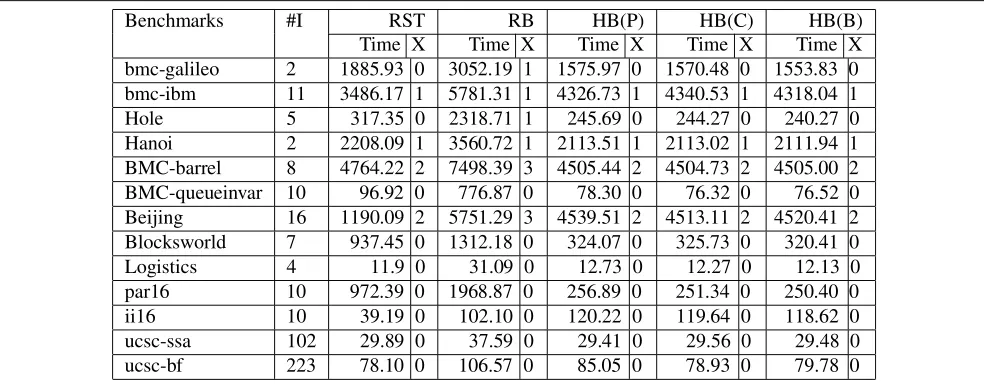
Experimental evaluation of the different algorithms has been done using the JQUEST SAT framework [10], a Java framework for prototyping SAT algorithms. All the ex-periments were run on the same P4/1.7GHz/1GByte of RAM/Linux machine. The CPU time limit for each instance was set to 2000 seconds, except for instances from Bei-jing family, for which the maximum run time allowed was 5000 seconds. In all cases where the algorithm was unable to solve an instance was due to memory exhaustion. The to-tal run time for solving different classes of benchmarks are shown in Table 1 and results for some specific instances are shown in Table 2. In both tables,Timedenotes the CPU time andXdenotes the number of aborted instances. In addition, each column indicates a different form of backtracking re-laxation:
¯ RST indicates that the search restart strategy is applied
with a cutoff value of 100 backtracks and is kept fixed. All recorded clauses are kept to ensure completeness.
¯ RB indicates that random backtracking is applied at
each backtrack step.
¯ HB(P) indicates that plain heuristic backtracking is
ap-plied at each backtrack step. All recorded clauses are kept.
¯ HB(C) indicates that the Chaff’s VSIDS-like
heuris-tic backtracking is applied at each step. All recorded clauses are kept.
¯ HB(B) indicates that the Berkmin-like heuristic
back-tracking is applied at each step. All recorded clauses are kept.
As can be concluded from the experimental results, heuris-tic backtracking can yield significant savings in CPU time, and also allow for a smaller number of instances to be aborted. This is true for several of the classes of prob-lem instances analyzed.
7. Conclusions and Future Work
This paper proposes the utilization of heuristic back-tracking in backtrack search SAT solvers. The most well-known branching heuristics used in state-of-the-art SAT solvers were adapted to the backtrack step of SAT solvers. The experimental results illustrate the practicality of heuris-tic backtracking.
The main contributions of this paper can be summarized as follows:
1. A new heuristic backtrack search SAT algorithm is proposed, that heuristically selects the point to back-track to.
2. The proposed SAT algorithm is shown to be a special case of unrestricted backtracking, where different ap-proaches for ensuring completeness can be utilized.
3. Experimental results indicate that significant savings in search effort can be obtained for different organiza-tions of the proposed heuristic backtrack search algo-rithm.
Besides the preliminary experimental results, a more comprehensive experimental evaluation is required. In ad-dition, future work entails deriving conditions for selecting among search restarts and heuristic backtracking.
References
[1] L. Baptista and J. P. Marques-Silva. Using randomization and learning to solve hard real-world instances of satisfiabil-ity. In R. Dechter, editor,Proceedings of the International Conference on Principles and Practice of Constraint Pro-gramming, volume 1894 ofLecture Notes in Computer Sci-ence, pages 489–494. Springer Verlag, September 2000. [2] M. Davis, G. Logemann, and D. Loveland. A machine
pro-gram for theorem-proving. Communications of the Associa-tion for Computing Machinery, 5:394–397, July 1962. [3] M. Davis and H. Putnam. A computing procedure for
quan-tification theory. Journal of the Association for Computing Machinery, 7:201–215, July 1960.
[4] J. Gaschnig.Performance Measurement and Analysis of Cer-tain Search Algorithms. PhD thesis, Carnegie-Mellon Uni-versity, Pittsburgh, PA, May 1979.
[5] M. Ginsberg. Dynamic backtracking. Journal of Artificial Intelligence Research, 1:25–46, 1993.
[6] M. Ginsberg and D. McAllester. GSAT and dynamic back-tracking. InProceedings of the International Conference on Principles of Knowledge and Reasoning, pages 226–237, 1994.
[7] E. Goldberg and Y. Novikov. BerkMin: a fast and robust sat-solver. InProceedings of the Design and Test in Europe Con-ference, pages 142–149, March 2002.
[8] C. P. Gomes, B. Selman, and H. Kautz. Boosting combinato-rial search through randomization. InProceedings of the Na-tional Conference on Artificial Intelligence, pages 431–437, July 1998.
[9] I. Lynce and J. P. Marques-Silva. Complete unrestricted backtracking algorithms for satisfiability. InProceedings of the International Symposium on Theory and Applications of Satisfiability Testing, pages 214–221, May 2002.
[10] I. Lynce and J. P. Marques-Silva. Efficient data structures for backtrack search SAT solvers. InProceedings of the Inter-national Symposium on Theory and Applications of Satisfia-bility Testing, pages 308–315, May 2002.
[12] M. Moskewicz, C. Madigan, Y. Zhao, L. Zhang, and S. Ma-lik. Engineering an efficient SAT solver. InProceedings of the Design Automation Conference, pages 530–535, June 2001.
[13] E. T. Richards and B. Richards. Non-systematic search and no-good learning. Journal of Automated Reasoning, 24(4):483–533, 2000.
[14] B. Selman and H. Kautz. Domain-independent extensions to GSAT: Solving large structured satisfiability problems. In
Proceedings of the International Joint Conference on Artifi-cial Intelligence, pages 290–295, August 1993.
[15] R. M. Stallman and G. J. Sussman. Forward reasoning and dependency-directed backtracking in a system for computer-aided circuit analysis.Artificial Intelligence, 9:135–196, Oc-tober 1977.
Benchmarks #I RST RB HB(P) HB(C) HB(B)
Time X Time X Time X Time X Time X
bmc-galileo 2 1885.93 0 3052.19 1 1575.97 0 1570.48 0 1553.83 0
bmc-ibm 11 3486.17 1 5781.31 1 4326.73 1 4340.53 1 4318.04 1
Hole 5 317.35 0 2318.71 1 245.69 0 244.27 0 240.27 0
Hanoi 2 2208.09 1 3560.72 1 2113.51 1 2113.02 1 2111.94 1
BMC-barrel 8 4764.22 2 7498.39 3 4505.44 2 4504.73 2 4505.00 2
BMC-queueinvar 10 96.92 0 776.87 0 78.30 0 76.32 0 76.52 0
Beijing 16 1190.09 2 5751.29 3 4539.51 2 4513.11 2 4520.41 2
Blocksworld 7 937.45 0 1312.18 0 324.07 0 325.73 0 320.41 0
Logistics 4 11.9 0 31.09 0 12.73 0 12.27 0 12.13 0
par16 10 972.39 0 1968.87 0 256.89 0 251.34 0 250.40 0
ii16 10 39.19 0 102.10 0 120.22 0 119.64 0 118.62 0
ucsc-ssa 102 29.89 0 37.59 0 29.41 0 29.56 0 29.48 0
[image:6.612.59.551.86.279.2]ucsc-bf 223 78.10 0 106.57 0 85.05 0 78.93 0 79.78 0
Table 1. Performance of different algorithms on different classes of benchmark
Instances RST RB HB(P) HB(C) HB(B)
Time Time Time Time Time
Beijing2bitadd 10 942.70 4083.75 4061.04 4070.14
Beijing3bitadd 31
Beijing3bitadd 32
BMC-longmult7 263.55 165.46 165.30 163.89
BMC-longmult8 1234.53 1223.3 1227.76
crypto-cnf-r3-b1-k1.1 16.61 127.31 46.20 45.58 45.91
crypto-cnf-r3-b1-k1.2 123.89 556.65 109.24 108.28 108.31