Ames Laboratory Conference Papers, Posters, and
Presentations
Ames Laboratory
2012
Integration of the DAYCENT Biogeochemical
Model within a Multi-Model Framework
Jared M. Abodeely
Idaho National LaboratoryDavid J. Muth Jr.
Idaho National Laboratory, [email protected]
Kenneth M. Bryden
Iowa State University, [email protected]
Follow this and additional works at:
http://lib.dr.iastate.edu/ameslab_conf
Part of the
Agriculture Commons
,
Biotechnology Commons
,
Energy Systems Commons
, and
the
Oil, Gas, and Energy Commons
This Conference Proceeding is brought to you for free and open access by the Ames Laboratory at Iowa State University Digital Repository. It has been accepted for inclusion in Ames Laboratory Conference Papers, Posters, and Presentations by an authorized administrator of Iowa State University Digital Repository. For more information, please [email protected].
Recommended Citation
Abodeely, Jared M.; Muth, David J. Jr.; and Bryden, Kenneth M., "Integration of the DAYCENT Biogeochemical Model within a Multi-Model Framework" (2012).Ames Laboratory Conference Papers, Posters, and Presentations. 88.
Integration of the DAYCENT Biogeochemical Model within a
Multi-Model Framework
Abstract
Agricultural residues are the largest near term source of cellulosic biomass for bioenergy production, but
removing agricultural residues sustainably requires considering the critical roles that residues play in the
agronomic system. Determination of sustainable removal rates for agricultural residues has received significant
attention and integrated modeling strategies have been built to evaluate sustainable removal rates considering
soil erosion and organic matter constraints. However, the current integrated model, comprised of the
agronomic models WEPS, RUSLE2, and SCI, does not quantitatively assess the impacts of residue removal on
soil organic carbon and long term crop yields. Furthermore, it does not evaluate the impact of residue removal
on greenhouse gas emissions, specifically N2O and CO2 gas fluxes from the soil surface. The DAYCENT
model simulates several important processes for determining agroecosystem performance. These processes
include daily nitrogen gas flux, daily CO2 flux from soil respiration, soil organic carbon and nitrogen, net
primary productivity, and daily water and nitrate leaching. Each of these processes is an indicator of
sustainability when evaluating emerging cellulosic biomass production systems for bioenergy. This paper
couples the DAYCENT model with the existing integrated model to investigate additional environmental
impacts of agricultural residue removal. The integrated model is extended to facilitate two-way coupling
between DAYCENT and the existing framework. The extended integrated model, including DAYCENT, is
applied to investigate additional environmental impacts from a recent sustainable agricultural residue removal
dataset. Results show some differences in sustainable removal rates compared to previous results for a case
study county in Iowa, US. The extended integrated model also predicts that long term yields will decrease
.32%– 1.43% under sustainable residue removal management practices.
Keywords
Mechanical Engineering, Bioenergy, Model integration, Agricultural residues, Soil organic carbon
Disciplines
Agriculture | Biotechnology | Energy Systems | Oil, Gas, and Energy
International Environmental Modelling and Software Society (iEMSs) 2012 International Congress on Environmental Modelling and Software Managing Resources of a Limited Planet, Sixth Biennial Meeting, Leipzig, Germany R. Seppelt, A.A. Voinov, S. Lange, D. Bankamp (Eds.) http://www.iemss.org/society/index.php/iemss-2012-proceedings
Integration of the DAYCENT
Biogeochemical Model within a
Multi-Model Framework
Jared Abodeelya, David Mutha, Kenneth Mark Brydenb,c a
Biofuels and Renewable Energy Technologies, Idaho National Laboratory
b
Department of Mechanical Engineering, Iowa State University
c
Simulation, Modeling, and Decision Science, Ames Laboratory
a
[email protected], [email protected], b,[email protected]
Abstract: Agricultural residues are the largest near term source of cellulosic biomass for bioenergy production, but removing agricultural residues sustainably requires considering the critical roles that residues play in the agronomic system. Determination of sustainable removal rates for agricultural residues has received significant attention and integrated modeling strategies have been built to evaluate sustainable removal rates considering soil erosion and organic matter constraints. However, the current integrated model, comprised of the agronomic models WEPS, RUSLE2, and SCI, does not quantitatively assess the impacts of residue removal on soil organic carbon and long term crop yields. Furthermore, it does not evaluate the impact of residue removal on greenhouse gas emissions, specifically N2O and CO2 gas fluxes from the soil surface. The DAYCENT model simulates several important processes for determining agroecosystem performance. These processes include daily nitrogen gas flux, daily CO2 flux from soil respiration, soil organic carbon and nitrogen, net primary productivity, and daily water and nitrate leaching. Each of these processes is an indicator of sustainability when evaluating emerging cellulosic biomass production systems for bioenergy. This paper couples the DAYCENT model with the existing integrated model to investigate additional environmental impacts of agricultural residue removal. The integrated model is extended to facilitate two-way coupling between DAYCENT and the existing framework. The extended integrated model, including DAYCENT, is applied to investigate additional environmental impacts from a recent sustainable agricultural residue removal dataset. Results show some differences in sustainable removal rates compared to previous results for a case study county in Iowa, US. The extended integrated model also predicts that long term yields will decrease .32%– 1.43% under sustainable residue removal management practices.
Keywords: Bioenergy; model integration; agricultural residues; soil organic carbon.
1 INTRODUCTION
J. Abodeely et al. / Integration of the DAYCENT Biogeochemical Model within a Multi-Model Framework
agronomic system. Six environmental factors can potentially limit sustainable residue removal: soil organic carbon, wind and water erosion, plant nutrient balances, soil water and temperature dynamics, soil compaction, and off-site environmental impacts (Wilhelm et al., 2010). A number of previous efforts have examined potential sustainable residue removal considering a subset of these factors. Nelson (2002) performed a county-level assessment investigating residue retention requirements considering soil erosion from rainfall and wind using the Revised Universal Soil Loss Equation (RUSLE) and the Wind Erosion Equation (WEQ), respectively. The methodology determined the potential annual availability of corn stover and wheat straw for the 37 states analyzed to be 50 million metric tons for the years 1995 to 1997. In 2004, Nelson et al. used an updated methodology for calculating residue retention requirements for the top 10 corn producing states in the US. This included performing assessments at the soil type scale and investigating a subset of crop rotations and tillage practices. The study found that nearly 34 million metric tons of corn stover and wheat straw were available annually for the span of 1997 to 2001. Gregg and Izaurralde (2010) performed a study using the Erosion Productivity Impact Calculator/Interactive Environment Policy Integrated Climate (EPIC) model (Williams, 1995) to investigate the relationships between crop yield, soil erosion, and carbon and nitrogen balance with respect to residue removal. Although the study addressed more limiting factors than previous studies, it was computationally limited in the number of management scenarios and spatial extent that could be represented.
Muth and Bryden (2012a) developed an integrated modeling framework for determining sustainable agricultural residue removal that overcame several of the computational limitations of previous modeling approaches. The integrated model performs sustainable residue removal investigations considering water erosion, wind erosion, and soil organic matter constraints. Three models are integrated into the framework: The Revised Universal Soil Loss Equation, Version 2 (RUSLE2); the Wind Erosion Prediction System (WEPS); and the Soil Conditioning Index (SCI). The modeling framework used for the integrated model is VE-Suite (McCorkle and Bryden, 2007). Muth et al. (2012b) used the integrated model to perform a spatially comprehensive national assessment on the conterminous US considering multiple environmental factors. Spatial assessments were performed at the Soil Survey Geographic (SSURGO) (NRCS, 2012a) database map unit level (10 – 100 m) using a local SSURGO database to enhance performance. Three climate databases were required to perform the assessment—NRCS managed RUSLE2 climate database, the CLIGEN daily climate generator (USDA, 2009), and the WINDGEN daily wind speed and direction generator. The integrated models identify the county using the SSURGO map unit and load the appropriate climate data. Crop rotations were determined using cropland data layers that have a spatial resolution of 30 – 54 m. Management scenarios were selected using the Natural Resources Conservation Service (NRCS) defined crop management zones (CMZ). Managements were built at the county-level using remotely sensed crop rotation data. Currently, the integrated model does not quantitatively address the impacts of residue harvest on long term grain yields, N2O gas fluxes, and CO2 fluxes through soil respiration.
J. Abodeely et al. / Integration of the DAYCENT Biogeochemical Model within a Multi-Model Framework
account for the wide range of soil characteristics that can occur over a county or the impact of erosion on the system. An additional study has used DAYCENT to predict greenhouse gas emissions and changes in soil organic carbon for agricultural systems used for biofuels production (Kim et al., 2009).
This paper integrates DAYCENT into the existing framework through the development of a DAYCENT model wrapper and two-way coupling between DAYCENT and other integrated models. This creates an integrated, multi-factor model for residue removal. Using the extended integrated model, this paper investigates additional environmental impacts associated with the residue removal management practices identified as sustainable by Muth et al. (2012b). This study uses the sustainable residue removal scenarios from Boone County, Iowa, US from the previous study to quantitatively investigate soil organic carbon, long term crop yield, and greenhouse gas emission impacts of the residue removal scenarios.
2 MODELS AND METHODOLOGY
This paper extends the integrated model developed by Muth and Bryden (2012a), which integrates the models RUSLE2, WEPS, and SCI. RUSLE2 simulates daily changes in conditions including soil water and temperature dynamics to quantify the impacts of water erosion processes. It has been applied to a wide range of land management scenarios including cropland, pastureland, rangeland, and disturbed forestland (Muth and Bryden 2012a). WEPS is a process-based daily time-step model that simulates how field conditions including soil water and temperature interact with wind forces including direction and magnitude. WEPS models a three-dimensional region to resolve mass balance equations and project wind erosion impacts. WEPS has been used for cropland scenarios (Hagen, 2004), including previous studies for evaluating the impacts of corn stover removal (Wilhelm et al., 2007). The SCI utilizes parameters contributed by RUSLE2 and WEPS to provide qualitative prediction of the impact of land management practices on soil organic carbon. The SCI has been used for a broad range of soil quality assessments (Karlen et al., 2008).
There are two extensions required to the integrated model to support inclusion of DAYCENT. First, the DAYCENT model wrapper has to be developed for seamless data exchange between the framework and the DAYCENT model. Second, the framework has to be enhanced to support two-way data exchange between the integrated models. DAYCENT utilizes soil erosion inputs from the other integrated models to calculate long term changes in crop yields and soil conditions. These changes can subsequently impact future soil erosion within the agronomic system. Because of this, integrating DAYCENT requires two-way data coupling and iterative model execution to resolve the long term impacts of agricultural residue removal management practices.
2.1 DAYCENT Model Wrapper
J. Abodeely et al. / Integration of the DAYCENT Biogeochemical Model within a Multi-Model Framework
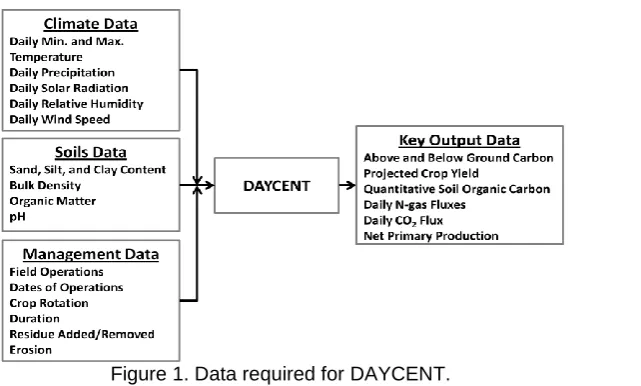
contain as many blocks as required to replicate the changes in land uses over time. The schedule file also determines the output frequency per block, contains references to the climate and site file, and options to scale certain simulation functions. Figure 1 shows the minimum data requirements for DAYCENT to run within the integrated model. The DAYCENT API wrapper retrieves the climate, soil, and management data from existing files and databases and converts them into the native DAYCENT format. Climate and management data are gathered from CLIGEN and the NRCS skel files, respectively. The CLIGEN data is formatted to create the weather file while the XML skel file is parsed into the operations and dates of the operations. Erosion data is then retrieved and aggregated to a monthly value from the results of the erosion models. These values are integrated into the operation events chronologically, occurring at the beginning of each month. Soil data is retrieved from a local SSURGO database and parsed into the defined soil layer depths with respect to the soil component horizon depths and thicknesses. The soil data, along with calculations for soil characteristics using the soil inputs, are formatted for each soil layer within the soil file.
2.2 Extended Integrated Model with DAYCENT
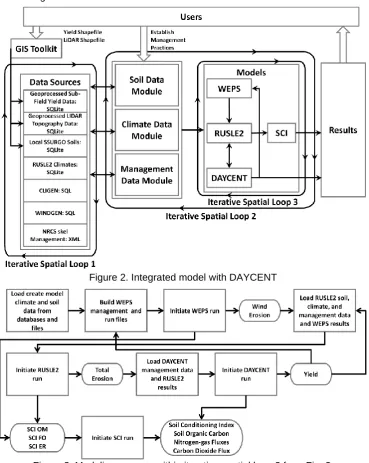
The integrated model is supported by a coupled set of multi-scale databases (Fig. 2). A detailed description of the format, size, and spatial scale of the databases can be found in Muth and Bryden (2012a). The databases communicate with three data modules for soils, climate, and management data. The data modules are responsible for formatting the data inputs for each of the models integrated in the framework. The input data is provided to each model through the individual model wrappers. The WEPS and RUSLE2 wrappers are discussed in detail by Muth and Bryden (2012a). The DAYCENT wrapper handles the assembling and loading of climate, soil, and management data. Climate data is assembled from the CLIGEN database and formatted for DAYCENT. Soil data is extracted from the SSURGO database to populate the DAYCENT soil file. Management operations and dates are acquired from the NRCS management database (NRCS, 2012b). The management data is used with erosion data from RUSLE2 and WEPS to assemble the DAYCENT schedule file. The schedule file is initialized, querying a suite of parameterized management and vegetation files executing the model scenario. Figure 2 shows the initialization process and the flow of data within the framework for the integrated models. The iterative spatial loops identify areas within the simulation where datasets and models iterate over spatial components. Within iterative spatial loop 1 geoprocessing tools are used to organize the databases around the spatial extent and discretization for the analysis. Iterative spatial loop 2 initiates the data and models to simulate the environmental processes for each spatial location and management scenario. Iterative spatial loop 3 provides
[image:6.595.157.478.67.260.2]J. Abodeely et al. / Integration of the DAYCENT Biogeochemical Model within a Multi-Model Framework
way coupling where results generated from the integrated models are distributed to other integrated models and results are recalculated.
[image:7.595.115.485.92.556.2]Figure 3 shows the modeling process and data flow within iterative spatial loop 3 from Fig. 2. The modeling process begins with execution of the WEPS model producing wind erosion values and soil conditioning index parameters. Upon completion, RUSLE2 data inputs are adjusted with the required WEPS model output, and RUSLE2 is executed. Total erosion is then delivered to DAYCENT. DAYCENT retrieves climate and soil data assembled by the respective data modules and uses the WEPS and RUSLE2 model outputs to adjust the schedule file. DAYCENT is then executed producing yield and agricultural residue projections. If long term grain yields differ from initial yield inputs, then the iterative loop passes that data back to WEPS and RUSLE2 so that erosion rates can be recalculated under the adjusted agronomic conditions. Because erosion affects soil characteristics, which results in impacts on yield, and yield and agricultural residue affect erosion rates, two-way coupling within the framework is required to comprehensively investigate a specific agricultural residue removal scenario. The time dimension for a single iteration of the integrated models is dependent on the length of the crop rotation.
J. Abodeely et al. / Integration of the DAYCENT Biogeochemical Model within a Multi-Model Framework
3 RESULTS
The extended integrated model with DAYCENT is used in this study to investigate sustainable agricultural residue removal scenarios developed by Muth et al. (2012b). The scenarios are representing residue removal from standard agricultural practices in Boone County, Iowa, US. The seven dominant SSURGO soils, in terms of area, from Boone County are selected for investigation with the extended integrated model. Sustainable residue removal practices are defined by soil erosion less than tolerable limits for each soil and maintaining or increasing long term soil carbon levels in the soil. The management practices considered for these soils are a corn-soybean crop rotation with reduced tillage practices. The sustainable residue removal results reported by Muth et al. (2012b) are compared with the sustainable removal rates from the extended integrated model in Table 1 in columns two and three. While the sustainable removal rates differ between the integrated models, the soils that have higher sustainable removal rates from the previous study generally have higher sustainable rates with the extended integrated model. The original integrated model results show greater variability in sustainable removal rates across the selected soils as compared to the extended integrated model. This result requires further investigation because it is not clear whether the original integrated model is overly sensitive to local soil and management conditions, or whether the extended integrated model is not capturing these effects sufficiently.
The extended integrated model with DAYCENT quantifies the long term impact on soil organic carbon. Table 1, columns four and five, show the projected soil organic carbon after ten years under no residue removal, and under the sustainable residue removal management practices. The extended integrated model projects that soil organic carbon for each of the seven soils investigated will increase under no residue removal management practices. This is an important consideration for land managers. Residue removal rates are considered sustainable when soil carbon levels are not decreasing, but residue removal operations can impact potential long term gains in soil organic carbon.
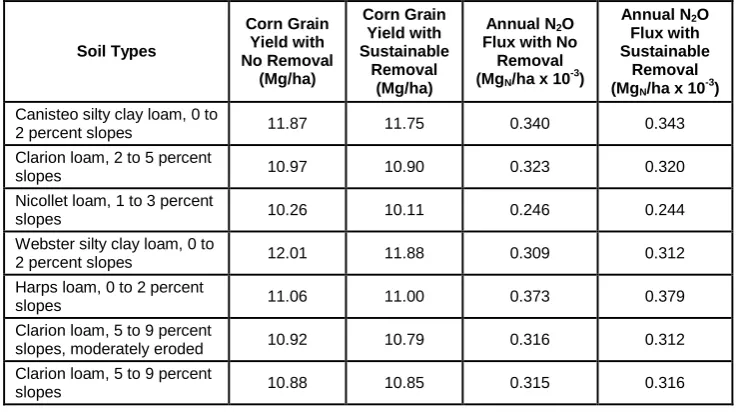
[image:8.595.115.486.523.736.2]Changes in soil organic carbon over ten years can also impact grain yields. Table 2, columns two and three, shows the projected ten-year impact on grain yield from sustainable residue removal management. For each of the soils investigated in this study the extended integrated model projects ten-year yield decreases from
Table 1. Sustainable residue removal results and its impact on soil organic carbon.
Soil Types
National Assessment
Study (Mg/ha)
Annual Sustainable
Residue Removal (Mg/ha)
Soil Organic Carbon with No Removal
(Mg/ha)
Soil Organic Carbon with Sustainable Removal
(Mg/ha)
Canisteo silty clay loam, 0 to
2 percent slopes 3.35 2.19 29.40 26.88
Clarion loam, 2 to 5 percent
slopes 1.20 1.95 23.43 21.25
Nicollet loam, 1 to 3 percent
slopes 2.16 1.26 24.00 22.84
Webster silty clay loam, 0 to
2 percent slopes 3.35 2.18 29.14 26.51
Harps loam, 0 to 2 percent
slopes 3.35 2.01 25.20 22.91
Clarion loam, 5 to 9 percent
slopes, moderately eroded 0.00 1.95 22.59 20.44
Clarion loam, 5 to 9 percent
J. Abodeely et al. / Integration of the DAYCENT Biogeochemical Model within a Multi-Model Framework
sustainable residue removal management practices. This is again an important consideration for land managers that can impact economic viability of the agronomic system. The greenhouse gas emissions from the agronomic system are also modeled with the extended integrated model. Columns four and five of Table 2 compare the projected N2O gas flux from no residue removal and sustainable residue removal management practices. The initial case study shows that changes in N2O flux are another parameter to investigate further because of the significance of greenhouse gas emissions.
4 CONCLUSIONS
This study extended an integrated model developed to investigate sustainable agricultural residue removal to include the DAYCENT model. Two extensions to the integrated model were developed to integrate DAYCENT. The first was the development of the DAYCENT model wrapper that passes the required data to and from the DAYCENT model. The second was an additional iterative spatial loop that handles the two-way information exchange between DAYCENT and the other models integrated within the framework. Erosion parameters are calculated by the RUSLE2 and WEPS models and provided to DAYCENT. DAYCENT then calculates yield impacts and changes in soil conditions and provides that data back to the other models to recalculate erosion. This iteration continues until the agronomic system reaches an equilibrium state. Integration of DAYCENT allows investigation of additional environmental factors that may be affected by residue removal. These include quantifying long term trends in soil organic carbon levels, projecting impacts on long term yield, and projecting impacts on greenhouse gas emissions. Results from the extended integrated model were compared to previous sustainable residue removal data. Differences in the sustainable removal rates were found. Furthermore, by using the extended integrated model it was found that sustainable residue removal management can have long term impacts on soil organic carbon levels and grain yields when compared to no residue harvest operations.
ACKNOWLEDGMENTS
[image:9.595.114.483.86.292.2]The authors gratefully acknowledge the funding support from DOE’s Office of Biomass Programs, as well as significant support from all partners in the DOE Biomass Regional Feedstock Partnership Program.
Table 2. Impacts of residue removal on long term grain yield and N2O flux.
Soil Types
Corn Grain Yield with No Removal
(Mg/ha)
Corn Grain Yield with Sustainable
Removal (Mg/ha)
Annual N2O
Flux with No Removal (MgN/ha x 10-3)
Annual N2O
Flux with Sustainable
Removal (MgN/ha x 10-3)
Canisteo silty clay loam, 0 to
2 percent slopes 11.87 11.75 0.340 0.343
Clarion loam, 2 to 5 percent
slopes 10.97 10.90 0.323 0.320
Nicollet loam, 1 to 3 percent
slopes 10.26 10.11 0.246 0.244
Webster silty clay loam, 0 to
2 percent slopes 12.01 11.88 0.309 0.312
Harps loam, 0 to 2 percent
slopes 11.06 11.00 0.373 0.379
Clarion loam, 5 to 9 percent
slopes, moderately eroded 10.92 10.79 0.316 0.312
Clarion loam, 5 to 9 percent
J. Abodeely et al. / Integration of the DAYCENT Biogeochemical Model within a Multi-Model Framework
REFERENCES
Del Grosso, S. J., Mosier, A. R., Parton, W. J., Ojima, D.S. DAYCENT model analysis of past and contemporary soil N2O and net greenhouse gas flux for major crops in the USA. Soil and Tillage Research 83(1), 9-24 2005.
Del Grosso, S. J., Parton, W. J., Mosier, A. R., Walsh, M. K., Ojima, D. S., Thornton, P.E. DAYCENT National-Scale Simulation of Nitrous Oxide Emissions from Cropped Soils in the United States. Journal of Environmental Quality 35(4), 1451-1660 2006.
Energy Independence and Security Act (EISA) of 2007: H.R. 6, 110th Congress. Gregg, J. S., Izaurralde, R. C. Effect of crop residue harvest on long-term crop
yield, soil erosion, and nutrient balance: trade-offs for a sustainable bioenergy feedstock. Biofuels 1(1), 69–83 2010.
Hagen, L. J. Evaluation of the Wind Erosion Prediction System (WEPS) erosion submodel on cropland fields, Environmental Modelling and Software 19(2), 171–176 2004.
Karlen, D. L., Tomer, M. D., Neppel, J., Cambardella, C. A. A preliminary watershed scale soil quality assessment in North Central Iowa, USA. Soil and Tillage Research 99(2), 291–299 2008.
Kim, H., Kim, S., Dale, B. E. Biofuels, Land Use Change, and Greenhouse Gas Emissions: Some Unexplored Variables. Environmental Science and Technology 43(3), 961-967 2009.
McCorkle, D. S., Bryden, K. M. Using the Semantic Web technologies in virtual engineering tools to create extensible interfaces. Virtual Reality 11(4), 253-260 2007.
Muth, D. J., Bryden, K. M. An integrated model for assessment of sustainable agricultural residue removal limits for bioenergy systems. Environmental Modelling and Software. In Review 2012a.
Muth, D. J., Bryden, K. M., Nelson, R. Sustainable Agricultural Residue Removal for Bioenergy: A Spatially Comprehensive National Assessment. Bioresource Technology. Accepted 2012b.
Nelson, R., Walsh, M., Sheehan, J., Graham, R. Methodology for estimating removable quantities of agricultural residues for bioenergy and bioproduct use. Applied Biochemistry and Biotechnology 113(1), 13-26 2004.
Nelson, R. Resource assessment and removal analysis for corn stover and wheat straw in the Eastern and Midwestern United States—rainfall and wind-induced soil erosion methodology. Biomass and Bioenergy 22(5), 349-363 2002. NRCS. Soil Survey Geographic (SSURGO) Database. Available at
http://soils.usda.gov/survey/geography/ssurgo/ (accessed 24 Feb. 2012). NRCS, Washington, DC 2012a.
NRCS. NRCS Land Management Database. Available at
http://fargo.nserl.purdue.edu/rusle2_dataweb/RUSLE2_Index.htm (accessed 24 Feb. 2012) 2012b.
USDA, Cligen Overview.
http://www.ars.usda.gov/Research/docs.htm?docid=18094 ( last accessed 24 Feb. 2012) 2009.
U.S. Department of Energy. U.S. Billion-Ton Update: Biomass Supply for a Bioenergy and Bioproducts Industry. Perlack, R. D., Stokes, B. J. (Leads), ORNL/TM-2011/224. Oak Ridge National Laboratory, Oak Ridge, TN. 227p 2011.
Wilhelm, W. W., Hess, J. R., Karlen, D. L., Johnson, J. M.-F., Muth, D. J., Baker, J. M., et al. Balancing limiting factors and economic drivers for sustainable midwestern agricultural residue feedstock supplies. Industrial Biotechnology 6(5) 271-287 2010.
Wilhelm, W. W., Johnson, J. M. F., Karlen, D. L., Lightle, D. T.. Corn stover to sustain soil organic carbon further constrains biomass supply. Agronomy Journal 99(6) 1665-1667 2007.