Abstract—An adaptive multi-objective optimization artificial immune algorithm (AMOAIA) is presented in this paper. An innovating sorting mechanism based on its Pareto ratio is used to sort individuals in the antibody population. The selection and cloning scheme is improved by using a neighborhood-based fitness assessment. An adaptive clone selection mechanism is introduced to preserve the diversity of the antibody. A new hybrid mutation operator using chaos random series for globally optimization solution has been proposed to maintain the diversity of the antibody population. A multi-objective optimization clustering algorithm based on the distribution of distributed Pareto frontiers is proposed. In addition, the effectiveness of the proposed algorithm is verified under many difficult conditions such as local optimality, non-uniformity, discontinuity, non-convexity, high-dimension, and constraints. The comparative study shows the effectiveness of the proposed algorithm, which produces solution sets that are highly superiority in terms of global convergence, diversity and distribution.
Index Terms—Multi-objective optimization, artificial immune algorithm, Pareto sort, adaptive clone selection, chaos mutation
I. INTRODUCTION
O
PTIMAZTION problem is one of the hot topics in engineering practice and scientific research [1, 2]. Only one objective function of the optimization problem is a single objective optimization problem. The objective function is more than one and has to be handled at the same time is called the multi-objective optimization problem [3-5]. For multi-objective optimization problems, a solution to a certain goal may be good, but other goals may be poor, so there is a compromise solution set, known as the Pareto-optimal set [6, 7].Artificial immune system (AIS) is an adaptive system which is inspired by immunology. AIS simulates the immune function, principle and model to solve the complex problems [8, 9]. In the multi-objective optimization artificial immune algorithm (MOAIA), the feasible solution of the optimization problem corresponds to the antibody, and the Pareto optimal
Manuscript received Apr 09, 2018; revised September 12, 2018. This work was supported in part by the Science Research Project of Liaoning Education Department under Grant LGD2016009, and the Natural Science Foundation of Liaoning Province of China under Grant 20170540686.
Zhongda Tian is with the College of Information Science and Engineering, Shenyang University of Technology, China, E-mail: [email protected].
Gang Wang is with the College of Information Science and Engineering, Shenyang University of Technology, China, E-mail: [email protected]. Yi Ren is with the College of Information Science and Engineering, Shenyang University of Technology, China, E-mail: [email protected].
individual corresponds to the antigen [10]. This antigen is kept in the antigen group. The new clustering algorithm is used to update the antigen in the antigen group constantly, and then a large number of Pareto optimal sets are obtained. According to the experimental results of Coello in his literature [11], it is known that MOAIA can obtain the satisfactory solution, even better when solving the non constrained multi-objective optimization problem. In recent years, the application of artificial immune algorithm in multi-objective optimization has been widely studied. The research shows that the artificial immune algorithm has some advantages in maintaining the diversity of the solutions [12-16]. Artificial immune algorithm and its improved algorithms showed many advantages on many optimization problems, such as having a good individual diversity maintaining mechanism, strength of multi-modal function optimization ability, strong get rid of local extreme value, and global search ability. But it also reflects some deficiencies of the artificial immune algorithm, such as the existence of premature convergence, local search ability is not strong [17, 18], etc. Therefore, it is necessary to improve the artificial immune algorithm to make up the deficiency of the algorithm, to enhance the ability of optimization, to make it better applied in multi-objective optimization problems.
In view of the mentioned shortcomings, this paper proposes an improved adaptive multi-objective artificial immune algorithm, called adaptive multi-objective optimization artificial immune algorithm (AMOAIA). In the AMOAIA, a kind of improved Pareto individual ranking mechanism is introduced. It makes the ranking is carried out in the current population, but do not need to compare the many existing ranking methods. It only needs to solve the maximum and minimum values, and simplify the comparison process. At the same time, the fitness evaluation function is improved. Meanwhile, the adaptive clone selection is introduced. These two improvements can make the algorithm to keep good diversity. The chaos mutation mechanism can ensure the convergence of the algorithm, and enhance the optimization capability of the algorithm. Simulation results on some typical test functions show the effectiveness of the proposed algorithm.
The main contents of this paper are as follows. Section 2 introduces the preliminaries of multi-objective optimization problem and artificial immune algorithm. Section 3 proposes AMOAIA algorithm. The simulation results are presented in Section 4. The summary and prospects of the paper are summarized in Section 5.
AMOAIA: Adaptive Multi-objective
Optimization Artificial Immune Algorithm
Zhongda Tian, Gang Wang, and Yi Ren
IAENG International Journal of Applied Mathematics, 49:1, IJAM_49_1_03
II. THE PRELIMINARIES
A. Multi-objective optimization problem
The general multi-objective optimization problem consists of a set of objective functions, some related equations and inequality constraints, which can be described as the following[19].
1 2
min ( )
( ( ),
( ),...,
( ))
. . ( )
0,
1, 2,
,
( )
0,
1, 2,
,
ki
j
F
f x
f x
f x
s t g
i
p
h
j
q
=
≤
=
=
=
x
x
x
⋯
⋯
(1)
where,
x
=
[ ,
x x
1 2,...,
x
n]
T is a n-dimensional vector invector space
ℝ
n .f x
i( ), (
i
=
1, 2,..., )
k
is the i-th sub objective function.f x
1( ),
f x
2( ),...,
f x
k( )
with k-dimensional vector is called target spatial of the problem,( )
ig
x
is the i-th inequality constraint,( )
jh
x
is the j-th equality constraint.Different from the single objective optimization problems which have the only optimum solution, the optimum solutions of multi-objective optimization problems are a group of trade-off solutions, namely Pareto optimum solutions set, non-dominated solutions or non-inferior solutions. Optimal solutions set means there is at least one goal solution better than all the other solutions.
Let
x
∗∈
D
is Pareto optimal solutions, if∀ ∈
x
D
, then meets the conditions are as the following.( ( )
i i(
))
i I
f x
f x
∗∈
≥
∩
(2)where,
I
=
{1, 2,
⋯
, }
k
,k
as the number of the objective function. And there is at least onej
∈
I
that makes( )
(
)
j j
f x
>
f x
∗ (3) In general, the optimal solution is not only one, but also an optimal solution set. The goal of the multi-objective optimization algorithm is to construct the non-dominated set, and make the non-dominated set approach to the Pareto optimal solution set.B. Artificial immune algorithm
The standard artificial immune algorithm can be described as follows.
Step 1: Antigen recognition, the algorithm firstly carries on the antigen recognition. Algorithm needs to understand the problem to be optimized, and to extract a priori knowledge;
Step 2: Initial antibody production, random generate the initial populations with size
N
;Step 3: The fitness evaluation, calculate the affinity of antibody to antigen, the affinity between the antibody and the antibody. The fitness evaluation of every feasible solution in the population is carried out;
Step 4: Calculate the antibody concentration. The concentration of the antibody is mainly used to maintain the diversity of the population;
Step 5: Immune process. It mainly includes immune selection, cloning, mutation and clone suppression;
Step 6: Population updating. The new antibody produces random antibodies with low affinity in the population, which will produce new antibodies;
Step 7: Judge whether the optimization algorithm satisfies the termination condition. If the condition is satisfied, then the algorithm terminates and outputs the optimal results; otherwise, go to Step 3 to continue.
III. AMOAIA ALGORITHM
Although artificial immune algorithm has better performance than genetic algorithm, particle swarm optimization algorithm and other optimization algorithms in the multi-objective optimization problems, and achieve a better accuracy and success rate [20]. But artificial immune algorithm also has premature convergence; local search capability is not strong and other problems. It is necessary to improve the performance of artificial immune algorithm. This paper will improve artificial immune algorithm in the next 5 aspects.
A. Artificial immune algorithm
In multi-objective optimization algorithm, since the ranking method reflects the preference relationship of individual sets, this paper introduces a Pareto frontier selection strategy based on non-dominant individual ranking. At present, it is difficult and inefficient to sort multiple targets and high dimensional variables based on the non-dominated sorting method of Pareto. In this paper, a non-dominated sorting method based on Pareto coefficients is proposed. This method does not need to distinguish the effective area, determine and select the individual directly, reduce the complexity of the algorithm, so that the convergence rate and the degree of approximation are improved.
Definition 1: Pareto coefficient.
For the multi-objective optimization problem in Equation (1), if
f
∈
ℝ
m k× , its Pareto sort can be expressed as next.1 1 2 2
1
( ) 1 max{min{
,
, ,
}}
m
k k
i i p i p i p
p p i
x
fw
fw fw
fw
fw
fw
µ
= ≠
= −
−
−
⋯
−
(4)where, fwij =(fij− fminj ) / (fmaxj − fminj ) ,
i
=
1, 2,
⋯
,
m
1, 2,
,
j
=
⋯
k
,min min{ , 1, 2, , }
j j
i
f = f i= ⋯ m ,
max max{ , 1, 2, , }
j j
i
f = f i= ⋯ m .
Theorem 1. Let inf i( )
x X f x
∈
≠ −∞ , sup i( )
x X f x
∈
≠ +∞ , (i=1, 2,⋯, )k . And f X( )≠φ, if
µ
(
x
j)
≥
1
, thenx
j is a weak feasible solution.Proof. Denote
x
j∈
V
j,V
j is an envelope set ofX
. If(
x
j)
1
µ
≥
, according to the Theorem in [21],x
j is the weak feasible solution ofV
j. According to the Theorem in [22],j
x
is a weak feasible solution ofX
ifinf
i( )
x X∈
f x
≠ −∞
,sup
i( )
x Xf x
∈≠ +∞
, andx
j is the weak feasible solution ofV
jare satisfied.
Theorem 1 shows that the solutions satisfy the condition of
(
x
j) 1
µ
≥
have better alternative solutions than other solutions. At the same time, each solution satisfies the mentioned conditions can be seen as non-dominated individuals. For each given solutionx
j∈
X
, ifµ
(
x
j) 1
≥
IAENG International Journal of Applied Mathematics, 49:1, IJAM_49_1_03
and
x
*j is better thanx
j, then there is*
(
)
(
)
i j i j
f x
<
f x
,{1, 2,
, }
i
∈
⋯
k
. It can know asfw
ij−
fw
ij*>
0
.1 1 2 2
min{
fw
i−
fw fw
k,
i−
fw
k,
⋯
,
fw
iN−
fw
kN} 0
>
(5)1 1 2 2
max{min{
i k,
i k, ,
iN kN}} 0
k ifw
fw fw
fw
fw
fw
≠
−
−
−
>
⋯
(6) Equation (5) and (6) has conflict. Therefore, the individuals satisfy the conditions of non-dominated individuals..B. The design of fitness function
For the optimization problem with multiple fitness functions, the high dimensional search space will be difficult to compare the advantages of each individual in the group [23, 24]. In this paper, the design of fitness function should be taking into account the evolving group of integrated and individual information. Considering the above reasons, the fitness function of individuals in this paper is defined as
( )
( ) 1 / (deg( ) 1)
fitness x
=
strength x
+
x
+
(7)where, ( ) y( )
y P strength x d x
∈
=
∑
, it is the degree of enhancement of antibodyx
, deg( )x is isolation degree of individuals.C. The design of adaptive clone operator
Standard clone selection method uses the proportional selection method or roulette selection method. It will lead clone selection method has very strong randomness. The adaptive clone factor is introduced in this paper. The clone number of i-th antibody is
1 1
(
)
1
1
T T
T N N
i
T T
N
m
m
m
m
m
round
i
N
N
⋅
−
−
=
+ ⋅
−
−
(8)where,
N
T is antibody number of clone selection population,1
m
is clone number of the first antibody,T
N
m
is clone number of theN
T-th antibody. This clone operator makes the antibodies with high fitness have more clones. At the same time, antibodies with low fitness also have the opportunity to be reproduced. The new antibody is cloned after mutation. Because the antibody with high fitness has more cloned offspring, the new antibody can be carried out more detailed search in near range of higher fitness antibody. Antibodies, meanwhile, with low fitness also have the opportunity to be evolved.D. The design of chaos mutation operator
In the standard artificial immune algorithm, the encoding method uses the real number encoding; the mutation operator generally uses the random mutation of Guassian distribution [25, 26]. The chaos mutation operator is introduced in this paper. The shortcomings of artificial immune algorithm are overcome through the ergodic of chaotic. The convergence of the artificial immune algorithm is improved through chaos mutation operator replace the standard mutation operator. The most common chaotic system model in chaos theory is Logistic mapping equation.
1
(1
), 0
1
q q q q
x
+=
µ
x
−
x
<
x
<
(9) With sensitivity to initial value characteristic of chaos system, then
initial values with small differences areassigned to Equation (9), then
n
chaotic variables can be obtained., 1 ,
(1
,),
1, 2,
,
i q i q i q
x
+=
µ
x
−
x
i
=
⋯
n
(10) where,n
is the size of the population.n
chaotic variables are mapped into interval( 2, 2)− , then chaotic sequence functionC
(0,1)
can be obtained. The improved mutation operator can be expressed as' '
(0,1) exp(
)
i i i
ab
=
ab
+
λ
C
×
−
aff
(11)where,
1
1
k
m
m
λ
= −
−
,m
is the number of iterations,k
isan integer.
aff
i' is 0 - 1 standardization ofaff
i, that is[1, ] '
[1, ] [1, ]
min( )
max( ) min( )
i j
j n i
j j
j n j n
aff aff
aff
aff aff
∈
∈ ∈
−
=
− .
C
(0,1)
change range is( 2, 2)− , it is similar with scale of standard Gauss or Cauchy mutation.
Equation (11) shows that evolutionary mutation control parameters are larger in the initial stage. The great influence of chaotic motion makes the algorithm have strong global search ability; find a neighborhood of global optimal solution of the problem. With the increase of evolutionary algebra, the variability of control parameters decreases, which is beneficial to the local search algorithm and improves the convergence speed and accuracy of the algorithm.
E. The design of clustering algorithm
With the increase of the iterations, the numbers of antigen groups are increasing. Antigen competes with each other, so it is not destructive to the equilibrium characteristic of the antigenic group to fight against the original cluster. The steps of the algorithm are as the following.
Step 1: The initial antigen group is
C
. Each individual can be seen as a cluster group;Step 2: If the number of clusters is less than or equal to
T
, go to Step 5, otherwise go to the next step;Step 3: Calculating each Euclidean distance of two antigenic clusters, that is
||
pareto
i−
pareto
j||
;Step 4: Find out the least distance between two cluster groups in the antigen group. Merge it into a cluster group. If the number of clusters is larger than
T
, go to Step 3; Step 5: For each cluster, large isolated individuals are derived from the cluster group based on the degree of isolation;Step 6: The individual groups in each cluster will be assembled together to generate a new antigen group;
In the antigen group, the Pareto solution can be updated and evenly distributed by antigen clustering algorithm.
IV. SIMULATION
In order to verify the effectiveness and advancement of the proposed AMOAIA, this paper selects some typical test functions. The algorithm is compared with 2 classical algorithms as NSGA-II [27, 28] and MOAIA [11]. The same parameter setting is adopted in the simulation process. Population size is 200, the iteration number is 100, and the threshold of the non-dominated solution set is 200. The
IAENG International Journal of Applied Mathematics, 49:1, IJAM_49_1_03
crossover probability of NSGA-II algorithm is 0.9, and the mutation probability is 0.1, mu is 20, mum is 20. For MOAIA and AMOAIA in this paper, crossover probability is 0.9, clone selection probability
α
is 0.4, number of cloned antibodiesm
1 is 10,T
N
m
is 5, coefficient of mutationλ
is 0.1, refresh rateβ
is 0.2. The results are verified by the results of 10 independent operations. In this paper, the following evaluation indicator is introduced.GD (generational distance), it is introduced in the literature [29]. GD is used to estimate the approach degree of final solution set and global Pareto optimal regional of algorithm, which is calculated as follows.
2 1
n i i
GD
d
n
=
=
∑
(12) where,n
is the individual number of solution set,d
i is theminimum Euclidean distance of each individual to the theoretical global non-Inferior Pareto optimal solution set. The smaller the value of GD is, the more close to the theoretical global non-inferior Pareto optimal solution set. If GD is 0, it shows that the solution of the algorithm is in the global non-Inferior optimal region, which is the ideal result of the algorithm.
SP (Spacing), it was proposed by Schott [30]. In this method, SP is used to evaluate the solution set distribution in the target space through calculating the distance changes of each individual and the solution concentration of the individual neighbors. Its function is defined as follows.
2
1( ) ( 1)
n i i
SP=
∑
= d −d n− (13)where,
(
)
1
min k i j
i m m m
d =
∑
= f − f ,i j
,
=
1, 2,
⋯
,
n
,i
≠
j
.n
is the number of individuals in the solution set.k
is the number of the objective function.d
is the average value of alld
i. The smaller value of SP, the more uniform distributionof the solution set is. If SP is 0, it shows that the distance between all individuals is equal, and the distribution is uniform.
MS (maximum spread), it was proposed by Zitzler [31]. MS is used to show that the optimal solution set is good or bad through the distribution range of the optimal solution set of the theoretical optimal solution. Its definition can be expressed as:
max min 2
1 1
1
1
[(max
min
) / (
)]
Kn i n i
i k i k k k
k
MS
f
f
F
F
K
= = ==
∑
−
−
(14)where
n
is the number of non-dominated solutions,K
represents the dimension of the target space,
f
mi isk th
-dimension objective function value of antibodyi
in non dominated solution,F
kmax is maximum value ofk th
-dimension objective function in theoretical optimal solution set,F
kmin is minimum value ofk th
-
dimension objective function in theoretical optimal solution set. The greater the value of MS, the wider range of the solution of the non dominated solutions. When MS is 1, the best effect can be achieved.A. Non constrained function optimization test (1) Test function ZDT-1
1 1
2 1
2
min ( )
min ( ) ( ) (1 / ( ) )
( ) 1 9( ) / ( 1)
[0,1], 1, 2, ,
n i i
i f x x
f x g x x g x
g x x n
subject to x i n
=
=
= ⋅ −
= + − ∈ =
∑
⋯
(15)
ZDT-1 is a test function with continuous concave optimization [32]. Its theoretical optimal solution is
1
[0,1]
x
∈
,x
i=
0
,i
=
1, 2,
⋯
,
n
, that isg x
( )
=
1
. Letn
is 30, the Pareto front of these three algorithms are shown in Fig. 1, 2, and 3, the evaluation indicators as shown in Table I.
0 0.1 0.2 0.3 0.4 0.5 0.6 0.7 0.8 0.9 1 0
0.2 0.4 0.6 0.8 1
f1(x)
f2
(x
)
true Pareto front NSGA-II
Fig. 1. Pareto front of ZDT-1 with NSGA-II
0 0.1 0.2 0.3 0.4 0.5 0.6 0.7 0.8 0.9 1 0
0.2 0.4 0.6 0.8 1
f1(x)
f2
(x
)
true Pareto front MOAIA
Fig. 2. Pareto front of ZDT-1 with MOAIA
0 0.1 0.2 0.3 0.4 0.5 0.6 0.7 0.8 0.9 1
0 0.2 0.4 0.6 0.8 1
f1(x)
f2
(x
)
[image:4.595.305.556.219.705.2]true Pareto front AMOAIA
Fig. 3. Pareto front of ZDT-1 with AMOAIA
IAENG International Journal of Applied Mathematics, 49:1, IJAM_49_1_03
TABLE I
THE EVALUATION INDICATORS OF ZDT-1
GD SP MS
Algorithms
Best Mean Best Mean Best Mean
NSGA-II 0.0072 0.0046 0.0062 0.0083 1.0000 0.9268
MOAIA 2.300e-003 4.300e-003 0.0019 0.0034 1.0000 0.9673
AMOAIA 1.3793e-005 2.4800e-005 1.9417e-004 3.4680e-003 1.0000 1.0000
(2) Test function ZDT-3
1 1
2 1 1 1
2
min ( )
min ( ) ( ) (1 / ( ) sin(10 ) / ( ))
( ) 1 9( ) /( 1)
[0,1], 1,2, ,
n i i
i
f x x
f x g x x g x x x g x
g x x n
subject to x i n
π
= =
= ⋅ − − ⋅
= + − ∈ =
∑
⋯
(16)
ZDT-3 is a test function with discontinuous optimization [33]. The Pareto front of ZDT-3 includes five discontinuous regions. Its theoretical optimal solution is
x
1∈
[0,1]
,0
i
x
=
,i
=
1, 2,
⋯
,
n
, that isg x
( )
=
1
. Letn
is 10, the Pareto front of the three algorithms is shown in Fig. 4, 5, and 6, the evaluation indicators are as shown in Table II.0 0.1 0.2 0.3 0.4 0.5 0.6 0.7 0.8 0.9 1
-0.5 0 0.5 1
f1(x)
f2
(x
)
[image:5.595.47.544.63.688.2]true Pareto front NSGA-II
Fig. 4. Pareto front of ZDT-3 with NSGA-II
0 0.1 0.2 0.3 0.4 0.5 0.6 0.7 0.8 0.9 1
-0.5 0 0.5 1
f1(x)
f2
(x
)
true Pareto front MOAIA
Fig. 5. Pareto front of ZDT-3 with MOAIA
0 0.1 0.2 0.3 0.4 0.5 0.6 0.7 0.8 0.9 1
-1 -0.5 0 0.5 1
f1(x)
f2
(x
)
true Pareto front AMOAIA
[image:5.595.69.535.465.699.2]Fig. 6. Pareto front of ZDT-3 with AMOAIA
TABLE II
THE EVALUATION INDICATORS OF ZDT-3
GD SP MS
Algorithms
Best Mean Best Mean Best Mean
NSGA-II 0.0034 0.0036 0.0040 0.0047 0.9276 0.8367
MOAIA 1.9495e-004 4.5354e-003 0.0030 0.0033 1.0000 0.9448
AMOAIA 4.2117e-005 4.6079e-005 0.0014 0.0016 1.0000 1.0000
(3) Test function DTLZ-2
1 1 2
2 1 2
3 1
2
3
min ( ) cos( / 2) cos( / 2)(1 ( ))
min ( ) cos( / 2) sin( / 2)(1 ( ))
min ( ) sin( / 2)(1 ( ))
( ) ( 0.5)
[0,1], 1, 2, ,
n i i
i
f x x x g x
f x x x g x
f x x g x
g x x
subject to x i n
π π π π π
=
= +
= +
= +
= −
∈ =
∑
⋯
(17)
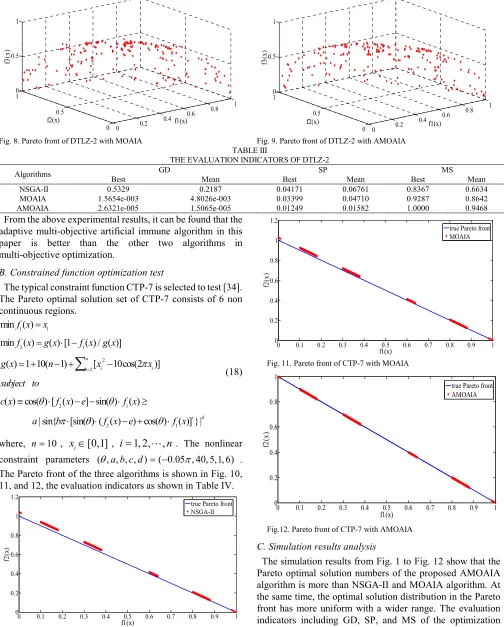
DTLZ-2 is a typical three objective problem. Its Pareto front is 1/4 spherical surface of f12+ f22+ f32=1. Let n is 12 , the Pareto front of the three algorithms is shown in Fig. 7, 8, and 9, the evaluation indicators as shown in Table III.
0 0.2
0.4 0.6
0.8 1 0
0.5 1
0 0.5 1
f1(x)
f2(x)
f3
(x
)
Fig. 7. Pareto front of DTLZ-2 with NSGA-II
IAENG International Journal of Applied Mathematics, 49:1, IJAM_49_1_03
0 0.2
0.4 0.6
0.8 1
0 0.5
10 0.5 1
f1(x) f2(x)
f3
(x
[image:6.595.48.552.59.686.2])
Fig. 8. Pareto front of DTLZ-2 with MOAIA
0 0.2
0.4 0.6
0.8 1
0 0.5
1 0 0.5 1
f1(x) f2(x)
f3
(x
)
Fig. 9. Pareto front of DTLZ-2 with AMOAIA TABLE III
THE EVALUATION INDICATORS OF DTLZ-2
GD SP MS
Algorithms
Best Mean Best Mean Best Mean
NSGA-II 0.5329 0.2187 0.04171 0.06761 0.8367 0.6634
MOAIA 1.5654e-003 4.8026e-003 0.03399 0.04710 0.9287 0.8642
AMOAIA 2.6321e-005 1.5065e-005 0.01249 0.01582 1.0000 0.9468
From the above experimental results, it can be found that the adaptive multi-objective artificial immune algorithm in this paper is better than the other two algorithms in multi-objective optimization.
B. Constrained function optimization test
The typical constraint function CTP-7 is selected to test [34]. The Pareto optimal solution set of CTP-7 consists of 6 non continuous regions.
1 1
2 1
2
2
2 1
2 1
min ( )
min ( ) ( ) [1 ( ) / ( )]
( ) 1 10( 1) [ 10cos(2 )]
( ) cos( ) [ ( ) ] sin( ) ( )
| sin{ [sin( ) ( ( ) ) cos( ) ( )] }|
n
i i
i
c d f x x
f x g x f x g x
g x n x x
subject to
c x f x e f x
a b f x e f x
π
θ θ
π θ θ
=
=
= ⋅ −
= + − + −
≡ ⋅ − − ⋅ ≥
⋅ ⋅ − + ⋅
∑
(18)
where, n=10,
x
i∈
[0,1]
,i
=
1, 2,
⋯
,
n
. The nonlinear constraint parameters ( , , , , )θ a b c d = −( 0.05 , 40, 5,1, 6)π . The Pareto front of the three algorithms is shown in Fig. 10, 11, and 12, the evaluation indicators as shown in Table IV.0 0.1 0.2 0.3 0.4 0.5 0.6 0.7 0.8 0.9 1 0
0.2 0.4 0.6 0.8 1 1.2
f1(x)
f2
(x
)
true Pareto front NSGA-II
Fig. 10. Pareto front of CTP-7 with NSGA-II
0 0.1 0.2 0.3 0.4 0.5 0.6 0.7 0.8 0.9 1
0 0.2 0.4 0.6 0.8 1 1.2
f1(x)
f2
(x
)
[image:6.595.306.551.227.585.2]true Pareto front MOAIA
Fig. 11. Pareto front of CTP-7 with MOAIA
0 0.1 0.2 0.3 0.4 0.5 0.6 0.7 0.8 0.9 1 0
0.2 0.4 0.6 0.8 1
f1(x)
f2
(x
)
true Pareto front AMOAIA
Fig.12. Pareto front of CTP-7 with AMOAIA
C. Simulation results analysis
[image:6.595.42.563.734.785.2]The simulation results from Fig. 1 to Fig. 12 show that the Pareto optimal solution numbers of the proposed AMOAIA algorithm is more than NSGA-II and MOAIA algorithm. At the same time, the optimal solution distribution in the Pareto front has more uniform with a wider range. The evaluation indicators including GD, SP, and MS of the optimization results from the Table I to Table IV can be seen the Pareto optimal solution front of proposed algorithm in this
TABLE IV
THE EVUALTION INDICATORS OF CTP-7
GD SP MS
Algorithms
Best Mean Best Mean Best Mean
NSGA-II 0.0127 0.0537 0.0140 0.5635 1.0000 0.9247
MOAIA 3.2390e-004 3.4200e-004 0.0076 0.0648 1.0000 0.9647
AMOAIA 2.1965e-004 2.2522e-004 3.2170e-003 3.4404e-003 1.0000 1.0000
IAENG International Journal of Applied Mathematics, 49:1, IJAM_49_1_03
paper is more close to the true optimal solution. And the proposed algorithm has a very good uniform distribution. The AMOAIA in this paper shows the distribution of the non-dominated solutions of the Pareto optimal surface is wider. From the data in the tables, it also shows the maximum spread of the proposed AMOAIA is better than other two algorithms. At the same time, the adaptive multi-objective artificial immune algorithm also shows a good optimization performance for the multi-objective optimization problem with constraints. The test results for non convex, discontinuous, high dimensional and constrained simulation functions of the Pareto frontier show that the proposed algorithm has a strong ability in global convergence, diversity and optimal solution set distribution.
V. CONCLUSION
An adaptive multi-objective artificial immune algorithm (AMOAIA) is proposed in this paper. The clone selection operator of this algorithm is adapted to adaptive clone the number of antibodies. At the same time, the chaos sequence is added to the Gauss mutation operator. The mutation performance of the algorithm is improved. The application of neighbor clustering algorithm guarantees that the Pareto optimal solution has better uniform distribution. Simulation results show that AMOAIA can obtain more solutions with uniform distribution. The results of AMOAIA are more close to the true Pareto optimal solutions. Meanwhile, the convergence speed of the algorithm is rapidly, and the premature convergence is avoided effectively.
Although proposed AMOAIA in this paper has shown a good performance, but there are still a lot of work to do. In the future, the influence of the algorithm parameters on the optimization process will be further studied, and the efficiency of the algorithm will be improved.
REFERENCES
[1] Z. Z. Li and Z. K. Li, "Optimal robust optimization approximation for chance constrained optimization problem," Computers & Chemical Engineering, vol. 74, pp. 89-99, 2015.
[2] J. S. Wang and J. D. Song, "A hybrid algorithm based on gravitational search and particle swarm optimization algorithm to solve function optimization problems," Engineering Letters, vol. 25, no. 1, pp. 22-29, 2017.
[3] M. Shi, "Degree reduction of disk rational Bézier curves using multi-objective optimization techniques," IAENG International Journal of Applied Mathematics, vol. 45, no. 4, pp. 392-397, 2015. [4] D. F. He, L. Wang and J. Sun, "On stability of multiobjective NMPC
with objective prioritization," Automatica, vol. 57, pp. 189-198, 2015. [5] G. G. Chen, S. Y. Qiu, Z. Z. Zhang and Z. Sun, "Quasi-oppositional cuckoo search algorithm for multi-objective optimal power flow,"
IAENG International Journal of Computer Science, vol. 45, no. 2, pp. 255-266, 2018.
[6] A. Guigue, "Approximation of the pareto optimal set for multiobjective optimal control problems using viability kernels," Esaim Control Optimisation & Calculus of Variations, vol. 20, no. 1, pp. 95-115, 2014.
[7] H. Yano and R. R. Zhang, "Interactive decision making for multiobjective fuzzy random programming problems with simple recourse through a fractile model," IAENG International Journal of Applied Mathematics, vol. 46, no. 3, pp. 379-387, 2016.
[8] A. S. Muhamad and S. Deris, "An artificial immune system for solving production scheduling problems: a review," Artificial Intelligence Review, vol. 39, no. 2, pp. 97-108, 2013.
[9] D. A. B. Fernandes, M. M. Freire, P. A. P. Fazendeiro and P. R. M. Inacio, "Applications of artificial immune systems to computer security: A survey," Journal of Information Security and Applications, vol. 35, pp.138-159, 2017.
[10] Q. Z. Lin, Q. L. Zhu, P. Z. Huang, J. Y. Chen, Z. Ming and J. P. Yu, "A novel hybrid multi-objective immune algorithm with adaptive differential evolution," Computers & Operations Research, vol. 62, pp. 95-111, 2015.
[11] C. A. C. Coello and N. C. Cortes, "Solving multiobjective optimization problems using an artificial immune system," Genetic Programming and Evolvable Machines, vol. 6, no. 2, pp. 163-190, 2005.
[12] F. R. Alonso, D. Q. Oliveira and D. S. A. C. Zambroni, "Artificial immune systems optimization approach for multiobjective distribution system reconfiguration," IEEE Transactions on Power Systems, vol. 30, no. 2, pp. 840-847, 2015.
[13] Z. P. Liang, R. Z. Song, Q. Z. Lin, Z. H. Du, J. Y. Chen, Z. Ming and J. P. Yu, "A double-module immune algorithm for multi-objective optimization problems," Applied Soft Computing, vol. 35, pp. 161-174, 2015.
[14] Y. T. Qi, Z. T. Hou, M. L. Yin, H. L. Sun and J. B. Huang, "An immune multi-objective optimization algorithm with differential evolution inspired recombination," Applied Soft Computing journal, vol. 29, pp. 395-410, 2015.
[15] J. A. Rezaee, "A chaotic artificial immune system optimisation algorithm for solving global continuous optimisation problems,"
Neural Computing and Applications, vol. 26, no. 4, pp. 827-833, 2015.
[16] Y. T. Qi, L. Bao, Y. Y. Sun, J. G. Luo and Q. G. Miao, "A memetic multi-objective immune algorithm for reservoir flood control operation," Water Resources Management, vol. 30, no. 9, pp. 2957-2977, 2016.
[17] S. S. Priyadharsini, S. E. Rajan and S. F. Sheniha, "A novel approach for the elimination of artefacts from EEG signals employing an improved artificial immune system algorithm," Journal of Experimental & Theoretical Artificial Intelligence, vol. 28, no. 1-2, pp. 239-259, 2016.
[18] L. Xiao, "Application of an improved immune algorithm in generation expansion planning, "International Conference on Sustainable Energy and Environmental Engineering, pp. 2254-2258, 2013.
[19] A. M. Zhou, B. Y. Qu, H. Li, S. Z. Zhao and P. N. Suganthan, "Multiobjective evolutionary algorithms: A survey of the state of the art," Swarm & Evolutionary Computation, vol. 1, no. 1, pp. 32-49, 2011.
[20] Y. Zhou, X. L. Zhang and W. Guo, "Structural fault diagnosis based on artificial immune algorithm of GA optimization," Journal of Shenyang University of Technology, vol. 38, no. 3, pp.293-297, 2016. [21] G. X. Tan, Z. Y. Mao, "Study on Pareto front of multi-objective
optimization using immune algorithm," International Conference on Machine Learning and Cybernetics, pp. 2923-2928, 2005.
[22] B. Wilson, D. J. Cappelleri, T. W. Simpson and M. I. Frecker, "Efficient Pareto frontier exploration using surrogate apprioxmations,"
Optimization and Engineering, vol. 2, no. 1, pp. 31-50, 2001. [23] Z. N. He and G. G. Yen, "Many-objective evolutionary algorithm:
Objective space reduction and diversity improvement," IEEE Transactions on Evolutionary Computation, vol. 20, no. 1, pp. 145-160, 2016.
[24] Q. K. Cao, L. F. Zhao, X. Y. Ren and W. C. Liang, "Disruption management for vehicle scheduling with considering customer value,"
Journal of Shenyang University of Technology, vol. 40, no. 2, pp. 185-191.
[25] T. T. Khuat and M. H. Le, "A genetic algorithm with multi-parent crossover using quaternion representation for numerical function optimization," Applied Intelligence, vol. 46, no. 4, pp. 810-826, 2017. [26] P. Sun and S. Y. Wang, "Redundant input safety tracking control for omnidirectional rehabilitative training walker with control constraints," Asian Journal of Control, vol. 19, no. 1, pp. 116-130, 2017.
[27] S. Qu, J. B. Zhao and T. R. Wang, "Experimental study and machining parameter optimization in milling thin-walled plates based on NSGA-II," International Journal of Advanced Manufacturing Technology, vol. 89, no. 5-8, pp. 2399-2409, 2017.
[28] K. Deb, A. Pratap, S. Agarwal and T. Meyarivan, "A fast and elitist multiobjective genetic algorithm: NSGA-II," IEEE Transactions on Evolutionary Computation, vol. 6, no. 2, pp. 182-197, 2002. [29] O. Schutze, X. Esquivel, A. Lara and C. A. C. Coello, "Using the
averaged Hausdorff distance as a performance measure in evolutionary multiobjective optimization," IEEE Transactions on Evolutionary Computation, vol. 16, no. 4, pp. 504-522, 2012.
[30] J. R. Schott, "Fault tolerant design using single and multi-criteria genetic algorithms optimization," Massachusetts: Massachusetts Institute of Technology, 1995.
IAENG International Journal of Applied Mathematics, 49:1, IJAM_49_1_03
[31] E. Zitzler and L. Thiele, "Multiobjective evolutionary algorithms: a comparative case study and the strength Pareto approach, "IEEE Transactions on Evolutionary Computation, vol. 3, no. 4, pp. 257-271, 1999.
[32] G. Yu, T. Y. Chai and X. C. Luo. "Multiobjective production planning optimization using hybrid evolutionary algorithms for mineral processing," IEEE Transactions on Evolutionary Computation, vol. 15, no. 4, pp. 487-514, 2011.
[33] M. Q. Zhang, Z. H. Zhu, Z. H. Cui and X. J. Cai, "NSGA-II with local perturbation, "29th Chinese Control and Decision Conference, pp. 208-213, 2017.
[34] H. K. Singh, A. Isaacs, T. Ray and W. Smith, "Infeasibility driven evolutionary algorithm (IDEA) for engineering design optimization,"
21st Australasian Joint Conference on Artificial Intelligence, pp. 104-115, 2008.