DEMOGRAPHIC RESEARCH
VOLUME 34, ARTICLE 3, PAGES 63
−
108
PUBLISHED 15 JANUARY 2016
http://www.demographic-research.org/Volumes/Vol34/3/ DOI: 10.4054/DemRes.2016.34.3
Research Article
Counting Souls: Towards an historical
demography of Africa
Sarah Walters
©2016 Sarah Walters.
This open-access work is published under the terms of the Creative Commons Attribution NonCommercial License 2.0 Germany, which permits use, reproduction & distribution in any medium for non-commercial purposes, provided the original author(s) and source are given credit.
1 Introduction 64
2 Fieldwork 65
3 The database 68
4 The White Fathers 68
5 What? Description of the sources 71
6 Why? Purpose of parochial registration 75
7 Where? Geographic variation in parochial registration 78
8 When? Time and censoring in parochial registration in Africa 81
9 Who? Population composition and categorisation in African parish
registers
85
10 Conclusion 94
11 Acknowledgements 95
References 96
Counting Souls: Towards an historical demography of Africa
Sarah Walters1
Abstract
BACKGROUND
Little is known about even the relatively recent demographic history of Africa, because of the lack of data. Elsewhere, historical demographic trends have been reconstructed by applying family reconstitution to church records. Such data also exist throughout Africa from the late 19th century. For the Counting Souls Project, nearly one million records from the oldest Catholic parishes in East and Central Africa have been digitised. These data are currently being processed into a relational database. The aim of this paper is to describe their potential for demographic reconstruction in the region, and to outline how their provenance defines the analytical approach.
RESULTS
Empirically, religion is correlated with population patterns in contemporary Africa, and, historically, reproduction and family formation were central to Christian mission in the region. Measuring change using sources created by agents of change raises questions of epistemology, causation, and selection bias. This paper describes how these concerns are balanced by missionary determination to follow the intimate lives of their parishioners, to monitor their ‘souls’, and to measure their morality, fidelity, and faith. This intimate recording means that the African parish registers, together with related sources such as missionary diaries and letters and oral histories, describe qualitatively and quantitatively what happens to individual agency (reproductive decision-making) when the moral hegemony shifts (via evangelisation and colonisation), and how the two interact in a reciprocal process of change.
CONCLUSION
Reconstructing long-term demographic trends using parish registers in Africa is therefore more than simply generating rates and testing their reliability. It is a bigger description of how ‘decision rules’ are structured and re-structured, unpicking the cognitive seam between individual and culture by exploring dynamic micro-interactions between reproduction, honour, hope, and modernity over the long term. With such a
mixed-methods approach, parish registers offer real potential for historical demography in Africa.
1. Introduction
The aim of the Counting Souls Project is to collect the parish registers of the earliest churches in East and Central Africa, and to reconstruct micro-demographic histories of those parishes from the late 19th century to the present using family reconstitution and event history analysis. This will improve understanding of contemporary African population growth and permit a longitudinal approach to African fertility transition, filling the pre-1960 data gap.2 The objective of this paper is to describe these data sources, to consider how their provenance could affect measurable outcomes, and to propose an analytic strategy.
During the 20th century, Christianity grew from nascency in Africa into one of the most powerful cultural forces on the continent (Hastings 1979, 1996, Sundkler and Steed 2000). That expansion had wide-ranging implications for reproduction and health through the establishment of Christian health and education services (Vaughan 1991, Iliffe 1995) and through the Church’s intervention in African sexual and domestic life (Hunt 1999, Thomas 2003, Smythe 2006). The people who appear in parish registers do so for dynamic rather than normative reasons, and that dynamism has implications for who and what can be measured over time. Furthermore, there is a tension between the priests’ need to keep track of Christians (to count ‘souls’) and the demographers’ need to count people. Interrogating these motivations is fundamental to understanding the strengths and weaknesses of the data.
The paper is organised around five questions about provenance: what are these sources and what events are recorded? Why were they produced, and why did people comply (or not)? Where are they found? When were they produced? Who produced them, who is in them, and who is excluded? Addressing these historiographical questions reveals the complexity and richness of these documents for reconstructing
2 The first censuses with detailed age-specific data on fertility and mortality were not conducted until the
Africa’s demographic past, raising wider questions about selection and sub-populations and the interaction between evidence and action in demographic research. A critical, mixed-methods and interdisciplinary approach to these sources is necessary in order to understand their silences, as well as to exploit their strengths.
2. Fieldwork
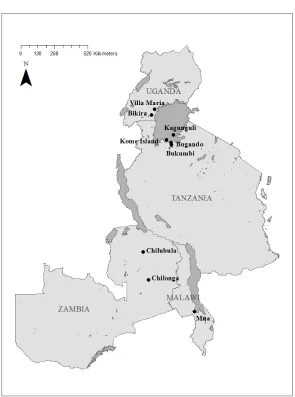
Thirty-seven parish archives of different denominations in Malawi, Tanzania, Uganda, and Zambia were investigated. The oldest and most significant parishes in the region were selected through literature review: missionaries, priests, and archivists were consulted to determine which parishes would most likely have surviving and accessible data. Permissions were obtained from the relevant bishop and the missionary society, as well as ethical approval from the London School of Hygiene and Tropical Medicine [reference: 8326]. With the exception of Bugando (Tanzania), all parishes were in rural and occasionally remote locations, necessitating extended residence in the parish while digitising data and reliance on the parish for transport and logistics. The parishes were remunerated for costs and all received a digital copy of their archive. Over 200,000 photographs were taken.3
The data were collected in two waves. In 2006, registers from the six oldest Catholic parishes in northwestern Tanzania (Bukumbi, Kagunguli, Bugando, Kome Island, Kagunguli, Sumve) were photographed, as well as from the daughter parishes of Kagunguli (Murutunguru, Nansio, Itira).4 Data for Kome Island and Kagunguli were available until 1984 and 1989 respectively; for the other parishes data were available until the early 2000s.5 The data for all but Sumve, Murutunguru, Nansio, and Itira were transcribed and a family reconstitution study conducted, resulting in the Mwanza Historical Demographic Database (MHDD).6 The MHDD contains linked life histories
3
A Fujifilm X10 camera and tripod were used to photograph the registers as raw files, following digitisation guidelines from the Endangered Archives Programme at the British Library to enable future archiving and storage: http://eap.bl.uk/downloads/guidelines_copying.pdf (last accessed 14 March 2014).
4 These daughter parishes were collected to enable eventual digitisation of the whole island of Ukerewe.
5 Data for most parishes were collected in situ, but for Kome Island the records in the Mwanza diocesan
archives were used. These records ended in 1984 because Kome came under the administration of Geita when that diocese was formed in 1985. More up-to-date records almost certainly exist in the parish, and may be collected in future. Likewise, it may be possible to update the data from Kagunguli and its daughter parishes.
6 A significant problem for historical demographers using parish registers in Africa is loss to follow up due to
of c.80,000 people during 1883−2005, and trends in fertility, mortality, and marriage age have been described (Walters 2008).
In 2012−2013, the registers of the oldest Catholic parishes in Malawi (Mua), Uganda (Villa Maria and Bikira), and Zambia (Chilubula and Chilonga) were photographed and transcribed, and the Bukumbi (Tanzania) records were updated.7 Mua, Villa Maria, and Chilubula were the main centres of Catholic education and ministry in Malawi, Uganda, and Zambia respectively during the colonial period (Linden and Linden 1974, Waliggo 1976, Garvey 1994, Nolan 2012).8
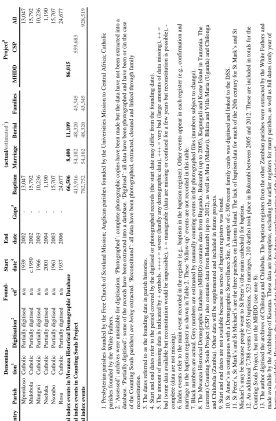
Missionaries had previously extracted incomplete baptism data from 19 other Catholic parishes in Zambia, and the Bishop of Kasama made the data available to the Counting Souls Project. Full dates were not included (only year of baptism), and pre-1950s data were excluded for some parishes. Little demographic analysis can be done with these records given the missing birthdates,9 but the >300,000 lines of digitised nominal data form the basis of future digitisation project.10
The archives of some of the oldest non-Catholic parishes in Malawi were also explored. The registers of Anglican St Peter’s (Likoma Island) were photographed, together with its daughter parishes (St Michael’s and St Mark’s). An informal inventory was made of available data at the famous Presbyterian Livingstonia Mission in Northern Malawi. Disappointing findings in these Anglican and Presbyterian archives (see Appendix) led to a focus on Catholic records for the Counting Souls Project.
but this parish is of interest due to the history of medical work at Sumve. It is planned that these data will all be digitised eventually.
7 These are the earliest continuously established parishes. Earlier missions were established from 1889 in
Malawi (Mponda Mission) and in Zambia (Mambwe Mission), but these were periodically abandoned (Linden and Linden 1974, Garvey 1994, Hinfelaar 2004).
8 The registers of a fourteenth Catholic parish, St Anne’s in Karonga (Northern Malawi), were partially
digitised. The parish was founded in the 1950s, and hence was considered too young to include in the project, but its boundaries are contiguous with the demographic surveillance site (DSS) of the Karonga Prevention Study (now Malawi Epidemiology and Intervention Research Unit (MEIRU) (Crampin et al. 2012). It is the subject of a pilot study to link the parish data to the DSS to validate the parish data (forthcoming).
9 In English historical demography, date of baptism was used as a proxy for date of birth (Wrigley 1977), but
this would not be successful in a missionary context, given the prevalence of adult baptism.
3. The database
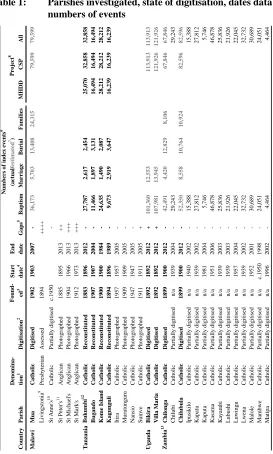
The Mwanza Historical Demographic Database, containing family reconstitution data for four of the Tanzanian parishes, has been described by Walters (2008). Work is currently underway to complete the wider Counting Souls Database, which will additionally contain updated data from Bukumbi (Tanzania) and data from Mua (Malawi), Villa Maria and Bikira (Uganda), and Chilonga and Chilubula (Zambia) parishes. Data have been rendered into machine-readable format. They are currently being cleaned, de-duplicated, and linked using family reconstitution methods adapted for the missionary and African context (Walters 2008). The Double Metaphone Search Algorithm has been adjusted for nominal data linkage with common Bantu linguistic practices and work is underway to develop an algorithm for the entire data cleaning and record-linkage process.11 In future, it is planned that the data extracted by missionaries in Zambia (recorded as “partially digitised” in Table 1) will be completed through reference to the original registers and that these will be added to the Counting Souls Database, together with the remaining data which have been photographed in Tanzania (“photographed” in Table 1). Flat copies of the digitised data are made available to the parishes once complete and the database is otherwise stored securely at the London School of Hygiene and Tropical Medicine, where it is administered by the author.
4. The White Fathers
All of the parishes included in the Counting Souls Project and the MHDD were established by a single Catholic missionary society, the White Fathers, which was founded in 1868 by Cardinal Lavigerie, the then Bishop of Algiers (Ceillier 2008).12 The Society has been described as “a missionary force of unsurpassed vigour and consistency in the interior of Africa” (Shorter 2006: 1) and as “Africa’s most dynamic missionary society” (Iliffe n.d.). That dynamism and consistency arose in part from the strict founding rules of the society, which emphasised adaptability, language learning, communal living, and record keeping (Renault 1992).13
11
Thanks to Gill Newton at the Cambridge Group for the History of Population and Social Structure for helping to adapt the Double Metaphone Search Algorithm (Newton 2005). The original algorithm is described in Philips (2000).
12 The White Fathers are now officially called the Missionaries of Africa, but they are still known popularly
by their former name, which refers to the Arab-style white robes they wore due to their origins in Algiers.
13
Lavigerie’s Instructions aux Missionaries were carried by the early missionary caravans which followed the
Table 1: Parishes investigated, state of digitisation, dates data available and numbers of events
Table 1: (Continued) D eno m ina -F o und-St a rt En d P ro ject 8 C o unt ry P a ri sh ti on 1 D ig it is a tio n 2 ed 3 da te 4 da te Ga p s 5 B a pt is m M ar ri age B ur ia l F a m ilie s M H DD CS P Al l M por ok os o C ath o lic P ar tia lly d ig itis ed n/ a 1939 2002 -13,047 13,047 M ul obol a C ath o lic P ar tia lly d ig itis ed n/ a c.1950 2002 -15,792 15,792 M ung w i C ath o lic P ar tia lly d ig itis ed n/ a 1966 2003 -10,236 10,236 N sel u k a C ath o lic P ar tia lly d ig itis ed n/ a 2001 2004 -1,190 1,190 N som bo C ath o lic P ar tia lly d ig itis ed n/ a 1961 2003 -15,707 15,707 Ro sa C ath o lic P ar tia lly d ig itis ed n/ a 1937 2006 -24,677 24,677 T ot al i n d ex e ve n ts i n M w an za H is tor ic al D em ogr ap h ic D at ab as e 66,506 8,400 11,109 86,015 T o ta l i nde x e v ent s i n C o unt ing So ul s P ro je ct 413,916 54,102 48,320 43,345 559,683 T o ta l i nde x e v ent s 782,752 54,102 48,320 43,345 928,519 N u m b ers o f i n d ex ev en ts 6 (ac tu al / est im a ted 7) 1 . P res b y ter ia n p ar is h es f o u n d ed b y t he F re e C hu rc h o f S co tl a nd M is si o n; A ng li ca n p ar is he s fo u nd e d b y t he U n iv er si ti es M is si o n t o C ent ra l A fr ic a ; C a tho li c p ar is h e s f o u n d ed b y t h e Wh it e F at h er s. 2 . ‘ A ss es sed ’: ar ch iv e s w er e u n su it a b le fo r d ig it is a ti o n . ‘ P h o to g rap h ed ’: co m p let e p h o to g rap h ic co p ie s h a v e b ee n m ad e b u t th e d at a h a v e n o t b een e x tr act ed i n to a d at ab as e. ‘ P ar ti a ll y d ig it is ed ’: s o m e o f t h e r eco rd s h a v e b ee n e x tr act ed i n to a d at ab as e. ‘ D ig it is ed ’: a ll d at a h av e b ee n p h o to g rap h ed an d h a v e b ee n o r ( in t h e cas e o f t he C o u nt ing S o u ls p ar is h e s) ar e be ing ex tr act ed . ‘ R eco n st it u ted ’: a ll d at a h a v e b ee n p h o to g rap h e d , ex tr ac ted , cl ea n ed a n d l in k ed t h ro u g h f a m il y re co n sti tu ti o n . 3 . T h e d at es r ef er red t o as t h e f o u n d in g d at e i n p ar is h h is to ri es . 4 . S tar t an d en d d at es r ef er t o t h e p er io d co v er ed b y t h e d ig it is ed o r p h o to g rap h ed r ec o rd s ( th e s tar t d at e m a y d if fer f ro m t h e fo u n d in g d at e) . 5 . T h e am o u n t o f m is si n g d at a is i n d icat ed b y + s y m b o ls
. ++++ = s
e v er e ( h ar d ly a n y d e m o g rap h ic d a ta)
, +++ = v
er y b ad ( lar g e a m o u n ts o f d at a m is si n g ), ++ = ba d ( so m e d at a av a il a b le b u t r eco n st it u ti o n w o u ld b e im p o ss ib le)
, + = m
a n ag ea b le ( d at a ar e m is si n g o r c o n fu sed f o
r a f
White Fathers were responsible for transcribing languages in the regions where they worked and for producing the first dictionaries; they monitored rain gauges, food prices, and crop yields; and the resident missionaries kept diaries which today form a substantial archive describing everything from epidemics and famines to local customs and celebrations, and their tussles with traditional authority and the colonial state. Their neatly-kept parish registers were part of a larger project to codify, understand, and ‘order’ the societies in which they lived (Linden and Linden 1974).
5. What? Description of the sources
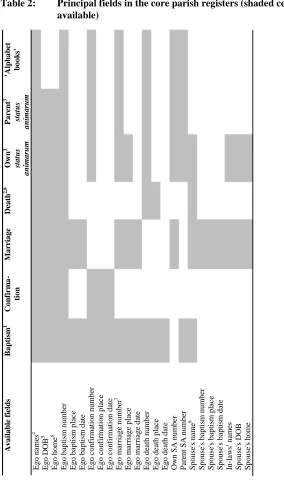
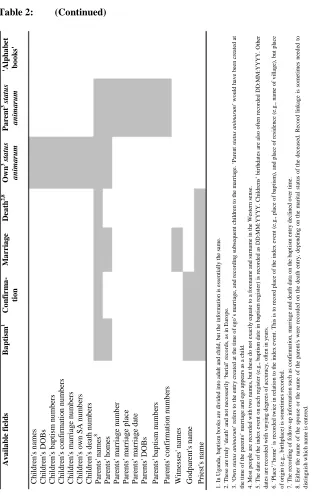
The core parish registers consist of books of baptism, marriage, burial, communion, confirmation, and baptism in danger of dying. The registers are large bound volumes, initially printed in Europe with the column headings in Latin or French, and later printed at Catholic printing presses in Africa, with the headings in English or a local language. Each register contains space for the date and reference number of the index event, the first and second names of the index person (‘ego’), his/her parents and the godparents/witnesses, as well as the name of the priest. Places of residence and birth are recorded, and the baptism book contains additional space for the recording of follow-up events (communion, confirmation, marriage, and death).14 The date of death as well as burial is recorded in the death register15, and the marriage register includes a note about the type of dispensation granted if one of the couple is not Catholic, as well as an indexed reference to a marriage enquiry book where a detailed description of the relationship history is found. Marriage and burial books refer to the baptism number, facilitating record linkage. If someone moves parish between two events, there is correspondence between priests.16 Within a parish, the reference numbers for each individual are consolidated in ‘alphabet books’, which is a nominal index system.
14 A single event could therefore appear in multiple places: e.g., confirmation, marriage, and burial were all
recorded in the baptism book as well as in their respective registers, often with dates and places as well. This greatly facilitates record linkage, provided rules are specified about handling conflicting information. Not all entries contain all information; e.g., in the MHDD 80% of baptism entries included a year of birth, 85% and 89% included the name of the mother and father respectively, and 20% included the name of the spouse (Walters 2008: Appendix 1).
15 Unlike in pre-19th century Anglican registers in England, where burial was used as a proxy for death
(Wrigley and Schofield 1989).
16 For example, if an in-migrant wants to marry, the priest writes to the parish of origin to request baptism
Table 2: (Continued) A v a ila b le f ie ld s B a p ti sm 1 C o n fi rma -ti o n M a rr ia g e De a th 2 ,8 Ow n
3 st
a tu s a n im a rum P a re n t
3 st
a tu s a n im a rum 'A lpha b et b o o k s' C h il d re n 's n am es C h il d re n 's DOB s C h il d re n 's b ap ti sm n u m b er s C h il d re n 's c o n fi rm at io n n u m b er s C h il d re n 's m arri ag e n u m b ers C h il d re n 's o w n S A n u m b er s C h il d re n 's d ea th n u m b er s P ar en ts ' n am es 8 P ar en ts ' h o m es P ar en ts' ma rr ia g e n u mb er P ar en ts ' m ar ri ag e p lace P ar en ts ' m ar ri ag e d at e P ar en ts ' DOB s P ar en ts ' b ap ti sm n u m b er s P ar en ts ' c o n fi rm at io n n u m b er s W it n esse s' n am es G o d p ar en t' s n am e P ri est 's n am e 1. I n U ga n da , b apt is m b o o ks a re di vi de d in to a dul t a n d c hi ld, b ut t h e inf o rm at io n i s e ss e n ti a ll y t h e s a m e. 2 . T h es e ar e tr u ly ‘ d eat h ’ a n d n o t n eces sar il y ‘ b u ri a l’ r eco rd s, as i n E u ro p e. 3 . ‘ Own st at us ani m ar um ’ r e fer s t o t h e en tr y cr eat ed at t h e t im e o f eg o ’s m ar ri ag e, a n d r eco rd in g s u b seq u e n t ch il d re n t o t h e m ar ri ag e. ‘ P ar e n t st at us ani m ar um ’ w o u ld ha v e be e n c reat ed at th e ti m e o f t h e p ar en ts ’ m ar ri ag e a n d eg o ap p ear s a
s a ch
In addition, parishes in all countries except Uganda keep libri status animarum. These ‘state of souls’ registers also exist in Catholic Europe and have been the mainstay of Italian and some Eastern European historical demography (Manfredini and Breschi 2008a, 2008b, Breschi, Manfredini and Fornasin 2011, Guzowski 2012). They were prescribed by the Roman Ritual of 1614, which demanded that the priest “carefully inscribe [in the liber status animarum] each family in his parish, with everyone living in it, and take note of those fit for Communion, and those fit for catechistical instruction or for Confirmation” (cited in Laslett 1977: 53). They were a dynamic record to show whether parishioners were eligible to receive sacraments.17
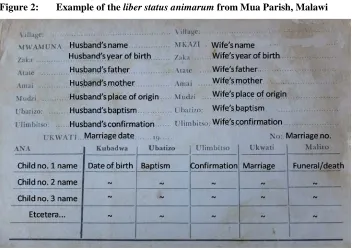
European libri status animarum have been described as “census-like” (Őri and Pakot 2011), and are a hybrid between a continuous population-register and a census, the latter often conducted in preparation for canonical visitations (Willigan and Lynch 1982). In Africa, libri status animarum are both prospective and retrospective, created either at the time of marriage or in-migration or through a parish census, and updated in a continuous and cross-sectional fashion. The records contain dedicated space for the birth, baptism, marriage, and death dates and reference numbers of each of the parents, and the birth and baptism dates and reference numbers of children (biological and fostered). Single people identified through the census are listed in corresponding books of singuli.
In some parishes, two copies exist of the libristatus animarum: a set of books or cards that remain in the parish office, and a set of ‘touring cards’ that were used on outstation visits. One priest described using these cards in the 1960s:
“We got about on motorcycle in those days. I would do up to a thousand kilometres a year. Imagine! It was a lot, on those dirt paths...all the way from up in the mountains down to the lakeshore. It would be a party when I arrived. The children would chase me down the track and there would be dancing and singing and they would cook...There were three
of us at the mission but Father […] was old and you had to be strong so
it was just for us two on our motorcycles. Eee we travelled!
“When I arrived, I would take those cards out of my bag and I would call out ‘so and so, son of so and so’, and usually no-one would come, because they didn’t recognise that name! That was the name they were baptised but not one they used in the village. So I would call out ‘so and
17 In Europe, these registers may originally have been a means of assuring numbers against a growing
so, son of so and so, married to so and so, father of so and so’.
Eventually the person would come!” (Personal communication Fr.
Claude Boucher).
As each family finally reported to the priest, he would question them to ascertain any change in circumstance, e.g., new births, deaths, or living arrangements. The touring cards were then returned to the parish office where information was updated in the liber status animarum.
The Catholic libristatus animarum are analogous to the family books kept by the Lutheran Church which have been the basis for some historical demographic studies in Namibia and Tanzania (Colwell 2000, Notkola and Siiskonen 2000).18Libri status
animarum have two additional advantages. First, they include space to record people’s
attendance at significant services (e.g., Easter mass), and the payment of tithes or contributions at specific points in the religious calendar. They also formed the basis for the periodic parish censuses, which were conducted to facilitate parish administration and to provide statistics to the White Fathers headquarters in Rome. These cross-sectional markers of presence in the parish are essential when dealing with censoring (see “When?”). Furthermore, the libri status animarum contain information on the religiosity and de factoliving arrangements of Catholics (see “Why?”).
6. Why? Purpose of parochial registration
Understanding the purpose of the parish registers (and in particular the libri status
animarum) helps to underscore their demographic worth. As in Europe, libri status
animarum were used to determine a person’s eligibility to receive the sacraments, and
they therefore contain data on transgression of Catholic family structures as well as conformity. As ‘state of souls’ registers, they go further than simply recording families, and provide a dynamic update of the status of those families, and the degree of their association with the Church (their ‘religiosity’).19
In Mua, the libristatus animarum are structured similarly to family reconstitution forms, with information about the husband and wife (birth dates, baptism and
18 Historical demographers working on Lutheran records in Namibia argued that “[v]arious vital registers are
also maintained in the Roman Catholic and Anglican parishes, but the main book or family book is used only
in the Evangelical Lutheran parishes” (Siiskonen, Taskinen and Notkola 2005: 393). In fact, the Catholic libri
status animarum contain very similar information to the Lutheran family books.
19 Religiosity is notoriously difficult to measure and define in studies of demography and religion (Yeatman
confirmation details, names of their parents, etc.) at the top of the form and the children listed below with their dates of birth and reference numbers for baptism, confirmation, and marriage.20 On the reverse, further information is provided about the actual living arrangements of the family, numbers of unbaptised children, extra-marital relations, etc. Others, as in the Zambian parishes, are in register format. Parents are listed at the top of the page with children below, and second and third marriages are also listed, as are children from previous marriages.
Figure 2: Example of the liber status animarum from Mua Parish, Malawi
As well as information on family structure, the cards record whether a person attended church and prayed, or whether they were “lazy” in their faith. The story of some families unfolds on the cards through updates scrawled by the priest over several visits. Missionary conflation between piety, morality, and capability is manifest in how physical and mental disabilities are noted on the cards, together with comments about whether people pray and their parenting skills.
For the missionaries, parish registers not only facilitated effective administration, but also a form of intimate paternalism that might otherwise have been impossible in these vast parishes. With touring cards, priests could appear to recall detailed family relationships, names, and events when they visited outstations, which was a powerful tool in establishing the relationship between Church and people. One historian of Mua suggested that meticulous record keeping was also a means of imposing or imagining order and control over the transient parish population, and a means of coping with the uncertainty of missionary life:
“A record was kept of every Christian family in the district in a status
annimarum [sic]. At the mission office were a large assortment of registers in which the Christian life of the parish was translated into statistics. Registers of births, baptisms, confirmations, marriages, deaths, banns, catechumens, and marriage cases, were maintained
with scrupulous care. The Agurupa[Christian leaders] visited villages
armed with a copy of the status annimarum[sic] and new entries were
written into the main record at the mission office. Every soul was accounted for. Even if the shifting population of the lakeshore never had the makings of the stable organic society of priestly dreams, it could at least be reduced to canonical order in the station records. There was something very touching about the missionaries’ careful returns of annual totals of communions and confessions sent to their bishop when they were at a loss to explain what made their parishioners turn up for, or absent themselves from, weekly mass”
(Linden and Linden 1974: 201−2).
the clerk’s regular ‘office day’ I would be banished while s/he used the books to resolve queries and requests from villagers. The registration system was evidently well used and useful for people in both their religious and secular lives, particularly at times of migration, employment, or marriage.
Just as in pre-industrial England before the advent of secular identity documentation, parochial registration in Africa can be used to form “actionable legal personhoods” (Szreter and Breckenridge 2012: 22).21 The Church itself portrays the utility of its registration in those terms. The Father Superior of Mua Parish in Malawi described to me how he promotes the safe-keeping of the buku la banja (the ‘family books’ carried by all Catholics in Malawi, with records of baptisms, marriages, and burials to family members): “I say to them, this is your passport”, he explained, waving one of the (passport-shaped) books in the air (personal communication: Fr. O’Shea). Judging by the ancient buku presented for parish stamping following ecclesiastical events, they do seem to be highly valued, allowing a person to carry an official record of their Catholic history as they migrate between parishes, and in case of changing personnel in their home parish.
The enabling nature of parochial registration and the lack of secular alternatives clearly motivated people to record events. However, the extent to which registration systems were structured to be useful varied between places and over time, with further implications for the types of demographic questions that can be answered.
7. Where? Geographic variation in parochial registration
There is broad consistency in registration in all White Fathers’ parishes in Africa, but some divergences are evident over time and between places. The White Fathers’ provincial and global headquarters prescribed the structure of the system, but it also reflects local church history and the socio-economic and political context. In Malawi and Zambia, where parishes were more affected by labour migration, additional books were kept to record Catholics migrating in (Malawi, Zambia) and out (Zambia) of the parish.22 In Zambia, additional books were kept of baptisms to people away in the copper mines. The Tanzanian parishes did not record movement in the same structured way, although there was inter-parish correspondence.
21 This distinguishes registration from enumeration, which may bring benefits in terms of improved services
and monitoring but does not confirm identity at the micro-level in a way that is enabling for accumulation and inheritance and the settlement of claims.
22 These were the books of alendo (travellers, Malawi) and ‘Incorporations’ and ‘Excorporations’
Southern Uganda is a heartland of African Catholicism, following the mass conversion of the populace and the martyrdoms of the 1890s (Waliggo 1976).23 Villa Maria and Bikira parishes were integral to this ecclesiastical expansion. African clergy took an early role in running the Church24, and these parishes were effectively autonomous from missionaries by the early 1930s. The Ugandan data differ to those in other countries: rather than a single baptism book, there are separate registers for adult and infant baptisms (reflecting the early shift to second generation Catholics); records are less detailed than elsewhere; and there are no death records, libristatus animarum, or evidence of parish censuses. Pressure of numbers may have militated against detailed data, or reduced its necessity, or the departure of European missionaries 60−80 years prior to their departure from other parishes may have given rise to a different system of recording.25
If the relative acceptance of Catholicism in Uganda created a large but shallow set of parish registers, the reverse was true in areas where missionaries met resistance. In Mua parish (Malawi) there was a fractious relationship between the mission and traditional authority (Linden and Linden 1974, Kachipila 2006). In the first half of the 20th century, people were asked to choose between their Catholicism and the religion of their ancestors: it was seen as incompatible to be Catholic and to engage in customs such as initiation ceremonies or to attend dances held by the Chewa secret society, the
nyau. The missionaries pitted themselves against the nyau, and there are frequent descriptions in the diaries of perceived triumphs and defeats in this battle over Chewa souls. The missionaries kept a record of Catholics who were nyau (or who had been influenced by them) in the libri status animarum. Notes about nyau affiliation were often accompanied with comment about the frequency of church attendance, prayer habits, and parenting abilities.
23 By 1960 there were more than 300,000 baptisms in the Ugandan Rubaga Archdiocese compared to fewer
than 120,000 in the other archdioceses in this study, and about 50% of the population was Catholic compared to around 10% in all other areas, except Kasama Archdiocese in Zambia, where about half were also Catholic
(White Fathers Annual Statistics, 1960−61).
24 The first ordinations of African clergy occurred here in 1913, and the first African bishop (Joseph
Kiwanuka) was consecrated in Villa Maria in 1939 (Nolan 2012: 376).
25 Records were lost during the politically unstable 1970s−1980s (personal communication Fr. Paul Ssegawa),
Figure 3: Structure of registers in parishes founded by the White Fathers, by country
A
ll p
ar
is
h
es
N
ot
U
g
anda
O
n
ly
Za
m
b
ia
M
al
aw
i
an
d
Z
am
b
ia
O
nl
y
U
g
anda
M
ar
ri
ag
e
B
a
p
tis
m
D
ea
th
St
at
us
ani
m
ar
um
C
h
ild
b
a
p
tis
m
A
dul
t
b
a
p
tis
m
A
lp
h
a
b
et
books
M
ar
ri
ag
e
enqui
ri
es
T
o
u
ri
ng
ca
rd
s/
books
P
a
ris
h
cen
su
ses
In
-m
igr
a
n
ts
Ou
t-m
igr
a
n
ts
B
a
p
tis
m
in
m
in
es
B
a
p
tis
m
in da
ng
er
of
dyi
ng
C
onf
ir
m
-a
tio
n
if su rviv e
if d
ie
L
inks
to/
fr
om
ot
he
r
p
a
ri
sh
Conflict between mission and nyau was especially intense at the time of someone’s death, with both priests and nyau wanting to secure souls by performing or officiating at funerals. The Catholic practice of baptising in danger of death led nyau to hide dying members in the bush in “macabre squabbles over corpses” (Linden and Linden 1974: 129). At the end of July 1972, the diarist of Mua mission described a “quite interesting and even exciting experience” concerning the burial of a Catholic in Kanchamba called Abraham. Abraham was a “mfiti [witch] who prevented formerly Christian burials of others (since formerly he was a Nyau)”, and although he had since “repented and become a receiving Christian”, the nyau wanted to dance at his hut, while the missionaries were simultaneously requested to pray: “Father Mernier went to the catechist saying: ‘isn’t it a shame when the nyau burry [sic] the world, whom we gave sacraments, and even cloth and food. What did the zirombo [animal characters] give him – and now they want to burry [sic] him – and laugh at us. I am intent to go there.’” Three priests, a sister, and a catechist went to Abraham’s hut, and prayed and kept vigil while “there came many nyau, drumming, dancing but without uniform [masks]”. The stand-off lasted all night, climaxing when “suddenly these nyau came near behind our chairs, uttering cries of mourning very loud, and two went up to the house crying as well. We raised our voices in the rosary and nobody moved” (Mua mission diary 30 July 1972). These fights over funerals sometimes resulted not only in cacophony, but in more serious unrest (Linden and Linden 1974: 125).
Conflict over funerals (and hence priests’ awareness of deaths) may be why burial recording is more complete in Mua than in other parishes. The ratio of burials to baptisms is about 1:3 in Mua, compared with less than 1:4 elsewhere (and compared to no burial recording in Uganda). Although ‘representativeness’ of the wider population may be higher in regions like Southern Uganda where a greater proportion of the population converted, the data are richer in areas where peoples’ relationship with the mission was more fluid or contentious, and where they were more likely to be caught by competing influences.
8. When? Time and censoring in parochial registration in Africa
the end of colonialism; the timing of my fieldwork. These moments all have censoring influences because they affected the likelihood of conversion, adherence to the Church, and the possibility of follow-up. For example, the provision of food aid in times of famine led to surges in baptism in some parishes, and similarly the establishment of clinics and schools by parishes would draw local communities to the Church. The departure of missionaries led to changes in recording practices that creates censoring. Knowing what weight to give to that censoring is the most important technical challenge for African historical demography. I address the challenge here, and describe how the libristatus animarum allow us to bypass some of the constraints of traditional family reconstitution.
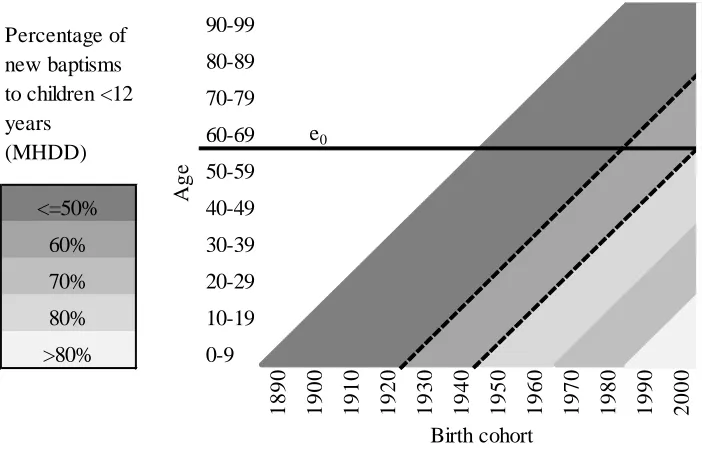
In Europe, most people recorded in historical parish registers were born into the Church, and the long time span of family reconstitution studies means cohorts can be followed throughout their lifetimes.26 Even so, the observation of a complete marital history requires a couple to be continuously resident in a parish, and there is debate about how far this select population of ‘stayers’ (the ‘reconstitutable minority’) is more widely representative (Ruggles 1992, Wrigley 1994). In Africa, traditional reconstitution methods would yield an even more select population of ‘stayers’ because the congregation of a missionary and youthful church includes many first-generation converts who were baptised as adults, and many people who are still alive. In a parish started at the turn of the century, with data available to c.2010 (e.g., Mua, Chilubula, Chilonga), women born before 1950 could be followed up to the end of their reproductive years. Assuming adult life expectancy was relatively low, there is also potential for burial recording for those cohorts. However, in practice, many of the converts in the first few decades of a new parish were either infants baptised in danger of dying or people baptised as adults, implying left-truncated fertility histories. In the MHDD it was not until the 1930s that more children than adults were baptised each decade. In the context of Henry/Wrigley logical family reconstitution rules, which would demand end-of-marriage dates (death or remarriage), and (generously) assuming life expectancy of no more than 60 years and follow-up to c.2010, this would effectively reduce the sample to people born and baptised in the 1930s−1940s (Wrigley and Schofield 1973) (Figure 4).
26 European historical demography with parish registers was enabled through family reconstitution which
Figure 4: Censoring in the Mwanza Historical Demographic Database
Note: The figure shows that if we assume life expectancy at birth is less than 60 years, then we can only expect follow-up to death for cohorts born before 1950. Furthermore, prior to 1930 more than half of new baptisms were to adults and not to children. The use of these records for demographic reconstitution is limited due to the problem of left censoring. Hence, the best quality data for a reconstitution study date from the 1930s-1940s, despite having available registers dating back to the 1890s. Earlier and later data can be used, especially in the context of event history analysis, but it is important to note these censoring effects.
A further censoring factor is the decline in record keeping following Independence (1960s). Parish clerks began to replace priests as bookkeepers in this period, and missionaries left some parishes, as they were handed over to the diocese. Although index events were still recorded with the same detail, there was less consistency in recording follow-up data; e.g., it became rarer to find a person’s marriage or burial recorded on their baptism record. Hence, from the 1960s we are more reliant on nominal record linkage to establish life histories.
Therefore, censoring, taken with the under-reporting of death in some parishes, means that traditional family reconstitution in Africa has a limited prospect, which is why the libri status animarum, migration records, parish censuses, and touring books are so important.
90-99
80-89
70-79
60-69
50-59
40-49
30-39
20-29
10-19
0-9
1890
1900
1910
1920
1930
1940
1950
1960
1970
1980
1990
2000
Birth cohort
Percentage of
new baptisms
to children <12
years
(MHDD)
<=50%
60%
70%
80%
>80%
Ag
e
In describing the Roman Ritual prescribing libri status animarum, Peter Laslett noted:
“If every beneficed priest of the English Church had in fact kept...these...registers – indeed even if some of them (a very small proportion would have sufficed) had kept a Liber status animarum to hand down to us – then the task of the historian of social structure would be transformed. We should have the chance of reconstructing the population of our country as it was during all those generations which went by before the official census began in the early nineteenth century, of doing it swiftly, accurately and completely” (Laslett 1977: 53−4).
As Laslett hints, and as Del Panta et al explicate, libri status animarum “entail a change in the [family] reconstitution technique” (Del Panta, Rettaroli, and Rosental 2006: 601). Not only do the registers ease the demands of nominal record linkage because children and parents are recorded together, but their cross-sectional markers of presence in the parish (e.g., attendance at services) enable calculation of observation time without relying on events that are also outcomes of interest. Using event history analysis, demographic rates can be estimated even when complete marital histories are rare. An example is provided in Mua, where a cross-sectional parish census was conducted in 1972. Priests visited all households, and noted the presence of a family by marking “1972” on the corner of their enty in the liberstatus animarum, and this can be used as a censoring date, enabling the inclusion of fertility histories which would otherwise be dropped from analysis due to the lack of an end-of-marriage or parental death date. Libri status animarum and touring books contain information on attendance at specific services (e.g., the Zambian touring books record dates together with the letter ‘k’ for kulaya, meaning the renewal of baptism vows at Easter (personal communication Fr. Gotthard Rosner); the Tanzanian touring cards contain dates together with the annual amount paid in contributions at Easter mass). Not all of these data were kept consistently over time or are necessarily complete, but all such timestamps expand the possibility of observation.
9. Who? Population composition and categorisation in African
parish registers
If censoring presents the greatest technical challenge of African historical demography, then dealing with compositional change and the issue of categorisation is the greatest conceptual challenge. African Catholic populations were more dynamic than historical European populations due to the nascent missionary Church and the colonial context. Understanding the constitution of the population – who became Catholic, and at what junctures they moved in and out of Catholicism – is central to knowing how to treat the data. Furthermore, divergences in how being and becoming were conceptualised in Catholic versus local imaginings give rise to spaces in the record. We are reliant on the ontological categories employed by the Catholic Church to measure change in African families, while the Church was simultaneously an agent of change in those families.27 This raises the question of whether measuring change using sources created by agents of change implies inherent bias or selectivity.
Becoming a Catholic in turn-of-the-century East and Central Africa was a risky undertaking28, and historians have emphasised that early converts throughout the region tended to come from “subordinated rather than dominant groups” (Hunt 1999: 43). Such converts were women running away from husbands or unwanted betrothals or who had been divorced for infertility (Larsson 1991, Hodgson 2005, Nolan 2012). Some of the first catechists in Bukumbi were freed Ganda slaves (Austen 1968, Nolan 2008), and four of the earliest converts on Kome Island were women from Maasailand, who had been seized in German raids in 1899-1890 and entrusted to the mission (Larsson 1991: 73, Grondin 1995). Baptism peaks coincided with years of famine, drought, and epidemic, as people went to the mission for security and food aid. The upsurge in baptisms across the region during the famine and influenza pandemic of 1918 is one example (Iliffe 1979: 260). In Bukumbi parish there was an eightfold increase in baptisms, probably because ‘Bwana Malole’ (Father Spectacles) was known for distributing food aid (personal communication Fr. Frank Nolan; and Figure 5).
27 Critical literature on how categories are constructed for demographic data collection, and how power
relations affect the terms and boundaries of that measurement, is relevant here (Szreter, Sholkamy, and Dharmalingam 2004).
28
Some of the earliest Ugandan Catholics were famously martyred for their faith in the Buganda court in
Figure 5: Annual count of baptisms, Bukumbi Parish, Tanzania 1890–2000
That people sought baptism as a means of managing uncertainty29 raises two issues for demography. First, even missionaries were suspicious of the ‘depth’ of conversion achieved when people came to the Church for material reasons such as food aid, and this has implications for who stayed with the Church, and for whom there are follow-up
29
The ‘uncertainty’ and contingency of life in Africa may be integral to reproductive decision-making in the region, and indeed may drive African exceptionality in fertility transition. Caldwell hypothesised that African fertility transition would be characterised by a decline in fertility at all ages and parities, driven by widening birth intervals rather than by age- and parity-specific stopping behaviour (Caldwell, Orubuloye, and Caldwell 1992). He proposed a religio-cultural explanation which focused on the social supports for high fertility (Caldwell 1987). More recently, it has been proposed that the exceptionally long birth intervals in the region represent a rational and evolving response to high levels of personal and political uncertainty and insecurity, rather than normative conformity to a cultural ideal (Johnson-Hanks 2004, Moultrie, Sayi, and Timæus 2012). If uncertainty/change is also a driver of religious conversion because the Church is an important means of managing uncertainty – or of dislocation from the Church because of religious censure of certain acts – this raises questions about bias and how far we will capture the role of uncertainty in driving demographic action over time using these data.
0 100 200 300 400 500 600
1890 1900 1910 1920 1930 1940 1950 1960 1970 1980 1990 2000
A
nnua
l num
be
r
o
f
ba
pt
is
m
s,
B
ukum
bi
P
a
r
is
data.30 Second, such converts had traumatic (atypical?) life histories characterised by abandonment, divorce, illness, infertility, famine, and freedom from slavery. Change in circumstance could lead to departure from the Church, e.g., marriage breakdown or polygamy (oftentimes through widow inheritance, where older mechanisms of social security came into conflict with Christian values). If baptism, and also departure from the Church, coincided with demographic ‘conjuncture’ this may introduce ‘bias’ (Johnson-Hanks 2002, 2004). It is likely that ‘bias’ changed over time as second and third generation Christians were born, but its direction is difficult to predict, and it is not clear whether it should be seen as a ‘problem’ for demographic reconstitution and something to be factored out of analysis, or as a legitimate object of study, revealing of the institutional, intellectual, and social pathways through which people enact agency in reproduction (Watkins and Warriner 2003, Johnson-Hanks 2015).
As missions became established and began to build dispensaries and schools, the reasons for seeking baptism shifted, implying changing population composition and a growing Catholic hegemony. Catholicism became a pathway into the administration and towards social mobility. The Church shifted from proselytising freed slaves towards working with the state to educate elites for indirect rule (Austen 1968: 140). Employment opportunities arose through the Church directly, and through education. Christian ‘readers’ all over Africa came to dominate the lower ranks of colonial administration, and later led nationalist movements through to Independence (McCracken 2008). Christians not only had access to health and education services, with implications for mortality and reproduction, but through these services the Church (sometimes in collaboration with colonial and commercial concerns) sought to establish a Catholic moral order in Africa, instilling as normative a western model of the Christian family and domestic life, and controlling, forming, and constraining sexuality in new ways (Hunt 1988, Hansen 1992, Hunt 1999, Smythe 2006).
There is a vast, multi-disciplinary, literature on the family in Africa, which I will not attempt to summarise here. There is, furthermore, great variation between (and within) the parishes in this study in terms of their kinship structures, levels of pre-transitional fertility, and ideologies of family and family law.31 Notwithstanding this
30 Alternatively, it may be that people who took risks to become Christian, or did so out of material or social
desperation, in fact became its most devoted converts. Indeed, one missionary in Machame, Tanzania lamented that by 1907, Christianity “was becoming a pleasantly approved social custom, lacking all the ardour and conviction shown by the first converts” (quoted in Iliffe 1979: 231).
31 The Malawian and Zambian parishes are largely populated by people traditionally considered to be
complexity, there is undoubtedly contrast between customary and Catholic models, which is fundamental to understanding missionary (and colonial) intervention in African domestic and sexual lives. Whether viewed from within an evolutionary framework or from one based around the relations of production (Vaughan 1983), there is broad concurrence that inheritance systems in Africa favoured lineage over the conjugal, and that as a result “Eurasian levels and patterns of pre-marital and extra-marital fertility and the melting together of pater and genitor contrast strikingly with [high] African levels of ‘illegitimate’ fertility and the traditional lack of interest in biological fatherhood” (Lesthaeghe 1989: 26). Missionaries were particularly taxed by the prevalent practice of polygyny, which was seen as “the chief stumbling block”32 to Christianity (Hunt 1991).
Priestly concern about the morality of polygyny and extra-marital sex chimed with colonial worries about the birth rate (Kuczynski 1949: 396, Vaughan 1991: 142). In the first half of the 20th century there was widespread concern about the possible de-population of Africa, because of rising rates of venereal diseases coupled with very high levels of infant mortality (Kjekshus 1996, Koponen 1996). While colonial concerns may have been economic (a determination to meet the demands of labour supply), and missionary thinking was largely ideological/moralistic, there was concordance over the likely causes and possible remedies for perceived population decline. Two explanations prevailed. The first was that ‘traditional’ prolonged lactation and postpartum abstinence were associated with polygyny and high levels of extra-marital sex (which led to the rapid spread of sexually-transmitted diseases (STDs))33, the second was that contact with Europeans had led to a breakdown of traditional authority leading to ‘degeneration’ and a lack of control over sexuality, especially of the young (Vaughan 1991). The proposed solution was similar: reinforce patriarchal control through three
governing marriage and reproduction; for example, the Tanzanian Government Anthropologist, Hans Cory, described 11 different forms of marriage among the Sukuma in the 1940s (Cory 1953).
32
This is a quote from a report by a colonial official who visited the parish of Kagunguli on Ukerewe Island in Tanzania in the 1930s (E.C. Baker, 1931, ‘Report on Administrative and Social Conditions on Ukerewe’, Tanzanian National Archives (TNA) V10/20298 volume 1 pp.19-20).
33 The causal relationship between polygyny and postpartum abstinence/prolonged lactation is contested,
methods.34 First, quash the practice of post-partum abstinence and extended, responsive breastfeeding, which was associated with polygyny and men seeking extra-marital relationships, as well as having perceived adverse psychological effects for infants (Vaughan 1991: 128–9). Second, abolish any customary practices perceived to encourage promiscuity, such as dances and initiation ceremonies (Kachipila 2006). Third, campaign against the payment – or at least the rising price – of bridewealth, which was seen as prohibitive of marriage, in turn encouraging pre-marital sex and a lack of stability (Cory 1953: 16, Larsson 1991: 95).
Missionary work to relocate the morality of reproduction therefore became a pivot of Church-community interactions in colonial Africa. In the Belgian Congo, Nancy Rose Hunt has documented how a (self-professed) “crusade to combat the prejudices that separate the spouses” (i.e., reduce post-partum abstinence and extended lactation) was launched in the 1930s, both within the confines of mining compounds where infant feeding was closely controlled, and more widely through the network of missionary maternity and child welfare centres where “missionaries were well known to combat the custom by advising “couples to resume conjugal commerces a certain while after birth” (Hunt 1988: 407). In 1920s’ Uganda, Anglican missionaries in Mengo railed against “the entire absence of a national conscience against the sins of immorality” and launched the Social Purity Campaign, which aimed to instil a sense of shame around promiscuity and polygamy and promote “domesticated existence and family life” (Summers 1991: 796–8). At the same time, Catholics at Nsambya were training midwives to act as ambassadors, spreading Christian morals into families and influencing women at the time of birth (See also: Hansen 1992). In northwest Tanzania, Catholic missionaries campaigned hard against the Sukuma practice of sending young women to live in the shared dormitories known as the maji¸ where they received advice about marriage and sexual life (Cory 1953: 39–40, Tanner 1955: 239), and across Africa missionaries tried to intervene in adolescent initiation (Steegstra 2005) and female circumcision (Thomas 2003, Nolan 2012: 303 footnote 770). In Sukumaland and in Central Malawi, missionaries tried to persuade the colonial state to legislate against dances organised by Sukuma and Chewa societies, which they saw as sites of promiscuity and as a “hot-bed of venereal disease”.35
34
Historians and sociologists concur that Christian approaches to ‘stabilising’ the family in Africa may be seen as more revolutionary or modernising than interventions by other westerners (e.g., colonial officials/contemporary Non-Governmental Organisations). Whereas the latter have generally sought to reinforce and work through existing systems, the Church established new patriarchies which often undermined traditional authority structures (Vaughan 1991: 68, Swidler 2013).
35 Quote from: Father Langemeyer’s address to the provincial education committee (Mwanza), 7 May 1929,
There is evidence that these missionary morality campaigns had an impact: isolated surveys and anthropological observations from the 1950s-1970s indicate that birth intervals narrowed, and narrowed fastest for Christians (on Unyakyusa see Wilson 1957: 232, on Kilimanjaro see Raum 1972: 43), and that “the old channels [i.e., the
maji in Tanzania] through which the instruction in birth-preventing techniques took place do not function any longer” (Varkevisser 1973: 236, Allen 2000). Contemporary commentators observed higher fertility among Christian women even as early as the 1920s (Hunt 1988: 408), and late-colonial/early post-colonial censuses echoed that finding (Olusanya 1969a). These observations are fragmentary, and there has been a call for more systematic quantitative research (Hunt 1988: 432). 36 The parish registers offer exactly that opportunity – to study whether and how missionary attempts to institute a new moral demography37 had an impact, and what the implications are for the long-view of fertility transition on the continent. However, if missionaries were potential agents of demographic change we might question whether that change is measurable with sources which they created, or whether the parish registers will simply restrict observation to the types of reproduction and family organisation sanctioned by the Church.
To a degree, this worry is circumvented by the Church’s own administrative need. As described above in ‘What?’ and ‘Why?’, the missionaries had an interest in recording transgression as well as adherence to Catholic moral codes, not least because it enabled them to keep track of who was eligible to receive communion. The libri
status animarum contain the kind of data on polygamy, pre- and extra-marital
relationships, and resulting children which enabled the missionaries of Mua to record on the fiftieth anniversary of that parish that:
“We now have 6,140 baptised Christians, 1,579 families; 639 of these are broken marriages. Only 2,100 of our 3,324 adults are allowed to receive the sacraments; 2/5ths of our parishioners never receive communion. Out of a total of 2,516 children and youngsters, 750 are
illegitimate” (Mua Mission diary, 1 January 1952).
36 Nancy Rose Hunt concluded: “the decline in birth spacing customs and intervals in twentieth century
Central Africa appear less an innocent and inescapable outcome of “modernisation” in light of candid colonial aspirations to shorten them in the Belgian Congo”, but called for more quantitative data (Hunt 1988: 432).
37 If “‘moral economy’ is the study of how economic activities of all kinds are influenced and structured by
Even in the Ugandan parishes, which did not have libristatus animarum, Catholic ontological categories can be breached by reconstituting (even polygamous) marriages through grouping sibling sets on the basis of parental names in the baptism register (Walters 2008). This is crucial, given that Catholic marriage co-existed with customary marriage, meaning that the Catholic wedding may be an inappropriate marker for the start of marital fertility (see above, ‘When?’).38
Therefore, the African Catholic registers permit the quantitative reconstruction of African demographies both within and without formal Catholic ontological categories, presenting the possibility of charting ‘true’ demographic rates over time. What is more, there is a rich archival (and potential oral historical) record of qualitative data about Catholic-customary tussles over morality and reproduction which will permit insight into a) what might be missing in the quantitative record and b) the intimate negotiations that underpin ideational change in demographic development.
Just as it is relevant to consider what drove Africans to become Catholics, knowing the motivations of the missionaries can help explain the missionary archives. Personal commitment to ‘their’ people, their isolation, the risks they took in devoting their lives to Africa and their mission, their oftentimes academic and scholarly personalities, led missionaries to act as unofficial and amateur diarists, linguists, oral historians, anthropologists, and cultural commentators and interpreters of the societies with whom they lived and worked. As a result they often acted as arbiters between people and the colonial state, and even between local communities. The diaries, letters, ethnographies, dictionaries, letters, sketches, and observations kept by the missionaries form a large archive split between the main White Fathers’ library in Rome, and regional/provincial headquarters and cultural centres across Africa.39 Three examples demonstrate the ways in which this archive can be used to enhance the quantitative record.
First, missionaries documented dissonance between Catholic categories and local practice, which can explain gaps and silences in the record. One instance is this description of Chewa ideas about infancy found in notebooks kept by a missionary in Mua, Malawi:
38
I observed the weddings of about 80 couples in Mua in 2012 and a very large proportion of them were to couples already married according to customary law and who already had children, emphasising that “marriage is not necessarily the point at which reproduction starts” (Lesthaeghe 1989: 25).
39 White Fathers’ archives exist at the Kafukufuku Research Centre, Mua Parish (Malawi), at the Faith and
“At first, at the time of conception, pregnancy and birth, a person is not a personified being. He comes from a pool of beings that seems completely unpersonified and vague which is called Uzimu – Chimzimu. The human person will slowly depart from that stage of vagueness and show this beginning of a personality by certain signs – kuseka, kulankhula, kukwawa, etc, which are proper human activities”
(Boucher notebook 20: 69, Kafukufuku Centre, KuNgoni, Mua, Malawi).
The author goes on to describe how these unpersonified, ‘on-loan’ beings could be reclaimed by the spirit world, and children were not considered full persons until they reached an age of about three months, when they were formally welcomed with a naming ceremony and exposure to the world outside of the home. A child would not be given a full human burial if s/he died before this coming out ceremony (see also van Breugel and Ott 2001: 84). It is to be expected that such on-loan beings were excluded from the parish record, meaning some neonatal and early infant mortality will be missed.40 In this instance the qualitative record highlights differences between Catholic and Chewa ontological categories: juxtaposing the registers with the diaries and anthropological writings illuminates their gaps and silences, raising the potential for imputation and adjustment.
Second, diary entries can be revealing of the private discussions about sexuality and reproduction which conversion to Christianity engendered. For example, when a
nyau dance was organised in Mua parish (Malawi) in May 1948, a woman asked her husband for permission to go, and the priest recounted the discussion in the mission diary:
“At night when she asked him permission to go to Lunguzi to the get-together, it was not her beloved husband who stood up but a furious leopard, a man wounded in his honour. Impossible to tell the entire scene between the two, but we can summarise it like this: “I am Christian, I am not married to your mother, or to this one or that one, but to you before God. I will never allow that my wife went half naked to a dance with naked men. Songs, words and acts of rubbish! I have no fear of your mistresses of initiation, nor of Demons, no one. If you go to
40 The parallel with Scheper-Hughes’ research on the perceived liminality of infants in the Brazilian favelas is
your orgy you will know that we can marry you to one of these good-for-nothings. I will not be your husband. You will have broken what was uniting us...”. The woman answered: “Forgive me I will not go”. She stayed in her hut. For the second time, the demons were defeated and
the young women did not go to dance” (Mua Mission Diary May 1948:
214-5, translated from the French by Fr. Claude Boucher).
Such accounts detail how Christianity came to define moral discourses within sexual relationships. With enough data, this presents the possibility of understanding how ideational change happens in the context of a shifting hegemonic morality, and how cultural and individual cognition interplay to produce the demographic outcomes identified through quantitative reconstitution.
Third, the White Fathers occasionally commissioned Africa-wide ethnographic investigations in all of their parishes. For example, in the 1950s an “enquiry into the beliefs, manners and customs” of all tribes among whom the White Fathers worked was conducted at the behest of the headquarters in Rome. This enquiry followed a standardised schedule of 745 questions on aspects of social, domestic, and intellectual life, from birth, marriage, and sex to beliefs about the afterlife, witchcraft, magic, dress, food, customary law, and traditional authority.41 Such structured enquiries permit comparative analysis at specific points in time, adding to the more subjective and variable recording in the missionary diaries.
Certainly, these qualitative data need to be treated critically, with awareness of how missionary attitudes may have changed over time, from attempting to reform and ‘domesticate’ traditional culture during the colonial period, to engaging with it in a process of Africanisation, syncretism, and ‘inculturation’ following Independence and Vatican II.42 But these sources – combined with the quantitative data from the parish registers – offer rich insight into how moral demographies were created, deconstructed, and re-created in colonial Africa.
41 Copies of the enquiry are held in various archives, including the main White Fathers’ Archives in Rome, as
well as in local archives such as the Faith and Encounter Centre (FENZA), Lusaka, Zambia (e.g., accession number: 1-M-C-13).
42