Abstract—In recent years, precision agriculture and
Wireless Sensor Network (WSN) technology have attracted great attention and concentration in industrial and academic levels. The combination between WSNs and the agricultural sector will be beneficial to solve several issues and challenges. This combination can realize a set of benefits such as improving the quality of the agricultural product, increasing the efficiency of production, improving the efficiency of crop, and conserving energy and water resources. Precision agriculture manages a set of different services (e.g., irrigation, fertilization), especially irrigation systems. The irrigation system is considered one of the most critical factors for successful agricultural production and development of the agriculture. However, the current irrigation systems are characterized by poor performance and a significant increase in demand for agricultural productivity. In addition, these current systems are affected by many factors and problems such as the water scarcity, drought, and waste of limited water resources. To correct these problems, we propose a prototype for an intelligent irrigation system that is based on the integration of a drip irrigation technique with the wireless sensor network. In this paper, we develop an automated and intelligent irrigation technique using a WSN and ZigBee wireless communication technology for saving water and increasing the performance and efficiency of irrigation systems and we present the operation and design of this system. The proposed system controls irrigation water through the detection of temperature and soil moisture and other environmental parameters; the data is measured using several special sensors deployed near the root part of plants. This system also allows an analysis and checks the measured data with a developed base of threshold values for each measured parameter in order to activate or deactivate the irrigation mechanism. The main aims of our proposed system are saving of water, time, and energy.
Index Terms—Intelligent irrigation, Sensor, Water saving, Wireless Sensor Networks, ZigBee.
I. INTRODUCTION
GRICULTURE plays a key role in the development of
human civilization, and also plays a tactical role in the process of economic development of a nation. In addition, agricultural sector has a great importance in the different aspects of life such as it is the source of livelihood of many people around the world, roughly 2.5 billion of the rural people directly rely on agriculture as a mean of living [1],
Manuscript received July 26, 2018; revised August 16, 2018.
Hamami Loubna and Nassereddine Bouchaib are with Computer, Networks, Mobility and Modeling Laboratory, Department of Mathematics and Computer, Faculty of Sciences and Technology, Hassan 1st
University, Settat, Morocco (e-mail: [email protected];
[2], it contributes to national income for most developing countries, and it provides the food for population and fodder for animals.
Due to the increased requirements of food to satisfy the large world population, the nations are applying special techniques and extra efforts to augment the food production. Utilization of new technologies and solutions in the agricultural domain, to supply an optimal choice for collecting and processing information to improve productivity, is one of such efforts. In addition, the scarcity of water [3], alarming climate change [4], and drought [5] necessitate enhanced and new methods for modern agricultural fields. To achieve this goal, the automation and smart decision making is becoming more important. Technologies such as wireless ad-hoc and sensor networks [10]-[14], Internet of Things (IoT) [15], [16], and cloud computing [17], [18] are supporting agricultural services for improved monitoring and decision making capabilities in a smart way.
The use of sensors and their networks supports the practices of agricultural and farming services like irrigation, fertilization, and pesticide spraying in a very positive direction [6], [7]. Especially irrigation, because irrigation system plays a critical role in agriculture: it is a crucial factor in ensuring the good yields and production of high quality food in adequate quantities to feed the rising world population, and by irrigation the population can stabilize i.e. increase food production and encourage the development of livestock breeding, processing and other branches of economy [8]. The agricultural production is estimated to rise by 60–100% [9], and the land of irrigated in total world food production will increase also in the future. But irrigation systems do not often give the expected results because much of the water evaporates instead of feeding the plants, not to mention leaks and other losses. Thus, it is necessary and obligatory to use new technologies in this latter to achieve a lot of benefits. In this regard, the aim of our work is to propose an intelligent irrigation system using wireless sensor networks and ZigBee.
The objective of our proposed smart irrigation system is to combine the drip irrigation system with new technologies: the wireless sensor network and ZigBee wireless communication technology to design a remote irrigation control system for farmers. To realize this, we propose a prototype that permits to monitor and measure soil moisture and temperature and air humidity and temperature using several special sensors. Then we analyze and check the measured data with predefined threshold values of humidity
Integration of Irrigation System with Wireless
Sensor Networks: Prototype and Conception of
Intelligent Irrigation System
HAMAMI Loubna and NASSEREDDINE Bouchaib
and temperature for the soil and for the air. Based on the result of this analysis and verification, the irrigation system is activated/deactivated.
The rest of the paper is organized as follows: Section 2 presents a general background about wireless sensor networks and different irrigation systems. Section 3 provides a literature review in the domain of smart irrigation systems with a critical analysis. In Section 4, we present and detail our solution for intelligent and complete irrigation system based on wireless sensor networks. Finally, the paper concludes in Section 5.
II. BACKGROUND
A. Different irrigation systems
The irrigation system is considered among the most important requirements of the agricultural sector. Irrigation is an artificial operation of water used on agricultural land. It permits bringing fresh water artificially to cultivated plants, with the aim of increasing and optimizing the production and development of crops. This technique is intended to cover the lack or insufficiency of water of natural origin (i.e., rain or groundwater), especially in arid areas or semi-arid areas. There are currently several irrigation systems, these systems can be classified according to three broad categories: (1) surface irrigation, (2) sprinkler irrigation, and (3) drip irrigation.
--Surface Irrigation [31]: this is the most known and oldest irrigation technique. It includes all irrigation methods in which the distribution of water to the land is done entirely in the open air by simple gravity flow to the soil surface.
--Sprinkler irrigation [35]: is a system that consists of imitating the phenomenon of rainfall. This method allows providing the necessary water to crops in the form of an artificial rainfall which spreads uniformly over the surface of the ground just at the needed moment, and that is analogous to natural rainfall.
--Drip irrigation [32], [34]: is a modern irrigation system with very low water consumption. This system is more suited to semi-arid and arid areas, achieving significant water savings in comparison with other irrigation methods. It consists of delivering water in drops on the ground surface under low pressure and with a low dose. This is achieved by bringing a low quantity of water under low pressure to the root zone of plants in a piping system. Then, this water is distributed to the field precisely at or near the root zone of plants in the form of drops using a set of drippers distributed all along rows of crop. With drip irrigation, the application of water is more frequent, more regular, more accurate, and more water-efficient. Therefore, if this technique is well managed, it is considered one of the most effective irrigation systems [33], since a set of benefits can be achieved such as water saving, minimizing runoff and evaporation, and reducing weeding.
B. Wireless Sensor Networks
With the evolution in technologies and diminution in size, the WSNs have attracted worldwide attention in recent decades, especially by the proliferation in MEMS (i.e., Micro-Electro-Mechanical Systems) technology that has eased the development of intelligent sensors. These sensors
are inexpensive and autonomous, have a miniature size with computing and processing resources, and can be deployed in dense and random manner in the controlled environment. WSN is a particular type of Ad-Hoc network and consists of multiple detection elements called sensor nodes. These nodes communicate between them via radio links for the sharing of information and the co-operative treatment. The sensor network achieves three fundamental functions: sensing, communication, and computation.
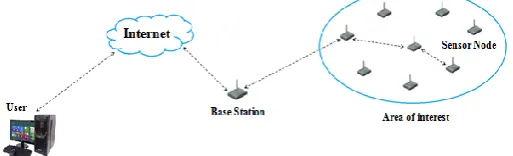
[image:2.595.306.563.274.352.2]In this network, the sensors are dispersed over the field and collect the information to build a global view of the region controlled. The data collected by these sensors are routed directly or via other sensors of close in close to a "collection point ", called base station for subsequent treatment. The base station also acts as gateway node whenever there is a requirement to communicate and connect with the external network [23] shown in Fig. 1.
Fig. 1. Wireless Sensor Network (WSN).
Initially, the wireless sensor network was developed for military reasons (e.g., battlefield monitoring). But the evolution of technologies and the pliability of WSNs have enabled searchers to consider this network as a prospective application in various other areas. Therefore, the WSNs can be very useful in a set of applications when it comes to collect and to treat information from the environment. Current and possible applications of wireless sensor networks have been outlined and addressed in existing literature [13], [19]-[21]. There are numerous applications of WSNs include areas such as military, agriculture, environment, industrial, automobiles, and medical device.
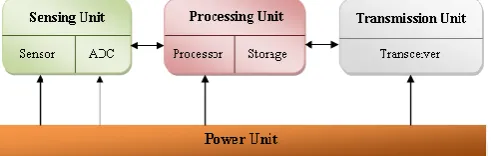
The sensors are the basic units of WSNs. They are devices equipped with features of advanced sensation. The sensor nodes appear as autonomous systems miniaturized with a set of units. Having organized in form of network; the sensors in a WSN, despite the limitation of their computing resources, storage and energy, have the mission to collect data and transfer them to a base station [19]-[22]. A sensor composes of four basic units, as shown in Fig. 2:
--Sensing Unit: it is the main component of a sensor. It is composed of two subunits: a sensor which obtains measurements from the monitored environment, and Analog/Digital Converter (ADC) that converts measured information and transmits it to processing unit.
--Processing Unit: it includes a processor (computing unit) which allows doing simple calculations for collaboration with other sensors, and a memory (storage unit) integrating a specific operating system.
--Power Unit (Battery): each sensor is equipped with a battery to power all its components.
Fig. 2. Sensor node architecture.
Wireless communication technologies such as Wi-Fi, Bluetooth, and ZigBee are part of several research projects based on the wireless sensor network. Each technology is characterized by a set of features. In our proposed system, we will use the ZigBee as the wireless communication technology to connect the WSN nodes.
--ZigBee [26], [28], [30]: technology was presented by the ZigBee Alliance [26]. It is a spec based on the IEEE 802.15.4 standard [27] to define a series of high layer communication protocols used in the creation and designing a wireless personal area network (WPAN) with low power radios signals. The technology specified by the ZigBee is designed to be easier, less expensive and simpler than other WPANs. The ZigBee is employed low power consumption that limits the distances of transmission to 10–100 meters (i.e., 10–100 meters is the nominal range) according to the output power and the environmental conditions. ZigBee supports simple devices; these devices can transfer data over long spaces for reaching the farthest ones by through a mesh network of intermediate devices. Zigbee typically uses in the applications with a low data rate that necessitate secure networking and long battery life. Zigbee network is secured by 128 bits symmetric encryption keys. It has 250 kbps of the rate data, best suitable for intermittent data transmissions from an input or sensor device. ZigBee provides several characteristics including self-organized, high security, multi-hop, mesh networking, and low cost with long battery lifetime [29], [30].
III. LITERATURE SURVEY
The irrigation technique is examined as one of the most vital needs of agriculture. The alarming scarcity of water in the world instigates to manage irrigation mechanism for optimizing the use of water. Various irrigation systems (e.g., drip irrigation) are deployed to avert and reduce the problem of wasting water in traditional systems. However, these systems are still inefficient, but we can improve their efficiency by using information on soil, climate, and environment. In this regard, wireless sensor networks are applied as the coordination technology in the irrigation method to develop and improve the efficiency of this system. A set of research was done in this context.
Damas et al. [38] presented and described an automatic irrigation system with remote and centralized control to supervise large areas of irrigated terrain in Spain. In this system, the agricultural land was divided into seven sub-areas. Each sub-area was controlled by sector of control. The seven monitoring sectors were connected to each other and also to the central controller through WLAN network.
The test results were positive with regard to water conservation; where it reached up to 30-60%.
Kim et al. [39] presented and described the design of the software of decision support and the integration of this software with wireless sensor network in-field for the control of sprinkler irrigation operations. They developed this software for decision making, monitoring, detection and implementation of control in real-time for site-specific sprinkler irrigation via Bluetooth wireless communication. Morais et al. [40] proposed and implemented an intelligent irrigation system based on a wireless data acquisition network (WDAN) for collecting data about the climate and soil moisture in irrigated regions in Portugal. In this system, several solar-powered wireless data acquisition stations (SPWAS) have been used for measuring soil moisture and climate conditions to improve irrigation efficiency and increase the production yield of agricultural land.
Gutiérrez et al. [41] proposed and developed an automated irrigation system to manage and optimize the use of irrigation water in agricultural lands using GPRS module and the WSN. The system is composed of a distributed wireless network of temperature and soil moisture sensors placed in the root part of plants to properly control the irrigation. The data from this system is transmitted to the main control unit; this unit allows identifying, analyzing, and recording these data. It also permits the management of the irrigation activation automatically using a developed program contains threshold values of information measured.
In [42], Stefanos et al. proposed an automated irrigation technique that manages and controls effectively the irrigation water using the environment of WSNs by calculating the amount of water needed for irrigation and using the threshold values of soil moisture content. In this technique, the authors integrated an automated irrigation system with a new advanced routing protocol for WSN; this protocol is named ECHERP and it is energy efficient.
Troy Peters et al. [43] integrated a control and decision support system with a wireless sensor network to manage the irrigation technique for an apple orchard in Prosser, WA. The authors developed this system using soil, weather, and thermal sensors. They also tested seven irrigation scheduling algorithms on the apple field. The test results were positive with regard to the reduction of applied water (up to 70 %).
Işik et al. [44] developed and implemented a precision irrigation system to control and manage the different phases of plant growth by integrated the sensor network technology with IOS/Android application. The system is composed of a set of moisture sensors at certain points of the irrigated zone to measure the amount of water in the soil. The data from these sensors was transferred in real time to a mobile phone based on IOS/Android through Wi-Fi. From these measured data, the precision irrigation system was well controlled and managed based on the quantity of water required by the plants during each stage in their growth. And in [45], Alvino and Marino presented an extensive survey on applications of remote sensing to monitor and examine soil and water status of crops for the control and management of irrigation systems. Many techniques, systems, approaches and challenges have been studied and analyzed.
hydroponic precision agriculture in greenhouses using WSN. They developed this system using an auto-calibrated pH sensor for detection and adjustment of the imbalances in pH levels found in nutrient solutions used for hydroponic agriculture. Each auto-calibrated pH sensor is connected to a wireless node. A set of nodes connected to each other compose the wireless sensor network which is responsible for greenhouse control to ensure correct operation.
IV. PROPOSED SYSTEM
From the data treated above, we conclude that the common irrigation technique around the world is characterized by a remarkable increase in the demand for agricultural productivity, very low water availability and poor performance. These problems can be corrected appropriately through effective management of irrigation water, an adequate choice of the irrigation system, and use of an automatic control for this system. The integration of wireless sensor network technology with irrigation systems will be beneficial to solve the issues mentioned above in order to save water and increase the performance and efficiency of irrigation. Therefore, we want to develop a smart irrigation system based on the use of WSN that operates automatically by detecting temperature and moisture of soil and other environmental parameters and by activating/deactivating the mechanism of irrigation without the intervention of the farmer. To apply our proposed system, we select several tools and methods:
--Based on a comparison of the different existing irrigation systems [36], [37], we find that the drip irrigation system has numerous advantages over other systems such as an important water saving, limit of soil erosion, possibility of automation, and reduction of evaporation losses. So for the irrigation system used in our system, we choose the drip irrigation that is the most efficient and adaptable to have a smart irrigation system.
--Another comparison made to choose the most efficient wireless communication technology [47], [48]. From a set of protocols Zigbee, Bluetooth and Wi-Fi, Zigbee is the best choice and the most efficient for use in WSNs and thus for our system due to its limited computing and memory ability. --The most important parameters for irrigation systems are temperature and moisture of soil. From these key parameters, we choose to use the humidity and temperature sensors like EC-5 Soil Moisture Sensor [50] and DS18B20 temperature sensor - waterproof [49].
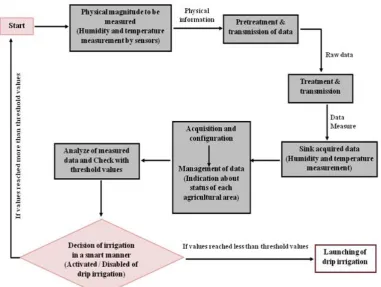
The objective of our proposed smart irrigation system is to utilize different new technologies: the wireless sensor network and ZigBee wireless communication to design a remote irrigation control system for farmers. To realize this, we propose a prototype that permits to monitor and measure soil moisture and temperature and air humidity and temperature using several special sensors. Then we analyze and check the measured data with predefined threshold values of measured parameters (predefined threshold values can be modified according to the type of crop). Based on the result of this analysis and verification, the irrigation system is activated / deactivated. A set of steps describing the flow of operation of our intelligent irrigation system using the
WSN and ZigBee, these steps are shown in Fig. 3.
Our proposed irrigation system is based on the integration of a drip irrigation system with the wireless sensor network and other technologies such as ZigBee to achieve a smart and automatic control for irrigation. In Fig. 4, we describe and show the prototype of our proposed system. In our proposed prototype, we divide the agricultural land to be irrigated into multiple small areas in order to prolong the lifetime of the WSN, and thus the system. In each area, we deploy a set of temperature and humidity sensors to monitor and measure the moisture and temperature of the soil and the humidity and temperature of the air. The soil parameters are measured using EC-5 Soil Moisture Sensor and DS18B20 temperature sensor – waterproof; these sensors were placed near the root part of plants. The data measured by the sensors are transferred to a coordinator node (collection point), called a base station. The coordinator node receives and processes the data and stores the processed data in a database. These sensors are connected to each other and to a coordinator node via ZigBee wireless communication technology. After that, an analysis of the recorded data is performed by checking them with a developed base of threshold values for each measured parameter. From the result of this verification, the irrigation system is turned ON or OFF (Activated / Deactivated). In case of dry area, it will activate drip irrigation if the values reached less than threshold values.
To describe the working of our proposed system, show the different desired features of this system and depict the different interactions found. We present a use case diagram where we illustrate the different actors of the system as well as their different interactions. In this case, we adopted the use case diagram design for the proposed intelligent irrigation system, showing the different actors and the set of actions to perform as shown in Fig. 5.
V. CONCLUSION
With the technological revolution, wireless sensor networks (WSNs) have become essential elements and involved in almost every area of life, especially to evaluate and analyze the information from the external environment. At present, improving the sustainability of different agricultural services has become a serious challenge to reduce the impact of the global water crisis. The irrigation system is one of the most vital services that can develop and improve agriculture. Therefore, we want to develop an intelligent irrigation system based on the use of Wireless Sensor Network and ZigBee wireless communication technology. In this work, a prototype of a smart irrigation system using WSN and ZigBee is developed and presented. Moreover, the operation, architecture, and design of our proposed solution are described. The proposed system allows controlling and managing irrigation system in a smart way by monitoring the parameters of soil and weather and taking the decision to launch water irrigation, in order to increase the efficiency and performance of irrigation systems and save water.
Fig. 3. Steps of operating flow for our proposed irrigation system
[image:5.595.67.513.427.597.2]FIG. 5.DESIGN AND CONCEPTION OF AN INTELLIGENT IRRIGATION SYSTEM USING WSNS (USE CASE DIAGRAM).
REFERENCES
[1] FAO. (2013). FAO statistical yearbook 2013. Part 1—The setting.
Rome: Food and Agriculture Organization of the United Nations.
[Online]. Available:
http://www.fao.org/docrep/018/i3107e/i3107e01.pdf, accessed April 2018.
[2] J. Rockström, J. Williams, G. Daily, A. Noble, N. Matthews, L.
Gordon, et al. “Sustainable intensification of agriculture for human prosperity and global sustainability,” Ambio, vol. 46, no. 1, pp. 4-17, 2017.
[3] W. A. Jury, and Jr, H. J. Vaux, “The emerging global water crisis: managing scarcity and conflict between water users,” Advances in agronomy, vol. 95, pp. 1-76, 2007.
[4] P. Falloon, and R. Betts, “Climate impacts on European agriculture and water management in the context of adaptation and mitigation— the importance of an integrated approach,” Science of the total environment, vol. 408, no. 23, pp. 5667-5687, 2010.
[5] H. Cooley, K. Donnelly, R. Phurisamban, and M. Subramanian,
“Impacts of California’s ongoing drought: agriculture,” Pacific Institute: Oakland, CA, USA, pp. 24, 2015.
[6] A. ur Rehman, , A. Z. Abbasi, N. Islam, Z. A. Shaikh, “A review of
wireless sensors and networks' applications in agriculture,” Computer Standards & Interfaces, vol. 36, no. 2, pp. 263-270, 2014.
[7] N. Wang, N. Zhang, M. Wang, “Wireless sensors in agriculture and
food industry—Recent development and future perspective,” Computers and electronics in agriculture, vol. 50, no. 1, pp. 1-14, 2006.
[8] B. Mihailović, D. Cvijanović, I. Milojević, and M. Filipović, “The role of irrigation in development of agriculture in Srem district,” Economics of Agriculture, vol. 61, no 4, pp. 829-1088, 2014.
[9] N. Alexandratos, and J. Bruinsma, “World agriculture towards
2030/2050: the 2012 revision,” FAO, Rome: ESA Working paper, vol. 12, no. 3, 2012.
IEEE Transactions on Parallel and Distributed Systems, Institute of Electrical and Electronics Engineers (IEEE), no. 99, pp. 1-17, 2013.
[11] M. Srbinovska, C. Gavrovski, V. Dimcev, A. Krkoleva, and V.
Borozan, “Environmental parameters monitoring in precision agriculture using wireless sensor networks,” Journal of Cleaner Production, vol. 88, pp. 297-307, 2015.
[12] S. Zhang, and H. Zhang, “A review of wireless sensor networks and
its applications,” in Automation and Logistics (ICAL), 2012 IEEE International Conference on. IEEE, pp. 386-389, 2012.
[13] M. Sunita, J. Malik, and S. Mor, “Comprehensive study of
applications of wireless sensor network,” International Journal of Advanced Research in Computer Science and Software Engineering, ISSN, vol. 2277, 2012.
[14] D. Bri, M. Garcia, J. Lloret, and P. Dini, “Real deployments of wireless sensor networks,” in Sensor Technologies and Applications, 2009. SENSORCOMM'09. Third International Conference on. IEEE, pp. 415-423, 2009.
[15] J. Gubbi, R. Buyya, S. Marusic, M. Palaniswami, “Internet of Things
(IoT): A vision, architectural elements, and future directions,” Future generation computer systems, vol. 29, no. 7, pp. 1645-1660, 2013.
[16] J. Ye, B. Chen, Q. Liu, and Y. Fang, “A precision agriculture
management system based on Internet of Things and WebGIS,” in Geoinformatics (GEOINFORMATICS), 2013 21st International Conference on. IEEE, pp. 1-5, 2013.
[17] T. Ojha, S. Bera, S. Misra, and N. S. Raghuwanshi, “Dynamic duty scheduling for green sensor-cloud applications,” in Cloud Computing Technology and Science (CloudCom), 2014 IEEE 6th International Conference on. IEEE, pp. 841-846, 2014.
[18] Y. Cho, K. Cho, C. Shin, J. Park, E. S. Lee, “An agricultural expert cloud for a smart farm,” in Future Information Technology, Application, and Service. Springer, Dordrecht, pp. 657-662, 2012.
[19] I. F. Akyildiz, W. Su, Y. Sankarasubramaniam, and E.
Cayirci, “Wireless sensor networks: a survey,” Computer networks, vol. 38, no. 4, pp. 393-422, 2002.
[20] J. Yick, B. Mukherjee, and D. Ghosal, “Wireless sensor network
survey,” Computer Networks, vol. 52, pp. 2292–2330, 2008.
[21] D. P. Agrawal, “Applications of Sensor Networks,” in Embedded
Sensor Systems. Springer, Singapore, pp. 35-63, 2017.
[22] I. F. Akyildiz, W. Su, Y. Sankarasubramaniam, and E. Cayirci, “A survey on sensor networks,” IEEE communications magazine, vol. 40, no. 8, pp. 102-114, 2002.
[23] K. Beydoun, “Design of a hierarchical routing protocol for sensor networks,” PhD thesis, University of Franche-Comte, Besançon, France, Sept. 2009.
[24] Kristofer, Pister, SmartDust. [Online]. Available:
http://robotics.eecs.berkeley.edu/~pister/SmartDust/, accessed Mai 2018.
[25] Crossbow, MICA2 Datasheet. [Online]. Available:
http://www.investigacion.frc.utn.edu.ar/sensores/equipamiento/wirele ss/MICA2_Datasheet.pdf, accessed Mai 2018.
[26] ZigBee Specifications, ZigBee Alliance Std. [Online]. Available:
http://www.zigbee.org/, accessed Mai 2018.
[27] “IEEE Standard for Local and metropolitan area networks--Part 15.4:
Low-Rate Wireless Personal Area Networks (LR-WPANs),” in IEEE Std 802.15.4-2011, pp.1-314, Sept. 2011.
[28] T. Obaid, H. Rashed, A. Abou-Elnour, M. Rehan, M. M. Saleh, and M. Tarique, “ZigBee Technology and its application in Wireless Home Automation systems: a survey,” International Journal of Computer Networks & Communications, vol. 6, no. 4, pp. 115, 2014. [29] J. S. Lee, “Performance evaluation of IEEE 802.15. 4 for low-rate
wireless personal area networks,” IEEE Transactions on Consumer Electronics, vol. 52, no. 3, pp. 742-749, 2006.
[30] J. S. Lee, and Y. C. Huang, “ITRI ZBnode: A ZigBee/IEEE 802.15. 4
platform for wireless sensor networks,” in Systems, Man and Cybernetics, 2006. SMC'06. IEEE International Conference on. IEEE, pp. 1462-1467, 2006.
[31] M. Valipour, M. A. G. Sefidkouhi, and S. ESLAMIAN, “Surface
irrigation simulation models: a review,” International Journal of Hydrology Science and Technology, vol. 5, no. 1, pp. 51-70, 2015. [32] S. Postel, P. Polak, F. Gonzales, and J. Keller, “Drip irrigation for
small farmers: A new initiative to alleviate hunger and poverty,” Water International, vol. 26, no. 1, pp. 3-13, 2001.
[33] G. Provenzano, “Using HYDRUS-2D simulation model to evaluate
wetted soil volume in subsurface drip irrigation systems,” Journal of Irrigation and Drainage Engineering, vol. 133, no. 4, pp. 342-349, 2007.
[34] D. J. Bloomer, P. Johnstone, and J.Holland, “Drip Irrigation for
Vegetable Production,” Irrigation New Zealand, Book 7, 2013.
[35] E. Moreno-Jiménez, A. A. Meharg, E. Smolders, R. Manzano, D.
Becerra, J. Sánchez-Llerena, et al. “Sprinkler irrigation of rice fields
reduces grain arsenic but enhances cadmium,” Science of the Total Environment, vol. 485, pp. 468-473, 2014.
[36] P. Keeratiurai, “Comparison of drip and sprinkler irrigation system for the cultivation plants vertically,” J. Agric. Biol. Sci, vol. 8, pp. 740-744, 2013.
[37] C. M. Burt, A. J. Clemmens, R. Bliesner, J. L. Merriam, and L. Hardy, “Selection of irrigation methods for agriculture,” American Society of Civil Engineers On-Farm Irrigation Committee Report, ASCE, Reston, VA 129 p, 1999.
[38] M. Damas, A. M. Prados, F. Gómez, and G. Olivares, “HidroBus
system: fieldbus for integrated management of extensive areas of irrigated land,” Microprocessors and Microsystems, vol. 25, no. 3, pp. 177-184, 2001.
[39] Y. Kim, R. G. Evans, “Software design for wireless sensor-based
site-specific irrigation,” Computers and Electronics in Agriculture, vol. 66, no. 2, pp. 159-165, 2009.
[40] R. Morais, A. Valente, C. Serôdio, “A wireless sensor network for smart irrigation and environmental monitoring: A position article,” in 5th European federation for information technology in agriculture, food and environement and 3rd world congress on computers in agriculture and natural resources (EFITA/WCCA) , Portugal, pp. 845–850, 2005.
[41] J. Gutiérrez, J. F. Villa-Medina, A. Nieto-Garibay, and M. Á. Porta-Gándara, Automated irrigation system using a wireless sensor network and GPRS module,” IEEE transactions on instrumentation and measurement, vol. 63, no. 1, pp. 166-176, 2014.
[42] S. A. Nikolidakis, D. Kandris, D. D. Vergados, and C. Douligeris “Energy efficient automated control of irrigation in agriculture by using wireless sensor networks,” Elsevier Journal on Computers and Electronics in Agriculture, vol. 113, pp. 154-163, 2015.
[43] Y. Osroosh, R. T. Peters, C. S. Campbell, and Q. Zhang, “Comparison
of irrigation automation algorithms for drip-irrigated apple trees,” Computers and Electronics in Agriculture, vol. 128, pp. 87-99, 2016.
[44] M. F. Işik, Y. Sönmez, C. Yilmaz, V. Özdemir, and E. N. Yılmaz, “Precision Irrigation System (PIS) Using Sensor Network Technology Integrated with IOS/Android Application,” Applied Sciences, vol. 7, no. 9, pp. 891, 2017.
[45] A. Alvino, and S. Marino, “Remote sensing for irrigation of
horticultural crops,” Horticulturae, vol. 3, no. 2, pp. 40, 2017.
[46] C. Cambra, S. Sendra, J. Lloret, and R. Lacuesta, “Smart System for
Bicarbonate Control in Irrigation for Hydroponic Precision Farming,” Sensors (Basel, Switzerland), vol. 18, no. 5, 2018.
[47] J. S. Lee, Y. W. Su, and C. C. Shen, “A comparative study of wireless
protocols: Bluetooth, UWB, ZigBee, and Wi-Fi,” in Industrial Electronics Society, 2007. IECON 2007. 33rd Annual Conference of the IEEE. Ieee, pp. 46-51, 2007.
[48] S. Chakkor, E. A. Cheikh, M. Baghouri, and A. Hajraoui,
“Comparative performance analysis of wireless communication protocols for intelligent sensors and their applications”, arXiv preprint arXiv:1409.6884, 2014.
[49] “Datasheet of DS18B20”. [Online]. Available:
http://datasheets.maximintegrated.com/en/ds/DS18B20.pdf, accessed April 2018.
[50] “Operator's Manual of EC-5 Soil Moisture Sensor”. [Online].
Available: