ABSTRACT – As the development of global trade becomes saturated, the income of enterprises gradually changes from open source to throttling. In this paper, we use a method to calculate the cost of dispatching containers for each port due to trade inequality, and add a fuzzy theory that is more in line with the actual situation. Generally, when estimating costs, it is assumed that the cost is fixed, but in fact we cannot guarantee the stability of the cost. In the model building, there are three main costs: holding cost, ordering cost and leasing cost. By assuming fuzzy holding cost and leasing cost, then defuzzifying, estimating the total cost under fuzzy semantics, and using Matlab R2014b to calculate the results of the hypothesis model.
Index Terms—Fuzzy theory, trade inequality, empty container dispatching
I. INTRODUCTION
ffected by globalization, the prevalence of international trade, container transportation has become an indispensable part of the logistics system. Trade inequality is a problem caused by the difference in import and export. A huge trade surplus will lead to the lack of port in the port. In order to effectively save the cost of container scheduling, Won Young Yun et al. (2011) considered the peak season. The difference, and according to the status of different inventory levels, judge whether to order or lease the container, and based on the difference between the cost and the lead time, establish a complete cost estimation model, and finally use the program to analyze and discuss the value.
Yang M.F. (2006) calculates the integrated inventory model and makes fuzzy assumptions about demand and productivity respectively. In the process of fuzzification and defuzzification, it describes each step in detail and uses the reduced distance method to estimate the total cost. Numerical
Manuscript received December 17, 2018; revised December 17, 2018. This work was supported in part by the Department of Transportation Science, National Taiwan Ocean University. Paper title is Empty Container Dispatching Inventory Model in Fuzzy Environment (paper number: ICINDE_16). C. H Lin Authoris with the department of transportation science, National Taiwan Ocean University, No.2, Beining Rd., Keelung City 202, Taiwan (R.O.C), (corresponding author to provide phone: 0926-188-797; e-mail: [email protected])
S. L. Kao Author is with Center of Excellence for Ocean Engineering; the department of transportation science, National Taiwan Ocean University, No.2, Beining Rd., Keelung City 202, Taiwan (R.O.C). (e-mail: [email protected])
C. M. Su Author is with Center of Excellence for Ocean Engineering; the department of transportation science, National Taiwan Ocean University, No.2, Beining Rd., Keelung City 202, Taiwan (R.O.C), (e-mail: [email protected])
M. R. Tu Author is with Center of Excellence for Ocean Engineering; the department of transportation science, National Taiwan Ocean University, No.2, Beining Rd., Keelung City 202, Taiwan (R.O.C), (e-mail: [email protected])
analysis explores the relationship of variables. Yang M.F. et al. (2010) built a two-echelon inventory model for fuzzy demand in a supply chain, while at the same time took approach with mutual beneficial pricing. According to previous researches, fuzzy is often used in the calculation of demand in order to generate results that fit better to the reality. Pranab Biswas and Surapati Pramanik (2011) propose a multi-objective allocation problem with fuzzy costs, in which all targets are simultaneously minimized. Here each fuzzy cost is assumed to be a trapezoidal fuzzy number. Yager’s ranking has been used to transform the newly formed single-objective fuzzy assignment problem into a clear assignment problem in the form of linear programming problems. Gomathi, M. and G. Rajendran (2012) proposed the selection of best paths in Mobile Ad Hoc Network (MANET) based on multipath routing with fuzzy cost in respect of the Fuzzy Cost Enabled Cluster based Routing (FCECR), it is shown PK De et al. (2012) discusses the conventional and fuzzy allocation problems, and proposes a method to solve the fuzzy allocation problem, in which the cost is inaccurate. digital. The element of the cost matrix of the assignment problem is a triangular fuzzy number whose triangle membership function is defined. Using this method, the optimal solution of the fuzzy assignment problem is successfully obtained.
Ali Ebrahimnejad (2013) prove that in the absence of degeneracy these frizzy methods stop in a finite numbers of iterations and the fundamental theorem of linear programming in a crisp environment to a fuzzy one. Finally, illustrated the proof by use of a numerical example. G. Santhi and Alamelu Nachiappan (2013) proposed a QoS (Quality of Service) route algorithm that uses fuzzy logic to consider multiple independent QoS metrics to select the optimal path. All available resources of the path are converted into a single metric. Blur costs and explore the performance comparison of different approaches to network routes. P. Parvathi and D. Chitra (2013) consider the interests of buyers and sellers and the combined total profit to find the optimal order quantity, sales price and shipping policy. The productivity of the buyers and sellers, the quantity of orders, the shortage and the cost of holding are regarded as triangles. Fuzzy numbers and defuzzification for numerical analysis. Y. Long et al. (2013) developed a tool that takes into account the actual conditions and limitations of the operator and helps to effectively manage the repositioning of the empty containers at sea. Lin Xudong et al. (2014) based on the principle of activity cost accounting, studied the problem of economic order quantity under quantity discount, proposed an inventory cost control model with loss rate and quantity discount and fuzzy
Empty Container Dispatching Inventory Model
in Fuzzy Environment
Sheng-Long Kao
,
Chien-Min Su
,
Meng-Ru Tu, Cheng-Hao Lin
parameters, and finally solved the inventory problem by numerical analysis. feasibility.
JK Dash and Anuradha Sahoo (2015) introduced the optimization of the single-period inventory problem (SPIP), considering the demand as a fuzzy random variable, the purchase cost is regarded as a fuzzy number, and the optimal order quantity is obtained through the concept of Buckley fuzzy number minimization. And expected profits. Ali Bozorgi et al. (2015) found that the Unit Maintenance Program (UMS) has a significant impact on company profitability. Based on the fuzzy framework, the uncertainty of load and production cost factors is modeled. The data analysis shows the effectiveness of UMS. S.Vimala and S.Krishna Prabha (2015) minimize the cost of fuzzy allocation problems by using fuzzy numbers. Each fuzzy cost is considered as a triangular fuzzy number, and the fuzzy assignment problem is transformed into a clear value by using semantic variables. The optimistic index is used to reflect the optimistic attitude of the decision maker and the modal index indicating the neutrality of the decision maker. David A. Wood (2016) provides deterministic, fuzzy and stochastic analysis of the cost-term schedule of complex projects under high-level, uncertain conditions, enabling decision makers to plan and monitor infrastructure and other complex projects. Sang-Wha Seo (2017) proposed a T-S fuzzy method to select the finite control set model to predict the cost function weight of the DC-DC converter control algorithm. The state or input variable with an excessively large value can be penalized by increasing the weight corresponding to the variable; the optimal control input is determined by online optimization of the T-S fuzzy cost function for all possible control input sequences.
Through the addition of fuzzy theory, the container dispatching model added the changes occurred in fuzzy cost. The decision makers set the cost range by considering the actual environment and current situation in order for the estimation model to calculate the total cost more accurately. To discuss how upper and lower bound affects the total cost, software is used to calculate results and perform sensitive analyses.
II. MODEL FORMULATION
With reference to the empty container dispatching model, depending on the differences in different periods, the demand changes and the difference between the inventory limit and the reorder point will be generated. Using the previous data, the inventory at the beginning of the current period can be calculated, and the current inventory level can be got through the addition of the ordering and leasing policies in this model, which is used to calculate the current order cost. Finally, the lease method is used to make up the lacking container quantity. In the cost of holding and the cost of leasing, the change of the triangular fuzzy number is added, which allows the decision maker to set the value in line with the current situation and add up the three costs to get the estimated total cost.
A. Ordering and leasing policy
When the inventory level of the container is below the low
bound (reorder point), the container is dispatched by ordering, but the goods have a lead time from order to delivery. In this paper, it is assumed that in order to order containers in the period, four periods of lead time are required, and the goods will be delivered in the i+4 period.
In the case of urgently needed containers, it is not possible to order containers to meet our immediate needs. Therefore, through the way of container leasing, the number of containers missing can be fully compensated, but the cost is higher than that of the ordering containers. Since it is a rental container, there is also the problem that the container needs to be returned. In this paper, it is assumed that in the term lease of containers, the required quantity can be obtained immediately, but after the fourth period, the goods need to be returned in the i+4 period.
B. Assumption
(1) Only consider the same type of container.
(2) Demand increases or decreases according to the season. (3) After (i+4) periods, leasing containers need to be returned. (4) The lead time of the leasing container is 0.
(5) The lead time of ordering containers is stable for 4 periods.
C. Notation
Highest inventory level in low demand season. Reorder point in low demand season.
Highest inventory level in high demand season. Reorder point in high demand season.
Customer demand in the period.
The amount of containers returned from customer in the period.
Net inventory at the beginning of the period. Inventory level in the period.
Inventory level in the lead time of period. Order quantity in the period.
Lease in the period. Inventory holding cost per unit. Fixed-ordering per unit. Ordering cost per unit. Leasing cost per unit.
Total cost of the period
D. Model process
time, it’s also the main reference for the establishment of the model.
Fig.1. Flow chart for container dispatching model with fuzzy costs.
E. Model building
Choose or depending on the differences between peak-off season, according to the previous remaining stock as, the net stock at the beginning of the present period can be got:
(1)
Through the net stock at the beginning of the present period, the holding cost will be calculated:
(2) Through adding the order amount in period (lead time) and subtracting the lease amount in period (lead time), the current inventory level can be obtained:
(3) Then,
Determine , if , ordering is not in need; if , ordering will be replaced by :
Then,
(6)
Determine , if , leasing is
not in need; if , leasing will be replaced by :
Then,
(8) Finally, the total cost of the dispatching container can be obtained by taking , , and and add them together: (9) Definition 1. According to George and Yuan (1995), for a fuzzy set and , -cut of this set is
, where
and .
Gravity method is used to the defuzzication of
Then,
Use the above formula toreplace the original equation:
Then,
(14)
III. NUMERICAL ANALYSIS
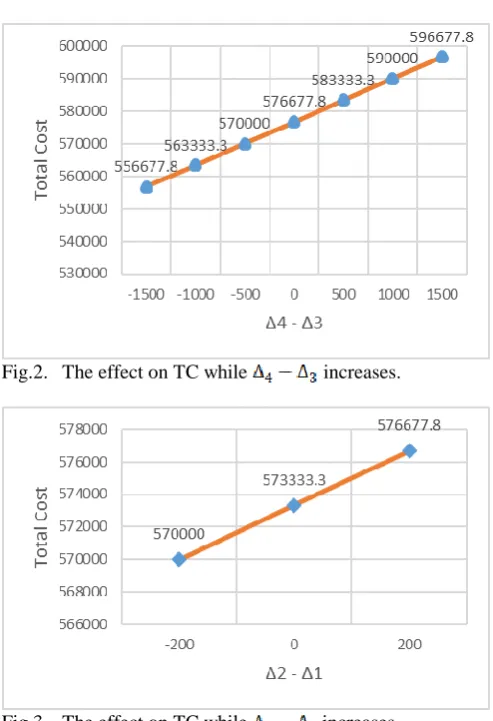
[image:4.595.304.551.39.400.2]The calculation for the numerical analysis uses Matlab R2014b; the 500th period is used as a reference for analyzing. Data assumptions for , , , and various costs factors (holding costs per unit, ordering cost per unit, fixed-ordering costs and leasing costs) in the off-peak season are made in TABLE I and TABLE II; while TABLE III does sensitivity analysis for changes in .
TABLE I
AND IN HIGH OR LOW DEMAND
in high demand season
in low demand season
in high demand season
[image:4.595.42.290.279.712.2]in high demand season 300 200 220 150
TABLE II
, AND VARIOUS COSTS FACTORS
Holding costs per unit
Ordering costs per unit
Fixed-ordering costs
Leasing costs per unit 90 40 130 60 2000 4000 50000 12000
TABLE III
NUMERICAL EXAMPLE RESULTS
200 400 1000 500 2066.7 11833.3 576677.8 1000
1500
2066.7 2066.7
12000 12167.8
583333.3 590000 2000 1000 2066.7 11667.8 570000 2000 2066.7 12000 583333.3 3000 2066.7 12333.3 596677.8 4000 2500 2066.7 11500 563333.3 4000 2066.7 12000 583333.3 5500 2066.7 12500 603333.3 400 400 1000 500 2000 11833.3 573333.3
1000 1500
2000 2000
12000 12167.8
580000 586666.7 2000 1000 2000 11667.8 566666.7 2000 2000 12000 580000 3000 2000 12333.3 593333.3 4000 2500 2000 11500 560000
4000 2000 12000 580000 5500 2000 12500 600000 400 200 1000 500 1933.3 11833.3 570000
1000 1500
1933.3 1933.3
12000 12167.8
576677.8 583333.3 2000 1000 1933.3 11667.8 563333.3 2000 1933.3 12000 576677.8 3000 1933.3 12333.3 590000 4000 2500 1933.3 11500 556677.8
4000 1933.3 12000 576677.8 5500 1933.3 12500 596677.8
Fig.2. The effect on TC while increases.
Fig.3. The effect on TC while increases.
(1) While is stable; when increases, will increase along with Total Cost.
(2) While and is the same; when decreases, will decrease along with Total Cost.
(3) The minimum of Total Cost will be obtain while and according to the numerical results.
IV. CONCLUSION
In the maritime market approaching saturation, the vicious price-cutting competition between the two sides has led to the deteriorating development of the maritime industry. How to effectively control the cost of expenditure is one of the keys to truly help the current maritime industry. In this research, by simulating the model of container dispatching cost, the cost triangle fuzzy number is added; and the cost can be changed by the decision maker according to the current situation, which allow the result to be more in line with the actual changes.
[image:4.595.42.293.288.715.2]REFERENCES
[1] Gomathi, M. and G. Rajendran, “Fuzzy Cost Enabled Cluster Based Multipath Routing Algorithm for Mobile Ad-Hoc Networks,” Journal of Computer Science 8 (9): 1434-1440, 2012, ISSN 1549-3636 [2] Pranab Biswas and Surapati Pramanik, “Multi-objective Assignment
Problem with Fuzzy Costs for the Case of Military Affairs,” International Journal of Computer Applications (0975 – 8887), Volume 30– No.10, September 2011
[3] P. K. De and Bharti Yadav, “A General Approach for Solving Assignment Problems Involving with Fuzzy Cost Coefficients,” Modern Applied Science Vol. 6, No. 3; March 2012
[4] Ali Ebrahimnejad, “Some New Results in Linear Programming Problems with Fuzzy Cost Coefficients,” Walailak J Sei & Tech 2013; 10(2): 191-199
[5] G. Santhi and Alamelu Nachiappan, “An Agent-assisted Fuzzy cost based Multicast QoS routing in MANETs,” ISSN: 1109-2742 Issue 3, Volume 12, March 2013
[6] Ali Bozorgi, Mir Mohsen Pedram, G. Reza Yousefi, “Unit Maintenance Scheduling: A robust model, based on fuzzy cost factors and peak loads,” Electrical Power and Energy Systems 79 (2016) 142–149
[7] S. Vimala and S. Krishna Prabha, “Solving Assignment Problems with fuzzy costs using circumcenter of centroids,” Global Journal of Pure and Applied Mathematics. ISSN 0973-1768 Volume 11, Number 6 (2015), pp. 4353-4364
[8] J.K. Dash∗ and Anuradha Sahoo, “Optimal solution for a single period inventory model with fuzzy cost and demand as a fuzzy random variable,” Journal of Intelligent & Fuzzy Systems 28 (2015) 1195–1203, DOI:10.3233/IFS-141402, IOS Press
[9] David A. Wood, “High-level integrated deterministic, stochastic and fuzzy costduration analysis aids project planning and monitoring, focusing on uncertainties and earned value metrics,” Journal of Natural Gas Science and Engineering 37 (2017) 303-326
[10] Sang-Wha Seo, Yong Kim and Han Ho Choi, “Model predictive controller design for boost DC–DC converter using T–S fuzzy cost function,” INTERNATIONAL JOURNAL OF ELECTRONICS, 2017, VOL. 104, NO. 11, 1838–1853
[11] Won Young Yun, Yu Mi Lee, Yong Seok Choi, “Optimal inventory control of empty containers in inland transportation system,” Int. J. Production Economics 133 (2011) 451–457
[12] Lin Xudong, Ye Jun, Zhang Xianjun, He Li, “Fuzzy Inventory Model Based on Activity-based Costing,” International Journal of Applied Engineering Research, ISSN 0973-4562 Volume 9, Number 11 (2014) pp.
[13] J.K. Dash∗ and Anuradha Sahoo, “Optimal solution for a single period inventory model with fuzzy cost and demand as a fuzzy random variable,” Journal of Intelligent & Fuzzy Systems 28 (2015) 1195–1203, DOI:10.3233/IFS-141402, IOS Press
[14] Wasim Akram Mandal and Sahidul Islam, “Fuzzy Inventory Model for Deteriorating Items, with Time Depended Demand, Shortages, and Fully Backlogging,” Pak.j.stat.oper.res. Vol. XII No.1 2016 pp101-109 [15] P. Parvathi and D. Chitra, “A Fuzzy Inventory Model for Vendor–Buyer Coordination in a Two Stage Supply Chain with Allowed Shortages,” International Journal of Computer Applications (0975 – 8887), Volume 76– No.2, August 2013
[16] Y. Long, L. H. Lee, E. P. Chew, Y. Luo, J. Shao, A. Senguta, S. M. L. Chua, “OPERATION PLANNING FOR MARITIME EMPTY CONTAINER REPOSITIONING,” International Journal of Industrial Engineering, 20(1-2), 141-152, 2013
[17] M.F. Yang, M.C. Lo and W.H. Chen, “Optimal Strategy for the Three-echelon Inventory System with Defective Product, Rework and Fuzzy Demand under Credit Period,” Engineering Letters, Vol.23(2015), No.4,312-317. (EI)
[18] M.F. Yang, H.J. Tu and M.C. Lo, “A two-echelon inventory model for fuzzy demand with mutual beneficial pricing approach in a supply chain,” African Journal of Business Management (Accepted August 31, 2010). (Impact Factor 1.105, 58/112) (SSCI).
[19] M.F. Yang, M.J. Luo, C.Y. Shen, “Applying fuzzy theory to the
integrated inventory model for adjusting productivity,” Qingyun