Improved Approaches Edge Direction Histogram and
HSV Histogram, Color Auto Correlagram; Gabor Wavelet
Transforms using CBIR
Raksha Sharma
Dept. of CSE
ITM
Gwalior, India
Rajendra Singh Kushwah
Dept. of CSE
ITM
Gwalior, India
ABSTRACT
Content Based Image Retrieval (CBIR) is a creating pattern in Digital Image Processing (DIP) for seeking and recovering the question picture from extensive variety of databases. CBIR framework comprise of different stages to concentrate and match the highlights and hunt the pictures from the substantial scale picture databases based on visual substance such as Color, Shape and Texture according to the user’s interest. To supply the reasonable answer to the client query, CBIR provides some run of work. A new method is planned in this paper for color picture indexing by developing the ease of SVM system. A New technique is proposed on this paper for coloration photograph indexing via exploiting the simplicity of the Histogram equalization method. In this algorithm, now we have proposed a mixture of color, shape and texture features. In this approach, the past work is improved to accomplish better precision. In this paper we propose histogram equalization to improve image quality and applied distance matrix to get better result than base work.
At that point we encrypt the three channels independently. Here component Extraction was viewed as the paired order issue and SVM was utilized for arrangement this issue and the procedure of grouping is given to the whole picture which are extricated after the feature extraction process.
Keywords
CBIR, edge direction Histogram; HSV histogram, Color Auto correlagram; Gabor wavelet transform; Feature extraction, Distance matrix, SVM, etc.
1.
INTRODUCTION
The significance of digital image (DI) databases relies upon how cordial and precisely clients can recover pictures of intrigue. In this way, propelled inquiry and recovery apparatuses have been seen as a dire requirement for different picture recovery applications. The soonest web crawlers have embraced CBIR approaches. These arrangements have demonstrated exceptional restrictions in light of the fact that advanced pictures to be mined are either not marked or commented on utilizing off base catchphrases. At the end of the day, content based recovery approaches require manual comment of the entire picture accumulations. Be that as it may, this dull manual errand isn't doable for substantial picture databases. CBIR developed as a promising substitute to outperform the difficulties met by CBIR arrangements. Actually, computerized pictures, which are mined utilizing CBIR framework, are spoken to utilizing an arrangement of visual highlights. As delineated in Figure 1, regular CBIR framework comprises of a disconnected stage which goes for removing and putting away the visual element vectors from the database pictures. Then again, the online stage enables the client to begin the recovery errand by giving his inquiry picture. At last, run of the mill CBIR framework restores
an arrangement of pictures outwardly applicable to the client question. Notwithstanding, its fundamental downside comprises in the presumption that the visual similitude mirrors the semantic similarity. This suspicion does not hold on account of the semantic hole [1] between the more elevated amount meaning and the low-level visual highlights.
These problems lead to the very capable CBIR method. A CBIR system executes two main functions: first, image feature extraction where a feature set (image signatures, feature vectors) is produced.
This set carries image data and shows it within database taking small storage space. Second is similarity measurement. It calculates the space among the question image and whole database (DB) pictures with their feature vectors. The most like the inquiry pictures are shown because of the looking procedure. [2]
2.
USING TECHNIQUES
1. Feature Extraction:
Features, for example, shape, texture, color, and so forth are utilized to portray the substance of the picture. The features further can be appointed low-level and unusual state features. In this progression visual data is removes from the picture and spares them as highlights vectors in a highlights database. For every pixel, the picture depiction is found as highlight esteem (or an arrangement of significant worth called an element vector) by utilizing the feature extraction. These element vectors are utilized to contrast the question and alternate pictures and recovery.
2. Color Correlograms (CC)
Another picture includes called CC for picture requesting proposed in. A CC imparts how the spatial relationship of sets of tones changes with division and gets both shading and spatial transport, gives spatial data of pixels in a photo. Correlogram is more vigorous to zooming, revolution and scaling and considered as a non specific apparatus for spatial shading ordering and thus more productive than histograms. CBIR accomplished with CC by including importance criticism and two managed learning systems of taking in the question and taking in the metric in [3]. Color Auto Correlogram (CAC) separates spatial dispersion between precisely comparable hues, with which computational multifaceted nature gets decreased Semantic CBIR utilizing correlograms in HSV space with more touchy changes to tint and less delicate to immersion and esteem depicted in [3].
3. Similarity Matching:
25 available or not or what number of are comparable kind pictures
are exist or not) which helps in estimating the comparability. This progression includes the coordinating of the above expressed highlights to yield an outcome that is outwardly comparable with the utilization of closeness measure technique called as Distance strategy. Here is diverse distance, strategy accessible, for example, Euclidean distance,, City Block Distance, Canberra Distance. [4]
4. Histogram Equalization (HE)
It is a methodology for modifying photo powers to finish appraisal. It is a graphical representation of the power appropriation of a photo. It measures the amount of pixels for each profundity expense mulled over. It is a manner that improves the comparison in a photograph, so one can stretch out the depth range. Evening out infers mapping one dissemination (the offered histograsm) to each unique dispersion (a miles more extensive and more prominent uniform appropriation of profundity esteems) so the intensity values are speeded over the entire variety. [5].
5. Gabor Filter
:
Gabor filter is the most widely used technique to extract texture features for image retrieval .It is extensively used for texture analysis because of its similar characteristics with human perception. A 2D Gabor filter g(x, y) comprises of a sinusoidal plane influx of some recurrence and introduction (Carrier), and 2D deciphered. Gaussian Envelope is utilized to regulate it.
6. Support Vector Machine (SVM)
:
It is regulated learning technique in which data is investigated and distinguish design utilized for arrangement reason. In classification it takes input set, read it and forms output for all desired input and if output is continuous then regression is performed [6]. The point of SVM arrangement strategy is to locate the best hyper-plane isolating important and unimportant vectors augmenting the span of the edge (between the two classes). Introductory technique accepts that important and superfluous vectors are directly distinguishable. The SVM isolate the entire picture database into two classes. The two classes are additionally incorporating the unlabelled pictures with two sorts they are pertinent and insignificant unlabelled pictures. The applicable unlabelled picture is identified with the important marked pictures in the picture database. In comparative way the unessential unlabelled picture is identified with the superfluous named pictures in the database. This SVM is also classifying the unlabelled images in accuracy manner.
7. HSV Color histogram
Color function is among the primary matters to entry the picture. The color of a photo is spoken to from the prominent shading spaces like RGB, XYZ, YIQ, L*a*b, U*V*W, YUV and HSV. HSV color space gives the best CH incorporate, among the differing color spaces. HSV color hole is spoken to by three embellishments relating to Hue (H), Saturation(S), and value (V).[7].
H= 𝑐𝑜𝑠
−11
2 𝑅−𝐺 + (𝑅−𝐵)
𝑅−𝐺 + 𝑅−𝐵 (𝐺−𝐵)
S = 1-
𝑅+𝐺+𝐵3min(𝑅, 𝐺, 𝐵, )
V =
13
[𝑅 + 𝐺 + 𝐵]
8. Wavelet Transform (WT)
A multi-determination approach is given to surface examination and grouping because of Wavelet changes. The estimation of the WT incorporates recursive isolating and sub-looking at. At each
level, the signal is broken down into four repeat sub-gatherings, LL, LH, HL, and HH, where L demonstrates low recurrence and H implies high frequency (HF). Figure shows sample wavelet transforms. In this we use Haar Transform.[8]
Fig.1.Sample wavelet transform
3.
LITERATURE SURVEY
Savita, et.al. [2017] This paper explores distinctive strategies for speaking to shape and texture in CBIR. We have joined five highlights set in our work and these are prepared and ordered with SVM classifier which makes utilization of machine learning innovation. We consolidated histogram highlights, surface highlights (GLCM features), wavelet highlights, gabor highlights, and measurable highlights, which makes utilization of worldwide and neighborhood highlights. A database of 1000 pictures (Wang database) of 10 distinct classes is utilized to separate all highlights vector for each picture and put away in our database with the goal that SVM can utilize it to characterize the inquiry mage. By utilizing these highlights set, we can reach up to 97.53% grouping accuracy.[9]
Mohd. Aquib Ansari, et.al. [2017] In this work, we utilized HSV color histogram with quantized non-uniform 72 receptacles to separate shading data of picture, DWT on every part (H, S and V) of HSV picture to remove the mind boggling surface example of picture and worldwide and also nearby edge histogram descriptor on V segment of HSV picture to extricate the geometry data of. Here, Euclidean separation is utilized as comparability estimation to discover how comparable the client picture is as for the picture in the database. For trial examination, 600 pictures of Wang picture database are utilized and the outcomes demonstrate that this approach gives great execution in term of exactness and flexibility while contrasting and other's joining scheme.[10].
Muhammad Fachrurrozi, et al. [2017] Constant face acknowledgment framework process isolated into three stages, include extraction, bunching, identification, and acknowledgment. Each step uses a different method that is Local Binary Pattern (LBP), Agglomerative Hierarchical Clustering (AHC) and Euclidean Distance. CBIR, a picture seeking systems in light of picture highlight, is executed as the looking technique. Based experiments and the testing result, recall and precision values are 65.32% and 64.93% respectively.[11].
enhanced outcomes when contrasted with the current works.[12].
Behzad Merhrbakhsh Choobar et al. [2017] Furthermore, rather than applying the calculation to the picture itself, we apply it to another picture built by getting mean of 3™3 sub-districts gray an incentive as every pixel's esteem. In the proposed strategy, eight unmistakable headings are characterized. Each pixel gets one of the headings as demonstrated by its relationship with its enveloping neighbors, which is figured using first-orchestrate subordinates in vertical, level and two askew bearings. We utilized Corel 1000 database to assess our system with LBP and neighborhood tetra test (LTrP). Our proposed technique demonstrates gigantic progress in both ordinary exactness and survey. Because of applying the figuring to the mean estimation of 9 pixel-windows, the proposed method demonstrates better recuperation occurs for uproarious pictures [13].
Abdolreza Rashno, et al. [2017] In this paper, new CBIR plot is proposed in neutrosophic (NS) space. For this assignment, RGB pictures are first changed to three subsets in NS area and after that divided. For each section of a picture, shading highlights including dominant color discribtor (DCD), histogram and measurement segments are extricated. All separated highlights from either portioned picture or the entire picture are joined to make an element vector. Feature vectors are supplied for ant colony optimization (ACO) function selection which selects the most relevant features. Experimental results show that the proposed technique outperforms our previous method (with the same characteristic vector and feature collection technique) by 2% and 1% with deference to precision and recall, in that order. Additionally, the proposed strategy accomplishes the change of 13% and 2% in exactness and review, individually, in examination with earlier techniques [14].
4.
PROPOSED WORK
4.1 Propose Methodology
A New technique is proposed on this paper for coloration photograph indexing via exploiting the simplicity of the edge direction Histogram method. In this algorithm, now we have proposed a mixture of color, shape and texture features. In this approach, the previous work is enhanced to achieve better precision. In this paper we propose histogram equalization to improve image quality and applied distance matrix to get better result than base work.
At that point we encrypt the three channels independently. Here component Extraction was viewed as the twofold order issue and SVM was utilized for arrangement this issue and the procedure of characterization is given to the entire image which are extracted after the feature extraction process.
4.2 Propose Algorithm
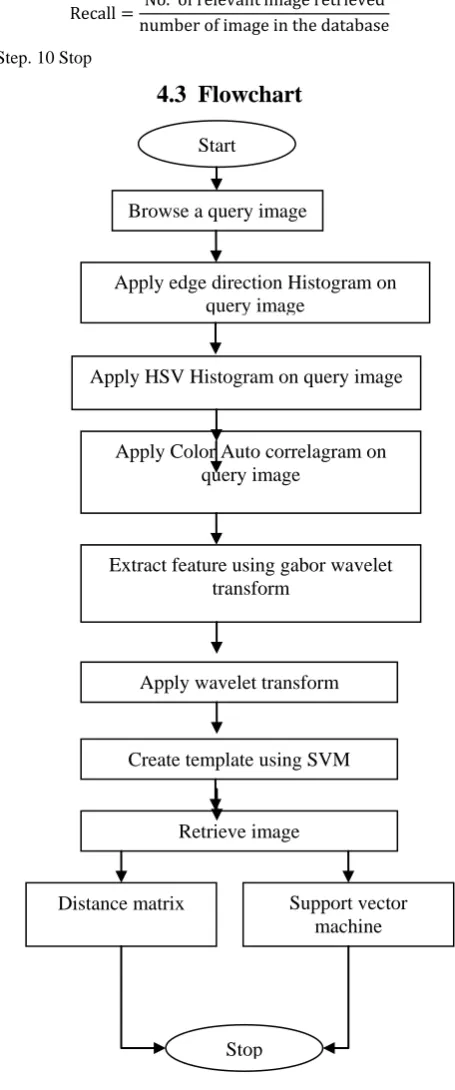
Step. 1. First browse the query picture.Step. 2. Apply edge direct histogram for edge preserving based feature extraction.
Step. 3. Apply HSV Histogram on query picture. Step. 4. Apply color Auto correlagram.
Step. 5. Apply Gabor wavelet transform on query image. Step. 6. Apply wavelet transform on query image. Step. 7. Create feature template using SVM.
Step. 8. Retrieval image using distance matrix and SVM.
Step. 9. Calculate precision, execution time and recall of retrieved images.
Precision = No. of relevant image retrieved Total number of image retrieved
Recall = No. of relevant image retrieved number of image in the database
Step. 10 Stop
[image:3.595.309.537.132.678.2]4.3 Flowchart
Fig. 1. Flow chart of propose work
5.
RESULT ANALYSIS
In this section used of Matlab2013b for performance measurement. In this work, the proposed strategy is performed by leading trials on Corel-1000 database. This database, including African, flowers, elephant, beach, horses, dinosaur,
Start
Browse a query image
Apply edge direction Histogram on
query image
Apply HSV Histogram on query image
Apply Color Auto correlagram on
query image
Extract feature using gabor wavelet
transform
Retrieve image
Distance matrix
Support vector
machine
Stop
Apply wavelet transform
27 building, texture and food images. All categories contain 100
images with size of 384*256. The experimental checked by different number of returning images which varies from 10 to 50.
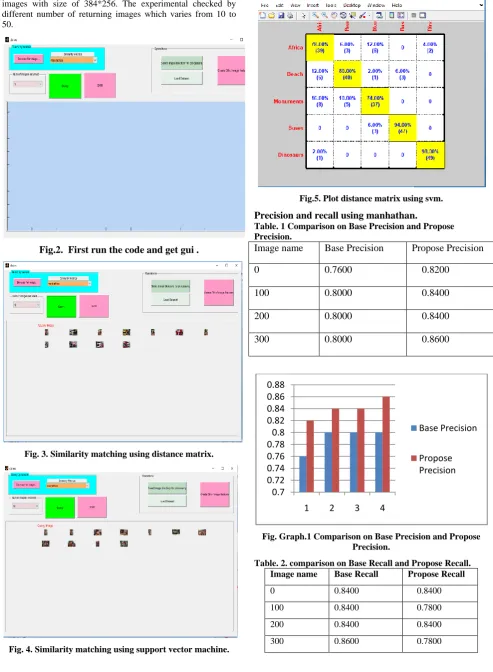
Fig.2. First run the code and get gui .
[image:4.595.308.542.72.276.2]Fig. 3. Similarity matching using distance matrix.
Fig. 4. Similarity matching using support vector machine.
Fig.5. Plot distance matrix using svm.
[image:4.595.52.546.84.757.2]Precision and recall using manhathan.
Table. 1 Comparison on Base Precision and Propose Precision.
Image name
Base Precision
Propose Precision
0
0.7600
0.8200
100
0.8000
0.8400
200
0.8000
0.8400
300
0.8000
0.8600
Fig. Graph.1 Comparison on Base Precision and Propose Precision.
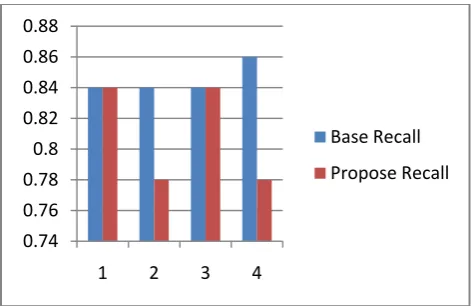
Table. 2. comparison on Base Recall and Propose Recall. Image name Base Recall Propose Recall
0 0.8400 0.8400
100 0.8400 0.7800
200 0.8400 0.8400
300 0.8600 0.7800
0.7
0.72
0.74
0.76
0.78
0.8
0.82
0.84
0.86
0.88
1
2
3
4
Base Precision
[image:4.595.294.545.312.614.2]Fig. Graph.2.Comparison on Base Recall and Propose Recall
6.
CONCLUSION
The essential point of this paper is to speak to the hugeness of SVM in the proficient recovery of picture in this SVM is utilized as the classifier which is playing out the assignment of grouping of the picture and this procedure of order is given to the whole image which is extracted after the FE using Gabor filter. Finally, In this approach, the previous work is enhanced to achieve better precision. In this paper we propose histogram equalization to improve image quality and applied distance matrix to get better result than base work. This strategy gives much preferable execution over the conventional technique for picture retrieval.
7.
REFERENCES
[1] Mohamed Maher Ben Ismail, “A Survey on Content-based Image Retrieval”. (IJACSA) International Journal of Advanced Computer Science and Applications, Vol. 8, No. 5, 2017
[2] Stella vetova, ivan ivanov, “Image Features Extraction Using The Dual-Tree Complex Wavelet Transform”. Advances in Applied and Pure Mathematics 2015
[3] Mrs. P. Nalini, Dr. B. L. Malleswari, “Review on Content Based Image Retrieval: From Its Origin to the New Age”. International Journal of Research Studies in Science, Engineering and Technology Volume 3, Issue 2, February 2016, PP 18-41 ISSN 4751 (Print) & ISSN 2349-476X International Journal of Research Studies in Science, Engineering and Technology [IJRSSET]
[4] Mohd. Danish, Ritika Rawat , Ratika Sharma, “A Survey: Content Based Image Retrieval Based On Color, Texture, Shape & Neuro Fuzzy “.Mohd. Danish et al. Int. Journal Of Engineering Research And Applications ISSN : 2248-9622, Vol. 3, Issue 5, Sep-Oct 2013, Pp.839-844
[5] Rupneet Kaur Hanspal, Kishor Sahoo, “A Survey of Image Enhancement Techniques”. International Journal of Science and Research (IJSR) ISSN (Online): 2319-7064 Index Copernicus Value (2015): 78.96 | Impact Factor (2015): 6.391, Volume 6 Issue 5, May 2017
[6] Pooja Devi1 and Mahesh Parmar, “A SURVEY ON CBIR TECHNIQUES AND LEARNING ALGORITHM COMPARISON”. International Journal of Latest Trends in Engineering and Technology Vol.(8)Issue(1), pp.197-205 DOI: http://dx.doi.org/10.21172/1.81.026 e-ISSN:2278-621X.
[7] R. Usha , K. Perumal , “Content Based Image Retrieval using Combined Features of Color and Texture Features with SVM Classification”. International Journal of Computer Science & Communication Networks.2014 [8] Mr. Niraj S. Fegade1 , Prof. Dinesh D. Patil, “Content Based
Image Retrieval using Combination of Wavelet Transform and Color Histogram”. International Journal of Computer Science and Mobile Computing, IJCSMC, Vol. 5, Issue. 1, January 2016, pg.161 – 169
[9] Savita, Mr. Sandeep Jain, Prof. (Dr.) K.K.Paliwal, “CBIR by Cascading Features & SVM”. International Conference on Computing, Communication and Automation (ICCCA2017). ISBN: 978-1-5090-6471-7/17/$31.00 ©2017 IEEE
[10]Mohd. Aquib Ansari, Manish Dixit, “An Enhanced CBIR using HSV Quantization, Discrete Wavelet Transform and Edge Histogram Descriptor”. International Conference on Computing, Communication and Automation (ICCCA2017) ISBN: 978-1-5090-6471-7/17/$31.00 ©2017 IEEE
[11]Muhammad Fachrurrozi, Erwin, Saparudin, Mardiana, “Multi-Object Face Recognition Using Content Based Image Retrieval (CBIR)”. International Conference on Electrical Engineering and Computer Science (ICECOS) 2017.
[12]Amjad Shah1, Rashid Naseem1, Sadia2, Shahid Iqbal1, and Muhammad Arif Shah1, “Improving CBIR Accuracy using Convolutional Neural Network for Feature Extraction”.IEEE 2017
[13]Behzad Merhrbakhsh Choobar , Saeed Mozaffari ” A Robust Content Based Image Retrieval Using Local Full-Directional Pattern (LFDP)” 2017 IEEE.
[14] Abdolreza Rashno, Saeed Sadri “Content-based Image Retrieval with Color and Texture Features in Neutrosophic Domain” 3rd International Conference on Pattern Recognition and Image Analysis (IPRIA 2017) April 19-20, 2017.