Running head: Working memory in L2 input processing
The role of working memory in processing L2 input: Insights from eye-tracking
Bimali Indrarathne and Judit Kormos
Lancaster University
*We are grateful for the support of the Economic and Social Research Council, United Kingdom Grant No ES/P00962X/1. All instruments used in this study are deposited in the IRIS database (https://www.iris-database.org).
Address for correspondence: Professor Judit Kormos
Lancaster University
Department of Linguistics and English Language Lancaster, United Kingdom
LA1 4YL
Abstract
Our study investigated how attention paid to a target syntactic construction causative had is
related the storage capacity and attention regulation function of working memory (WM) and
how these WM abilities moderate the change of knowledge of the target construction in
different input conditions. 80 Sri Lankan learners of English were exposed to examples of the
target construction in explicit and implicit learning conditions and their eye movements were
tracked as they read the input. Correlational and multiple regression analyses indicated a very
strong relationship between WM abilities and gains in the knowledge of the target construction.
WM scores were closely associated with gains in receptive knowledge in all input conditions,
but they had a weaker link to the improvement of productive knowledge in the implicit learning
Introduction
Working memory (WM) ability is a key cognitive individual characteristic that can
potentially influence second language (L2) learning outcomes (for a review see Juffs &
Harrington, 2011). WM assists in the comprehension of L2 input, regulation of learners’
attention while processing input, and encoding this perceived input into long-term memory.
WM is part of what, in educational psychology, are called aptitude complexes (Snow, 1992),
in other words, individual differences that dynamically interact with the situation in which
learning takes place. Although the role of language learning aptitude under various learning
conditions has been investigated in previous studies (e.g. De Graaff, 1997; Erlam, 2005;
Robinson, 2005; Yilmaz & Granena, 2015), little is known about how the storage capacity and
attention regulation functions of WM jointly influence the acquisition of previously unknown
syntactic constructions in explicit and implicit learning conditions. Findings in the field of
second language acquisition research (SLA) and cognitive psychology are also inconclusive
with regard to the interaction of WM abilities with instructional treatment types. The novelty
of our research is that it extends the use of eye-tracking methodology in SLA (e.g. Issa,
Morgan-Short, Villegas & Raney, 2015; Godfroid & Uggen, 2013; Godfroid & Winke, 2015)
to the analysis of how WM abilities are related to attentional processing under various
instructional conditions. The main aim of our research is to examine what role the combined
storage and attention regulation functions of WM play in L2 learners’ attentional processing of
a target grammatical construction and in accounting for learning gains in explicit and implicit
instructional conditions.
In our research, L2 learners of English were exposed to the syntactic construction
causative had (e.g. He had the house painted) in four different conditions: input flood, whereby
construction is highlighted in the text; an instruction to pay attention to the highlighted
grammatical construction; and an explicit metalinguistic explanation of the highlighted target
language construction with instruction to pay attention to the highlighted grammatical
construction.According to Norris and Ortega (2000, p. 437), the instructional conditions that
have “neither rule presentation nor directions to attend to particular forms that were part of a
treatment” can be treated as implicit instruction. Thus, in this experiment, the first two can be
regarded as implicit instructional conditions, and the second two as explicit conditions (Spada
& Tomita, 2010). Eye-tracking was used to measure attentional processing and a novel feature
of our study was that, in addition to a test of phonological short-term memory (PSTM) storage
capacity, three instruments that assess individual differences in attention regulation were also
administered.
Review of literature
There are two important cognitive processes associated with L2 learning that are
relevant from the perspective of our study: attention and consciousness. It is widely accepted
that attention paid to input is vital for L2 development (Doughty, 2001; Schmidt, 2010;
Schmidt, 1990; Robinson, Mackey, Gass & Schmidt, 2012). Although there seems to be no
consensus in cognitive psychology or in the SLA literature on what attention is (Allport, 1988;
Hulstijn, 2015; Shinn-Cunningham, 2008; Wolfe & Horowitz; 2004), two characteristics of
attentional processing seem to be key to all definitions, namely that attention is subject to
intentional control and is selective (e.g. James, 1890; McFarland, 2006; Shiffrin, 1988; Smith
& Kosslyn, 2006; Styles, 2006).
Consciousness, which is identified as the understanding of one’s experiences (Max
Tsuchiya’s (2006) and Lamme’s (2003) positions on attention and consciousness. Koch and
Tsuchiya (2006) argue that attention with or without consciousness is possible. However,
attention with consciousness is necessary so that stimuli attended to can be registered in WM,
and thus people can distinguish between stimuli and provide a full report of them. Lamme’s
(2003) model also maintains a similar position. The model explains that input should be
attended consciously if it is to enter WM (for a more detailed discussion of attention, awareness
and noticing see Author 1 and 2, 2016). Chun, Golomb, and Turk-Browne (2011) distinguish
external attention, which operates on stimuli perceived externally through one’s senses, and
internal attention, which processes information already contained in long-term memory. They
argue that WM in general, and central executive (CE) functions in particular, play a key role
at the interface of internal and external attentional processes. Therefore, an investigation of the
association between the functioning of WM and attentional processing can yield new insights
into how L2 learners attend to and process input while learning an additional language.
One of the most frequently employed WM models by Baddeley (for a recent review see
Baddeley, 2015) contains three main components: a CE and two slave systems called the
phonological loop and the visuospatial sketchpad. The CE acts as the general attentional
controller, the phonological loop is responsible for processing information related to speech,
and the visuospatial sketchpad handles information related to visuospatial imagery. In this
model, the CE is considered to be a processor of all information that is not processed by the
phonological loop and the visuospatial sketchpad. Baddeley (2003, 2015) explains that the CE
is responsible for mechanisms such as coordinating the subsidiary memory systems, switching
attention, controlling encoding, retrieval strategies, and manipulating information in the
phonological loop and the visuospatial sketchpad. Some other functions are also assumed to be
controlled by the CE, for example, switching attention between multiple tasks (Rogers &
Heron, 1994), monitoring and updating the content of WM (Van der Linden, Bredart, &
Beerten, 1994), temporal tagging and contextual coding of incoming information (Jonides &
Smith, 1997) and planning and sequencing intended actions (Ward & Allport, 1997).
An important question relating to CE functions is to what extent its three main
operations of task switching, inhibition control, and updating are inter-related with each other,
and with the storage capacity of WM. According to Miyaki et al’s (2000) unity in diversity
model, these three CE functions are separable but they share a common underlying function.
In a recent revision of their model, they argue that this common underlying function is “one’s
ability to actively maintain task goals and goal-related information and use this information to
effectively bias lower level processing” (Miyaki & Friedman, 2012, p. 11). Their new research
data suggest that instead of the previously assumed three separate functions of task switching,
inhibition control, and updating, the diversity of the model lies in two main functions: an
updating specific and a shifting specific function. They hypothesize that the updating function
is responsible for the efficient manipulation and retrieval of information, whereas the shifting
function reflects the flexibility with which individuals make transitions between tasks.
Although PSTM is conceptualized as being primarily responsible for storing verbal
information in Baddeley’s (2003, 2015) model, research evidence suggests that there is a
substantial overlap between span tasks assessing PSTM and updating tasks (e.g., St
Clair-Thompson & Gathercole, 2006). One important conclusion from this line of research is that in
order to understand the complex role of WM abilities in learning processes and ultimate
attainment, it is necessary to apply a variety of tasks that assess different processes within WM.
Based on Baddeley and Hitch’s model (1974 and its extensions), Gathercole and
Baddeley (1993) identify key areas of language learning, such as vocabulary acquisition,
reading development, grammar learning, and speech production, which are influenced by the
associated with processes of language learning. It is, however, also important to study the role
of CE functions because they can assist in regulating attention paid to relevant linguistic
features. In addition, they play an important role in maintaining chunks of language in memory
for further processing and in inhibiting irrelevant stimuli and automatic response patterns
(Author 2, 2013). The inhibition function of the CE has been found to be predictive of L1
reading comprehension ability (Cain, 2006; Cain & Bignell, 2014) and associated with L2
comprehension and production processes (Abutalebi & Green, 2007). The potentially
significant role of CE functions in predicting language learning outcomes and influencing L2
learning processes has led to recent reconceptualizations of the construct of language learning
aptitude and to the inclusion of tests of CE functioning in assessments of aptitude (Linck et al.,
2013).
Drawing on the findings of studies on the language learning difficulties faced by
learners with dyslexia, who are generally characterized by a smaller PSTM capacity (Jeffries
& Everatt, 2004), Ellis (1996) and Ellis and Sinclair (1996) argue that PSTM, as well as more
general WM abilities, play an important role in the processes of acquiring L2 grammatical
knowledge and skills. Individuals with better WM abilities are assumed to be more efficient in
decoding and attending to various features in the input (Mackey, Philp, Fuji, & Tatsumi, 2002;
Sunderman & Kroll, 2009). WM abilities are also implicated in maintaining linguistic
information in the PSTM and in the “identification, selection, and correlation of relevant
features both in the input and in long-term memory” (Martin & Ellis, 2012, p. 406).
The role of WM in grammar learning has been investigated in a large number of studies
(e.g. Ahmadian, 2015; Baralt, 2015; Ellis & Sinclair; 1996; Grey, Williams & Rebuschat, 2015;
Li, 2015; Martin & Ellis, 2012; O’Brien, Segalowitz, Collentine & Freed, 2006; Révész, 2012;
Sagarra & Abbuhl, 2013; Santamaria & Sunderman, 2015, Tagarelli, Borges Mota &
its importance in implicit learning, that is, in “the process by which knowledge about the rule
governed complexities of the stimulus environment is acquired independently of conscious
attempts to do so” (Reber, 1989, p. 219) and in explicit learning, which is the conscious process
of gaining knowledge. Studies are also inconclusive with regard to the question whether higher
WM abilities enhance the development of explicit and implicit knowledge in implicit and
explicit instructional contexts.1 Existing research findings unequivocally indicate that WM
assists L2 learners in acquiring explicit knowledge, that is “facts that speakers of a language
have learned” (R. Ellis, 2006, p. 95) under explicit learning conditions (Robinson, 2005;
Santamaria & Sunderman, 2015). Tagarelli et al. (2015), however, found that WM capacity
was not associated with the development of implicit knowledge, that is, “abstract, unconscious
and rule-like representations” (N. Ellis, 2007, p. 19), in an explicit learning condition. WM was
traditionally assumed to be influential in explicit learning, but not in implicit and incidental
learning processes (e.g. Reber, Walkenfeld & Hernstadt, 1991), which are the by-products of
other cognitive operations and less prone to the influence of individual differences (Unsworth
& Engle, 2005). Nonetheless, recent work in the field of cognitive psychology by Hassin,
Bargh, Engell and McCulloch (2009) and Soto and Silvanto (2014) indicates that WM
operations might be involved in implicit learning processes. In implicit learning conditions
high working memory capacity can assist in keeping larger chunks of information active for
further processing and can extend the scope of attention (Martini, Sachse, Furtner, & Gaschler,
2015).
Findings with regard to the role of WM abilities in the implicit learning of L2 grammar
have also been mixed. Learning gains in explicit knowledge in implicit learning contexts were
significantly associated with higher WM abilities in most studies (Ellis & Sinclair, 1996;
1. Implicit instruction is “directed at enabling learners to infer rules without awareness” (R. Ellis, 2009, p. 16) and in explicit instruction “learners are encouraged to develop
Martin & Ellis, 2012; Williams & Lovatt 2003) except for Grey et al.’s (2015) research. A
significant link between WM abilities and implicit knowledge gain in an implicit learning
condition was also found by Ellis and Sinclair’s (1996) study. In contrast, Robinson’s (2005),
Tagarelli et al.’s (2011) and Grey et al.’s (2015) research revealed no relationship between
WM abilities and the development of implicit knowledge in implicit learning conditions.
Given the contradictory findings in the field of SLA research with regard to the
importance of WM abilities in grammar learning under different conditions, and the dominance
of previous research that only assessed the storage function of WM, it is important to examine
what role WM abilities, including both PSTM storage capacity and CE functions, play in L2
learners’ attentional processing of a novel grammatical construction. All previous studies
exposed participants to either an artificial language or a language unknown to them and
presented grammatical constructions out of context. Therefore, little is known about how WM
abilities affect grammatical development in a language that the participants have prior
knowledge of and how these cognitive factors influence processing of a novel grammatical
construction that is embedded in a reading text.
The chosen syntactic construction was causative had. The choice of this construction
was motivated by the assumption that the selected pre-intermediate learner sample of Sri
Lankan students would have no or very little pre-existing knowledge of it as this construction
is usually taught at higher proficiency levels in English language courses. Another important
consideration was that the construction should form an easily identifiable area of interest for
eye-tracking research. Furthermore, we also aimed to select a construction whose meaning can
be inferred from the context, and for which there is a one-to-one form to meaning mapping.
Moreover, the causative construction in Sinhala, the first language of the participants of the
study, is different to that in English. Sinhalese is a SOV language, and the causative is marked
In our study, three different tests of the CE and a test assessing the storage capacity of
PSTM were applied. With the administration of four different assessment tools, we aimed to
overcome a shortcoming of many previous studies that used instruments that only measure the
storage capacity of PSTM. The inclusion of tests of the CE also allowed us to examine its
additional role in the regulation of attentional processing in combination with the PSTM.
Our research questions were:
RQ 1: How is the functioning of WM related to the change in knowledge of the target
grammatical construction ‘causative had’ in different input conditions?
RQ 2: How is the functioning of the WM related to the attention paid to target items?
Method
Context
The data for this study were collected in Sri Lanka at a state university where the student
population comes from Sinhala or Tamil first language speaking backgrounds. Most of these
students belonged to the first language Sinhala community, which receives their primary and
secondary education at Sinhala medium schools. They learn English as a subject from Grade 1
to university entrance, i.e., for approximately 13 years. The medium of instruction at this
university is English for both undergraduate and postgraduate courses and all undergraduate
students have to take English language as a credit-bearing course throughout the degree
programme.
The original sample of participants in this study included 103 first year undergraduates
from the Bachelor of Commerce degree programme, and their ages ranged from 19 to 21 years.
Based on university entrance test results, the students had around B1/low B2 level of language
proficiency on the Common European Framework of Reference (Council of Europe, 2001). By
the time data collection was completed, the participants had been learning English at the
university for five months. The 29 female and 71 male participants all belonged to the first
language Sinhala community. English was the only additional language these participants had
learned. None of the participants of the study were bilinguals according to the questionnaire
data.
Three students were excluded from the study because they demonstrated existing
knowledge of the target condition in the sentence reconstruction (SR) task of the pre-test, i.e.
they scored 2 or above in this test (see below). Thus, as previously stated, 100 participants were
invited to participate in further stages of the research. Among them 97 scored 0 in this
component of the pre-test. The other three students scored 1 in the item with an irregular past
participle (put). Thus, it was assumed that they did not have knowledge of the target
construction, and they gave a correct answer to this item by chance. Eighty students were
randomly assigned to the experimental conditions and 20 learners participated as controls. The
participants who scored 1 in the SR task were in three different input conditions. As we explain
below, high-quality eye-tracking data were available for 45 out of the 80 experimental group
participants. The control group did not participate in the eye-tracking phase of the study.
Materials
Input texts. Three short stories were applied as input texts, which we had written specifically for the purposes of this study (for an example see the supplementary file). After
to determine the lexical complexity of each text. More than 90% of the words in all texts were
K1 words (most frequent 1,000 words in English) and K2 words (the second most frequent
1,000 words in English). For example, Text 1 had 93.56% K1 and K2 words, Text 2 had
91.74% of K1 and K2 words, and Text 3 had 91.84% of K1 and K2 words. The rest of the
words, which Vocabprofile identified as ‘off list words’, were proper nouns. This procedure
assured that the three texts were within the lexical competence of the participants and contained
very frequent words. This was important because the participants would have otherwise spent
more time gazing at unknown vocabulary in the text which would have given inaccurate
eye-tracking data of the amount of attention paid to the target examples. The Flesh-Kincaid Grade
Level value was 4 for all three texts.
The target construction was causative had (had + article + noun + main verb). Seven
examples of the target construction were included in each input story, with a total of 21 items
in the three texts. In order to ensure that the verbs used in the examples of the target
construction belonged to the most frequent verbs used in the particular construction, all target
items were taken from the British National Corpus (BNC). It was also necessary to maintain
the storyline; therefore, some alterations were made to the nouns (e.g. had the tools delivered
instead of had the letters delivered). We also controlled the target items for syllable length so
that all of them contained four to eight syllables (see supplementary materials for BNC
frequencies and the numbers of syllables in the target examples).
Four reading comprehension questions were included at the end of each text with the
aim of giving the participants a purpose for reading. Two of the four questions measured if the
participants understood the meaning of the target construction (e.g., Who stopped the bus?)
Pre-test and post-test. A sentence reconstruction (SR) task and a grammaticality judgment (GJ) task were used as pre- and post-tests. These tests were selected so as to be able
to assess the comprehension and production of the target construction. In the SR task the
participants were asked to construct a sentence with a similar meaning to a previously given
sentence. The first words of the sentence to be produced were given as a cue.
A sample SR item:
Sara got someone to print invitation cards for her party. Sara had ...
In the GJ task, the participants were asked to judge whether the sentences were
grammatically accurate and tick the relevant column.
A sample GJ item:
My dad had his lunch delivered to his office yesterday. Correct/Incorrect
We used 20 SR items of which six were target items and 40 GJ items of which ten were target
items, while others functioned as distracter items in both pre- and post-tests. The
ungrammatical items included two items where the –ed suffix was omitted, three word order
errors and one instance of the use of the wrong suffix, –ing. The length of sentences was also
controlled: all items except two GJ items contained ten words each and the remaining two items
consisted of eleven words. The SR task was administered in a written format with a time limit
and the participants were expected to use the target construction in their reformulated
sentences. The GJ task was administered aurally with the help of a recorded presentation of the
40 items. One of the authors, whose first language was the same as that of the participants,
recorded the sentences with a five-second interval between each of them. We wanted to ensure
that the participants understand the sentences that they heard and that they did not have
In the GJ test, the participants were expected to decide on the grammatical accuracy of
the sentences that they heard and mark it on an answer sheet. This allowed us to maintain some
degree of time pressure in this task. The nouns in subject and object positions used in the
pre-test sentences were changed in the post-pre-test sentences to minimise the possibility that the
participants would answer the items based on their memory of the pre-test items. The BNC was
consulted to construct sentences for the pre- and post-tests, but we made slight alterations to
nouns in the original BNC sentences, and added some phrases, in order to maintain the equal
length of sentences.
The reliability of the post-test SR task as measured by Cronbach’s alpha was 0.681 and
that of the post-test GJ task .447. The lower value of the GJ task might have been due to the
lower number of items (Lance, Butts & Michels, 2006). It is also important to note that the
Cronbach alpha measure assesses internal consistency across test items and might
underestimate reliability if the instrument is not unidimensional or uses dichotomous items.
Our test items had only two values (correct vs. incorrect) and included both grammatical and
ungrammatical items, and within the ungrammatical items the grammatical errors were also
different. The Cronbach alpha for the gain scores, which were used in the correlational and
regression analyses, were above .6 (SR task Cronbach alpha = 0.692; GJ task Cronbach alpha
= .650). Given the low number of items, these values can be considered acceptable. The mean
for the post GJ task (M = 5.80, SD = 2.02) was also significantly above the 50% guessing range
(t (96) = -3.79, p < .001).
Working memory tests. Four different cognitive tests were used in this study, which were selected based on previous research in the field of cognitive psychology. The forward
digit-span test has been used by Briscoe and Rankin (2009), Gathercole, Willis, Baddeley and
Emslie (1994), Pickering and Gathercole (2001) and Shahabi, Abad and Colom (2014) to
(Shahabi, Abad, & Colom, 2014; Tamnes et al., 2013; Wilhelm, Hildebrandt, & Oberauer,
2013; Zheng et al., 2012) and Plus Minus tasks have been applied to assess attention shifting
capacity (Hull, Martin, Beier, Lane, & Hamilton, 2008; Puric & Pavlovic, 2012; St
Clair-Thompson & Gathercole, 2006; Tamnes et al., 2013). The Stroop task has been used widely in
psychology as a tool to measure inhibition (Shahabi et al., 2014; Zheng et al., 2012).
The forward Digit-Span test used in this study consisted of nine spans starting with
three digits and going up to eleven digits. Each span consisted of two sets. Before taking the
test, the participants completed a set of practice tasks, which consisted of two three-digit items.
In the test the longest span that the participants could remember without a mistake was taken
as their actual digit span.
Based on Miyake et al.’s (2000) description, a Keep Track task was used in this study
to assess the updating function of the CE (for an example of this task see the supplementary
file). In completing this task, participants have to monitor incoming information, delete
irrelevant information, and update it with new and relevant information. In this task, words
from six different categories – animals, colours, countries, distances, metals, and relatives –
were used. Each category contained three words (for example, animal words were cat, horse,
cow). First, the participants were shown all the categories (animals, colours, countries,
distances, metals, and relatives) and all the words within each category that would be used in
the experiment. Then they were told that they would be presented with words from one
category in a serial random order and their task was to remember the last word of the category.
Then they had to write down the last words of the categories shown to them in each trial. The
target category (e.g., country) was given at the bottom of the screen each time when the
participants were shown the words. The total number of words that the participants had to recall
was 27 in six different series (three trials with words from four categories and three trials with
categories. The proportion of correctly recalled words was taken as a measure of the updating
function of the CE. In this test the words were in English, but they were highly frequent and
well-known by the participants,.
An Internet-based Stroop task (Online version – cognitivefun.net-test2) was used to
measure inhibition. In this task, the participants were shown the names of colours (e.g., red,
blue, purple) and the letters on the screen also appeared in a particular colour. They had to
press the first letter of the colour of the letters that they could see, not the first letter of the
colour mentioned in the word (e.g., if the letters that appeared on the screen were ‘green’, but
if the colour of those letters was in red, they had to press ‘r’ on the keyboard). The measurement
made was of ‘interference time’, i.e., the difference between the time taken to press a key when
a word was written in the colour of the letters and when the word did not match the colour of
the letters. The program provided information on accuracy rate, overall reaction time, and the
interference time.
Based on the description provided by Miyake et al. (2000), a Plus Minus task was
devised to measure attention shifting. The participants were given three lists of two-digit
numbers (30 in total in each list): in the first list they had to add 3 to each number and write
the answer, in the second list they were asked to subtract 3 from each number and write down
the answer, and in the third list they had to shift between adding and subtracting 3 from
alternative numbers. The participants were asked to complete each list as quickly as possible
and were told to pay attention to the accuracy of their answers. The time spent on completing
each list was measured by a digital stopwatch, which provided data measured to 1/100 sec with
0.003% accuracy. The shifting cost between addition and subtraction was “calculated as the
difference between the time to complete the alternating list and the average of the times to
Procedures. The study had five groups to which we randomly assigned 20 participants each. Four were experimental groups and one was the control group. On the first day of data
collection, the 100 participants were given a consent form to sign and a background
questionnaire to fill in. They also took the pre-test on that day. Five days later, the eye-tracking
sessions started, and the participants in the four experimental groups met with the first author
every other day on three occasions to read the three texts on the tracker. The third
eye-tracking session was immediately followed by a post-test. Three days after the post-test, they
took WM tests. The control group took only the pre and post-tests and did not participate in
the WM tests. In the pre- and post-tests, the participants first completed the SR and then the
GJ task.
Eye-tracking procedures. As illustrated in Figure 1, the four experimental groups were
provided with input in four different ways. The examples of the target construction in the three
texts were textually enhanced by bolding for three of the groups, while one group read
unenhanced texts. At the beginning of each eye-tracking session, the enhanced+instructions
and the enhanced+instructions+explanation groups were requested to pay attention to the
phrases highlighted in bold. In addition, participants in the
enhanced+instructions+explanation group received an explanation of the form and meaning
of the target construction in a PowerPoint presentation immediately before the second
eye-tracking session. The presentation consisted of six slides and included four examples from Text
1. The use of the same examples as in the input text ensured that this group would not be
exposed to substantially more input in addition to the metalinguistic explanation than the other
experimental groups. The enhanced only and unenhanced groups were not instructed to pay
Insert Figure 1 around here
A Tobii X2-60 portable eye-tracker was used for the collection of eye-tracking data.
We placed the laptop on which the eye-tracker was fixed in a quiet room where individual
participants read the input texts. At the beginning of the experiment, the first author explained
the functions of the eye-tracker to the participants who were then allowed to go through a trial
slide to ensure that they understood the procedure. A 9-point calibration was carried out at the
beginning of each session. Participants sat approximately 67 centimetres away from the screen.
The eye-tracking slides were first prepared in PowerPoint using 24-point,
double-spaced Calibri font. We selected this font because it is considered to be suitable for screen
display (Ericson, 2013). Since we were interested in the total fixation duration on the whole
construction (AOI or Area of Interest, e.g., he had the walls painted), all the words that
belonged to the target construction were placed in one line. The position of the AOIs within
the lines, however, could not be controlled because the targets formed part of a coherent
storyline. As the targets and the texts were identical in all experimental conditions, variations
in the position of the AOIs were not expected to influence the findings. Each slide contained
4–5 double-spaced lines (see Figure 2 for an illustration of a sample of an unenhanced input
slide and Figure 3 for a sample of enhanced input). At the beginning of each session, the
participants were informed that they were going to read a story. During the eye-tracking
session, they were not allowed to move back to a previous slide; however, they could spend as
much time as they required on the current slide.
Working memory testing procedures. The participants took the four WM tests
individually in a quiet room with the researcher present. In the digit-span test, first they read
the instructions slide in the PowerPoint presentation, and the first author of the paper also gave
a verbal explanation. Then the participants completed the first two practice spans and following
this they took the test. In this task, digits were presented in the PowerPoint slides (one number
per slide) with 0.1 seconds between them. The participants had to look at the screen and write
down the span when the instruction slide “Write” appeared after each span.
In the Keep Track task a similar method was applied using a PowerPoint presentation.
The participants read the instructions slide and then listened to the instructions of the
researcher. Next, they completed the two trials and the researcher showed them the answers to
ensure that the participants understood the instructions. Following this, the test was
administered to the participants. In the Stroop task, the participants received verbal instructions
on how to perform the task. Then, they had to complete the task by pressing the correct keys
on the computer keyboard for 30 trials. The Plus Minus task was completed on paper. First, the
participants read the instructions and also listened to verbal instructions given by the
researcher. Then they were asked to complete the first column asking them to add 3 to the
numbers given. The time to complete the column (in milliseconds) was measured by a
stopwatch. The same process was applied in completing the other two columns.
Data analysis. We used two eye-tracking measurements to determine the amount of attention paid to the examples of target construction. The first was Total Fixation Duration
(TFD). First the mean TFD for each participant was computed. For this calculation, the TFD
of each participant on each AOI was extracted from the Tobii software and a mean value
calculated. For the second eye-tracking measurement, first the TFD for each participant for the
proportion of the number of syllables that the AOI had in relation to the number of syllables
on the whole page where the particular AOI occurred.
Expected fixation duration of an AOI = No. of syllables of the AOI x TFD-whole page No. of syllables of the whole page
As a next step, the difference between the observed and expected TFD was calculated for each
participant for each AOI. Finally, the mean value of the difference for each participant for all
AOIs was computed and used in further analyses. This is presented as the difference between
observed and expected fixation duration (ΔOE). For example, if a participant spent 2400
milliseconds on reading a slide that contained a text with 30 syllables, the expected fixation
duration for the target construction that consisted of 10 syllables was 800 milliseconds (10/30
x 2400). If the participant’s actual fixation duration was 900 milliseconds, then the ΔOE value
was 100 milliseconds (900-800).
Syllables were used because Trueswell, Tanenhaus, and Garnsey (1994) argue that
letter-based standardizations are inaccurate. Furthermore, in English, there is no one-to-one
correspondence between letters and sounds and often letter combinations rather than individual
letters denote phonemes. This results in the fact that beyond the initial stages of learning to
read, it is not letters but larger grain-sized units such as onsets and rimes and ultimately
syllables that constitute the basic units of word-level decoding in English (Ziegler & Goswami,
2005).
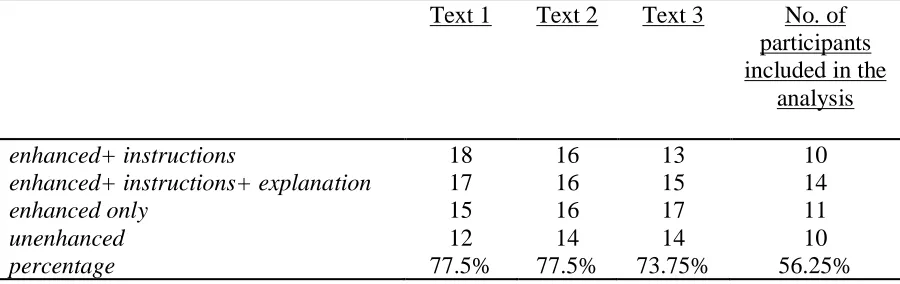
Unfortunately, on each testing occasion, approximately 23-25 % of participants’ data
had to be excluded because their eye-fixations went beyond the screen for a considerable
amount of time. This is due to the limitations of the portable eye-tracker used to collect data
(Tobii X2-60). Use of a desktop eye-tracker would have prevented the data loss. As we needed
appropriate quality for all three texts were included in the eye-tracking data analysis for
Research Question 2 (see Table 1). This resulted in the loss of data for 35 participants out of
the 80 whose eye-tracking measures were taken in the experimental conditions.
Insert Table 1 around here
Scoring of the pre- and post-tests and the working memory tests. When scoring both
SR and GJ items, spelling mistakes were ignored and half marks were not awarded. Each
correct answer received one mark. The gain scores in both SR and GJ tasks were computed
separately as the difference between the total post-test score and the total pre-test score.
In the Digit-Span test, the longest span participants could remember without a mistake
was taken as their PSTM span. The total number of words that they had to recall in the Keep
Track task was 27. The proportion of correctly recalled words was taken as the measure of
updating. In the Stroop test, the interference time was used as a measure of inhibition. The
average interference time in milliseconds for each participant as calculated and displayed by
the website itself was taken as the score for this test. In the Plus Minus test, the shifting cost
was used as the measurement.
Results
First of all, before analysing the role of PSTM storage and CE functions in processing
L2 input, we checked if the treatment groups were comparable in terms of their cognitive
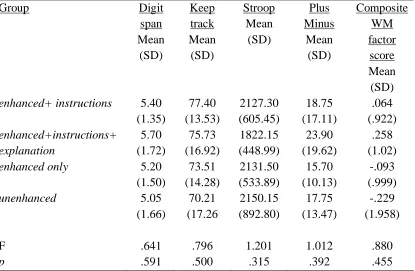
abilities. The MANOVA analysis showed that the four groups were not statistically different
from each other with regard to any of the cognitive tests F(3, 75) = 1.06, p = .391 (see Table 2
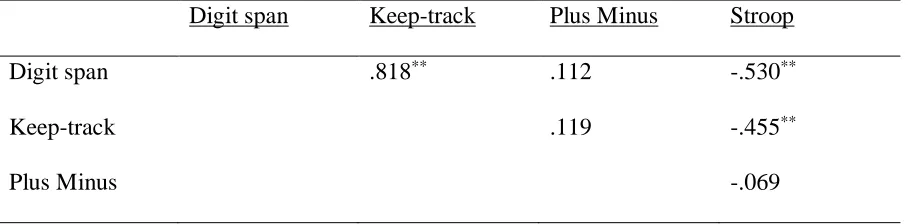
functions and PSTM. As can be seen in Table 3, the Digit-Span and Keep Track tasks were
very highly correlated. There was still a significant and strong correlation between the Keep
Track, and the Stroop tasks, and the Stroop and the Digit Span tasks, but the magnitude of these
correlations was smaller. The performance on the Plus Minus task was not linked to the scores
of any of the other cognitive tests. In order to test Miyaki et al’s (2000) unity in diversity
hypothesis on our data, we conducted a principal component analysis to examine the factorial
structure of these four cognitive tests. The factor analysis indicated that the Digit Span, Keep
Track and Stroop tasks form one factor (Eigenvalue= 2.42) and the Plus Minus task constitutes
a different factor (Eigenvalue = 1.02). The Kaiser-Meyer-Olkin measure of sampling adequacy
was .68, which is higher than the recommended minimum value of .50 (Pett, Lackey, &
Sullivan, 2003). The Barlett’s test of sphericity reached statistical significance (p < .001),
supporting the factorability of the correlation matrix. The common variance shared by the Digit
Span (Factor 1 loading = .939), Keep Track (Factor 1 loading = .903) and Stroop (Factor 1
loading = -.850) was 60.53%. The Plus Minus (Factor 2 loading = .999) task added 25.08%
variance to the model. The results of the correlational and factor analysis lend very strong
support for Miyaki and Friedman’s (2012) revised unity and diversity model as they suggest
that attention switching seems to be a distinct component of CE functions, whereas storage
capacity, updating, and inhibition control are interdependent. Based on the commonalities
among the Digit Span, Keep Track, and Stroop tasks and the results of the factor analysis, it
was deemed appropriate to create a composite score using regression factor scores (Tabachnick
& Fidell, 2001). An additional motivation for the use of this factor score was to avoid a Type
I error by applying multiple tests with highly inter-correlated variables.
Relationship between gain scores and WM abilities
In order to answer the question of how the functioning of WM is related to the change
in knowledge of the target grammatical construction ‘causative had’ in different input
conditions, we first analysed learning effects, which are reported in detail in Author 1 and
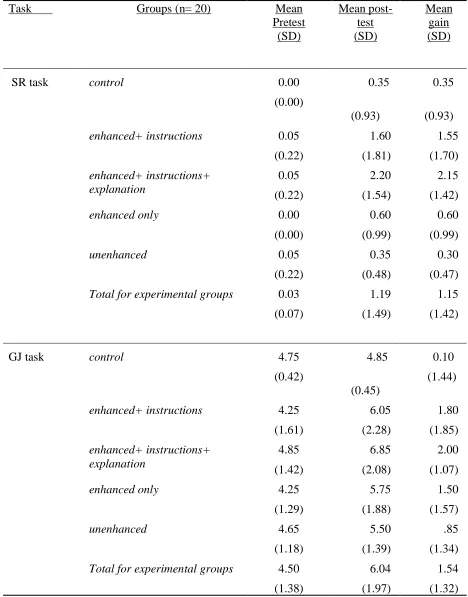
Author 2 (2016). For this analysis we applied mixed between-within subjects analysis to assess
the impact of the four different treatment conditions (enhanced+instructions,
enhanced+instruction+explanation, enhanced, unenhanced, control) across two time periods
(pre- and post-test) (see descriptive statistics in Table 4). For the SR task, the analysis showed
a significant effect of the treatment condition with a large effect size, F(4, 95) = 8.22, p < .001
partial eta squared = .25, a significant effect of time Wilks’ Lambda = .57 F(4, 95) =66.539,
p < .001 partial eta squared = .425, and a significant interaction between treatment conditions
and time also with a large effect size, Wilks Lambda = .71, F(4, 95) = 9.62, p < .001 partial eta
squared = .288. A follow-up ANOVA with the gain score as the dependent variable and the
post-hoc Bonferroni analysis indicated a significant mean difference in the SR gain scores
between the control group and the enhanced+ instructions group (p =.018) and between the
control group and the enhanced+ instructions+ explanation group (p < .001). A significant
mean difference was also found between the unenhanced group and the enhanced+ instructions
group (p =.012) and the enhanced+ instructions+ explanation group (p < .001). Moreover, the
enhanced+ instructions+ explanation group showed a significant improvement (p =.001)
compared to the enhanced only group.
The analyses for the GJ task indicated a significant effect of time Wilks’ Lambda =
0.57 F(4, 95) =66.042, p < .001 partial eta squared = .423, but no significant treatment
condition effect, F(4, 95) = 1.28, p = .281, partial eta squared = .051. However, a significant
interaction between treatment conditions and time was found, Wilks’ Lambda = 0.81, F(4, 95)
by means of ANOVA and post-hoc Bonferroni tests showed that enhanced + instructions
group (p =.005), and the enhanced+ instructions+ explanation group (p = .001) and the
enhanced group (p = .036) achieved significantly higher gains than the control group (for
further details see Author 1 & 2, in 2016).
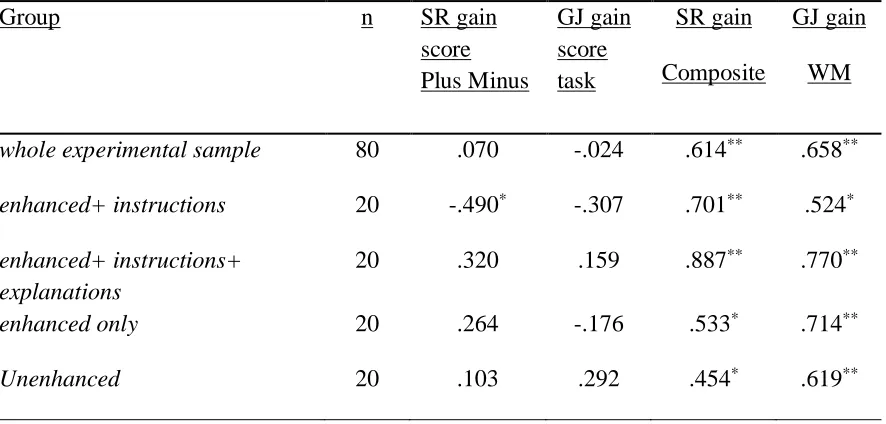
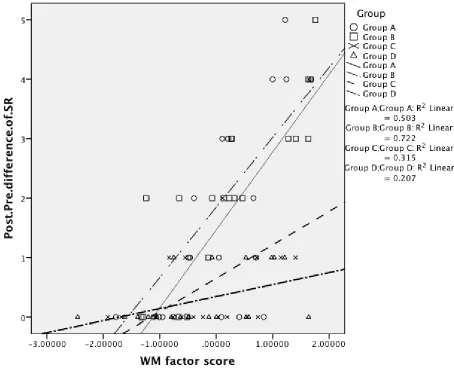
Insert Figure 4 and Table 4 around here
Next we conducted a correlational analysis with the composite WM score, the Plus
Minus task, and the gains in the SR and GJ tasks using Spearman rank-order correlations.
Spearman rank-order correlations were selected because for the group-level analyses the
sample size did not warrant the application of Pearson correlation analyses. As Table 5
indicates, the correlations between the composite WM score and the gains in both tasks were
statistically significant and were particularly strong in the enhanced+instructions+explanation
group. The weakest relationships emerged in the unenhanced group (see Figure 4). The Plus
Minus task only correlated significantly with the gain in the SR task in the
enhanced+instructions group.
Insert Table 5 around here
To assess whether there was a differential effect of WM abilities on gains across the
four experimental conditions, we also ran multiregression models with the experimental
condition and the WM composite score as the independent variables. The dependent variable
for the first model was the SR gain score and for the second model the GJ test gain score. The
unenhanced group was used as the reference category in both models. This analysis
strength of the association between gain scores and WM abilities across experimental
conditions. In the case of gains in the SR task, the multiple regression model showed a
significant interaction effect between the treatment type and the composite WM score (Wald
χ2 = 23.089, p < .001) suggesting that WM abilities have a differential effect on SR gain scores
in the different experimental groups. The analysis revealed that the relationship between the
SR gain score and the composite WM score was different in the enhanced+instructions
(β=1.105, p < .001) and the enhanced+instructions+explanation group (β=.973, p <.001) when
compared to the relationship in the unenhanced group. This indicates that WM abilities played
a stronger role in performance gains in the SR task in the enhanced+instructions and
enhanced+instructions+explanation groups than in the unenhanced group. In the GJ task,
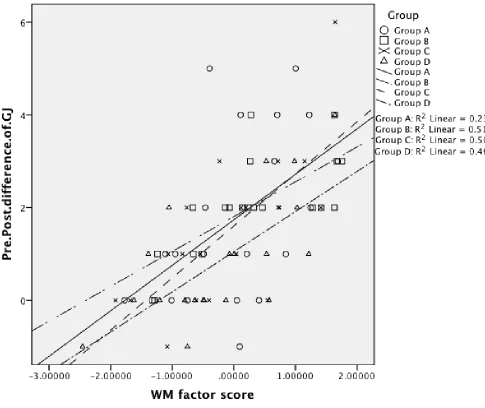
however, we found no significant interaction between the WM composite score and the
differential instructional conditions score (Wald χ2 = 1.114, p = .766) (see Figure 5). This
indicates that WM abilities had a similar effect on GJ test gain scores across the experimental
conditions.
Insert Figure 5 here
Relationships between eye-tracking measures and WM abilities
With our second research question, we aimed to investigate the nature of the
relationship between WM capacity and the attention paid to the target language item in
different input conditions. For this purpose, we first conducted correlational analyses using
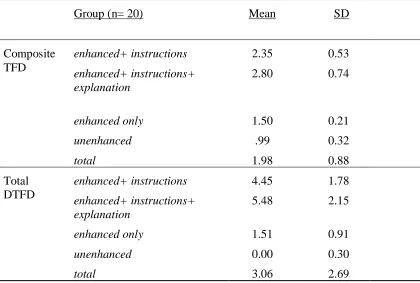
Spearman rank-order correlations (see Table 7 for the correlations and Table 6 for descriptive
statistics). When the whole sample was considered, the correlations between the two
eye-tracking measures and the composite WM scores were significant, but weak. The Plus Minus
enhanced+instructions+explanation group the strength of the relationship between the fixation
durations and the composite WM score was remarkably high. The ΔOE value also showed a
strong correlation with the composite WM score in the enhanced+instructions and enhanced
only groups.
Insert Tables 6 and 7 around here
For an examination of the interaction between WM abilities and experimental
conditions, we ran a multiregression model with the eye-tracking measures as outcome
variables, and the experimental condition and the WM composite score as the independent
variables. Similar to the analysis of gain scores, this analysis yielded insights into whether the
strength of association between the composite WM scores and eye-tracking measures differs
in the four treatment conditions. The unenhanced group was used as the reference category.
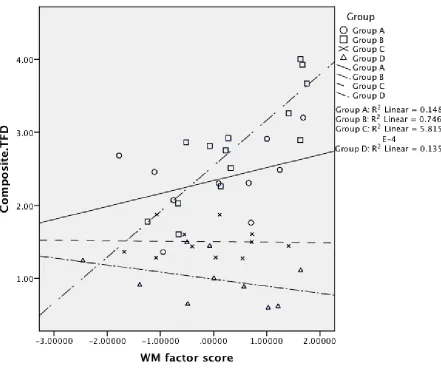
In the case of composite TFD measure as the dependent variable, the multiple regression model
showed a significant interaction effect between the treatment type and the composite WM
score, suggesting that the strength of association between the TFD measure and the composite
WM score varied significantly across the experimental groups (Wald χ2 = 34.49, p < .001) (see
Figure 6). The analysis also revealed that the relationship between the TFD and the composite
WM score in the enhanced+instructions (β =. 274, p =.042) and
enhanced+instructions+explanation groups (β = .723, p <.001) was statistically different from
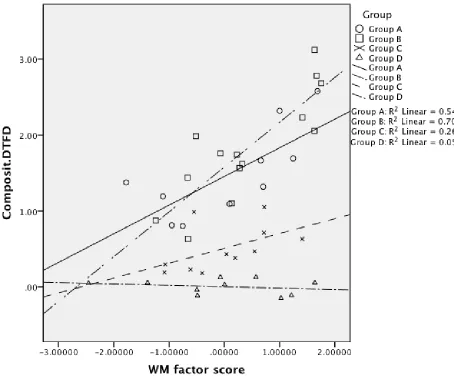
the relationship observed in the unenhanced group. As can be seen in Figure 7, similar findings
were obtained for the composite ΔOE score as the dependent variable (Wald χ2 = 29.178, p <
.001). The relationship between the composite TFD and the composite WM score in the
enhanced+instructions (β =.395, p =.001) and enhanced+instructions+explanation groups (β
Insert Figures 6 and 7 around here
Discussion and conclusions
Role of working memory abilities on learning gains under different instructional conditions
In our first research question we asked what role individual differences in the
functioning of WM play in participants’ learning gains in a previously unknown syntactic
construction in various instructional conditions. For the whole sample the correlational and
multiple regression analyses suggest a very strong relationship between the composite score of
the examined WM abilities and gains in both the SR and GJ tasks. This indicates that when the
scores of abilities relating to storage capacity, updating, and inhibition are combined, they
account for a substantial variance in gains in these tests. The results relating to the Plus Minus
task reveal that the ability to switch between tasks does not play an influential role in the
acquisition of the targeted grammatical construction. The only significant correlation for this
cognitive test emerged in the enhanced+instructions group, and it indicated an inverse
relationship between task switching and the SR gain score. This suggests that flexibility to
switch from one task to the other seems to be advantageous with regard to the acquisition of
novel grammatical constructions when students are explicitly told to pay attention to specific
features of the input.
The use of tests CE functions to assess L2 learners’ aptitude complexes was first
recommended by Linck, Osthus, Koeth, and Bunting (2013), but in their study measures of the
CE had little predictive power for ultimate attainment in L2 reading and listening skills. To our
knowledge, our study is the first one to show that a combination of WM tests that assess the
amount of variation in the development of syntactic knowledge through exposure to exemplars
in meaningful written texts. This points to the significance of the ability to regulate attentional
resources efficiently in learning from written L2 input. Higher WM abilities have been
associated with better L2 reading skills in previous research (e.g., Alptekin & Ercetin, 2009;
Harrington & Sawyer, 1992; Miyake & Freedman, 1998). Therefore, we can hypothesize that
learners with a strong ability to hold and update verbal information in short-term memory and
to inhibit irrelevant stimuli have more attentional resources available for processing
grammatical information in a reading text such as the one used in our study. In addition, the
increased storage and processing functions of WM allow learners to manipulate larger chunks
of language more efficiently. This assists pattern recognition as well as encoding grammatical
knowledge in long-term memory (Martin & Ellis, 2012; Williams & Lovatt, 2003).
The results of the correlational and multiple regression analyses conducted with the
whole sample also suggest that the composite WM scores account for a slightly higher
percentage of variance in the GJ task than in the SR task. However, when the correlation
co-efficients for the composite WM score (SR gain r = .614 and GJ gain r = .658) are compared,
no statistically significant differences emerge between them (z = -.46, p = .64). The GJ task,
which was presented to the learners in auditory mode, was carried out under some degree of
time pressure and assessed the receptive knowledge of the grammatical construction. In
contrast, the SR task required the participants to use their knowledge of the target construction
productively, and was not performed under time pressure. Therefore, our results indicate that
WM abilities played an important role in the development of grammatical knowledge
regardless of whether participants had to apply this knowledge productively or receptively.
Our results also show that the combined storage, updating, and inhibition functions of
WM contribute significantly to learning gains in all four learning conditions. The
groups in the case of the GJ task. Therefore, learners with high WM storage capacity and good
abilities to regulate their attentional resources seem to be at an advantage in acquiring receptive
grammatical knowledge regardless of the type of instruction they received. Our results are
similar to those of Ellis and Sinclair’s (1996) with regard to the facilitative role of WM abilities
in implicit learning conditions. In the SR task, however, WM abilities seemed to play a
different role in the different experimental groups. In the unenhanced condition, which can be
considered to be an implicit learning context, the contribution of the composite WM scores to
improvement in SR task gains was significantly smaller than in the enhanced+instructions and
enhanced+instructions+explanation conditions, which were the two highly explicit learning
contexts. We might hypothesize that perhaps the productive use of grammatical knowledge
acquired in implicit input conditions is less influenced by WM storage and processing abilities,
and other components of aptitude, such as inductive learning ability, play a more important
role in these contexts (see also Skehan, 2015).
Relationship of eye-tracking measures and working memory abilities
An examination of the relationship between WM abilities and eye-tracking measures,
which was the focus of our second research question, can help us to elucidate the potential
mechanisms of how the storage, updating, and inhibition functions of WM can affect learning
in implicit and explicit learning conditions. When we analysed the correlations between
eye-fixation measures and the composite WM factor score for the whole sample, we found
significant but moderately strong correlations with the ΔOE measure. The relatively weak
relationship across the sample can be explained by the fact that our previous study showed a
large effect of the treatment condition on eye-tracking measures, TFD, (F = 27.06, p < .001,
partial eta squared = .67) and ΔOE (F= 28.42, p < .001, partial eta squared = .68) (see Authors
attentional processing of the target input. Our results reveal that in the most explicit learning
condition, which was the enhanced+instructions+explanation condition, individual
differences in WM abilities are highly predictive of how much attention L2 learners pay to the
target input. The ΔOE measure, which we argue to be an indicator of attentional processing in
addition to what would be expected if learners were just simply reading the text for meaning,
was also strongly associated with the composite WM score in the enhanced only and
enhanced+instructions groups. This finding reveals that those learners who have high WM
storage capacity and efficient attention regulation abilities engage in more attentional
processing of the input if their awareness of the existence of a target syntactic construction in
the input is experimentally manipulated. In other words, these learners might respond better to
the instruction that they should pay specific attention to the target construction embedded in
the text because they are more efficient in directing their attentional resources.
What is interesting in our study is that despite the apparent lack of increased attentional
processing of the target language input in the unenhanced condition, the correlational analyses
show that L2 learners with better WM abilities still made more learning gains in both receptive
and productive grammatical knowledge. This suggests that WM abilities can potentially be
involved in implicit L2 learning processes. Recent theorizations of WM by Hassin et al. (2009)
and Soto and Silvanto (2014) question the previously held assumption that WM can only
operate on consciously attended input (e.g. Baddeley, 2003; Koch & Tsuchiya, 2006).
Emerging evidence in Hassin et al.’s and Soto and Silvanto’s work suggests that conscious
awareness might not be necessary for information to enter WM and hence WM can also be
active in implicit learning. As Soto and Silvanto highlight, “The key aspect is that WM
processes can be engaged without awareness, that WM can operate on non-conscious
representations, and that the process through which WM contents reach awareness is subject
found a relatively strong association between the composite WM score and gains in a test of
receptive knowledge in the implicit learning condition in the absence of a link between
attentional processing and WM abilities. This finding seems to lend additional support to the
relevance of WM abilities in implicit L2 learning.
In sum, our study shows that L2 learners with better WM abilities are advantaged in
learning a novel grammatical construction from written input in both explicit and implicit
conditions. Combined storage, updating and inhibition functions of WM, however, were found
to play a larger role in the acquisition of productive knowledge in explicit learning conditions
than in implicit conditions. As regards the development of receptive knowledge, there did not
seem to be a difference in the strength of association between the composite WM score and
learning gains in the different treatment groups. This suggests that regardless of the type of
instruction, language learners with better WM abilities improve their receptive knowledge
more successfully than those with lower levels of storage capacity and updating, and inhibition
functions. These findings have direct relevance for language teaching pedagogy as they
indicate that this latter group of L2 learners might require extensive exposure to target syntactic
constructions and additional instructional support.
Our study has a number of limitations, the most important being the fact that a
substantial proportion of the learners’ eye-tracking data had to be excluded and hence the
sample size for which we could analyse eye-tracking measures within the specific treatment
groups was relatively small. It would have been useful to administer a post-test to the learners
for us to be able to assess long-term learning gains, but unfortunately for logistical reasons this
was not possible. A larger battery of WM tests could also have been applied so that we could
have drawn conclusions about participants’ WM abilities based on more sources of
information. It would also seem to be important to examine to what extent our conclusions
constructions and when input is provided through an aural rather than a written mode. We
controlled for unknown vocabulary in the reading texts used; however, it does not guarantee
that all learners knew all the words used. Nevertheless, our study is the first one in the field
that has assessed the combined role of storage, updating, and inhibition functions of WM in
developing grammatical knowledge through meaningful reading input in a language the
participants had prior knowledge of. It would be useful to conduct further studies that use
authentic language input in a learning context that resembles naturalistic and classroom
language learning more closely.
Notes
1 In this paper, the four experimental conditions are named as follows: input
flood-unenhanced, textual enhancement-enhanced only, an instruction to pay attention to the
highlighted grammatical construction-enhanced+instruction, an explicit metalinguistic
explanation of the highlighted target language construction-
enhanced+instruction+explanation
2 Implicit instruction is “directed at enabling learners to infer rules without awareness” (R.
Ellis, 2009, p. 16) and in explicit instruction “learners are encouraged to develop
References
Author 1 and 2 (2016)
Author 2 (2013)
Abutalebi, J., & Green, D. (2007). Bilingual language production: The neurocognition of
language representation and control. Journal of Neurolinguistics, 20, 242–275.
Ahmadian, M. J. (2015). Working memory, online planning and L2 self-repair behaviour. In
Z. Wen, M. Borges & A. McNeill (Eds.), Working memory in second language
acquisition and processing (pp. 160-174). Bristol, England: Multilingual Matters.
Allport, A. (1988). What concept of consciousness? In A. J. Marcel & E. Bisiach (Eds.),
Consciousness in contemporary science (pp. 159-182). London, England: Clarendon
Press.
Alptekin, C., & Erçetin, G. (2009). Assessing the relationship of working memory to L2
reading: Does the nature of comprehension process and reading span task make a
difference? System, 37, 627-639.
Baddeley, A.D., & Hitch, G. (1974). Working memory. In G.H. Bower (Ed.), The psychology
of learning and motivation: Advances in research and theory (Vol. 8, pp. 47–89).
New York, NY: Academic Press.
Baddeley, A. D. (2003). Working memory and language: An overview. Journal of
Communication Disorders, 36 (3): 189-208.
Baddeley, A.D. (2015). Working memory in second language learning. In Z. Wen, M. Borges
& A. McNeill (Eds.), Working memory in second language acquisition and
processing (pp. 17-28). Bristol, England: Multilingual Matters.
Baralt, M. (2015). Working memory capacity, cognitive complexity and L2 recasts in online
second language acquisition and processing (pp. 248-269). Bristol, England:
Multilingual Matters.
Briscoe, J., & Rankin, P. M. (2009). Exploration of a 'double-jeopardy' hypothesis within
working memory profiles for children with specific language impairment.
International Journal of Language & Communication Disorders, 44, 236 - 250.
Cain, K. (2006). Individual differences in children’s memory and reading comprehension:
An investigation of semantic and inhibitory deficits. Memory, 14, 553–569.
Cain, K., & Bignell, S. (2014). Reading and listening comprehension and their relation to
inattention and hyperactivity. British Journal of Educational Psychology, 84, 108–124.
Chun, M. M., Golomb, J. D., & Turk-Browne, N. B. (2011). A taxonomy of external and
internal attention. Annual Review of Psychology, 62, 73-101.
Cognitivefun (2008-2012). Cognitive tests: Color Reading Interference (Stroop). Available at
http://cognitivefun.net/test/2
Council of Europe (2011). Common European Framework of Reference for Languages.
Strasbourg: Language Policy Division, Council of Europe. Available at
http://www.coe.int/t/dg4/linguistic/Source/Framework_EN.pdf
De Graaff, R. (1997). The eXperanto experiment: Effects of explicit instruction on second
language acquisition. Studies in Second Language Acquisition, 19, 249–276.
Doughty, C. (2001). Cognitive underpinnings of focus on form. In P. Robinson (Ed.),
Cognition and second language instruction (pp. 206–57). Cambridge, England:
Cambridge University Press.
Ellis, N.C. (1996). Sequencing in SLA: Phonological memory, chunking, and points of
Ellis, N. C. (2007). The weak-interface consciousness, and form-focussed instruction: Mind
the doors. In S. Fotos & H. Nassaji (Eds.), Form focused instruction and teacher
education: Studies in honour of Rod Ellis (pp. 17-33). Oxford: Oxford University Press.
Ellis, N. C. (2011). Implicit and explicit SLA and their interface. In C. Sanz & R. Leow
(Eds.), Implicit and explicit language learning: Conditions, processes, and knowledge
in SLA & bilingualism (pp. 35-47). Washington, DC: Georgetown University Press.
Ellis, N.C., & Sinclair, S.G. (1996). Working memory in the acquisition of vocabulary and
syntax: Putting language in good order. The Quarterly Journal of Experimental
Psychology, 49A, 234-250.
Ellis, R. (2006). Current issues in the teaching of grammar: An SLA perspective. TESOL
Quarterly, 40, 83-107.
Ellis, R. (2009). Implicit and explicit learning, knowledge and instruction. In R. Ellis (Ed.),
Implicit and explicit knowledge in second language learning, testing and teaching
(pp. 3-25). Bristol, England: Multilingual Matters.
Erçetin, G., & Alptekin, C. (2013). The explicit/implicit knowledge distinction and working
memory: Implications for second-language reading comprehension. Applied
Psycholinguistics, 34, 727-753.
Erickson, A.P. (2013). The ABC's of font: Effects of changing default fonts. EWU Masters
Thesis Collection. Paper 108.
Erlam, R. (2005). Language aptitude and its relationship to instructional effectiveness in
second language acquisition. Language Teaching Research, 9, 147–171.
Gathercole, S., & Baddeley, A. D. (1993). Working memory and language (Essays in
cognitive psychology). Mahwah, NJ: Lawrence Erlbaum.
Gathercole, S. E., Willis, C. S., Baddeley, A. D. & Emslie, H. (1994). The Children’s Test of