ISSN Print: 1949-4998
DOI: 10.4236/health.2018.107066 Jul. 4, 2018 902 Health
A Study of Exercise Intensity Based on
Individual’s BMI and Heart Rate
Xiaoao Zou
1, Junhui Gao
2*1The Village School, Houston, TX, USA
2American and European International Study Center, Wuxi, China
Abstract
The purpose of this research is to explore if individuals of different BMI can achieve a given intensity using the same exercise load. For the first part of our research, a survey was sent out to gather responses from people of various age groups. We asked their weight, height, and resting heart rate. We found out there was no correlation between BMI and heart rate. We also designed an experiment to study the relationship between BMI and exercise intensity. The result shows people with higher BMI need more exercise load in order to match the exercise intensity of people with lower BMI.
Keywords
BMI, Heart Rate, Exercise
1. Introduction
In recent years, more and more people get motivated to go to the gym and start working out. A lot of people are willing to invest time and money to improve their general health and fitness. Newly-built gymnasiums, weight rooms, and swimming pools also facilitate people’s activities. It’s not surprising to see people in many developing countries to pay more attention to their body. However, every formation a habit like exercising needs a learning process. New vocabula-ries thus come into our sight.
Some of the words that will be discussed in the research are BMI (Body Mass Index) and heart rate. The measurement of BMI is relatively simple. You will need to know a person’s body weight in kilograms and then divide it by the square of his or her height in meters. It’s a convenient way to categorize a person into underweight, normal weight, or obesity [1]. BMI is commonly used in
sta-How to cite this paper: Zou, X.A. and Gao, J.H. (2018) A Study of Exercise Inten-sity Based on Individual’s BMI and Heart Rate. Health, 10, 902-906.
https://doi.org/10.4236/health.2018.107066
Received: June 9, 2018 Accepted: July 1, 2018 Published: July 4, 2018
Copyright © 2018 by authors and Scientific Research Publishing Inc. This work is licensed under the Creative Commons Attribution International License (CC BY 4.0).
DOI: 10.4236/health.2018.107066 903 Health
tistical studies. The second word, heart rate, means the speed of heart contrac-tions (usually measured by how many beats in a minute). For a healthy adult, the normal range of resting heart rate is from 60 to 100 beats per minute. People who have been exercising regularly tend to have a lower number because their heart muscle is trained to pump more oxygen-rich blood into the body. Heart rate is widely used to calculate exercise intensity, which is personalized depend-ing on the goal of an individual. Some people want to increase strength. Some want to lower their body fat percentage. For example, setting up a targeted heart rate is important in aerobic exercises. Maintaining the targeted heart rate for a period of time (20 minutes minimum) will efficiently enhance a person’s cardi-ovascular health [2].
In this research, we will try to implement BMI into consideration when we study the relationship between heart rate and intensity.
2. Results
Our first conclusion is: a person’s BMI has no correlation between his or her resting heart rate.
Our second conclusion is: a person with a higher BMI need more exercise load in order to achieve the same workout intensity.
3. Materials and Methods
Our research is composed of two parts. The first part is a survey, which is used to determine the correlation between BMI and heart rate. The second part is a study on BMI and exercise intensity. The study is based on a theory that states exercise intensity can be represented by the change in heart rate.
3.1. Relationship between BMI and Heart Rate
We designed an online survey, asking respondents about their height, weight, resting heart rate, age, and sex. The results of the survey from 343 respondents are collected by WenJuan Net [3]. We calculated their Body Mass Index and in-vestigated the correlation between BMI and heart rate. We represented the data (BMI and heart rate) using linear regression. The coefficient r-squared is 0.0095, showing virtually no correlation. Figure 1 shows most BMI measurements are located around 20 - 21.
3.2. Relationship between BMI and Change in Heart Rate
DOI: 10.4236/health.2018.107066 904 Health
Figure 1. The distribution of BMI.
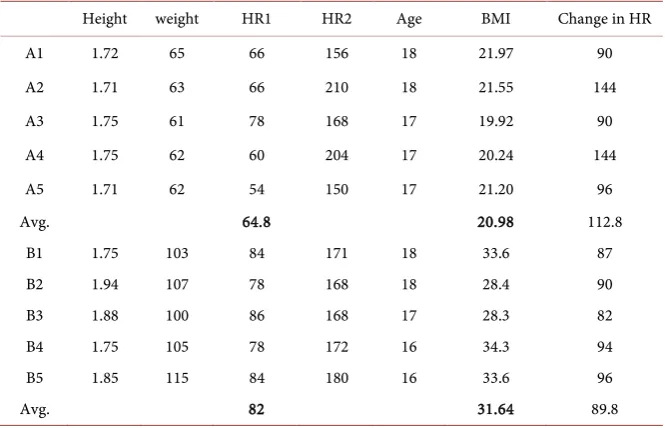
Table 1. Heart rate changes before and after exercise in two groups.
Height weight HR1 HR2 Age BMI Change in HR
A1 1.72 65 66 156 18 21.97 90
A2 1.71 63 66 210 18 21.55 144
A3 1.75 61 78 168 17 19.92 90
A4 1.75 62 60 204 17 20.24 144
A5 1.71 62 54 150 17 21.20 96
Avg. 64.8 20.98 112.8
B1 1.75 103 84 171 18 33.6 87
B2 1.94 107 78 168 18 28.4 90
B3 1.88 100 86 168 17 28.3 82
B4 1.75 105 78 172 16 34.3 94
B5 1.85 115 84 180 16 33.6 96
Avg. 82 31.64 89.8
running. The results are shown in Table 1.
The average BMI of group A was 20.98, and group B was 31.64. Obviously, there was a significant difference between the two groups of BMI. Before and af-ter exercise, the average heart rate in group A was 112.8, while that in group B was 89.8. This shows that in order to achieve the same exercise intensity (heart rate change), people with high BMI need more exercise.
4. Applications
[image:3.595.207.540.347.561.2]DOI: 10.4236/health.2018.107066 905 Health
First of all, Chinese students nowadays don’t get an adequate amount of daily exercise. It’s partially due to the lack of science in their Physical Education class. For instance, students in most middle schools are required to run 1000 meters at the beginning of every P.E. class. It’s a simple task for students who have a lower BMI and exercise regularly. Since they pass the running test easily, P.E. teachers will give them permission to other activities of their choice. In other words, teachers don’t expect more from them. In my opinion, the absence of progres-sive overload decreases the exercise intensity in those students. They don’t have to work hard to make change to their body since they are already accustomed to this intensity. Therefore their potentials are limited. If P.E. teachers could design a progressive intensity for those individuals, We believe they would witness sig-nificant improvements.
Secondly, commercial gyms and personal trainers can use this knowledge to better help their clients. The goals of gym goers can be categorized to fat-loss, gaining muscle, or gaining strength. When trainers are making workout plans, they can refer to the trainees’ BMI, resting heart rate, and age. For people who want to lose weight, the fat burning zone is at 60%-70% of their max heart rate
[4]. After achieving the targeted heart rate, trainers can adjust the time depend-ing on trainees’ BMI.
5. Discussion
Before we started our research, an online journal called Exercise and associated dietary extremes impact on gut microbial diversity [5] caught our eyes. This journal discusses how the gut microbiota of elite athletes differ from those of normal participants. The researchers of this journal have proved that exercising can enhance the biodiversity of human microbiota, by analyzing data collected from athletes and their control groups. Nevertheless, we believe that the experi-ment designing still requires a bit more adjustexperi-ment to be considerate. The re-searchers kept the exercise intensity of two control groups (Group 1. BMI ≤ 25, Group 2. BMI > 28) nearly equal. The exercise intensity is represented by crea-tine kinase levels. However, they did not realize BMI could influence one’s exer-cise load, even when the intensity is same. As a result, our research could pro-vide more information in this topic.
DOI: 10.4236/health.2018.107066 906 Health
Finnish doctor Martti Karvonen in 1957: target heart rate = training intensity* heart rate reserve + resting heart rate. Kai first measured his resting heart rate of 76 beats/minute. According to the formula, his target heart rate = 80% × (202 − 76) + 76. The result is about 177 beats/minute [7]. However, we find that this me-thod is not perfect. For example, height and weight of the subject are neglected.
6. Conclusion
In our research, we first verified through a survey that there is no direct rela-tionship between heart rate and BMI. With the clear link between heart rate and exercise intensity, we conducted experiments to further explore the relationship between BMI and exercise intensity. We summoned 10 students of the same age, collected their weight, height, and heart rate at rest, and divided them into two groups with 5 individuals each by their BMI. We recorded the heart rate of these two groups of students after intense exercise. After analyzing the data, we con-cluded that people with higher BMI need more exercise to achieve the same level of intensity. We hope that our research results can bring practical applications to people who care about their health.
Acknowledgements
We are grateful to Ms. Zhang and Mr. Yang of Jiangsu Tianyi High School for helping with collecting data. We also want to thank the 10 students who partook my experiment. Thank you all for your time.
We hope to see our readers gain some insight from this research. We would achieve our goal if you readers could learn something new.
References
[1] Nuttall, F.Q. (2015) Body Mass Index Obesity, BMI, and Health: A Critical Review. Advances in Pediatrics, US National Library of Medicine.
www.ncbi.nlm.nih.gov/pmc/articles/PMC4890841/
[2] Know Your Target Heart Rates for Exercise, Losing Weight and Health. American Heart Association.
https://healthyforgood.heart.org/move-more/articles/target-heart-rates
[3] https://www.wenjuan.com/
[4] Achten, J., Gleeson M. and Jeukendrup, A.E. (2002) Determination of the Exercise Intensity That Elicits Maximal Fat Oxidation. Medicine and Science in Sports Exer-cise, 34, 92-97. https://doi.org/10.1097/00005768-200201000-00015
[5] Clarke, S.F., et al. (2014) Exercise and Associated Dietary Extremes Impact on Gut Microbial Diversity. Gut, 63, 1913-1920. https://doi.org/10.1136/gutjnl-2013-306541 [6] Target Heart Rate and Estimated Maximum Heart Rate. Centers for Disease
Con-trol and Prevention, Centers for Disease ConCon-trol and Prevention, 2015.
https://www.cdc.gov/physicalactivity/basics/measuring/heartrate.htm
[7] Kelly, M. Advances in Aerobic Training: How to Apply the New Heart Rate For-mulas. ACE.
https://www.acefitness.org/education-and-resources/professional/expert-articles/35