Energy Efficient Content Based Image Retrieval in
Sensor Networks
Qurban A. Memon, Hend Alqamzi
Electrical Engineering Department, UAE University, Al-Ain, UAE Email: {qurban.memon, hend.alqamzi}@uaeu.ac.ae
Received April 25,2012; revised June 12, 2012; accepted June 20, 2012
ABSTRACT
The presence of increased memory and computational power in imaging sensor networks attract researchers to exploit image processing algorithms on distributed memory and computational power. In this paper, a typical perimeter is in-vestigated with a number of sensors placed to form an image sensor network for the purpose of content based distri- buted image search. Image search algorithm is used to enable distributed content based image search within each sensor node. The energy model is presented to calculate energy efficiency for various cases of image search and transmission. The simulations are carried out based on consideration of continuous monitoring or event driven activity on the perime-ter. The simulation setups consider distributed image processing on sensor nodes and results show that energy saving is significant if search algorithms are embedded in image sensor nodes and image processing is distributed across sensor nodes. The tradeoff between sensor life time, distributed image search and network deployed cost is also investigated.
Keywords: Image Sensor Networks; Image Identification in Sensor Network; Camera Sensor Networks; Distributed
Image Search
1. Introduction
Miniaturization in sensing and imaging technology has resulted in cost-effective solutions in industry, environ- mental monitoring and security applications. The current generation of low-power analog and digital electronics and radio transceivers (as tiny devices) has individually limited capabilities. But when they are deployed in a large number, they can wirelessly form ad hoc sensor networks. Such networks can be used effectively for various appli- cations, such as object tracking, surveillance, environ- mental sensing and controlling, robotic applications, situational awareness in support of decision making, etc. The competitiveness in industrial market has caused a large deployment of sensor systems to achieve efficient production. Internet and newer smart technologies are adding a rising edge to change and growth to industries, cultures and businesses. According to a survey [1], the usage of sensor network applications is diverse: security applications 4%, industrial applications 3%, videocon- ferencing 5%, consumer and professional 37%, and office tools 51%. The revenue from this market has grown ex- ponentially from 500 million dollars in 1996 to 4 billion dollars in 2008.
Monitoring applications usually involve deployment of hundreds or thousands of sensors over a region where some parameter such as pressure, sound, electromagnetic field, vibration, etc. is to be detected and monitored. For
example, sensor networks can be used to track inventory assets, monitor and control home or office temperature, or other parameter in a perimeter. Each application has spe-cial requirements, which in turn determine the sensors’ size, type, method of deployment, and system configura-tion. Since the batteries of sensor nodes are difficult to be replenished during the course of a mission, it is essential for sensor networks to operate under energy-efficient architectures and protocols. Another problem is with volume of data traffic that increases if all sensor nodes respond to a gateway, which initiates queries about spe-cific monitored regions.
There is always a need to group sensors or create zones of sensors in wide or close area systems to perform specific task like detecting intrusions or events, etc. The respective sensor deployment schemes are also depend-ent on the tasks assigned. Typically, image search algo-rithms within a zone of image sensors are based on cen-tralized databases for image identification. As cencen-tralized storage grows, so does the complexity of image identifi-cation. The centralized storage has its inherent limita-tions related to the complexity of image search once images are received from image sensor nodes intermit- tently. In case images are to be backed up in a centralized storage intermittently, it creates privacy concerns as well, which makes this infrastructure less preferable.
smaller memories within image sensor nodes contain ad- ditional limitations like limited power supply, short com- munication range, high transmission failure rates, high communication delay rates, limited amount of memory and computational power. Thus, it may be said safely that issues emanating from deployment of diversified image sensors for different applications would be many. The first and foremost is the size of the storage of corre- sponding image sensor node. As sensor storage increases so is the local image identification complexity within that image sensor. The complexity of local image search is also affected by local battery power. In many cases, de-vices used for multimedia activities run out of battery power very quickly. Thus, there is a tradeoff in power consumption versus performance. Another issue is that the volume of traffic emanating from this local sensor node is expected to be high in absence of an efficient search algorithm. This increases cost per transmission of an image search result.
In this work, network traffic and processing cost caused by transmission of an image from a sensor network to the gateway is targeted. The concept of centralized storage (database) is set aside; instead smaller databases within sen- sors are exploited to cause reduction in network traffic. For this purpose, a sensor network based on distributed image search is investigated to optimize energy savings.
Sensor network applications can be classified into four classes based on the data delivery and communication pattern between the sensors and the gateway station [2]. In the “continuous” model, sensor nodes periodically re- port to the observer about a physical parameter. The second model is “event-driven”, where sensors send in- formation only if an event of interest is detected. The third model is “observer-initiated” in which the observer sends an explicit request to specific sensors based upon the occurrence of an event. This can be viewed as a pre-scheduled observer-initiated model. The fourth model is called “hybrid” model where some or all of the above three models coexist in the same network. In this work, hybrid model (covering continuous, event-driven and observer-initiated models) would be used to detect, iden- tify and send images to the gateway based upon an image query to image sensor network. Then energy efficiency is analyzed in storing, processing and transmission of images to the gateway.
The rest of the paper is organized as follows. Section 2 presents related work in literature. Section 3 discusses image retrieval parameters, especially image search algo- rithm used in sensor network. Section 4 presents simula- tion setup, energy models and results. Section 5 con- cludes the work.
2. Related Work
In literature, a lot of research work about sensor net-
works has been reported. For applications like airport security, the authors in [3] propose a perimeter intrusion detect systems (PIDS) using general packet radio service (GPRS) and code division multiple access (CDMA) dual-mode wireless sensor networks to deliver an optimal data transmission service with auto Shutdown mecha- nism. Intrusion detection and response in wireless mobile ad hoc networks is also investigated and surveyed in [4]. The authors in [4] argue that response schemes that are distributed and collaborative are likely to succeed in de- tecting the anomalies in the network. In another work [5], the authors realize the fact that the probability of detect-ing an intruder is a quality of service (QoS) parameter to use it as a trade-off between the amount of resources that a defender can muster and the QoS (in terms of probabil-ity of detection) that they get. The perimeter securprobabil-ity of general large facilities such as airports, seaports and rail facilities has also been examined in [6], where the au-thors discuss a system architecture and design by using a multi-sensor approach including ground surveillance ra- dars and cameras, to detect, assess and track perimeter incursions. The authors in [7] present the detection of an intruder moving through a polygonal space using a pro- babilistic sensor tasking algorithm on example layouts in which cameras sense the environment independently of one another.
In order to achieve energy efficiency, the authors [8] propose a two step distributed and energy efficient algo- rithm for collection of raw data in sensor networks by exploiting spatial correlation to reduce the communica-tion energy in sensor networks with highly correlated data. In that, one sensor shares its raw data in the neigh- borhood and other sensors use this reference data to compress their observations by representing them in the form of mutual differences in order to minimize the num- ber of reference transmissions, followed by minimizing the size of mutual differences. In another effort [9], the authors use an image transform and semi-reliable trans- mission to achieve energy conservation in order to pro- vide a graceful tradeoff between the image quality and the sensor nodes’ lifetime. The authors in [10] propose a data collection method based on the analysis of surveil-lance data from sensors by dynamically partitioning sen-sors into clusters.
sens-ing characteristics with limited field of view of cameras. In this work, the non-occupied areas in the cone are iden- tified and studied followed by generation of the so-called certainty map of non-existence of targets. A full-view coverage model using camera sensor networks is pro- posed in [13]. Using this model, the authors propose an efficient method with a sufficient condition on the sensor density for full-view coverage in a random uniform de- ployment in any given camera sensor network.
Various models for intrusion detection can also be inte- grated to increase efficiency. The author in [14] discusses the integration of PIDS and different models of integra- tion, and review prospects for increased use of standards in PIDS integration. In another research work, robotics has been integrated with security approaches to boost detection of intrusions. For example in [15], the authors argue that a system of robotic security platforms that respond in an adaptive fashion to disturbances represents a powerful new defensive tool to encounter various threats. Similarly, the authors in [16] have investigated detection of intrusions using a single robot that moves along the rectangular perimeter.
Using sensors, the authors in [17] present architecture of an intrusion detection application developed for border and perimeter security over off-the-shelf low cost sensors. Further, the authors claim developing algorithms for power-optimal self-organization, reliable message deli- very, and energy efficient monitoring mechanisms. The real time analysis has been carried out in [18], where the authors present real-time intrusion prevention system that combines the merits of misbehavior-based and anomaly- based detection.
For practical applications, the deployment of image sensors is increasing on daily basis to implement cost- effective solutions. Along with deployment, it carries corresponding technological challenges. As an example, image search within an image sensor network with a centralized storage creates a serious network traffic pro- blem. For example in [19], the authors investigate the impact of increasing number of query words on a number of image search engines like Google and Yahoo etc., and determine that the information retrieval effectiveness of image search engines decreases, when the number of query words increases. In another work [20], the authors combine novel statistical modeling techniques and the Word Net ontology to offer new approach to image search that uses automatic image tagging directly to per-form image retrieval. For multimedia database search, the authors in [21] investigate image representations/ kernels derived from probabilistic models of images class and present a feature selection method to be used in re- ducing the dimensionality of the image representation.
In general, various strategies have been reported in li- terature to search images in distributed or centralized da-
tabases, but to the best of our knowledge approaches targeting energy-efficiency based image search and pro- cessing to reduce network traffic has not been reported in literature. In the following sections, such an environment is investigated.
3. Image Retrieval
In this section, the image retrieval at gateway node is investigated once sensors are placed within required pe- rimeter for area monitoring. The important parameters in image retrieval include image storage, pre-processing of the image within a sensor, image search within a sensor network, image transmission to the gateway, etc. These are discussed as follows.
3.1. Image Storage and Processing
Image sensors typically have very low memories. Once deployed in an environment, their memories fill up very quickly based on sampling time set for image capture. In order to estimate available free memory, assume sampling time for the sensor is set at 1picture/sec, and sensor node contains maximum of 1150 pictures (each of size 176 × 144 resolution). This means that the time it takes to fill up a memory of a typical image is about T = 19 minutes and 10 seconds. In order to continue taking pictures and store them subsequently, either image is to be deleted or over-written, or to be transmitted to the gateway, or be com-pressed to create more space, etc. In case, it is decided to create space in sensor memory, either of these options results in energy usage overhead. In this work, a trade off is investigated to optimize energy savings in sensor life time. This is investigated in Section 4.
3.2. Image Search Algorithm
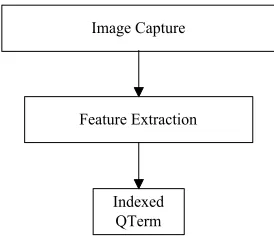
Image search requires matching of images or their repre-senting features. In order to save energy of the sensor nodes, some image representing features that require few bytes of sensor storage, are to be used instead. The Scale- Invariant Feature Extraction Algorithm [22] is descrip- tive of the local region and may be used to generate con- tinuous 128-dimensional feature vector by finding local orientation histograms of the image. These feature ve- ctors of 128-dimensional vector are still computationally expensive to match. Instead, these features may be clus-tered hierarchically [23,24] for example, using K-means clustering technique. These clusters may be termed as QTerms, each occupying few bytes of the local sensor memory. Thus, during image search these QTerms are used to represent images for matching. These steps are summarized in Figure 1.
Image Capture
Feature Extraction
[image:4.595.103.240.84.202.2]Indexed QTerm
Figure 1. Energy-efficient image representation.
gateway, to be searched in local databases of the sensor nodes. At sensors, image matching is done between these QTerms and the ones representing the images, based on scores. The weight may be calculated using the following equation as [23,25,26]:
score k k k
tf idf
,where
Total su
k
idf m of images k
df
Energy in Sensor :
(1)
where tfk represents frequency of QTerm k in an image, and dfk represents number of images in which QTerm k occurs. The index k is over QTerms common to the query and local database image and dfk represents the document frequency of k. Thus, the image search proceeds in two stages:
1) In the first round, image search is done by matching only QTerms, and score calculated by each sensor node is transmitted to the gateway. This score counts few bytes.
2) In the second round, all of the scores received at the gateway are globally ranked. The second query consists of the top-m matches obtained through merging of these local scores and is sent to appropriate sensor nodes. The required “m” sensor nodes then transmit these images to the gateway.
This way, instead of each sensor responding to the query, only few sensors respond, reducing traffic on the link between sensors and their gateway. This in turn, in- creases energy savings of those sensor nodes which do not respond to the gateway in the second round.
3.3. Energy Savings Criteria
In this section, the objective to minimize energy con- sumed in retrieval of images from sensor nodes is high- lighted. Since the life time of the wireless sensor node with battery is very low, therefore once deployed, their energy needs to be saved on various operational in- stances. These include minimization of energy usage on image search and transmission of images at every query
from the gateway. The examples of the energy usage include active camera vs. standby; active processor vs. standby; active transmitter/receiver vs. standby, etc. Thus, total energy consumed in a sensor node is a function of energy consumed in camera, processor and communica-tion with gateway, etc. Let us represent this consumed energy from image acquisition to image transmission as follows:
sensor cam proc com
E E E E
_ _ _
cam cam mode cam time cam switching
E E E E
(2) where Ecam stands for energy consumed during image acquisition and is dependent upon active/standby mode of camera, image capture time, energy consumed in switching from standby to active mode, etc.; and may be written as:
_ _ _
_ / _
(3)
Eproc stands for energy consumed in the processor and is dependent upon active/standby mode of the processor, building QTerms, reading/writing the image, image search using or without QTerms, switching between standby and active mode, etc; and may be written as:
proc proc mode proc QTerms proc srch
proc read write proc switch
E E E E
E E
_ _ _
_ /
com com mode com switching com query
com image Qterm tx
E E E E
E
(4)
Ecom stands for energy consumed during communica- tion between sensor node and gateway, and is dependent upon communication mode, switching between transmis- sion and reception (Tx/Rx), reception of the query, trans- mission of image/Qterm reply, etc; and may be written as:
(5)
The next logical step would be to explore minimizing either of the variables in Equations (3)-(5) to increase life time of the sensor. In other words, use of less number of terms in either of the Equations (3)-(5) for calculating total energy consumption in Equation (1) would help in increasing the life time of the sensor network. This is investigated further in simulations presented in the next section.
4. Simulation Setup
A C program simulator is used to analyze and examine the proposed approach that considers network traffic and the energy consumption of image sensor nodes. Based on coverage range of Imote2 image sensor nodes, a perime- ter of size 8 m × 8 m is used with focus on monitoring the center at 5 m distance from image sensor. Using the geometry shown in Figure 2(a), a set of four image
communication between sensors themselves. The image sensors have cameras with viewing angle of 62˚ in the direction of center of the perimeter, as shown in Figure 2(b). The radio transmission speed is set to 250 kb/s and
the radio transmission range is set to 50 meters. These values are taken from typical commercial products avai- lable in the market, and used here for simulation pur-poses. The sensors are provided initially with energy amount of 200 Joules within a standard deviation of ±5% to allow for variation in startup energy typically found in sensors. The sensors’ memory has a capacity to store 1150 pictures within a standard deviation of ±10%. The standard deviation accounts for heterogeneity of image sensors and reflects variation in size of each image sen-sor memory. The simulation model considers pictures of the perimeter taken at regular intervals or driven by an event, such as motion.
4.1. Energy Model
In our simulations, the energy model is based on real sensor Imote2 hardware platform [27]. Sensors’ radio spends energy in transmitting and receiving packets. The simulation considers three kinds of packets; query pack-ets received from the gateway requesting images with specified parameters called Request-Query, image pack-ets transmitted by sensors that have the required images called Image-Packet, and transmitted image parameters from image sensors called QTerm_Reply. We assume that the packet length of the Request-Query received from the gateway and the transmitted picture parameters
QTerm_Reply from the image sensor are of the same length, which is 48 bits (6 bytes), while the length of the transmitted image packet from the sensor is 202,752 bits. Considering the radio transmission speed of Imote2, which is 250 kb/s, the required time to send one QTerm_ Reply is (48 bits/250 kb/s) = 1.875 × 10⁻⁴ sec. The cur-rent consumption spent in sending this packet is 17.4 mA. The energy consumed in sending the QTerm_Reply is calculated as follows:
E I V t
5
45
0
(6) where I is the consumed current, and V is the battery voltage, and tis the time needed to send a packet. There-fore, by substituting the calculated packet time, the cur-rent obtained from the data sheet of the image sensor, and assuming a new sensor battery with voltage of 3.6 V, the energy expended in transmitting the QTerm_Reply is 1.1745 × 10⁻⁵ Joules. Similarly, the energy expended in receiving Request-Query can be obtained using (6), but instead using the current withdrawn in the receiving mode as 19.7 mA. This calculates energy to be equal to 1.32975 × 10⁻⁵ Joules. Likewise, applying the same method, the energy spent in transmitting the requested image is 0.112752 Joules.
(a)
8m 8m
E P t
(b)
Figure 2. (a) Part of perimeter; (b) Perimeter under invest- tigation.
On the other hand, the simulation also considers the energy expended by the camera. The camera has two modes; active and standby. Using the data sheet of the camera, the active camera withdraws 40 mW of power, while it spends 30 uW in the standby mode. The energy consumption is calculated using the following equation:
standby active s
t t t
(7) where P is the consumed power and t is either the active time of the camera or the standby time. Note that the standby and active camera times are related to the sam-pling time as follows:
(8)
Assuming the sampling time as 100 msec, the capture time (i.e., the active time) as 10 msec, then the standby time is 90 msec. Using Equation (7), the energy con-sumed by an active camera is 4 × 10⁻⁴ Joules, whereas the energy spent by a standby camera is 2.7 × 10⁻⁶. As a summary, the parameters used in simulations based on Imote2 platforms are summarized in Table 1.
4.2. Simulation and Analysis
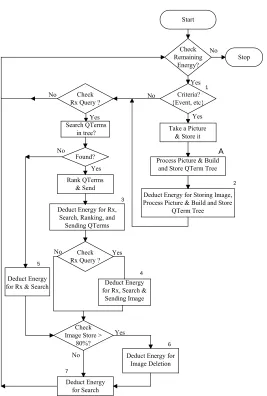
The energy expended in the process of taking a picture, processing, storing and sending it to the gateway may be depicted as a flow graph shown in Figure 3. The
[image:5.595.356.490.84.357.2]2
Start
Check Remaining
Energy?
Criteria? {Event, etc} Check
Rx Query ?
Stop
Check Rx Query ?
No
Yes Take a Picture
& Store it
Process Picture & Build and Store QTerm Tree
Deduct Energy for Storing Image, Process Picture & Build and Store
QTerm Tree Search QTerms
in tree?
Rank QTerms & Send No
Yes
Yes
Deduct Energy for Rx, Search &
Sending Image Yes No
Deduct Energy for Rx & Search
No
Deduct Energy for Rx, Search, Ranking, and
Sending QTerms
Check Image Store >
80%?
Deduct Energy for Search
Deduct Energy for Image Deletion Yes
No
3
5
4
6
7
1
Found? Yes
[image:6.595.167.434.77.473.2]No A
Figure 3. A flow graph for energy calculation in image retrieval from sensor network.
Table 1. Imote2 parameters used in simulations. The Figure 3 includes a criterion to take a picture as an input; and an optional block marked as “A” to be used as a variation in simulations. The numbers marked in the figure represent energy points, where energy is to be de-ducted for the actions performed by the sensors. A typi-cal value of 80% image store is used by sensor boards before deleting images to create space for storing a new image.
Radio transmission speed = 250 kb/s Radio transmission range = 50 meters Initial energy = 200 Joules with ±5% Memory capacity = 1150 pictures ±10% New battery voltage = 3.6 V
Active camera withdraws = 40 mW of power Standby mode = 30 uW
PXA271 processor active = 192.3 mW PXA271 processor inactive = 137 mW Image capture (including sensing) = 0.04 J Write in SD flash = 7.65 nJ/bit
Energy consumed in building Qterms = 0.04 J Radio (CC2420) active = 46.39 uJ/bit
Current withdrawn in the receiving mode = 19.7 mA Image search (for images without Qterms) = 0.52 J Qterm query processing at sensor node = 0.01 J
Time spent for the node in switching (Rx/Tx) = 250 e−6 sec Current consumption spent in QTerm_Reply = 17.4 mA Read from SD flash = 5.32 nJ/bit
First simulation setup: In this setup, three cases are
discussed each with slight variations in Figure 3. The
objective behind these variations is to examine impact of image capture, storage, processing and transmission of the images versus sensor life time.
Case 1: In this case, there are three different scenarios
[image:6.595.63.286.518.736.2]query is received as a broadcast, each sensor searches for the requested image within its memory. If it is found, then energy is deducted for receiving the gateway query, searching the stored image, and sending it wirelessly to the gateway. Our simulator uses a robust random number generator that uniquely generates queries randomly from the gateway and broadcast it to all the sensors.
The second scenario differs from the first scenario in the criterion to capture the image. Here, the image sensor takes pictures based on an event driven activity only. Similar to the gateway queries, the event is simulated by a random number generator, where the value of zero in-dicates no movement and the value of one inin-dicates a moving object within range of the image sensor.
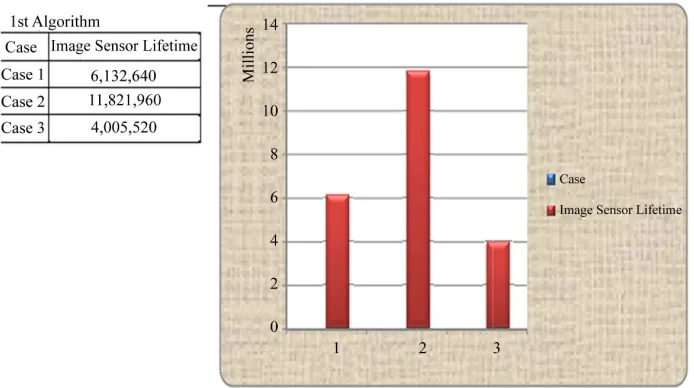
The last scenario simulates the case where the image sensor takes pictures typically every 100 msec and also during an event driven activity. However, the time be-tween any two picture capture is 100 msec. The results are shown in Figure 4, where second case shows larger
sensor life. This energy savings is mainly due to standby mode of camera as well as the processor when no event takes place.
Case 2: In this case, there are four scenarios each of
which does not involve processing of the image for building QTerms (i.e., the block marked as “A” in Fig-ure 3 is not used). This also means that searching of the
image due to gateway query does not involve QTerms. In the first scenario, each image sensor takes a picture at fixed sampling time (say 100 msec), and then it sends directly to the gateway without storing it. Thus, energies for active and standby camera; and wireless transmission are deducted.
The second scenario considers the event driven acti- vity, where the image sensor only takes picture if move-ment is detected and without storing the image, it sends
the image directly to the gateway. The major energy cost is the direct transmission of the image to the gateway.
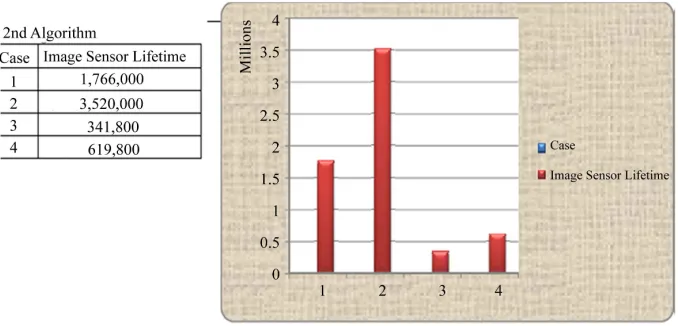
Note that in both setups, no query is generated by the gateway. In the third scenario, each image sensor takes pictures at fixed sampling time, stores the image, and sends it on query. Thus, the energy is deducted for active and standby camera, for memory storage, for receiving query, for searching the image, and for sending the image if found. The last scenario simulates image sensors that take pictures only on an event driven activity, store the image, and send it to the gateway on query. Similar to the third scenario, the image is not processed for building and storing QTerm tree. In this case, the energy is con-sumed only if an even driven activity takes place. Again, the expected major energy cost is the direct transmission of the image minus energy savings due to standby mode of the camera. This increases network lifetime as the active camera time is much less than the standby camera time. The results are shown in Figure 5, where the se-
cond case shows longer sensor life cycle. Compared to case 1, the scenarios in this case do not exploit energy savings (due to QTerms) as QTerm search requires less computational time and that the images are not sent when there is no need at the gateway.
Case 3: In the third case, similar scenarios as in the
second case are considered but with a varying initial energy and memory capacity to account for heterogeneous image sensors. Thus, the initial energy ranges from 190 Joules to 210 Joules, while the storage capacity ranges from 1035 stored pictures to 1265 stored pictures. The results are shown in Figure 6, where the second scenario
[image:7.595.126.473.521.715.2]shows longer sensor life cycle. The results of case 2 and case 3 can be related statistically, as both consider the similar energy costs. The results from first simulation setup (Figures 4-6) suggest that building QTerm tree
Figure 5. Life time of each sensor for the 2nd case.
Figure 6. Life time of each sensor for the 3rd case.
has significant impact in increasing the life time of the sensor node in addition to increased standby mode of camera and the processor. In next simulation setup, QTerm based query is further investigated to yield addi-tional energy savings.
Second simulation setup: In this setup, the objective is
to further investigate the increase in life time of the sen-sor nodes by exploiting second term “Eproc” and third term “Ecom” in Equation (2). Specifically, the terms
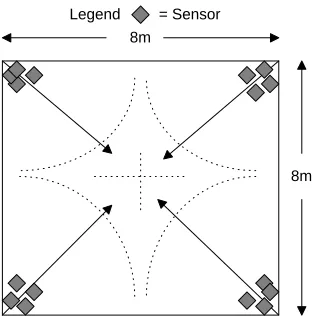
Eproc_mode, Eproc_read/write, Eproc_srch, Eproc_switch in Equation (4) and Ecom_switching, Ecom_query, Ecom-image/QTerm_tx in Equation (5) are exploited to contribute to the further reduction in en-ergy consumption of the sensor node. It will be shown that this also results in increased memory space of the sensor memory with a tradeoff in deployment cost. Here, it is considered that sensors are grouped into sensor zones marked as clusters. For example, four sensors be-long to the same overlapping sensing range, and may form a cluster, as shown in Figure 7. The variation in
center of viewing angle of each sensor node per cluster is
considered to be very small to ensure that all nodes with- in a cluster have nearly similar viewing angle. For sim- plicity, it is assumed that each corner of the perimeter has same deployment geometry of four sensors. Since all sensors within that cluster have similar viewing angle, therefore it is more likely that all sensor nodes within that cluster capture similar images. It seems, thus, waste- ful for all four sensor nodes (for example) to store the same image with slight orientation variations. If a me- chanism is chosen (to be commonly adopted by each sensor node in the cluster) where sensor nodes process the image independently and then store 1/4 of the total image size, then this may help each sensor node to in-crease available free storage capacity by four. Of course, this processing of the image (resulting in 1/4 of the image size) will consume further energy of the sensor, but this is offset by many advantages. The processing mechanism and resulting benefits are discussed below.
8m 8m
[image:9.595.90.248.86.245.2]Legend = Sensor
Figure 7. Sensors placed for second simulation setup.
signal (i.e., image in our case) by passing them through filters. Generally, the two-dimensional image is decom-posed into n number of resolution levels, each with four sub-bands (LL, HL, LH, HH), where L and H stand for low-pass information and high-pass information. Mathe- matically, this decomposition may be described as fol-lows [28]:
1 1 0 0 0 1 1 0 0 1 , , 1 , , , M N x y M N i x yW j m n f
0, ,
, ,
, ,
,
j m n i j m n
x y x y
x y
, ,
i j m n MN
W j m n f x y
MN
(9)where f(x, y), φ(j0, m, n) and Wφ (j0, m, n) represent 2-D image, wavelet used and wavelet transformed image sub-band (LL) respectively. The W represent
LH, HL, and HH sub-bands respectively, for different values of i. The 2-D image can be reconstructed using the following [28]:
, , , , , ,j m n
i i
j m n
m n x y
n x y
0
0 ,
0
1 , ,
1
, ,
m n
i j m n
f x y W j
MN
W j m MN
(10)In second simulation setup, the reconstruction of the image from its sub bands is conceived to be done at the gateway. There exist numerous methods like wavelet- based multi-view fusion [29,30] that combines the com-plementary directional information from all available views into a single volume. As gateway function analysis is outside the scope of this paper, therefore it is not dis-cussed further here. The analysis is restricted to energy savings pertaining to sensor nodes only.
Typically, the LL sub-band contains low frequency features (like shape, etc.) and is assigned higher priority while HH contains high frequency features (like edges, details, etc.) and is assigned lower priority. Each of these is 1/4 of the original image. Thus, the sensor nodes
within the same cluster capture the same picture and then process it in order to store one of these four sub-bands. Out of these four sensor nodes, one sensor will work as a main node within that cluster. The functionality within a cluster during capturing and storing a picture varies be- tween main and other nodes, and is shown in Figure 8.
In fact, the role of the main node differs in many ways from other sensor nodes, and is conceived to be based on energy level of the sensor:
1) It stores LL sub band, while others store HL, LH, and HH respectively;
2) During the first round of image search query from the gateway, only main node within each cluster re-sponds to the gateway after it conducts image search us-ing QTerm and ranks it. This also means that QTerm is developed using 1/4 of the total image size;
3) All sensors respond to the second round of query if response during first round of query is selected by the gateway.
There may be many ways to select the main node within the cluster, but the one considered in this ap-proach is like the following:
1) During initialization, the main node and other nodes are selected randomly from the cluster (like LL = main;
HL = node 2; LH = node 3; HH = node 4);
2) The sensors participating in second round of query recalculate remaining energy, and send it to the gateway as part of the image transmission;
3) The gateway selects the node with highest energy as main node and the one with lowest energy as node 4 and updates its broadcast table. The remaining nodes in the cluster are assigned randomly.
This way, the main node role is likely to change from one sensor to another during intervals and thus the energy level is balanced amongst all nodes within the cluster.
Take a Picture & Process it
Store LL band image, Build and Store QTerm Tree
Store Image band Main Node?
Yes No
Deduct energy for processing and storing image
[image:9.595.318.524.522.707.2]Deduct energy for processing, storing image and building QTree
Compared to the first simulation setup, this setup has the following main differences:
1) In the first simulation setup, broadcast is used dur-ing first query, where as multicast (to only main nodes) is used in the second simulation setup. Thus, only one sen-sor node responds to the first round of query;
2) Four times more sensors are required to be deployed per same perimeter coverage;
3) The gateway responsibilities increase: a) group sub- bands to reconstruct original image; b) assigning respon-sibilities to nodes in each cluster.
The benefits of the second simulation setup can be ac-cumulated as:
1) Less traffic on the network (during first round of query);
2) Main node assignment based on energy level of the sensor nodes results in more standby time for sensor nodes that are not main node;
3) Storing only 1/4 of the actual image in sensor nodes results in increase in storing capacity of the sensor node. In turn, this decreases the number of image deletions per sensor node at any given time, etc.
In order to stop the simulation, a criterion based on remaining energy in any of the sensor nodes was used as shown in Figure 3. The simulation results of this setup
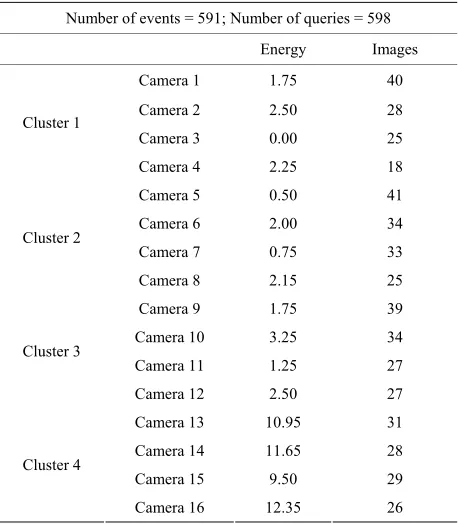
are shown in Table 2. The Table 2 shows total images
taken and remaining energy in sensor nodes. It is evident from results that leftover energy within sensor nodes remains nearly balanced in each cluster.
[image:10.595.58.287.473.735.2]In all of the simulations, it is clear that there is a
Table 2. Results of simulation setup.
Number of events = 591; Number of queries = 598
Energy Images
Camera 1 1.75 40
Camera 2 2.50 28
Camera 3 0.00 25
Cluster 1
Camera 4 2.25 18
Camera 5 0.50 41
Camera 6 2.00 34
Camera 7 0.75 33
Cluster 2
Camera 8 2.15 25
Camera 9 1.75 39
Camera 10 3.25 34
Camera 11 1.25 27
Cluster 3
Camera 12 2.50 27
Camera 13 10.95 31
Camera 14 11.65 28
Camera 15 9.50 29
Cluster 4
Camera 16 12.35 26
tradeoff between transmission traffic on the network and energy efficiency of image sensors. Clearly, if image sensors have low memory and low computational power, it may be better to transmit image(s) to the gateway without processing them on the sensor node. But this generates a lot of traffic on the network even when the transmitted image is required by the gateway or not. Such a scenario will also require the gateway to search image in its entire centralized database. As discussed before in Section 2, such an image search is usually of higher complexity resulting in higher search time. On the other hand, if sensor nodes have relatively higher mem-ory and relatively more computational power, which is normal in current product line, then it is advisable that each sensor node performs local processing and trans- mits only when the gateway initiates image search query. This network setup leads to reduced network traffic and allows for higher network scalability. The results of both simulation setups show that distributed image processing and search gives increased sensor life time.
5. Conclusion
The network traffic and energy efficiency of image sen-sors have been analyzed with respect to a perimeter with a typical size of 8 m × 8 m with image sensor nodes placed on its corner for event based or continuous moni-toring of the area. Three scenarios were considered to send images to the gateway. Three key factors were iden-tified in such monitoring: network traffic, energy effi-ciency, and number of sensors placed on the perimeter. It was found out that tradeoff between sensor network traf-fic and energy eftraf-ficiency is signitraf-ficant when the number of sensor nodes increases to enable distributed image processing and search.
REFERENCES
[1] D. M. Flournoy, “The Broadband Millennium: Commu-nication Technologies and Markets,” International Engi-neering Consortium, Chicago, 2004.
[2] S. Tilak, N. Abu-Ghazaleh and W. Heinzelman, “A Taxo- nomy of Wireless Micro-Sensor Network Models,” ACM SIGMOBILE Mobile Computing and Communications Review, Vol. 6, No. 2, 2002, pp. 28-36.
[3] Y. H. Liu, C. Li, Y. He, J. Wu and Z. Xiong, “A Perime-ter Intrusion Detection System Using Dual-Mode Wire-less Sensor Networks,” Second International Conference on Communications and Networking, Shanghai, 22-24 August 2007, pp. 861-865.
doi:10.1109/CHINACOM.2007.4469520
[4] A. Mishra, K. Nadkarni and A. Patcha, “Intrusion Detec-tion in Wireless Ad Hoc Networks,” IEEE Wireless Communications Magazine, Vol. 11, No. 1, 2004, pp. 48- 60.
[image:10.595.54.541.485.743.2]Networks: Perimeters and Axes,” IEEE Military Commu-nications Conference,Vol. 3, 2005, pp. 1780-1786. [6] S. Hennin, G. Germana and L. Garcia, “Integrated Pe-
rimeter Security System,” IEEE Conference on Tech- nologies for Homeland Security, Woburn, 16-17 May 2007, pp. 70-75. doi:10.1109/THS.2007.370022
[7] P. Skraba and L. Guibas, “Energy Efficient Intrusion Detection in Camera Sensor Networks,” Proceedings of the IEEE International Conference on Distributed Com-puting in Sensor Systems, Springer-Verlag, 18-20 June 2007, pp. 309-323.
[8] S. Sharafkandi, D. Du and A. Razavi, “Distributed and Energy Efficient Collection of Raw Data in Sensor Net-works,” Technical Report, University of Minnesota, 2010. [9] V. Lecuire, C. Duran-Faundez and N. Krommenacker,
“Energy-Efficient Image Transmission in Sensor Net-works,” International Journal of Sensor Networks, Vol. 4 No. 1-2, 2008, pp. 37-47.
doi:10.1504/IJSNET.2008.019250
[10] C. Liu, K. Wu and J. Pei, “An Energy-Efficient Data Collection Framework for Wireless Sensor Networks by Exploiting Spatiotemporal Correlation,” IEEE Transac-tions on Parallel and Distributed Systems, Vol. 18, No. 7, 2007, pp. 1010-1023. doi:10.1109/TPDS.2007.1046 [11] S. Avancha, et al., “Secure Sensor Networks for
Perime-ter Protection,” Computer Networks, Vol. 43, No. 4, 2003, pp. 421-435. doi:10.1016/S1389-1286(03)00352-9 [12] M. Karakaya and H. Qi, “Distributed Target Localization
Using a Progressive Certainty Map in Visual Sensor Net-works,” Ad Hoc Networks, Vol. 9, 2011, pp. 576-590. doi:10.1016/j.adhoc.2010.08.006
[13] Y. Wang and G. Cao, “On Full-View Coverage in Ca- mera Sensor Networks,” Proceedings of IEEE on IN-FOCOM, Shangahi, 10-15 April 2011, pp. 1781-1789. [14] S. Dewar, “Opportunities for Increased Use of Standards
in the Integration of Perimeter Intrusion Detection Sys-tems,” 42nd Annual IEEE International Carnahan Con-ference on Security Technology, Prague, 13-16 October 2008, pp. 305-311. doi:10.1109/CCST.2008.4751319 [15] H. Everett, “Robotic Security Systems,” IEEE
Instru-mentation and Measurement Magazine, Vol. 6, No. 4, 2003, pp. 30-34. doi:10.1109/MIM.2003.1251480
[16] X. N. Liang and Y. Xiao, “Capturing Intrusions by Mo-bile Robot in Rectangular Perimeter,” IEEE International Conference on Information and Automation, Harbin, 20- 23 June 2010, pp. 1404-1409.
doi:10.1109/ICINFA.2010.5512096
[17] The Smart Detect WSN Team, “Smart Detect: An
effi-cient WSN Implementation for Intrusion Detection,” Sec-ondInternational Conference on Communication Systems and Networks, 18 March 2010, pp. 1-2.
[18] R. Koller, et al., “Anatomy of a Real-Time Intrusion Pre-vention System,” International Conference on Autonomic Computing, Chicago, 2-6 June 2008, pp. 151-160. doi:10.1109/ICAC.2008.24
[19] F. Uluc, E. Emirzade and Y. Bitirim, “The Impact of Number of Query Words on Image Search Engines,” In-ternational Conference on Internet and Web Applications and Services, Morne, 13-19 May 2007, p. 50.
doi:10.1109/ICIW.2007.61
[20] R. Datta, et al., “Toward Bridging the Annotation-Re- trieval Gap in Image Search,” IEEE Multimedia, Vol. 14, No. 3, 2007, pp. 24-35. doi:10.1109/MMUL.2007.67 [21] T. Evgeniou, et al., “Image Representations and Feature
Selection for Multimedia Database Search,” IEEE Trans-actions on Knowledge and Data Engineering, Vol. 15, No. 4, 2003, pp. 911-920. doi:10.1109/TKDE.2003.1209008 [22] D. Lowe, “Distinctive Features from Scale-Invariant Key-
points,” International Journal of Computer Vision, Vol. 60, No. 2, 2004, pp. 91-110.
doi:10.1023/B:VISI.0000029664.99615.94
[23] D. Nister and H. Stewenius, “Scalable Recognition with a Vocabulary Tree,” IEEE Conference on Computer Vision and Pattern Recognition, Vol. 2, 2006, pp. 2161-2168. [24] J. Sivic and A. Zissermann, “Video Google: A Text
Re-trieval Approach to Object Matching in Videos,” IEEE Conference on Computer Vision and Pattern Recognition, Nice, 13-16 October 2003, pp. 1470-1477.
[25] R. Baeza-Yates and B. Ribeiro-Neto, “Modern Informa-tion Retrieval,” ACM Press, New York, 1999.
[26] J. Philbin, et al., “Object Retrieval with Large Vocabu-laries and Fast Spatial Matching,” IEEE Conference on Computer Vision and Pattern Recognition,Minneapolis, 17-22 June 2007, pp. 1-8.
doi:10.1109/CVPR.2007.383172
[27] http://www.memsic.com/products/wireless-sensor-networ ks/sensor-boards.html
[28] S. Mallat, “A Wavelet Tour of Signal Processing,” 2nd Edition, Academic Publishers, Leiden, 1999.
[29] J. L. Rubio-Guivernau, et al., “Wavelet-Based Image Fusion in Multi-View Three-Dimensional Microscopy,” Bioinformatics, Vol. 28, No. 2, 2011, pp. 238-245. [30] V. Castelli and L. Bergman, “Image Databases: Search