An Analysis on Efficiency and Equity of Fixed-Time
Ramp Metering
Ali Sercan Kesten1,2*, Murat Ergün2, Tetsuo Yai1
1Department of Built Environment, Tokyo Institute of Technology, Tokyo, Japan 2Department of Civil Engineering, Istanbul Technical University, Istanbul, Turkey
Email: *[email protected], [email protected], [email protected]
Received February 1, 2013; revised March 1, 2013; accepted March 8, 2013
Copyright © 2013 Ali Sercan Kesten et al. This is an open access article distributed under the Creative Commons Attribution Li-cense, which permits unrestricted use, distribution, and reproduction in any medium, provided the original work is properly cited.
ABSTRACT
Various traffic management strategies have been developed to alleviate the congestion on freeways. The equity issue has been considered as one of the major challenges for the implementation of some traffic control strategies, especially ramp metering. This paper presents a comparative evaluation of the efficiency and equity performance of a traffic con-trol strategies namely Fixed Time Ramp Metering (FTRM). Instead of focusing on a single equity measure and/or indi-cator, different approaches to the equity concept are discussed and various equity measures are examined. The equity and efficiency performance of traffic control strategies are compared and evaluated by incorporating them into the simulated corridor. The Bosporus Bridge of Istanbul O-1 Freeway, Turkey is used as a test-bed for the simulation model and the control strategy is employed through microscopic traffic flow simulation software, VISSIM AG. The findings from the simulations show that the equity and efficiency properties of the network vary with the measures and indica-tors taken into account. The results also suggest that the trade-off between equity and efficiency can be observed for some measures, whereas regarding to other measures the trade-off is not validated.
Keywords: Traffic Control Strategies; Traffic Flow Micro-simulation; Equity in Traffic Control; Efficiency and Equity
Trade-Off
1. Introduction
Freeways had been commonly recognized as to provide virtually unlimited mobility to road users, without any flow disturbance [1]. The constant increase of traffic de-mand, however, yields either recurrent congestion which occurs daily during rush hours or non-recurrent tion which is defined as unexpected or unusual conges-tion [2]. The congested freeways within and around met-ropolitan areas degrades infrastructure utilization and causes increase in delays and Green House Gases (GHGs) emissions and decrease in average travel speed and safety [3-5]. The continuously increasing traffic conges-tion problem has led to applicaconges-tion of various control strategies. Basically, these are formed by controlling the number of vehicles entering the freeway and/or by changing the speed limit of designated section along the freeway. Advanced urban traffic networks include both urban roads and freeways utilize control strategies like signal control, ramp metering, variable message signs and route guidance [6].
The efficiency of the traffic control is commonly ana-lyzed through the measures of effectiveness such as; total travel time in hours, total delay time in minutes or hours, number of stops, average speed in km/h and total dis-tance traveled in kilometers. The efficiency of traffic flow is essentially sensitive to demand levels, network topology, link geometry, and number of bottlenecks [7]. In practice mostly the links with higher traffic flows in the network are targeted for control where a maximum efficiency gain in travel time can imply a significant re-duction of aggregate delays and generalized travel costs. On the contrary, this may trigger the increase of regional disparities [8].
In traffic control, in some cases it is observed that when efficiency is selected as the single most important measure, the impacts are not consistent with either envi-ronmental or social sustainable transportation principles [9]. Therefore, equity issues should be taken into account in traffic management and control. Before integrating equity issues to traffic control the broader definition of equity and specific meaning in traffic control should be
put forward. Nevertheless, the definition and measure-ment of equity is one of the most controversial debates of humankind where a consensus is far over the horizon. There are some recent trials on integration of equity ob- jectives in transportation planning and traffic engineering. The first studies of equity integration in transportation covered the fairness of transportation policies and later, road network design evaluated the equity issues [10].The most common drawback of these researches is the single measure dependent nature. The authors of this paper be-lieve that, various existing equity measures should be evaluated for the traffic control and the implications should be analyzed critically.
The goal of this paper is to present a brief review of efficiency and equity measures in transportation studies given the emphasis on traffic control and to analyze the efficiency and equity properties of FTRM strategy on a selected urban highway corridor.
The remainder of the paper is organized as fallows. The second section of this paper presents a brief review of efficiency and equity concepts in transportation plan- ning giving a special emphasis on traffic control. FTRM methodology is introduced in Section 3. In Section 4, FTRM is applied in a traffic micro simulation environ- ment a case study where the study site, data, calibration and simulation details are explained in detail. The equity and efficiency performance of FTRM are assessed in Section 5 and the conclusion section provides the impli- cations of the efficiency and equity measures of FTRM control.
2. Efficiency and Equity Concepts
Efficiency can be simply measured as a function of input and output of investments. In traffic control, the effi- ciency mostly considered as the gain of implementing a facility or a management strategy as the input where a reduction in total travel time, delay, number of stops, fuel consumption, emissions and accidents and/or increase in total traffic volume and speed as an output. In the case of ramp metering, speed management and route guidance, the investment is the cost of the installation of equipment, maintenance and operations. The return on the invest- ment is the overall capacity increase and the indirect re- duction in external costs. The significance and impor- tance of measures can be varied in between and among the drivers, traffic authorities and the other peer groups of traffic. Therefore, the cost criterion may not be suffi- cient enough to draw a conclusion as it is the case in many of the studies in literature.
Equity is a complex idea that is not suitable to explain with simple formulations. It is mostly affected by cultural and societal values, by the specific types of goods i.e. divisible and non-divisible and conditional to given situ-
ation. Therefore, for a clear comprehension the contex-tual details are highly important. Equity has been one of the greatest topics debated as a matter of distribution of the prey. Thus, one of the simplest and shortest defini- tions attempts of equity could be justice and fairness in distribution of goods or rights ubiquitously. For the dis- tribution among the group, firstly the group should be defined. The horizontal equity considers the group mem- bers have the same rights hence they deserve the same portion of distribution.
The concept of equity has been extensively examined in several disciplines e.g., health [11,12], political sci- ence [13], sociology [14], and economics [15,16]. Even though there is an increasing interest of utilizing equity concept in policy assessment, there is no solid and widely accepted framework available. There are numer- ous measures used in the literature, but a general con- sensus on the best measures to use for a particular case is still far away. Withal, there are also very good examples of equity analyses, one of them is the Peyton’s work on conceptual evaluation of equity [17], and the other one is Cowell’s systematic and delicate work on equity meas-urement [18]. Another significant review and framework is written by Marsh and Schilling which they analyzed equity measurement in facility location [19].
2.1. Approaches to Equity in Transportation
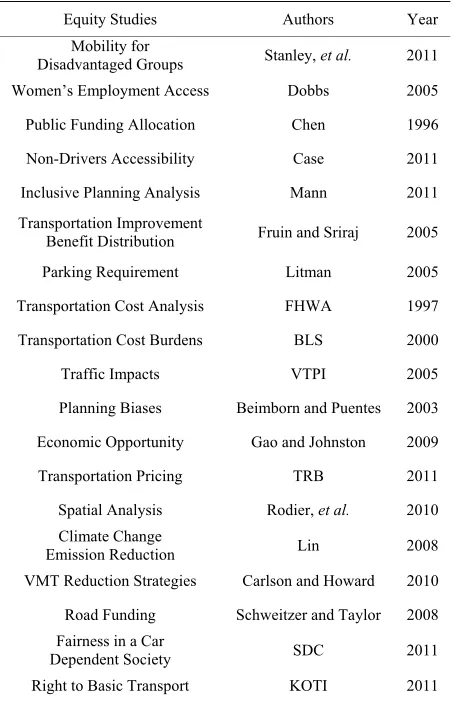
In the transportation literature, equity issues were gener-ally concentrated on evaluation of the economic impacts of transportation policies. The picture has been changed especially with the studies concerning the distribution of impacts among various social groups in road pricing policies [20,21]. There are many equity analyses exam- ples can be found in literature. Some of them are tabu lated in Table 1.
2.2. Equity Measures and Indicators
The equity of traffic control strategies are one of the biggest concern in practice. There are several indexes used in evaluation of equity issue in traffic control strate- gies mainly adapted from statistical or socio-economic models (welfare distribution). In this paper, the equity is rather used in the context of horizontal equity where in traffic control the drivers or alternatively cars should be treated equally1.
Statistical measures examine the distribution of any variable in a given population. The most frequent use is the distribution investigation of income. Examples of these are; range, variance, measure of variation, log vari- ance, Gini measure and Theil’s entropy measure. Welfare measures are based on welfare economics and integrate
1The priority vehicles such as ambulances and security patrols are not
Table 1. Equity studies in transportation literature.
Equity Studies Authors Year
Mobility for
Disadvantaged Groups Stanley, et al. 2011
Women’s Employment Access Dobbs 2005
Public Funding Allocation Chen 1996
Non-Drivers Accessibility Case 2011
Inclusive Planning Analysis Mann 2011
Transportation Improvement
Benefit Distribution Fruin and Sriraj 2005
Parking Requirement Litman 2005
Transportation Cost Analysis FHWA 1997
Transportation Cost Burdens BLS 2000
Traffic Impacts VTPI 2005
Planning Biases Beimborn and Puentes 2003
Economic Opportunity Gao and Johnston 2009
Transportation Pricing TRB 2011
Spatial Analysis Rodier, et al. 2010
Climate Change
Emission Reduction Lin 2008
VMT Reduction Strategies Carlson and Howard 2010
Road Funding Schweitzer and Taylor 2008
Fairness in a Car
Dependent Society SDC 2011
Right to Basic Transport KOTI 2011
equity concerns into a welfare function. The axiomatic measures can be applied to the evaluation of inequality of any vector or distribution of observations, even to non- economic data such as the distribution of the dispersion of pollutants or delay on a network. Table 2 shows the
measures are examined in this study and summarizes their properties.
In the measures given in Table; Y is a measure of wel- fare n is the number of observations on welfare Y is the mean level of welfare log Y is the mean level of log of welfare ε and α in Atkinson and Kolm measures re-spectively are the parameters that address inequality aversion.
3. Traffic Control Strategies
[image:3.595.307.538.102.387.2]Traditional control strategies use advanced technologies and more efficient procedures by integrating into the context of freeway management strategies that seek to manage, operate, and maintain expressways in an effi-cient and cost-effective manner [22]. The most effective control measures that are typically employed in freeway networks can be classified as ramp metering, speed ma-
Table 2. A summary of equity indexes.
Properties2
Measure Definition T SI TI
Range R Y maxYmin
Variance
2 n
i 1 1
V = Y Y
n i
+ − −Covariance c =
Y
V ± + −
Relative Mean Deviation n 1 Y 1 1 n Y i i M
+ + − Logarithmic Variance 2 n 1 Y 1 = log n Y i i
− + − Variance of Logarithms 2 n 1 Y 1 = log n Y i i
− + −Gini 2
1 1 1 Y Y 2 Y n n i j i j G
n
± + − Theil 1 Y Y 1 Y Y N i i i T log N
+ + − Atkinson 1 1 1 1 Y 1 A 1 n Y n i i
+ + −Kolm
1
1 1 n Y Y
i i
K log exp
N
+ + +nagement, route guidance and integrated control.
3.1. Ramp Metering
The use of traffic signals on-ramps to control the merg- ing on freeways is called ramp metering. Ramp meters are installed to control the rate of vehicles moving into to the mainline traffic thus it prevents the critical volume of a freeway in order to control the demand and moreover, breaks the platoon of vehicles entering the freeway up- stream of the signal to decrease the weaving phenome- non at the merge area. Ramp metering is projected to relieve or even eliminate congestion, ameliorate traffic flow conditions, safety and air quality, reduce total travel time and improve the performance measures, and regu- late the demand in order to establish a stable freeway system [23].
Ramp metering is a well-known technique for free- ways. In fact, various techniques of ramp control were used in the late 1950s and through 1970s in Japan and USA. By the early 1990s with the technological ad- vancement both in computing and measurement tech- niques make more sophisticated ramp metering systems possible to analyze and implement. The specification of the metering which is the specific entrance allowance for vehicles from ramp to the freeway rate draws an impor- tant role in control success. An extensive literature re- views found on ramp metering algorithms and compari-
son of the performances of some of these algorithms are demonstrated in [24-27].
Three different metering operations can be defined according to the control logic as: fixed-time, local traffic responsive and coordinated traffic responsive. A fixed- time ramp-metering control uses historical traffic data and a time-of-day basis [28]. Local traffic responsive ramp-metering strategies use the measurements of traffic flow and the metering rate is based on prevailing traffic conditions in the vicinity of the ramp. The most promi- nent examples of the local ramp-metering strategies are the demand capacity (DC), the occupancy (OCC) strate- gies and (ALINEA) strategy [29]. Local traffic respon- sive metering algorithms regardless of type of controller which can be either linear [30], artificial neural network [31] or Fuzzy-logic [32] are performed well without con- sidering the system wide optimization. The coordinated traffic responsive ramp metering aims optimization of the performance of entire freeway facility. Fixed time and/or local traffic responsive control approaches could be used in concert with the coordinated traffic responsive control approach by predicting the traffic conditions. Coordi- nated ramp-metering strategies benefits the measure- ments from the entire network to control all metered ramps. Some studies [33,34] stated that coordinated traf- fic responsive strategies are more efficient when the de- mand is extremely high. Contrary in some studies [35,36] coordinated control algorithms are obtained not superior to the local ramp metering strategies. The main drawback of coordinated traffic responsive ramp metering approach is the complex and costly nature to realize.
3.2. Fixed-Time Ramp Metering
Historically, the solution of the conflicts between the multidirectional flows of traffic is sought by consider- ing the allocation of saturation, time or delay among all movements. The use of traffic signal establishes an or- derly movement of traffic and increases the capacity and safety of intersections thoroughly. The design process of timing plans for signalized intersections in Highway Capacity Manual [37] treats the traffic merely as static volumes of conflicting movements that require right-of- way alternatively. With a given phase sequence and phase groups, the method can determine how much green time within a cycle will be allocated to each phase, or the green splits. One fundamental difference of these meth- ods is the design logic to allocate green splits; and these logic will affect how efficient and equitable a timing plan can be. Three major logics have been developed are; equal-saturation strategy [38] where the green time is determined in such a way that the phase duration will be proportional to its critical Volume/Capacity (V/C) ratio, delay minimization strategy [39] which is a policy that minimizes the total intersection delay and the capacity
maximization policy [40] maximizing the intersection capacity through balancing the traffic pressures of con- flicting approaches where the pressure is defined as the product of the approach capacity and its average delay for each approach link.
Likewise traffic lights, ramp metering control utilize traffic signals at freeway on ramps or freeway inter- changes to manage the rate of vehicles entering the free- way. However, there is no established method for the specification of optimum cycle time for fixed time ramp metering. Therefore, the traditional analytical models developed for fixed time intersection control are exam- ined and capacity maximization approach is modified for fixed time ramp metering simulation experiment.
Ramp metering algorithms aim to set the allowable ramp flow value r (in veh/h) which can be basically de- fined as (cr/3600) vehicles where c denotes cycle time in seconds [41]. Traffic lights are operated on the basis of a traffic cycle consisting of a green phase TG, an amber
phase TA, a red phase TR, and a red-amber phase TAR
which are adjusted in seconds such that:
G A R A
c T T T TR (1)
In this study, the number of vehicles that the signals allow off the ramp is calculated as the difference between the actual demand at the bottleneck, more specifically the sum of the mainline and ramp flows) and the pre-specified capacity of the road. The most critical point is the specification of the bottleneck capacity since it varies over time. Nevertheless, in most cases bottlenecks are also considered as having the same capacity as basic freeway segments which takes values between 1800 and 2200 veh./h/lane. The excess demand (De) would be de-
termined from:
e a
D D C (2) where Da is the actual demand (in veh./h) including ramp
and mainline flows and C (in veh./h) is the capacity of the downstream section of the bottleneck. Resulting from (4), the admissible ramp flow value (r) would be:
e
r C D (3)
The translation of the ramp flow value r into a corre- sponding green phase under a full traffic cycle plan, where the traffic cycle c is always equals to the metering period, would be based on the green ratio (f):
f r C (4) Therefore, the green time leads to:
G
T cf (5)
4. Traffic Micro-Simulation Modeling
4.1. Study Site and Data
proximately 7 km of
Traffic Control C
e two different geometries as; 5 m wi
d through the recorded vi
However, the results indicate that the speed profiles at ramps are relatively lower than mainline speed. The av- erage mainline speed decreases down to 20 km/h after 6:45 a.m. and oscillates between 30 to 40 km/h for auto- mobiles afterwards. The average ramp speed is around 20 km/h for automobiles and after 9:00 a.m. the speed in- creases to 30 km/h.
Asia to Europe direction along O1 route, schematically shown in Figure 1, is selected as the study site.
The corridor investigated has ap
length, where there are 6 entrance ramps and 2 exit ramps up to the Bosporus Bridge. There are 4 main junc- tions entering/exiting to/from O1 Route and the bottle- necks are mostly occurring at around the downstream sections of the junctions (S4, S7, S11 and S13) due to the merging flow. In morning hours, especially weekdays the queue length may reach kilometers long and the average speed on the corridor can decrease down to 5 km/h which indicates a complete hyper-congestion.
The data is collected at the Istanbul
4.2. Calibration and Simulation
There are two ways to evaluate the performance of ramp metering systems: field operational tests and computer simulations. Although field tests provide more realistic results, due to the high costs and time consuming nature, traffic simulation studies are becoming more popular. In this study, widely accepted, discrete, stochastic, time step based microscopic traffic flow simulation software, VIS-SIM, is employed to test the performance of control stra- tegies and compare their performances.
enter at 14th of March, 2011. The traffic flow is ob- served from 6:00 a.m. to 11:30 a.m. through video re- cordings. Later, manual counts aggregated to 15 min. and inserted to commercial spreadsheet program (Microsoft Excel). The volumes at ramps are high between 6:00 a.m. and 7:00 a.m. especially most of the vehicles are medium type vehicles (minibus or midibus) which are used as service vehicles. Service vehicles could be classified as a special type of car sharing model which is mostly pro- vided by companies free of charge to their employees. The hourly volumes of some ramps (S9, S10 and S12) even have higher volumes per lane than the mainline for a short time period.
The on-ramps hav
VISSIM utilizes psychophysical car following models which combines a perceptual driver behavior model with a vehicle dynamic model (1974, 1999) [43-45].
The study corridor is simulated for the morning peak hours which start from 6:30 a.m. to 9:30 a.m. and per- formance measurement interval is selected as 15 minutes.
The traffic composition and the priorities at the ramp weaving areas are set through the analyses of video re-cordings. It is observed that the vehicles entering to the mainline are more aggressive than the vehicles cruising on the right most lanes. Therefore the priority is given to the ramp flows over mainline flows in simulation. It is also watched that, if there is an enough gap the drivers tend to change the left most lane within the minimum possible distance. Typically, the drivers are highly ag- gressive and breaking and acceleration values are taken higher than the default values. Lane changing is also highly strong in Istanbul traffic and drivers are frequently cutting in and overtaking. The car following model is selected as Wiedmann 1999, which has ten driver be- havior parameters labeled CC0-CC9. Several driver be- havior parameters are reported to have significant im- pacts on roadway capacity and speed profiles thus, the parameters need to be optimized to attain the visual con- formity and numerical correlation between the observa- tion and simulation [46].
dth single lane and dual lanes with 3.5 m width. How- ever, a virtual lane occurs at every single ramp during congested hours. The congestion starts at 6:45 m. and the flow decreases down to 400 veh./h/lane at the bottleneck downstream sections. It is observed that, once the break-down occurs along the O1 Route, the congested flow remains invariant regardless of the time of the day which is verified by Sahin et al. [42].
The speeds are also calculate
deos despite the measurement is not based on an ap- proved method. The average speed is represented by randomly taken cars (medium, heavy) for a time period. The speed profiles are only used in visual conformity check and not considered for calibration purposes due to possible measurement errors.
UZUNCAYIR ACIBADEM ALTUNIZADE BEYLERBEYI
Bosporus Bridge Direction of Flow
[image:5.595.60.541.632.726.2]1100m 1500m 1900m 1900m
the model calibration process, mode al
headway and driver reaction time, w
hu et al. [47] con- fir
ration process GEH index [48] is often used to te
In l parameters are
tered until a qualitative and a quantitative balance be-tween the simulation and the observation is reached. Tra-ditionally, calibration requires several runs based on en-gineering judgment and experience. A three step tion procedure is applied in this study, which are; calibra-tion of driving behavior models, OD estimacalibra-tion and model fine-tuning.
The mean target
hich are the key user specified parameters in the car-following and lane changing models, can drastically influence overall driver behaviors of the simulation [46]. The calibrated values of the two parameters are 0.6 sec and 1.5 sec in this study. The calibration of ten parame-ters in car following model could be performed through some optimization techniques in order to achieve the most representative model. However, this is not the focus of this paper. Likewise, the local arterial roads are not included in the studied network hence, route choice is not considered in this calibration process.
In this study, the observations of C
med that the precise geometry of merging angle and connector link length have an impact of simulation accu- racy. Proportion of each vehicle type, vehicle characteris- tics and performance, such as the acceleration and decel-eration rate, driving restrictions, the speed limits and the driving lane restriction, the look back distance at merging and bifurcation weaving area, the priorities and traffic flow bases on conflicting areas also effects the simulation results.
In calib
st the relative difference between observed (Qo) and
simulated (Qs) link volumes. GEH formula can be calcu-
lated with equation (6).
2
2 o s o s
GEH Q Q Q Q (6)
The simulation model is acceptable for the GEH sc
cle time and green tim
Th ontrol process is to
vel times, delays, number of stops, or
ance
selected as total travel lated in hours for all
tro
e achieved for FTRM control at 15 sec cycle tim
ol case, it can be seen that the total travel time, th
formances of on-ramps, iven for the indicators of
Measur RM
ores are smaller than 5 in 85% of the links and smaller than 4 for the sum of all link counts. The GEH values are below the limit values thus the simulation model devel- oped is considered as representative.
In order to determine the optimal cy
e for fixed time ramp metering control and examine the cycle time duration effects on network performance, a set of simulation experiments is designed. At each ramp, the green times are calculated for the average flows of entire simulation period by varying the signal cycle time from 5 to 20 seconds.
5. Efficiency and Equity Performance of
Traffic Control Strategies
e objective of the freeway traffic c
optimize a performance index that mostly consists of efficiency measures. Performance index can be stated to
some other parameters such as fuel consumption and environmental pollution or in a more social context the optimization temporal and spatial of equity along the network or a more comprehensive objective that consid- ers all the aspects with suitable weighting. However, only the efficiency properties are investigated for each control strategies in this study.
5.1. Efficiency Perform
minimize the tra
The first performance measure is time. The Total travel time is calcu
[image:6.595.309.537.533.735.2]active and arrived vehicles. In addition to the total travel time, the total delay in hours, the total number of stops and the average speed in km/h are evaluated by averag-ing values of 15 min. intervals for each simulation run.
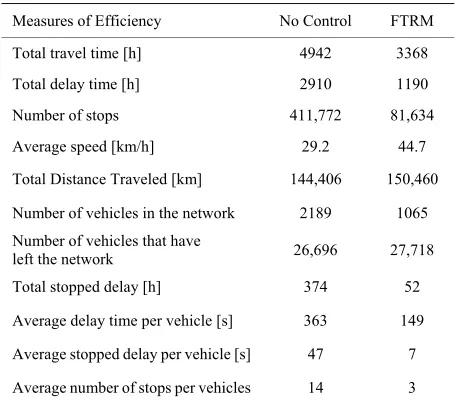
Table 3 compares the performance measure of control
strategies investigated. It shows that all the traffic con-l strategies significantcon-ly increase the network per- formance.
According to the results obtained, the best network performanc
e.
When the 15 sec cycle time control is compared with no contr
e total delay and the number of stops decreased by 32%, 60% and 80% respectively and the actual average speed increase from 29.2 km/h to 44.7 km/h.
5.2. Equity Performance
The results of the equity per mainline and the corridor is g
spot speed, space mean speed and delay in Table 4.
From the evaluation results of on-ramps, mainline and
Table 3. Efficiency performance of FTRM.
es of Efficiency No Control FT
Total travel time [h] 4942 3368
Total delay time [h] 2910 1190
Number of stops 411, 81,
/h]
m] 144, 6 150, 0
rk Number of vehicles that have
ehicle [s]
Average number of stops per vehicles 14 3
772 634
Average speed [km 29.2 44.7
Total Distance Traveled [k 40 46
Number of vehicles in the netwo 2189 1065
left the network 26,696 27,718
Total stopped delay [h] 374 52
Average delay time per v 363 149
T e 4. Equity performance of FTRM control. raffic Control Strategy (Indicator) abl
T
NO CONTROL
(Spot Speed, km/hr) FTRM (Spot Speed, km/hr) (Space Mean Speed, km/hr) FTRM (Delay, min)
FTRM Measure
ON-
RAMPS MAIN LINE CORRI-DOR RAMPSON- MAIN LINE RIDORCOR- RAMPSON- MAILINE N CORRI-DOR RAMON- PS MAINLI CORRI-NE DOR
Range 27.55 14.25 16.86 65 41. 22.78 27.63 8.37 6.98 7.15 3.1 6.4 3.19
Variance
Co of
Variance Relative Mean
1. 2 3 2 7 4. 2. 2. 4 1 4.
102.1 24.2 37.3 191.6 66.4 89.3 4.2 3.7 3.4 0.7 3.7 0.9
efficient 0.29 0.11 0.14 0.32 0.16 0.19 0.05 0.04 0.04 0.02 0.03 0.02
Deviation Logarithmic
0.26 0.09 0.12 0.26 0.14 0.16 0.04 0.03 0.03 0.01 0.03 0.01
Variance Variance of
3E−02 E−03 .E−03 .2E−02 5E−03 E−03 8E−04 7E−04 7E−04 .9E−05 .8E−04 9E−05
Logarithms
GINI
1.805 2.028 2.051 1.985 2.166 2.149 1.98 2.177 2.133 2.183 2.373 2.306
0.143 0.06 0.069 0.188 0.09 0.11 0.024 0.02 0.019 0.009 0.016 0.008
Th me n α in Ind lation is taken a
corri ide p ances, it is us e
are taken into account. However, when equity of the
tial of implementing gies in alleviating the traffic conges-
. The fixed time ramp metering
p and average speed. The pre- va
ottlen down ream flows. Th
tendency to increase the start-up lost times and limits the merging rate, therefore the delay
when it is compared to
e aversion para ter of ε is taken as 5 in Atkinson I dex and Kolm ex calcu s 0.025.
dor w erform obvio that th FTRM
increased the inequality on ramps when the spot speeds cycle lengths have a
on-ramps is compared through space mean speed and delay as indicators, the results are dramatically favoring the equity of no-control policy. The possible explanation for this controversy is the measurement methodology of the indicators. The equity measures are basically calcu- lating the distribution of differences from the mean value. The spot speeds are relatively stable in no control case, which actually show the heavy congestion on ramps. With the help of FTRM, the on-ramps have a tendency to fluctuate because of no queue control mechanism which yields sudden spot speed changes on ramps. Therefore, the selection of spot speed detection location gains an extreme importance due to this fluctuating nature of FTRM control. On the other hand, the space mean speed and delay indicators create even more equal tableau than no-control case where the indicator calculations are based on spatial measurements.
6. Conclusions
This study demonstrates the poten traffic control strate
tion on an urban freeway
control is analyzed as a traffic control strategy. The traf- fic simulation network is modeled in a traffic micro simulation environment and the traffic model is cali- brated for the analyses.
The FTRM is successfully increased the effectiveness of the traffic flow referring the total travel time, the total delay, the number of sto
iled results lead that; there is an optimum cycle time that can be determined for each on ramp considering the
increases rapidly. Long cycle lengths allows platoon of vehicles entering the mainline which also contributes an increase in delay. The model shows that there is an opti- mum cycle length obtaining the best performance values for the merging section. The result of study is highly congruent with previous findings on sensitivity of delay to cycle length for intersections exhibited on 16-16 at Highway Capacity Manual [37].
Another important output of this study is the results accord with the existing literature suggesting that the ramp control brings equity concerns for ramp users when the spot speeds are taken into account [49]. From the results, it is also observed that the equity of ramps is worsened with the control strategy
b eck st capacity and e short
the equity of mainline and overall corridor.
Finally, the change in magnitude of equity with respect to the measure and indicator taken into account could be vast. Thus, first the equity indicators and measures should be evaluated carefully and then the performance should be interpreted accordingly to make a conclusive judgment.
As evaluation results indicated the controversial nature of selection and evaluation of efficiency and equity, the future research would be continuing on the examination of other traffic control strategies such as speed manage- ment, integrated control as well as dynamic ramp meter- ing control.
7. Acknowledgements
the license key of VISSIM and their continual support during the research. Ali Sercan Kesten acknowledges the support of ITU and TiTech, and his PhD research is
sup-n, Culture, Sports, Sci
dings, Vol. 91, No. 12, 2003, pp. 2043-2067.
[2] M. E. Hallenb J. Nee, “Meas
ment of Recu rring Congestion,”
ther, Potential Ramp Metering Gain, and
n of Traffic Flow,” Accident Analysis
ported by Ministry of Educatio ence
& Technology of Japan.
REFERENCES
[1] M. Papageorgiou, C. Diakaki, V. Dinopoulou, A. Kotsia-los and Y. Wang, “Review of Road Traffic Control Stra- tegies,” IEEE Procee
eck, J. M. Ishimaru and rring versus Non Recu
ure-
Washington State Transportation Center, Olympia, 2003. [3] J. Kwon, M. Mauch and P. Varaiya, “The Components of
Congestion: Delay from Incidents, Special Events, Lane Closures, Wea
Excess Demand,” Proceedings of 85th Annual Meeting of the Transportation Research Board (CD-ROM), Wash-ington DC, 2006.
[4] M. Barth and K. Boriboonsomsin, “Real-World CO2 Im- pacts of Traffic Congestion,” Paper for the 87th Annual Meeting of Transportation Research Board, Washington DC, 2008, p. 10
[5] T. F. Golob, W. W. Recker and V. M. Alvarez, “Freeway Safety as a Functio
and Prevention, Vol. 36, No. 2004, pp. 933-946. doi:10.1016/j.aap.2003.09.006
[6] G. Pesti, P. Wiles, R. L. Cheu, P. Songchitruksa, J. Shel- ton and S. Cooner, “Traffic Control Strategies for
Con-omic Activity,” Working Paper, OECD/
, pp. 71-76.
cord: Journal of the Transportation gested Freeways and Work Zones,” Final Report FHWA/ TX-08/0-5326-2, Texas Transportation Institute, College Station, 2007.
[7] J. C. Williams, “Macroscopic Flow Models,” In: N. Gartner, C. J. Messer and A. K. Rathi, Eds., Traffic Flow Theory, Oak Ridge National Laboratory, Oak Ridge, Chapter 6, 1997, pp. 1-31.
[8] J.-F. Thisse, “How Transport Costs Shape the Spatial Pattern of Econ
ITF, London, 2009.
[9] D. J. Rosa, “Sustainability and Infrastructure Resource Allocation,” Journal of Business & Economics Research (JBER), Vol. 7, No. 9, 2011
[10] B. Santos, A. Antunes and E. J. Miller, “Integrating Eq- uity Objectives in a Road Network Design Model,” Trans- portation Research Re
Research Board, Vol. 2089, No. 1, 2008, pp. 35-42. doi:10.3141/2089-05
[11] P. Konings, S. Harper, J. Lynch, A. R. Hosseinpo
9-0078-y
or, D. Berkvens, V. Lorant and N. Speybroeck, “Analysis of Socioeconomic Health Inequalities Using the Concentra- tion Index,” International Journal of Public Health, Vol. 55, No. 1, 2010, pp. 71-74.
doi:10.1007/s00038-00
oi:10.1186/1475-9276-11-28
[12] A. Pinto, H. Manson, B. Pauly, J. Thanos, A. Parks and A. Cox, “Equity in Public Health Standards: A Qualitative
Document Analysis of Policies from Two Canadian Provinces,” International Journal for Equity in Health, Vol. 11, No. 1, 2012, p. 28. d
ederal Economic Devel-[13] J. L. Hall “The Distribution of F
opment Grant Funds: A Consideration of Need and the Urban/Rural Divide,” Economic Development Quarterly, 2010. doi:10.1177/0891242410366562
[14] J. L. Hall, “The Distribution of Federal Economic Devel- opment Grant Funds: A Consideration of Need and the Urban/Rural Divide,” Economic Development Quarterly, 2010. doi:10.1177/0891242410366562
[15] J. P. Chavas, “Equity Considerations in Economic and Policy Analysis,” American Journal of Agricultural Eco- nomics, Vol. 76, No. 5, 1994, pp. 1022-1033.
[16] B. Hansen, “The Political Economy of Poverty, Equity, and Growth: Egypt and Turkey,” Oxford University Press, Oxford, 1991. doi:10.2307/1243386
[17] H. P. Young, “Equity: In Theory and Practice,” Princeton University Press, Princeton, 1995.
F. Cowell, “Measuring Inequality,” Oxford Univ
[18] ersity Press,
Oxford, 2011.
[19] M. T. Marsh and D. A. Schilling, “Equity Measurement in Facility Location Analysis: A Review and Frame- work,” European Journal of Operational Research, Vol. 74, No. 1, 1994, pp. 1-17.
doi:10.1016/0377-2217(94)90200-3
[20] J. M. Viegas, “Making Urban Road Pricing Acceptable and Effective: Searching for Quality and Equity in Urban Mobility,” Transport Policy, Vol. 8, No. 4, 2001, pp. 289- 294. doi:10.1016/S0967-070X(01)00024-5
[21] A. Karlström and J. P. Franklin, “Be
and Equity Effects of Congestion havioral Adjustments Pricing: Analysis of Morning Commutes during the Stockholm Trial,” Trans- portation Research Part A: Policy and Practice, Vol. 43, No. 3, 2009, pp. 283-296. doi:10.1016/j.tra.2008.09.008 [22] L. Jacobson, J. Stribiak, L. Nelson and D. Sallman, “Ramp
-
” Master Thesis,
Massachusetts Institute of
Coordinated Management and Control Handbook,” Federal Highway Administration, Washington DC, 2006.
[23] H. M. Zhang, T. Kim, X. Nie, W. Jin, L. Chu and W. Recker, “Evaluation of On-Ramp Control Algorithms,” California PATH Research Report, University of Califor nia, Berkeley, 2001.
[24] M. Hasan, “Evaluation of Ramp Control Algorithms Us- ing a Microscopic Simulation Laboratory,
Massachusetts Institute of Technology, Cambridge, 1999. [25] J. R. Scariza, “Evaluation of Coordinated and Local
Ramp Metering Algorithms Using Microscopic Traffic Simulation,” Master Thesis,
Technology, Cambridge, 2003.
[26] R. Horowitz, X. Sun, L. Munoz, A. Skabardonis, P. Va- raiya, M. Zhang and J. Ma, “Design, Field Implementa- tion and Evaluation of Adaptive Ramp Metering Algo- rithm: Final Report, California PATH Research Report,” UCB-ITS-PRR-2006-21, 2006.
[27] K. Bogenberger and A. D. May, “Advanced
l. 3, No. 4, 2002, pp.
271
-A: A Local Feedback Control Law for On-Ramp
cial Neural Networks,” Transportation Re- Metering: An Overview,” IEEE Transactions on Intelli- gent Transportation Systems, Vo
281.
[29] M. Papageorgiou, H. Haj-Salem and F. Middelham, “ALINEA Local Ramp Metering: Summary of Field Re sults,” Transportation Research Record, No. 1603, 1998, pp. 90-98.
[30] M. Papageorgiou, H. Haj-Salem and J. M. Blosseville, “ALINE
Metering,” Transportation Research Record, No. 1320, 1991, pp. 58-64.
[31] H. M. Zhang and S. Ritchie, “Freeway Ramp Metering Using Artifi
search Part C: Emerging Technologies, Vol. 5, No. 5, 1997, pp. 273-286. doi:10.1016/S0968-090X(97)00019-3 [32] C. Taylor, D. Meldrum and L. Jacobson, “Fuzzy Ramp
Metering—Design Overview and Simulation Results,” Transportation Research Record, Vol. 1634, 1998, pp. 10-18. doi:10.3141/1634-02
[33] C. Taylor and D. Meldrum, “Evaluation of a Fuzzy Logic Ramp Metering Algorithm: A Comparative Study among Three Ramp Metering Algorithms Used in the Greater Seattle Area WSDOT Technical Report WA-RD 481.2,” 2000.
[34] S. Ahn, R. L. Bertini, B. Auffray, J. H. Ross and O. Eshel,
, H. X. Liu, W. Recker and H. M. Zhang, “Per- “Evaluating the Benefits of a System-Wide Adaptive Ramp-Metering Strategy in Portland,” Journal of Trans- portation Research Board, Transportation Research Re- cord, Vol. 2007, No. 1, 2012, pp. 47-56.
[35] L. Chu
formance Evaluation of Adaptive Ramp-Metering Algo- rithms Using Microscopic Traffic Simulation Model,” Journal of Transportation Engineering, Vol. 130, No. 3, 2004, pp. 330-338.
doi:10.1061/(ASCE)0733-947X(2004)130:3(330)
[36] K. Ozbay, I. Yasar and P. Kachroo, “Modeling and PA- RAMICS Based Evaluation of New Local Freeway Ramp Metering Strategy That Takes into Account Ramp Que- ues,” Transportation Research Record, No. 1867, 2004, pp. 89-97.
[37] “Highway Capacity Manual,” Transportation Research
Engineering and Control, Vol. 12, No. 2,
russels, 2007.
Board, Washington DC, 2000.
[38] F. V. Webster, “Traffic Signal Settings,” Road Research Technique Paper No. 39, Road Research Laboratory, London, 1958.
[39] R. B. Allsop, “SIGSET: A Computer Program for Calcu- lating Traffic Capacity of Signal-Controlled Road Junc- tions,” Traffic,
1971, pp. 58-60.
[40] M. Papageorgiou and I. Papamichail, “Handbook of Ramp Metering. Deliverable 7.5,” Report for the Euro- pean IST Office, B
[41] M. J. Smith and T. Van Vuren, “Traffic Equilibrium with Responsive Traffic Control,” Transportation Science, Vol. 27, No. 2, 1993, pp. 118-132.
doi:10.1287/trsc.27.2.118
[42] I. Sahin and G. Akyildiz, “Bosporus Bridge Toll Plaza in Istanbul, Turkey: Upstream a
Features,” Transportation
nd Downstream Traffic Research Record: Journal of
Heft 8, 1974 (in German).
mmunity,
.
r 2006, pp. 1406-1413.
ard 82nd
ion,” IEEE International Conference on Automa-
pp. 218-235.
the Transportation Research Board, Vol. 1910, No. 1, 2005, pp. 99-107.
[43] R. Wiedemann, “Simulation des Straßenverkehrsflusses,” Schtifienreihe des Instituts fur Verkehrswesen der Uni- versität Karlsruhe,
[44] R. Wiedemann, “Modeling of RTI-Elements on Multi- lane Roads,” Advanced Telematics in Road Transport Edited by the Commission of the European Co
Vol. DG XIII, 1991.
[45] PTV, “VISSIM Version 5.40 User Manual,” PTV Planug Transport Verkehr AG, Stumpfstraße 1 D-76131 Karl- sruhe, Germany, 2011
[46] N. Lownes and R. Machemehl, “Vissim: A Multiparame- ter Sensitivity Analysis,” Winter Simulation Conference, Monterey, 3-6 Decembe
[47] L. Chu and X. Yang, “Optimization of the ALINEA Ramp-Metering Control Using Genetic Algorithm with Micro-Simulation,” Transportation Research Bo
Annual Meeting, Washington DC, 12-16 January 2003, pp. 22-24.
[48] K. Chu, L. Yang, R. Saigal and K. Saitou, “Validation of Stochastic Traffic Flow Model with Microscopic Traffic Simulat
ntion Science and Engineering, Trieste, 24-27 August 2011, pp. 672-677.
[49] L. Zhang and D. Levinson, “Ramp Metering and Freeway Bottleneck Capacity,” Transportation Research Part A, Vol. 44, No. 4, 2010,