Clean and comfortable
when we ship it'
when you store it
Our computer tape is clean and error-free. We think that our supe· rior cleaning process makes it cleaner than anybody else's, but of course we're prejudiced. Point is, to be computer tape at all; it has to be clean and free from dropouts.
But we don't stop at merely making clean tape; we make sure that it gets to you clean and that you can keep it clean. Here's how:
Our exclusive environmental shipper which we call the Tape-Safe keeps dust out and your tape "clean and comfortable." Clean, because the polystyrene foam won't shed like cardboard; comfortable, because it cushions the tape in transit against shock and damaging fluctuations of temperature and humidity. Best of all, it's free with your minimum order of Ampex tape for IBM and IBM-compatible computers.
Then, for the only sure protection in storage, we pack our tape in a unique all-plastic canister. It keeps tape clean because it cannot generate contam-ination and its positive seal prevents outside dirt from getting in; comfortable because it pro-tects against shock and humidity. This canister is even encased in an airtight poly bag during shipment. From then on, it's up to you.
FREE! If you'd like a few suggestions on how to keep tape clean, write Tape-Safe, Ampex
Corpora-tion,401 Broadway, Redwood City,
I
AM P EX
I
CaJiforn ia 94063, for a copy of our , , TREN DS Bulletin No. 12, "Care Career opportunities? Write Box 0,Now you
can
rent it and
save 15
to 20%
on rental costs.
You've probably heard about the long-term
advan-tages of purchasing an MAl Magnetic Tape Unit
-how it pays for itself in 2-3 years in direct
savings.
Now you can get comparable short-term financial
benefits with an MAl rental plan.
First, you save a flat
15
to
20% over your current
monthly rental costs.
Just as important, you get unlimited use at no
extra cost. (You pay no more for running an MAL
unit 720 hours a month than 176 hours.)
But either way-purchase or rental-you have a
tape unit that's directly interchangeable with your
729/240 I units on a plug-to-plug, reel-to-reel basis.
You have a unit that, dollar for dollar, will out·
perform anything in this market.
A new kind of tape unit. No tape wear and tear
from
pin~h-feedmechanisms on this tape unit.
Its single capstan drive mechanism handles tape
the way it should be handled. Gently.
During operation, the recording surface of the
tape touches only the read-write station. And that
retracts to eliminate tape wear during loading and
rewinding.
A new kind of systems reliability. Because the
unit's design is so simple, you improve systems
reliability. Read-write reliability equals or
exceeds that of your present tape units. Downtime
has
to go down because the MAl unit is so easy to
maintain. (I t requires no mechanical adjustments,
andaminimum number of electrical adjustments.)
So, if you purchase, you'll save on an MAl
main~tenance agreement too .. And without worrying
about quick service. MAl has branch offices in 45
principal cities from coast to coast.
For more information, call your 10call\fAI branch
office, or write us.
Jl1rl~jIrEQUIPMENT
CORPORATION
~
SIEMENS
Teleprinter 100
for Internal Data Networks
Lower Price Higher Speed Faster Delivery
The Teleprinter 100 is used by railroads, utility and pipeline companies, plants, department stores, many other organizations, to transmit and receive data on internal communications networks. It is compatible with all systems-over 100,000 are now in use
in over 100 countries.
Up to 13 characters per second. 5 level code. Transmits to one unit, several or all units in system. Low noise level. Makes up to 12 carbons. Sends in red, receives in black, or vice versa. Receive-only units available. Tape reader and tape punch attachments. Many special features.
4
Latest Literature on TRANS DATA: For detailed information on high speed tape equipment, modems, etc., send now for .the 32·page, color brochure, ' "Data Communication Siemens TRANSDATA".
SIEMENS AMERICA INCORPORATED
. 350 Fifth Avenue, New York, N. Y. 10001CIRCLE 6 ON READER CARD
JaIL1tlarjT
1968
volume 14
Publisher Editor
number 1
GARDNER F. LANDON ROBERT B. -FOREST
Managi~g Editor & Art Director CLEVE MARIE BOUTELL
Associate Editor WILLIAM J. ROLPH
Assistant Editors WENDY REID
Eastern Editors
Midwestern Editor European Editor Contributing Editors
Washington Reporter Editorial Adviser Technical Consulta';t Production Manager Director of Circulation Circulation Fulfillment
JANET EYLER ANGELINE PANTAGES PHIL HIRSCH EDITH GOODMAN CHARLES WHITE. HOWARD BROMBERG
ROBERT V. HEAD PHIL HIRSCH ROBERT L. PA.TRICK LOWELL AMDAHL MARILEE PITMAN FRANK DeCARLO ALGENE TRAINA
Eastern District Managers JAMES M. MORRIS
WARREN A. TIBBETTS 35 Mason Street, Greenwich, Conn. 06830 (203) 661 ·5400
New England District Manager WARREN A: TIBBETTS
& Vice President 112 West Haven Rd.,
Manchester, N.H., 03104 (603) NAtional 5-9498
Midwest District Manager JOHN BRENNAN
205 West Wacker Drive, Chicago, III. 60606 (312)· Financial 6·1026
Western District Manager HAMILTON S. STYRON
& Senior Vice President 94 So. Los Robles Ave.,
[iW
Pasadena, Cal., 91101 (213) 795·9721 (213) 681-8486-from Los Angeles
EDITORIAL OFFICES
94 So. Los Robles Ave. Pasadena, Cal if. .9 J 1 0 1
Circulation audited by
Business Publications Audit American Business Press, Inc. Member,
DATAMATION is published monthly on or about the tenth day of every month by F. D. Thompson Publications, Inc., Frank D. Thompson, Chairman; Gardner F. Landon, Pres· ident; Gilbert Thayer, Senior Vice President. Executive, Circulation and Advertising offices, 35 M~on Street, Greenwich, Conn. 06830 (203) 661-5400. Editorial offices, 94 So. Los Robles Ave., Pasadena, California 91101. Published at Chicago, III. . DATAMATION is circulated without charge by name and title to certain qualified individuals who are employed by companies involved with automatic information han· dling equipment. Available to others by subscription at the rate of $15.00 annually; single issues (when available) $1.50. Reduced rate for qualified students. Foreign sub· scriptions are on a paid basis only at a rate of $25.00 annually. No subscription agency is authorized by us to solicit or take orders for subscriptions. Controlled circulation paid at Columbus, O. and. Chicago, III. Form 3579 to be sent to F. D. Thompson Publications, Inc., 205 W. Wacker Dr., Chicago, 111.60506. Copyright)968, F. D. Thompson Publications, Inc. Microfilm copies of DATAMATION may be obtained from University Microfilms, Inc., 313 No. First St., Ann Arbor, Michigan.
Printed by Beslow AssOCiates, Inc.
This issue 76,786 copies
Cheap mass storage. for small computers
,and how to get the most out of it
For some people the only limitation of the small co'mputeris the price of the extra memory. What's nee.dedis low-cost mass storage, and lots of it. For filing data. For quick and . convenient program manipulation.
DJGIT AL, the leader in small computers, has a low-cost disc and unique magnetic tape. unit tailored for the small com-puter. NOvv,new software isavailableto take even better
adv~ntageofthis low"cost mernory.
[)sCdiscac:ld~32, 76~ Vlorqs()f. memoryfqr$6'()()C)',b,cJd iti.onal expanderd iscs (up to 3) can be addeqat$3,OOO €Eich. That means a total of 131 ,072 words of disc memoryfqr$15,OOO. ~f.ullscal~· PDP-8/S computer with 36,.864 twelve bit words of memory, for example (4k core plus disc),cos~s$18,500. DECtape,Digital's un ique fixed address magnetic tape sys·
COMPUTERS' MOOULEs
tem, provides over 200,000 words of· storage on a 3 X-inch reel. It's the lowest cost. mass storage available anywhere. You can edit and debug programs on line. Then you can put your programsln your pocket and take them away until you want them again.
New keyboard monitor software all but eliminates the labori-oususeof paper tape andcards. You edit from the keyboard, compile from thekeyboard,assemble,load,store, debugall fromthekeyboard.\Nhatmig hthave been. hours or days in getting the computer ready for use~ isnowjust minutes.
6
An evolutionary answer
to data processing expansion.
N ow there is a family of electronic data processing systems which can't be outgrown. The Burroughs 500 Systems
family-the broadest line of EDP equipment you can find.
There's a basic computer, the B 2500. And a powerful medium-scale machine, the B 3500. Higher capacity large-scale systems like the
B 5500, B 6500 and B 7500. And the B 8500 supercomputer. So you can start off with a system that matches your cpmpany's present
EDP needs, yet can grow in step with your changing requirements. You can add components and capabilities to your Burroughs 500 com-puter at any time. Or move up to a larger 500 system. Develop a combination of systems. A network of systems. And you can do this without the prohibitive cost of rewriting your computer program libraries. That's becaUse you communicate with all Burroughs 500
Systems computers in the same standard scientific or business-oriented languages.
Your Burroughs representative has more gpod reasons why you should meet the 500 Systems family. Ask him.
Burr~~.~~::m
CIRCLE 8 ON READER CARD
January
1968
volume 14 number 1
automatic
information
processing
for business
industry
&
science
January 1968
®
22 GENERAL PURPOSE SOFTWARE,
by
Donald
H.
Sundeen.
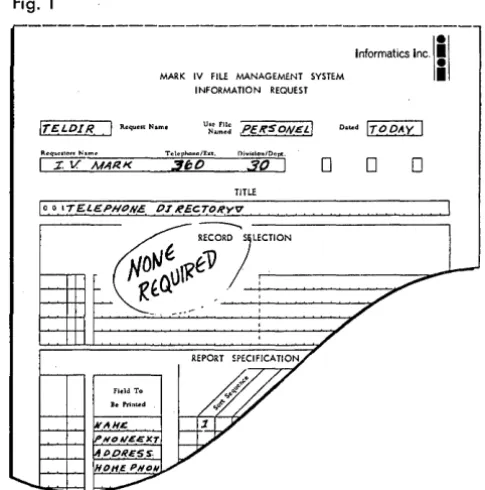
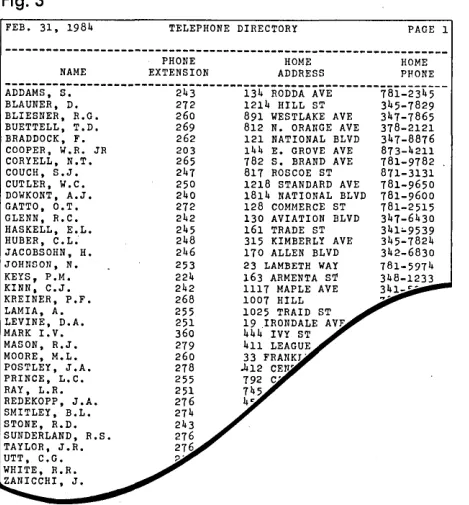
A sum-mary of the evolution of several types of general purpose software, with descrip-tions of the characteristics for some systems now in use or soon to be ready.28 THE MARK IV SYSTEM,
by
John A. Postley.
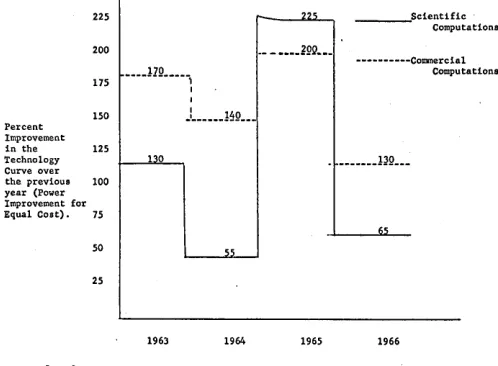
Brief look at the fe~tures and facilities of a proprietary, general-purpose file management system for 360' s operating under DOS or OS.31 EVOLVING COMPUTER PERFORMANCE-1963-1967,
by
Ken-neth E. Knight.
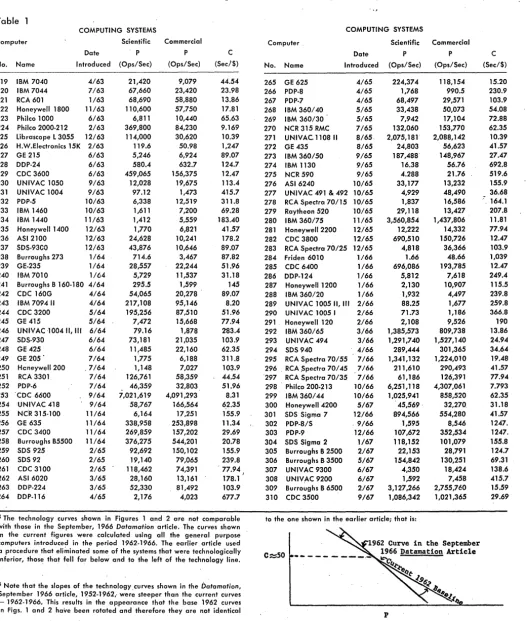
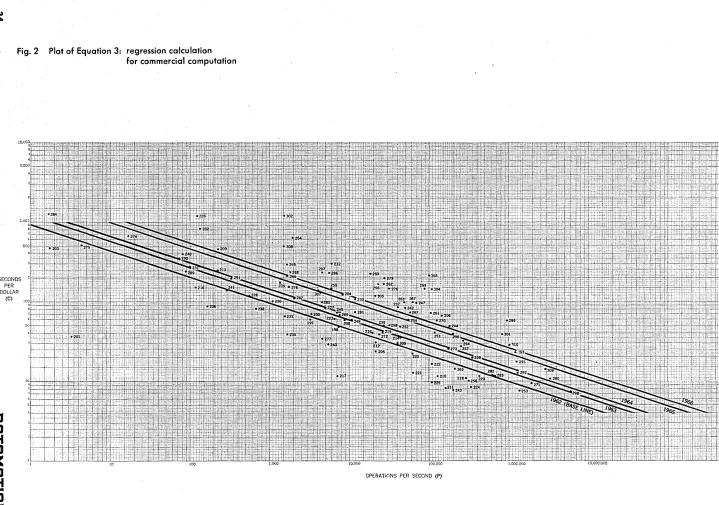
A continuation of the computer performance analysis pre-sented in September, 1966, covering 93 systems introduced from 1963 to thepresent.
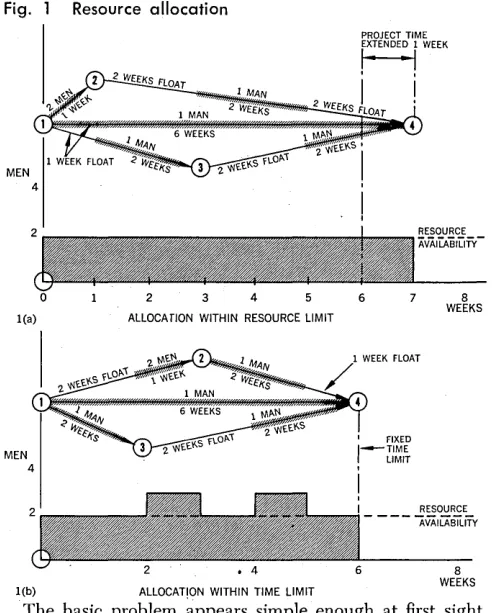
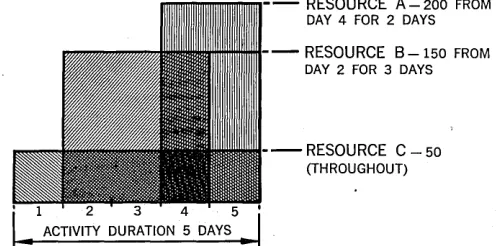
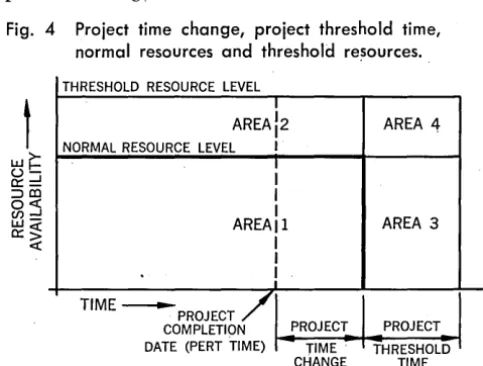
36 PLANNING NETWORKS AND RESOURCE ALLOCATION,
by H. S.
Woodgate.
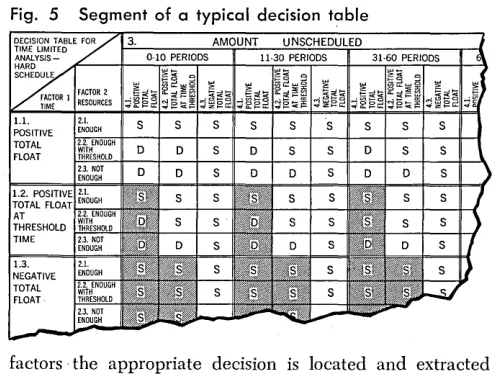
Recent developments in the U.K. have overcome some of the restrictions of network-based resource allocation programs, and scheduling has been made more flexible by t1~e use of decision tables.45 A HEXADECIMAL PRONUNCIATION GUIDE,
by
Robert
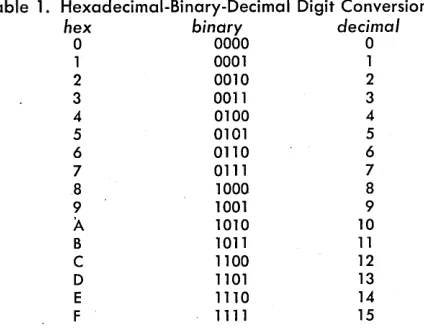
A.Magnuson.
For letters A-F, new suggestions to minimize confusion .. 48 MECHANIZATION'IN DEFENSE LIBRARIES,
by
GeorgeKershaw
and
J. Eugene Davis.
Not attempting to improve the quality of input, butpermitting an increase in processing speed without an increase in staff.
54 THE COMMON BUSINESS ORIENTED GOLDILOCKS,
by
Philip
Stanley.
The versatility of COBOL is demonstrated by this pioneering appli-cation.57 COMPUTERS IN CLINICAL ELECTROCARDIOGRAPHY,
A Conference Report.
datamation departments
9
Calendar701
New Products72
Letters to the Editor773
New Literature77
Look Ahead779
Books27
The Editor's Readout737
Datarnart67
News Briefs734
People97
Washington Report740
Index to Advertisers93
World Report142
The Forumif you think the story is spectacular
wait till you see the picture
As the complexity of CRT displays increases, and as the need for user manipulation of the picture increases, it is more and more the case that the central computer cannot provide the required on-line processing - or that com.munication lines cannot handle the high throughput rates. The graphics I/O terminal itself must include the necessary display-processing capabilities. That's why every Adage Graphics Terminal has its own Ambilog 200 computer with special arrays for high speed coordinate transformation.
8
Hybrid techniques exclusive with Adage provide extraordinary image-processing power and make possible dynamic 3-D displays which move with full six degrees of freedom. Objects containing over.5000 lines can· be presented without flicker even with frame-to-frame dynamic changes. And pictures are always bright and clear, thanks to scope-driving circuitry tnat's way ahead of its time.
Starting with the AGT /10 at $60,000, standard models are available with either 2-D or 3-D capability, perspective generation, three-dimensional windowing, and intensity-modulated depth cueing. Options include dataphone interface, joystick control, analog tablet input,
,CIRCLE 9 ON READER CARD
hardware character generation, and photographic hard-copy output. Complete systems software is provided with every terminal for local image control, for console I/O, and for communicating with the central facility.
Now that you've read the story, don't miss the picture. A free 16mm demonstration (JIm of the Adage Graphics Terminal in action is yours just by writing on your company letterhead to David Sudkin, Manager of Marketing Services, Adage, Inc., 1079 Commonwealth Avenue, Boston, Mass. 02215
>q
c:f;~2
Q•
~
calendar
DATE TITLE LOCATION
Feb. 7-9 Honeywell COBOL Disneyland Hotel Users' Meeting Anaheim, Calif.
Mar. 14-16 Sixth Annual Shamrock Hilton' Symposium on Houston, Texas
Biomathematics &
Computer Science
Mar. 18-29 Course: Systematic Univ. of Calif. Methods for Computer Los Angeles Aided Design of
Computers. Fee: $375
Mar. 20-22 Symposium on Critical As Above Factors in Data Mgt.
Fee: $75
April 3-5 Numerical Control: Marriott Motor Hotel, Tomorrow's Tech. Philadelphia, Pa. Today
April 8-10 Users' Meeting: Pick Congress Small IBM Computers Chicago, III.
April 16-18 Second National liT Research Inst. Symposium on law Chicago, 111. Enfcrrcement Sci.
& Tech.
April 23-25 Fourth Annual Conf. Sheraton-Chicago on Data Processing Chicago, 111.
April 26 Ninth Annual 50uth- Del Webb's Town-west Systems Conf. house, Phoenix, Ariz.
April 30- Spring Joint Com- Convention Center, May 2 puter Conference Atlantic City, N.J.
May 1-3 Anhual Convention Ft. Worth, Tex.
May 3-4 Fifth Annual Nat'l. Univ. of Penna. Colloquium on Info. Philadelphia Retrieval
January 1968
, SPONSOR! CONTACT
H. Roach, Univ. of Southern Calif., 1020 W. Jeffer-son, Los Angeles 90007
Univ. of Texas, Div. of Cont. Educ., P.O. Box 20367, Houston, Tex. 77025
Eng.!Physical Sci. Ext., 6532 Boelter Hall, UCLA, Los Angeles 90024
As Above
Numerical Con-trol Soc., 44 Nassau St., , Princeton, N.J.
08540
COMMON/Laura Austin, Admin. Div., General Motors Inst., Flint, Mich.
liT Research Inst., 10 W. 35 St., Chicago 60616
NRECA,2000 Florida Ave., N.W., Washing-ton, D.C. 20009
Systems & Pro-cedures Assn.! R. K. Braithwaite, Valley Nat'l. Bank, 141 N. Central Ave., Phoenix 85004
AFIPS
Assn. for Educa-tional Data Systems
Dr. D. Lefkowitz, Moore School, Univ. of Pa., Philadelphia
HOW A CHESHIRE
MAKES
IZIPI
EASY
Cheshire applies form as labels or imprints and ZIP-sorts
Converting to ZIP codes? Use your EDP
sys-tem plus a Cheshire. Write for brochure.
Cheshire
A XEROX COMPANY
408 Washington Blvd. Mundelein, Illinois 60060
Reports show how each of these firms use data processing equipment toaddress continuous forms-then use Cheshire equipment to apply these forms as labels or address imprints to mailing pieces.
Studies cover mail operations of manu-facturers, sales organizations, service companies, printers and publishers. In-clude quantities mailed, man - hour re-quirements, speeds of operation and time/labor savings over previous systems.
Write for studies today. No obligation!
Cheshire
A XEROX COMPANY
408 Washington Blvd., Mundelein, 1I1inois 60060
Have you only gone half way in modern methods of hous-ing, referring to and retrieving the data on your marginal-punched sheets? If so, you are not taking full advantage of your Nylon Post Binders.
"Data-Rack" uses the suspension principle to file Nylon Post Binders in the easiest to-get-at and easiest to-refer-to system ever developed.
"Data-Racks" come in two sizes. They hold binders with 147/8" x 11" sheets-burst or unburst-or any smaller size. 162 Wilson Jones Nylon Post Binders of more than 20 sizes can be adapted with inexpensive, easy to insert or
remove, hanger sets for "Data-Racks" in less than a minute.
"Data-Rack" Outfits consist of a rack and movable floor stand. 6 Hanger Sets with each rack. Racks are available without stands for counter or desk top use. Handsome beige finish. All steel construction. Ball-bearing' casters.
A Division of ....s:~ ® Inc.
Ask your office
or "tab" supply
dealer for full
in-formation today
... 01'
mail this
CIRCll' 11 ON READER CARD
Wilson Jones 6150 Touhy Avenue Chicago, Illinois 60648 Gentlemen:
Dr ~ 1
PI case send mp rom plptc i nfnrmc:llion on thf) hri1nd-new .. Di1tCl-Racks." il(llnc
r-\dcJrE:SS~ .
~
~
letters
-acronumbs
Sir:
Considering the plethora of ADD in-structions on the System/360, for ex-ample: AR, A, AH, ALR, AL, AP, ADR, AD, AER, AE, A WR, etc., and considering the list of suggested 360 instructions you published ( Jan. '66, p. 120), may I suggest one for the next list:
AN-Add Nauseam
ROBERT HIGGINS
Detroit, Michigan
the computer in society
Sir:
Copyright legislation now before Congress and Mr. Freed's article "Computer Law Searching: Problems for the Layman," (Oct., p. 38) call attention to the fact that certain basic principles need to be stated regarding the interaction of the computer with various aspects of our society. Four such principles are:
. 1. Society and its laws should be equitable in their treatment of the computer and the user, neither favor-ing nor discriminatfavor-ing against them, jn considering the computer as one of a number of comparable (if not actu-ally equivalent) alternative means by which a given objective may be ac-complished.
2. Since the computer will remain in a dynamic state of rapid development for some time to come, society and its laws should provide for automatic and periodic review of policy by committees representing appropriate spheres of influence.
3. Society and its laws should distin-guish between the use of a computer for information storage and retrieval, and its use to produce a substitute for goods (e.g., copyrighted material) or services (e.g., legal services) .
4. Society and its laws also should
12
distinguish among: i1)put to a com-puter, with its potential uses; opera-tion on the input by a computer, with its operationally-restricted uses; out-put from a comout-puter, with its outout-put-
output-restricted uses; and utilization of out-put from a comout-puter, with its actual uses.
ARNOLD GOODMAN
Huntington Beach, California
The author replies: You suggest that laws ap-plicable to computers and computer users should be equitable and should take into account the dynamics of computer technology and its dif-ferent uses. Fortunately, our legal system will satisfy your suggestions automatically in large measure, if not completely. You will recall that, since we use the common law system along with the British, a major source of our legal rules is the decision of courts in individual cases. Al-though courts indicate that they are influenced heavily by precedent, in actual fact they are able to achieve substantial dynamics by dis-tinguishing cases at hand from prior situations. The problem you advert to probably is experi-enced when legislative bodies undertake to . adopt statutes applicable to the new technology. Although it is generally difficult to anticipate, for legislative purposes, what future situations will be, it is almost impossible to do so with re-spect to the new technology.
toward democracy?
Sir:
Dr. Sapolsky's "Technological Change and Politics" (Oct., p. 47) may be the first work intended for publication to mention "electronic referendum de-vices," although Dr. Frank Stanton, president of CBS, spoke of " looking forward to electronic plebis-cites . . . for the guidance of our government . . ." in his commence-ment address at the California Insti-tute of Technology, circa 1965. In neither case did the possible implica-tions of such devices receive proper attention.
For some three years now I have been tryng to direct attention to this matter. Computer professionals will recognize that with the state of the art today (or tomorrow, surely) it would be technically almost simple to design hardware capable of polling the entire electorate in something like sixty seconds. If this prospect did not intrigue a broadcasting executive, it still might have been expected that its revolutionary potential would have been baldly obvious to a political scientist.
Our current political method, par-liamentary democracy, was the insti-tutional solution to a technically un-solvable information processing prob-lem besetting direct dem )cracy, the task of measuring the distribution of citizens' opinions. Unable to count many ballots quickly and cheaply, it was essential to reduce the number of ballots to be counted; hence the citi-zens' votes were used to choose del-egates to a· parliamentary body small enough to be handy under 18th Cen-tury technology.
The costs of this "solution" -alien-ation, apathy, anomie, pressure groups, the convertibility of wealth to political power, etc.-are not yet recognized as attributable to the central fact of dele-gating power. Political science has yet to learn to see political systems as if
DYNAMI[
MEMORY
LD[ATION
NEW YORK, NEW YORK'Midtown Manhattan, from the East River. On the other side, in the middle of Long Island, stands the
Brookhaven National Laboratory.
0Early in
1965,an SDS
920computer and a Digital Development
Corpo-ration Model
12500drum memory made time sharing a reality at Brookhaven's High Flux Beam Reactor.
The system enables conversational dialogue via user keyboard terminals. Complete control is provided over
nine independent spectrometer experiments. Each user is permanently assigned
500words 'of fast memory
and the use of
3500words of auxiliary drum storage during his computational "turn."
0If
you're planning
. an advanced computer application requiring high performance rotating memories, contact Digital
Develop-ment Corporation, a subsidiary of the Xebec Corporation,
5575Kearny Villa Road, San Diego, California
92123,Phone
(714) 278-9920.letters
they were information systems, which they are, and to recognize the impor-tance of such technological determi-nants upon the gross form of political structures.
It also needs to be stressed that the interaction of a technology and a culture ·is more strongly determined by the latter; hardware does not bear within it the seed of any necessary impact, vide the ancient Chinese, who discovered the magnetic compass and gunpowder, but unable to chal-lenge their assumptions, used the former to point out magic rocks and the latter to frighten away evil demons.
Dr. Sapolsky's assumptions may be apparent in his choice of "electronic referendum devices ... ," the referen-dum being a feature of the parliamen-tary variety of democracy, whose last reason for being is eliminated by these device,~. I prefer to call them "vote boxes.
Put one in every home, and with the techniques of dissemination now at hand a Town Meeting can be attended by 200 million people. It is to be hoped that the political· scien-tists can now be attuned to the possi-bilities offered by our machines and so led to take a fresh look at their area of specialty.
But inquiry is wasted that asks the wrong questions. Just as we do not now expect a mechanical engineer to devote his life to the further refine-ment of horse-drawn vehicles, I for one would not like to see political science spend much more time on the complex of socio-political organiza-tions and instituorganiza-tions that have grown up around the now obsolescent par-liamentary structure. The question is not what will be the impact of tech-nology upon democracy; the question now is what new institutions, de-signed to take best advantage of the
t~chnology, ought we be innovating in order to create a democracy.
FRED I.' WHITE
Pacifica, California
Ed. note: Another interesting view on this con· cept was presented in a speech recently by broadcaster David Brinkley (DATAMATION, Dec., p. 85).
the british market
Sir:
In the October World Report (p. 137) a comment was made to the effect that a proposed merger be-tween English Electric Computers Ltd., and International Computers &
14
Tabulators Ltd. "would give EEC a larger marketing organization and the overseas sales outlets which they sore-ly need."
It might not have occurred to you that seen through other eyes the re-port might have been written: " . . . the rumoured merger would give ICT the extra funds to capitalize on their already successful marketing of the 1900 series, orders for which exceed $300 million with installations of s·ome $150 million. (By comparison EEC has orders for some $70 million for System/4 machines with installa-tions of about $5 million.)"
With extra capital ICT could be expected to increase its share of the British, European, Commonwealth, African and Asian markets as well as expanding its market application sec-tors.
Money seems to be the key to this expansion since ICT already has a wider product line-from the $100K 1901 to the $6 million 1906A-and with more software already written than any other European manufac-turer (and a good many U.S.-based companies, too!).
The real point is not the implica-tions of a merger between two British companies, but whether there should be created one British or one larger European computer manufacturing organization. There are many obvious problems associated with the imple-mentation of either grouping, but of
key significance in both cases is ICT's marketing and product superiority compared with other European com-puter manufacturers.
It is thus suggested that both Bri-tain and Europe must look first to leT to lead. the marketing and prod-uct development operations of a non-U.S.-based worldwide computer cor-poration.
J.
ANDREWSLondon, England M. A. WAKEFIELD
Staffordshire, England
fee or free?
Sir:
I must take issue with some of the .
remarks made by Dick Tanaka in "Fee or Free Software" (Oct., p. 205).
He is concerned about a shortage of programmers, and wants to make existing programmer~ more effective by avoiding duplication of effort. His solution is to encourage proprietary packages. It seems to me that a more relevant solution to this problem would be to increase communication about what software is available. I have long contended that charging fees for proprietary packages restricts rather than encourages their use. En-couraging free distribution of pro-grams does not mean that they have no economic worth (as he implies), but that we pay for programs with programs, rather than money. I think we owe a great deal of the growth of the computing industry that Dick talks about to the free distribution of information, and we should be thank-ful that we didn't start with proprie-tary packages from the beginning. I don't think they're needed now, either.
BERNARD A. GALLER
Ann Arbor, Michigan
The author replies: I agree with Professor Galler that the free exchange of programs has been important to the growth of the computing in-dustry-and will continue to be. But, presumably, this is already going on, and we are still in trouble. The relationship between the two prac-tices of exchanging free programs and market· ing proprietary packages is not .symmetric. The availability of proprietary packages does not necessarily inhibit the exchange of free grams; typically, scientific or developmental pro-grams no doubt will continue to be traded this way. Good. On the other hand, viewing "free" software as a right, rather than a privilege, makes it hard to justify the investment in pre-paring proprietary packages, for markets where there is little practical hope that a free exchange will occur. Bad. The barter system works well when the economic implications are minor. But how does one measure the equity of contribu· . tions to a pool? Will an exchange occur when one feels he is giving more than he gets? More important, can we expect anyone to contribute programs which give away a competitive ad. vantage? For example, certain programs for fi· nancial reporting, process control, computer· aided design, etc. carry vested interests. These. will not be shared freely, however Bernie Galler and I would wish that they could be.
balkan controversy Sir:
J.
C. Vorvoreanu's letter (Oct., p. 13) . . . is not substantiated by history. Ancient Transylvania was not in-habited by Rumanians; in the 2nd century it was the Roman penal colo-ny of Dacia. The Hungarians have occupied this territory since the 10th century. The Rumanians lived in Va-.lachia (south of Transylvania) . . .immigrating later and especially . . . when the Turks occupied Valachia. After the expulsion of the Turks . . . the "Rumanian kingdom" was estab-lished with a Hohenzollern prince as king. The Valachi, [and] also those living in Transylvania, began to call themselves Rumanians.
A. KOVATS
Livingston, N ew Jersey
Sir:
. . . the "ancient and beautiful city of Cluj," [is] also known as Kolozsvar by Hungarians and Clausenburg by Saxons.
D. PASINT
New York, New York
Sir:
The city of Kolozsvar . . . has been the cultural capital of
Hungari-an TrHungari-ansylvHungari-ania for mHungari-any centuries ...
MICHAEL ARVE .
Rochester, New York
the government organizes
Sir:
News Briefs (Nov., p. 96) cited a Federal ADP Council of Northern California and Nevada· as the "first of its kind in the country."
The Federal Government Data Processing Association of Philadel-phia, which was established approxi-mately October 1965, is similar in scope, intent and organization as the <;:ited council, and pre-dates the latter organization by about two years.
PATRICK
J.
WHiTEDept. of the Army Philadelphia, Pennsylvania
goof
Sir:
In The Forum (Nov., p. 178), Mr. Bromberg argues for a good cause, but with a wild numeric error. The fraction of ACM membership· in-volved [in U.S. standards activities] is about .5% not 0.005%1
HOWARD WRIGHT
Greenbelt, Maryland
•
Datamation welcomes yo':!r correspondence concerning articles or items appearing in this magazine. Letters should be double spaced . . . and the briefer the better. We re-serve the right to edit letters submitted to us.
January 1968
How to compare
System/30o apples
with Spectra 70 pears.
Fruitfully.
Where can you go for straightforward comparisons of the
costs and capabilities of digital computer systems?
One place. AUERBACH Computer Notebook.
This looseleaf reference service, up-dated bi-monthly,
contains detailed comparison charts of system hardware,
rentals, and performance on typical business and scientific
problems. In individual descriptions, it summarizes
out-standing capabilities, software, prices, features-and
limi-tations-of each system.
The AUERBACH Computer Notebook costs $175 a
year, including the bi-monthly supplements. It's probably
the hardest-working $175 you· could spend: where else can
you get
a
quiet, unbiased, thoroughly informed computer
expert for less than 50¢ a day?
Get the facts. The coupon below, attached to your
letterhead, will bring you full details, including a sample
report.
---
AUERBACH Info, Inc.121 N. Broad Street, Phila., Pa. 19107
Gentlemen:
o
Please send me more data about the AUERBACH AUERBACH Computer Notebook, including a free sample report. eo
Send me a copy of the notebook on a free-trial basis.· If I like it, I'll keep it, and you can bill me for the $175. If I don't like it, I'll send it back three weeks after I receive it.o
Tell me about your other reports, too: 0 AUERBACH DataCommuni-o
AUERBACH Standard EDP Reports cations Reports .o
AUERBACH Data Handling Reports 0 AUERBACH Software Note-bookName Title Co rl-ma ny Street
City State Zip
Mail this coupon today.
---_
...
_----CIRCLE 13 ON READER CARD
WHAT"S
NEW
IN TEL E PRO
C ES
5'1 N G
?
THE
NOW
BEST
HAS
COMPUTER IN ITS CLASS, THE
IBM 1130
MULTIPLE COMMUNICATIONS CAPABILITYI
MORRISSEY ASSOCIATES & WESTERN TELEMATIC Inc. have teamed to provide a completely software supported 15 channel multiplex system. The TMl13 Transmission Controller connects from 1 to 15 tele-printers or IBM 2741 type terminals to 1130 core storage.
SOFTWARE The Software package, in-cluded in the base price, permits FORTRAN or sym-bolic programs to commun-icate directly with terminal equipment and does:
- character to message assembly /disassembly.
- character recognition (EOM, SOM, etc.).
- error checking.
- code translation.
HARDWARE
The Hardware accepts any combination of teleprinters (28, 33, 35) or IBM termi-nals and performs:
- bit to character assembly/disassembly.
- generation and detection of control & dataset signals.
- generation of scanning & core address functions.
Applications include REAL-TIME INQUIRY with over 1 million characters available on disc storage & TIME SHARING for scientific & business use. Lease rates are low. Delivery is 90 days. What are your applica-tion requirements? For Eastern U.S., mail the request forms to: MORRISSEY ASSOCIATES, 18 E. 41st St., New York, N.Y. 10017. For Western U.S., mail to: WESTERN TELEMATIC INC., 5507 Peck Road, Ar-cadia, California 91006.
,---~---~~--~~-, SEND MORE DATA ON THE TM1l3_
OUR APPLICATION IS, _ _ _ _ _ _ _ _ _ _ _ _ _ _
WE (HAVE 0) (DO NOT HAVE 0) AN 1130
NAM~E __________ ~ __________________ _ _
CO. NAME & ADDR. _ _ _ _ _ _ _ _ _ _ _ _ _ _ _ _ _ _ _ _
City State' . Zip
, _______________
~---J-WtJ
0western telematic, inc.
:8 Imp
'8
---
I-1
iJity
the
i
1OlIIG~"""'''''''''_'______ '
1
1
1
I
I
1
1
I
,I
CI)
E
C'O
z
Co
N
..
/look~ahead
AGELESS B5500 WILL
GET NEW T-S
SO~AREThe uniquely long-lived Burroughs B5500, which has
sold better each year since its introduction 'as the
5000 some six years ago, will get further
rejuvenation with the addition of new time-sharing
software--expected to be ready for release about
August.
Main changes are the addition of a Basic
compiler, modification of the MCP
ope~ati~gsystem,
and more flexible programming
faciliti\es-~fordata
communications.
For example, many of the restrictions
for manipulating files introduced remotely will
be removed.
Many of the improvements will be
available for regular batch use as well--directory
search changes, upping the number of jobs that can
be handled at the same time.
Maximum number of terminals that can be
serviced is not yet set--but one potential customer
who wants to use 48 was told this would be no
problem.
It may be worth noting in this connection
that one current non-T-S user has the facility
to deal with 200 remote inquir.y stations.
I BEFORE E
EXCEPT AFTER
Q
How do you like your keyboards arranged? Hot
controversy has arisen over proposed standards for
OCR and USASCII-coded keyboards, now in ballot before
X4.
If both are adopted, a user wanting to do these
functions plus regular correspondence would need two
or three different typewriters and face the problem
of training typists on each keyboard.
Some opt for a
single standard for both OCR and ASCII, using ASCII's
arrangement for the basis, and adding at least two
more keys to accommodate OCR symbols.
Opponents
to this say it still leaves the retraining problem,
and the addition of two keys would create havoc in
type alignment on machines of many manufacturers.
Options: redo the ASCII arrangement so'that it's
closer to the long-standing electric typewriter
standard; accept the two proposed standards; or.go
for the universal ASCII-based standard, and with it,
change the electric typewriter standard so it's based
on logical bit-pairing, as the ASCII arrangement is.
X4 is very concerned; the balloting due to close
by March 31 may be extended or stopped.
A symposium
at NBS to discuss the problem has been proposed,
as has an IEEE human factors group workshop.
FILES VANISH
FROM SLIPPED DISCS
An
L.A.-area credit firm is getting ready.to sue a
well-known service bureau'over its alleged failure to
return basic files used in billing for some 100
small retailers.
The credit company switched to the service
bureau, at the same time gave them a contract to
develop a program to convert their accounts
here's a quick and simple way
to graphically input data
into your computer ...
it's called GRAFACON
and here's how it worl(s.
•
•
Place a chart-a sketch-or project from the rear on GRAFACON's 10" x 10" surface (which has a built·in 1024 x 1024 matrix for 100·line·per. inch resolution), trace it with GRAFACON's stylus, and GRAFACON converts the stylus position to 20 bits of X and Y coordinate data ready for computer processing. Or, digitize as you sketch at 45 inches per second. GRAFACON is a production version of the famous Rand tablet, and operates directly on/line or off/line.
GRAFACON accessories include keyboards-, for annotating data, CRT displays-for monitoring, off/line tape and card converters, and on/ line converters for most computers, including System 360.
We have a technical brochure and applications data on dozens of GRAFACONS in use today; yours for the asking-just write to:
,:]_111
BOLT BERANEK AND NEWMAN
D A T A E Q U I P M E N T D I V I S
INC
o
N 2126 South lyon Street, Santa Ana, California 92705- Phone: (714) 546·530018 CIRCLE 16 ON READER CARD CATAMATICN
We know you want Datamation to follow you. If you're changing your business address, please fill out the card at the right and mail it to us now. Besides your new address, we need your old address, just as it's printed on the mailing label. (Be sure to paste the whole label on the card to facilitate handling.)
Name_ Title _ _ Compan;
Address_ City _ _
NEW AI
Name_ , Title_'_
~mpon1
I
Address-I
City _ _I
What is~
I
Your Sigl,
,---DATAMA
INFORMATl
Whatever your work in informa ADP Glossary. It gives you con4 daily EDP use. It covers the bas tronics, communications, systen This glossary has provided va' students as a reference to SUPI familiarity with the specialized venience for customer, prospec1 preparing or evaluating proposal
P
lease use the attached coupon
62:'·~~k:~···~;~~~~;:i:;:~·~~d
~100each
75c
in lots
0/10·
to
49
copies
50c
in lots·'
0/
50- or more cc>pi(!s
---'I
J
DI=
q
I 35 Masc
I
.1
Please 541
,I
Name_q
:1 Address_
q
City _ _I
H
'I
look ahead
NEW DIRECTION
FOR RAYTHEON COMPUTERS
THE SWEATS AND SWEETS
OF . PHASE
!.!
January 1968
receivables from 1400 series to the 360.
The 360
program, however, was so full of bugs that the first
billing for 25,000 statements had to be eyeballed
for errors, and many hand-changed.
Understandably concerned, the credit firm asked
that its historical Age Trial Balance files (given to
the service bureau on discs) be returned, so
th~ycould be run on a 1400 at another bureau.
But
the discs had been wiped out when the bureau converted
the files to tape, which it at first promised to
return. Reversing itself, the bureau then said it
would not return the tapes unless the client promised
no legal action.
The credit cQmpany sought an injunction to have
the tapes returned, but was overruled by the court.
Since then,'the company has had to re-keypunch
~ver80,000 accounts at a cost of more than $9000.
Raytheon acquired the Packard Bell computer operation
a little over three years ago.
Since then, they've
undoubtedly been looking over their shoulder at
ex-PB-er MaxPalevsky, wondering what'went wrong in
Orange County.
Still trying to find the answer,
Raytheon has brought in a new man to headqp the
commercial computer activity in Santa
~a,Calif.
He's Andy Huson, who most recently headed up
Benson-Lehner before it was acquired by University
Computing.
!aike the gm before him, Joe Ricca, HUSon
starts off with assurance 'of corporate support,
despite rumors that Raytheon boys back east say ntheyn
(Raytheon West) are in the computer biz, not nwe."
For
starters~Huson has indicated the division
will emphasize the 703, beef up the sales force, back
off some of the speCial systems activities (such
as an on-line inventory control prototype in Canada
which was to lead to more orders) pushed by Ricca.
And we hear some heads have rolled.
Future emphasis
will be on small systems computers.
Meanwhile, Ricca has formed Ricca Data Systems
Inc., in Santa Ana.
The new company will specialize
in special systems for commercial applications.
If Congressman Jack Brooks' comments are any
indication, at least part of the Hill is satisfied
with Burroughs' selection for the Air Force Phase II
contract.
"Despite problems in the early stages of
this procurement, the
A~rForce has an excellent dp
equipment selection and management system," said
Brooks.
Although some of'the protests on the original
IBM selection involved the benchmarks, Brooks also
implied that these tests are the way to
go-.-throughout the government.
.
Both IBM and Honeywell also met AF requirements
in the second go-round.
IBM, stung by the'
reversal of the original award, 'bowed to the deciSion
although it felt it did the best job on the
benchmarks, and added that its second price was
lower than the original one of $114 million.
Honeywell was' at least pleased that its protest had
resulted in a savings to the govt; (the
AF
figures
savings of $36 million, when the cost of delay is
included).
Burroughs will draw about $60 million for
equipment, $20 million in. maintenance, for 100-160
B3500's.
The Friden 7311 terminal will be used
throughout.
(Continued on page
129)
Anyone can promise you time-sharing software.
We can demonstrate it.
Nearly every computer manufacturer has some sort of
time-sharing hardware ready to deliver.
Including us.
But when you ask a computer salesman about
software, he's likely to start talking about the
future. Because what most computer
manu-facturers have to offer is an operating
sys-tem, a primitive FORTRAN, and a
tape full of promises.
Notus.
When we sell you a 940
time-sharing system it comes
com-plete with an operating system,
plus BASIC (a programming
tool for beginners) plus a conversational
algebraic language, plus a conversational
FORTRAN IV, plus a FORTRAN II, plus
a powerful text editor, plus a two
pa~sassembler, plus a
ma-chine language. debugging package, plus a whole library of
programs and subroutines. All operating and ready to work.
Now.
The reason we have more is that we've been at it longer. We
started working on time-sharing in prehistoric times, almost
two years ago. Since then we've sold our 940's to companies,
to research institutes, and to time-sharing utility service
cen-ters. And they have used them for everything from character
recognition to locating a 4-door sedan with red upholstery in
a car dealer's inventory.
So when you ask an SDS salesman
S·
C
S'
about time-sharing software he won't
'
start talking about the future. He'll
.
plug in his teletype unit and put you in
direct contact with our 940 computer.
Scientific Data Systems, Itcan speak for itself.
Santa Monica, CaliforniaJanuary 1968
editor's
read~ut
DURING THE NEW YEAR . . .
G
o
PLACIDLY AMID THE NOISE
&
HASTE,
&
REi\1ElVl-BER \NHAT PEACE THERE MAY BE IN SILENCE.
As far as possible \vithout surrender be on good terms \vith all
persons. Speak your truth quietly
&
clearly; and listen to others,
even the dull
&
ignorant; they toohav¢ their story.
~Avoid loud
&
aggressive persons, they are vexations !to the spirit. If you cornpare
yourself 'with others, you may become vain
&
bitter; for alw'ays there
'will be greater
&
lesser persons than yourself. Enjoy your
achieve-ments as '!\Tell as your plans.
~K.eep interested in your own career,
however humble; it is a real possession in the changing fortunes of
time. Exercise caution in your business affairs; for the world is full
of trickery. But let this not blind you to \vhat virtue there is; many
persons strive for high ideals; and everyw"here life is full of hero-'
ism.
~Be yourself. E'specially, do not feign affection. N either be
cynical about love; for in the face of all aridity
&
disenchantment
it is perennial as the
g~ass. ~Take kindly the counsel of the years,
gracefully surrendering the things of youth. Nurture strength of
spirit to shield you in sudden misfortune. But do not distress
your-self with in1aginings. Many fears are born of fatigue
&
loneliness.
Beyond a ,vholesome discipline, be
\~entle,vith yourself.
~You
are a child of the llniverse, no less than the trees
&
the stars; you
have a right to be here. And ,vhether or not it is clear to you, no
doubt the universe is unfolding as it should.
~Therefore be at
peace 'w"ith God, ,vhatever you conceive Him to, be, and ,vhatever
your labors
&
aspirations, in the noisy confusion of life keep peace
,vith your soul.
~With all its sharn, drudgery
&
broken drealns,
it is still a beautiful world. Be careful. Strive to be happy.
~, ;i.FOOT\'"O IN OLD SAINT PAUL'S CHURCH, BALTIl\10RE; DATED 1692
GENERAL
PURPOSE
SOFTWARE
by DONALD H. SUNDEEN
D
There has recently been increasing user interest in general purpose software packages, especial-ly those not requiring that the user be a com-puter programmer. This interest in generalized systems" has, to a large extent, been stimulated by the critical shortage of qualified programmers, which is being aggravated in various ways. First, the explosive prolifera-tion of third generaprolifera-tion hardware has resulted in a signifi-cant reduction in the number of qualified programmers per installation. Secondly, there is a certain amount of natural programmer attrition through advancement into staff and management positions.Another important factor is the more complex architec-ture of third generation machines. This complexity lengthens the time to write and check out programs and makes the difficult task of converting from second to third generation equipment extremely costly.
The shortage of skilled programmers is going to worsen appreciably before. it gets better. Accordingly, it is this author's opinion that the demand for general purpose or "canned" software is going to be expanded sharply in the next few years. The majority of computer users are becoming increasingly disturbed by the "programming bottleneck," realizing that the elapsed time to implement a new application by conventional "methods is going to be-at best-poor. Such lengthy implementation periods have been a fact of life faced by most users to this point in time, independent of whether the programming lan-guage employed was machine lanlan-guage or a higher order language. This disturbing situation is exaggerated further by discovering that many of the applications are charac-teristically not complex ones. Finally, the cost of imple-mentation, for both machine time and personnel, is high, this being compounded by inordinate costs in maintaining the programs.
General purpose packages, when cleanly designed and implemented, are a means of circumventing the program-ming bottleneck faced by most computer users. For one thing, they enable an installation to increase potential productivity by orders of magnitude. Another benefit is that a staff of qualified programmers can concentrate on the more complex applications that they should be work-ing on in the first place, the more mundane applications being the domain of the generalized systems.
22
relief in
sight'
Unfortunately, the hardware manufacturers' historical role in, and approach to, general purpose software devel-opment has left something to be desired. There have been some exceptions, among them SDS MANAGE and NCR
BEST. In general, user apathy toward
manufacturer-devel-oped packages has been brought about by the lack of flexibility and/or inefficient performance of these pack-ages. It should be pointed out, however, that moderate inefficiency should not preclude using a general purpose package. Efficiency and economics have to be defined in their total perspective-namely, machine time costs (both checkout and production), personnel costs, and the intan-gible value of getting an application implemented in a relatively short period of time.
evolution of general purpose software
This article will discuss the evolution and types of general purpose software. Emphasis will be placed on those systems applicable to business data processing. Attention will be given to variations in language syntax and parameter notation and their implications for the user. Aspects of both batch and on-line systems will be covered. Finally, what the future holds in store will be discussed.
Mr. Sundeen is founder and president of Applications Soft-ware, Inc. He has been ac-tive in the development of six general purpose data
manage-ment systems during the past eight years and has been a senior member of the tech-nical staffs of Scientific Data Systems and Informatics' ad-vanced information systems di-vision.
Utility Packages. Generalized systems, in a limited sense, began with the availability of utility packages for card-tape, tape-printer and other peripheral operations. This was followed by the development of generalized input-output routines, since such functions were common to all applications accessing peripheral equipment. Com-plete input/output control systems (IOCS) next entered the picture followed by resident operating systems. Most recently, time-shared executive systems, comprehensive in scope (and often plagued with trouble), have appeared on the scene. The primary function of all the aforemen-tioned tools is input and output, that is, the getting data from, and giving data to, peripheral devices. In the earlier systems the input/output functions were device depen-dent and applicable to data only. Second generation . systems were directed at data and/or programs and were device independent., Regardless of the flexibility of such systems, they are tools used by programmers to facilitate input/ output operations.
Application Dependent Packages. Application depen-dent· packages are generalized programs for performing specific applications, such as billing, payroll, accounting, and inventory control. As one can see, such applications are universal ones. For years applications packages have been natural parts of the software support packages offered by computer manufacturers. Historically, these packages have not been well received by the industry. The main reason is that applications packages are invari-ably format and parameter . constrained. This lack of flexibility has precluded the serious use of these tools by computer users. The manufacturers' traditional arzument has been that the customer should be willing to bend a little. However, users have discovered this really means bend a lot.
Generalized payroll packages are a good illustration of the amount of "bending" required. In its simplest form, a payroll run consists of producing an updated payroll master file, a payroll ledger, and printing the payroll checks and stubs. The degree of parameterization normal-ly allowed for by generalized payroll packages is usualnormal-ly limited to, at best, the following:
1. Method of calculating gross and net eamings. 2. Technique for handling tax withholding and
manda-tory deductions.
January 1968
3. Allowance for optional deductions (e.g., insurance, credit union).
4. Moderate flexibility for rate differentials and over-time premiums.
Where the "bending" occurs is in the formats accommo-dated by the package. Consistently, they require control over the format of the payroll master file, time card file, payroll detail file and/or payroll ledger, and finally the format of the payroll checks themselves. This format de-pendence is a common characteristic of traditional appli-cation dependent packages. One known exception to this lack of flexibility is covered later in this article. Until this lack of flexibility is significantly overcome, application de-pendent packages will continually be ignored by com-puter users.
Application Independent Packages. As indicated earlier, utility packages are primarily intended for use by pro-grammers and, to a lesser extent, operations personnel. One of the first examples of.a software tool that eliminated the need for programming by the user was the sort/merge package. The sorting and merging of data files is a common function that applies to many applications. The primary differences encountered in sorting files of data consist of:
A. File Structure
1. Blocked or unblocked records (in and out) 2. Recording mode
a. BCD b. Binary
3. Tape labeling (header and/or trailer) . 4. Record format and length
a. Fixed b. Variable B. Sorting sequence
1. Types of keys (alpha, numeric, binary) 2. Relative position and length of key fields 3. Direction of sort (ascending or descending) Specification forms were designed for the description of the input parameters such as those above and along with the given sort/merge system became a natural element in the strmdard software support package of computer man-ufacturers.
The preparation of reports is likewise an extremely