Transfer Trajectory Design for Mars Exploration
Jing Lü, Mingming Zhang, Qishao Lu
School of Aeronautics Science and Engineering, Beihang University, Beijing, China Email: [email protected]
Received February 26, 2013; revised March 28, 2013; accepted April 5, 2013
Copyright © 2013 Jing Lü etal. This is an open access article distributed under the Creative Commons Attribution License, which permits unrestricted use, distribution, and reproduction in any medium, provided the original work is properly cited.
ABSTRACT
With regard to the human exploration of Mars, low energy transfer trajectory is designed for Mars exploration based on the combination of invariant manifolds, differential correction and aerobraking methods. The whole transfer trajectory is composed of four stages: 1) from the Earth parking orbit to the Lyapunov orbit around Lagrange point L2 in the Sun- Earth system; 2) from the Lyapunov orbit around L2 to the Lyapunov orbit around L1 in the Sun-Mars system; 3) from the Lyapunov orbit around L1 in the Sun-Mars system to the large elliptical orbit around Mars; and 4) from the large elliptical orbit around Mars to the near-Mars parking orbit. In the first three stages, the circular restricted three-body problem is considered, and the trajectory is designed by using invariant manifolds and the differential correction method. The simulation results show that the transfer trajectory designed by means of the invariant manifolds of the Lyapunov orbit costs lower energy and shorter time of flight than that designed by means of the invariant manifold of the Halo orbit. In the fourth stage, the two-body problem is considered, and the aerobraking method is applied. A comparative performance analysis of static and rotating atmospheric models is carried out by using the details of duration, aerody-namic loading of the Mars vehicle, and other orbital parameters. It is shown that, on the low periareon where the influ-ence of the atmospheric density increases, the changes of orbit parameters between rotating and static atmospheric en-vironments are in large difference, such as orbital semimajor axis, orbital eccentricity, and so on. The influence of Mar-tian rotating atmospheric environment should be considered.
Keywords: Invariant Manifolds; Differential Correction Method; Lyapunov Orbit; Aerobraking; Rotating and Static Atmospheric Environments
1. Introduction
Beginning in the 1960s, the former Soviet Union and the United States have both repeatedly carried out successful launches of Mars vehicles and, thus, obtained an enrich-ing experience in deep space exploration. However, China’s advent to the technological exploration of Mars is still in a developmental stage, with preliminary proposals that engineering research of deep space exploration would materialize within the next ten years. With the smooth progress of China’s exploration of the Moon, it is ex-pected that exploration of Mars will also make it to the research agenda. Traditionally, the dynamical basis of the two-body problem, through the patched conic method, has been used for preliminary design of interplanetary trajectories, but this method consumes large energy. To satisfy rendezvous constraints and reduce maneuever costs to acceptable levels, techniques such as gravity assists and, more recently, low thrust trajectories are now being investigated. In addition, in the past few decades, mission scenarios have increased in complexity and science goals
require an expansion of the solution space. For example, trajectory designers have explored three-body techniques to develop missions to the vicinity of the Lagrange points, such mission scenarios are impossible to model accu-rately in the two-body problem.
that Interplanetary Superhighway(IPS) [10-14], in 1995- 1998. Their works evidenced the importance of the in-variant manifolds associated to the periodic orbits around Lagrange points, that using these invariant manifolds design the transfer trajectories between two planets can save a lot of energy. Howell designed the transfer trajec-tories from Earth parking orbits to L1 or L2 halo orbits by using the manifolds of halo orbits [15]. Belbruno de-signed the transfer trajectories from Sun-perturbed earth- to-moon by using manifolds of halo orbits [16]. German and Frabcesco designed the transfer trajectories for plan-ets by using the invariant manifolds of halo orbits [17,18]. Xuming applied the invariant manifolds of Lyapunov orbit to achieve the quick transfer to the distant retro-grade orbit in Earth-Moon system [19]. MJ Capinski fo-cused on Lyapunov orbits at L2 and transversal intersec-tions of invariant manifolds in the Jupiter-Sun CR3BP [20]. Llibre J found out homoclinic orbits using trans-versality of the invariant manifolds associated to the Lyapunov family of periodic orbits near L2 in CR3BP [21]. Baoyin focused on trajectories from the Lagrange points and their Lyapunov orbits that can access the en-tire surfaces of the primary bodies for the sun-Earth and Earth-moon systems [22]. Gong designed the low-energy lunar landing trajectory using the invariant manifolds of halo orbits [23]. From the above, the invariant manifolds of halo orbits and Lyapunov orbits are applied to design the transfer trajectories for planets, and the invariant manifolds of halo orbits have been used to transfer from a Sun-Earth halo orbit to a Sun-Mars halo orbit in the literature. For Earth and Mars are almost coplanar planets, the invariant manifolds of Lyapunov orbits are used to design the transfer trajectories for Mars exploration in this paper, and the four-body problem consisted of Sun- Earth-Mars-vehicle is decomposed into two coplanar circular restricted three-body problem, Sun-Earth-vehicle and Sun-Mars-vehicle.
Aerobraking method is always adopted when design-ing the transfer trajectory from the large elliptical orbit around the Mars to near-Mars parking orbit. Aerocapture can be classified into single and multiple crossings. Be-cause a single crossing through the atmosphere requires a more precise angle of incidence and greater energy, in engineering practice, there is a tendency to generally em- ploy multiple crossings through the atmosphere. The re- search results present resulted in the published literature [24,25]. On exploration and orbit capture for Mars have all been based on premise that the Martian atmosphere is static. In fact, the Martian atmosphere is rotating. When studying the influence of the Earth’s external rotation atmosphere on the orbit of Earth’s satellites, the rota- tional angular velocity of the atmosphere is considered to be equal to the angular velocity of Earth’s rotation.
With increased proximity to Earth, the satellite would be more apparently affected by the rotating atmosphere [26]. So, the influence of the Martian external rotation atmos-phere will be studied in this paper.
In this paper, low energy transfer trajectory is designed for Mars exploration based on combination of invariant manifolds, differential correction and aerobraking meth- ods. The whole transfer trajectory is divided into four stages. The first three stages, the part of transfer trajec-tory from Earth parking orbit to L2 Lyapunov orbit in Sun-Earth system, the part of transfer trajectory from L2 Lyapunov orbit in Sun-Earth system to L1 Lyapunov orbit in Sun-Mars system and the part of transfer trajec-tory from L1 Lyapunov orbit in Sun-Earth system to the large elliptical orbit around the Mars, are designed ap-plying invariant manifolds of Lyapunov orbit and differ-ential correction method. The fourth stage, the part of transfer trajectory from the large elliptical orbit around the Mars to near-Mars parking orbit, is designed by the aerobraking method, and the effect of Martian rotating atmosphere is considered. Moreover, the premise in the second stage is the same as the work of German [17], which is that the Sun-Earth-Mars-vehicle four-body prob-lem is decomposed into two coplanar circular restricted three-body problems. To compare with German’s work, transfer trajectory designed using the invariant manifolds of Lyapunov orbit costs lower energy and shorter time of flight than the one which is designed using the invariant manifold of Halo orbit. The premise in the fourth stage is that the rotational angular velocity of the external rota-tional atmosphere of Mars is equal to the rotation angular velocity of Mars. The results indicate that the influence of the rotating atmosphere should be taken into full con-sideration when the periareon is low.
[image:2.595.309.538.582.717.2]2. Transfer Trajectory Design Based on
Invariant Manifolds and Differential
Correction Method
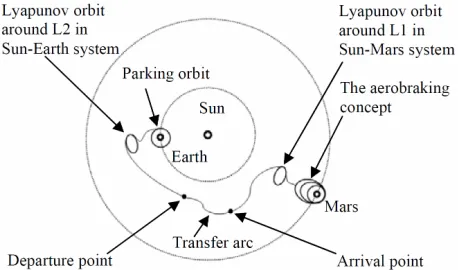
Figure 1 shows the whole transfer trajectory from Earth to Mars, which is divided into four stages: 1) the part of
transfer trajectory from Earth parking orbit to L2 Lyapunov orbit in Sun-Earth system; 2) the part of transfer trajec-tory from L2 Lyapunov orbit in Sun-Earth system to L1 Lyapunov orbit in Sun-Mars system; 3) the part of trans-fer trajectory from L1 Lyapunov orbit in Sun-Earth sys-tem to the large elliptical orbit around the Mars; 4) and the part of transfer trajectory from the large elliptical orbit around the Mars to near-Mars parking orbit. In this section, the circular restricted three-body problem is con-sidered. Using invariant manifolds of Lyapunov orbits around Lagrange points in Sun-Earth system and Sun- Mars system, the first three steps of low energy transfer trajectory are designed.
2.1. Equations of Motion
Consider a vehicle P of negligible mass move under the gravitational influence of two masses P1 and P2, referred to as the primary masses, or simply the primaries. P1 and
P2 have masses m1 and m2m1, with a unique pa-rameter m m2 1m2
0,1 2
. Assume that P1 and
P2 have circular orbits about their common center of mass. The vehicle P is free to move in the plane defined by the circular orbits of the primaries, but cannot affect their motion. In the usual rotating coordinate system, the origin is located at the mass center of primaries P1 and P2. The x-axis is always directed from the larger toward the smaller primary. The y-axis is 90˚ from the x-axis in the primary plane of motion. The z-axis completes the right handed system, defining the out of plane direction. To simplify the equations of motion, let us take the units of mass, length, and time, such that the sum of the masses of primaries P1 and P2, the distance between the prima-ries, the gravitational constant, and the period of the pri-maries are 1, 1, 1, and 2π, respectively.
Let
x y z, , be the position of the vehicle, the equa-tions of motion can be written as
x f x (1)
wherex
x y z x y z, , , , , ,
f1x f, 2 y f, 3z,4 2 x
f y U , f5 2x U y,f6 Uz.
In the equations above, U can be written as follows
2 21 2
1 1
2
U
r r x y
(2)
where
2 2
2 21 , 2 1
r x y z r x y z .
2.2. Lyapunov Orbit
In accordance with the Lindstedt-Poincare method, Ri- chardson got third-order approximation of periodic or quasi-periodic orbits as [27]
2 2 2 2
21 22 1 23 24 1
3 2
31 32 1
2 2
1 21 22 1
3 2
31 32 1
1 21 1
2 3
32 31 1 1
cos cos 2
cos3
sin sin 2
sin 3
cos cos 2 3
cos 2 3 cos 3
x z x x z
x x z
x x z
x x z
n z n x z
n x z z
x a A a A A a A a A
a A a A A
y kA b A b A
b A b A A
z A d A A
d A A d A
(3) where Ax and Az represent the amplitudes in x direction and z direction respectively, in addition, 1 ,
2 n n
, where σ represents the phase angle of xy, λ
represents frequency factor, τ represents the time of pe-riodic orbit, other parameters can be seen in literature [27]. Since Lyapunov orbits are located on the x-y plane, third-order expansions of Lyapunov orbit can be obtained after substituting Az = 0 into the Equation (3).
For third-order approximations are insufficient for se-rious study of accurate motion, analytical approximations must be combined with differential correction process to generate a Lyapunov orbit accurate enough for mission design. Initial conditions are chosen on the x-axis, and can be written as x0
x0, 0, 0, 0, , 0y0
. The equations ofmotion are integrated until the trajectory crosses the xy- plane, then the time when crossing occurs are expressed as ε,
;x0
denotes the trajectory. To produce aLyapunov orbit, a perpendicular crossing is needed, and so the target state vector needs to have the form
,0,0,0,
f xf yf,0. By adjusting the initial variables
x
0
x and , the final values xf and yf can be driven
to zero.
The difference of final states is written as following
; 0 0
0f
x x x ;x
0
(4)
Using the Taylor expansion Method and ignoring the higher-order term
; 0
f t
x g x (5)
where
;t0
g and
0
0
0 ;
;t t
x
. So, the
differential variables xf and yf can be expressed
as
45 4 0 25 2
f
f
x g y
y g
(6)
The state transition matrix can be computed numeri-cally by integrating simultaneously the following equa-tions
D
x f x f x
(7)
0 0,
0 6x x I 6
where Df(x) represents the Jacobian matrix, I6 6
repre-sents the 6 × 6 identity matrix.
The iteration process will be continue until
, within some acceptable tolerance. Then, combining third order approximation and differential cor-rection, we can get sufficient accurate Lyapunov orbits around L1 in Sun-Earth system and L2 in Sun-Mars sys-tem.
0
f f
x y
2.3. Invariant Manifolds of Lyapunov Orbit
The computation of the stable and unstable manifolds associated with a Lyapunov orbit can be accomplished numerically. The procedure is based on the monodromy matrix which is the state transition matrix after one period of a Lyapunov orbit. The characteristics of the local geometry of the phase space can be determined from the eigenvalues and eigenvectors of the monodromy matrix [14]. The eigenvectors can then be used in ap-proximating the local invariant manifolds near any point along the Lyapunov orbit. Let Ys and Yu denotes the sta-ble and unstasta-ble eigenvector of the monodromy matrix at a point X0 respectively. The initial values of the stable manifold and unstable manifold can be written as fol-lowing,
respectively. The initial guess of the stable mani-fold and unstable manimani-fold can be written as following
0 0 0 0
s d s u d u
X X Y X X Y (8) where d represents a micro constants.
By integrating the motion Equation (1) forward with the initial conditions of the stable manifold, we generate the stable manifold tube. By integrating the motion Equa-tion (1) backward with the initial condiEqua-tions of the unsta-ble manifold, we generate the unstaunsta-ble manifold tube. The results are shown in Figures 2-5.
From the simulation results in Figures 2-5, it can be seen that the expand direction of stable or unstable mani-fold is different if the positive and negative sign of the micro constant d is changed.
2.4. Trajectory Design from Earth Parking Orbit to Large Elliptical Orbit around Mars
Based on invariant manifolds and differential correction method, we can design the transfer trajectories from Earth parking orbit to large elliptical orbit around Mars. To link two specific points, a differential correction method is usually employed in designing intermediate transfer orbit [28]. The initial position and velocity, the time of flight (TOF), and the final position are specified, the ini-tial position and velocity are the numerically propagated for the given TOF and a state transition matrix relating the initial and final positions and velocities is computed.
0.99 0.995 1 1.005 1.01 1.015 -4
-2 0 2 4 6x 10
-3
x
y
Ax=0.0008
L2
(a) Lyapunov orbit and left part of stable manifold (d < 0)
1.01 1.015 1.02 1.025 1.03 -5
0 5 10 15
x 10-3
x
y
Ax=0.0008
L2
[image:4.595.326.515.411.705.2](b) Lyapunov orbit and right part of stable manifold (d > 0)
Figure 2. Stable manifold associated with Lyapunov orbit around L2 in Sun-Earth system.
0.99 0.995 1 1.005 1.01 -6
-4 -2 0 2 4 6x 10
-3
x
y
L2 Ax=0.0008
(a) Lyapunov orbit and left part of stable manifold (d < 0)
1.01 1.015 1.02 1.025 1.03 -5
0 5 10 15
x 10-3
x
y
Ax=0.0008
L2
(b) Lyapunov orbit and right part of stable manifold (d > 0)
0.994 0.996 0.998 1 1.002 1.004 -3
-2 -1 0 1 2 3
x 10-3
x
y
L1
Ax=0.0004
(a) Lyapunov orbit and left part of stable manifold (d < 0)
0.991-4 0.992 0.993 0.994 0.995 0.996 0.997 -3
-2 -1 0 1 2x 10
-3
x
y
Ax=0.0004
L1
[image:5.595.84.259.93.324.2](b) Lyapunov orbit and right part of stable manifold (d > 0)
Figure 4. Stable manifold associated with Lyapunov orbit around L1 in Sun-Mars system.
0.994-3 0.996 0.998 1 1.002 1.004 -2
-1 0 1 2 3 4x 10
-3
x
y
Ax=0.0004
L1
(a) Lyapunov orbit and left part of unstable manifold (d < 0)
0.991 0.992 0.993 0.994 0.995 0.996 0.997 -2
0 2 4 6x 10
-3
x
y
Ax=0.0004
L1
(b) Lyapunov orbit and right part of unstable manifold (d > 0)
Figure 5. Unstable manifold associated with Lyapunov orbit around L1 in Sun-Mars system.
0 0, 0
X x v and Xf x vf, f denote the initial state and the target state respectively. Since Lyapunov orbits locate on the x-y plane, x
x y, , 0
and
x y, , 0
v . xf,vf can be obtained from the
fol-lowing equation
0 11 12 00
0 21 22 0
,
f
f f
t t
x x φ φ x
v v φ φ v (9)
where the 6 × 6 matrix 6 6 has been decomposed into four 3 × 3 submatrices, tf and t0 represents the final TOF and the initial TOF respectively.
Note that, for the Equation (9), x0 is assumed to be equal to zero because the initial position is fixed. Then it is used with the 3 × 3 matrix 12 to update the initial velocity to reach the desired final location, that is
φ
12 ,0 0
f t tf
x φ v (10)
Usually, convergence to a solution is achieved within a few iterations.
2.4.1. Transfer Trajectory from Earth Parking Orbit to Lyapunov Orbit around L2 in Sun-Earth System
In this paper, the amplitude of L2 Lyapunov orbit in Sun-Earth system is Ax 0.0008. It can be seen that the expand directions of invariant manifolds depend on the value of d, as illustrated in Figure 2. So, the stable manifold of L2 Lyapunov orbit in the Sun-Earth System which corresponds to the condition of is selected. Afterwards, the manifold which is nearest to earth park-ing orbit is chosen as the standard manifold (as shown in Figure 6). According to the literatures [28,29], it indi-cates that the vehicle can enter the glide status earlier, which is advantageous to continuous working for pay-load, when a certain point on the manifold is picked as the initial point, therefore, we choose point A on the standard manifold as the initial point of the transfer tra-jectory, and a point on the parking orbit which orbit alti-tude is 200 km is selected as the target point B, in the end, we connect the orbits using the differential correction method. During this process, the integration should pro-ceed backwards with respect to time. The simulation re-sults is shown in the Figure 7, to minimize the energy consumption that from the Earth parking orbit to the sta-ble manifold, we should make the angle between the ve-hicle’s velocity vector on the intermediate transfer tra-jectory at point B and the vehicle’s velocity vector on the Earth parking orbit at point B equal to zero, so we choose the 1857th point (point A) on stable manifold as the ini-tial point, the flight time from the earth parking orbit to the stable manifold is 23.35 d, and the energy consump-tion is 4.223 km/s.
0
[image:5.595.72.265.406.702.2]1 1.005 1.01 -2
-1 0 1 2
x 10-3
x
y L2
[image:6.595.90.252.77.222.2]Standard manifold Earth
Figure 6. Standard manifold in Sun-Earth system.
1 1.005 1.01
-2 -1 0 1 2
x 10-3
x
y
(1857) 1900 2000
1800 100
200
300
400 600
700 800 900 1000 1100
1300
1400
1500
1700
L2
A B
Figure 7. Transfer trajectory designed by differential cor-rection process.
2.4.2. Transfer Trajectory between the Sun-Earth L2 Lyapunov Orbit and the Sun-Mars L1
Lyapunov Orbit
German and Frabcesco indicated that two-Circular Re-stricted three-body problems (CR3BP), having small mass parameters, do not allow the manifolds to develop for enough in order to approach each other, in more re-fined models contemplating the full solar system dynam-ics, a closer approach or even an intersection, after thou-sands of years, may occur [17,18]. Because mass pa-rameters of Sun-Earth system and Sun-Mars system are equal to 3.036 ×10⁻⁶ and 3.229 ×10⁻⁷ respectively, un-stable manifolds of L2 of the Sun-Earth system will not intersects with stable manifolds of
2 L1u L W
1s L W in the Sun-Mars system. To accomplish the L2 in Sun-Earth system to L1 in the Sun-Mars system transfer, an inter-mediate transfer orbit should be designed.
In this paper, the amplitude of L2 Lyapunov orbit of Sun-Earth system is Ax0.0008, and the amplitude of
L1 Lyapunov orbit of Sun-Mars system is Ax 0.0004. First, we should attempt to determine the two trajectories, which are on unstable manifold of L2 Lyapunov orbit of Sun-Earth system and stable manifold of L1 Lyapunov orbit of Sun-Mars system respectively, most closely ap-proach each other, called the standard manifolds. Then
we selected the appropriate initial angle of location the earth relative to Mars, here the angle is 60.
Case 1: Design of transfer trajectory in Sun-Earth system
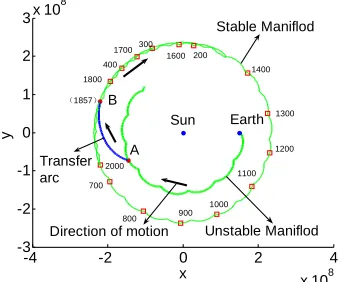
First, we convert the stable manifold associated with the Sun-Mars L1 Lyapunov orbit to the Sun-Earth rotat-ing coordinate system. Then, we connect the initial point
A on the unstable manifold of the Sun-Earth L2 Lyapunov orbit and the target point B on the stable manifold of the Sun-Mars L1 Lyapunov orbit using the differential cor-rection method, as shown in Figure 8. To minimize the energy consumption that from the unstable manifold of the Sun-Earth L2 Lyapunov orbit to the stable manifold of the Sun-Mars L1 Lyapunov orbit, we should make the angle between the vehicle’s velocity vector on the inter-mediate transfer trajectory at point B and the vehicle’s velocity vector on the stable manifold at point B should equal to zero, so we select the 1857th point (point B) on the stable manifold of L1 Lyapunov orbit in Sun-Mars system as the target point, in this process the fight time is 181.5 d. Table 1 shows the comparison results of inter-mediate transfer trajectory for Mars exploration, one is designed using invariant manifold of Lyapunov orbit, and the other is designed using invariant manifold of Halo orbit. From the comparison result, it can be seen that the costs in terms of ΔV using invariant manifold of Lyapunov orbit to design transfer trajectory is 3.78% less than the ones using halo orbit, and the time of flight us-ing invariant manifold of Lyapunov orbit to design trans-fer trajectory is 23.02% less than the one using halo or-bit.
-4 -2 0
3x 10
8
2 4
x 108 -3
-2 -1 0 1 2
x
Stable od
Eart Sun
Manifl
h
y
A B
Transfer arc
Unstable Maniflod
2000
200 300 400
700
800 900 1000
1100 14 1600
1200 1300 00 1800
1700
(1857)
[image:6.595.93.254.255.392.2]Direction of motion
[image:6.595.338.509.471.612.2]Figure 8. Transfer trajectory designed in Sun-Earth rotat-ing coordinate system.
Table 1. Cost comparison for design transfer trajectorybe-tween L2 in the Sun-Earth system and L1 in the Sun-Earth system.
1 -min km s sum
V
TOF/d
[image:6.595.309.539.691.736.2]Case 2: Design of transfer trajectory in Sun-Mars system
First, the unstable manifold of the Sun-Earth L2 Lyapunov orbit is converted to the Sun-Mars rotating coordinate system. Let point A on the stable manifold of the Sun-Mars L1 Lyapunov orbit is chosen as the initial point, and point B on the unstable manifold of the Sun- Earth L2 Lyapunov orbit is chosen as the target point. The intermediate transfer trajectory is designed to con-nect the initial point A and the target point B using the differential correction method, as shown in Figure 9. During this process, the integration should proceed back-wards with respect to time. To minimize the energy con-sumption that from the unstable manifold of the Sun- Earth L2 Lyapunov orbit to the stable manifold of the Sun-Mars L1 Lyapunov orbit, we should make the angle between the vehicle’s velocity vector on the intermediate transfer trajectory at point B and the vehicle’s velocity vector on the unstable manifold at point B should equal to zero, so we select the 971th point on the unstable manifold of L2 Lyapunov orbit in Sun-Earth system as the target point B, and this process the fight time is 219.4d. Table 2 shows that the costs in terms of ΔV us-ing invariant manifold of Lyapunov orbit to design trans-fer trajectory is 9.32% less than the one using halo orbit, and the time of flight using invariant manifold of Lyapunov orbit to design transfer trajectory is 23.02% less than the one using halo orbit.
-2 -1 0 1 2 3
x 108 -2
-1.5 -1 -0.5 0 0.5 1 1.5x 10
8
x
y
Mars
Stable Manifold Transfer
arc Sun
Direction of motion B
A Unstable Manifold
300 200 400
500
600
700
800 900
1000
(971)
1100 1200 1300 1400 1500 1600
1700
1800
1900
[image:7.595.66.280.434.603.2]2000
[image:7.595.58.287.681.734.2]Figure 9. Transfer trajectory designed in Sun-Mars rotat-ing coordinate system.
Table 2. Cost comparison for design transfer trajectorybe-tween L2 in the Sun-Earth system and L1 in the Sun-Mars system.
1 -min km s sum
V
TOF/d
Based on manifolds of Lyapunov orbits 5.567 219.4
Based on manifolds of halo orbits 6.139 285
2.4.3. Transfer Trajectory from the Sun-Mars L1 Lyapunov Orbits to the Large Elliptical Orbit around the Mars
As shown in Figure 5, we can see that expansion direc-tion of the manifold depend on the positive and negative sign of d. So, the unstable manifold of the Sun-Mars L1 Lyapunov orbit which corresponds to d0 is selected. For the amplitude of L1 Lyapunov orbit in Sun-Mars system is Ax0.0004, the closet distance between the unstable manifolds of L1 Lyapunov orbit and Mars is 4107.6 km.
Note that the aerobraking method will be applied to design the transfer trajectory from the large elliptical orbit around the Mars to near-Mars parking orbit. In this paper, the apareon of the large elliptical selected is 50,000 km, so the manifolds of L1 Lyapunov orbit whose am-plitude is Ax0.0004 can reach the apareon of the large elliptical orbit around the Mars, and a maneuver is needed to adjust the vehicle’s velocity vector on the apareon when the manifolds intersect the large elliptical orbit to make the vehicle from the manifolds to the large elliptical orbit around the Mars, this stage need not to use the differential correction method. In the simulation from
L1 Lyapunov orbits to the Large elliptical orbit around the Mars, the flight time is 276.8 d, the energy consump-tion is 3.246 km/s.
3. Transfer Trajectory Design Based on
Aerobraking Method
In this section, the two-body problem is considered. Based on aerobraking, the transfer trajectory from the large elliptical orbit around the Mars to near-Mars park-ing orbit is designed, as shown as Figure 1. This study establishes the dynamics equations for the Mars vehicle, both in the static and rotating atmospheric environment. A comparative performance analysis of atmospheric mod-els was carried out using details of the duration, aerody-namic loading of the Mars vehicle, and other orbital pa-rameters.
3.1. Equations of Motion
Let us set the inertial coordinates of Mars as OXYZ. The origin O is right at the center of mass of Mars and XY
plane is the equatorial plane of Mars; the x-axis indicates the direction of periareon whereas the z-axis indicates the direction of rotation of Mars. The y-axis, x-axis, and
z-axis form a right-handed system. After the Mars vehi-cle crosses through the atmosphere, the kinetic vector equation can be written as follows
2 2 d d
m
t
r
D L G (11)
the atmospheric lift vector, and the gravity vector acting on the Mars vehicle, respectively; r is the distant vector from the Mars vehicle to the center of Mars.
The atmospheric lift acceleration vector, the atmos-pheric drag acceleration vector, and gravity acceleration of the Mars vehicle are expressed, respectively, as
2 2
3
1 1
2 D r 2 L r
r
C S v C S v
v m r
vr
D L E G r
m m (12)
where CL and CD represent the coefficient of the atmos-pheric lift and the atmosatmos-pheric drag, respectively; S and
m represents the area and the mass of the Mars vehicle, respectively; vr represents the velocity vector of the Mars
vehicle in relation to the atmosphere, where vr v vg,
v is the velocity vector of the Mars vehicle in the inertial coordinate of Mars, and vg is the velocity vector of the
atmosphere in the inertial coordinate of Mars. Moreover,
g
v r, where is the angular velocity vector of Mars. Otherwise, the atmospheric density of the external rotation atmosphere of Mars can be expressed as [24]
0.000165
0e
H
(13)
where H stands for the height of the orbit that the Mars vehicle occupies. In addition, the E in Equation (12) can also be written as following
r
r r
v r v E
v r v
r (14)
By factoring Equations (12)-(14) into Equation (11), the motion equation of the Mars vehicle in the inertial coordinate of Mars can be obtained.
3.2. Simulation and Analysis
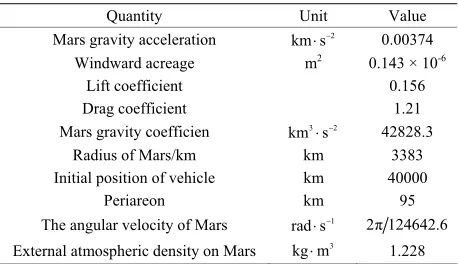
The results of this study can be considered on the basis of the differences in the results of simulation, shown in the dynamics equation, of the Mars vehicle when subjected to two types of atmospheres. The initial position of the Mars vehicle is the apareon; the other initial parameters are shown in Table 3. The initial velocity of the Mars vehicle can be written as:
Table 3. Initial parameters.
Quantity Unit Value
Mars gravity acceleration km s 2 0.00374 Windward acreage m2 0.143 × 10⁻⁶
Lift coefficient 0.156
Drag coefficient 1.21
Mars gravity coefficien km s3 2 42828.3 Radius of Mars/km km 3383 Initial position of vehicle km 40000
Periareon km 95
The angular velocity of Mars rad s 1 2π124642.6 External atmospheric density on Mars kg m 3 1.228
11
e a v
e
(15)
In this equation, e is the orbital eccentricity and a is the semimajor axis of the orbit.
Case 1: Comparison of orbital parameters
In this case, the orbitinclination is set to 3.9653˚and the longitude of the ascending node of the orbit is 0.573˚, other initial parameters are presented in Table 3. From the simulation results shown in Figures 10 and 11, it can be seen that with multiple crossings of the Mars vehicle through the atmosphere, the disparity of changes in the orbital semimajor axis and the orbital eccentricity in the two atmospheric models is small; however, in the rotat-ing atmosphere model, the change in the cycle of the
0.62 0.625 0.63 0.635 0.64 2.25
2.3 2.35 2.4 2.45x 10
4
Time(days)
O
rb
it
a
l s
e
mi
ma
jo
r a
x
is
(k
m
) Curve of orbital semimajor axis changes in rotating atmospheric model Curve of orbital semimajor axis changes in static atmospheric model
(a) The first time crossing through the atmosphere
1.81 1.815 1.82 1.825 1.83 2.2
2.25 2.3 2.35
x 104
Time(days)
O
rb
it
a
l se
m
im
a
jo
r a
x
is(
k
m
) Curve of orbital semimajor axis changes in rotating atmospheric model Curve of orbital semimajor axis changes in static atmospheric model
(b) The second time crossing through the atmosphere
2.93 2.94 2.95 2.96 2.1
2.15 2.2 2.25
x 104
Time(days)
O
rb
it
a
l s
e
m
im
a
jo
r a
x
is
(k
m
) Curve of orbital semimajor axis changes in rotating atmospheric model Curve of orbital semimajor axis changes in static atmospheric model
[image:8.595.58.287.603.735.2](c) The third time crossing through the atmosphere
0.62 0.625 0.63 0.635 0.64 0.845
0.85 0.855 0.86
Time(days)
Or
bi
tal
ecc
e
ntr
ici
ty
Curve of orbital eccentricity changes in rotating atmospheric model Curve of orbital eccentricity changes in static atmospheric model
(a) The first time crossing through the atmosphere
1.81 1.815 1.82 1.825 1.83 0.84
0.845 0.85 0.855
Time(days)
Orbi
tal
ec
c
entri
ci
ty
Curve of orbital eccentricity changes in rotating atmospheric model Curve of orbital eccentricity changes in static atmospheric model
(b) The second time crossing through the atmosphere
2.93 2.94 2.95 2.96 0.83
0.835 0.84 0.845 0.85
Time(days)
Orbi
tal
ec
ce
ntri
c
it
y
Curve of orbital eccentricity changes in rotating atmospheric model Curve of orbital eccentricity changes in static atmospheric model
[image:9.595.90.255.81.510.2](c) The third time crossing through the atmosphere
Figure 11. The curve of orbital eccentricity changes in dif-ferent time periods.
orbital semimajor axis a and the orbital eccentricity e
becomes longer, compared with that in the static atmos-pheric model; this marks the emergence of “hysteresis”. Thus, it is evident that the rotating atmospheric model influences the time that the Mars vehicle reach the target orbit.
The simulation results shown in Figures 12 and 13 validate the accuracy of the Gaussian perturbation theory [25], which holds that the change of the orbital inclina-tion and the longitude of the ascending node of the orbit are zero in the static atmosphere model; in the rotating atmospheric model, the orbital inclination and longitude of the ascending node of the orbit
i
i
are found to decrease, but the variation of is so small that the orbital plane can be approximated to appear without change.
i,0 1 2 3 4 5
3.9652 3.9652 3.9652 3.9653 3.9653 3.9653
Time(days)
D
egree
Changes in the curve of orbital inclination in rotating atmospheric model
[image:9.595.347.503.87.197.2]Changes in the curve of orbital inclination in static atmospheric model
Figure 12. Changes of orbital inclination.
0 1 2 3 4 5 0.56
0.565 0.57 0.575 0.58 0.585 0.59 0.595
Time(days)
De
g
re
e
[image:9.595.346.502.229.348.2]Changes in the curve of the longitude of the ascending node of the orbit in rotating atmospheric model Changes in the curve of the longitude of the ascending node of the orbit in static atmospheric model
Figure 13. Changes of the longitude of the ascending node of the orbit.
The article described the findings of a study evaluating variations in parameters contributing to differences in the longitude of the ascending node and the orbital inclina-tion. The research data show that, when the orbital incli-nation changes in the range of 0˚ - 9˚ (the longitude of the ascending node of the orbit can be obtained from the formula provided). In the two atmospheric models, or-bital parameters (such as the oror-bital semimajor axis and orbital eccentricity) were found to differ by 4% to 10%.
Case 2: Comparison of time and cost
In this case, a 400 × 400 target track was provided, and some relevant conclusions were obtained through the simulation results. In this model, the orbit inclination was 10˚ and the longitude of the ascending node of the orbit was 60˚. The other initial values are shown in Table 3.
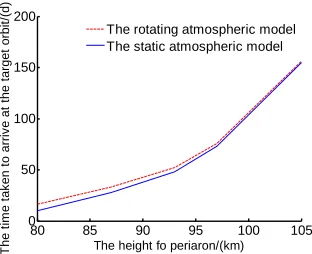
From the simulation results shown in Figure 14, it can be seen that, when the height of the periareon is less than 105 km, the time the Mars vehicle takes to reach the tar-get orbit under the static atmospheric model is less than the time it takes in the rotating atmosphere model. In addition, in the two types of atmospheric models, the biggest difference in the time taken by the Mars vehicle to reach the target orbit is about 6.2 days. Further, if the height of the periareon is more than 105 km, the time taken by the Mars vehicle to reach the target orbit both the atmospheric models will basically be the same.
Table 4. Cost comparison for transfer under two atmos-pheric models.
80 85 90 95 100 105 0
50 100 150 200
The height fo periaron/(km)
T
he
ti
m
e t
ak
en
to arr
iv
e
at
t
he t
arget
o
rbit
/(
d)
The rotating atmospheric model The static atmospheric model
Periareon/km
Transfer from actual orbit to target orbit in rotating
atmospheric model
Δν/km·s−1
Transfer from actual orbit to target orbit in static
atmospheric model
Δν/km·s−1
90 0.143 0.156
95 0.162 0.185
100 0.196 0.211
Figure 14. Change of time taken to arrive at the target orbit
in different periareon heights. body problem is considered. The four-body problem, In the first three stages, the circular restricted three- Sun-Earth-Mars-vehicle, is decomposed into two copla-nar circular restricted three-body problems, Sun-Earth- Vehicle and Sun-Mars-vehicle. In the first stage, the in-variant manifolds of L2 Lyapunov orbit in Sun-Earth system cannot reach the earth parking orbit, so the dif-ferential correction method is applied accompany with invariant manifolds. In the second stage, the unstable manifold of L2 Lyapunov orbit in Sun-Earth system will not intersect with stable manifold of L1 Lyapunov orbit in Sun-Mars system, so the transfer trajectory is designed combining the invariant manifold and the differential correction method. To compare with the intermediate transfer trajectory designed by the invariant manifolds of Halo orbit, the results show that using the invariant manifold of Lyapunov orbit has advantages in energy consumption and time of flight, reducing energy con-sumption 3.78 percent and reducing flight time 23.02 percent in Sun-Earth system, and reducing energy con-sumption 9.32 percent and reducing flight time 23.02 percent in Sun-Mars system. In the third stage, the in-variant manifold of L1 Lyapunov orbit in Sun-Mars sys-tem can reach the apareon of the large elliptical orbit around the Mars, so only a maneuver is applied to adjust the velocity of the vehicle, and the differential correction method is not needed.
lower the height of the periareon selected, the greater the atmospheric density becomes. Although the relative ve-locities of the vehicle in the two atmospheric models are different, the gap between them is very small. In addition, the effect on the orbit of the Mars vehicle is more obvi-ous in the rotating atmospheric model. Therefore, when the periareon is low, the time taken to reach the target orbit in the two atmospheric models is different; however, when the height of the periareon is high, the atmospheric density become smaller. Although the relative velocity value of the Mars vehicle and the atmosphere will in-crease in the rotating atmospheric model, the difference in the time taken to reach the target orbit in the two atmospheric models is small because the rotational an-gular velocity of the external rotation atmosphere of Mars is small.
Table 4 shows the increment in the velocity of transfer from actual to target orbit with different periareons of the Mars vehicle in two different atmospheric models. From the contrast shown in the Table 4, it can be seen that, as the height of the periareon increases, the velocity incre-ment consumption of the Mars vehicle in the two atmos-pheric models shows a trend to increase. In addition, the consumption rate of increment for the detector under the rotating atmospheric model is bigger than that under the static atmospheric model. The biggest difference between these two models is about 10.8%.
In the fourth stage, the two-body problem is consid-ered, and the aerobraking method is applied. By com-parative analysis of the simulation results of the dynam-ics equations of the Mars vehicle in the static and rotat-ing atmospheric environments, it can be observed that, in the low periareon, because of higher atmospheric density, the differences in the orbital parameters between the ro-tating and static atmospheric environments are higher, thus, the time taken by the Mars vehicle to reach the tar-get orbit is different in the two atmospheric models, and the time gap is marked. Moreover, when the periareon in two atmospheric environment models is of the same height, the inclination and longitude of the ascending node of the orbit in the rotating atmospheric environment showed a subtle change, whereas that in the static at-mospheric environment remained unchanged.
4. Conclusions
Transfer trajectory design for Mars exploration is apply-ing combination of invariant manifolds, differential cor-rection and aerobraking method. The whole transfer tra-jectory is divided into four stages: the part from Earth parking orbit to Lyapunov orbit around Lagrange point
[image:10.595.308.537.113.204.2]5. Acknowledgements
This research was supported by the National Natural Science Foundation of China (10832004, 11102006), and the Fan-Zhou Foundation (20110502).
REFERENCES
[1] J. Barrow-Green, “Poincare and the Three-Body Prob- lem,” American Mathematical Society-London Mathe- maticl Society, Providence, 1997.
[2] B. Wie, “Space Vehicle Dynamic and Control,” Ameri-can Institute of Aeronautics and Astronautics, Reston, 1998.
[3] R. W. Farquhar, “The Flight of ISEE-3/ICE: Origns, Mis-sion History, and a Legacy,” AAS/AIAA Astrodynamics Specialist Conference and Exhibit, Boston, 10-12 August 1998, pp. 98-4464.
[4] P. Sharer and T. Harrington, “Trajectory Optimization for the ACE Halo Orbit Mission,” AAS/AIAA Astrodynam- ics Specialist Conference, San Diego, 29-31 July 1996, pp. 96-3601.
[5] P. Sharer and D. Folta, “Wind Extended Mission De- sign,” AAS/AIAA Astrodynamics Conference, San Diego, 29-31 July 1996, pp. 96-3640.
[6] H. Franz, P. Sharer, K. Ogilvie and M. Desch, “Wind Nominal Mission Performance and Extended Mission Design,” AAS/AIAA Astrodynamics Specialist Confer- ence and Exhibit, Boston, 10-12 August 1998, pp. 98- 4467.
[7] O. O. Cuevs, L. Kraft-Newman, M. A. Mesarch and M. Woodard, “An Overview,” AAS/AIAA Astrodynamics Specialist Conference and Exhibit, Monterey, 5-8 August 2002, pp. 2002-4425.
[8] M. A. Mesarch, D. Rohrbaugh and C. Schiff, “Contin-gency Planning for the Microwave Anisotropy Probe Mission,” AAS/AIAA Astrodynamics Specialist Confer- ence and Exhibit, Monterey, 5-8 August 2002, pp. 2002- 4426.
[9] S. Stalos, D. Folta, B. Short, J. Jen and A. Seacord, “Op- timum Transfer to Largeamplitude Halo Orbit for the So- lar and Heliospheric Observatory,” AAS/GSFC Interna- tional Symposium on Space Flight Dynamics, Greenbelt, 26-30 April 1993, pp. 93-553.
[10] W. S. Koon, M. W. Lo, J. E. Marsden and S. D. Ross, “Dynamical Systems, the Three-Body Problem, and Space Mission Design,” Springer, Berlin, 2007.
[11] M. W. Lo, “The Interplanetary Superhighway and the Origins Program,” IEEE Aerospace 2002 Conference, Big Sky, 9-16 March 2002, pp. 3543-3562.
[12] W. S. Koon, W. Martin, M. W. Lo, J. E. Marsden and S. D. Ross, “Shoot the Moon,” AAS/AIAA Astrodynamics Specialist Conference, Clearwater, 2000, pp. 100-167. [13] W. S. Koon, M. W. Lo, J. E. Marsden and S. D. Ross,
“Low Energy Transfer to the Moon,” Celestial Mechan-ics and Dynamical Astronomy, Vol. 81, No. 1-2, 2001, pp. 63-73.doi:10.1023/A:1013359120468
[14] G. Gomez, W. S. Koon, M. W. Lo, J. E. Marsden and J. J. Masdemont, “Connecting Orbits and Invariant Manifold in the Spatial Restricted Three-Body Problem,” Nonlin- earity, Vol. 17, No. 5, 2004, pp. 1571-1606.
doi:10.1088/0951-7715/17/5/002
[15] K. C. Howell, D. L. Mains and B. T. Barden, “Transfer Trajectories from Earth Parking Orbits to Sun-Earth Halo Orbits,” AAS/AIAA Spaceflight Mechanics Meeting, Co-coa Beach,14-16 February 1994, pp. 94-160.
[16] E. A. Belbruno and J. K. Miller, “Sun-Peturbed Earth-to- Moon Transfers with Ballistic Capture,” Journal of Guid- ance, Control, and Dynamics, Vol. 16, No. 4, 1993, pp. 770-775. doi:10.2514/3.21079
[17] G. P. Alonso, “The Design of System-to-System Transfer Arcs Using Invariant Manifolds in the Multi-Body Prob- lem,” Ph.D. Dissertation, Purdue University, West Lafay- ette, 2006.
[18] F. Topputo, M. Vasile and A. E. Finzi, “Combining Two and Three-Body Dynamics for Low Energy Transfer Tra-jectories of Practical Interest,” Proceedings of the 55th International Astronautical Congress, Vancouver, 4-8 October 2004, pp. 584-596.
[19] M. Xu and S. J. Xu, “Stability Analysis and Transiting Trajectory Design for Retrograde Orbits around Moon,” Journal of Astronautics, Vol. 30, No. 5, 2009, pp. 1785- 1791.
[20] M. J. Capinski, “Lyapunov Orbits at L2 and Transversal Intersections of Invariant Manifolds in the Jupiter-Sun Planar Restricted Circular Three-Body Problem,” 2011. http://arxiv.org/pdf/1109.1439v2.pdf
[21] J. Llibre, J. R. Martlnez and C. Simo, “Transversality of the Invariant Manifolds Associated to the Lyapunov Fam- ily of Periodic Orbits near L2 in the Restricted Three- Body Problem,” Journal of Differential Equations, Vol. 58, No. 1, 1985, pp. 104-156.
doi:10.1016/0022-0396(85)90024-5
[22] H. X. Baoyin and C. R. McInnes, “Trajectories to and from the Lagrange Points and the Primary Body Sur- faces,” Journal of Guidance, Control and Dynamics, Vol. 29, No. 4, 2006, pp. 998-1003.doi:10.2514/1.17757 [23] S. P. Gong, J. F. Li and H. X. Baoyin, “Lunar Landing
Trajectory Design Based on Invariant Manifold,” Applied Mathematics and Mechanics, Vol. 28, No. 2, 2007, pp. 201-207.doi:10.1007/s10483-007-0208-1
[24] X. Min, T. Pan and H. Guo, “Analysis of Orbit Capture Method for Mars Vehicle,” Spacecraft Engineering, Vol. 17, No. 6, 2008, pp. 39-43.
[25] F. Xiao, “Man-Made Earth Satellite Orbit Perturbation Theory,” Press of National University of Defense Tech- nology, Changsha, 1995, pp. 178-192.
[26] Kh. I. Khalil, “The Drag Exerted by an Oblate Rotating Atmosphere on an Artifical Satellite,” Applied Mathe-matics and Mechanics, Vol. 23, No. 9, 2002, pp. 903-915. doi:10.1007/BF02437712
of Dynamical Systems Theory to Trajectory Design for a Lagrange Point Mission,” Journal of Astronautical Sci- ences, Vol. 45, No. 1, 1997, pp. 161-178.
[29] K. C. Howell, B. T. Barden, R. S. Wilson, etal., “Trajec- tory Design Using a Dynamical Systems Approach with