A New Approach for Wireless Cellular Network Design
Hamed Saghaei1, Hamideh Saghaei2, Malihe Darvishi1
1Faculty of Engineering, Islamic Azad University, Shahrekord Branch, Shahrekord, Iran 2School of Mathematics, Iran University of Science and Technology, Tehran, Iran
Email: [email protected]
Received August 24, 2012; revised October 13, 2012; accepted October 23, 2012
ABSTRACT
Wise arrangement of antennas is critical in wireless cellular systems for both reduction of co-channel interference (CCI) and increase the quality of service (QoS). In this paper, a novel architecture for antenna arrangement in CDMA wireless cellular systems is presented. In this architecture that we called Microzone, every cell is divided into three (or more) zones and information transmission in downlink channel is done by an antenna which is placed at the outer region of the related zone. Also, the transmitting signal by the mobile station (MS) in uplink channel is received by all the antennas of the related cell. Analytical calculations of the received signal to noise ratio (SIR) and outage probability for both microzone and used architectures show that proposed architecture has better performance in compared with the used architecture. Also, simulation results confirm lower outage probability in uplink channel for microzone architecture.
Keywords: Microzone Architecture; Used Architecture; Interference; Outage Probability; Co-Channel Interference (CCI)
1. Introduction
Frequency reuse in wireless cellular systems based on either code division multiple access (CDMA) or fre- quency/time division multiple access (FDMA-TDMA) results in co-channel interference (CCI) which is one of the major factors that limits the capacity of cellular sys- tems [1]. Co-channel interference arises when the same carrier frequency is used in different cells. In this case, the power spectral density of the desired and interfering signals completely overlap [2]. The generated levels of CCI can be controlled by the use of several techniques such as cell sectoring [3], smart antennas [4], power con- trol [5], discontinuous transmission [2], effective hand- off algorithms, macroscopic base station (BS) diversity and etc. The impact of CCI on the radio link can be mitigated using many techniques such as interference cancellation [6], error control coding, and antenna diver- sity against of commonly used techniques, this paper proposes a novel architecture for the antenna arrange- ment. This paper is organized as follows. In Section 2, cellular architectures are introduced. System model is in- vestigated in Section 3. Simulation results shown in Sec-tion 4 and SecSec-tion 5 conclude the paper.
2. Cellular Architectures
The aim of this section is introducing the used and the microzone architectures. In Figure 1, the used archi-
tecture is shown that it includes many clusters to cover a big area in which each cluster encompasses 1, 3, 5, or 7 cells [7]. Every cell has a base station (BS) which is located at the center of the cell. Cell sectoring may be used which is a way for increasing the system capacity while keeping the cell radius constant. It is a process of replacing one omnidirectional antenna at the BS by several directional antennas. Each of these antennas radiates within a specific sector of the cell. Directional antennas, therefore, minimize interference for a given cell by receiving and transmitting with only a fraction of available co-channel cells, so the QoS will be increased [8]. The degree of interference minimization depends on the amount of used sectors. In general, a sector corre- sponds to or 12 . Since each sectorized antenna ra- diates within a specific sector, each sector is allocated a subset of the frequency channels available for the cell. When sectoring is used, the channels in a particular cell are broken down to sectored groups. Figure 2 shows that sectoring reduces the co-channel interference (CCI) by a factor of six, while the sectoring reduces it by a factor of three [4]. Figure 3 shows microzone architec- ture in which, each of cells is divided into three (or more) zones and each zone has an antenna that is connected by cable or microwave link to the BS of the Cell. Antennas are placed at the outer edge of a cell. Cells are shown by circles, while zones are represented by hexagons cir- cumscribed within each circle. The microzone antennas
60 0
60
300 m - 35 km
Figure 1. Used architecture [5].
3
2
1 1
2
3 4 5 6
[image:2.595.61.284.398.586.2](a) (b)
Figure 2. Cell sectoring: (a) sectoring; and (b) sec- toring [5].
120 60
Cell D
Cell E
Cell F
Cell C
Cell B
Cell A
D1 C1
B1
E1
F1
A1
Location of Mobile Unit
Figure 3. Microzone architecture for one cell per cluster (i.e., frequency reuse factor equals to one).
are designated by black semi-circles and mobile station (MS) is determined by black triangular. When a MS travels within the cell, its transmitted signal in uplink channel is received by all antennas in a cell and by the use of diversity technique, i.e., maximum ratio com- bining (MRC); so that an acceptable level of the received signal is achieved. Another advantage of this architecture is remaining a MS in the same cell with same frequency band as long as it travels from one zone to another within
the cell. Therefore, unlike sectoring, handoff is not re- quired when the MS travel zone to zone in a cell, and only, the BS switches the signal from one zone to another. In this case, the used antennas are directional and the microzone architecture is configured similar to used architecture (i.e., it has 1, 3, 5 or 7 cells per cluster).
3. System Model
The transmitted signals of all users will be experienced with the channel attenuation that is the most important specification of the radio channel which is shown by and calculated as follows [2]
h
,
p s m
hh h h (1) where p represents the path loss that is the large-scale distance-dependent attenuation in the average signal power.
h
s
h shows shadowing loss that is the medium- scale attenuation, which is caused by reflections, refrac- tions and diffractions of the signal from buildings, trees, and rocks. These result in relatively slow variations in the mean signal power and modeled as a log-normally distributed random variable and known as slow fading.
m represents the multipath fading or fast fading at-
tenuation, which is the rapid fluctuation in the received signal power that is caused by the constructive and de- structive addition of the signals that propagate through different paths with different delays from the transmitter to the receiver. In urban environment the number of sig- nificant signal paths is typically much larger than rural areas. This is called the multipath spread, which is the time between the first occurrence of the transmitted sig- nal at the receiver and the last significant reflection of the same signal at the receiver [9]. If the multipath spread is smaller than the inverse of the bandwidth of the informa- tion-bearing signal, i.e., smaller than the duration of a transmitted symbol, then the fading is said to be fre- quency-non-selective or flat fading [7]. [10] proposes a model for a Rayleigh fading channel with the required spectral properties based on a sum of sinusoids which is used in this paper. Based on these concepts, the channel gain,
h
g, is calculated as [7]
10
1
10 ,
p
g A d A
h
f (2)
where Ap depends on the transmission wavelength
, the antenna gain of the transmitter
gT and theantenna gain of the receiver
gr that is given by [7]
22 4π ,
p T r
A g g (3) and is the distance between the transmitter and the receiver,
d
f
A is assumed to be independent exponentially distrib- uted random variable (In a Rayleigh fading environment, the received signal envelop, Af has a Rayleigh dis- tribution and its power, Af
, has an exponential distribu- tion). In other words, the received power at the BS from a MS is an exponentially distributed random variable.
Transmitted signals are also polluted by additive white Gaussian noise (AWGN). In CDMA systems, co-channel users’ interference power is much greater than the noise power, and then we use interference power instead of users’ interference plus noise power in the following analysis. Therefore, the ratio of the transmitted signal power to interference power is called signal to interfere- ence ratio (SIR).
3.1. Received SIR in Uplink for Used Architecture Based on Figure 1
If MS is served by BS, Then the uplink measured SIR for MS at time is calculated as
-i th b th
-i th k
1,
, bi bj i g k k g k i
bi N G
j b j j p k P p k
(4)where p ki
,gbi
k and b are the transmitted powerof user , link gain between MS and BS b at time (which is an exponentially distributed random vari- able) and the noise power which is additive white Gaus- sian noise (AWGN), respectively. is the number of users that distributed in environment, G is the proc-
essing gain which equals to
i i
N k
P
w R
that is the total spread spectrum bandwidth occupied by the CDMA sig- nals and is the bit rate transmitted from MS . Note that in a Rayleigh fading channel, biw
R i
is a random variable with a complex distribution, since it has a ratio of an exponential random variable to a sum of exponen- tial random variables with different means. For reliable connection the received SIR should be more than the target value, i.e.,
bi
biT
We assume that the quality of service (QoS) requested is provided when the SIR exceeds a given threshold
r k r [2].
th . The outage probability of the user at time is given by
-i th k
use Pr Pr d, 1, 1, Prob ob ob ,i b i
bi i th
G i
N
bj b
j j i
N
bi i bj j b
j j i
O k
g k
P g k
g k p k g k p k
th i j th i G k p k p k P , , z z (5)Lemma 1: Suppose 1 2 are independent ex-
ponentially distributed random variables with mean
,zn
E zi 1i
, and is a constant, then c1
1 1 1
2 2
Prob n 1 e c 1
i
n
i
i i
z z c
(6)Proof: See Appendix 1.
The mean value of the received power in BS from MS at time is given by
-b th
-i th k
bi i bi i
E g k p k g k p k (7) Using Equation (6), the measured outage probability is calculated as
used, 11 e b ith G bi 1
i
th
P g k i bj j
j i G bi i
O k
g k p k
P g k p k
i p k
(8)
3.2. Received SIR in Uplink for Microzone Architecture Based on Figure 3
In wireless systems, in many situations, there may not be a line-of-sight between the MS and the BS. Therefore, transmitted signals are received from different paths with different delays at the receiver and this causes abrupt increases or decreases in the received signal power. This problem is more troublesome in uplink channel due to the low transmitting power of the MS. In microzone ar- chitecture because of using zones in each cell, antenna diversity in the BS is used in uplink channel to overcome this problem. Also, the distance between each pair of antennas is at least several times greater than the trans- mitted signal wavelength, so that the signal transmission paths would stay independent from each other. Then, if the probability of a received signal from an antenna falls below the threshold, equals P, the probability that all the received signals by L antennas simultaneously falls below the threshold, would be L
P , which is considerably smaller than P . If MS is served by BS includes an antenna in each zone. Then the uplink meas- ured SIR from antenna at time is calculated as
-i th b th
-1-th k
1 1 1 1 1, , i i i G N j jj j i
g k p k
k P
g k p k
(9)The received signals by all antennas are combined us- ing MRC algorithm [8] at the BS, in which a specific weight is allocated to each antenna where this weight is given by
1 , li li L li l k w k k (10)
-4) Handoff is not required when the MS travel in a cell.
antenna at time and k li is the received SIR of the
antenna related to zone l and the output of the diversity combiner,
-l th
,
div i
, is calculated as
l
Because of using diversity technique, antenna arrange- ment, and above mentioned reasons
.div,i k li k
1
L li
k w
(11)
Micro,i used,i
O k O k
Equation (10) shows that using diversity technique, greater value of the received SIR is achievable and pos- sible in microzone architecture.
that is shown and confirmed by the simulation results in the next section.
4. Simulation Results
We assume that the quality of service (QoS) requestedis provided when the output of the diversity combiner, ,
div i
exceeds a given threshold
th . The outage pro- bability of the i th- user at time is given by
k
,
,
1
1,
N
j j k
Prob
Prob
Micro i
div i
L
th
G i
l
j l
O k
k k
P p k th
i
li
lj i w k
li g
g k i p
In this section, the simulations are done for used and mi- crozone architectures to investigate the system perform- ance. Based on Figure 2(a), for used architecture, the cell sectoring is assumed. Also, the gain of each sectorized antenna is supposed to be0 d , which is kept constant during the simulations. In the microzone system, it is not possible to use omnidirectional antennas, be- cause the antennas must be located at the outer edge of any cell and cover only the related zones. However, both and antennas are employed in the microzone system but in these simulations, we use only an- tennas to have the same conditions with the used archi- tecture. The BS antennas for the uplink are assumed to be identical. The cluster sized is assumed by the value of 1. The number of users that are uniformly distributed over a cell is 40. Each user generates its data at a constant rate of
120
60
B
120
120
45
(12)
Microzone architecture has some advantages that are listed as follows.
1) The received SIR is increased by the use of diver- sity technique;
2) If users uniformly distributed in a cell then a large number of them are distributed at the regions near to an- tennas of a cell in compared with the used architecture. Therefore, by the use of microzone architecture, the re- ceived SIR is also increased;
kb s. The generated data is modulated using BPSK and then, using corresponding spreading sequence, the data is spread with a rate of 3.8 Mchip s
dB
0 dB
(therefore, the processing gain will be ). The spreading signals are transmitted in the uplink channel. Here, the SIR threshold is supposed to be about for every user. The transmitting signals are corrupted by AWGN with a
19.3
3) An increase in the received SIR will decrease the outage probability and finally, network capacity and performance will be increased;
0 100
10-1
10-2
10-3
10-4
Used Architecture Microzone Architecture
Ou
ta
ge
Prob
ab
il
it
y
[image:4.595.70.286.245.340.2]2 4 6 8 10 12 14 16 18 20 SIR(dB)
[image:4.595.89.511.502.718.2]mean of zero and a standard deviation of . Here we ignore the effect of Doppler frequency. The path loss exponent
5 dB
equals to 4.
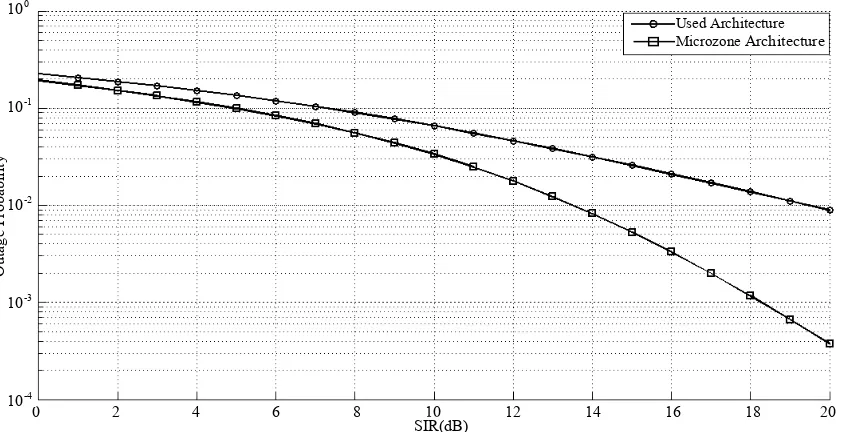
Figure 4 shows the outage probability versus the SIR for used and microzone architectures and confirms the better performance of microzone architecture.
5. Conclusion
In this paper, the used architecture was introduced and a novel architecture for antenna arrangement that called microzone was proposed. Also, the mathematical ana- lyses on outage probability for both of architecture were calculated and shown better performance of the proposed architecture. Moreover, the simulation results confirmed the lower outage probability of the microzone in com-pared with the used architecture which results in higher QoS, and lower bit error rate at the BS.
REFERENCES
[1] H. Yu, et al., “Outage Probability of Decode-and-For-
ward Cooperative Relaying Systems with Co-Channel In- terference,” IEEE Transactions on Wireless Communica-tions, Vol. 11, No. 1, 2012, pp. 266-274.
[2] H. Saghaei, et al., “Novel Approach to Adjust the Step
Size for Closed-Loop Power Control in Wireless Cellular Code Division Multiple Access Systems under Flat Fa- ding,” IET Communications, Vol. 5, No. 11, 2011, pp. 1469-1483. doi:10.1049/iet-com.2010.0029
[3] D. H. Kim, et al., “Adaptive Cell Management in a Femto-
Cell System,” Informatics Engineering and Information
Science,Vol. 253, 2011, pp. 604-613.
[4] H. Saghaei and B. Seyfe, “Power Control with Diversity Antenna Arrays in CDMA Wireless Cellular Systems under Multipath Fading,” 4th International Conference
on Wireless Communications, Networking and Mobile
Computing, Dalian, 12-14 October 2008, pp. 1-4.
[5] H. Saghaei and A. A. L. Neyestanak, “Variable Step Closed- Loop Power Control in Cellular Wireless CDMA Systems under Multipath Fading,” IEEE Pacific Rim Conference
on Communications, Computers and Signal Processing,
Victoria, 22-24 August 2007, pp. 157-160.
[6] R. Vaze and R. W. Heath, “Transmission Capacity of Ad- Hoc Networks with Multiple Antennas Using Transmit Stream Adaptation and Interference Cancellation,” IEEE
Transactions on Information Theory, Vol. 58, No. 2, 2012,
pp. 780-792. doi:10.1109/TIT.2011.2173712
[7] G. L. Stüber, “Principles of Mobile Communication,” Springer Verlag, New York, 2011.
[8] H. T. Cheng and W. Zhuang, “Pareto Optimal Resource Management for Wireless Mesh Networks with QoS As-surance: Joint Node Clustering and Subcarrier Alloca-tion,” IEEE Transactions on Wireless Communications,
Vol. 8, No. 3, 2009, pp. 1573-1583. doi:10.1109/TWC.2008.080726
[9] H. Saghaei and B. Seyfe, “New Approach to Closed-Loop Power Control in Cellular CDMA Systems under Multi- path Fading,” 4th International Conference on Wireless
Communications, Networking and Mobile Computing, Da-
lian, 12-14 October 2008, pp. 1-4.
[10] L. Aydin, et al., “Reverse Link Capacity and Coverage
Improvement for CDMA Cellular Systems Using Polari- zation and Spatial Diversity,” IEEE International Con-
ference on Communications, Vol. 3, 2002, pp. 1887-1892.
Appendix 1
In this section, we prove the Equation (6). Suppose
1 2 are independent exponentially distributed
random variables with mean
, , , n
z z z
E zi 1i
, and is apositive constant, then
c 1 1 1 1 2 2
Prob n 1 e c 1 ,
i
n
i i i
z z c
To prove this, we note that
2 2 2 1 1 1 2 1 21 2 1 2
0 0 0
1 1 2 2
0 0 0
1 1 2 2
0 0 0
Prob
d d d
d d
e d d d
1 e n i i n i i n i i n i i n i i z c n n z c n n z c z n n z c
z z c
f z f z f z z z z
d
f z z f z z f z z
z f z z f z z
2 2
2 2
0 0
e z d d
n n
z f z z
1 1 2 2
3 2 2 1 3 1 4 2 2 0 0 2 3 3 1 2 0 0 2 3
1 2 1 3
e e d d
e 1 d e 1 n i i n i i n i i
z c z
z
n n
z c
n n
z c
z f z z
f z z f z z
f z
d
1 4 4 4 0 0 2 3 4 41 2 1 3
0 0 d d e 1 d n i i n n z c n n
z f z z
d
f z z f z z
1 1 2 1 1 1 2 1 e1 e 1 .
![Figure 1. Used architecture [5].](https://thumb-us.123doks.com/thumbv2/123dok_us/7730388.705666/2.595.58.289.80.356/figure-used-architecture.webp)