Role of long non-coding RNA in cells: Example of the
H19/IGF2 locus
Constance Vennin, Fatima Dahmani, Nathalie Spruyt, Eric Adriaenssens*
UMR 8161 CNRS, Institut Biologie de Lille, University of Lille1, Lille, France; Email: *[email protected]
Received 28 March 2013; revised 1 May 2013; accepted 18 May 2013
Copyright © 2013 Constance Vennin et al. This is an open access article distributed under the Creative Commons Attribution License, which permits unrestricted use, distribution, and reproduction in any medium, provided the original work is properly cited.
ABSTRACT
In the past decade, studies of non-coding RNAs in-crease. Non-coding RNAs are divided in two classes: small and long non-coding RNA. It was shown that long non-coding RNAs regulate expression of 70% of genes. Long non-coding RNAs are involved in several cellular processes like epigenetic regulation, dosage compensation, alternative splicing and stem cells main- tenance for example. Misregulations of their expres- sion induce diseases such as developmental syndrome or cancer. In this review, we describe some functions of long non-coding RNA in cells. Furthermore, we study the H19/IGF2 cluster: an imprinted genomic locus located on chromosome 11p15.5. Genomic im-printing allows gene expression from a single allele in a parent-origin-dependent manner. This cluster en-code for the first long non-coding RNA identified:
H19. In 1990, it was established that H19 functions as
a riboregulator. Recently, it was shown that H19 is a precursor of microRNA (hsa-miR-675), and several news transcripts were identified at the H19/IGF2 lo-cus. So, the complexity of this locus increasing, in this review, we summarize our current understanding about the H19/IGF2 cluster both in terms of trans- cription as well as in terms of functions in cells. We highlight the involvement of H19, its new antisense transcript 91H and its microRNA, in the regulation of IGF receptor function and in cell cycle progression.
Keywords:H19 Gene; Genomic Imprinting;
Non-Coding RNA; Cell Cycle
1. INTRODUCTION
Recently, the ENCODE project have proved that ap-proximately 90% of the genome is transcribed. In cells, about 2% of sequences coding for protein, the others
transcripts act as introns or non-coding RNA. These non-coding transcripts are composed of non-protein coding gene and background of transcription. This trans- criptional noise would allow maintaining chromatin in a conformation favourable to the transcription of pro- tein-coding gene. In the past decade, studies of non-pro- tein coding gene, also called non-coding RNAs (nc- RNAs), have increased and revealed that they are impor-tant in cells. NcRNAs are highly regulated and have sev-eral functions for normal development of tissues to tu-morigenesis. Non-coding RNAs are divided in two class- es of RNAs: the small and the long non-coding RNAs.
Small non-coding RNA (<200 nts), notably micro-RNAs (miRNAs), are involved in post-transcriptional regula-tion of RNA. MiRNAs are the most studied of the small ncRNAs because they regulate 60% of protein-coding gene. Mostly, they are encoded by the genome, trans- cribed by RNA polymerase II, cleaved by Drosha in the nucleus and by Dicer in the cytosol. Then, they interact with Argonaut protein family to form the RISC complex (RNA-induced silencing complex). This complex allows the function of miRNA [1]. They induce silencing of gene by degrading or inhibiting the translation of mRNA into protein. They are involved in all process of the cell: proliferation, cell cycle progression, differentiation, and apoptosis. Two others small non-coding RNAs are de-scribed: piRNA (PIWI-interacting RNA) and snoRNA (small nucleolar RNAs). piRNAs have recently been discovered. They are important for germline develop-ment and for the suppression of transposon activity in germline cells. SnoRNA are components of ribonucleo-proteins (snoRNPs). They are responsible for post- tran-scriptional modifications of rRNA that take place in the nucleolus (the nucleus compartment where ribosomes are formed) [1].
Long non-coding RNAs (LncRNAs (>200 nts)) can have different origins: mRNA, antisense transcripts or long-intergenic non-coding RNA (lincRNA). LincRNAs are produced by sequence between two genes or set of
genes. In Homo sapiens, 4500 lincRNAs have discovered but only 108 lncRNAs are studied and published [2]. LncRNAs have an important place in cell as they regu-late expression of 70% of genes. They are involved, for example, in epigenetic regulation, alternative splice or stem cells maintenance. Misregulations of their expres-sion induce diseases such as cancer.
The first imprinting lncRNA identified is the H19
RNA. H19 is transcript from the H19/IGF2 cluster
lo-cated on the chromosome 11p15.5. Recently, the com-plexity of this locus has increased since several new transcripts were identified.
In this review, firstly, we describe some functions of long non-coding RNA in cells. Then, to illustrate our point, we summarize our current understanding about the
H19/IGF2 cluster, its complexity and its function in cells.
2. LONG NON-CODING RNA
FUNCTIONS
2.1. Dosage Compensation
The lncRNA Xist (X-inactive-specific-transcript), an
lncRNA of 17.000 nucleotides, is the most studied. This lncRNA is implicated in the X chromosome inactivation
in dosage compensation [3]. Xist is encoded by the X
chromosome and acts in cis. Thanks to its conserved
repeat motif RepA, Xist interacts with the Polycomb
re-pressive complex (PRC2), the complex responsible for
trimethyaltion of histone H3 at Lys27, and targets this
complex to the XIC (X-inactivation centre). PRC2 com-plex induces histone modifications, heterochromatin formation and silencing of the targeted X chromosome.
Xist is regulated by two others lncRNAs, one acting
negatively Tsix, and the other positively Jpg. Tsix, an-
tisense RNA to Xist, is expressed from the X-active
chromosome and inhibit Xist expression in cis. When
expressed, Tsix recruits DNA methyltransferases (Dnmt3a)
to repress the expression of Xist, and blocks the interac-
tion between Xist and the PRC2 complex.
2.2. Epigenetic Regulation
The lncRNA Air is submitting to the genomic imprinting.
It consists of a 108 kb-long transcript. Air promoter is
localized in the imprinting centre within the IGF2r gene
and it is necessary for the paternal repression of the gene of the locus [4,5]. However, the molecular mechanism remains unclear and authors propose hypothesis of
me-thylation propagation from the IGF2r gene or of
repres-sive ARN/protein complexes formation.
The third lncRNA well studied is located in the cluster
Kcnq1/Kcnq1ot1on the chromosome 11 in position 15.5.
Kcnq1ot1 RNA is a 91 kb transcript which is expressed
in antisense orientation from a highly conserved and dif-ferentially methylated region Kcnq1 ICR or ICR2
pre-sent in intron 10 of Kcnq1 gene. Expression of this
tran-script is exclusively paternal. Indeed, the Kcnq1ot1
pro-moter shows a maternal specific methylation. This dif-ferential epigenetic mark is lost in patients affected by Beckwith-Wiedemann syndrome with RNA biallelic ex-pression [6-8]. More recently, Pandey and colleagues
(2004) have documented that the Kcnq1ot transcript has
a key role in silencing of genes contained in the Kcnq1
gene imprinted region and that it participates directly or indirectly to the methylation but without RNA interfere- ence mechanisms [9]. Furthermore, interruption of
Kcnq1ot1 RNA production by the insertion of a polyade-
nylation sequence downstream of the promoter also caused a loss of both silencing activity and methylation spreading. Thus, the antisense RNA plays a key role in the silencing function of the ICR [10].
2.3. Regulation of Alternative Splicing
The lncRNA Malat1 (Metastasis-associated lung
adeno-carcinoma transcript 1), also known as NEAT2
(Nu-clear-enriched abundant transcript 2), is polyadenylated and overexpressed in various cancers. It is a conserved transcript among mammals of 6 - 7 kb, localized in
nu-clear. RNA-fish studies have shown that Malat1 is
local-ized in sub-compartment of nuclear: nuclear speckles [11,
12]. Contrary to NEAT1 (a lncRNA essential for nuclear
paraspeckle formation), Malat1 is not essential to nuclear
speckle integrity. This compartment is composed in ma-jority of factor involved in pre-mRNA splicing, like SR family protein and protein implicated in RNA transport
for example. Bernard et al., have shown that Malat1
con-trols of SR family protein (SF2/ASF) of splicing factor to transcription site. Tripathi and co-workers have
estab-lished that Malat1 regulates expression levels,
localiza-tion and activity of SR protein. Targets genes of Malat1
are tissue-dependant. In neuronal cells, Malat1 regulates
preferentially splicing of genes involved in
synaptogene-sis like Neuroligin gene (Nlgn1) and synaptic cell
adhe-sion molecule 1 (SynCAM1).
2.4. Stem Cells Maintenance
of Reprogramming”. So, they identified the first func-tional lincRNA in establishing iPSC.
Furthermore, a study has identified several ncRNAs implicated in stem cells differentiation [14]. They have demonstrated that lncRNAs are associated with trime- thylated H3K4 histones and histone methyltransferase MLL1. These suggest that lncRNAs have a role in epi-genetic regulation during ES cell differentiation.
2.5. LncRNA in Cancer
In human, HOX transcription factor are encoded by four HOX cluster on four different chromosomes: HOXA to D. From HOX cluster only 39 transcription factors are expressed but 231 ncRNAs are transcript [15,16]. The
well HOX ncRNA studied is HOTAIR (Hox antisense
transcript RNA). It is antisense RNA of 2.2 kb, transcript
from the HOXC cluster. Studies have shown that
HO-TAIR regulates expression of genes on HOXD cluster, so
acts in trans. Indeed, when expressed, due to its
5’domain, HOTAIR interacts with PRC2 complex,
nota-bly Suz12 and EZH2 protein [15]. PRC2 complex in-duces trimethylation of Histone H3 lysine 27 on HOXD
cluster (an inactive methylation). HOTAIR can also
in-teract with the LSD1/CoREST/REST complex: a com-plex involved in trimethylation of Histone H3 lysine 4
(active chromatin). HOTAIR regulates chromatin
con-formation from active chromatin to inactive. So, it is scaffold RNA [17]. In several cancers, notably breast
cancer, HOTAIR expression is associated to metastasis
[18]. Authors have shown that HOTAIR overexpression
increases cells invasion and metastasis in mice. They
established that HOTAIR invasion is PRC2 complex
de-pendent. So, HOTAIR expression is associated to poor
prognosis.
LncRNAs are implicated in several cellular processes (epigenetic regulation, dosage compensation, stem cells self-renewal and differentiation). In some cases, lncRNA expression allows maintains of stem cells pool for exam-ple, whereas, sometimes, lncRNA expression is respon-sible of cancers. So, expression of lncRNA must be well
regulated. They can act per se but can also acts as
pre-cursor of small ncRNA such as microRNA. The lncRNA
H19, the first imprinting ncRNA discover is the
precur-sor of the microRNA: miR-675 [19]. Recently, several groups have identified targets of this miRNA in several cell lines [20,21]. To illustrate our point, we summarize
our current understanding about the H19/IGF2 cluster, its
transcription complexity and its function in cells.
3. THE H19/IGF2 CLUSTER
3.1. Genomic Imprinting at the H19/IGF2 Cluster
The H19/IGF2 cluster is submitted to genomic
imprint-ing. Genomic imprinting is a form of epigenetic gene regulation that results in expression of a single allele in a parent-of-origin-dependent manner. This form of mo- noallelic expression is essential for normal development. Despite extensive studies, the molecular mechanisms of genomic imprinting remain unclear. However, some hall- marks of this phenomenon have been identified and we can note that:
Gene expression is allele-specific and tissue or stage-
specific.
Many of imprinted genes are found in clusters
throughout the genome. The clusters contain two or more imprinted genes over a region that can span 1 Mb or more.
Within each cluster, a common regulating region
which are called “imprinting control region” (ICR, also called IC for imprinting Centre or ICE for im-printing control element) controls the imim-printing of all genes in the cluster and can act over hundreds of kilobases. ICRs are designed as differentially methy-lated regions with parental-specific modifications that determine their activity. Deletions of this region lead to the loss of imprinting of multiple genes of the cluster [22,23].
More recently, it has been reported that non-coding
RNA were associated with imprinted clusters and have an essential role in regulating gene expression.
The H19/IGF2 cluster is located on the human
chro-mosome 11 in position p15.5. This 1Mbp domain con-tains 9 imprinted genes and 2 independent imprinting center. The first imprinting center (ICR) regulates the
cluster H19/IGF2 and the second (ICR2), the cluster
Kcnq1/Kcnq1ot1.
The H19gene is one of the first genes proven to be
imprinted. This gene is co-regulated negatively with the
IGF2 gene located 200kb upstream of the transcription
site of the H19 gene. Indeed, H19 is expressed only from
the maternal allele whereas IGF2 is expressed from the
paternal allele [24]. The paternal allele exhibits several
characteristics that explain the silencing of the H19 gene:
it is hypermethylated in the promoter region and the promoter shows a compact chromatin structure [25,26]. Moreover, the histone acetylation rate is lower than the one of the maternal allele [27].
Surprisingly, the IGF2 promoter region is not
methy-lated and its chromatin structure is favourable to a bialle-lic transcription [28]. However, two other differentially methylated regions (DMR) on the expressed paternal allele have been identified within the gene: the DMR1 located 3 kbp upstream the P1 promoter acts as a silencer on the maternal allele when it is unmethylated, and the DMR2, located within exons 5 and 6 is an activator on the paternal allele when it is methylated [29-31].
the mono-allelic expression. Indeed, the ICR is the key of the genomic imprinting: it controls the chromatin structure and regulates the effect of enhancers located
downstream of the H19 gene [32,33]. This region is
lo-cated 2 to 4 kbp upstream of the transcription site of the
H19 gene. In human, it contains seven binding site of
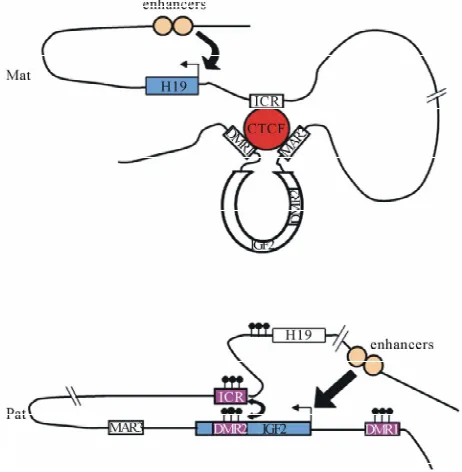
zinc-finger protein named CTCF (CCTC-binding factor) but only the sixth is differentially methylated [34]. On the maternal allele, the CTCF protein interacts with non-methylated ICR due to four consensus site (Figure 1) [35]. On the ICR, this protein has a chromatin insulator function as it prevents the action of enhancers on the
promoter of IGF2. On the paternal allele, methylation of
the ICR represses the H19 expression and prevents the
attachment of the CTCF protein [36]. So enhancers can
activate the IGF2 expression from this allele. Thus, H19
is expressed from the maternal allele and IGF2 from the
paternal allele (Figure 1).
Chromosome conformation capture (3C) analysis shows interaction between different chromosomal re-gions and suggests that the CTCF protein has a critical
role in the epigenetic regulation of the cluster H19/IGF2.
Kurukuti and al. 2006 demonstrated that on the maternal allele, CTCF interact with the DMR1 and the Matrix At-
tachment Region (MAR3) at the IGF2 locus to generate
a tight loop around the IGF2 gene [37,38]. This interact-
[image:4.595.307.538.392.628.2]tion creates an inactive domain where IGF2 is far away
Figure 1. Genomic imprinting at the H19/IGF2 locus. Activa-tion of gene transcripActiva-tion is represented by (+), repression by (-) and inhibition of enhancers function by ( ). Relative posi-tions are expressed in kilobase pairs relatively to the H19 tran-scription start site. Gene expression is regulated by three mecha-nisms: methylation, enhancers activity and insulator activity. Three DNA region are differentially methylated : DMR 1 and 2 of the IGF2 gene (violet diamond) and ICR (blue oval). On the maternal allele, the CTCF protein interacts with the non-me- thylated ICR (blue oval). This interaction prohibits enhancers access to the IGF2 gene. Furthermore, the DMR1 non-me- thylated of IGF2 gene acts as a silencer. On the paternal allele, the methylated ICR repress H19 and inhibits CTCF interaction. So, enhancers can activate IGF2 transcription. Moreover, the methylated DMR2 of IGF2 gene activate also IGF2 transcrip- tion.
from the enhancers. Therefore, this gene is in inactive domain so it cannot be expressed from this allele (Figure 2).
On the paternal allele, the methylated ICR interacts
with methylated IGF2DMR2 moving IGF2 into the
ac-tive chromatin domain [39].
So genomic imprinting of the H19/IGF2 cluster is
al-lowed by DNA methylation, chromatin composition, organization and conformation.
3.2. News Transcripts at the H19/IGF2 Locus
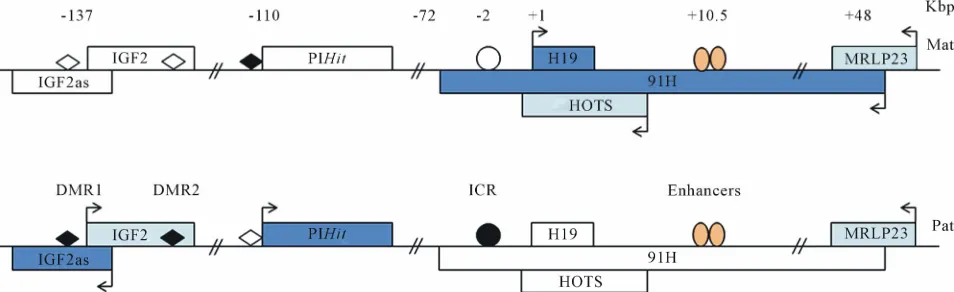
In 1991, an antisense transcript of the IGF2 gene in
chicken was identified [40]. Others studies have
identi-fied antisense IGF2 transcripts of 3-4 kb in mouse and
human (Figure 3) [41,42]. This transcript is expressed only from paternal allele and no open reading frame (ORF) was identified. Its function remains unclear, but it is a good marker for Wilm’s tumor where it is
overex-pressed [42]. Recently, it was shown that IGF2as is
ex-ported in the cytoplasm and associated with polysomes
[43]. So, it is not impossible that IGF2as is a protein
coding transcript.
We have identified a non-coding transcript, antisense
to H19, that we named 91H (Figure 3) [44]. This tran-
[image:4.595.58.288.420.565.2]Figure 3. News transcripts at the H19/IGF2 locus. Gene expressed are in blue rectangle with arrow whereas inactive gene are in white rectangle. Protein coding gene are represented by ( ) and non-protein coding gene by ( ). Direction of arrows indicates direction of gene transcription. Relative positions are expressed in kilobase pairs relatively to the H19 transcription start site. ICR is represented by circle and DMR by diamond. Methylation of ICR and DMR is in black. Enhancers are represented by orange oval. The first antisense transcript described is IGF2as. It is ncRNA overexpressed in Wilm’s tumour. Its function remains unclear. Re-cently, news transcripts have been discovered at the H19/IGF2 locus. On maternal allele, a long antisense transcript to H19 was iden-tified: it is 91H. This ncRNA and its function are conserved in mice. Neither protein was identified, so it is supposed that 91H acts as lncRNA. Recently, from the same allele, a protein coding gene imprinting has discovered: HOTS. This transcript is antisense to H19. It is possible that HOTS protein is coding by 91H RNA. The last transcript discovered from H19/IGF2 locus is PIHit. It is ncRNA expressed after birth from paternal allele.
script is a lncRNA of 120 kb expressed only in human from the maternal allele. It is known that lncRNAs can mediate epigenetic regulation transcription. Indeed, the
lncRNA Xist induce X-chromosome inactivation in
dos-age compensation. So, we have studied effects of 91H
expression at the H19/IGF2 locus. By invalidation of
91H with si-RNA, a reduction of IGF2 expression was
observed. However, today, the molecular mechanism
remains unclear. Recently, it was shown that 91H RNA
and its function are conserved among mammals, notably
in mice [45]. By 91H overexpression, they have shown
that 91H regulates positively IGF2 translation from a
novel promoter. More recently, a group identified
an-tisense transcript of H19, expressed from the maternal
allele, encoding for a protein named HOTS (H19
oppo-site tumour suppressor) [46]. But it is not excluded that
this protein is encoded by the 91H transcript. Thus, today
the function of the 91H transcript remains unclear.
A new paternal transcript was identified in mice. This
transcript, PIHit (Paternally-expressed IGF2/H19
inter-genic transcript), is coding by interinter-genic sequence,
be-tween IGF2 and H19, and expressed, in mice, principally
8 days after birth (Figure 3) [47]. Then, its expression decreases rapidly during the third post-natal week. It is
expressed at similar level to mRNA (IGF2), capped but
no polyadenylated. Neither ORF was identified, so it is supposed that it is a lncRNA. Authors have identified transcription start site but not the 3’end, which is why it is a transcript of 5 to 6 kb. Neither function has been
associated to PIHit RNA. By 3C, they observed two
chromatin conformation of paternal allele. They
sup-posed that there is a dynamic system permitting IGF2 or
PIHit expression. However, it cannot exclude that there
is chromatin conformation cell lines specific.
4. THE H19 RNA AND ITS FUNCTION IN
CELLS
4.1. The H19 RNA
The H19 gene was discovered in the mouse in 1984 and
in the human in 1992 [48-50]. This gene is composed of five exons and encoded an mRNA of 2.3 kb. This RNA is transcribed by the RNA polymerase II, polyadenylated, capped and spliced with conserved secondary RNA structure. But, no conserved open reading frame was identified. Even if deletion and/or mutation produce a 26 kDa protein, no endogenous translation has so far been
identified [51]. So, in 1990, Brannan et al. have proposed
that H19 RNA functions as a riboregulateur of which
expression is developmentally regulated [52].
It is well established that a ncRNA can be precursor of microRNA. There are different biogenesis pathways of microRNA, but generally stem-loop structure RNA are recognized by protein like DGCR8, cleaved by Drosha and Dicer to generate the duplex miR-5p/miR-3p. Then, the duplex interacts with Argonaut protein family and is incorporated in the RISC complex. MicroRNA can also be generated in Drosha or Dicer-independent pathways [53]. Introns from the splicing or tRNA (tRNA-Ile for example) can be directly recognized by Dicer, cleaved by this enzyme and incorporated in the RISC. There is a microRNA (miR-451) cleaved by Drosha which is di-rectly recognized by Ago and incorporated in the RISC.
precursor of microRNAs: miR-675-5p and miR-675-3p [19]. They are generated by the exon1 of the gene. Today, few targets of the miR-675 have identified. Due to its
microRNA, it was shown that H19 can regulate placental
growth and cell cycle.
4.2. H19/91H Regulate IGF Associated Phenotypes
We and others groups have established that H19
regu-lates IGF2 ligand and receptor expression. Expression of
H19 and IGF2 are regulated by enhancers located
down-stream of H19. Actions of enhancers are regulated by
imprinting control region (ICR), located between H19
and IGF2. Expression of H19 and IGF2 are allele-de-
pendent. On the maternal allele, the CTCF protein
inter-acts with ICR non-methylated, DMR1 of IGF2 and the
MAR3 domain [35,37,38]. This interaction creates a loop
containing IGF2 gene. Enhancers cannot active
tran-scription of IGF2 gene when chromatin is in this
con-formation. So, only H19 is expressed from the maternal
allele. On the paternal allele, ICR is methylated, so the protein CTCF is absent on this allele. ICR methylated
interacts with IGF2 DMR2 methylated too. This
interac-tion allows acinterac-tion of enhancers on IGF2 promoter and
then IGF2 expression [30]. H19 and IGF2 are in
compe-tition for enhancers. Furthermore, it was shown that
de-letion of H19 and its flanking region affect expression of
IGF2. So, H19 and region flanking regulate IGF2
ex-pression in cis.
Moreover, H19 is a RNA polyadenylated, spliced and
exported in the cytosol. In cytosol, a group have shown
that H19 is associated to polysomes [54]. These
poly-somes have similar size to those associated to IGF2
mRNA. Then, they have found an inverse co-regulation
between H19 expression and IGF2 translation in cytosol.
In Wilm’s tumor, H19-negative cells show
overexpres-sion of IGF2 3 fold higher then control. Inversely, in
H19-positive cells, IGF2 expression protein was reduced.
So, they hypothesized, that H19 regulates translation of
IGF2 mRNA in trans. Moreover, it was shown a
co-regulation between H19 and IGF2 transcription. In
breast cancer cells, when H19 is overexpressed, IGF2
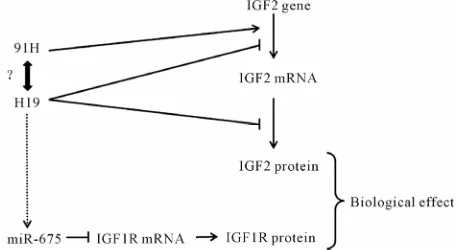
expression decreases severely [55,56]. H19 regulates
negatively transcription of IGF2 in trans. So, it was
supposed that H19 acts as a trans-riboregulateur.
In mouse placental cells, the expression of miR-675,
from H19 gene, is regulated negatively by HuR protein
[21]. They observed a relation between miR-675 expres-sion and size of placenta. Indeed, when miR-675-3p is expressed (from E11.5 until term), a reduction size of placenta is observed. This reduction is due to a decrease of cells proliferation but not an increase of apoptosis. They established that miR-675-3p interacts with two
seed on 3’UTR IGF1r and inhibits its translation. So,
H19 is a key regulator of IGF ligand and receptor
ex-pression (Figure 4).
Intriguingly, we have shown that the lncRNA 91H,
transcript antisense to H19, affects a little H19
expres-sion but regulates positively IGF2 [44]. However, the
mechanism remains unclear. We supposed that 91H
in-teracts with proteins that modulate expression of genes.
More recently, a group have shown that 91H
overexpres-sion, in mouse, upregulates IGF2 expression [45]. They
supposed that 91H activate a novel promoter of IGF2.
4.3. Cell Cycle Regulation by H19 Promotes Cancer
H19 is implicated in embryonic development. It is
ex-pressed in blastocyst stage of development and accumu-lated at high level in tissues of endodermal and meso-dermal origins as well as ectomeso-dermal origin [57-60]. Af-ter birth, the gene is repressed in all tissues except
skele-tal muscle [61]. Misregulations of H19 expression during
development induce developmental syndrome like Sil-ver-Russel syndrome or Beckwith-Wiedemann syndrome
[62,63]. In adulthood, function of H19 is controversial: it
was supposed that H19 act as tumor suppressor or
onco-gene. Nevertheless, several data show that H19 act as
oncogene in various cancer tissues: breast [61,64,65], uterus [66], bladder [67,68] and gastric [69]. Indeed,
today, it was clearly established that H19, per se or
through its microRNA, regulates different check-point of the cell cycle.
H19 mRNA generates two microRNAs: miR-675-5p
and miR-675-3p [19]. The mir-675-5p is most studied but few targets have been identified. The first target
identified is 3’UTR of Retinoblastoma (RB) mRNA in
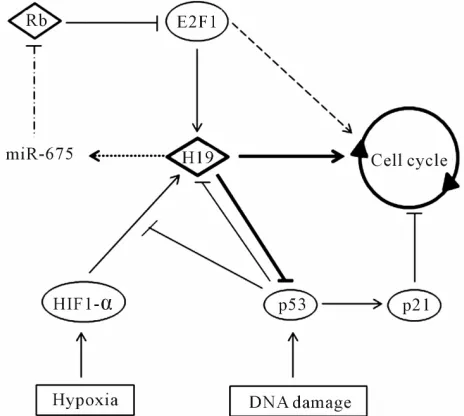
colon cancer cells [20]. Authors have shown a negative
[image:6.595.309.538.523.648.2]co-regulation between H19 and RB in human colorectal
tumour. They demonstrated a reduced expression of RB
in tumour whereas H19 and miR-675-5p are
overex-pressed (Figure 5). Owing to a reporter luciferase vector, they established the interaction and the negative effect of
miR-675-5p on 3’UTR of RB. They have shown that
miR-675-5p increases clonogenicity in soft agar of hu-man colon cancer cells. So, in colon cancer cells lines,
H19 and miR-675-5p increase proliferation of cells.
In 1998, it was shown that the H19 expression is
regulated by p53 protein [70]. Indeed, the H19 promoter
contains consensus site to interaction with p53. A nega-tive regulation of p53 on this promoter was observed. In
parallel, in human breast tumour, H19 is overexpressed
in 70% of tumour independent of p53 expression [71].
However, it was shown that H19 is located in stromal
cells whereas p53 is located in epithelial cells.
Recently, a group studying gastric cancer shows that
H19 expression is increased in this disease [69]. They
observed an increase cell proliferation and a reduction of
apoptosis when H19 is overexpressed. So, they studied
the effect of H19 overexpression on a protein inhibiting
[image:7.595.56.288.363.571.2]cell cycle proliferation and inducing apoptosis: the p53
Figure 5. Regulation of cell cycle by H19. Proteins are represented by circle, RNA by diamond, cellular stress by rectangle and cell cycle by circle with arrow. Activation of gene expression is represented by arrow ( ) and repression by vertical bar ( ). Mir-675 is processed from H19 transcript and represses translation of an inhibitor cell cycle progression mRNA: Rb (Retinoblastoma). So, E2F1 protein is activated and promotes H19 overexpression and expression of genes involved in cell cycle progression. H19 overexpression facilitates G1/S transition. Hypoxia, by activating HIF1-α, induces H19 expression in p53-dependent manner. DNA damage activates the p53 protein. P53 repress H19 expression and inhibits cell cycle progression by activating p21. Recently, it was shown that H19 overexpression inhibits p53 activity. So, H19 is a key regulator of cell cycle progression.
protein. Thanks to a RNA-immunoprecipitation (RIP),
they have shown that H19 RNA can interact physically
with the p53 protein. By a luciferase reporter system,
they demonstrated that H19 RNA regulates negatively
the p53 protein may be by blocking this phosphorylation.
So, the H19 overexpression in gastric cancer cells
con-tributes to tumorigenesis by regulating p53 activation. In tumour, some cells are in hypoxic condition. So, a
team has studied effect of hypoxia on H19 expression.
Upon hypoxia, they observed an increase rate of H19
RNA [72,73]. So, they have verified that the activation is
due to the activation of the HIF1-α pathway (pathway
activated during hypoxia). Invalidation of HIF1-α by
RNA interference induces a diminution of H19
overex-pression upon hypoxia. Furthermore, they have observed
that H19 is overexpressed only when p53 is mutated or
absent. If, p53 is not mutated, they have observed a
de-crease H19 expression. It has previously been reported
that p53 inhibits action of HIF1-α by increasing its
ubiq-uitination and degradation [74]. So, upon hypoxia, H19
is overexpressed by activation of HIF1-α pathway and
p53-dependent manner.
Surprisingly, in breast cancer cells (MCF-7), they have
observed an overexpression of H19 upon hypoxia
al-though p53 is present. In this cell, the p53 protein is principally in the cytoplasm. So, to repress activation of
transcription by HIF1-α, p53 must be in the nucleus.
Taken these results together, we can hypothesize that, in
MCF-7 cells, H19 interacts with the p53 protein and
in-hibits its activation by sequestering p53 protein in the cytoplasm.
Furthermore, it was shown that H19 facilitates cell
cy-cle transition G1/S [75]. This check-point is regulated
particularly by the E2F1 protein. The H19 promoter
con-tains two consensus sites for this protein. It was studied
the potential role of E2F1 on the H19 promoter. Using
luciferase system, it was reported that E2F1 induced H19
expression through theses two sites. Moreover, the RB protein and E2F6 factor inhibit the activation of E2F1. So, E2F1 is negatively regulated by RB and E2F6.
Re-cently, it was shown that H19, thanks to its microRNA,
regulates negatively RB expression [20]. So, theses studies have demonstrated a positive feedback loop
be-tween H19 and E2F1 (Figure 5). Then, in breast cancer
cells lines as BT20, T47D and MCF-7, E2F1 and H19
are overexpressed. It was shown that H19 overexpression
conferred a growth advantage on cells. Indeed, an in-crease S-phase entry was observed when cells
overex-press this gene [75]. So, H19, through a positive
regula-tion by E2F1, active cell cycle progression and promotes growth of breast cancer cells.
To resume, it was shown that, in cancer cell lines, H19
control p53 activity, reduced translation of the RB mRNA
So, H19 have a key role in the regulation of cell cycle and could be implicated in cancer progression.
6. CONCLUSION
Recently, the ENCODE project have proved that 90% of the genome is transcribed, but protein-coding genes rep-resent only 2% of transcripts. So, the genome encode for ncRNAs which have an important place in function of cells. Today, small non-coding RNAs are most studied than lncRNAs. However, lncRNAs regulate the expres-sion of 70% of genes. So general, it is accepted that lncRNAs regulate gene expression by interacting with PRC complex chromatin modifications, including PCR2.
In this review, we show that lncRNA, notably H19 RNA,
may have several functions in cell without involving the
complex. So, we show that lncRNAs can act per se
and/or as precursor of microRNA. Furthermore, we show that lncRNAs can be involved in different cellular
proc-ess. For example, the H19 RNA and its microRNA
regu-late negatively expression of IGF2 ligand and IGF1
re-ceptor; and control positively cell cycle progression. So, today, it is clear that lncRNAs have function as important as protein within cellular processes.
REFERENCES
[1] Esteller, M. (2011) Non-coding RNAs in human disease. Nature Reviews. Genetics, 12, 861-874.
doi:10.10398/nrg3074
[2] Knowling, S. and Morris, K.V. (2011) Non-coding RNA and antisense RNA. Nature’s trash or treasure? Biochimie, 93, 1922-1927. doi:10.1016/j.biochi.2011.07.031
[3] Lee, J.T. (2012) Epigenetic regulation by long non--coding RNAs. Science, 338, 1435-1439.
doi:10.1126/science.1231776
[4] Rougeulle, C. and Heard, E. (2002) Antisense RNA in imprinting: spreading silence through Air. Trends in Ge- netics, 18, 434-437.
doi:10.1016/S0168-9525(02)0274-X
[5] Sleutels, F., Zwart, R. and Barlow, D.P. (2002) The non-coding Air RNA is required for silencing autosomal imprinted genes. Nature, 415, 810-813.
doi:10.1038/415810a
[6] Mitsuya, K., Meguro, M., Lee, M.P., Katoh, M., Schulz, T.C., Kugoh, H., Yoshida, M.A., Niikawa, N., Feinberg, A.P. and Oshimura, M. (1999) LIT1, an imprinted an- tisense RNA in the human KvLQT1 locus identified by screening for differentially expressed transcripts using monochromosomal hybrids. Human Molecular Genetics, 8, 1209-1217. doi:10.1093/hmg/8.7.1209
[7] Lee, M.P., DeBaun, M.R., Mitsuya, K., Galonek, H.L., Brandenburg, S., Oshimura, M. and Feinberg, A.P. (1999) Loss of imprinting of a paternally expressed transcript, with antisense orientation to KVLQT1, occurs frequently in Beckwith-Wiedemann syndrome and is independent of
insulin-like growth factor II imprinting. Proceedings of the National Academy of Sciences of the USA, 96, 5203- 5208. doi:10.1073/pnas.96.9.5203
[8] Du, M., Zhou, W., Beatty, L.G., Weksberg, R. and Sadowski, P.D. (2004) The KCNQ1OT1 promoter, a key regulator of genomic imprinting in human chromosome 11p15.5. Genomics, 84, 288-300.
doi:10.1016/j.ygeno.2004.03.008
[9] Pandey, R.R., Ceribelli, M., Singh, P.B., Ericsson, J., Mantovani, R. and Kanduri, C. (2004) NF-Y regulates the antisense promoter, bidirectional silencing, and differen-tial epigenetic marks of the Kcnq1 imprinting control re-gion. Journal of Biological Chemistry, 279, 52685-52693. doi:10.1074/jbc.M408084200
[10] Thakur, N., Tiwari, V.K., Thomassin, H., Pandey, R.R., Kanduri, M., Göndör, A., Grange, T., Ohlsson, R. and Kanduri, C. (2004) An antisense RNA regulates the bidi- rectional silencing property of the Kcnq1 imprinting con- trol region. Molecular and Cellular Biology, 24, 7855- 7862. doi:10.1128/MCB.24.18.7855-7862.2004
[11] Bernard, D., Prasanth, K.V., Tripathi, V., Colasse, S., Nakamura, T., Xuan, Z., Zhang, M.Q., Sedel, F., Jourdren, L., Coulpier, F., et al. (2010) A long nuclear-retained non-coding RNA regulates synaptogenesis by modulating gene expression. EMBO Journal, 29, 3082-3093. doi:10.1038/emboj.2010.199
[12] Tripathi, V., Ellis, J.D., Shen, Z., Song, D.Y., Pan, Q., Watt, A.T., Freier, S.M., Bennett, C.F., Sharma, A., Bubulya, P.A., et al. (2010) The nuclear-retained non- coding RNA MALAT1 regulates alternative splicing by modulating SR splicing factor phosphorylation. Molecu-lar Cell, 39, 925-938. doi:10.1016/j.molcel.2010.08.011 [13] Loewer, S., Cabili, M.N., Guttman, M., Loh, Y.-H.,
Thomas, K., Park, I.H., Garber, M., Curran, M., Onder, T., Agarwal, S., et al. (2010) Large intergenic non-coding RNA-RoR modulates reprogramming of human induced pluripotent stem cells. Nature Genetics, 42, 1113-1117. doi:10.1038/ng.710
[14] Dinger, M.E., Amaral, P.P., Mercer, T.R., Pang, K.C., Bruce, S.J., Gardiner, B.B., Askarian-Amiri, M.E., Ru, K., Soldà, G., Simons, C., et al. (2008) Long non-coding RNAs in mouse embryonic stem cell pluripotency and differentiation. Genome Research, 18, 1433-1445. doi:10.1101/gr.078378.108
[15] Rinn, J.L., Kertesz, M., Wang, J.K., Squazzo, S.L., Xu, X., Brugmann, S.A., Goodnough, L.H., Helms, J.A., Farnham, P.J., Segal, E., et al. (2007) Functional demar- cation of active and silent chromatin domains in human HOX loci by non-coding RNAs. Cell, 129, 1311-1323. doi:10.1016/j.cell.2007.05.022
[16] Tano, K. and Akimitsu, N. (2012) Long non-coding RNAs in cancer progression. Frontiers in Genetics, 3, 219. doi:10.3389/fgene.2012.00219
[17] Shore, A.N., Herschkowitz, J.I. and Rosen, J.M. (2012) Non-coding RNAs Involved in Mammary Gland Devel-opment and Tumorigenesis: There’s a Long Way to Go. Journal of Mammary Gland Biology and Neoplasia, 17, 43-58. doi:10.1007/s10911-012-9247-3
H.M., Wong, D.J., Tsai, M.-C., Hung, T., Argani, P., Rinn, J.L., et al. (2010) Long non-coding RNA HOTAIR reprograms chromatin state to promote cancer metastasis. Nature, 464, 1071-1076. doi:10.1038/nature08975 [19] Cai, X. and Cullen, B.R. (2007) The imprinted H19
non-coding RNA is a primary microRNA precursor. RNA, 13, 313-316. doi:10.1261/rna.351707
[20] Tsang, W.P., Ng, E.K.O., Ng, S.S.M., Jin, H., Yu, J., Sung, J.J.Y. and Kwok, T.T. (2010) Oncofetal H19-de- rived miR-675 regulates tumor suppressor RB in human colorectal cancer. Carcinogenesis, 31, 350-358.
doi:10.1093/carcin/bgp181
[21] Keniry, A., Oxley, D., Monnier, P., Kyba, M., Dandolo, L., Smits, G. and Reik, W. (2012) The H19 lincRNA is a developmental reservoir of miR-675 that suppresses growth and IGF1r. Nature Cell Biology, 14, 659-665.
[22] Leighton, P.A., Ingram, R.S., Eggenschwiler, J., Efstra-tiadis, A. and Tilghman, S.M. (1995) Disruption of im- printing caused by deletion of the H19 gene region in mice. Nature, 375, 34-39. doi:10.1038/375034a0
[23] Ripoche, M.A., Kress, C., Poirier, F. and Dandolo, L. (1997) Deletion of the H19 transcription unit reveals the existence of a putative imprinting control element. Genes and Development, 11, 1596-1604.
doi:10.1101/gad.11.12.1596
[24] DeChiara, T.M., Robertson, E.J. and Efstratiadis, A. (1991) Parental imprinting of the mouse insulin-like growth factor II gene. Cell, 64, 849-859.
doi:10.1016/0092-8674(91)90513-X
[25] Bartolomei, M.S., Webber, A.L., Brunkow, M.E. and Tilghman, S.M. (1993) Epigenetic mechanisms underly- ing the imprinting of the mouse H19 gene. Genes and Development, 7, 1663-1673. doi:10.1101/gad.7.9.1663 [26] Ferguson-Smith, A.C., Sasaki, H., Cattanach, B.M. and
Surani, M.A. (1993) Parental-origin-specific epigenetic modification of the mouse H19 gene. Nature, 362, 751- 755. doi:10.1038/362751a0
[27] Grandjean, V., O’Neill, L., Sado, T., Turner, B. and Fer-guson-Smith, A. (2001) Relationship between DNA me-thylation, histone H4 acetylation and gene expression in the mouse imprinted IGF2-H19 domain. FEBS Letters, 488, 165-169. doi:10.1016/S0014-5793(00)02349-8
[28] Sasaki, H., Jones, P.A., Chaillet, J.R., Ferguson-Smith, A.C., Barton, S.C., Reik, W. and Surani, M.A. (1992) Parental imprinting: potentially active chromatin of the repressed maternal allele of the mouse insulin-like growth factor II (IGF2) gene. Genes and Development, 6, 1843- 1856. doi:10.1101/gad.6.10.1843
[29] Feil, R., Walter, J., Allen, N.D. and Reik, W. (1994) De-velopmental control of allelic methylation in the im-printed mouse IGF2 and H19 genes. Development, 120, 2933-2943.
[30] Murrell, A., Heeson, S., Bowden, L., Constância, M., Dean, W., Kelsey, G. and Reik, W. (2001) An intragenic methylated region in the imprinted IGF2 gene augments transcription. EMBO Reports, 2, 1101-1106.
doi:10.1093/embo-reports/kve248
[31] Constância, M., Dean, W., Lopes, S., Moore, T., Kelsey,
G. and Reik, W. (2000) Deletion of a silencer element in IGF2 results in loss of imprinting independent of H19. Nature Genetics, 26, 203-206. doi:10.1038/79930 [32] Tremblay, K.D., Duran, K.L. and Bartolomei, M.S. (1997)
A 5’ 2-kilobase-pair region of the imprinted mouse H19 gene exhibits exclusive paternal methylation throughout development. Molecular and Cellular Biology, 17, 4322- 4329.
[33] Drewell, R.A., Arney, K.L., Arima, T., Barton, S.C., Brenton, J.D. and Surani, M.A. (2002a) Novel conserved elements upstream of the H19 gene are transcribed and act as mesodermal enhancers. Development, 129, 1205- 1213.
[34] Takai, D., Gonzales, F.A., Tsai, Y.C., Thayer, M.J. and Jones, P.A. (2001) Large scale mapping of methylcytosi-nes in CTCF-binding sites in the human H19 promoter and aberrant hypomethylation in human bladder cancer. Human Molecular Genetics, 10, 2619-2626.
doi:10.1093/hmg/10.23.2619
[35] Hark, A.T., Schoenherr, C.J., Katz, D.J., Ingram, R.S., Levorse, J.M. and Tilghman, S.M. (2000) CTCF mediates methylation-sensitive enhancer-blocking activity at the H19/IGF2 locus. Nature, 405, 486-489.
doi:10.1038/35013106
[36] Srivastava, M., Hsieh, S., Grinberg, A., Williams-Simons, L., Huang, S.P. and Pfeifer, K. (2000) H19 and IGF2 monoallelic expression is regulated in two distinct ways by a shared cis-acting regulatory region upstream of H19. Genes and Development, 14, 1186-1195.
[37] Murrell, A., Heeson, S. and Reik, W. (2004) Interaction between differentially methylated regions partitions the imprinted genes IGF2 and H19 into parent-specific chro- matin loops. Nature Genetics, 36, 889-893.
[38] Kurukuti, S., Tiwari, V.K., Tavoosidana, G., Pugacheva, E., Murrell, A., Zhao, Z., Lobanenkov, V., Reik, W. and Ohlsson, R. (2006) CTCF binding at the H19 imprinting control region mediates maternally inherited higher-order chromatin conformation to restrict enhancer access to IGF2. Proceedings of the National Academy of Sciences of the USA, 103, 10684-10689.
doi:10.1073/pnas.0600326103
[39] Dekker, J., Rippe, K., Dekker, M. and Kleckner, N. (2002) Capturing chromosome conformation. Science, 295, 1306- 1311.doi:10.1126/science.1067799
[40] Taylor, E.R., Seleiro, E.A. and Brickell, P.M. (1991) Identification of antisense transcripts of the chicken insu- lin-like growth factor-II gene. Journal of Molecular En- docrinology, 7, 145-154.doi:10.1677/jme.0.0070145 [41] Moore, T., Constancia, M., Zubair, M., Bailleul, B., Feil,
R., Sasaki, H. and Reik, W. (1997) Multiple imprinted sense and antisense transcripts, differential methylation and tandem repeats in a putative imprinting control re- gion upstream of mouse IGF2. Proceedings of the Na- tional Academy of Sciences USA, 94, 12509-12514. doi:10.1073/pnas.94.23.12509
antisense transcript from the IGF2 locus, in Wilms’ tu- mors. Journal of Biochemistry, 127, 475-483.
doi:10.1093/oxfordjournals.jbchem.a022630
[43] Duart-Garcia, C. and Braunschweig, M.H. (2013) The IGF2as transcript is exported into cytoplasm and associ- ated with polysomes. Biochemical Genetics, 51, 119-130. doi:10.1007/s10528-012-9547-8
[44] Berteaux, N., Aptel, N., Cathala, G., Genton, C., Coll, J., Daccache, A., Spruyt, N., Hondermarck, H., Dugimont, T., Curgy, J.-J., et al. (2008) A novel H19 antisense RNA overexpressed in breast cancer contributes to paternal IGF2 expression. Molecular and Cellular Biology, 28, 6731-6745.doi:10.1128/MCB.02103-07
[45] Tran, V.G., Court, F., Duputié, A., Antoine, E., Aptel, N., Milligan, L., Carbonell, F., Lelay-Taha, M.-N., Piette, J., Weber, M., et al. (2012) H19 antisense RNA can up-re- gulate IGF2 transcription by activation of a novel pro-moter in mouse myoblasts. PLoS ONE, 7, e37923. doi:10.1371/journal.pone.0037923
[46] Onyango, P. and Feinberg, A.P. (2011) A nucleolar pro- tein, H19 opposite tumor suppressor (HOTS), is a tumor growth inhibitor encoded by a human imprinted H19 an- tisense transcript. Proceedings of the National Academy of Sciences of the USA, 108, 16759-16764.
doi:10.1073/pnas.1110904108
[47] Court, F., Baniol, M., Hagege, H., Petit, J.S., Lelay-Taha, M.-N., Carbonell, F., Weber, M., Cathala, G. and Forne, T. (2011) Long-range chromatin interactions at the mouse IGF2/H19 locus reveal a novel paternally expressed long non-coding RNA. Nucleic Acids Research, 39, 5893-5906.
doi:10.1093/nar/gkr209
[48] Pachnis, V., Belayew, A. and Tilghman, S.M. (1984) Lo- cus unlinked to alpha-fetoprotein under the control of the murine raf and Rif genes. Proceedings of the National Academy of Sciences of the USA, 81, 5523-5527.
doi:10.1073/pnas.81.17.5523
[49] Pachnis, V., Brannan, C.I. and Tilghman, S.M. (1988) The structure and expression of a novel gene activated in early mouse embryogenesis. The EMBO Journal, 7, 673- 681.
[50] Zhang, Y. and Tycko, B. (1992) Monoallelic expression of the human H19 gene. Nature Genetics, 1, 40-44. doi:10.1038/ng0492-40
[51] Joubel, A., Curgy, J.J., Pelczar, H., Begue, A., Lagrou, C., Stehelin, D. and Coll, J. (1996) The 5’ part of the human H19 RNA contains cis-acting elements hampering its translatability. Cellular and Molecular Biology, 42, 1159- 1172.
[52] Brannan, C.I., Dees, E.C., Ingram, R.S. and Tilghman, S.M. (1990) The product of the H19 gene may function as an RNA. Molecular and Cellular Biology, 10, 28-36.
[53] Yang, J.-S. and Lai, E.C. (2011) Alternative miRNA bio- genesis pathways and the interpretation of core miRNA pathway mutants. Molecular Cell, 43, 892-903.
doi:10.1016/j.molcel.2011.07.024
[54] Li, Y.M., Franklin, G., Cui, H.M., Svensson, K., He, X.B., Adam, G., Ohlsson, R. and Pfeifer, S. (1998) The H19 transcript is associated with polysomes and may regulate
IGF2 expression intrans. Journal of Biological Chemis- try, 273, 28247-28252.doi:10.1074/jbc.273.43.28247 [55] Wilkin, F., Paquette, J., Ledru, E., Hamelin, C., Pollak,
M., Deal, C.L. and Mamelin, C. (2000) H19 sense and antisense transgenes modify insulin-like growth factor-II mRNA levels. European Journal of Biochemistry, 267, 4020-4027.doi:10.1046/j.1432-1327.2000.01438.x
[56] Lottin, S., Adriaenssens, E., Dupressoir, T., Berteaux, N., Montpellier, C., Coll, J., Dugimont, T. and Curgy, J.J. (2002) Overexpression of an ectopic H19 gene enhances the tumorigenic properties of breast cancer cells. Car- cinogenesis, 23, 1885-1895.
doi:10.1093/carcin/23.11.1885
[57] Poirier, F., Chan, C.T., Timmons, P.M., Robertson, E.J., Evans, M.J. and Rigby, P.W. (1991) The murine H19 gene is activated during embryonic stem cell differentia- tion in vitro and at the time of implantation in the deve- loping embryo. Development, 113, 1105-1114.
[58] Lustig, O., Ariel, I., Ilan, J., Lev-Lehman, E., De-Groot, N. and Hochberg, A. (1994) Expression of the imprinted gene H19 in the human fetus. Molecular Reproduction and Development, 38, 239-246.
doi:10.1002/mrd.1080380302
[59] Ohlsson, R., Hedborg, F., Holmgren, L., Walsh, C. and Ekström, T.J. (1994) Overlapping patterns of IGF2 and H19 expression during human development: Biallelic IGF2 expression correlates with a lack of H19 expression. Development, 120, 361-368.
[60] Hemberger, M., Redies, C., Krause, R., Oswald, J., Wal- ter, J. and Fundele, R.H. (1998) H19 and IGF2 are ex- pressed and differentially imprinted in neuroecto-derm- derived cells in the mouse brain. Development Genes and Evolution, 208, 393-402.doi:10.1007/s004270050195 [61] Douc-Rasy, S., Coll, J., Barrois, M., Joubel, A., Prost, S.,
Dozier, C., Stéhelin, D. and Riou, G. (1993) Expression of the human fetal BAC/H19 gene in invasive cancer. In- ternational Journal of Oncology, 2, 753-758.
[62] Okamoto, K., Morison, I.M., Taniguchi, T. and Reeve, A.E. (1997) Epigenetic changes at the insulin-like growth factor II/H19 locus in developing kidney is an early event in Wilms tumorigenesis. Proceedings of the National Academy of Sciences of the USA, 94, 5367-5371.
doi:10.1073/pnas.94.10.5367
[63] Steenman, M.J., Rainier, S., Dobry, C.J., Grundy, P., Horon, I.L. and Feinberg, A.P. (1994) Loss of imprinting of IGF2 is linked to reduced expression and abnormal methylation of H19 in Wilms’ tumour. Nature Genetics, 7, 433-439.doi:10.1038/ng0794-433
[64] Dugimont, T., Curgy, J.J., Wernert, N., Delobelle, A., Raes, M.B., Joubel, A., Stehelin, D. and Coll, J. (1995) The H19 gene is expressed within both epithelial and stromal components of human invasive adenocarcinomas. Biology of the Cell, 85, 117-124.
doi:10.1016/0248-4900(96)85272-5
[66] Ariel, I., Ayesh, S., Perlman, E.J., Pizov, G., Tanos, V., Schneider, T., Erdmann, V.A., Podeh, D., Komitowski, D., Quasem, A.S., et al. (1997) The product of the im- printed H19 gene is an oncofetal RNA. Molecular Pa- thology, 50, 34-44.doi:10.1136/mp.50.1.34
[67] Ariel, I., Lustig, O., Schneider, T., Pizov, G., Sappir, M., De-Groot, N. and Hochberg, A. (1995) The imprinted H19 gene as a tumor marker in bladder carcinoma. Urol- ogy, 45, 335-338.doi:10.1016/0090-4295(95)80030-1 [68] Elkin, M., Shevelev, A., Schulze, E., Tykocinsky, M.,
Cooper, M., Ariel, I., Pode, D., Kopf, E., De Groot, N. and Hochberg, A. (1995). The expression of the im- printed H19 and IGF2 genes in human bladder carcinoma. FEBS Letters, 374, 57-61.
doi:10.1016/0014-5793(95)01074-O
[69] Yang, F., Bi, J., Xue, X., Zheng, L., Zhi, K., Hua, J. and Fang, G. (2012) Up-regulated long non-coding RNA H19 contributes to proliferation of gastric cancer cells. FEBS Journal, 279, 3159-3165.
doi:10.1111/j.1742-4658.2012.08694.x
[70] Dugimont, T., Montpellier, C., Adriaenssens, E., Lottin, S., Dumont, L., Iotsova, V., Lagrou, C., Stéhelin, D., Coll, J. and Curgy, J.J. (1998) The H19 TATA-less promoter is efficiently repressed by wild-type tumor suppressor gene product p53. Oncogene, 16, 2395-2401.
doi:10.1038/sj.onc.1201742
[71] Adriaenssens, E., Dumont, L., Lottin, S., Bolle, D., Leprêtre,
A., Delobelle, A., Bouali, F., Dugimont, T., Coll, J. and Curgy, J.J. (1998) H19 overexpression in breast adeno- carcinoma stromal cells is associated with tumor values and steroid receptor status but independent of p53 and Ki-67 expression. American Journal of Pathology, 153, 1597-1607.doi:10.1016/S0002-9440(10)65748-3
[72] Matouk, I.J., DeGroot, N., Mezan, S., Ayesh, S., Abu-lail, R., Hochberg, A. and Galun, E. (2007) The H19 non- coding RNA is essential for human tumor growth. PLoS ONE, 2, e845.doi:10.1371/journal.pone.0000845
[73] Matouk, I.J., Mezan, S., Mizrahi, A., Ohana, P., Abu-Lail, R., Fellig, Y., Degroot, N., Galun, E. and Hochberg, A. (2010) The oncofetal H19 RNA connection: Hypoxia, p53 and cancer. Biochimica et Biophysica Acta, 1803, 443-451.
[74] Ravi, R., Mookerjee, B., Bhujwalla, Z.M., Sutter, C.H., Artemov, D., Zeng, Q., Dillehay, L.E., Madan, A., Se- menza, G.L. and Bedi, A. (2000) Regulation of tumor an- giogenesis by p53-induced degradation of hypoxia-induci- ble factor 1alpha. Genes and Development, 14, 34-44.