Growth and Yield Responses of Switchgrass Ecotypes to
Temperature
Tanka Prasad Kandel, Yanqi Wu, Vijaya Gopal Kakani*
Department of Plant and Soil Sciences, Oklahoma State University, Stillwater, USA. Email: *[email protected]
Received February 21st, 2013; revised March 29th, 2013; accepted April 15th, 2013
Copyright © 2013 Tanka Prasad Kandel et al. This is an open access article distributed under the Creative Commons Attribution
License, which permits unrestricted use, distribution, and reproduction in any medium, provided the original work is properly cited.
ABSTRACT
Varietal differences of switchgrass in growth and development, biomass yield and partitioning in response to tempera- ture are not well documented. A study was conducted to quantify the effect of temperature on growth, development, and feedstock quality of switchgrass cultivars, and to determine differences between upland and lowland switchgrass. Two lowland (“Alamo” and “Kanlow”) and two upland (“Caddo” and “Cave-in-Rock”) cultivars of switchgrass were grown in pots filled with pure, fine sand in growth chambers. Four different temperature treatments of 23˚C/15˚C, 28˚C/20˚C, 33˚C/25˚C, and 38˚C/30˚C with 14/10 hours day/night were imposed at four leaf stage. High temperature significantly decreased the biomass yield across all cultivars. Stem elongation rate (SER) and leaf elongation rate (LER) decreased at the highest temperature treatment but lowland cultivars had significantly higher SER and LER across the temperature treatments. Upland cultivars produced more tillers across the temperature treatment. Both shoot/root and leaf/stem ra- tios increased under the highest temperature in all cultivars, but upland cultivars partitioned more to the leaf and root at higher temperature. Concentration of cellulose decreased at the highest temperature but temperature had no effect on lignin concentration of leaf and stem biomass. In conclusion, although none of the cultivars studied showed strong tol- erance to high temperature, differences were observed for many traits of switchgrass in response to temperature.
Keywords: Biomass Partitioning; Chemical Composition; Growth Response; Switchgrass; Temperature
1. Introduction
Switchgrass is one of the most promising grasses for bioenergy production in the United States. Switchgrass is a perennial, warm-season grass with C4 photosynthestic pathway for carbon assimilation [1] which is classified as upland and lowland types based on ecological origin. Lowland ecotypes are mostly tetraploid (2n = 4x = 36) while upland ecotypes are mainly octaploid (2n = 8x = 72) or hexaploid (2n = 6x = 54) [2,3]. Although switch- grass is a cross pollinated plant, no natural crossing oc- curs across the ploidy groups making upland and lowland types reproductively distinct [3]. Lowland ecotypes are larger and taller, yield higher biomass and they are commonly found in wet areas with milder winter tem- peratures. In contrast, upland ecotypes are shorter, pro- duce less biomass, and they are predominantly found in drier and colder areas [1]. Also, studies have shown in- traspecific variations in both upland and lowland culti- vars in biomass yield and other traits [3-5].
Temperature affects growth and development, dry matter accumulation and partitioning, expansion growth and phenological development of plants [6]. High tem- peratures during the crop growing season of switchgrass are a norm and expected to increase in the future as a result of climate change in Oklahoma and other regions of the Southern Great Plains of the United States [7]. Thus, it is likely that productivity of switchgrass in the Southern Great Plains will be affected in the future cli- mate. However, the elevated temperature in future can have differential sensitivity to switchgrass populations as huge genetic variations exist in switchgrass population [8]. Such a huge genetic variability in a species is an as- set to design and develop specific types of plants that can tolerate one or multiple abiotic stresses [9]. Studying the switchgrass varietal response to temperature is therefore important to understand the growth responses of switch- grass populations in present and future climates and abiotic stresses tolerant plants.
In light of global change, it is very important to under- stand the influence of temperature on plant growth and
development of bioenergy crops which had not get much attention in the past [6,10]. Although few studies have been conducted to evaluate the influence of temperature on switchgrass [11,12], no information is available to document varietal differences in switchgrass in response to temperature. To fill this gap, we conducted an experi- ment with objectives to quantify the effect of temperature on growth, development, and feedstock quality of switch- grass cultivars and to determine if there exits ecotype and/or varietal differences between upland and lowland switchgrass in response to growth temperature.
2. Materials and Methods
2.1. Plant Culture and Treatments
This experiment was conducted in 2009 using Conviron indoor growth chambers (Conviron Ltd., Winnipeg, Can- ada) at the Controlled Environmental Research Labora- tory (CERL) at Oklahoma State University (36˚7'N, 97˚4'W), Oklahoma, USA. Four large Conviron growth chambers, floor area of 2.97 m2 were used for the study
and each chamber consisted of temperature control sys- tem. The chambers provide a full color spectrum of light supplied by a combination of high intensity fluorescent and incandescent bulbs. Plastic pots that were 0.45 m tall and 0.2 m in diameter were used for this study. Pots were filled with gravel at the bottom to ensure proper drainage and the rest of the pot was filled with pure, fine sand. Seeds of four cultivars of switchgrass were sown in pots in each chamber. Six pots of each cultivar were placed in a row and a distance of 30 cm was maintained between the rows. The cultivars included two lowland (Alamo and Kanlow) and two upland (Caddo and Cave-in-Rock) cul- tivars of switchgrass. Emergence was observed after 4 days in Cave-in-Rock and after 7 days in the rest of the cultivars. After emergence, plants were thinned to 4 plants per pot that were of similar physiological age (based on leaf number). Temperature treatment was imposed in each chamber after the plants reached the 4 leaf stage, at 30 days after sowing. Four day/night temperature of 23˚C/ 15˚C, 28˚C/20˚C, 33˚C/25˚C and 38˚C/30˚C were assign- ed randomly to four chambers and held constant until final harvest. A photoperiod of 14 hours daylight and 10 hours night was maintained from sowing to final harvest. The PPFD was set to 960 μmol m−2·s−1 when the lamp
rack was 50 cm above the canopy. Plants were irrigated with a drip irrigation system and supplied with standard Hoagland’s nutrient solution. Irrigation was provided three times in a day for three minutes at 0800, 1200, and 1600 and controlled with a timing device.
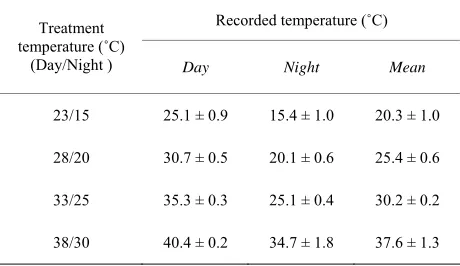
Day/night temperature inside the growth chambers were recorded with TP325—temperature/humidity data loggers (The Dickson Company, Addison, IL). The mean
recorded temperature in each unit is presented in Table 1.
The measured daily temperature was 0.5˚C - 2.9˚C higher than the assigned temperature. The average daily tem- peratures are presented replacing assigned temperature regimes hereafter (20.3˚C, 25.4˚C, 30.2˚C, 37.6˚C for 23˚C/15˚C, 28/20, 33˚C/25˚C and 38˚C/30˚C, respectively).
2.2. Growth Measurements
Growth measurements were made from first week of temperature treatment. One plant from each of the three middle pots in the row were selected and tagged as sample plants for growth measurement. The plants were marked and growth measurements were taken until 86 DAS. Plant height, tiller number and node number were re- corded at weekly intervals. Leaf elongation was recorded every day and leaf elongation rate was derived from av- erage elongation rate of 6 - 10th leaves. At the final har- vest, plant height, tiller number and node number were measured for all 4 plants in each pots (n = 6) and average were used for statistical analysis. Leaf and stem of plants from middle three pots (n = 3) were separated to study partitioning of biomass. Leaf area and weight were measured to calculate the specific leaf area (SLA).
2.3. Biomass Analysis
[image:2.595.308.538.602.735.2]Dried samples of leaf and stem were ground separately in a Wiley Mill (Thomas-Wiley Mill Co., Philadelphia, PA) to pass a 2 mm screen and then reground to uniformity in an Udy-Cyclone Impact Mill (Udy Corporation, Fort Collins, CO.) with a 1-mm screen. Biomass was analyzed at the Soil, Water and Forage Analytical Laboratory (SWFAL) at Oklahoma State University for neutral de- tergent fiber (NDF), acid detergent fiber (ADF), and acid detergent lignin (ADL) with an Ankom 200 Fiber Ana- lyser (ANCOM Technology Corp., Fairport, NY) follow- ing the Van Soest and Wine method [13]. From these, cellulose was calculated as ADF minus ADL, hemicellu- lose was calculated as NDF minus ADF, and ADL was considered as lignin.
Table 1. Temperatures in the four growth chambers.
Recorded temperature (˚C) Treatment
temperature (˚C)
(Day/Night ) Day Night Mean
23/15 25.1 ± 0.9 15.4 ± 1.0 20.3 ± 1.0
28/20 30.7 ± 0.5 20.1 ± 0.6 25.4 ± 0.6
33/25 35.3 ± 0.3 25.1 ± 0.4 30.2 ± 0.2
2.4. Statistical Analysis ure 1(b)) but no interaction was observed. Kanlow had
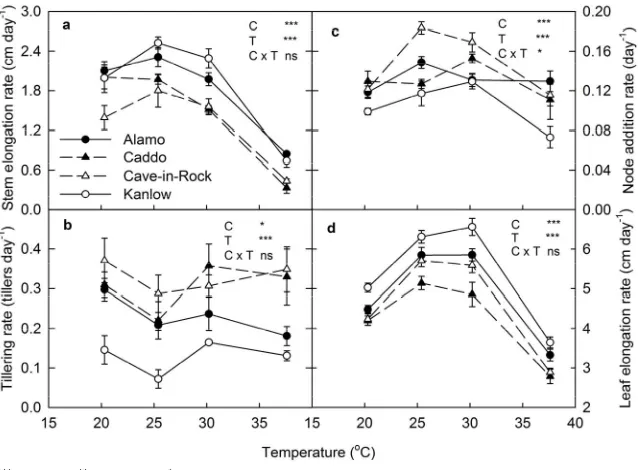
the lowest tillering rate across the temperature treatments. Increase in temperature increased the tillering rate of upland cultivars as compared to lowland cultivars. Measurements taken from each pot were averaged before
statistical analysis, and statistical analysis were done considering the pots as replication. Therefore, the uncer- tainty associated variation among pots was presented as standard errors SE of mean (n = 3 or 6). A two-way ANOVA was carried out on the data to determine the effect of temperature (T), cultivar (C) and their interac-tion (C × T) for various traits using PROC GLM in SAS [14].
Node development was also significantly different among cultivars (P < 0.001) and temperature treatments (P < 0.001). The interaction effect of temperature and cultivar was also significant (P < 0.05) (Figure 1(c)).
Node development rate decreased sharply at 37.6˚C ex- cept for Alamo. Leaf elongation rate was significantly different among cultivar (P < 0.001) and temperature (P < 0.001) treatment but interaction effect was not signifi- cant (Figure 1(d)). Lowland types had higher leaf elon-
gation rate across the temperature treatments than upland types. Kanlow had the highest leaf elongation rate and Caddo had the lowest leaf elongation rate. Leaf elonga- tion rate of all cultivars was higher in moderate tempera- tures but declined sharply at 37.6˚C.
3. Results
3.1. Growth Measurements
Stem elongation rate significantly differed among culti- vars (P < 0.001) and temperature (P < 0.001) treatments
(Figure 1(a)). Stem elongation rate (SER), derived from
the linear phase of increase of main tiller height over time, was generally higher in lowland cultivars than up- land cultivars across the temperature treatments. How- ever, at the lowest temperature condition (20.3˚C) SER of Caddo was equal to other two lowland cultivars. SER dropped sharply in all cultivars at the highest temperature. Although stem elongation decreased sharply for all cul- tivars in the highest temperature condition, it remained higher for lowland cultivars than upland cultivars. Tillering rate was significantly different among cultivars (P < 0.05) and temperature (P < 0.001) treatments (Fig-
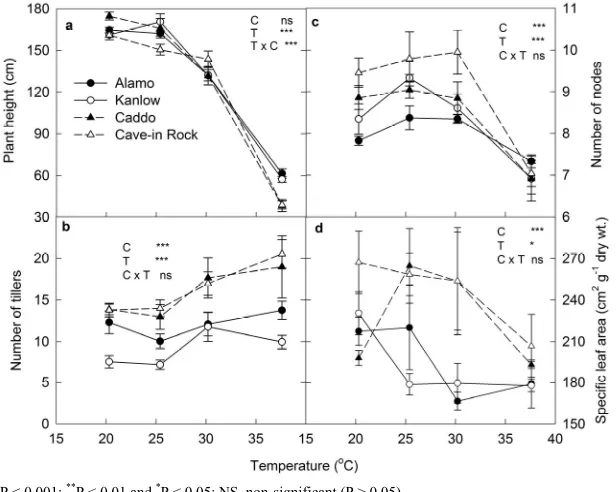
Plant height measured at final harvest was signifi- cantly different among temperature (P < 0.001) (Figure 2(a)). Similar to SER, plant height also decreased sharply
at 37.6˚C for all cultivars. The interaction effect was also significant (P < 0.001). Tiller number per plant increased at higher temperatures (30.2˚C and 37.6˚C). Total culti- vars was greater in all temperature treatments compared to lowland cultivars (Figure 2(b)). Final node number of
all cultivars decreased sharply at 37.6˚C (Figure 2(c)).
Both the tiller and node addition of Alamo remained more stable than in other cultivars showing wider adapta-
***P < 0.001; **P < 0.01 and *P < 0.05; NS, non-significant (P > 0.05).
[image:3.595.140.459.446.681.2]***P< 0.001; **P< 0.01 and *P< 0.05; NS, non-significant (P> 0.05).
Figure 2. The effect of temperature on final (a) plant height, (b) tiller number, (c) node number of switchgrass cultivars, and (d) specific leaf area. Vertical bars denote standard errors of mean (n = 6). Significance level for cultivar (C), temperature (T) and G × T are shown.
tion of Alamo across the temperature range.
Specific leaf area was significantly different among cultivars (P < 0.001) and temperature treatments (P < 0.05) (Figure 2(d)). The interaction effect was not sig-
nificant (P > 0.05). Specific leaf area of upland cultivars was generally higher at all temperature treatments com- pared to lowland types. Specific leaf area decreased sharply at 37.6˚C in upland cultivars. In lowland culti- vars, there was no significant difference in specific leaf area when plants were grown at 30.2˚C and 37.6˚C.
3.2. Biomass Yield and Partitioning
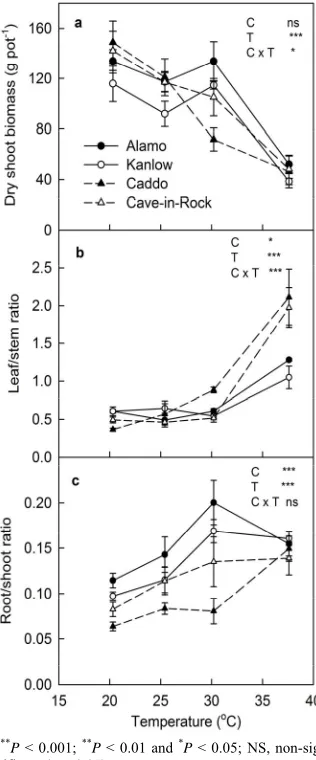
Temperature had significant (P < 0.001) effect on shoot biomass yield of switchgrass cultivars (Figure 3(a)). Si-
milarly, the interaction effect was also significant (P < 0.05). Upland cultivars produced maximum shoot bio- mass at 20.3˚C and lowland cultivar produced maximum biomass at 30.2˚C.
Biomass yield of all cultivars declined sharply at 37.6˚C. Significant interaction was observed in shoot biomass yield of switchgrass cultivars in response to temperature. Biomass yield of the two upland cultivars was the highest at 20.3˚C but it decreased with increase in temperature. Biomass yield of two lowland cultivars was increased up to 30.2˚C and decreased sharply at 37.6˚C.
This shows that lowland cultivars are adapted to a wider range of climates compared to upland cultivars. Within lowland ecotypes, Alamo produced more shoot biomass compared to Kanlow.
Partitioning of biomass between plant parts was meas- ured as shoot/root ratio and leaf/stem ratio. Leaf/stem ratio varied significantly among cultivars (P < 0.05) and temperature treatments (P < 0.001) (Figure 3(b)). Leaf/
stem ratio of upland cultivars increased more sharply at 37.6˚C compared to lowland cultivars. Root/shoot ratio varied significantly among cultivars (P < 0.001) and be- tween temperature treatments (P < 0.001) but interaction effect was not significant (Figure 3(c)). Root/shoot ratio
of lowland cultivars increased up to 30.2˚C and de- creased slightly at 37.6˚C. Among the upland types, root/shoot ratio of Caddo increased sharply at the highest temperature 37.6˚C. Root/shoot ratio of lowland cultivars was generally higher than upland cultivars.
3.3. Cell Wall Components of Shoot Biomass
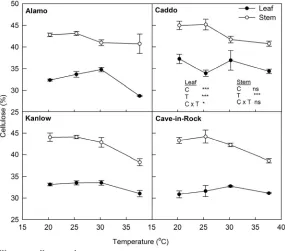
Cellulose concentration of leaves was significantly different among cultivars (P < 0.001) (Figure 4). Caddo had the
interaction effect of cultivar and temperature on cellulose concentration of the stem was not significant (P > 0.05).
Hemicellulose concentration of leaves was significantly different among cultivars (P < 0.05) and temperature treatments (P < 0.001) (Figure 5). It increased from 20.3˚C
to 25.4˚C, and then decreased again at higher temperatures, except in cave-in-Rock in which hemicellulose concentra- tion increased at the highest temperature. The interaction effect was not significant (P < 0.05). Hemicellulose concentration of stems did not differ significantly (P > 0.05) among cultivars but temperature and the interaction effect were significant (P < 0.05). Contrary to the leaves, hemicelluloses concentration of stems tended to increase when plants were grown at higher temperature.
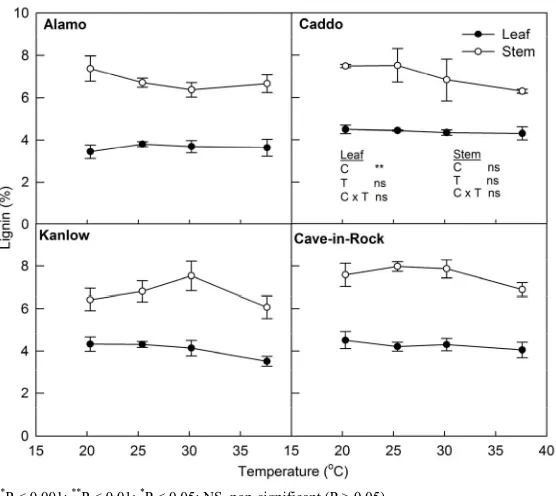
Lignin concentration of leaves was significantly different (P < 0.01) among cultivars (Figure 6). Leaves
***
P < 0.001; **P < 0.01 and *P < 0.05; NS, non-sig-
[image:5.595.92.250.292.672.2]nificant (P > 0.05).
Figure 3. The effect of temperature on final (a) Shoot bio- mass yield, (b) leaf/stem ratio, and (c) root/shoot ratio of switchgrass cultivars. Vertical bars denote standard errors of mean (n = 6). Significance level for cultivar (C), tem- perature (T) and C × T are shown.
of Caddo had highest concentration of lignin (4.39%) while Alamo had the lowest of lignin concentration (3.64%). Temperature and the interaction effects were not significant (P > 0.05). Lignin concentration of stems was not significantly different (P > 0.05) among cultivars, temperature treatment and interaction effect.
4. Discussion
The current study, under well irrigated and fertilized conditions using controlled environment growth cham- bers, proves differences in growth, development, yield and quality of switchgrass cultivars. Varietal difference was noted for stem elongation, tiller addition, node de- velopment, biomass yield and partitioning. Although direct comparisons of the trait expression between a con- trolled environmental study and field condition are diffi- cult, growth and development responses observed in this study show that there is considerable genetic variation in switchgrass in response to temperature.
The leaf/stem ratio of all cultivars increased at 37.6˚C for all cultivars but the increase in the ratio was higher in upland cultivars compared to lowland cultivars. As the leaf/stem ratio is known to increase at both lower and higher temperature with a minimum at optimum tem- perature [15], both upland cultivars were more suscepti- ble to high temperature than lowland cultivars. Among upland cultivars, Cave-in-Rock had more stable leaf/stem ratio in the temperature range of 20.3˚C - 30.2˚C which shows wider adaptation of Cave-in-Rock compared to Caddo. Moreover, Caddo had a sharp increase in root/ shoot ratio at 37.6˚C indicating the cultivar was more affected by high temperature than the other cultivars as root/shoot ratio is known to increase at both lower and higher temperature with a minimum at optimum tem- perature [15]. In the lowland types, a decrease in root/ shoot ratio was observed at 37.6˚C which indicate root development was severely impaired in lowland types at high temperature.
A decrease in cellulose concentration of both stem and leaf biomass in higher temperature was observed, which may be associated with higher loss of glucose molecules in the respiration process at higher temperature. Al- though lignification of plant biomass is under genetic control, environmental factors also play a role in lignifi- cation [16]. However, the present study found no effect of temperature on lignin concentration of both stem and leaf biomass. Similar result was found by Ford et al. [17]
***P < 0.001; **P < 0.01; *P < 0.05; NS, non-significant (P > 0.05).
Figure 4. Effect of temperature on cellulose concentration of leaf and stem of switchgrass cultivars. Vertical bars denote standard errors of mean (n = 3). Significance levels for cultivar (C), temperature (T) and (C × T) are shown.
[image:6.595.155.440.89.340.2]***P < 0.001; **P < 0.01; *P < 0.05; NS, non-significant (P > 0.05).
Figure 5. Effect of temperature on hemicellulose concentration of leaf and stem of switchgrass cultivars. Vertical bars denote standard errors of mean (n = 3). Significance levels for cultivar (C), temperature (T) and (C × T) are shown.
Our findings on responses to temperature are specific to four cultivars of switchgrass. These are high yielding cultivars of upland and lowland types and they are cur- rently grown for forage purposes and Alamo and Cave- in-Rock are grown extensively as biofuel feedstock. Our
***P < 0.001; **P < 0.01; *P < 0.05; NS, non-significant (P > 0.05).
Figure 6. Effect of temperature on lignin concentration of leaves and stems of switchgrass cultivars. Vertical bars denote standard errors of mean (n = 3). Significance levels for cultivar (C), temperature (T) and (C × T) are shown.
further investigation of the temperature response of a larger number of switchgrass cultivars and accessions to screen for tolerant cultivars is necessary.
In conclusion, our study reveals some beneficial traits of switchgrass cultivars for improved biomass production in present and future climates. Although none of the cul- tivars studied showed strong tolerance to high tempera- ture, differences was observed for many traits of switch- grass in response to temperature. Some of these traits in- clude stem elongation rate, rate of tiller development, and root/shoot and leaf/stem ratios which can be used as traits in determining the yield and stress tolerance of switchgrass.
5. Acknowledgements
This research was funded in part by the Oklahoma Bio- energy Center. The manuscript is a contribution of Okla- homa Agricultural Experiment Station at Oklahoma State University, Stillwater, OK.
REFERENCES
[1] M. A. Sanderson and D. D. Wolf, “Morphological De- velopment of Switchgrass in Diverse Environments,” Ag- ronomy Journal, Vol. 87, No. 5, 1995, pp. 908-915.
doi:10.2134/agronj1995.00021962008700050022x [2] L. E. Gunter, G. A. Tuskan and S. D. Wullschleger, “Di-
versity among Populations of Switchgrass Based on RAPD Markers,” Crop Science, Vol. 36, No. 4, 1996, pp.
1017-1022.
doi:10.2135/cropsci1996.0011183X003600040034x [3] S. D. Wullschleger, M. A. Sanderson, S. B. McLaughlin,
D. P. Biradar and A. L. Rayburn, “Photosynthesis Rates and Ploidy Levels among Populations of Switchgrass,”
Crop Science, Vol. 36, No. 2, 1996, pp. 306-312.
doi:10.2135/cropsci1996.0011183X003600020016x [4] C. L. Porter Jr., “An Analysis of Variation between Up-
land and Lowland Switchgrass, Panicum virgatum L., in
Central Oklahoma,” Ecology, Vol. 47, No. 6, 1996, pp.
980-992. doi:10.2307/1935646
[5] I. C. Madakadze, K. A. Stewart, R. M. Madakadze and D. L. Smith, “BASE temperature for Seedling Growth and Their Correlation with Chilling Sensitivity for Warm- Season Grasses,” Crop Science, Vol. 43, No. 3, 2003, pp.
874-878. doi:10.2135/cropsci2003.0874
[6] V. G. Kakani and K. R. Reddy, “Temperature Response of C4 Species Big Bluestem (Andropogon gerardii) Is
Modified by Growing Carbon Dioxide Concentration,”
Environmental and Experimental Botany, Vol. 61, 2007,
pp. 281-290. doi:10.1016/j.envexpbot.2007.06.002 [7] J. H. Christensen, B. Hewitson, A. Busuioc, A. Chen, X.
Gao, I. Held, R. Jones, R. K. Kolli, W.-T. Kwon, R. La-prise, V. Magaa Rueda, L. Mearns, C. G. Menéndez, J. Räisänen, A. Rinke, A. Sarr and P. Whetton, “Regional Climate Projections,” In: S. Solomon, D. Qin, M. Man- ning, Z. Chen, M. Marquis, K. B. Averyt, M. Tignor and H. L. Miller, Eds., Climate Change 2007: The Physical Science Basis. Contribution of Working Group I to the
Fourth Assessment Report of the Intergovernmental Panel on Climate Change, Cambridge University Press, Cam- bridge, and New York, 2007.
Science, Vol. 44, No. 2, 2004, pp. 443-448.
[9] A. F. Foschiani, F. Miceli and M. Vischi, “Assessing Di- versity in Common Bean (Phaseolus vulgaris L.) Acces-
sions at Phenotype and Molecular Level: A Preliminary Approach,” Genetic Resources and Crop Evolution, Vol.
56, No. 4, 2009, pp. 445-453. doi:10.1007/s10722-008-9377-z
[10] V. G. Kakani, G. K. Surabhi and K. R. Reddy, “Photo- synthesis and Fluorescence Responses of C4 Plant An- dropogon gerardii Acclimated to Temperature and Car-
bon Dioxide,” Photosynthetica, Vol. 46, No. 3, 2008, pp.
420-430. doi:10.1007/s11099-008-0074-0
[11] J. A. Balasko and D. Smith, “Influence of Temperature and Nitrogen Fertilization on the Growth and Composi-tion of Switchgrass (Panicum virgatum L.) and Timothy
(Phleum pratense L.) at Anthesis,” Agronomy Journal,
Vol. 63, No. 6, 1971, pp. 853-857.
doi:10.2134/agronj1971.00021962006300060009x [12] J. C. Hartman and J. B. Nippert, “Physiological and Growth
Responses of Switchgrass (Panicum virgatum L.) in Na- tive Stands under Passive Air Temperature Manipula- tion,” GCB Bioenergy, 2012, in press.
doi:10.1111/j.1757-1707.2012.01204.x
[13] P. J. Van Soest and R. H. Wine, “Use of Detergents in the
Analysis of Fibrous Feeds. IV. Determination of Plant Cell Wall Constituents,” Journal of Associated Officers of Agricultural Chemistry, Vol. 50, No. 1, 1967, pp. 50-55.
[14] SAS Institute, “SAS/STAT User’s Guide, Version 9.1,” SAS Institute, Cary, 2009.
[15] H. Lambers, R. VandenBoogaard, E. J. Veneklaas and R. Villar, “Effects of Global Environmental Change on Car- bon Partitioning in Vegetative Plants of Triticum aesti- vum and Closely Related Aegilops Species,” Global Change Biology, Vol. 1, No. 6, 1995, pp. 397-406.
doi:10.1111/j.1365-2486.1995.tb00038.x
[16] K. J. Moore and H. J. G. Jung, “Lignin and Fiber Diges- tion,” Journal of Range Management, Vol. 54, No. 4,
2001, pp. 420-430. doi:10.2307/4003113
[17] C. W. Ford, I. M. Morrison and J. R. Wilson, “Tempera- ture Effects on Lignin, Hemicellulose and Cellulose in Tropical and Temperate Grasses,” Australian Journal of Agricultural Research, Vol. 30, No. 4, 1979, pp. 621-633. doi:10.1071/AR9790621
[18] W. G. Hohenstein and L. L. Wright, “Biomass Energy Production in the United States: An Overview,” Biomass and Bioenergy, Vol. 6, No. 3, 1994, 115-124.