doi:10.4236/cn.2011.31001 Published Online February 2011 (http://www.SciRP.org/journal/cn)
Fast Sparse Multipath Channel Estimation with Smooth
L0 Algorithm for Broadband Wireless Communication
Systems
Guan Gui1,2, Qun Wan1, Ni Na Wang3, Cong Yu Huang4
1
Department of Electronic Engineering, University of Electronic Science and Technology of China, Chengdu, China
2
Department of Electrical and Communication Engineering, Graduate School of Engineering, Tohoku University, Sendai, Japan
3
Key Laboratory of Universal Wireless Communications, Ministry of Education, Beijing University of Posts and Telecommunications, Beijing, China
4
School of Software, Tsinghua University, Beijing, China E-mail: [email protected]
Received November 29, 2010; revised December 14, 2010; accepted December 18, 2010
Abstract
Broadband wireless channels are often time dispersive and become strongly frequency selective in delay spread domain. Commonly, these channels are composed of a few dominant coefficients and a large part of coefficients are approximately zero or under noise floor. To exploit sparsity of multi-path channels (MPCs), there are various methods have been proposed. They are, namely, greedy algorithms, iterative algorithms, and convex program. The former two algorithms are easy to be implemented but not stable; on the other hand, the last method is stable but difficult to be implemented as practical channel estimation problems be-cause of computational complexity. In this paper, we introduce a novel channel estimation strategy using smooth L0 (SL0) algorithm which combines stable and low complexity. Computer simulations confirm the effectiveness of the introduced algorithm. We also give various simulations to verify the sensing training signal method.
Keywords:Smooth L0 Algorithm, Restricted Isometry Property, Sparse Channel Estimation, Compressed Sensing
1. Introduction
Coherent detection in broadband wireless communica-tion systems often requires accurate channel state infor-mation (CSI) at a receiver. The study of channel estima-tion for the purposes of channel equalizaestima-tion has a long history. In many previous studies, they assume that the channel impulse responses (CIRs) in time domain are distributed densely. Under this assumption, it is neces-sary to use a redundant training sequence to probe the CSI. In addition, the linear channel estimation methods, such as least square (LS) algorithm and minimum mean square error (MMSE), always lead to lower spectral effi-ciency due to utilizing more training source in transmit-ted data block. It is very interesting to develop an effec-tive channel estimation method to save training sequence
and to improve spectral efficiency.
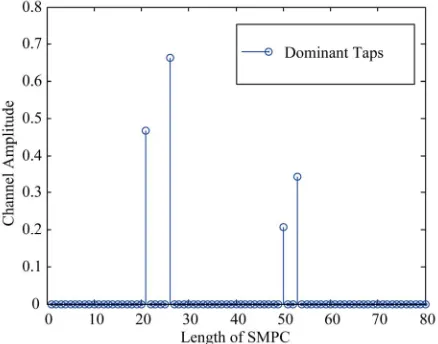
An example of SMPC impulse response channel is shown in Figure 1. Recently, the study on SMPC has drawn a lot of attentions and concerning results can be found in literature [3-5]. Correspondingly, sparse chan-nel estimation technique has also received considerable interest for its advantages in high bit rate transmissions over multipath channel [6].
Exploiting the sparse property of SMPC, orthogonal matching pursuit (OMP) algorithm [7,8] and convex program algorithm [9] have been proposed. OMP algo-rithm is fast and easy to be implemented. However, the stability of OMP for sparse signal recovery has not been well understood yet. To mitigate the unstability, Needell and Tropp have presented a compressive sampling matching pursuit (CoSaMP) algorithm for sparse signal recovery in [10]. After that, Gui et al. [11] have intro-duced the algorithm to SPMC channel estimation and acquired robust channel estimator [12]. However, as the increasing of number of channel dominant taps, accurate channel estimator is hard to obtain due to unavoidable correlation between columns of the training sequence, thus the instability of the CoSaMP algorithm easily leads to weak channel estimation. Convex program method can resolve the instability of Greedy algorithm. Convex program algorithm, such as Dantzig Selector (DS) [13], is based on linear programming. The main advantage of convex program method is its stability and high estima-tion accuracy. The convex problem method can work correctly as long as the RIC conditions of training se-quences are satisfied. However, this method is computa-tionally complex and difficult to be implemented in real applications [14].
[image:2.595.62.281.516.688.2]In this paper, we introduce a novel SMPC estimation method using smooth L0 (SL0) algorithm [15]. It has both the advantages of the greedy algorithm and the
Figure 1. An example of SMPC where the channel sampling length is 80 while its number of dominant taps is 4.
convex program. In other words, SL0 algorithm com-bines low computational complexity and robustness on practical channel estimation, especially in high sig-nal-noise-ratio (SNR) environment. The study in [15] focused on mathematical description on SL0 algorithm for sparse or approximate sparse signal recovery problem. The perfect CSI was assumed while practical channel estimation has not considered. In this paper, we intro-duce the SL0 algorithm to deal with the practical sparse channel estimation problems that via exploiting channel sparsity.
The rest of the paper is organized as follows. Sparse multipath channel model is presented in Section 2. Sec-tion 3 will describe the existing SL0 algorithm and pro-pose a CS-based SMPC estimation method by using the SL0 algorithm. In Section 4, we compare the perform-ance of the proposed method with the existing methods by simulations. Finally, conclusions are drawn in Section 5.
2. Sparse Multipath Channel Model
At first, the symbols used in this paper are described as follows. The superscript H stands for Hermite transposi-tion Bolded capital letters denote a matrix where bolded lowercase letters represent a vector. Notation stands for the absolute value. Norm operator 0 denotes 0
vector norm, i.e., the number of non-zero entries of the vector;
1 denotes 1 vector norm, which is the sum
of the absolute values of the vector entries.
2 denotes
L2 norm. and indicate estimate channel vector
and actual channel vector, respectively.
h h
We consider single-antenna broadband communica-tion systems, which are often equivalent to frequency- selective baseband channel model. Hence, the transmit-ted and received signal are relatransmit-ted by
max
0
y t
h x t d z t , (1)where x t
and y t
denotes the transmitted and received waveforms, respectively, and max is definedas the maximum possible dominant taps delay spread introduced by the channel. And is a zero-mean, circularly symmetric, complex additive white Gaussian noise (AWGN). The equivalent baseband transmitted
z t
X d received signals y given by
an N is
yXhz, (2)
where X is a complex training signal with Toeplitz structure of NL dimensions. z s the N1 com-plex additive white Gaussian noise (AWGN) with zero mean and variance 2
. is an unknown de-terministic channel vector which is given by
h L1
1
0 exp
L
i i
i
where hiexp
ji
are complex channel andcoefficients
is a sampling rate and hence Lmax is
defined as the channel length. S#
hi 0,iL
de-notes number of dominant taps of th ereSL. Suppose that there are S taps distributed uniform randomly over the channel. Hence, te estimate the dominant coefficients in the chan-nel is necessary for signal detection and demodulation at the receiver.
3. CS-Base
the e SMPC wh
dominant channel
accura
d Sparse Channel Estimation
attracted great ttentions in sparse channel estimation. We review the
3.1.1. Sparse Representation
onsider a signal vector that can be repre-3.1. Review of Compressed Sensing
Compressed sensing (CS) [16,17] has a
CS theorem on channel estimation by two aspects: 1) sparse approximation, 2) incoherence property of train-ing sequence (senstrain-ing matrix). We rewrite the above system model (2) as
y g z h z. (4)
C N1
g
sented in an arbitrary basis,
g kk, 1,,N
, with the weighting coefficients gk. S he coefficients into a vector,tacking t
g, the relationship with g is obviously through the transform g h, where
1, 2,,N
is a full rank N matrix. Let us take n example of sparse channel estimation problem quencyly, we sample xample from a finite length, discrete channel vector that one could rep-resent as discrete sinusoids in a limited bandwidth. T matrix (sometimes is termed as dictionary) would then be the discrete Fourier transform (DFT) matrix.
In CS one is particula y interested in any basis that allows a sparse representation of received signal y, i.e., a basis
N
om
a in the time-fre
e domai
he
rl
n. C mon N
1, 2, , N
such that most coefficients
k are zero. Obviously if one knows
h g, one could
al-ways choose some basis for which g h fo some
0
k ; then
r all gk, gk g0
re esentatio
, would be zero. This trivial e is not of interest; instead one is in ested in a pre-determined basis that will render a s r approxi-tely sparse pr n of any y that belongs to some class of signals. In (4),
cas
ma
ter parse o
denotes random meas-urement matrix for reconstruct sparse signal. In the fol-lowing section, we will discuss the restricted isometry property of measurement matri .
3.1.2. Restricted Isometry Property In the theory of CS, restricted i metr
x
so y property (RIP) as become a standard tool for studying how efficiently a about sparse and h
sensing matrix acquires information
compressible signals. If the sensing matrix with small restricted isometry constants (RIC), many proposed CS algorithms can reconstruct unknown sparse signal suc-cessfully. Let’s give an example in the sparse channel estimation. We can utilize a small number of training sequence robust capture all the information in a sparse channel. Furthermore, we estimate the sparse channel from these training sequence using efficient CS algo-rithms. We give a definition of restricted isometry prop-erty (RIP) [18] on sensing matrix.
Definition 1 (RIP [18]). For each integer 1, 2, ,
K N, define the restricted isometry constant (RIC) for all K of a sensing matrix X as the
small-est number such that
2 2
22 2 2
1 K h Xh 1 K h , (5)
holds for all S-sparse signal vector h. ue to simplify, we termed as
D
: , K
X RIC K 1 .
this paper, we consider the complex Rayleigh prob-cal channel impulse sponse, which is defined as
3.2. Sparse Channel Estimator
In
ability density distribution for practi re
2exp 22 2 2 2 exp
2 22
2 2
R I
R I h h
h h
h h
(6) where
f h
h , hR and hI
of
represent the amplitude, real and imaginary parts channel vector hL
. From above (6), we can find the complex channel amplitude
2 2
R I
h h h where its real part
2
~ 0,
R
h I and imaginary part hI ~
0,2I
are two independent normal distributions, where I reprema-cided by channel len sed sents identity
trix which de gth. On CS-ba
n, the optimal
channel estimatio sparse estimators are given by [16]
2
2 0
ˆ arg min
-opt h
h y Xh h . (7)
However, direct compute the -norm is a high com- putational cost problem [16] hence
channel estimator cannot obt unately, there lo 0 and ain. Fort tho the optimal have t of sparse approximation me ds (e.g., Lasso [16] and CoSaMP [19]) to obtain sub-optimal channel esti-mators. In this part, we introduce a fast algorithm for CS-based sparse channel estimation. At first, we define i-th (i0,,L1) taps of channel satisfies the follow function
0
lim 1 i 1 lim i
0
0
1 0 0
R I
i i
R I
i i i
f h f h
0
h h
h h or h
as a sparse measure function which related as channel variance . And the approximate norm function is given by
0
1
00 i 0
limF h L 1 limf hi L h
. (9)
That is to say,
0
h L F h . (10)
The channel variance specifies a tradeoff b accuracy and smoothness of the sparse channel estima-tio
etween
n: the smaller , the better estimation performance, and vice verse. Fr (5 inimizat
is equivalent xim zation of ), m
i om to ma
ion of the 0 norm
F for sufficiently
small are described b ollowing theorem [15]. Theorem 1 Sparse channel approximation problem:
max
y f
F h subejct to y Xh (11)
where , is the minimum 2 rm channel esti-
mator t t is, hXH
XXH
-1 yand 0
no
ha , is the mi-
nimum 0 norm estimator of system model yXhz.
Ba
timation with SL0 algorithm [15], the deta
p s.
parse channel estimation Train
sed on the above Theorem 1, on sparse channel es-il of channel estimation ste s is given as follow
CS-based s
Input: ing sequence X, received signal vector y, decreasing channel variance
1,,M
. Cth
s with function hoose e initial channel estimator h0 by LS.
Output: Sparse channel estimator hˆ for m1,,M
1) Find the support set of dominant tap
F h
Initialization hm1
for j = 1,,K Let
2 2
2 2
1exp 1 2 m , , Lexp L 2 m
h h h h h
j m
h h
1 h
(where is small step length) Compute hm hjX†
Xhjy
End 2) hˆhm end
Lower
To uate the MSE performance of channel estimators, it is very m ningful compare their achievements with formance bound in practical broadband ommunication systems, then they are approximate
op -ossible. This motivates the development of lower 3.3. Bound of Channel Estimators
eval ea theoretical per c
timal and further improvements in these systems are im p
bounds on the MSE of estimators in the sparse channel estimation. Since the channel vector to be estimated is
deterministic, and then we can give a lower bound as for the baseline of MSE. Suppose we know the location set
# i 0
T h iT of dominant channel taps. Thus, the oracle estimator given by
1, ˆ
0, elsewhere
H H
T T T T
oracle
X X X y T
h
, (12)
T
X is the
gnal
where partial training signal constructed from columns of training si X corresponding to the do taps of SMPC vecto . Hence, the refer-ence lower bound (RLB) of sparse channel est
given by
minant r h
imator are
2
2ˆ ˆ
oracle
RLB h hh . (13)
4. Simulation Results and Discussions
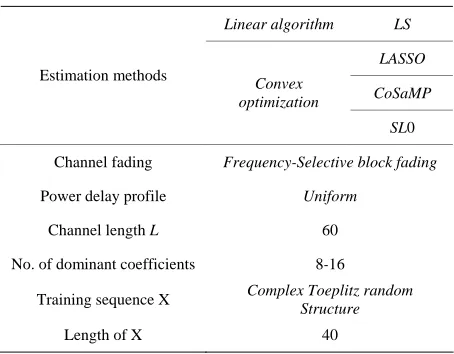
The parameters used in the simulation are listed 1. To illustrate the performance of propo
gorithm, Figure 2 shows the mean square error , SL0. (MSE) aluation criterion can be defined as:
in Table sed method with SL0 al
(MSE) of dominant taps by employing LS, Lasso The estimation error using mean square error ev
2
2
ˆ - m
MSE h h . (14)
4.1. CDF Versus MSE
To compare the MSE performance of estimation methods, the cumulative density function (C
Figures 2, 3. It can be clearly observed that the CDF rve of the proposed method by using SL0 algorithm is d better than the performance
DF) is compared in
cu
[image:4.595.310.537.543.720.2]very close to the LASSO an
Table 1. Simulation condition.
Linear algorithm LS
LASSO
CoSaMP
Estimation methods Convex
optimization
SL0
Channel fading Frequency-Selective block fading
Power delay profile Uniform
0
No. of dominant coefficients -16
Tr Complex Toeplitz random
Length of X 40
Channel length L 6
8
aining sequence X
Figure 2. MSE of the overall coefficients at SNR = 10 dB.
Figure 3. MSE of the dominant coefficients at SNR = 10 dB.
of other estimation methods when comparing with esti-mation performance on either taps or dominant taps.
4.2. MSE Versus SNR
e nce shorter than estimation he MSE performance of LS-
t measure of complexity, it can give us a ugh estimation of computational complexity. Our si- AB 2007 environ-ent using a 2.40 GHz Intel Core-2 processor with 2GB
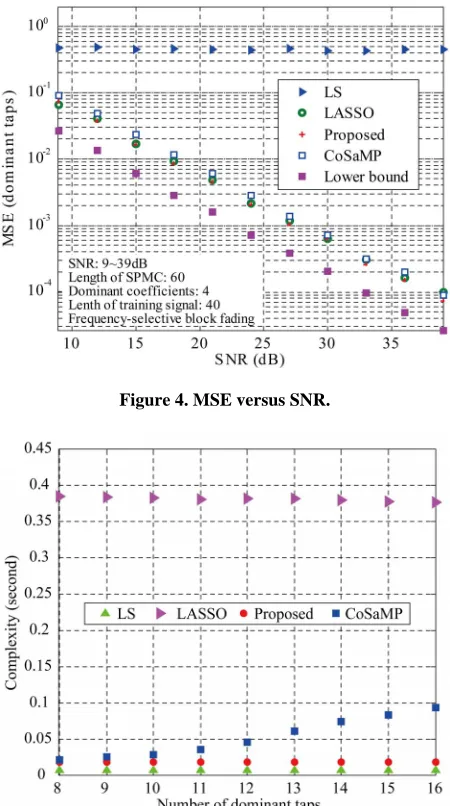
As is shown in Figure 4, the proposed estimation me- od has a better MSE performance than LASSO and th
CoSaMP. It was worth noting that LS-based linear esti-mation has a bad MSE performance which invariant with NR due to undetermined system, that is to say, th S
length of training seque hannel length. Hence, t c
based channel estimators is invariant whatever the SNR changes.
4.3. Computational Complexity
To study the computational complexity (CC) of the
in-troduced algorithm, we have evaluated the CPU time in second to complete the channel estimation for SNR = 10 dB. It is worth mentioning that although the CPU time is not an exac
ro
mulations are performance in MATL m
of memory and under Microsoft XP 2003 operating sys-tem.
[image:5.595.311.537.288.471.2]The comparison of computational complexity between LS, LASSO, CoSaMP and SL0 algorithms is shown in Figure 5. It is seen that the computing time of proposed method is close to 0.02 second, while the computing time of the LASSO algorithm is more than 0.4 seconds. As for the CoSaMP algorithm, the compute complexity is in-creasing as the number of dominant taps inin-creasing. Thus,
Figure 4. MSE versus SNR.
[image:5.595.64.282.295.475.2]CS-based sparse channel estimation with SL0 algorithm is lower complexity method and hence easy implement at receiver on practical communications system.
5. Conclusion
In this paper, we have proposed a novel sparse channel estimation method with SL0 algorithm which combines stable and fast. Thus this method has both advantage the greedy algorithm and convex program algorithm has been shown that, when compared with the existing algorithms, our introduced method is both bandwidth and computationally efficient. In our future work, we continue introduce the algorithm to sparse channel esti-mation problem in the multiple antennas systems and cooperative networks.
72146, the chnology Research and Development a (863 Program) under grant 2008
ku University Global COE pro-d Research Center for Earth
gital Underwater Acoustic Com-95 MTS/IEEE Challenges of Our bal Environment Conference Proceedings, l. 3, October 1995, pp. 1417-1422. doi:10. 1109/OCEANS.1995.528671
, Vol. 53,
Inaccurate Samples,”
Ap-ng
ces, Vol. 346, No. 9-10, May
/009053607000000532 [6]
s of
. It [7] Z. G. Karabulut and A. Yongacoglu, “Sparse Channel Estimation Using Orthogonal Matching Pursuit Algo-rithm,” 2004 IEEE 60th Vehicular Technology Confer-ence, Vol. 60, No. 6, 2004, pp. 3880-3884. doi:10.1109/ will VETECF.2004.1404804
[8] J. A. Tropp and A. C. Gilbert, “Signal Recovery from Random Measurements via Orthogonal Matching Pur-suit,” IEEE Transaction on Information Theory
6. Acknowledgement
This work is supported in part by the National Natural cience Foundation of China under grant 607
S
[9]
National High Te rogram of Chin P
AA12Z306, the Key Project of Chinese Ministry of Education under grant 109139 as well as Open Research Foundation of Chongqing Key Laboratory of Signal and Information Processing (CQKLS & IP), Chongqing University of Posts and Telecommunications (CQUPT). And the first author is special supported in part by China Scholarship of China Scholarship Council (CSC) under grant No. 2009607029 and the Outstanding Doctor Can-didate Training Fund of University of Electronic Science and Technology of China (UESTC). And he is also
sup-orted in part by Toho p
gram “Global Education an and Planetary Dynamics”.
7. References
[1] Z. Yan, M. Herdin, A. M. Sayeed and E. Bonek, “Ex-perimental Study of MIMO Channel Statistics and Ca-pacity via the Virtual Channel Representation,” February 2007. http://dune.ece.wisc.edu/pdfs/zhoumeas.pdf.
[2] J. Kivinen, P. Suvikunnas, L. Vuokko and P. Vainikainen, “Experimental Investigations of MIMO Propagation Channels,” Antennas and Propagation Society Interna- tional Symposium, IEEE, 2002.
[3] W. F. Schreiber, “Advanced Television Systems for Ter-res-Trial Broadcasting: Some Problems and Some Pro-posed Solutions,” IEEE Proceedings, Vol. 83, No. 6, June 1995, pp. 958-981. doi:10.1109/5.387095
[4] R. Steele, “Mobile Radio Communications,” IEEE Press, New York, 1992.
[5] M. Kocic, D. Brady and M. Stojanovic, “Sparse Equali-zation for Real Time Di
munications,” OCEANS’ Changing Glo
San Diego, Vo
C. Carbonelli, S. Vedantam and U. Mitra, “Sparse Chan-nel Estimation with Zero Tap Detection,” IEEE Transac-tions on Wireless CommunicaTransac-tions, Vol. 6, No. 5, May 2007, pp. 1743-1753. doi:10.1109/TWC.2007.360376
No. 12, 2007, pp. 4655-4666. doi:10.1109/TIT.2007.909 108
U. W. Bajwa, J. Haupt, G. Raz and R. Nowak, “Com-pressed Channel Sensing,” 42nd Annual Conference on Information Sciences and Systems, CISS’08, Princeton, 19-21March 2008. doi:10.1109/CISS.2008.4558485
[10] D. Needell and J. A. Tropp, “CoSaMP: Iterative Signal Recovery from Incomplete and
plied and Computational Harmonic Analysis, Vol. 26, No. 3, 2008, pp. 301-321. doi:10.1016/j.acha.2008.07.002
[11] G. Gui, Q. Wan, W. Peng and F. Adachi, “Sparse Multi-path Channel Estimation Using Compressive Sampli Matching Pursuit Algorithm,” IEEE VTS APWCS 2010, 19-22 May 2010.
[12] E. J. Candès, “The Restricted Isometry Property and Its Implications for Compressed Sensing,” Compte Rendus de l’Academie des Scien
2008, pp. 589-592. doi:10.1016/j.crma.2008.03.014
[13] E. Candès and T. Tao, “The Dantzig Selector: Statistical Estimation When p is Much Larger than n,” Annals of Statistics, Vol. 35, No. 6, 2007, pp. 2313-2351. doi:10. 1214
[14] N. H. Nguyen and T. D. Tran, “The Stability of Regular-ized Orthogonal Matching Pursuit Algorithm,” http:// www.dsp.ece.rice.edu/cs/Stability_of_ROMP.pdf.
[15] H. Mohimani, M. Babaie-Zadeh and C. Jutten, “Com-plex-Valued Sparse Representation Based on Smoothed L0 Norm,” Proceedings of ICASSP2008, Las Vegas, April 2008, pp. 3881-3884.
[16] E. Candès, J. Romberg and T. Tao, “Robust Uncertainty Principles: Exact Signal Reconstruction from Highly In-complete Frequency Information,” IEEE Transaction on Information Theory, Vol. 52, No. 2, February 2006, pp. 489-509. doi:10.1109/TIT.2005.862083
[17] D. L. Donoho, “Compressed Sensing,” IEEE Transaction on Information Theory, Vol. 52, No. 4, April 2006, pp. 1289-1306. doi:10.1109/TIT.2006.871582
“CoSaMP: Iterative Signal
ysis, Vol. 26, No.
Mathematique, Vol. 346, No. 9-10, May 2008, pp. 589- 592. doi:10.1016/j.crma.2008.03.014
[19] D. Needell and J. A. Tropp,
3, Ma
Recovery from Incomplete and Inaccurate Samples,”
Ap-plied and Computational Harmonic Anal