2019, Volume 6, e5680 ISSN Online: 2333-9721 ISSN Print: 2333-9705
DOI: 10.4236/oalib.1105680 Aug. 27, 2019 1 Open Access Library Journal
Risk Analysis of Integrated Pipe Gallery PPP
Project Based on the Analytic Hierarchy
Process
Yue Yue1, Jiaye Wu2*, Shuyang Liu1, Yingqian Zhang2
1School of Management of Sichuan University of Science & Engineering, Zigong, China 2School of Civil Engineering of Sichuan University of Science & Engineering, Zigong, China
Abstract
As a public infrastructure for integrated construction, the integrated pipe corridor can extend the service life of the road and save the urban ground space [1]. Rational distribution of integrated pipe corridors provides a strong guarantee for the sustainable development of the city [2]. In recent years, the integrated management of the corridor government and social capital coop-eration (PPP) has been widely used in China, in the integrated pipe gallery PPP project, high-speed under the development situation, problems such as out-of-control design in the early stage and loss of trust during the construc-tion period are frequent. Contractual disputes caused by these problems, government repurchase, project suspension and other risks damage the project benefits, which seriously violate the original intention of the project [3]. PPP projects are characterised by long-term, variability and complexity. Risks are more difficult to control than conventional projects. It is a need for a dynamic risk management system that can effectively prevent and control the occurrence of risks, accurately assess risk factors and ensure the protec-tion of risk management.
Subject Areas
Risk ManagementKeywords
Risk Analysis, PPP Project, Analytic Hierarchy Process
1. Introduction
As a public infrastructure for integrated construction, the integrated pipe
corri-How to cite this paper: Yue, Y., Wu, J.Y., Liu, S.Y. and Zhang, Y.Q. (2019) Risk Analysis of Integrated Pipe Gallery PPP Project Based on the Analytic Hierarchy Process. Open Access Library Journal, 6: e5680.
https://doi.org/10.4236/oalib.1105680
Received: August 8, 2019 Accepted: August 24, 2019 Published: August 27, 2019
Copyright © 2019 by author(s) and Open Access Library Inc.
This work is licensed under the Creative Commons Attribution International License (CC BY 4.0).
DOI: 10.4236/oalib.1105680 2 Open Access Library Journal dor can extend the service life of the road and save the urban ground space [1]. Rational distribution of integrated pipe corridors provides a strong guarantee for the sustainable development of the city [2]. In recent years, the integrated man-agement of the corridor government and social capital cooperation (PPP) has been widely used in China, in the integrated pipe gallery PPP project, high-speed under the development situation, problems such as out-of-control design in the early stage and loss of trust during the construction period are frequent. Con-tractual disputes caused by these problems, government repurchase, project suspension and other risks damage the project benefits, which seriously violate the original intention of the project [3]. PPP projects are characterized by long-term, variability and complexity. Risks are more difficult to control than conventional projects. It is a need for a dynamic risk management system that can effectively prevent and control the occurrence of risks, accurately assess risk factors and ensure the protection of risk management.
2. PPP Project Overview
PPP (Public-Private-Partnerships) is a cooperative model formed by govern-ment and social capital through the establishgovern-ment of formal contracts. Broad PPP refers to the long-term cooperation between the government and enterpris-es to provide public goods or servicenterpris-es; narrowly defined PPP refers to a serienterpris-es of long-term cooperation between the public sector and the private sector based on project financing, providing public goods or services [4] [5]. The risk of PPP project goes through the whole life cycle, and the PPP project has a longer con-struction period, a larger investment amount, and more stakeholders involved, resulting in poor predictability of risks. Therefore, risk management during project implementation. It has become ever more important.
3. PPP Mode Risk Analysis
3.1. PPP Project Risk Identification
Risk management of PPP projects is very complex, including risk identification, risk assessment, risk monitoring and risk response. Risk identification is the foundation for risk management of PPP projects. By collecting a large amount of project data, one or more combinations are used to determine the relevant sources and characteristics of the project [6]. It is necessary to establish a dy-namic and complete risk identification system within the project cycle, analyze the risks existing in the project by using certain risk identification methods, analyze the causes and processes of the risks, and evaluate the probability of oc-currence of risks and the impact on the project.
3.2. PPP Project Risk Classifications
as-DOI: 10.4236/oalib.1105680 3 Open Access Library Journal sumed by the government and the risk assumed by the investor. The risk as-sumed by the construction party; the risk can also be divided into three levels: macro level risk, metro level risk and micro level risk; the risk is divided into three levels: national risk, market risk and project risk [7]. In this paper, by re-ferring to the literature and analyzing the PPP project case, the risk factors of a PPP project are divided into four risk categories: pre-project, the project con-struction period, project operation period and project full-cycle. These four risks also include risk factors within their respective scope.
4. Risk Analysis of PPP Project Based on AHP
4.1. Construction of Investment Risk Index System for Integrated Pipe Corridor PPP Project
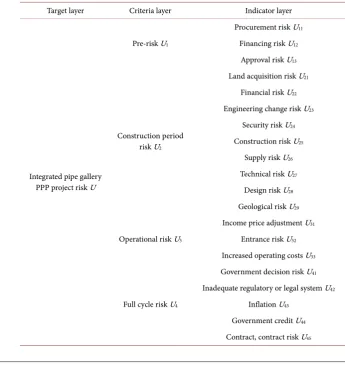
[image:3.595.190.536.375.741.2]The article first constructs an index system for comprehensive PPP project risk, and then determines the risk size and impact on the project based on the con-structed risk factor indicators. Depending on the above classification and classi-fication of risks, this paper establishes a three-level indicator system, namely the target layer, the criterion layer and the indicator layer. The criterion layer has 4 indicators and the indicator layer has 20 indicators, as showed in Table 1.
Table 1. Risk indicator system of integrated pipe gallery PPP project.
Target layer Criteria layer Indicator layer
Integrated pipe gallery PPP project risk U
Pre-risk U1
Procurement risk U11
Financing risk U12
Approval risk U13
Construction period risk U2
Land acquisition risk U21
Financial risk U22
Engineering change risk U23
Security risk U24
Construction risk U25
Supply risk U26
Technical risk U27
Design risk U28
Geological risk U29
Operational risk U3
Income price adjustment U31
Entrance risk U32
Increased operating costs U33
Full cycle risk U4
Government decision risk U41
Inadequate regulatory or legal system U42
Inflation U43
Government credit U44
DOI: 10.4236/oalib.1105680 4 Open Access Library Journal
4.2. AHP-Based Decision Results
Analytic Hierarchy Process (AHP) is a multi-criteria decision-making method that combines qualitative and quantitative analysis. The AHP method is used to decompose the relevant elements of the PPP project risk problem into the target layer, the criterion layer and the indicator layer, and then subjectively The judgment is objectively quantified, and finally the problem is reduced to the problem of determining the relative importance weight of the lowest level rela-tive to the highest level [8]. The AHP method is used to analyze the various fac-tors of the risk of the PPP project of the integrated pipe gallery, and the steps to obtain the decisive results of all levels of factors are as follows:
Step 1 construct a judgment matrix.
Each element of each layer in the comprehensive risk indicator system of the PPP project is compared with each other to obtain a judgment matrix of two layers of elements. The 1-9 scale method is used to quantify the decision judg-ment, and the experts analyze and determine two kinds of numerical judgment matrices: 1) the judgment matrix of the criterion layer for the target layer; 2) the judgment matrix of the index layer for the criterion layer U U- i, among them,
{
1, 2,3, 4,5}
i= (Table 2).
Step 2 consistency tests.
In order to prevent the determination of the relative importance of each indi-cator, there will be uncoordinated or even contradictory results, and a consis-tency check is required. According to the relationship between the matrix and the corresponding eigenvalues in the matrix theory, the characteristics of the ei-genvalue can largely reflect the characteristics of the matrix to which it belongs. Therefore, the indicator that the measurement matrix deviates from the consis-tency is represented by the eigenvalue (n = matrix order)
max 1 n CI n λ − =
− (1)
The larger the value of CI, the worse the consistency test result of the matrix
is, and the more uncoordinated between the indicators; on the contrary, the bet-ter the consistency test and the coordination of the indicators.
CI CR
RI
= (2)
As shown in Equation (2), in order to characterize the matrix random consis-tency ratio, the ratio of CI to RI (mean random consistency index) is
se-lected to determine and denoted as CR. Wherein, the value of RI is obtained
from Table 3 according to the order of the matrix.
With 0.1 as the limit, the meaning of the CR value can be divided into two
cases:
( )
( )
III 0.1, The matrix has satisfactory consistency Make adjustments until satisfaction 0.1, C C R R < ≥
(3)
DOI: 10.4236/oalib.1105680 5 Open Access Library Journal Table 2. Judges the relative importance and meaning of the matrix.
Scaling Definition
1 Equal importance
3 Moderate importance
5 Strong importance
7 Very Strong or demonstrated importance
9 Extreme importance
2, 4, 6, 8 Median value of adjacent judgment
Table 3. RI (Average Random Consistency Indicator) value table.
Order 1 2 3 4 5 6 7
R value 0 0 0.58 0.88 1.12 0.24 0.32
The weighting information of each element of the hierarchy relative to the previous layer is obtained by the judgment matrix, that is, the order of the hie-rarchical order of the solving system is transformed into the largest eigenvalue and the corresponding eigenvector of the solving matrix. In this paper, the least eigen method is used to solve the maximum eigenvalue λmax and the weight vector of the matrix Wi, i=
{
1, 2,3, 4,5}
, and the evaluation results of the con-sistency test are obtained by Equations (1) and (2).Step 4 levels total sorting.
The total hierarchical ranking calculation calculates the PPP project risk index system hierarchically from top to bottom along the ladder level, and obtains the weight share of all the index factors at the lowest level of the highest target layer.
5. Example Analysis
A-city new integrated and operated pipeline corridor in the new district of a city is a PPP project of cooperation between the government and social capital. The corridor is about 13 km long, 3 m high and 5 m wide, including weak electric pipelines, high-pressure pipelines, communication pipelines, and water pipe-lines. Pipeline. It was made available for operation in early 2015 and has now entered the operation period. The project cooperation period is 27 (including the 2a construction period), and the project has not been handed over.
On the basis of data review and field investigation, a risk index system was es-tablished according to the characteristics of the project, and the stakeholders in-volved in the government agencies, contractors, investors and other projects were investigated through questionnaire survey, and then according to the above introduction. The method is analyzed.
DOI: 10.4236/oalib.1105680 6 Open Access Library Journal
Table 4. Judgment matrix U.
U U1 U2 U3 U4 W
U1 1 1/2 1 1/2 0.1622
U2 2 1 3 2 0.4226
U3 1 1/3 1 1/2 0.1443
U4 2 1/2 2 1 0.2708
[image:6.595.209.540.318.472.2]CC λmax = 4.0458, CR = 0.0170 < 0.1.
Table 5. Judgment matrix U1.
U1 U11 U12 U13 W1
U11 1 3 2 0.2395
U12 1/3 1 4 0.6232
U13 1/2 1/4 1 0.1373
CC λmax = 3.0183, CR = 0.0176 < 0.1.
Table 6. Judgment matrix U2.
U2 U21 U22 U23 U24 U25 U26 U27 U28 U29 W2
U21 1 1/3 1/7 5 1/9 3 1/5 2 4 0.0562
U22 3 1 1/5 6 1/5 4 1/3 3 5 0.0951
U23 7 5 1 8 1/2 6 1/2 5 7 0.2396
U24 1/5 1/6 1/8 1 1/9 1/3 1/7 1/4 1/2 0.0171
U25 9 5 2 9 1 7 3 6 8 0.3210
U26 1/3 1/4 1/6 3 1/7 1 1/5 1/2 2 0.0335
U27 5 3 1/2 7 1/3 5 1 4 6 0.1655
U28 1/2 1/3 1/5 4 1/6 2 1/4 1 3 0.0485
U29 1/4 1/5 1/7 2 1/8 1/2 1/6 1/3 1 0.0235
CC λmax = 9.7092, CR = 0.0607 < 0.1.
Table 7. Judgment matrix U3.
U3 U31 U32 U33 W3
U31 1 1 3 0.4160
U32 1 1 4 0.4577
U33 1/3 1/4 1 0.1263
CC λmax = 3.0092, CR = 0.0089 < 0.1.
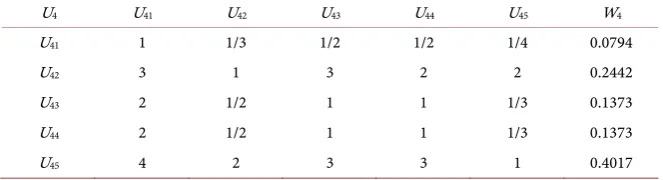
Table 8. Judgment matrix U4.
U4 U41 U42 U43 U44 U45 W4
U41 1 1/3 1/2 1/2 1/4 0.0794
U42 3 1 3 2 2 0.2442
U43 2 1/2 1 1 1/3 0.1373
U44 2 1/2 1 1 1/3 0.1373
U45 4 2 3 3 1 0.4017
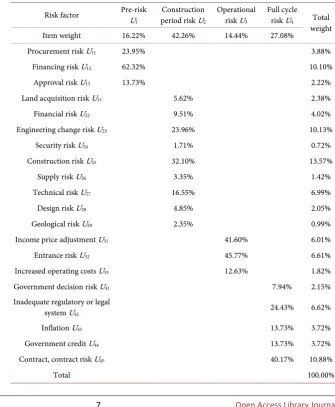
[image:6.595.209.539.515.577.2] [image:6.595.209.541.623.713.2]DOI: 10.4236/oalib.1105680 7 Open Access Library Journal According to the calculation results of the above-mentioned criteria layer and the weight of the measure layer, the weight of each layer of the PPP project of the A-site integrated pipe gallery is finally obtained, as showed in Table 9:
It can be seen from Table 9:
1) The risk of financing risk, engineering change risk, construction risk and contract and contract risk are more than 10%, which are a major risk factor for this project. Unreasonable handling can lead to grave consequences, even project failure, so project managers must attach great importance to these risk factors.
2) The nominal risk, the entrance risk, the income price and the imperfect supervision or legal system are between 5% and 10%, which is a huge risk factor for this project. It also needs to pay sufficient attention during the implementa-tion of the project.
[image:7.595.199.535.341.749.2]3) The remaining risk weight is all below 5%, which are general and routine risks. Such risks are more common, and the research on response measures is more comprehensive. It can handle reasonably according to the situation during project implementation.
Table 9. Judgment matrix U4.
Risk factor Pre-riskU
1
Construction period risk U2
Operational risk U3
Full cycle risk U4 Total
weight
Item weight 16.22% 42.26% 14.44% 27.08%
Procurement risk U11 23.95% 3.88%
Financing risk U12 62.32% 10.10%
Approval risk U13 13.73% 2.22%
Land acquisition risk U21 5.62% 2.38%
Financial risk U22 9.51% 4.02%
Engineering change risk U23 23.96% 10.13%
Security risk U24 1.71% 0.72%
Construction risk U25 32.10% 13.57%
Supply risk U26 3.35% 1.42%
Technical risk U27 16.55% 6.99%
Design risk U28 4.85% 2.05%
Geological risk U29 2.35% 0.99%
Income price adjustment U31 41.60% 6.01%
Entrance risk U32 45.77% 6.61%
Increased operating costs U33 12.63% 1.82%
Government decision risk U41 7.94% 2.15%
Inadequate regulatory or legal
system U42 24.43% 6.62%
Inflation U43 13.73% 3.72%
Government credit U44 13.73% 3.72%
Contract, contract risk U45 40.17% 10.88%
DOI: 10.4236/oalib.1105680 8 Open Access Library Journal
6. Integrated Pipe Gallery PPP Project Risk Response
6.1. AHP-Based Decision Results
1) Improve cognition and ability
Both the government and the social capital need to be aware of the PPP model so that the project does not lead astray.
2) Suggested financial product innovation
The economic and social benefits of the integrated pipe corridor are long, and it is recommended to innovate the medium and long-term financial instruments to solve the problem of maturity mismatch.
6.2. Project Construction Period Risk Responses
It is recommended that the PPP project of the A-city integrated pipe gallery adopts the method of using different design institutes for each project, and the design risks are decentralized by comparing the advantages and disadvantages of each design institute with the quality of design products and services.
Formulate management policies to form a normalized communication and rapid advancement mechanism for multiple entities. The responsible depart-ments of each pilot project to implement a summary system to detect and solve problems in a timely manner.
6.3. Risk Responses during Project Operation Period
1) Optimize the timing and sequence of the corridor
Since the entrance hall will be influenced by the size and quantity of the hoisting port during the operation period, it will increase the difficulty of enter-ing the corridor. Therefore, durenter-ing the construction period of the pipe gallery, pipeline units are urged to follow the progress of the construction of the pipe gallery.
2) Using floating pricing
With the continuous development and changes of the integrated pipe gallery and pipeline market, the price of the entrance fee will also fluctuate. Therefore, the market should be fully considered in the formulation of the fee collection price, and a variable mechanism should be adopted in order to cater to the mar-ket law.
6.4. Project Full Cycle Risk Responses
1) Establish a technical standards system
The establishment of a series of technical standards system of national stan-dards, industry standards and local standards is conducive to the formation of standardized integrated corridor design and construction, reducing engineering risks.
2) Establish appropriate financial subsidy policies
DOI: 10.4236/oalib.1105680 9 Open Access Library Journal and the establishment of appropriate financial subsidies to test the government’s grasp of the market.
7. Conclusions
Under the current situation of the government’s vigorous promotion of the PPP model, the integrated pipe corridor PPP project will be launched in major cities across the country as an emerging municipal infrastructure. Due to the large in-vestment amount, difficult construction, long cycle time and many uncertain factors, the integrated pipe corridor project needs to conduct risk management research in the early stage of development and seek management mode and me-thods to avoid or reduce risks.
1) The article adopts the stage-oriented and divides the risk from the perspec-tive of the whole life cycle theory, and divides the risk of the integrated pipe PPP project into the pre-project risk, the project construction period risk, the project operation period risk and the project full-cycle risk. The risk management objec-tives and management rights and responsibilities at each stage are clear, making the risks more systematic and controllable.
2) Identifying 20 risks factors for the project, the analytic hierarchy process is used to clarify that the PPP project of the integrated pipe gallery belongs to a more serious risk level, and identifies the important risk factors of the pipe gal-lery project, including financing risk, engineering change risk, construction risk and contract, contract risk, technical risk, and entrance. Risk, income price and regulatory or legal system are not perfect. Risk management is made more tar-geted and practical, and the results are more valuable.
Conflicts of Interest
The authors declare no conflicts of interest regarding the publication of this paper.
References
[1] Fan, H., Wang, F. and Wang, G.W. (2017) Research Progress in the Laying Method of Hot Water Hot Pipe Gallery. Journal of Huaqiao University (Natural Science), 38, 747-752.
[2] Wang, Y. and Fu, Z.L. (2013) Research on the Countermeasures of Urban Compre-hensive Pipeline Charging Based on Game Analysis. Chinese Journal of Under-ground Space and Engineering, 9, 197-203.
[3] Xue, M. and Liu, H.M. (2011) Study on the Improvement of Post-Evaluation System of Government Investment Projects in China. Journal of Engineering Management, 25, 318-322.
[4] Wang, L.C. (2016) Analysis of Several Key Issues in the Promotion of PPP Mode in China at the Present Stage. Friends of Accounting, 6, 2-7.
[5] Wang, S.Q. (2016) Research on Professional Ethics Requirements in the Implemen-tation of PPP Projects. Building Economy, 37, 37-41.
DOI: 10.4236/oalib.1105680 10 Open Access Library Journal
Economy, 35, 37-41.
[7] Zhang, L. (2015) Risk Analysis of PPP Mode. Master’s Thesis of the Ministry of Finance, Beijing.
[8] Saaty, T.L. (2000) Fundamentals of Decision Making and Priority Theory with the Analytic Hierarchy Process. In: Schmoldt, D.L., Kangas, J., Mendoza, G.A. and Pe-sonen, M., Eds., The Analytic Hierarchy Process in Natural Resource and Environ-mental Decision Making, Springer, Berlin, 15-35.