FACTORS AFFECTING E-LEARNING ADAPTATION IN TANZANIA HIGHER
INSTITUTIONS, THE CASE OF UDSM
Lecturer, Department of Community Development, Tengeru Institute of Community Development (TICD),
ARTICLE INFO ABSTRACT
This paper
Institutions (HLIs) in Tanzania. The Study was guided by these specific objectives: to examine critical barriers of E
examine critical barriers of E ascertain
content. Data was
from two selected institutions namely the Open University of Tanzania (OUT) and the University of Dar -Es
long experience
excel software revealed two critical barriers on acceptance of E content creation
termed in this study as perception on E
practitioners have limited skills on creating quality content or
Pedagogy and ICT. Study also indicated that employment market is inclined in favor of graduates that have gone learning through conventional learning approaches than those who attend E
programmes. The study also noted t
E-learning policy; to a large extent this led to lack of awareness among staff members. Study findings further indicated correlation between acceptance of E
quality of content creation. This study concludes that policy makers and administrators in HLIs have to institutionalize E
efforts on quality content creation. Stu BeL Model
Copyright © 2018, Jackson E. Muhoho. This is an open use, distribution, and reproduction in any medium, provided
1. INTRODUCTION AND BACKGROUND
1.1. INTRODUCTION
This study intended to answer two key questions namely; what are the critical barriers in implementing E-learning system; and what is the role of Organizational Culture, Infrastructure and Quality Content Creation in successful implementation of E learning system. In today’s world of globalization, knowledge and learning is considered a vital factor for acquiring
competitive advantage (Lee, 2006). To gain competit
advantage, firms and institutions are becoming more knowledge intensive, therefore they concentrate more on managing and sharing knowledge to gain significant advantage
(Wild et al., 2002). This need of knowledge acquisition, on the
other hand, has created a massive increase of student enrollment, hence a challenge to governments and learning institutions. In order to cope with the increase of student enrollment, many academic institutions have increased the use
ISSN: 0975-833X
Article History:
Received 25th March, 2018 Received in revised form 15th June, 2018
Accepted 5th July, 2018
Published online 31st July, 2018
Citation: Jackson E. Muhoho, 2018. “Factors affecting e
implementations”, International Journal of Current Research
Key Words: Organizational Culture, E-learning adaptation, Employment Market, E-Learning Policy, ICT Policy, Quality of Content, E-Learning programs.
*Corresponding autho: Jackson E.Muhoho
DOI: https://doi.org/10.24941/ijcr.32098.07.2018
RESEARCH ARTICLE
LEARNING ADAPTATION IN TANZANIA HIGHER
INSTITUTIONS, THE CASE OF UDSM and OUT E-LEARNING IMPLEMENTATIONS
*Jackson E. Muhoho
Lecturer, Department of Community Development, Tengeru Institute of Community Development (TICD),
Arusha, Tanzania
ABSTRACT
This paper examined critical factors which affect adaptation of E
Institutions (HLIs) in Tanzania. The Study was guided by these specific objectives: to examine critical barriers of E-learning acceptance with focus on organizational cultur
examine critical barriers of E-learning adaptation with reference to E
ascertain critical barriers of E-learning acceptance with focus on quality content creation of E
content. Data was collected from academic and administrative staff randomly and purposively selected from two selected institutions namely the Open University of Tanzania (OUT) and the University of
Es -Salaam (UDSM).These were selected as case study for this research experience and expertise in practicing E-learning. The analysis done through excel software revealed two critical barriers on acceptance of E-learning at HLIs which are content creation for E-learning content and organizational culture
termed in this study as perception on E-learning. It was revealed that majority of E practitioners have limited skills on creating quality content or basically n
Pedagogy and ICT. Study also indicated that employment market is inclined in favor of graduates that have gone learning through conventional learning approaches than those who attend E
programmes. The study also noted that institutions had ICT policy in place but were lacking reliable learning policy; to a large extent this led to lack of awareness among staff members. Study findings further indicated correlation between acceptance of E-Learning and organizational cult
quality of content creation. This study concludes that policy makers and administrators in HLIs have to institutionalize E-learning policy as enabling factor towards E
efforts on quality content creation. Study recommends that this challenge can be addressed using ISA BeL Model.
open access article distributed under the Creative Commons Attribution provided the original work is properly cited.
INTRODUCTION AND BACKGROUND
This study intended to answer two key questions namely; what learning system; and Culture, Infrastructure and Quality Content Creation in successful implementation of E-learning system. In today’s world of globalization, knowledge and learning is considered a vital factor for acquiring To gain competitive advantage, firms and institutions are becoming more knowledge intensive, therefore they concentrate more on managing and sharing knowledge to gain significant advantage 2002). This need of knowledge acquisition, on the ated a massive increase of student enrollment, hence a challenge to governments and learning In order to cope with the increase of student enrollment, many academic institutions have increased the use
of Internet to deliver training through
2005). During the late 1990s many online courses and universities were established, but mixed results of E
systems were encountered (Gulatee and Combes, 2007) as cited
by (Bashiruddin et al., 2010). Since then, barriers i
implementation process of
E-Frequently mentioned barriers includes
courses, economics of finance, computer literacy, course contents, staff training, management support and organizational culture (Muilenburg and Berge, 2005).
other hand, a number of initiatives are being done worldwide to guarantee effective E-learning. E
Initiative Program is one of the cross
initiatives. This program was a result of Bologna declaration signed by 29 European countries to promote E
higher education among European Union universities (EC, 1999). In Asia, the efforts to use E
June 1983 by establishment of the Center of the International International Journal of Current Research
Vol. 10, Issue, 07, pp.72092-72108, July, 2018
DOI: https://doi.org/10.24941/ijcr.32098.07.2018
Factors affecting e-learning adaptation in tanzania higher learning institutions, the case of udsm & out e International Journal of Current Research, Vol. 10, Issue, 07, pp.72092-72108, July, 2018 (DOI: https://doi.org/10.24941/ijcr.32098.07.2018
Available online at http://www.journalcra.com
z
LEARNING ADAPTATION IN TANZANIA HIGHER LEARNING
LEARNING IMPLEMENTATIONS
Lecturer, Department of Community Development, Tengeru Institute of Community Development (TICD),
examined critical factors which affect adaptation of E-learning in Higher Learning Institutions (HLIs) in Tanzania. The Study was guided by these specific objectives: to examine critical learning acceptance with focus on organizational culture or perception on E-learning ;to learning adaptation with reference to E-learning infrastructure; to learning acceptance with focus on quality content creation of E-learning collected from academic and administrative staff randomly and purposively selected from two selected institutions namely the Open University of Tanzania (OUT) and the University of Salaam (UDSM).These were selected as case study for this research based on criteria of their learning. The analysis done through SPSS ver.20 and learning at HLIs which are quality of organizational culture towards E-learning adaptation also learning. It was revealed that majority of E-learning basically no clear integration between Pedagogy and ICT. Study also indicated that employment market is inclined in favor of graduates that have gone learning through conventional learning approaches than those who attend E-learning hat institutions had ICT policy in place but were lacking reliable learning policy; to a large extent this led to lack of awareness among staff members. Study findings Learning and organizational culture as well as quality of content creation. This study concludes that policy makers and administrators in HLIs have learning policy as enabling factor towards E-learning adaptation and increase dy recommends that this challenge can be addressed using
ISA-ribution License, which permits unrestricted
of Internet to deliver training through E-learning system (Khan, 2005). During the late 1990s many online courses and universities were established, but mixed results of E-learning systems were encountered (Gulatee and Combes, 2007) as cited 2010). Since then, barriers in the -learning have been identified.
Frequently mentioned barriers includes infrastructure, type of
courses, economics of finance, computer literacy, course contents, staff training, management support and
(Muilenburg and Berge, 2005). On the other hand, a number of initiatives are being done worldwide to learning. E-Learning Community Initiative Program is one of the cross-countries E-learning initiatives. This program was a result of Bologna declaration European countries to promote E-learning for higher education among European Union universities (EC, 1999). In Asia, the efforts to use E-learning were boosted in June 1983 by establishment of the Center of the International
INTERNATIONAL JOURNAL OF CURRENT RESEARCH
Cooperation for Computerization (CICC). The role of CICC was to create an E-learning bridge between Japan and other Asian countries. Currently CICC is networking 21 countries. In Africa, the Association of African Universities (AAU) in 2001 launched a project known as “the use of ICT in African Higher Education Institutions”. This was followed by a new project in 2006. One of AAU success was an agreement with AfriNic for a 50% discount on acquisition of IP resources for all African education and research institutions (AAU, 2009). Together with AAU initiatives, eLearning Africa (eLA), an annual event hosted by International Conferences, Workshops and Exhibitions (ICWE), is another commendable job on promoting E-learning. In the year, 2011, the continent witnessed a total of
1,702 participants from over 90 countries, including 21 African countries, convened at the 6th eLearning Africa conference, held in Dar es Salaam, Tanzania. This year’s event demonstrated increasing investment in ICT and education across Africa. African Virtual University (AVU) project is another famous E-learning initiative. Since its inception in 1997, AVU established eLearning network in over 30 African countries (OUT, 2009). Unfortunately, these opportunities are somewhat not optimally utilized by Tanzanian HLIs in adaptation of E-learning as its application is still very low. In
this regard, this study
was carried out to examine critical
barriers that hinder the implementation of E-learning in
Tanzania.
1.2. Background to the study
Tanzanian Higher Learning Institutions (HLIs) enrollment in year 1999/2000 was 13,442 students. This number increased up to 127,057 students in the year 2009/2010 (TCU, 2011). Some of the challenges emanating from this increase include: limited number of teachers, student’s accommodation and quality assurance. The National Higher Education Policy identified the use of E-learning as one of the solution among others to these foreseen challenges (NHEP, 1999). However, for more than 11 years of this policy, the implementation of E-learning in the country seems to remain on infancy stage. In additional to the NHEP, the national ICT policy for basic education states that the use of ICT in education is the bedrock of a knowledge society and will enable the country to contribute both to achieving Education for All (EFA) goals (NICTPBE, 2007). However, despite this strong policy statement and previous related policies, the level of E-learning implementation and its adaptation in HLIs has remained low leading to failure of attaining projected E-learning benefits.
1.2.1. Government Initiative in Promoting E-Learning
Following realization of the need for a HLIs national ICT network; in January 2002, 16 HLIs signed a MoU to establish TERNET. Unfortunately, the name was taken up by the South African Universities network due to project delay in Tanzania. In March 2007, 21 Tanzanian HLIs formally adopted the new constitution of Tanzania Education and Research Network (TERNET), an organization that was meant to eventually connect all HLIs and research institutions in Tanzania
1.2.2. Policies Related to E-learning Improvement
The Communications Act was enacted in 1993 and the National Telecommunications Policy (NTP) was launched in 1997. Other Acts and policies directly relevant to ICT include the Broadcasting Services Act of 1993; the National Science
and Technology Policy of 1996; and the Tanzania Development Vision 2025 of 1998. However, the lack of proper coordination stands as a drawback on E-learning development
1.2.3. E-learning Initiatives done by Higher Learning Institutions
University of Dar es Salaam (UDSM) through its Centre for Virtual Learning (CVL) launched three Open Distance eLearning Centres (ODeL) in Arusha, Mwanza and Dar es Salaam. In November 2010, twenty five students graduated from two online postgraduate programmes. So far CVL managed to coordinate three programmes. Reliability and sustainability are critical challenges that CVL face to maintain remote centres in Mwanza and Arusha. Another challenge is to
increase the number of programmes. Open University of
Tanzania (OUT) in collaboration with the AVU and the African Development Bank (AfDB) launched an Open Distance and eLearning Centre (ODeL) at OUT in December 2009. Also OUT had a locally developed LMS abbreviated as OUTLeMS, which enables students to access study materials. Availability of online materials is a challenge due to frequently power interruption/disruptions. E-learning student’s enrollment
also is still relatively low. Other Universities and learning
institutions conducting E-learning programmes though at very low level include: Dar es Salaam Institute of Technology, Agha Khan University, Tumaini University, and Sokoine University of Agriculture. The slowness in E-learning adaptation amongst HLIs in Tanzania, despite its well known advantages, is one of the major factors that prompted for conducting this study(OUT, 2009).
1.2.4. Challenges Facing HLIs in implementation of E-learning
At universities and other institutions of higher learning, computer laboratories are available for use by students and academic staff. However, they are not enough to meet the demand. Internet bandwidth for most institutions is in the range of 512kbps to 2Mbps, which is inadequate for most E-learning systems. Few institutions have sufficient multi-media facilities for teaching purposes. Recruitment and retaining of high qualified and skilled staff to manage ICT infrastructure and systems is another challenge facing HLI’s. Reliability and prices of Internet services from service providers is another challenge facing HLIs in the country. The organizational culture is another factor that affects the implementation of E-learning (NHEP, 1999; NICTPBE, 2007). Another challenge is lack of effective central E-learning coordination unit as a result each institution deploys its own LMS platform i.e. we lack standardization at a national level (NHEP, 1999; OUT, 2009)
1.3. Statement of the Problem
target (NHEP, 1999). While enrollment increased significantly, it was expected that the use of E-learning would mitigate the anticipated challenges associated with this massive increase. However, the adaptation of E-learning for teaching and learning at Tanzania HLIs is at infancy stage, hence compromising the quality of education in the country. The basis of this research was to examine critical barriers for E-learning implementation with focus on organizational culture, infrastructure and quality content creation
1.4. Scope of the study
Data were collected from two institutions namely OUT and UDSM that have been practicing E-learning for a longer period compared with other institutions in the country. Individuals consulted for data collection were academic staff and ICT technical support staff. The two identified categories of people proved to be reliable source of valid data for this research. However, in future a separate research may be conducted involving more HLIs for better results; furthermore, research on sustainability of e-learning Projects is also important as an alternative model of quality delivery of education services in the country
2. LITERATURE REVIEW
2.1. Conceptual Definitions
Applicable key words such as Organizational culture;
E-learning; Infrastructure and Quality content creation, are conceptualized hereunder as follows:
Organizational culture can be defined as the “set of shared attitudes, goals, values and practices that characterizes a company or corporation” (Mclntosh, 2006). These are shared practices and norms based in the work spaces, which are practiced within the boundaries of an organization. Cultural
resistance from users, they negatively affect the
implementation process of a system. Such unwillingness of the employees to use required procedures can ultimately lead to
the system failure (Morakul and Wu, 2001). E-learning can be
defined as learning and communication exercises across computers and networks or for that matter any other electronic sources (Roffe, 2002; Schank, 2002; Sambrook, 2003; Wong,
2007). Wild et al., 2002 defines E-learning as “delivery of
training and education via networked interactivity and distribution technologies E-learning has been described in various ways as learning using a number of different technologies and methods for delivery e.g. Computer Based Training (CBT), Internet-based training (IBT), Web-based instruction (WBI), distance learning, online learning (OL), mobile learning (m-learning) and learning management systems (LMS) (Khan, 2005). Managing of learning environment like, registration of learners, scheduling learning resources, controlling and guidance of learning processes and analyzing learners’ performances are all accomplished in Learning Management System (LMS) (Brown, 2006) as cited
by (Bashiruddin et al., 2010) According to Alkhattabi,2010
there are two main types of e-learning: synchronous and asynchronous, depending on the interaction between learner and teacher. Synchronous E-learning environments require tutors and learners or the online classmates to be online at the same time, where live interactions take place between them. Asynchronous E-learning environment is the case where
students are logging into and using the system independently of other students and staff members. The focus of this research
was mostly on the later. Infrastructure in the context of this
research was used to refer to computer hardware and software; LMS; power supply; and bandwidth. Volery and Lord (2000), report that the success of the technological infrastructure also has implications for the success of E-learning, as malfunctioning hardware, software configuration, slow or down servers, busy signals and lack of access are all barriers which can cause frustration for students and ultimately affect the learning process. This issue is difficult to overcome as problems with technology can arise at any time. However it can be mitigated by ensuring the functionality of the technological infrastructure before E-learning is implemented.
Quality content creation - Currently there are two, worldwide, recognized challenges in E-learning: the demand for overall interoperability and the request for high quality. Although it is important to set standards for information quality, it is a difficult and complex issue because there is no formal definition of information quality, as quality is dependent on the criteria applied to it (Stracke, 2006). The researcher however
concentrated on the quality of content creation. Close et al.,
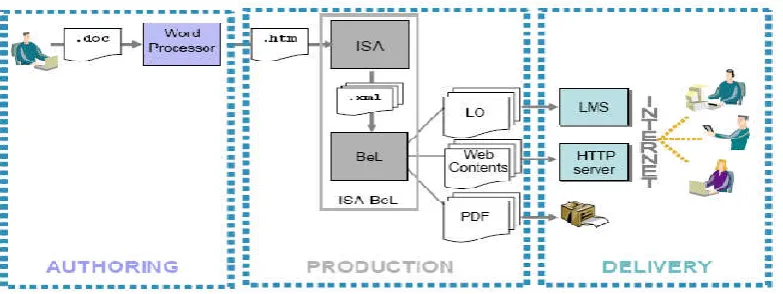
2000 state that to be able to use the Internet as a tool to improve learning, the content should not distract learners, but increase their interest for learning. Juran, 1974 summarizes the aspects of quality in his quality definition as “fitness for use”. In view of Juran’s definition, the study addressed the issue of quality content creation by focusing on a simple mechanism, called ISA-BeL, that drive authors in creating accessible leaning object (LO). ISA-BeL is one of the mechanisms to overcome author’s difficulties in creating E-learning content
(Di Iorio et al., 2005). It allows users to easily create
accessible and portable LOs by mainly using a word processor (or, more generally, a productivity tool), and the conversion engine transforms each fragment in a proper element of the final object. The study defined quality content creation as the LO development which follow the three phases of ISA-BeL
namely: Authoring (Content creation) using productivity tools
such as word processor; Producing (Content transformation)
to create a LO; and Delivery (Content distribution). The whole
process is depicted in Figure 1.1.
2.2. Theoretical review Framework
E-learning system implementation is dependent on the level of availability of some influential factors like budgeting, infrastructure, planning, human resource development and teachers or learners skills and attitude towards the technology (Khan, 2005). McLeod (2003) suggests instructors to consider principles of learning by means of historically grown learning theories in delivering successful E-learning content. In the context of HLIs E-learning content delivery, cognitive learning theory is of importance (Felex, 2006). Other theories reviewed in this research were associationist and Situative learning perspectives.
2.2.1. Theory of Associationist
The approach in this theory is that knowledge is an organized accumulation of associations and skill components. It further says that learning is the process of connecting the elementary mental or behavioural units, through sequences of activity.
This view encompasses the research traditions of
associationism, behaviourism and connectionism (neural networks).
This knowledge is not yet widely applied in education, but it is significant in E-learning delivery. Hence it is imperative to be
included in this research as a knowledge contribution to
readers. Associationist theory requires subject matter to be analysed as specific associations, expressed as behavioural objectives. This kind of analysis was developed by Gagne (1985) into an elaborate system of instructional task analysis of discriminations, classifications and response sequences. Learning tasks are arranged in sequences based on their relative complexity according to a task analysis, with simpler components as pre-requisites for more complex tasks. The neural network approach views knowledge states as represented by patterns of activation in a network of elementary units. It suggests an analysis of knowledge in terms of attunement to regularities in the patterns of activities, rather than in terms of components, as traditional task analysis requires. In this perspective learning is the formation, strengthening and adjustment of associations, particularly through the reinforcement of particular connections through feedback. One implication is the individualising of instruction, where each student responds actively to questions or problems and receives immediate feedback on their response. This has underpinned the development of programmed instruction and computer programmes that teach routine skills.
2.2.2. Theory of Situative Perspectives
The social perspective on learning has received a major boost from the reconceptualisation of all learning as ‘situated’. A learner will always be subjected to influences from the social and cultural setting in which the learning occurs, which will also define at least partly the learning outcomes. This view of learning focuses on the way knowledge is distributed socially. When knowledge is seen as situated in the practices of communities then the outcomes of learning involve the abilities of individuals to participate in those practices successfully. The focus shifts right away from analyses of components of subtasks, and onto the patterns of successful practice. This can be seen as a necessary correction to theories of learning in which both the behavioural and cognitive levels of analysis had become disconnected from the social. This
theory it is helpful to policy makers in developing E-learning
policy that focus on social needs. As Barab and Duffy, 1999 point out, there are at least two ‘flavours’ to situated learning. One can be regarded as a socio-psychological view of situative. This represent constructivist tasks in which every effort is made to make the learning activity authentic to the social context in which the skills or knowledge are normally embedded.
The second idea is that with the concept of a community of practice comes an emphasis on the individual’s relationship
with a group of people rather than the relationship of an
activity itself to the wider practice, even though it is the practice itself that identifies the community. For an environment of apprenticeship to be a productive environment of learning there need to be opportunities for learners to observe and then practice activities which move them into more ‘legitimate’ participation in the community.
2.2.3. Theory of Cognitive
Cognitive consider learning as an internal process that involves memory, thinking, reflection, abstraction, motivation, and meta-cognition (Ally, 2004) as cited by (Felex, 2006). Cognitive psychology comprises the learning process from an
information processing point of view, where information is
received in the sensory store through different senses and, further, transferred to the short-term and the long-term memory through different cognitive processes. Furthermore, the cognitive school recognises the importance of individual differences and of including a variety of learning strategies to accommodate those differences. According to Felex (2006), the cognitive theory it guide instructors to describe learner’s preferred way of processing information that is a person’s typical mode of thinking, remembering, or problem solving. In
the context of this research, practitioners developing
E-learning content are guided to do so in line with the theory of cognitive. Some of the aspects to be considered, in content
development, may include: enhance the learning process by
facilitating all sensors, focussing the learner’s attention by highlighting important and critical information; tie up new information with existing information from long-term memory using advanced organisers to activate the learner’s existing knowledge structure; and finally, connect learning content with different real-life situations, so that the learners can tie up to own experiences and, therefore, memorize things better.
2.2.4. Theory of Technology Acceptance Model – TAM
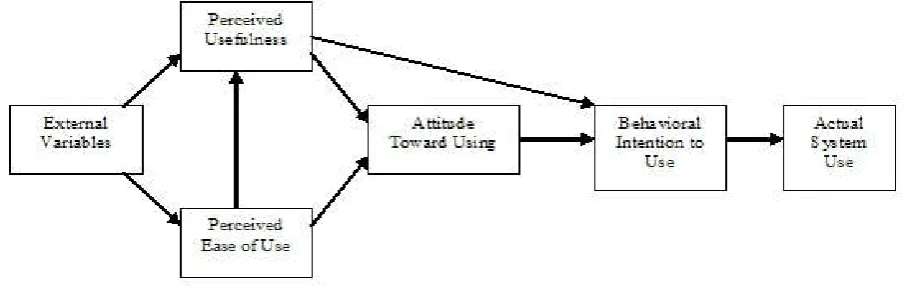
The TAM is an adaptation of the theory of reasoned action (Fishbein and Ajzen, 1975) specifically tailored for modelling user acceptance of information systems. TAM is an intention-based model. The TAM adopted belief-attitude-intention-behaviour relationship, from the theory of reasoned action, to model users’ acceptance of IT (Bernadette, 1996; Di Benedetto
[image:4.595.107.499.59.206.2]et al., 2003). The TAM posits that two factors, perceived usefulness and perceived ease of use, are of primary relevance in influencing IT acceptance behaviours.
Following Davis (1989) the posited relationship between perceived usefulness and perceived ease of use is that perceived usefulness mediates the effect of perceived ease of use on attitudes and intended use. In other words, while perceived usefulness has direct impacts on attitudes and intended use, perceived ease of use also influences attitude and use indirectly through perceived usefulness. This model is
imperative to E-learning practitioners in developing E-learning
system that users may easily adopt. Figure 2.1 summarizes the TAM.
2.3. Empirical Review/Analysis
2.3.1. Organizational Culture
Bashiruddin et al., 2010 observation about barriers to the
implementation of E-learning system with focus on organizational culture was carried out at Malardalen University in Sweden. The study used qualitative approach to realize the research objective which was to examine the cultural influence
of an organization towards E-learning system’s
implementation process. This study concluded that despite the notable success in E-learning implementation, there also exist barriers containing the cultural aspects of the organizations throughout the implementation process. The study further
concluded that organization should underpin their
implementation strategy of E-learning system proactively involving and motivating employee in order to reap the optimal benefits of E-learning an idea which has been
emphasized in this research. Ettinger et al., 2005 did a research
entitled E-learner experiences: learning from the pioneers
with the purpose of sharing the experiences of E-learning pioneers with regard to the cultural change necessary for E-learning to be successfully adopted in an organization. Their work was based on 29 research case studies. This research found out that a cultural change needs to take place in organisations for e-learners to engage in the process. The researchers further stated that blending E-learning with other forms of learning can be a useful introduction to the discipline, but enthusiasm soon wears off. Common resistances to the concept explored included lack of time and the loneliness of e-learning. Also where e-learning was introduced without support at senior levels of the institution management, this was a critical factor contributing to their lack of success. All these facts show that organizational culture has a big impact in the successful implementation of E-learning; hence it was a relevant factor for this research project too.
2.3.2. Infrastructure
Simba et al., 2009 did a research to explore the possibility for
rural secondary schools in Tanzania to access online E-learning resources from a centralized LMS. The research used three components model to address the issue of infrastructure. These components were: If E-learning contents and delivery were promoting self learning environment; if the learning management system (LMS) deployed were offering interactive mode; and status of Connectivity for E-learning between schools. The research concluded that the infrastructure to support E-learning, in particular rural areas of Tanzania, was inadequate. Hence in context of this research, together with the organization culture, the researcher examined the LMS as key
infrastructure for effective E-learning delivery. Rahman et al.,
2010 did a research on the effectiveness of LMS case study at
[image:5.595.68.525.81.225.2]open university Malaysia (OUM), Kota Bharu Campus. OUM is a seventh fully operated as an open and distance learning university in Malaysia. Although LMS is an important element in OUM, most of the students do not fully utilize the system to support for online submission of course works and discuss any matters in discussion board or online discussion as well as to self-evaluate their performance in learning. They tend to do all those things manually such as discuss any subject face to face meeting with their peers and tutors, they prefer to have paper based tests rather than online quizzes and so on. This paper was measuring the effectiveness of LMS of OUM by testing three categories of users which are novice, knowledge intermittent and expert users using questionnaires. Researchers choose one characteristic of (Shackel, 1991) usability model which is effectiveness with four factors namely: easy to learn, error tolerance, speed and quality. From this study it showed that the LMS of OUM is used effectively by students although students came from various levels of educational background, age, marital status, course, level of thinking, computer skills and so on, although novice users at first they seemed lost and cannot move around the system but lastly they can use it effectively. The intermittent users at first done several errors but they can recover the errors easily. From the study also, it showed the OUM's LMS is easy to learn for different levels of users, can easily recover from errors once users made errors, can speed up learning process and also it offers quality learning environment. The researchers further concluded that the implementation of LMS at OUM has been a stimulus in increasing enrollment from its first intake of 753 students in August 2001, to a total of 25,000 students in year 2008. The researcher found that effective LMS is vital infrastructure for effective implementation of E-learning in Tanzania HLIs.
2.3.3. Content Creation
Ndume et al., 2006 did a research to establish the acceptance
of E-learning, analyses the challenges of E-learning and designs an assistive tool for people with disability at HLIs in Tanzania. The information was gathered through documentary review. Primary data was collected from a sample survey by means of structured questionnaires and interviews. In their research they concluded that E-learning is more highly accepted in higher learning institutions than in basic education. However, there are doubts about the certificates obtained from online courses. Accessibility of resources of E-learning was found to affect disabled people more than normal person. Concerning factors challenging the implementation of E-learning, it was found that the learning culture is also one of the obstacles in adapting E-learning. Therefore, implementers should promote E-learning as a phenomenon for development.
Other challenges identified by Ndume et al., 2006, includes:
Technology support for learning process; Time and personal management during E-learning; Management of E-learning; Security and Quality assurance for online program; Developing E-learning platform; and Credibility of E-learning. Therefore from this research we learned that while the will to adopt E-learning is plenty available at HLIs, the critical barriers in adaptation of E-learning should be identified and worked upon to ensure effective E-learning in Tanzania. A research, unpublished and undated, by Leem and Lim of University of Incheon and Kyung Hee University respectively
was done in Korea to establish the current status of e-learning
and strategies to enhance educational competitiveness in Korean higher education. The purpose of this study was to examine the current status of E-learning in Korean higher education and find ways to encourage further use and development of E-learning systems that aim to enhance Korea's academic competitiveness. A total of 201 universities in Korea (27 national and public, 163 private, and 11 national universities of education) were examined in this study. At the time of the study, 85 percent of the universities and colleges had investigated implementing E-learning. There were special E-learning teams in most national and public universities, as well as private universities and colleges.
Findings from this study found that both teachers and learners alike, lacked meaningful support systems and opportunities to actively participate in E-learning programs. Leem and Lim
concluded that strategies for enhancing university
competitiveness through E-learning should include the following: developing quality assurance systems for E-learning; enhancing support systems for instructors and learners; developing knowledge sharing systems between schools and industry; and enhancing international collaboration for E-learning. To larger extent, the researcher found that these concluding remarks may also be applicable in Tanzanian E-learning environment, hence a proof on relevance of this research
2.4. Conceptual Framework
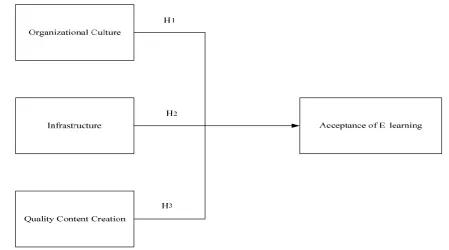
In the context of this research, factors known to contribute to effective E-learning were: organizational culture, infrastructure and quality content creation. These three factors formed the basis of hypothesis formulation for the research. Fig. 2.2 summarizes the conceptual framework for this research undertaking.
2.5. Hypotheses
[image:6.595.70.520.51.301.2]Based on the study results from the literature review, three elements were identified as key elements to be considered when facilitating E-learning system. These elements are: organizational culture, infrastructure and quality content creation. In this study, organizational culture was focusing on how supportive are senior officials on E-learning initiative; availability and effectiveness of institutions E-learning policies; and value of E-learning certification in comparison with traditional learning certification, the infrastructure included LMS; power supply; Computer hardware and software; and Bandwith, the quality content creation involved authoring; production; and delivery. Based on the cognitive theory, information processing is based on a model of memory. It proposes processes and structures through which an individual receives and stores information and focuses on cognitive processes during learning; these involve processing
instructional input to develop, test, and refine mental models until they are sufficiently elaborated upon and reliable to be effective in novel problem-solving situations. Studies have suggested that learner engagement is higher with interactive
communication and multimedia instruction: higher
interactivity can lead to higher learner engagement and better learning outcome (Northrup, 2001). Based on this, the researcher assumed that an instructional method that provides a greater variety of interactions and richer media should be more effective. The following were the hypotheses for this study:
H1: Organizational culture has a positive impact on acceptance
of E-learning.
H2: Infrastructure has a positive influence on acceptance of
E-learning.
H3: Perceived quality content creation positively affects the
acceptance of E-learning
3. RESEARCH METHODOLOGY
3.1. Research Paradigm
The research paradigm is a terminology widely used in research. The term means philosophy used in the respective research. There are two dominating paradigm namely the positivism and phenomenology. The positivism philosophy combines deductive logic with precise empirical observations of individual behavior in order to discover and confirm causal law while phenomenology is a systematic analysis of socially
meaningful action through direct observation (Saunders et al.,
2000). The approach used in this research was based on a positivism paradigm, as the research assumed high level of objectivity from data collection to analysis
3.2. Population of the Study
The population for this research covered HLIs in Tanzania with a specific reference to members of staff from UDSM and OUT. The Basis for this selection was availability of information and the fact that these are two prominent academic institutions in the country that have been practicing E-learning for a longer period as compared with other higher learning institutions
3.3. Sampling Design and Procedure
According to Kothari, 2007 a good sample design must result in a truly representative sample; be such which results in a small sampling error; be viable in the context of funds available for the research study; be such that systematic bias can be controlled in a better way; and be such that the results of the sample study can be applied, in general, for the universe with a reasonable level of confidence. For the purpose of collecting empirical data about 80 academic staff and technical support staff from UDSM and OUT were randomly selected to form a sample of this research.
3.4. Methods of Data Collection, Reliability and Validity
Fisher,2007 states that data can be collected from existing databases, through questionnaires, conducting fieldwork or performing case studies as it depends on the kind of research. In this research, both primary and secondary data were used. Method to collect primary data was done through questionnaires. The rating scale questionnaires were designed
with five numerical values (1-5). The scaling method was structured into “strongly agree, agree, undecided, disagree and strongly disagree”. The scoring key for each item was on the scale of 1 to 5. Positive items were scored from 5-1 i.e. “strongly agree to strongly disagree” while negative items were scored from 1-5 “strongly disagree to strongly agree”. The last question of the questionnaires was in the form of open-ended with the intention of getting respondents’ comments. Necessary precautions were taken, before using secondary data, to ensure that they possess reliability, suitability and adequacy in reference to this research.
3.5. Operationalization of Concepts
This research had one dependent variable and three independent variables. For this reason, multiple regression equation for relationship analysis was designed as follows:
Y = a + b1X1 + b2X2 + b3X3
Where the independent variables were: X1 representing
organizational culture, X2 representing infrastructure, X3
represents quality content creation; a dependent variable was Y
representing acceptance of E-learning and finally constants a,
b1, b2 and b3.
3.5.1. Organizational Culture
In this study, organizational culture was focusing on how supportive are senior officials on E-learning initiatives; availability and effectiveness of institution’s E-learning policies; and value of E-learning certification in comparison with traditional/conventional learning certification
3.5.2. Infrastructure
In context of this research, infrastructure was the second independent variable in the multiple regression equation. It included LMS; power supply; computer hardware and software; and bandwidth
3.5.3. Quality Content Creation
In context of this research, quality content creation was the third and last independent variable in the multiple regression equation. It involved authoring; production; and delivery. As for other independent variables, this variable was analyzed on how it positively affects the implementation of E-learning at HLIs in Tanzania.
3.5.4. Acceptance of E-learning
In context of this research, acceptance of E-learning was the only dependent variable in the multiple regression equation. All three hypotheses were tested against this variable
3.5.5. Other Variables (Areas for further research)
Apart from the three key identified barriers in the implementation of E-learning in Tanzania HLIs, there are other factors which may contribute to these barriers. These include: awareness, policies, LMS, course content, perceived usefulness, perceived ease to use, attitude to system, intention to use and support staff. These outlined factors may need a separate research to identify to what extent they might be
contributing positively to the acceptance of the E-learning in Tanzania.
3.6. Data Quality
According to Kothari, 2007 sound measurement must meet the tests of reliability, validity and practicality. Validity refers to the extent to which a test measures what we actually wish to measure. Reliability has to do with the accuracy and precision of a measurement procedure and practicality is concerned with a wide range of factors of economy, convenience and interpretability. These elements were considered in this research to ensure data quality.
3.6.1. Reliability
A measuring instrument is reliable if it provides consistent results (Kothari, 2007). The researcher used cronbach’s α (alpha) to measure the reliability of a sample of examinees. According to Develles,1991 cronbach's α is defined as:
∝ =
− 1 1 −
∑
Where K is the number of components (K-items or test lets),
the variance of the observed total test scores, and the
variance of component i for the current sample of persons.
[image:8.595.57.268.450.530.2]George and Mallery, 2003 state that a commonly accepted rule of thumb for describing internal consistency or reliability using Cronbach's alpha is as shown in Table 2.1.
Table 2.1. Cronbach’s alpha – reliability
Cronbach’s alpha Reliability α ≥ .9 Excellent .9 > α ≥ .8 Good .8 > α ≥ .7 Acceptable .7 > α ≥ .6 Questionable .6 > α ≥ .5 Poor .5 > α Unacceptable
Source: George & Mallery, 2003
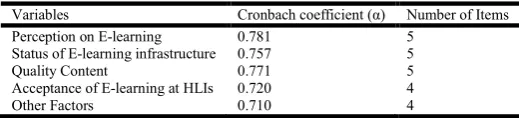
The cronbach’s α indicated that data collected and used for this research were reliable. Cronbach coefficient values, given in brackets, for each variable were as follows: Perception on E-learning (0.781); Status of E-E-learning infrastructure (0.757); Quality content (0.771); Acceptance of E-learning at HLIs (0.720); and Other factors (0.710).
3.6.2. Validity
Validity is the most critical criterion and indicates the degree to which an instrument measures what it is supposed to measure (Kothari, 2007). The researcher ensured validity by pretesting questionnaires and getting expert’s as well as experienced researcher’s opinions. Validity was also ensured in connection with constructs validity i.e. the results confirming to the predicted correlations with other theoretical propositions.
3.6.3. Practicality
The practicality characteristics of a measuring instrument can be judged in terms of economy, convenience and
interpretability (Kothari, 2007). This research ensured the practicability aspect with the use of reasonable sample of the population and using questionnaires which were easy to administer with clearly understandable instructions.
4. Data Analysis
Analysis refers to the computation of certain measures along with searching for patterns of relationship that exist among data-groups. Thus in the process of analysis, relationships or differences supporting or conflicting with original or new hypotheses should be subjected to statistical tests of significance to determine with what validity data can be said to indicate any conclusions (Kothari, 2007). The researcher used descriptive analysis in respect of three variables i.e. multivariate analysis in testing hypotheses for drawing inferences. The researcher did a further analysis based on a conceptual framework, which had one dependent variable that was presumed to be a function of three independent variables, i.e. acceptance of E-learning was a function of organizational culture, infrastructure and quality content creation, hence
multiple regression analysis was applied in the analysis as a primary test. Furthermore, the researcher subjected variables to
more tests including ANOVA and Chi-square test in order to
affirm the significance of association between attributes in reference to obtained regression model results.
4. DATA ANALYSIS AND STUDY FINDINGS
4.1. Sample Profile
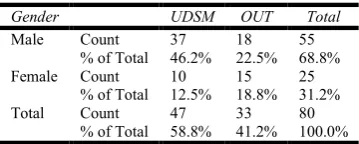
The sample size for this study was 80 respondents picked at random from UDSM and OUT. This sample involved academicians/ lecturers and support/ administrative staffs from these two institutions. Data were collected primarily using questionnaires, which were administered by the researcher. The sample comprised 25 female and 55 male. About 41.2 % of the respondents were from OUT while 58.8 % were from the UDSM. Table 4.1 provides summary of the sample profile. In context of the aim of this study, which was to identify critical barriers on acceptance of E-learning at HLIs, it is right to say that the selected sample used represented the population due to the fact that the UDSM and OUT are the two HLIs in Tanzania that have longer period of practicing E-learning when compared with other institutions in the country. These two institutions are also strategically located in other regions outside Dar es Salaam hence gives a better country wide picture than the rest. It is therefore ideal to say that the sample selected for this study was a right representation of a population.
Table 4.1. Sample Profile
Gender UDSM OUT Total
Male Count 37 18 55
% of Total 46.2% 22.5% 68.8%
Female Count 10 15 25
% of Total 12.5% 18.8% 31.2%
Total Count 47 33 80
% of Total 58.8% 41.2% 100.0% Source: Research findings, 2016/2017
4.2. Data Quality 4.2.1. Data Reliability
[image:8.595.343.523.659.731.2]this study, were used to assess the critical barriers on E-learning acceptance at HLIs in Tanzania, when subjected to this test, gave results which are acceptable for further analysis. Cronbach coefficient test results are summarized in Table 4.2.
Table 4.2. Results of Data Reliability Test
Variables Cronbach coefficient (α) Number of Items
Perception on E-learning 0.781 5
Status of E-learning infrastructure 0.757 5
Quality Content 0.771 5
Acceptance of E-learning at HLIs 0.720 4
Other Factors 0.710 4
Source: Research findings, 2016/2017
4.2.2. Data Validity
This study ensured validity of the data by pretesting questionnaires and getting expert’s as well as experienced researcher’s opinion from UDSM and OUT. Throughout this research, validity was also ensured in connection with constructs validity i.e. the results confirmation to predicted correlations with other theoretical propositions.
4.2.3. Conclusion about Data Quality
Data used for this study to identify critical barriers for acceptance of E-Learning at HLIs are reliable and valid. The data collected during the survey on this study, had an acceptable quality due to its reliability and validity as a result the researcher proceeded with further analysis of testing variables.
4.3. Variables for this Study Analysis
4.3.1. Perception on E-learning
In this variable, the researcher noted the way respondents perceive E-learning as a mode of teaching delivery at their respective institutions. The attribute of “Management recognition and reward on my E-learning initiatives motivates me to use E-learning” had high mean score of 3.19 though it had also a high standard deviation. This is an indication that some staff at the respective institutions are motivated and rewarded through the use of E-learning. The second attribute under the perception of E-learning was the one which says that lecturers are getting regular training on use of E-learning. Basically the attribute with a good distribution under this perception was the one which states that the aggressive marketing of learning courses has tremendously increased E-learning enrollment due to its small standard deviation. The attribute of institution conducting and accepting online examination at their examination centers is the last on weighting score. Table 4.3 and Fig 4.1 both provides summary of the perception on E-learning. Descriptively, majority of the respondents, about 51 percent, said that Management recognition and reward on my E-learning initiatives motivates them to use E-learning and also lecturers are getting regular training on use of E-learning. The survey also revealed that conducting of online examination HLIs is low. Some of the respondents involved in the survey had a limited understanding on E-learning. 41 percent of the respondents they were not sure whether there is any aggressive marketing done by their institutions about E-learning courses which in turn would had increased E-learning student’s enrollment. Also about 49 percent of respondents were not sure whether their institution
has E-learning policy. The matter of fact is that the researcher noted that both two institutions used as a sample during the time of this research, had ICT policy but missed the E-learning policy. The analysis in this variable indicates that institution’s management and departments entrusted in managing E-learning programmes should put more effort in creating awareness among their staff members and the general public at large on the use of E-learning for teaching and learning. The researcher also found out that it is imperative for institution that is interested in conducting E-learning programmes to start with developing and institutionalizing an E-learning policy before engaging in E-learning as an alternative or complementary way of teaching and learning; short of which it becomes a barrier in E-learning adoption.
4.3.2. Status of E-learning Infrastructure
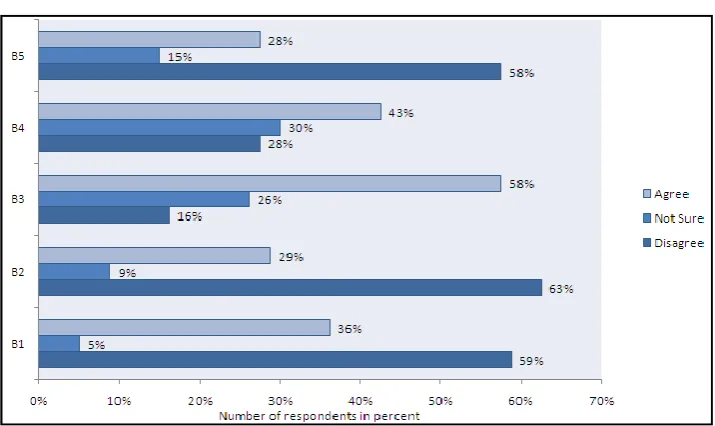
Survey on the status of E-learning infrastructure showed that the attribute of learning management system (LMS) on use is flexible and user friendly ranked the highest due to its mean value of 3.55, followed by the presence of necessary software installed on all computer labs which are supporting E-learning. The third attribute on the mean score basis was the presence of adequate computer labs and accessibility to student 24/7, though in a real sense for the security purpose the labs are not open 24hours, at least they are fully accessed for more than 12 hours per day as observed by the researcher. Least attribute in score for this variable was about the presence of reliable power supply while meeting the running costs comfortably. Summary of response on E-learning infrastructure is given in Table 4.4 and Fig. 4.2. More than 50 percent of the respondents they disagreed on the following areas as identified by the researcher: the institutions budget can ensure reliable and sufficient Internet bandwidth to support E-learning on monthly basis (58 percent of the respondents disagreed), the campuses have reliable power supply (63 percent of the respondents disagreed), also the institutions have enough computers in Labs and also the computers are accessible 24/7, many disagreed on this attribute however some commented that most of the labs are accessible during day time. Descriptive analysis in this variable of E-learning infrastructure shows that institutions are struggling with getting reliable power supply. The researcher also noted that there was gradual improvement in terms of other attributes in this variable such as LMS used and availability of computer labs for students. The Internet bandwidth also has been improving. These findings, in regard to this variable under descriptive analysis, led to the conclusion that currently, E-learning infrastructure might not be a critical barrier that hinders the adaptation of E-learning at HLIs. In fact, E-learning content can be even accessed via smart mobile phones which are widely owned by the majority.
4.3.3. Quality Content
The survey revealed how the respondents recommend about the quality of content creation in the Learning Management System. The researcher through using several attributes came up with the following results. The platform for LMS can be accessed by different type of web browsers and somehow has backward compatibility characteristics as it can be also used with lower version of computer tools this attribute ranked the first due to its high mean score value of 3.38. The second attribute was the way the platform support automatic feedback for any type of answered questions. Multimedia support like translation from one media to another (text to audio) and
mult-access using video and audio are attributes with the lowest score. Summary of Quality content creation response is outlined in Table 4.5 and Fig. 4.3. More than 40 percent of the respondents agreed that the platform of E-learning used at their respective institutions support automatic feedback for any type of answered questions and also the platform can overcome the mobility barriers such as access to content using any type of browsers and lower versions of computers tools. However many of the respondents they were not sure on the following attributes: that the system support speech synthesis such as translation of text to audio and vice versa, video and audio are used to allow multi access. The descriptive analysis for this variable shows that some of the respondents have limited knowledge in using key functionalities of LMS in E-learning content creation. This underutilization of LMS features, especially the ones responsible for content production, results in creating and uploading substandard content materials which are not attracting readers to continue reading. Such content sooner or later becomes a barrier for adaptation of E-learning as students are not motivated to continue reading substandard materials.
4.3.4. Acceptance of E-learning at HLIs in Tanzania
Under this variable, the attributes specified by the researcher, two of them got a high mean score compared to other variables. The researcher noted that respondent’s views on acceptance of E-learning are on the future perspective. For example the respondents were in a view that E-learning is best way to increase enrollment of students in HLIs with a mean score of 4.31. Also respondents are in a view that E-learning will lead to better performance if used with traditional learning. On the other hand, the attribute of E-learning affect negatively the organizational culture of teaching and quality monitoring ranked the lowest in score with a mean value of
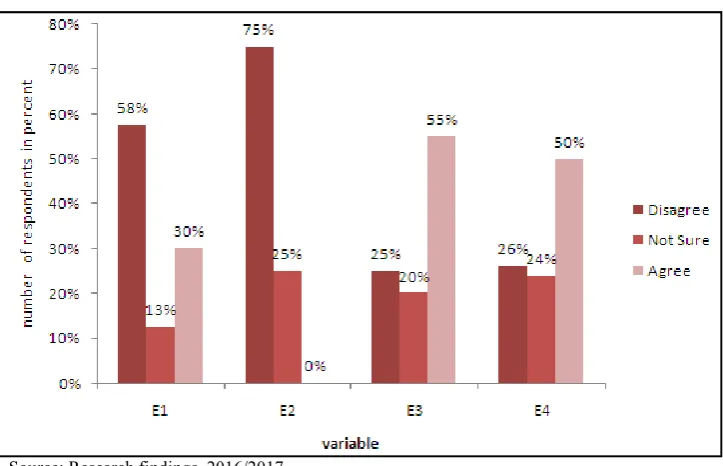
2.26. Summary of these attributes are outlined in Table 4.6 and Fig. 4.4. The researcher found that most respondents, about 93 percent, agreed that E-learning is the best way to increase student enrollment in higher institutions and this can overcome the problems associated with massive enrollment. 84 percent of the respondents agreed that E-learning in future can lead to a better performance if used with traditional learning while 68 percent of the respondents disagreed that E-learning will affect negatively their organization culture of teaching and quality monitoring. Also another group of respondents about 46 percent they don’t agree that acceptance of E-learning in Tanzania will lead to forged certificates. The response noted in this variable by the researcher it is good indicator which shows that generally E-learning is acceptable and is seen as one of the solution to education challenges facing HLIs in Tanzania.
4.3.5. Other factors
[image:10.595.41.551.77.139.2]The researcher also considered other factors which seem to be barriers on acceptance of E-learning. The respondents responded highly with a mean score of 3.49 that budget constraints for the higher learning institutions for paying internet bandwidth is a barrier for many students to enroll in E-learning. Another attribute in this category with a high mean score of 3.28, was that employment market is in favor of graduates that have gone through traditional learning i.e face to face. The attribute with poor response had a mean score of 1.86. Summary of the attributes of these other factors is provided in Table 4.7 and Fig 4.5. The survey found that 75 percent of the respondents disagreed that male students are more flexible in adapting E-learning environment than female students. 58 percent of the respondents disagreed that it is difficult to implement E-learning for science courses such as engineering and medicine. The employment industry in Tanzania is in favor of graduates that have gone traditional
Table 4.3. Perception of E-learning
Variable Mean Std. Deviation N
A1: Conduct and accept online examination done at our specified online examination centers 2.26 1.322 77
A2: Lecturers are getting regular training on use of E-learning 3.09 1.253 79
A3: Management recognition and reward on my E-learning initiatives motivate me to use E-learning 3.19 1.278 77 A4: The aggressive marketing of E-learning courses has tremendously increased E-learning students enrollment 2.76 0.917 80
A5: Our E-learning policy is reviewed regularly and made available to all members of staff 2.68 1.065 80
[image:10.595.39.554.182.256.2]Source: Research findings, 2016/2017
Table 4.4. Status of E-learning Infrastructure
Variable Mean Std. Deviation N
B1: Adequate computer labs installed with working computers for students whereby students are free to access any time 24/7
2.59 1.290 80
B2: Our campuses have reliable power supply and are able to meet the running costs comfortably 2.48 1.169 80
B3: The Learning management system (LMS) used is flexible and user friendly 3.55 1.146 80
B4: All computers in computer labs are installed with necessary software and support E-learning 3.20 1.163 80
B5: Reliable and sufficient internet bandwidth to support E-learning and monthly subscription is within Institution Budget
2.59 1.309 80
[image:10.595.38.553.303.374.2]Source: Research findings, 2016/2017
Table 4.5. Quality Content Creation
Variable Mean Std. Deviation N
C1: The facility provide for course authorizing inside exporting to and importing from other platform 3.03 0.993 78
C2: The platform support automatic feedback for any type of answered questions 3.27 0.848 78
C3: The system support speech synthesis such as translation of text to audio and vice versa 2.90 0.920 78
C4: Video and audio are used to allow multi-access 2.84 1.047 74
C5: The platform can overcome mobility barriers such as access to content using any type of browser and lower versions of computer tools
3.38 0.996 78
Source: Research findings, 2016/2017
Figure 4.1. Perception of E-learning
[image:11.595.119.477.305.518.2]Source: Research findings, 2016/2017
Figure 4.2. Status of E-learning Infrastructure
Source: Research findings, 2016/2017
Figure 4.3. Quality Content Creation
[image:11.595.120.477.553.762.2]learning as have been supported by 50 percent of the respondents. Budget for paying internet bandwidth is a barrier for students to enroll in E-learning courses as 55 percent of the respondents said this during the survey. Under this variable, the only attribute which showed significant barrier in adaptation of E-learning was that of budget constrain for paying Internet bandwidth. However, the researcher was in view that given the number of many options available in accessing Internet, serious users can easily afford to access E-learning content at affordable costs or for free through institutions networks. Hence other factors in context of this research study are not considered as critical barriers in adaptation of E-learning for HLIs.
4.3.6. Conclusion about Variables for this Study
The descriptive analysis done on the variables as proposed by the researcher, found that respondents have different opinions about the barriers which affects the acceptance of E-Learning at HLIs.
Generally, the descriptive analysis indicated two variables,
perception on E-learning and the quality of content creation, as critical barriers in adaptation of E-learning at HLIs. Hypotheses testing are discussed later on this paper
4.4. Hypotheses Testing
For the purpose of testing hypothesis, the researcher deployed regression model to identify effects of proposed factors in predicting the acceptance of E-Learning at HLIs. The dependent variable (DV) used in linear regression was the
Acceptance of E-Learning in HLIs and on the side of
independent variables (IV), the researcher used Organizational
culture, Infrastructure and Quality of Content Creation to complete the model. However, prior to conduct a regression
test, the researcher conducted a correlation test between
variables to check the Pearson correlation coefficient. The correlation test showed positive relationship for both independent variables. These results, from correlation test, which had linear relationship between variables, justified further testing of linear regression.
[image:12.595.118.478.53.271.2]Source: Research findings, 2016/2017
Figure 4.4. Acceptance of E-learning at HLIs in Tanzania;
Source: Research findings, 2016/2017
[image:12.595.118.480.305.538.2]