ISSN Online: 2152-7393 ISSN Print: 2152-7385
DOI: 10.4236/am.2019.106033 Jun. 24, 2019 468 Applied Mathematics
Diffraction of Surface Harmonic Viscoelastic
Waves on a Multilayer Cylinder with a Liquid
Safarov Ismoil Ibrohimovich
1, Kulmuratov Nurillo Rakhimovich
2,
Teshayev Muhsin Khudoyberdiyevich
3*, Kuldashov Nasriddin Urinovich
11Tashkent Institute of Chemistry and Technology, Tashkent, Republic of Uzbekistan 2Navoi State Mining and Metallurgical Institute, Navoi, Republic of Uzbekistan 3Bukhara Engineering-Technological Institute, Bukhara, Republic of Uzbekistan
Abstract
An infinitely long circular cylinder, consisting generally of a finite number of coaxial viscoelastic layers, surrounded by a deformable medium is consi-dered. The dynamic stress—the deformed state of a piecewise-homogeneous cylindrical layer from a harmonic wave is investigated. The numerical results of stress, depending on the wavelength are obtained.
Keywords
Viscoelasticity, Fluid, Frequency, Longitudinal and Transverse Wave, Shell, Plane Strain
1. Introduction
During seismic impacts, modern underground pipelines operate under condi-tions of not only static but also dynamic loads, which are accompanied by large damage and even failure of the whole system [1]-[6]. In the case of a sufficiently long cavity, the impact perpendicular to its longitudinal axis, the environment surrounding the cavity and the lining are in conditions of plane deformation, and the task of determining the stress state of the array and lining reduces to a flat problem of the dynamic theory of elasticity (and whether visco-elasticity) [7] [8] [9] [10]. In [11], the problem of stress concentration in an infinite linearly elastic cavity near a circular cavity with the propagation of longitudinal har-monic waves was solved. The solution of the diffraction problem for a harhar-monic transverse wave was obtained in [12]. This paper investigates the interaction of cylindrical stress waves with a cylinder, which in the general case consists of a
fi-How to cite this paper: Ibrohimovich, S., Rakhimovich, K.N., Khudoyberdiyevich, T.M. and Urinovich, K.N. (2019) Diffrac-tion of Surface Harmonic Viscoelastic Waves on a Multilayer Cylinder with a Liquid. Applied Mathematics, 10, 468-484.
https://doi.org/10.4236/am.2019.106033
Received: April 1, 2019 Accepted: June 21, 2019 Published: June 24, 2019
Copyright © 2019 by author(s) and Scientific Research Publishing Inc. This work is licensed under the Creative Commons Attribution International License (CC BY 4.0).
http://creativecommons.org/licenses/by/4.0/
DOI: 10.4236/am.2019.106033 469 Applied Mathematics
nite number of coaxial viscoelastic layers. Due to the fact that long-term seismic waves, as a rule, exceed the characteristic dimensions of the cross section designs (for example, diameter D), therefore, when solving diffraction problems, it is necessary to consider long-wave effects (Dλ <1,
λ
is the wavelength).With longer wavelengths (Dλ =0.04 0.16÷ ) maximum coefficients of dynamic concentrations turned out to be 5% - 10% more than with the corresponding bi-axial static loaded (
λ
→ ∞) [13]. At Dλ >0.16 dynamic stress concentrations are significantly lower than static. In [14], it was shown that the difference in dynamic stress concentrations in the case of a rigid inclusion and cavity can be attributed to the possibility of propagation of generalized Rayleigh-type waves on a concave free cylindrical surface of the cavity. A significant contribution to the calculation of flexible pipelines was made in [15] [16], which investigated such important issues as accounting without a backing zone and determining the stability of underground pipelines. There are a large number of authors who have applications in other branches of technology who can be successfully ap-plied to the calculation of underground pipelines. These works are devoted to the study of the stress distribution in plastic, weakened by a reinforced bore, op-erating under plane strain conditions. The most significant research in this area can be attributed to the work that solved the problem in stretching a plate in which a ring is embedded or soldered.2. Problem Statement and Basic Relations
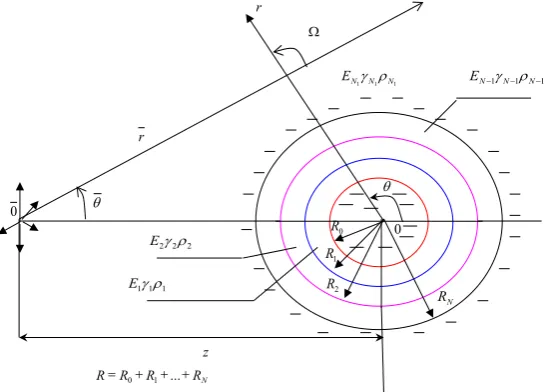
In this paper, the interaction of a cylindrical stress wave by parallel-layered elas-tic layers with a liquid is investigated. It is assumed that the linear source in Fig-ure 1 is a continuous source of dilatation (or transverse) stress waves with an angular velocity ω and amplitude ϕ0 (or ψ0), and the layered package is a
thick-walled and thin-walled layers of the cylinder. In describing the movement of thin-walled elements, the equations of the theory of such shells are used, which are based on the Kirchhoff-Love hypotheses. For thin-walled layers, the original equations are the linear theory of elasticity. The numbering of the layers is the product in ascending order of their radii from k = 1 to k = N (Figure 1). The value characterizing the properties and the state of the elements correspond to the values j=1,2, , N, where K is the elastic layer enclosed between K-1
and K-m layers. The environmental parameters are denoted by the indices K = N
(Figure 1). Under the assumption of a generalized plane-deformed state, the equation of motion in displacements has the form [1]
(
2)
(
( )
)
(
( )
)
22 .j j j grad div j rot rot j j j t
λ + µ −µ + =ρ ∂
∂ u
u u b
(1)
where λj and µj ( j=1,2, , N , j N= —relate to the environment,
1,2, , 1
DOI: 10.4236/am.2019.106033 470 Applied Mathematics Figure 1. The design scheme of layered cylindrical bodies in a deformable medium.
( )
( )
( )(
) ( )
( )
( )
( )(
) ( )
0
0
d
d ;
t i
j j
t i
j j
f t f t R t f
f t f t R t f
λ
µ
λ λ τ τ τ
µ µ τ τ τ
−∞
−∞
= − −
= − −
∫
∫
j
b —Volume force density vector (bj =0); f t
( )
—some function; ρj—density of materials, R t( )i
(
)
µ −τ and R tλ( )i
(
−τ)
—relaxation core, λ µoj, oj—instantaneous elastic moduli of viscoelastic material, uj
(
u urj, θj)
—displacement vector which depends on r t, ,θ
. At pressures up to 100 MPa, the movement of the fluid in is satisfactorily described by the wave velocity of the particle particles[14]
2 0
0 2 2
1
о
С t
ϕ
ϕ ∂
∆ =
∂ . (2)
where 22 2 2 2
d d d
d
dr r r r dθ
∆ = + + ; Со—acoustic velocity of sound in a fluid.
Poten-tial ϕ0 and the fluid velocity vector are dependent V =gradϕ0. Fluid pressure 0
r R= is determined using the linearized Cauchy-Lagrange integral
0 0
о
Р С
t
ρ ∂ϕ
= −
∂ —fluid pressure on the wall of the cylindrical layer and ρо-fluid
density Under the condition of continuous flow of fluid, the normal component of the velocity of the fluid and the layer on the surface of their contact r = R0
must be equal
0 0
0 r1
r R r R
u
r t
ϕ
= =
∂ =∂
∂ ∂ . (3)
where ur1—moving the layer along the normal. On the contact of two bodies r
= Rj equal displacements and stresses (fixed contact condition)
( 1); ( 1); ( 1); ( 1)
rj r j rrj rr j j j r j r j
u =u +
σ
=σ
+ uθ =uθ +σ
θ =σ
θ + (4) 11 1 N N
N
E γ ρ EN−1γN−1ρN−1
2 2 2γ ρ
E
1 1 1γρ
E r
0
z
θ
0
2
R
0
R
1
R
N
R r
Ω
N
R R R R= 0+ 1+...+
DOI: 10.4236/am.2019.106033 471 Applied Mathematics
Note that in the case of sliding ground contact over the pipe surface, the last Equation in (4) takes the form [16]:
0
r jθ
σ = .
where ( )j nn
σ
andσ
ns( )j1—radial and tangential stresses in the j-th viscoelasticbody; u( )nj and ( )1
j s
u —radial and tangential displacement of the j-th body. The solution of the wave Equation (1) in the displacement potentials satisfies at in-finity r→ ∞ the Summerfield radiation condition [14]:
( )
lim 0, lim к N 0
N N N
r r r r i
ϕ
ϕ α ϕ
→∞ →∞
∂
= + =
∂
, (5)
( )
lim 0, lim к N 0
N N N
r r r r i
ψ
ψ β ψ
→∞ →∞
∂
= + =
∂
.
As r→ ∞, natural oscillations by the first and third conditions (5) are not
fulfilled, therefore, the shortened Sommerfeld conditions at infinity are set, which in detail in [14] was considered.
If in place the equation of motion (1) is used cylindrical shells, then the equa-tion of moequa-tion of shells in a flat formulaequa-tion is:
2 2
1 2
4 2 2
2
2
4 2 2
u W R X
B
u b W V W W R X
B θ
θ
θ θ θ
∂ ∂
+ = −
∂ ∂
∂ + ∂ + ∂ + + =
∂ ∂ ∂
(6)
where u and W- longitudinal and transverse displacements respectively:
0 0
2 2
1 r r R hc 2 c c 2; 2 rr r R hc 2 c c 2 ;
u W
X h X h
t t
θ
σ = + ρ ∂ σ = + ρ ∂
= − − = − −
∂ ∂
2 2
2 2
0
, .
12c 1 c cc
h E h
b B
R v
= =
−
2 2
2 2
0
, .
12c 1 c cc
h E h
b B
R v
= =
−
Shell radius R0, ρc—shell density, νc—shells Puasson ratio, hc—shell
thickness, Ec—shell elastic modulus, σrr and σrθ —normal and tangent components of the reaction from the environment.
The contact between the shell and the environment can be hard or sliding:
0 c 2 0 c2, 0 c 2 r 0 c2
r R h r R h r R h r R h
u = + =uθ = + W = + =u = + (7)
Consider a longitudinal wave generated by a longitudinal source of expansion waves located at О (Figure 1). The displacement potentials of the incident expansion wave can be represented as [15]
( )1
(
)
0π e
Р i t
N NOi H αNr ω
ϕ =ϕ − . (8)
where ( )1 0
H —is the divergent functions of Henkel (the first kind of zero order);
NO
ϕ —expansion wave amplitude; αN —compression wave number;
2 2 2
N cα
α =ω , 2
(
2)
N N N
DOI: 10.4236/am.2019.106033 472 Applied Mathematics
incident wave (6), the natural oscillations of a reinforced bore located in a vis-coelastic medium are considered.
3. Solution Methods
The problem is solved in displacement potentials, for this we present the dis-placement vector in the form:
( )
( )
,(
1,2, ,)
j =grad ϕj +rot j j= N
u ψ
where ϕj —longitudinal wave potential; ψj
(
ψ ψrj, θj)
—vector potential oftransverse waves.
The basic equations of the theory of visco elasticity (1) for this problem of plane strain are reduced to the following equation
(
)
( )(
)
( )
(
)
2 2
2 2
2
2 d
2 d
t j
oj oj j oj j
t
j j
oj j j
R t
R t
t
λ
µ
λ µ ϕ λ τ ϕ τ
ϕ
µ τ ϕ τ ρ
−∞
−∞
+ ∇ − − ∇
∂
− − ∇ =
∂
∫
∫
( )
(
)
22 2
2 d
t
j j
oj j oj Rµ t j j t
µ µ τ τ ρ
−∞
∂
∇ − − ∇ =
∂
∫
ψψ ψ (9)
where 2 2 2
2 2 2
1 1
r r
r r θ
∂ ∂ ∂
∇ = + + +
∂
∂ ∂ —differential operators in cylindrical
coor-dinates and vj— Poisson’s ratio.
At infinity, r→ ∞ potentials of longitudinal and transverse waves with
j N= satisfy the Summerfield radiation condition (5).
The solution of Equation (9) can be sought in the form:
(
)
( )( )
(
)
( )( )
1 1
, , , e ;i t , , , e .i t
j kj j kj
k k
r tθ qϕ rθ ω ψ r t qψ r ω
ϕ ∞ − θ ∞ θ −
= =
=
∑
=∑
(10)where qkj( )ϕ
( )
r,θand qkj( )ψ
( )
r,θ—complex function which is solving the fol-lowing Equations (10)
( )
( )
( ) ( )( )
( )2 , 2 0, 2 , 2 0,
kj j kj kj j kj
qϕ rθ α qϕ qψ rθ β qψ
∇ + = ∇ + =
( )
( )
( )2 2
0 , 0 0 0, 1,2, ,
k k
qϕ rθ α qϕ j N
∇ + = = (11)
where 2
(
)
2(
)
1 2 1
j
oj oj oj oj
ρω α
λ λ µ µ
=
− + − ,
(
)
2 2
1
j
oj oj
ρω β
µ µ
=
− ,
2 2
0 2
0
С
ω
α =
( )
( )
oj aλj ibλj
λ = ω + ω , µoj =aλµ
( )
ω +ibµj( )
ω ,( )
( ) ( )
0
sin d
j j
aλ ω Rλ τ ωτ τ
∞
=
∫
,( )
( ) ( )
0
cos d
j j
bλ ω Rµ τ ωτ τ
∞
=
∫
.The solution of Equation (9) with regard to (11) is expressed in terms of Henkel functions of the 1st and 2-nd kind of the nth order:
( )1
( )
( )2( )
( )
0 cos e
i t
j nj n j nj n j
n A H r A H r n
ω
φ ∞ α α θ −
=
′
DOI: 10.4236/am.2019.106033 473 Applied Mathematics
( )1
( )
( )2( )
( )
0 sin e ; 1,2, , 1
i t
j nj n j nj n j
n
B H r B H r n ω j N
ψ ∞ β β θ −
=
′
=
∑
+ = −( )1
(
)
( )2(
)
( )
0 cos e
i t
N nN n N nN n N
n C H r D H r n
ω
φ ∞ α α θ −
=
=
∑
+ (12)( )1
(
)
( )2(
)
( )
0 sin e
i t
N nN n N nN n N
n M H r L H r n
ω
ψ ∞ β β θ −
=
=
∑
+ ( )
( )
( )
0 0 0 0 0
0 cos e
i t
n n n n
n K J r K N r n
ω
φ ∞ α α θ −
=
′
=
∑
+ where A A B B C D L Mnj, nj′, nj, nj′, nj, nj, nN, nN,KnN and KnN′ —decomposition
coef-ficients, which are determined by the corresponding boundary conditions;
( )1
( )
n j
H
α
r and ( )2( )
n j
H
α
r —respectively, the Henkel function of the 1st and2nd kind of the nth order ( ) ( )1 , 2
( )
( )
( )
n n n
H αr =J αr ±iN αr .
Solution (12) with j N= satisfies at infinity r→ ∞ the Somerfield
radia-tion condiradia-tion (5) and is represented as:
( )
(
) ( )
( )
(
) ( )
1
0
1
0
cos e ;
sin e .
i t
N nN п N
т
i t
N nN п N
т
C Н r m
M H r n
ω
ω
φ α θ
ψ β θ
∞
−
= ∞
−
=
=
=
∑
∑
Solving problem (2) with r→0 satisfies the condition of limiting the force
factors [10] and it follows that Kn′ =0
( ) ( )
0 0 0
0 cos e
i t n n
n K J r n
ω
φ ∞ α θ −
=
=
∑
The full potential can be determined by imposing the potentials of the inci-dent and reflected waves. Thus, the displacement potentials will be
( )
0 0
, , , ,
p
N N N N N j j j j
φ =ϕ +ϕ Ψ =ψ φ =ϕ Ψ =ψ φ =ϕ (13)
To determine the stress-strain state, it is first necessary to express the incident wave through wave functions (13). Using the geometric construction in Figure 1
and moving from the coordinates
r
,
θ
to coordinatesr
,
θ
in the area of Nr
r
≤
( )
( )
(
)
( )1(
)
( )
0 1
π 1n cos e
p i t
N n n N n N
n
i Е J r H z n ω
φ φ ∞ α α θ −
=
=
∑
− .where 1, 0
2, 1
n
n E
n =
= ≥
, Jn—cylindrical Bessel function of the first kind.
It follows that voltages and offsets can easily be expressed in terms of dis-placement potentials [15]
1 ; 1 ,
j j j j
rj j
u u
r r θ r r
ϕ ψ ϕ ψ
θ θ
∂ ∂ ∂ ∂
= + = −
∂ ∂ ∂ ∂ (14)
2 2
2
1
2 j j ;
rrj j j r r r
φ
ψ
σ
λ φ
µ
θ
∂ ∂ ∂
= ∇ + ∂ +∂ ∂
DOI: 10.4236/am.2019.106033 474 Applied Mathematics
2 2
2
2
2 2
2 2 2
1 1 1 1
2 ;
1 1 1 1
2
j j j j
j j j
j j j j
r j
r r r r r r
r
r r r r r r r
θθ
θ
φ φ ψ ψ
σ λ φ µ
θ θ
θ
φ φ ψ ψ
σ µ
θ θ θ
∂ ∂ ∂ ∂ = ∇ + + + − ∂ ∂ ∂ ∂ ∂ ∂ ∂ ∂ ∂ ∂ = ∂ ∂ − ∂ + − ∂ ∂ ∂
Displacement and stresses for the case of a compression wave falling on a layer
ψ
it turns out.Substituting (13) into (14) after considering (11), we obtain the following ex-pression for displacement and stress:
( )
(
)
( )(
)
( )
(
)
( )
1 3
1
0 51 51
0 3
52 cos e
N N
n
rN n N nN N
n
N i t
nN N
u r E i E r C E r
M E r n ω
φ α α
β θ ∞ − = = + +
∑
( )(
)
( )(
)
( )(
)
( )
1 3 10 61 61
0 3
62 cos e
N N
n
N n N nN N
n
N i t
nN N
u r E i E r C E r
M E r n
θ
ω
φ α α
β θ ∞ − = − = + +
∑
( )( )
( )( )
( )( )
( )( )
3 4 1 1 51 61 03 1 4
52 52 cos e
j j
rj nj j nj j
n
j j i t
nj j n
u r A E r A E r
B E r B E n ω
α
α
β
θ
∞ − = − = + + + ∑
( )( )
( )( )
( )( )
( )( )
( )
3 4 3
1 1
61 61 62
0 4 1
62 sin e
j j j
j nj j nj j nj j
n
j i t
n j j
u r A E r A E r B E r
B E r n
θ
ω
α
α
β
β
θ
∞ − = − = + + + ∑
(15)(
)
( )(
)
( )(
)
( )(
)
( )
1 3 20 0 11 11
0 3 12 2 1 cos e N N n
rrN N kN n N nN N
n
N i t
nN N
M r E i E r C E r
M E r n ω
σ
µ
φ
α
α
β
θ
∞ − = − = − + + ∑
(
)
( )(
)
( )(
)
( )(
)
( )
1 3 20 0 21 21
0 3 22 2 1 cos e N N n
N N kN n N nN N
n
N i t
nN N
M r E i E r C E r
M E r n
θθ
ω
σ
µ
φ
α
α
β
θ
∞ − = − = − + + ∑
(
)
( )(
)
( )(
)
( )(
)
( )
1 3 20 0 41 41
0 3 42 2 1 sin e N N n
r N N kN n N nN N
n
N i t
nN N
M r E i E r C E r
M E r n
θ
ω
σ µ φ α α
β θ ∞ − = − = − + +
∑
(
)
( )( )
( )( )
( )( )
( )( )
( )
3 4 2 10 11 11
0
3 1 4
12 11
2 1
cos e
j j
rrj j kj nj j n j j
n
j j i t
nj j nj j
M r A E r A E r
B E r B E r n ω
σ µ α α
β β θ
∞ − = − = − + + +
∑
(
)
( )( )
( )( )
( )( )
( )( )
( )
3 4 2 10 21 21
0
3 1 4
22 22
2 1
cos e
j j
j j kj nj j nj j
n
j j i t
nj j nj j
M r A E r A E r
B E r B E r n
θθ
ω
σ
µ
α
α
β
β
θ
DOI: 10.4236/am.2019.106033 475 Applied Mathematics
(
)
( )( )
( )( )
( )
( )
( )( )
( )
3 4
2 1
0 51 61
0
3 1 4
52 52
2 1
sin e
j j
r j j kj nj j nj j
n
j j i t
nj j nj j
M r A E r A E r
B E r B E r n
θ
ω
σ
µ
α
α
β
β
θ
∞ −
=
−
= − +
+ +
∑
where
( ) 2 2 2 ( )
( )
( )( )
11kj 2j nkj j j nkj1 j
r
E n n
β
Yα
rα
rY−α
r
= + − −
( )
(
)
( )( )
( )( )
12kj 1 nkj j j nkj1 j
E =n n + Y
β
r +β
rY−β
r ( ) 2 2 2 2 2 ( )
( )
( )( )
21kj 2j j nkj j j nkj1 j
r
E n n
β
α
r Yα
rα
rY−α
r
= − + + − +
( ) ( )
( )
(
)
( )( )
22kj j nkj j 1 nkj j
E =n
β
rYβ
r − +n Yβ
r ( ) 2 2 2 2 ( )
( )
31 2
j
kj kj
j n j
r
E =
α
r −β
Yα
r
( )
(
)
( )( )
( )( )
41kj 1 nkj j j nkj1 j
E =n n + Y
α
r −α
rY−α
r ( ) 2 2 2 ( )
( )
( )( )
42kj j2 nkj j j nkj1 j
r
E n n
β
Yβ
rβ
rH −β
r
= − + − +
( ) ( )
( )
( )( )
51kj j nkj1 j nkj j
E =
α
rY−α
r nY−α
r ( ) ( )
( )
52kj nkj j
E = −nY
β
r( ) ( )
( )
61kj nkj j
E = −nY
α
r( ) ( )
( )
( )( )
62kj nkj j j nkj1 j , 1,2,3,4
E =nY
β
r −β
rY−β
r k=where ( )1j , ( )2j , ( )3j ( )1, ( )4j ( )2
n n n n n n n n
Y =J Y =N Y =H Y =H .
The construction of a formal solution does not meet fundamental difficulties, but the study of such a solution requires a huge amount of computation. The tasks are reduced to solving inhomogeneous algebraic equations with complex coefficients
[ ]
C q{ } { }
= p . (16) where {q} is a vector column containing arbitrary constants; {F}—vector column of external loads; [C] is a square matrix, the elements of which are expressed through the functions of Bessel and Henkel. Equation (13) is solved by the Gauss method with the selection of the main element. In the work of movement and stress is reduced in dimensionless types* * *
0
* 2
0 0
; ; ;
; .
rj j rrj
rj j rrj
A A
r j
r j A
u u
u u
i i
θ θ
θ θ
σ σ
αϕ αϕ σ
σ
σ σ µβ ϕ
σ
= = =
DOI: 10.4236/am.2019.106033 476 Applied Mathematics
In the case when E1=E2 ==EN, ρ1=ρ2 ==ρN and
1 2 N
ν =ν ==ν , we get holes (r = R0) that are in infinitely elastic medium
(aλN
( )
ω =0, bλN( )
ω =0). The boundary (r = R0) is stress free, i.e. no liquid. Inthis case, the circumferential voltage on the surface of the cavity is reduced to the following:
(
)
2( )
( )1(
)
( )
0 2
0
4 1
, , 1 1 cos e ,
π
n i t
N N N n n N nN
n
R t H Z T n
k
ω θθ
σ θ β µ φ ∞ α θ −
=
−
= − − ∈
∑
(17)where
( )
(
)
(
)
(
)
(
)
(
)
( )(
)
(
)
( )(
)
( )(
)
1 1 1 13 2 2 2 2 2 2 2
1
1 1
2 2 2 2
1
2 2 2
1 1 2 4 1 1 2 .
nN nN N N N n N N n N N nN N N
N N N N n N N N N N N n N N
nN N N
N N n N N N N n N N
N pN SN
Т Т R R H R H R Q R
n n R R H R n n R R H R
Q R
n R H R n n R H R
k C C
α α α β
β β β β β β
β
β β β β
− − − − − = = − + − + − + − = − − − + =
Now consider some limiting cases. With r→0:
( ) ( )
( )
(
)
( ) ( )
( )
{
(
)
( )
}
2
1 , 2 4
0 0
2
1 , 2 2 4
0
2 ln 1 2ln 0 ln ,
π 2 π
1 ! ! 0 . π 2
r
т r
i z
H z z i z z z
i z
H z n n z z
→ → = ± − − + = − + +
And r→ ∞ : ( ) ( )
( )
( )1 2
1 , 2 2 e π 4
π i kz т H z z ± − =
, the asymptotic formulas of
Hankel of the 1st and 2nd kind were used [17]. If in expression (17) Z tends to infinity, then we can use the asymptotic expansions of the Henkel function for large values of the argument [17] (α- is a finite)
( )
1 2
0
4 1
lim 1 cos e
4
N
n i t
n nN r R
Z n
N
i E T n
k
ω θθ
σ
∗ ∞ +θ
−=
→∞ =
≈ −
∑
(18)This expression completely coincides with the expressions obtained by [17]
for a plane incident wave. If the wave number tends to zero, then the limiting process describes static solutions for long waves. This limiting process allows us to use approximating expressions for the Henkel functions for small values of the argument (Z is finite)
( )
(
) ( )
1 2 0 2 2 2 4lim 4 1 cos
1 1 cos
N r R m m N m R Z Z
R m m
Z
θθ
α σ θ
θ = → − ∞ − = ≈ + + ∗ − − −
∑
(19)DOI: 10.4236/am.2019.106033 477 Applied Mathematics
(
)
(
)
(
)
(
) (
)
(
)
(
)
(
)
1 2 2 4 4
2 2 2 0 2 3 2 2 0
3 2 2 2
0 1
2
3 2 2
0 2
4 1 1 1 1
π 2 4
1 1
4 2
1 1 1
4
1 1 1
2
n
n N N
n n N N
N n n N
N N n n N N
N n
N
i n R n n n n R
R n n R I R H R
n n n n R RI R H R
n n R RI
θθ
β β
σ
χ
β η β α β
β β α β
χ β α χ + ∞ ∗ = − ∈ = − − − − − − ∆ + + − + − − − − + − − +
∑
(
) (
)
(
)
(
)
(
)
( )
1 02 2 2
0 1 0 1
2
1 1 1 cos e
n N
i t N n n N
N
R H R
n R I R H R n ω
α β
α β α β θ
χ − − − − + − −
where 2
(
)
2 12 2 1 ; 1 2 N N N
N N N
v v β ρ χ η ρ α − = = =
− . At α →1R 0, then it turns out the
solu-tion of a static problem
(
) (
) ( )
1 1 1 1 2 1 1; 1 2 4 cos 2 .
1
N
rr N
N N N
v v v θθ
λ
λ
σ
σ
θ
λ µ
λ µ
∗ = ∗ = − − − −
+ − +
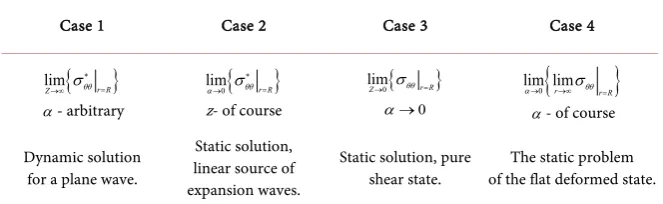
In the limiting processes in expressions (15) and (16) is described by physical results, is given in Table 1. The stress concentration coefficient σθθ∗ N is
deter-mined by the following formulas
( )N
N r R p r R θθ θθ θθ
σ
σ
σ
= ∗= = . (20)
where ( ) 2 ( )1
( )
(
2)
( )1( )
0 2 1 0 e
p i H r k H r i tω
θθ
σ = πϕ µα πϕµ α + − α −
.
If we take the fluid into account, then using (2), (3) and (15) we can determine the corresponding stresses σrr N∗ and σθθ∗N. In the absence of an incident wave
(6), the natural oscillations of an unsupported (or reinforced) hole located in the medium are considered.
At the boundary r = R, we set a voltage-free condition, i.e.
0
rr r a rθ r a
σ
= =σ
= = . (21)Substituting (12) into (21), we obtain the frequency equation
1n 2n 2n 1n 0
Z X +Z X = . (22)
where
( )1
( )
(
1 2)
( )1( )
1n 0 n 1 o n2 1 0 0 o ;X = Ω H + Ω + a − Ωd H Ω
(
)
( )1( )
( )1( )
2n 1 n 1 1 n1 1 ;
X =n n − H Ω − ΩH + Ω
(
)
( )1( )
( )1( )
1n 1 n o o n1 o ;
Z =n −n H Ω − Ω H + Ω
(
1 2)
( )1( )
( )1( )
2n n2 1 2 n 1 1 n1 1 ;
Z = a − Ω H Ω + Ω H + Ω
(
) (
)
2 1 21 1 1 1 2 ;1 n2 ; n2 ; o 1 1;
d = −v − v a =n a =n n− Ω = ΩL
(
) (
(
)
)
1 1 2 1 2 1 1 ; 1 p1
DOI: 10.4236/am.2019.106033 478 Applied Mathematics Table 1. Information on limiting processes.
Case 1 Case 2 Case 3 Case 4
{
}
lim r R Z σθθ
∗ = →∞
α- arbitrary
{
}
0
limα→ σθθ∗ r R= z- of course
{
}
0
limZ→ σθθr R=
0
α →
{
}
0
lim limr r R
θθ α→ →∞σ =
α- of course
Dynamic solution for a plane wave.
Static solution, linear source of expansion waves.
Static solution, pure
shear state. of the flat deformed state. The static problem
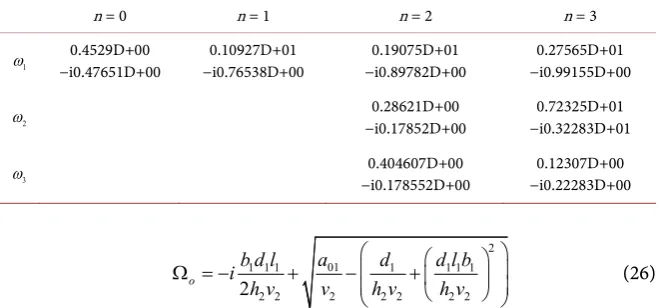
Frequency Equation (22) is solved numerically, i.e. Muller method. The com-plex eigenfrequencies
(
ωnj,j=1,2,3)
are given n≥0(
v1=0.25)
in Table 2. In the table of the first column correspond the complex frequency ω01, second11
ω , third ω ω ω21, 22, 23 and fourth, columns ω ω ω31, 32, 33.
The partial equation, for differential Equations (6), under the condition of a sliding contact, takes the form:
( )
( )
2 1 1 2 2 2
1 2
0
n o o n n o o n
n n
h Y Z X h Y Z Z
Z X
− Ω − Ω
= (23)
where
( )1
( )
( )1( )
2 o ; 1n n 1 1 n 1 1 ;
h =h R Y =nH Ω − ΩH + Ω
(
)
( )1( )
( )1( )
11 ;
jn n j j n j
Z =n −n H Ω + Ω H + Ω
(
2 1)
( )1( )
( )1( )
1n 1 1 n2 n 1 1 n1 1 ;
X = − Ω +d
α
H Ω + ΩH + Ω(
1 2)
( )1( )
( )1( )
2n 2n 2 2 n 2 2 n1 2 ;
X =
α
− Ω H Ω + Ω H + Ω( )1
( )
2n n 2 , 1,2
Y =nH Ω j=
(
)
2 2
2 1 o; n1 1 1; 1 1 ;
v = −v α =b n − + Ω =αa
(
)
2 β α1 1 C Cρ1 s1 ; o αoR;αo a0 ω Co;
Ω = = Ω Ω = =
(
)
(
(
)
)
2 2 2 2
1 1 0 1
12 ; 1 o 1 ;
b =h R b =E −v E +v
(
)
1 2 2
2 ; 1 1 ;
n o o o
a =n β =E h −v
o o o
C =E ρ —Rod wave velocity
( )
(
2)
2(
2)
1 0 2 1 0 2 2
o o n n
Z Ω =b Ω v a− −n Ω v a− (24)
In this case, we obtain asymmetric vibrations of the cylindrical shell, which are described by the expression
(
2)
( )1( )
( )1( )
2 0 2 01 1 1 1 1 o 1 1 1 0
h Ωv a− + −b b d HΩ Ω H Ω = . (25)
where Ω = Ω1 oL L1; 1=ηE
(
1+v1)(
1 2− v1) (
1−v1)
(the index “0” corresponds to the shell, and “1” to the environment). If we use the asymptotic expression of the Henkel function with l11, then for the zero and first order we obtain theDOI: 10.4236/am.2019.106033 479 Applied Mathematics Table 2. The dependence of the complex natural frequencies of the cylindrical hole.
n = 0 n = 1 n = 2 n = 3
1
ω 0.4529D+00
−i0.47651D+00 −i0.76538D+00 0.10927D+01 −i0.89782D+00 0.19075D+01 −i0.99155D+00 0.27565D+01
2
ω 0.28621D+00
−i0.17852D+00 −i0.32283D+01 0.72325D+01
3
ω 0.404607D+00
−i0.178552D+00 −i0.22283D+00 0.12307D+00
2 01
1 1 1 1 1 1 1
2 2 2 2 2 2 2
2
o ib d lh v av h vd d l bh v
Ω = − + − +
(26)
To obtain complex and imaginary natural frequencies, the following condition must be met
(
) (
) (
)
(
) (
) (
)
2
01 1 1 2 2 1 1 1 2 2
2
01 1 1 2 2 1 1 1 2 2
if if
R I I
i a v b h v d l b h v
a v b h v d l b h v
Ω + Ω > +
Ω =
Ω > +
(27)
To fulfill the first condition, the modulus of elasticity E must satisfy the in-equality
(
)
(
2)
2(
(
) (
)
1)
1(
2)
11 2 2 1 1 0
1 1 1 1 2 1
E v b h h v η v − − v −
> + + + − − − (28)
A similar condition is set for η:
(
)(
)
1(
)(
) (
1)
2 1 2 1 1 1 2 01 1 1 1 2 1 o 1 1
h v v h a v v E E
η
− − < − − + − −
The numerical values of asymmetric
Ω
(n = 0) natural frequencies are given in Table 3 for different values of E(Е1/E0).4. Numeric Results
For given incident wave, voltage and displacement are determined by the rows described by expressions (12) - (17) in the case of hard contact. The calculations were performed on the Mat lab computer program complex; the series were cal-culated with an accuracy of 10−8. All expressions for stresses and displacements
are:
(
)
(
2 2)
1 2 ( )Im e iwt Im e i wt
R i+ − = R + − −γ . (29)
As can be seen, the solution of the problem is expressed through the special functions of the Bessel and Henkel of the 1st and 2nd kind. With the increase in their argument, the series (12) - (17) converges. Therefore, on the basis of nu-merical experiments, it has been established that the accuracy of 5 - 6 members of the series has reached 10−6 - 10−8. As the relaxation core of a viscoelastic
ma-terial, let’s take a three-parameter core
( )
1 e tA R t
t
β
α −
−
= Rizhanitsen-Koltunova
DOI: 10.4236/am.2019.106033 480 Applied Mathematics Table 3. The dependence of the complex natural frequencies of ax symmetric vibrations of cylindrical shells on E.
ω E = 0.03 E = 0.09 E = 0.12 E = 0.15 E = 0.25
01
ω 1.3308D-01
−i1.9767D-02 −i4.5891D-02 2.3976D-01 −i6.1776D-02 3.2670D-01 −i7.9394D-02 4.1665D-01 −i1.3691D-01 1.5270D-12
Take the following parameters: A=0.048;
β
=0.05;α
=0.1. To study the stressconcentration on the free surface, we use the absolute values of the complex val-ue and relations (18) and (19). The magnitude of the complex function depends on the wave number α, angle θ distances
r
, Poisson’s ratio, Young’s module, densities, geometrical parameters R and Z. If all the characteristics (Figure 1) of the mechanical system are the same (Е1 =Е2 ==Еn;ρ1=ρ2 ==ρn ;1 2 3 n
ν =ν =ν ==ν ), then the problem of the interaction of cylindrical waves
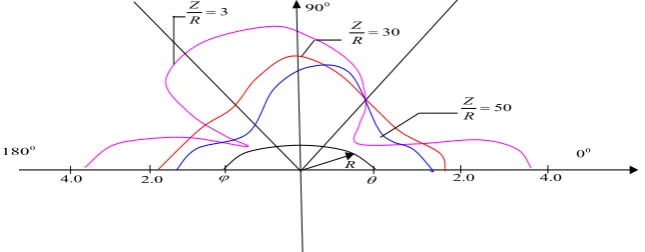
with cylindrical cavities is considered. Figure 2 shows the plot of the stress con-centration factor
N
r R
θθ
σ
∗= depending on θ at
0.048; 0.05; 0.1; 0.25; Z 3.0,30,50, 0.1
A R
R
β α ν α
= = = = = = .
Figure 2 shows that the influence of the proximity of the source lies in mov-ing the maximum value to the point where the line drawn from the source touches the boundary of the cavity.
For the stress concentration coefficients, we will use the absolute value of the complex value (21). Figure 3 shows the change
N
r R
θθ
σ
∗= depending on the wave number at different values Z 6.0;12;20
R= , which quickly aim for a
solu-tion for a plane wave when
α
R0.16. This means that when the source is at a distance of five radii from the cavity, the high frequency nature of the changeθθ
σ∗ can be approximated by a solution for a plane wave. Further, all values ap-proach the same asymptote. The largest difference between the solution for a plane wave ( Z→ ∞ ) and the solution under consideration is in the
0≤
α
R≤0.22. Легко видеть, что когда α →R 0, dynamic solution for thecase of a plane wave is reduced to a static value (ν =0.25,θ=π 2), i.e.
2.67 θθ
σ∗ = .
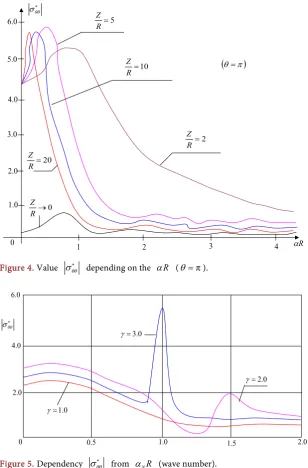
A similar but more pronounced change is noted for σθθ∗ at (
θ
=π) (Figure4). When
α
R≥1.0, solution for dynamic source with values Z 5.0;10;20R =
again reduced to a solution for a plane wave. When Z/R = 2 (Figure 3) the dy-namic concentration curve differs from static to 15%. When α =R 2.0 Static
DOI: 10.4236/am.2019.106033 481 Applied Mathematics
values strongly depend on the parameter 1 2
р
р
С С
γ = . And also there is a resonant
phenomenon. Calculation results n≥0 (v1=0.25) natural oscillations are
shown in Table 2. As the table shows, with the increase in the number of waves around the circumference, the corresponding complex frequencies increase.
The complex frequencies consist of two parts, the real (ReΩ) and imaginary
parts (ImΩ) which means natural frequencies and damping factors. Frequency
equations (23) depends only on the parameter ν (Poisson’s ratio). With
in-creasing Poisson’s ratio within 0≤ ≤
ν
0.4 real and imaginary parts of thecomplex frequency changes to 27%. With ν =1 0.5 the environment becomes
[image:14.595.207.536.290.717.2]incompressible, the attenuation is naturally absent. The existence of an imagi-nary value of the natural frequency means that the oscillatory processes in the system are only damped. The imaginary natural frequencies turn out to depend on the longitudinal and transverse speeds, as well as the whole radius.
Figure 2. Effect of source proximity on voltages σθθ
∗
depending on the θ α
(
R=0.1)
at different values of Z 3;30;50.
R=
Figure 3. σθθ∗ depending on the αR (wave number) when θ =90 ; A=0.048;
0.1; 0.5.
α= β=
0 . 4
0 0 0
90
R
0 . 4 0
. 2
θ ϕ
0 . 2
3 =
R Z
30 =
R Z
50
=
R Z
0
180
∗ θθ
σ
5 . 0
2 1
4
5 . 2
2
5 . 1
R α
8 6
4 2 =
R Z
5 =
R Z
10 =
R Z
∞ →
R Z/
r
θ
0
r
θ
R
0
z
0 90
[image:14.595.213.536.300.426.2]DOI: 10.4236/am.2019.106033 482 Applied Mathematics Figure 4. Value σθθ
∗
[image:15.595.220.529.72.541.2]depending on the αR (θ=π).
Figure 5. Dependency σθθ∗ from αNR (wave number).
The existence of a discrete frequency plays an important role for the calculation of underground pipelines located in the ground environment.
The obtained numerical results are presented in the form of tables and figures. The appearance of an additional free surface mainly thickens and reduces the Ei-genvalue frequency by 10% - 16%. The existence of a natural frequency means that Rayleigh waves can occur in the vicinity of the free surface of a cylindrical hole. Thus, according to (28) with Е Е
(
1 E0)
→1 the real part of the complex frequency does not exist.As we see,
(
E E1 o)
≥0.21 the real parts of the natural frequency vanish, andthe behavior of the imaginary parts remains unchanged. The obtained numerical results are confirmed by the condition (25).
0 . 3
0 . 4
0 . 5
0 . 6
1 2
0 . 2
0 . 1
0 3 4 αR
∗ θθ
σ
20
=
R Z
0
→
R Z
10
=
R Z
5
=
R Z
2
=
R Z
(
θ=π)
0 0.5 1.0 1.5 2.0
0 . 2 0 . 4
0 . 6
∗
θθ
σ
0 . 2
=
γ
0 . 3
=
γ
0 . 1
=
DOI: 10.4236/am.2019.106033 483 Applied Mathematics
5. Conclusions
1) The task of diffraction of harmonic waves in a cylindrical body is solved in displacement potentials. Displacement potentials are determined from solutions of the Helmholtz equation. Arbitrary constants are determined from the boun-dary conditions that are put between the bodies. As a result, the task is reduced to a system of inhomogeneous algebraic equations with complex coefficients, which are solved by the Gauss method with the selection of the main element.
2) Contour stresses σθθ on the free surface of cylindrical bodies reach their
maximum value in π
2—when exposed to longitudinal waves, and π
4 —shear
waves. Contour stresses σθθ when subjected to transverse harmonic waves, are 15%
- 20% more than those when subjected to longitudinal waves.
3) When the source of harmonic waves is at a distance of five radii (Z>5R)
from a cylindrical body, the high-frequency nature of changes in loop stresses σθθ
(on the inner free surface), is well approximated by the solution for a flat (Z → ∞) waves. Further, all values approach the same asymptote.
4) Numerical results show that the dynamic stress concentration factors near cylindrical bodies depend on the distance between the source and the body, the wave number for the cylinder and the medium; physico-mechanical parameters of the environment and the body.
5) Consideration of the viscous properties of the material of the environment when calculating the effect of seismic waves reduces stress and displacement by 10% - 15%. Calculations show that for fixed values of the amplitudes and the duration of the incident wave with increasing acoustic parameters of the fluid, the deflections and efforts also moderately increase. In the region of the long waves, the stress distribution of a pipe with and without liquid differs by up to 15%, and in the region of short waves, in some values of frequency, they differ by up to 40%. With a hole with a lining, the stress in the soil will be less than for the case of a hole without reinforcement. On the other hand, the amplification will be subjected to stresses from seismic loads and must withstand them.
6) The statement of the problem is proposed: natural oscillations of cylindrical bodies being in a deformable medium. The task is to find those Ω = Ω + ΩR i i
(ΩR—real and Ωi—imaginary parts of complex eigenfrequencies), in which
the system of equations of motion and shortened radiation conditions have a nonzero solution in the class of infinitely differentiable functions. It is shown that the task has a discrete spectrum.
Conflicts of Interest
The authors declare no conflicts of interest regarding the publication of this pa-per.
References
DOI: 10.4236/am.2019.106033 484 Applied Mathematics [2] Safarov, I.I. and Umarov, A.O. (2014) The Impact of Longitudinal and Transverse
Waves on Cylindrical Layers with a Liquid. Perm University Bulletin. Mathematics. Mechanics. Informatics, 3, 69-75.
[3] Safarov, I.I., Akhmedov, M.Sh. and Umarov, A.O. (2014) Dynamic Stresses and Mixing near a Cylindrical Reinforced Cavity from a Plane Harmonic Wave. Journal
“Prospero” (Novosibirsk), 3, 57-61.
[4] Safarov, I.I., Teshaev, M.Kh. and Boltaev, Z.I. (2017) Distribution of Harmonic Waves in Expansion Plastic and Cylindrical Viscoelastic Bodies. Open Science Pub-lishing, Raleigh, 218 p.
[5] Strelchuk, N.A., Slavin, O.K. and Shaposhnikov, V.N. (1971) Investigation of the Dynamic Stress State of Tunnel Lining under the Influence of Blast Waves. Building and Architecture, Moscow, No. 9, 129-136.
[6] Rashidov, T.R., Hozhimatov, G.Kh. and Mardonov, B.M. (1975) Oscillations of Structures Interacting with the Ground. Fan, Tashkent, 174 p.
[7] Rashidov, T.R., Sagdiev, H. and Safarov, I.I. (1989) On Two Main Methods for Studying the Seismic Stress State of Underground Structures under the Action of Seismic Waves. Reports of the Academy of Sciences, Tashkent, 6, 13-17.
[8] Muborakov, Ya.N. (1987) Seismic Dynamics of Underground Structures of the Shell Type. Fan, Tashkent, 192 p.
[9] Rashidov, T.R. (1973) Dynamic Theory of Seismic Resistance of Complex Systems of Underground Structures. Fan, Tashkent, 182 p.
[10] Rashidov, T.R., Dorman, I.Ya. and Ishanhodzhaev, A.A. (1975) The Seismic Resis-tance of Tunnel Structures of the Metro. Transport, M., 120 p.
[11] Muborakov, Ya.N. and Safarov, I.I. (1990) On the Basic Methods of Studying the Stress-Strain State of Underground Cylindrical Structures When Interacting with Elastic Waves. Collection: Durability of Engineering Structures under Seismic and Pulse Effects. Fan, Tashkent.
[12] Muborakov, Ya.N. and Safarov, I.I. (1988) Assessment of the Seismic State of Un-derground Structures by the Method of Wave Dynamics. In: Seismodynamics of Buildings and Structures, Fan, Tashkent, 114-122.
[13] Koltunov, M.A. (1976) Creep and Relaxation. Higher School, M., 277 p.
[14] Safarov, I.I. (1992) Collisions and Waves in Dissipatively Non-Fertile Environments and Constructions. Fan, Toshkent, 250 p.
[15] Mun, P. (1962) The Influence of the Curvature of Spherical Waves on the Concen-tration of Dynamic Stresses. Applied Mechanics, 2, 93.
[16] Mente, M. (1963) Dynamic Stresses and Displacement in the Vicinity of a Cylin-drical Discontinuity Surface from a Plane Harmonic Shear Wave. Applied Mechan-ics, 30, 117-126.
[17] Ilyushin, A.A., Rashidov, T.R., et al. (1985) The Effect of Seismic Waves on Under-ground Pipelines. Proceedings of the International Scientific Conference: Friction,
Wear and Lubricants, Tashkent, 22-26 May 1985, 128-132.
[18] Gorshkov, A.G. (1981) Non-Stationary Interaction of Plates and Shells with Conti-nuous Media. RHDL Proceedings of the Academy of Sciences. Fur. Solids, No. 4, 177-189.
[19] Avliyakulov, N.N. and Safarov, I.I. (2007) Modern Problems of Statics and Dynam-ics of Underground Pipelines. Fan, Tashkent, 306 p.