A k-CONNECTED MATROID
NICK BRETTELL AND CHARLES SEMPLE
Dedicated to James Oxley on the occasion of his 60th birthday
Abstract. For a k-connected matroidM, Clark and Whittle showed there is a tree that displays, up to a natural equivalence, all non-trivial
k-separations of M. In this paper, we present an algorithm for con-structing such a tree, and prove that, provided the rank of any subset of
E(M) can be found in constant time, the algorithm runs in polynomial time in|E(M)|.
1. Introduction
Oxley et al. [10] showed that every 3-connected matroid M with at least nine elements has a 3-tree: a tree decomposition that displays, up to a natu-ral equivalence, all non-sequential 3-separations of M. The approach taken in the proof of this result does not appear to elicit an efficient algorithm for finding such a 3-tree. However, by taking a different approach, and thereby reproving the result, Oxley and Semple [9] presented such an algorithm. Provided the rank of a subset of E(M) can be found in constant time, this algorithm finds a 3-tree for M with running time polynomial in the size of E(M).
Clark and Whittle [4] generalised the main result of [10], showing that every tangle of orderk in a connectivity system that satisfies a certain “ro-bustness” property has a tree decomposition, called ak-tree, that displays, up to equivalence, all the non-sequential k-separations of the connectivity system with respect to the tangle. In particular, this result specialises to k-connected matroids as follows:
Theorem 1.1. LetM be ak-connected matroid, wherek≥3and|E(M)| ≥
8k−15. Then there is a k-treeT for M such that every non-sequential k -separation of M is equivalent to a k-separation displayed byT.
Date: June 18, 2014.
1991Mathematics Subject Classification. 05B35.
Key words and phrases. k-connected matroid; Tree decomposition; k-tree; k -separation.
The first author was supported by a University of Canterbury Doctoral Scholarship and the second author was supported by the New Zealand Marsden Fund.
As with the case wherek= 3, although Theorem 1.1 ensures the existence of a k-tree forM, it does not guarantee the existence of a polynomial-time algorithm for finding such a tree. In this paper, we present an algorithm for finding a k-tree for M. The main result of the paper establishes that the algorithm indeed outputs ak-tree, thereby giving an independent proof of Theorem 1.1, and that it runs in time polynomial in the size of E(M) provided the rank of any subset ofE(M) can be found in constant time. Our overall approach is similar to [9]; however, there are a number of additional hurdles to overcome whenk≥4.
The paper is structured as follows. In the next section, we formally state the main result; to do so requires a review of connectivity and flowers in the setting ofk-connected matroids. Section 3 contains a number of preliminary results concerning k-connectivity, k-flowers, and k-paths, where the latter are a generalisation of 3-paths introduced in [9]. Throughout the algorithm, we repeatedly attempt to find non-sequentialk-separations where each side of the separation contains certain subsets; in Section 4, we show how to find such k-separations in polynomial time. In Section 5, we discuss one key situation that arises only when k ≥ 4. Section 6 contains a formal description of the algorithm; while in Section 7, we prove its correctness and that it runs in polynomial time. Finally, in Section 8, we review why the condition that the ground set have at least 8k−15 elements is necessary, and why a polynomial-time algorithm is not forthcoming from the proof of Theorem 1.1 in [4].
The notation and terminology in the paper follows Oxley [8]. Throughout, we assume that the matroid M for which we wish to construct a k-tree is specified by a rank oracle, that is, a subroutine that, given a subset X ⊆
E(M), returns the rank ofX in unit time. A number of results in the paper are generalisations of results in [9]. When the proofs can be obtained by making routine modifications, for example, essentially just replacing each “3” with “k”, we have omitted the details assuming the reader has access to [9].
2. Main Result
k-connectivity. LetM be a matroid with ground setE. Theconnectivity function of M, denoted byλM, is defined on all subsets X of E by
λM(X) =r(X) +r(E−X)−r(M).
A subsetX or a partition (X, E−X) ofE isk-separatingifλM(X)≤k−1.
A k-separating partition (X, E−X) is a k-separation of M if|X| ≥k and
|E−X| ≥k. Ak-separating setX, a k-separating partition (X, E−X) or a k-separation (X, E−X) is exact if λM(X) = k−1. The matroid M is
k-connected if, for all j < k, it has noj-separations.
k−2, for all i ∈ {1,2, . . . , m}, and X ∪(Sj
i=1Xi) is k-separating, for all
j ∈ {1,2, . . . , m}. A partial k-sequence (Xi)mi=1 for X is maximal if, for
every partialk-sequence (Xi0)mi=10 forX, we have Sm0
i=1X
0
i ⊆
Sm
i=1Xi.
Let (Xi)mi=1 be a maximal partialk-sequence for the exactly k-separating
setX. We define thefullk-closure ofX, denoted fclk(X), to beX∪Smi=1Xi.
For readers familiar with [4], note that this operator is a specialisation of the fclT operator used in that paper, where T is the unique “tangle” for a k-connected matroid. The fclk operator is a well-defined closure operator on
the set of exactlyk-separating subsets ofE[4, Lemma 3.3]. Whenk= 3, the operator is equivalent to the full closure operator for 3-connected matroids (as given in [10], for example) and, whenk= 4, it is equivalent to the full 2-span operator of [2]. It is important to note that the full k-closure operator is only well-defined on exactly k-separating sets; that is, k-separating sets with at least k−1 elements, but no more than|E| −(k−1) elements.
An exactlyk-separating set X is k-sequential if fclk(E−X) =E;
other-wise, it isnot k-sequential. When there is no ambiguity, we just say thatX is sequential or non-sequential, respectively. An exact k-separation (X, Y) isk-sequential ifXorY isk-sequential; otherwise, whenX andY are non-sequential, we say that (X, Y) is non-sequential. When X is k-sequential and (X1, X2, . . . , Xm) is a maximal partial k-sequence for E −X, we say
that (Xm, Xm−1, . . . , X1) is a k-sequential ordering of X.
Let (A1, B1) and (A2, B2) be k-separations of M; then (A1, B1) is k -equivalent to (A2, B2) if {fclk(A1),fclk(B1)}={fclk(A2),fclk(B2)}.
k-flowers. The crossingk-separations of ak-connected matroidM are rep-resented by thek-flowers of M.
Let M be a k-connected matroid for some k ≥ 3 with ground set E. For n > 1, a partition (P1, P2, . . . , Pn) of E is a k-flower with petals
P1, P2, . . . , Pn if each Pi is exactly k-separating, and each Pi ∪Pi+1 is
k-separating, where subscripts are interpreted modulon. We also view (E) as a k-flower with a single petal E; we call this k-flower trivial. In what fol-lows, for a flower (P1, P2, . . . , Pn), the subscripts will always be interpreted
modulo n. A k-flower Φ displays a k-separating set X or a k-separation (X, Y) if X is a union of petals of Φ. Let Φ1 and Φ2 be k-flowers. Then
Φ14Φ2if every non-sequentialk-separation displayed by Φ1 isk-equivalent
to a k-separation displayed by Φ2. We say that Φ1 and Φ2 arek-equivalent
if Φ1 4Φ2 and Φ2 4Φ1. Theorder of ak-flower Φ is the minimum number
of petals in ak-flower k-equivalent to Φ.
Let Φ = (P1, P2, . . . , Pn) be a k-flower of M. The k-flower Φ is a k -anemone if S
s∈SPs is k-separating for every subset S of {1,2, . . . , n};
whereas Φ is a k-daisy if Pi ∪ Pi+1 ∪ · · · ∪ Pi+j is k-separating for all
An element e∈ E is loose if e∈fclk(Pi)−Pi for some i∈ {1,2, . . . , n},
otherwise e is tight. A petal Pi, for somei∈ {1,2, . . . , n}, isloose if every
e ∈ Pi is loose; otherwise, Pi is tight. A flower of order at least three is tight if all its petals are tight; while a flower of order one or two is tight
if it has one or two petals, respectively. A k-daisy Φ is irredundant if, for all i∈ {1,2, . . . , n}, there is a non-sequential k-separation (X, Y) displayed by Φ with Pi ⊆ X and Pi+1 ⊆ Y. A k-anemone Φ is irredundant if, for
all distincti, j ∈ {1,2, . . . , n}, there is a non-sequentialk-separation (X, Y) displayed by Φ with Pi ⊆ X and Pj ⊆ Y. Note that a tight 3-flower is
always irredundant, but this does not necessarily hold for tight k-flowers wherek≥4 [2, Example 3.14]. As the purpose of ak-tree is to describe the non-sequentialk-separations of a matroid, it is most efficient to do so using irredundant flowers.
This definition of an irredundant k-flower Φ is stronger than that given in [2] when Φ is a k-anemone. The stronger definition ensures that for a tight irredundant k-anemone Φ with n petals, the order of Φ is n. This is illustrated by considering the 4-anemone (P1, P2, P4, P3) as described in
[2, Example 3.14], but with the last two petals interchanged; this 4-flower is “irredundant” as defined in [2], but (P1, P2∪P3, P4) is an equivalent 4-flower
with fewer petals. Our terminology also differs from [4], where a k-flower in the unique tangle T for M is called S-tight, where S is the set of all non-sequential k-separations of M, if no k-flower displaying the same k-separations contained inS has fewer petals. Thus, such anS-tightk-flower must be not only tight, as defined here, but also irredundant.
k-trees. Let π be a partition of a finite set E. Let T be a tree such that every member of π labels exactly one vertex of T; some vertices may be unlabelled but no vertex is multiply labelled. We say thatT is aπ-labelled tree; labelled vertices are called bag vertices and members of π are called
bags. If B is a bag vertex of T, then π(B) denotes the subset of E that labels it. If the degree ofB is at most one, thenB is a terminalbag vertex; otherwise B isnon-terminal.
Let G be a subgraph of T with components G1, G2, . . . , Gm. Let Xi be
the union of those bags that label vertices of Gi. Then the subsets of E displayed by G are X1, X2, . . . , Xm. In particular, if V(G) = V(T), then {X1, X2, . . . , Xm}is the partition of E displayed by G. Let ebe an edge of
T. The partition of E displayed by e is the partition displayed by T\e. If e = v1v2 for vertices v1 and v2, then (Y1, Y2) is the (ordered) partition of
E(M) displayed by v1v2 ifY1 is the union of the bags in the component of
is taken to represent the corresponding cyclic ordering on the members of the partition displayed by v.
LetM be ak-connected matroid with ground setE. LetT be aπ-labelled k-tree forM, whereπ is a partition ofE such that:
(F1) For each edge e of T, the partition (X, Y) of E displayed by e is k-separating, and, ifeis incident with two bag vertices, then (X, Y) is a non-sequentialk-separation.
(F2) Every non-bag vertex v is labelled eitherD orA; ifv is labelledD, then there is a cyclic ordering on the edges incident withv.
(F3) If a vertex v is labelledA, then the partition ofE displayed byv is ak-anemone of order at least three.
(F4) If a vertex v is labelled D, then the partition of E displayed by v, with the cyclic order induced by the cyclic ordering on the edges incident withv, is ak-daisy of order at least three.
A vertex of T is referred to as a daisy vertex or an anemone vertexif it is labelled D or A, respectively. A vertex labelled either D or A is a flower vertex. By conditions (F3) and (F4), the partition displayed by a flower vertex v is a k-flower Φ ofM; we say that Φ is the flower corresponding to
v, and the k-separations displayed by Φ are thek-separations displayed by
v. Ak-separation is displayed by T if it is displayed by some edge or some flower vertex of T. A k-separation (R, G) of M conforms with T if either (R, G) is equivalent to a k-separation that is displayed by a flower vertex or an edge of T, or (R, G) is equivalent to a k-separation (R0, G0) with the property that either R0 orG0 is contained in a bag ofT.
Aπ-labelledk-treeT forM satisfying (F1)–(F4) is aconformingk-treefor M if every non-sequentialk-separation ofM conforms withT. A conforming k-treeT is a partialk-treeif, for every flower vertexv ofT, the partition of E displayed by v is a tight maximalk-flower of M.
We now define a quasi order on the set of partial k-trees for M. Let T1
and T2 be partial k-trees for M. Define T1 4T2 if every non-sequential
k-separation displayed by T1 is equivalent to one displayed by T2. If T1 4T2
and T2 4 T1, then T1 and T2 are equivalent partial k-trees. A partial
k-tree is maximal if it is maximal with respect to this quasi order. We call a maximal partial k-tree ak-tree.
We can now state the main result of the paper.
Theorem 2.1. Let M be a k-connected matroid specified by a rank oracle, where |E(M)| ≥ 8k−15. Then there is a polynomial-time algorithm for finding a k-tree forM.
3. Preliminaries
Lemma 3.1. Let M be a k-connected matroid, and let X and Y be k -separating subsets of E(M).
(i) If |X∩Y| ≥k−1, then X∪Y is k-separating.
(ii) If |E(M)−(X∪Y)| ≥k−1, then X∩Y is k-separating.
When an application of Lemma 3.1 is used in subsequent proofs, we refer to it as “by uncrossing”.
The following results note some elementary properties of k-sequential k-separating sets. The first is a generalisation of [11, Lemma 2.7] and [2, Lemma 2.6]. The proofs of the subsequent corollaries are straightforward.
Lemma 3.2. In ak-connected matroidM, let XandY bek-separating sets such that |E(M)−X| ≥k−1 and Y ⊆X. If X is k-sequential, then so is
Y.
Proof. Take a k-sequential ordering (X1, X2, . . . , Xt) of X. Then, by
un-crossing, for all i ∈ {1,2, . . . , t}, the set Y ∩(X1 ∪X2 ∪ · · · ∪Xi) is
k-separating.
Corollary 3.3. Let (X, Y) be a k-separation in a k-connected matroid M
and let Y0 be a non-sequential k-separating set in M. If Y0 ⊆Y, thenY is non-sequential.
Corollary 3.4. LetM be ak-connected matroid, and let F be the collection of maximalk-sequential k-separating sets ofM. Then, ak-separating set X
is notk-sequential if and only if no member of F contains X.
The next lemma generalises a well-known property of non-sequential 3-separating sets (see, for example, [10, Lemma 3.4(i)]).
Lemma 3.5. Let (X, Y) be exactly k-separating in a k-connected matroid
M. If(X, Y) is not k-sequential, then|X|,|Y| ≥2k−2.
Proof. Suppose that|X| ≤2k−3. Clearly,|X| ≥k−1. Any (k−1)-element subsetX1 ofX is triviallyk-separating. Therefore, as|X−X1| ≤k−2, we
have fclk(E(M)−X) = fclk(E(M)−X1) =E(M); a contradiction.
An ordered partition (Z1, Z2, . . . , Zt) of E(M) is a k-sequence if, for all
i∈ {1,2, . . . , t−1}, the set Si
j=1Zj is k-separating.
Lemma 3.6. Let U and Y be disjoint subsets of the ground set E of a
k-connected matroid M. Suppose that U and U ∪Y are k-separating and
Y ⊆fclk(U). If fclk(U)=6 E, then there is a partition (Y1, Y2, . . . , Ys) of Y such that1≤ |Yi| ≤k−2for eachi∈ {1,2, . . . , s}and(U, Y1, Y2, . . . , Ys, E−
(U ∪Y))is a k-sequence.
Proof. Let (U1, U2, . . . , Ul) be a partition of fclk(U)−U such that, for all
i∈ {1,2, . . . , l}, we have 1≤ |Ui| ≤ k−2 and U ∪U1∪U2∪ · · · ∪Ui is
k-separating. Let (Y1, Y2, . . . , Ys) be the partition of the elements ofY induced
2k−2 by Lemma 3.5. So, by uncrossing U ∪Y and U ∪U1∪U2∪ · · · ∪Ui
for i ∈ {1,2, . . . , l}, we deduce that U ∪Y1∪Y2 ∪ · · · ∪Yj is k-separating
for all j in {1,2, . . . , s}. In particular, (U, Y1, Y2, . . . , Ys, E−(U ∪Y)) is a
k-sequence.
The following corollary is a straightforward consequence of Lemma 3.6, where (ii) follows by [4, Lemma 3.7].
Corollary 3.7. Let U and Y be disjoint subsets of the ground set E of a
k-connected matroid M. Suppose that U and U ∪Y are k-separating and
Y ⊆fclk(U). If fclk(U)6=E, then
(i) Y ⊆fclk(E−(U∪Y)), and
(ii) (U, E−U) is k-equivalent to (U ∪Y, E−(U ∪Y)).
k-flowers. The following lemma is a generalisation of [2, Lemma 3.4]. A partial k-sequence (Xi)mi=1 for X is fully refined if, for every partial
k-sequence (Xi0)mi=10 forX such thatSm0 i=1X
0
i =
Sm
i=1Xi, we have m≥m0.
Lemma 3.8. Let (P1, P2, . . . , Pn) be a tight k-flower Φ of order at least three in a k-connected matroid M. Let (Yi)mi=1 be a fully refined partial k -sequence ofP1∪P2∪ · · · ∪Pj, where j≤n−2. Letd be the largest member of {1,2, . . . , m} such that, for all i ∈ {1,2, . . . , d}, the set Yi is contained in one of Pj+1, Pj+2, . . . , Pn, or set d= 0 if there is no such member. Let
Y0 =Y1∪Y2∪ · · · ∪Yd.
(i) If d < m, then
(a) j =n−2;
(b) Yd+1 meets both Pn−1 andPn;
(c) each of Pn−1−(Y0∪Yd+1) andPn−(Y0∪Yd+1) has between 2 and k−2 elements;
(d) each of Pn−1−Y0 and Pn−Y0 has between k−1 and 2k−5 elements; and
(e) fclk(P1∪P2∪ · · · ∪Pj) =E(M).
(ii) When i≤d,
(a) if Yi is contained inPn, then Yi ⊆fclk(P1)−P1; and
(b) if Yi is not contained inPn, then Yi ⊆fclk(Pj)−Pj.
(iii) Thek-flower Φ isk-equivalent to
(P1∪(Y0∩Pn), P2, . . . , Pj−1, Pj∪(Y0−Pn), Pj+1−Y0, . . . , Pn−Y0). Proof. Cases (ii) and (iii) can be established by a routine upgrade of the proof of [2, Lemma 3.4(ii) and (iii)]. To prove (i), let Φ0 = (P10, P20, . . . , Pn0)
= (P1∪(Y0∩Pn), P2, . . . , Pj−1, Pj∪(Y0−Pn), Pj+1−Y0, . . . , Pn−Y0).
Recall that Yd+1 is not contained in any of Pj+1, Pj+2, . . . , Pn. Let s ∈ {j+ 1, j+ 2, . . . , n} be the minimum index such that Yd+1 meets Ps0. The
setsP10∪P20∪ · · · ∪Pj0∪Yd+1 andP10∪P20∪ · · · ∪Ps0 arek-separating. If their
union avoids at leastk−1 elements, then, by uncrossing,P10∪P20∪ · · · ∪Pj0∪
Yd+1, contradicting that the partialk-sequence is fully refined. Thus we may
assume that |(Ps+10 ∪Ps+20 ∪ · · · ∪Pn0)−Yd+1| ≤k−2. Since|Yd+1| ≤k−2
and Ps0 ∩Yd+1 6=∅, it follows that |
Sn
i=s+1P
0
i| ≤2k−5. But |P
0
i| ≥k−1
for alli∈ {1,2, . . . , n}, since Φ is tight. Thuss+ 1 =n, the setYd+1 meets
Pn0, andk−1≤ |Pn0| ≤2k−5. Likewise, by uncrossing (Sj
i=1Pi0)∪Yd+1 and
(Sj
i=1Pi0)∪Pn0, we deduce that|(
Sn−1
i=j+1Pi0)−Yd+1| ≤k−2, thuss=j+ 1
and k−1≤ |Ps0| ≤2k−5. Hencej =n−2 and, since|Pn0 −Yd+1|,|Pn0−1−
Yd+1|,|Yd+1| ≤ k−2, it follows that |(Pn0 ∪Pn0−1)−Yd+1| ≤ 2k−4. Thus
thek-separating set (Pn0−1∪Pn0)−Yd+1 isk-sequential, by Lemma 3.5. We
deduce that fclk(P1∪P2∪ · · · ∪Pj) =E(M). Thus (i) holds.
We now give three corollaries of the previous lemma. The first is analo-gous to [9, Lemma 3.4(i)], which concerns only 3-flowers. The requirement that fclk(P1∪P2∪ · · · ∪Pj)6=E(M), not present in thek= 3 case, is
neces-sary, as will become evident in Example 5.3. Corollary 3.10 generalises the corresponding results for k= 3 [10, Corollary 5.10] andk= 4 [2, Corollary 3.15]. Corollary 3.11 is a straightforward generalisation of [9, Corollary 3.5] that follows from Corollaries 3.9 and 3.10.
Corollary 3.9. Let(P1, P2, . . . , Pn)be a tightk-flower of order at least three in a k-connected matroid M. If1≤j ≤n−2 andfclk(P1∪P2∪ · · · ∪Pj)6=
E(M), then
fclk(P1∪P2∪ · · · ∪Pj)−(P1∪P2∪ · · · ∪Pj)⊆(fclk(P1)−P1)∪(fclk(Pj)−Pj), and every element of (fclk(P1)−P1)∪(fclk(Pj)−Pj) is loose.
Corollary 3.10. Let Φ = (P1, P2, . . . , Pn) be a tight irredundant k-flower. Then the order of Φ isn.
Proof. By definition, the order of Φ is at mostn. Towards a contradiction, suppose Φ0 is a k-flower with n0 petals, where n0 < n, that is k-equivalent to Φ. Without loss of generality, we may assume that Φ0 is tight. Ifn0 = 1, then Φ displays no non-sequentialk-separations, and it follows that Φ is not tight; a contradiction. Thusn0 ≥2.
Let (U1, V1) be a non-sequential k-separation displayed by Φ. Then Φ0
displays a k-separation (U10, V10) with fclk(U1) = fclk(U10) and fclk(V1) =
fclk(V10). Since Φ0 has fewer petals than Φ, we may assume, without loss of
generality, thatU1 is the union of p1 petals of Φ, andU10 is the union of p01
petals of Φ0, wherep01 < p1. Suppose there is a petalP1 of Φ contained inU1
for which (U1−P1, V1∪P1) is a non-sequentialk-separation. Thek-flower Φ0
displays an equivalent k-separation (U20, V20), with fclk(U1−P1) = fclk(U20)
and fclk(V1 ∪ P1) = fclk(V20), where U20 is the union of p02 petals of Φ0.
Since Φ is tight, it follows, by Corollary 3.9, that P1 * fclk(V1). Thus
fclk(V10) = fclk(V1) $ fclk(V1 ∪P1) = fclk(V20). If there is a petal P0 of Φ0
contained in V10 −V20, then P0 ⊆ fclk(V20)−V20. As fclk(V20) 6= E(M), the
it follows that U20 is the union of at most p01 −1 petals; that is, p02 < p01. Let (U2, V2) = (U1−P1, V1∪P1). If there is a petal P2 contained in U2 for
which (U2−P2, V2∪P2) is a non-sequentialk-separation, then we can repeat
this process until, for some i < n, we obtain a non-sequential k-separation (Ui, Vi) where for each petalPi of Φ contained in Ui, if (Ui−Pi, Vi∪Pi) is
a k-separation, then it isk-sequential. We relabel this k-separation (U, V). Observe that Φ0 displays a k-separation (U0, V0), with fclk(U) = fclk(U0)
and fclk(V) = fclk(V0), such thatU0 is the union ofp0 petals of Φ0, andU is
the union ofp petals of Φ, with p0< p.
Suppose that p0 ≥ 2, so p ≥ 3. Pick distinct petals Pa, Pb, and Pc of
Φ contained in U. Since Φ is irredundant, there exists a non-sequential k-separation (A, B) displayed by Φ such that Pa ⊆ A and Pb ⊆B. Without
loss of generality, we may assume that Pc ⊆ B. The k-flower Φ0 displays
a k-separation (A0, B0) equivalent to (A, B). We now consider petals of Φ0 contained inU0. For any such petalPa0 contained inA0, we have Pa0 ∩(Pb∪
Pc)⊆fclk(A)−A, and these elements are loose in Φ by Corollary 3.9. As Φ
is irredundant, there exists a non-sequentialk-separation (B2, C2) displayed
by Φ such that Pb ⊆ B2 and Pc ⊆ C2, with an equivalent k-separation
(B20, C20) displayed by Φ0. SincePb $U and (B2, C2) is non-sequential,B2
contains a petal of Φ other than Pb. Likewise, C2 contains a petal other
than Pc. Let Pb0 be a petal of Φ0 contained in B0 and U0. If Pb0 ⊆C20, then
Pb0∩Pb ⊆fclk(C2)−C2, and these elements are loose in Φ by Corollary 3.9.
Otherwise, Pb0 ⊆ B02, in which case Pb0 ∩Pc ⊆ fclk(B2)−B2, and, again,
these elements are loose by Corollary 3.9. We deduce that all the elements of U0 ∩(Pb ∪Pc) are loose in Φ. If V0 is a single petal of Φ0, then the
only non-sequential k-separation displayed by Φ0 is (U0, V0), in which case (A0, B0) is an equivalentk-separation, contradicting the fact that Φ0 is tight. Thus, by Corollary 3.9, the elements of fclk(U0)−U0 are loose, soPb andPc
are loose; a contradiction.
We may now assume that p0 = 1. Let Px and Py be distinct petals of Φ
contained in U such that Px∪Py is k-separating. Since Φ is irredundant,
there exists a non-sequential k-separation (X, Y) displayed by Φ such that Px ⊆ X and Py ⊆ Y. The k-flower Φ0 displays an equivalent k-separation
(X0, Y0) for which, without loss of generality, the petal U0 is contained in X0. Thus fclk(Px∪Py)⊆fclk(U0)⊆fclk(X0) = fclk(X). NowPy ⊆fclk(Px∪
Py)⊆fclk(X), andPy ⊆Y, soPy ⊆fclk(X)−X. SinceY is non-sequential,
it contains a petal of Φ other thanPy. Thus, by Corollary 3.9, Py is loose;
a contradiction. This completes the proof of the corollary.
Corollary 3.11. Let Φ be a tight irredundant flower in ak-connected ma-troidM and let(U, V)be a non-sequentialk-separation displayed byΦ. Then no petal of Φis in the full k-closure of both U andV.
Lemma 3.12. Let (P1, P2, . . . , Pn) be a k-flower in a k-connected matroid
M. If, for some i ∈ {1,2, . . . , n}, the petal Pi is loose, then either Pi ⊆
fclk(P1∪P2∪ · · · ∪Pi−1), or Pi ⊆fclk(Pi+1∪Pi+2∪ · · · ∪Pn).
Proof. LetPi− =P1∪P2∪ · · · ∪Pi−1 and Pi+ =Pi+1∪Pi+2∪ · · · ∪Pn. If
fclk(Pi+) = E(M), thenPi ⊆fclk(Pi+); so assume otherwise. Let A =Pi∩
fclk(Pi−) andB =Pi−fclk(Pi−). SincePiis loose,B ⊆fclk(Pi+). Then, there
exists a setB0containingBwhereB0∪Pi+isk-separating andB0 ⊆fclk(Pi+).
By Corollary 3.7(i), B0 ⊆fclk((Pi−∪Pi)−B0) ⊆fclk(Pi−∪A) ⊆fclk(Pi−).
Thus B ⊆ fclk(Pi−). We deduce that B = ∅, completing the proof of the
lemma.
Let Φ = (P1, P2, . . . , Pn) be ak-flower ofM. We can obtain a new flower
Φ0from Φ = (P1, P2, . . . , Pn) in the following way. Let Φ0 = (P10, P20, . . . , Pm0 ),
where there are indices 0 = j0 < j1 < · · · < jm = n such that Pi0 =
Pji−1+1∪ · · · ∪Pji for alli∈ {1,2, . . . , m}. Then we say that the flower Φ 0
is aconcatenation of Φ, and that Φrefines Φ0.
k-paths. Oxley and Semple [9] introduced the notion of a 3-path to facil-itate describing inequivalent non-sequential 3-separations. Here, we gener-alise this notion tok-paths.
LetM be ak-connected matroid with ground setE. Ak-path inM is an ordered partition (X1, X2, . . . , Xm) of E into non-empty sets, called parts,
such that
(i) Si j=1Xj,
Sm j=i+1Xj
is a non-sequential k-separation of M for all i∈ {1,2, . . . , m−1}; and
(ii) for alli∈ {2,3, . . . , m−1}, the setXi is not in the full k-closure of
eitherSi−1
j=1Xj orSmj=i+1Xj.
Condition (ii) is equivalent to the assertion that the non-sequential k-separations Si
j=1Xj,
Sm
j=i+1Xj
and Si+1
j=1Xj,
Sm
j=i+2Xj
are inequiv-alent for all i ∈ {1,2, . . . , m−2}. We say X1 and Xm are the end parts
of the k-path. For each i∈ {1,2, . . . , m}, we denote the sets Si−1
j=1Xj and
Sm
j=i+1Xj by X
−
i and X +
i , respectively. In particular,X
−
1 =∅=Xm+.
Ob-serve that each ofX1 andXm has at least 2k−2 elements, by Lemma 3.5, as
neither set is k-sequential, and each of X2, X3, . . . , Xm−1 has at least k−1
elements by (ii).
For a subsetX0 of E, an X0-rooted k-path is ak-path of the form (X0∪
X1, X2, . . . , Xm) whereX0∩X1 =∅.Thus ak-path is just a∅-rootedk-path.
An X0-rooted k-path ismaximal if
(I) none of the sets Xi with i ≥ 2 can be partitioned into sets
Xi,1, Xi,2, . . . , Xi,k for somek≥2 such that (X0∪X1, X2, . . . , Xi−1,
Xi,1, Xi,2, . . . , Xi,k, Xi+1, . . . , Xm) is a k-path; and
(II) X1cannot be partitioned into setsX1,1, X1,2, . . . , X1,kfor somek≥2
Observe that, in (II), the set X1,1 may be empty when X0 is non-empty
although all of X1,2, X1,3, . . . , X1,k must be non-empty. An X0-rooted
k-path is left-justified if, for all i ∈ {2,3, . . . , m}, no element of Xi is in the
full k-closure ofSi−1
j=0Xj.
In what follows, we shall frequently be referring to ak-separation (R, G) in ak-connected matroidM. In general, we shall view (R, G) as a colouring of the elements of E(M), the elements in R and G being colouredred and
green, respectively. A non-empty subset X of E(M) is bichromatic if it meets both R and G; otherwise it is monochromatic. We shall view the empty set as being monochromatic. A proof of the following lemma is given in [4, Lemma 3.7]. We make repeated use of this result in the subsequent lemmas.
Lemma 3.13. Let M be a k-connected matroid. If (R, G) is a non-sequential k-separation ofM and (R0, G0) is a k-separation of M such that
fclk(R0) = fclk(R) or fclk(R0) = fclk(G), then (R0, G0) is a non-sequential
k-separation of M that is k-equivalent to (R, G).
The following lemmas generalise the corresponding results for 3-paths [9, Lemmas 3.8–3.12, 3.14, and 3.15]. The majority of the proofs generalise in a straightforward manner and have been omitted. On the other hand, the proof for Lemma 3.16 is not a trivial upgrade, as [9, Lemma 3.10] relies properties specific to 3-sequences, and Lemma 3.21 is new.
Lemma 3.14. Let (X0 ∪X1, X2, . . . , Xm) be a left-justified maximal X0 -rooted k-path in a k-connected matroid M. Let (R, G) be a non-sequential
k-separation in M. If, for some i in {2,3, . . . , m−1}, both Xi− and Xi+
contain at least k−1 red and at least k−1 green elements, then Xi is monochromatic.
Lemma 3.15. Let (X1, X2, . . . , Xm) be a k-path in a k-connected matroid
M. LetX0 be a subset ofX1, and let(R, G)be a non-sequentialk-separation in M for which X0 is monochromatic and no equivalent k-separation in which X0 is monochromatic has fewer bichromatic parts. Suppose that, for some i in {1,2, . . . , m}, the set Xi is bichromatic. If, for some Z in {Xi−, Xi+}, there is at least one red element in Z, then there are at least
k−1 red elements inZ.
Lemma 3.16. Let (X0 ∪X1, X2, . . . , Xm) be a left-justified maximal X0 -rooted k-path in a k-connected matroid M. Let (R, G) be a non-sequential
k-separation in M for which X0 is monochromatic and no equivalent k -separation in which X0 is monochromatic has fewer bichromatic parts. Sup-pose, for some i∈ {2,3, . . . , m−1}, the setXi is bichromatic. Then either
Xi is not k-separating, or Xi−∪Xi+ is monochromatic.
Proof. Assume that Xi is k-separating and that Xi−∪Xi+ is bichromatic.
has at leastk−1 red elements; a contradiction. We deduce thatXi− orXi+ is green. Then, by Lemma 3.15, Xi+ or Xi−, respectively, contains at least k−1 red elements. IfXi contains at mostk−2 red elements, then, for some
Y in {Xi−∪Xi, Xi∪Xi+}, there are at most k−2 red elements contained
inY. By uncrossingY and G, we see that Y ∪G, which equalsXi∪G, is
k-separating, so Xi∩R can be recoloured green to produce a k-separation
equivalent to (R, G) with fewer bichromatic parts. ThusXicontains at least
k−1 red elements. SupposeXi contains at mostk−2 green elements. Now,
by uncrossing, Xi ∩R is k-separating, so Xi ∩G ⊆ fclk(Xi ∩R) as Xi is
k-separating. Since Xi ∪R is k-separating, by uncrossing, it follows that
we can recolour the elements in Xi∩Gred to obtain a k-separation that is
k-equivalent to (R, G) and which reduces the number of bichromatic parts; a contradiction. We conclude that bothXi∩R and Xi∩Gcontain at least
k−1 elements.
Recall that either Xi− or Xi+ is green. In the first case, by uncrossing Xi−∪Xi and G, we deduce that Xi−∪(Xi∩G) is k-separating. As (X0∪
X1, X2, . . . , Xi−1, Xi∩G, Xi∩R, Xi+1, . . . , Xm) is not ak-path, but (X0∪
X1, X2, . . . , Xm) is a left-justifiedk-path, it follows, by corollary 3.7(i), that
Xi∩R⊆fclk(Xi+) orXi∩R⊆fclk(Xi−∪(Xi∩G)). Again by Corollary 3.7(i),
Xi∩R ⊆ fclk(Xi−∪(Xi ∩G)) ⊆ fclk(G) in either case. Since Xi ∪G is
k-separating, Xi ∩R can be recoloured green to give a k-separation that
is equivalent to (R, G) but has fewer bichromatic parts; a contradiction. Similarly, if Xi+ is green, then (Xi∩G)∪Xi+ isk-separating by uncrossing
G and Xi ∪Xi+. As the original k-path is maximal and left-justified, it
follows, by Corollary 3.7(i), that Xi∩G⊆fclk(Xi+)⊆fclk(G−Xi), where
G−Xi isk-separating by uncrossingGandE(M)−Xi. It now follows that
the elements in Xi∩G can be recoloured red to give a k-separation that is
equivalent to (R, G) but has fewer bichromatic parts; a contradiction. This
completes the proof of the lemma.
Lemma 3.17. Let (X0 ∪X1, X2, . . . , Xm) be a left-justified maximal X0 -rooted k-path in a k-connected matroid M. Let (R, G) be a non-sequential
k-separation in M for which X0 is monochromatic and no equivalent k -separation in which X0 is monochromatic has fewer bichromatic parts. If, for some i in {2,3, . . . , m−1}, the set Xi− is monochromatic but Xi is bichromatic, then Xi−∪Xi+ is monochromatic.
Lemma 3.18. Let(Z0, Z1, Z2, . . . , Zm)be ak-path in ak-connected matroid
M wherem≥2. Let(R, G)be a non-sequentialk-separation ofM such that
(i) each of Z1, Z2, . . . , Zm−1 is monochromatic;
(ii) either
(a) Z0 is monochromatic but Z0∪Z1 is not, or
(b) Z0 is bichromatic and min{|Z0∩R|,|Z0∩G|} ≥k−1; and
(iii) either
(a) Zm is monochromatic but Zm−1∪Zm is not, or
Then M has a k-flower (Z0, Zi,1, Zi,2, . . . , Zi,s, Zm, Zj,t, Zj,t−1, . . . , Zj,1) where
(I) bothZi,1∪Zi,2∪ · · · ∪Zi,s andZj,t∪Zj,t−1∪ · · · ∪Zj,1 are monochro-matic;
(II) each of(Zi,1, Zi,2, . . . , Zi,s) and (Zj,1, Zj,2, . . . , Zj,t) is a subsequence of (Z1, Z2, . . . , Zm−1); and
(III) {Z1, Z2, . . . , Zm−1}={Zi,1, Zi,2, . . . , Zi,s} ∪ {Zj,1, Zj,2, . . . , Zj,t}. Moreover, when Z0 is bichromatic, this k-flower can be refined so that (Z00, Z000, Zi,1, Zi,2, . . . , Zi,s, Zm, Zj,t, Zj,t−1, . . . , Zj,1) is a k-flower where {Z00, Z000} = {Z0 ∩R, Z0 ∩G} and Z000 ∪Zi,1 and Z00 ∪Zj,1 are monochro-matic. When Zm is also bichromatic, this k-flower can be refined so that
(Z00, Z000, Zi,1, Zi,2, . . . , Zi,s, Zm0 , Zm00, Zj,t, Zj,t−1, . . . , Zj,1) is a k-flower where {Zm0 , Zm00}={Zm∩R, Zm∩G} and Zi,s∪Zm0 and Zm00 ∪Zj,t are monochro-matic.
Lemma 3.19. Let (X0 ∪X1, X2, . . . , Xm) be a left-justified maximal X0 -rooted k-path in a k-connected matroid M. Let (R, G) be a non-sequential
k-separation in M for which X0 is monochromatic and no equivalent k -separation in which X0 is monochromatic has fewer bichromatic parts. Sup-pose that{2,3, . . . , m−1} contains an element j such that Xj and Xj− are bichromatic, butXj+is red. Then R∩Xj ⊆fclk(Xj+). Furthermore, there is ak-separation(R0, G0)equivalent to(R, G)such thatR0∩Xj =Xj∩fclk(Xj+) while, for alli6=j, the setR0∩Xi=R∩Xi andG0∩Xi =G∩Xi.
Lemma 3.20. Let (X0 ∪X1, X2, . . . , Xm) be a left-justified maximal X0 -rooted k-path in a k-connected matroid M. Let (R, G) be a non-sequential
k-separation in M for which X0 is monochromatic and no equivalent k -separation in which X0 is monochromatic has fewer bichromatic parts. Sup-pose that m≥2, and that Xm and Xm− are bichromatic. Then both R∩Xm and G∩Xm are sequential k-separating sets.
Lemma 3.21. Let (X1, X2) be a left-justified maximal k-path in a k -connected matroid M. Let(R, G) be a non-sequential k-separation inM for which X1 and X2 are bichromatic, and there is no equivalent k-separation where X1 or X2 is monochromatic. Then each of R∩X1, G∩X1, R∩X2 and G∩X2 are sequential k-separating sets.
Proof. The sets R ∩X2 and G∩ X2 are sequential by Lemma 3.20. If
R∩X1 is non-sequential, then as (X1, X2) is a maximal k-path,G∩X1 ⊆
fclk(R∩X1), and so G∩X1 ⊆ fclk(R). But G∩X2 is sequential, so G⊆
fclk(R); a contradiction. We deduce that R∩X1, and similarlyG∩X1, are
4. Finding a Non-Sequential k-Separation
Our approach for constructing ak-tree for ak-connected matroid depends on being able to repeatedly find non-sequentialk-separations, in time poly-nomial in|E(M)|. We can do this by extending an algorithm of Cunningham and Edmonds that, in polynomial time, finds ak-separation if one exists. In order to find k-separations that are also non-sequential, we require a char-acterisation of non-sequentialk-separations, which we prove as Lemma 4.3. Towards this result, we begin by considering the complexity of constructing maximal k-sequential k-separating sets.
LetM be ak-connected matroid, and let X be a subset of E(M) where
|E(M)|=n. Since there areO(nk−2) subsets ofE(M) of size at mostk−2, we can find a non-empty subset X1 of E(M) such that (X1) is a partial
k-sequence forX, or determine that no such X1 exists, by makingO(nk−2)
calls to the rank oracle. By repeating this process O(n) times, we find a maximal partialk-sequence for X. Thus, we can find fclk(X) by making at
mostO(nk−1) calls to the rank oracle. We make use of this fact in the proof of the next lemma.
Lemma 4.1. Let M be a k-connected matroid specified by a rank oracle, where |E(M)| = n. Then, the collection F of maximal k-sequential k -separating sets of M can be constructed in time polynomial inn.
Proof. All (k−1)-element subsets ofE(M) are sequentialk-separating sets, and every sequential k-separating set Y is a subset of fclk(X) for some
(k−1)-element set X ⊆ E(M). Thus, the collection F consists of all the maximal members of{fclk(X) :|X|=k−1}. As there areO(nk−1) subsets
of E(M) consisting of k−1 elements, and we can find the full k-closure of such a subset by making O(nk−1) calls to the rank oracle, we deduce that
the lemma holds.
We now work towards an efficient algorithm for finding a non-sequential k-separation. The following is due to Cunningham [6], building on the Matroid Intersection Theorem of Edmonds [7].
Theorem 4.2. Let M be a k-connected matroid specified by a rank ora-cle, and let X0 and Y0 be disjoint subsets of E(M) each having at least k
elements. Then, there is a polynomial-time algorithm for either finding a
k-separation (X, Y) such that X0 ⊆ X and Y0 ⊆Y, or identifying that no such k-separation exists.
3-separations. However, as the proof of that result relies on properties spe-cific to 3-sequential sets, a different approach is taken in the proof below.
Lemma 4.3. Let (U, V) be a k-separation in a k-connected matroidM, let F be the collection of maximal k-sequential k-separating sets of M, and let
j ∈ {k, k+ 1, . . . ,2k−2}. Then (U, V) is not k-sequential if and only if there are j-element subsets U0 and V0 of U and V, respectively, such that no member of F contains U0 or V0.
Proof. Suppose (U, V) is not k-sequential. Then (U −fclk(V),fclk(V)) is
also not k-sequential. We will show that there is a subsetU0 ofU −fclk(V)
satisfying the conditions of the lemma; then, symmetrically, there is a subset V0 of V −fclk(U). Thus, in what follows, we may assume without loss of
generality that V is fully closed.
By Lemma 3.5, |U|,|V| ≥ 2k−2. Let U1 be a j-element subset of U.
Take U0 =U1, unlessU1 ⊆ F1 for some F1 ∈ F. Consider the exceptional
case. Leti= 1. If|V −Fi| ≤k−2, then|V ∩Fi| ≥k−1, so, by uncrossing,
V ⊆ fclk(Fi); a contradiction. It follows that, since |E(M)−(Fi ∪U)| = |V −Fi| ≥k−1, the setFi∩U isk-separating by uncrossing. Furthermore,
Fi∩U isk-sequential, by Lemma 3.2. Thus there is a (k−1)-element subset
Qi of Fi∩U such that Fi∩U ⊆fclk(Qi). Note that|U−fclk(Qi)| ≥k−1,
otherwiseU ⊆fclk(Qi) by uncrossing; a contradiction. Recall thatjis fixed
and j−k+ 1 ∈ {1,2, . . . , k−1}. Let Ci be a (j−k+ 1)-element subset
of U −fclk(Qi) and let Ui+1 = Ci ∪Qi. If Ui+1 is not contained in some
Fi+1∈ F, then we have the desired U0 =Ui+1. Otherwise, observe that for
all i ≥1 such that Ui+1 ⊆Fi+1 ∈ F, we have Fi∩U ⊆fclk(Ui+1) ⊆Fi+1
andCi ⊆Ui+1−fclk(Ui), so|Fi+1∩U|>|Fi∩U|. Therefore, we can repeat
the process with i= 2,3, . . . , i0 until fori0 ≤ |U| −k+ 1 either U0 =Ui0 is
not contained inF for allF ∈ F, or|U−fclk(Qi0)|< j−k+ 1, contradicting
the fact that U is not k-sequential.
The converse is a consequence of Corollary 3.4.
Now to obtain a non-sequentialk-separation ofM, we apply Theorem 4.2 where the disjoint sets X0 and Y0 are chosen to be k-element sets that are not contained in any member of F. Then, by Lemma 4.3, if there exists a k-separation (X, Y) such thatX0 ⊆X andY0 ⊆Y, thek-separation (X, Y) is non-sequential. As k is fixed, there are polynomially many k-element subsets not contained in a member ofF. If, after searching through all such pairs of sets {X0, Y0}, no k-separation (X, Y) with X0 ⊆X and Y0 ⊆Y is found, then M has no non-sequentialk-separations.
5. Sequential Petals in k-Paths
k= 3, Oxley and Semple [9, Lemma 3.13] showed that a non-sequential 3-separating set displayed by an end part of a 3-path breaks into at most two petals in a tight 3-flower. However, the same does not necessarily hold for the ends of k-paths when k ≥4, as we shall demonstrate in Examples 5.3 and 5.4. Nevertheless, the number of such petals in a tight k-flower is not a function of k. In this section, we will show that, for all k ≥ 3, a non-sequentialk-separating set displayed by an end part of ak-path breaks into at most three petals in a tightk-flower.
Let M be a k-connected matroid. Thetruncation of M, denotedT(M), is the matroid obtained by freely adding an element e to M, and then contracting e. It can be shown that for a subsetX ⊆E(T(M)), the rank of X in T(M) is given by rT(M)(X) = min{rM(X), r(M)−1}. We omit the
straightforward proof of the next lemma.
Lemma 5.1. Let M be a k-connected matroid with r(M) > k and no k -circuits. Then T(M) is (k+ 1)-connected.
We can truncate ak-flower to obtain a (k+ 1)-flower, due to the following result of Aikin [3, Lemma 2.5.2].
Lemma 5.2. Let (P1, P2, . . . , Pn) be ak-flower Φin ak-connected matroid
M, withn≥3. If r(E(M)−Pi)< r(M) for alli∈ {1,2, . . . , n}, then Φis a (k+ 1)-flower in T(M).
We now give two examples of 4-connected matroids for which an end part of a maximal 4-path breaks into three petals in a tight irredundant 4-flower. In the first example we construct a 4-anemone by modifying a type of 3-anemone called a paddle. Informally, one can obtain a paddle by gluing together sufficiently structured matroids along a common line, called the
spine. For further details, see [10, Section 4]. The free (n, j)-swirl is a 3-connected matroid obtained by beginning with a basis {1,2, . . . , n}, adding jpoints freely on each of thenlines spanned by{1,2},{2,3}, . . . ,{n,1}, and then deleting {1,2, . . . , n}. In the second example we construct a k-daisy from the free (5,3)-swirl.
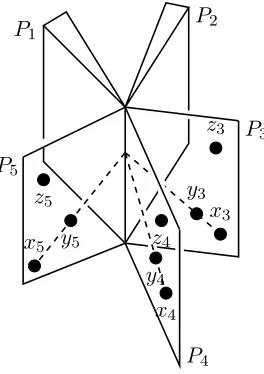
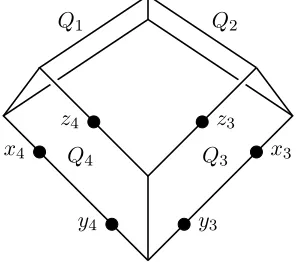
Example 5.3. Let (P1, P2, P3, P4, P5) be a paddle in a 3-connected
ma-troid N, where P1 and P2 each consist of 8 points freely placed in rank 4,
the petal Pi is a triad {xi, yi, zi} for each i ∈ {3,4,5}, and each of {x3, y3, x4, y4}, {x4, y4, x5, y5}, and {x3, y3, x5, y5} is a circuit of N. Then
Φ = (P1, P2, P3, P4, P5) is a tight 3-flower in N. A geometric representation
of N is given in Figure 1, where the elements of P1 and P2 are suppressed.
The rank-8 matroid T(N) is 4-connected by Lemma 5.1, and Φ is a tight 4-flower in T(N) by Lemma 5.2. It is easily verified that Φ is irredun-dant. The set P3 ∪P4 is 4-sequential, since it has a 4-sequential ordering
({x3, y3},{x4},{y4},{z3, z4}); likewise,P4∪P5 andP3∪P5 are 4-sequential.
Furthermore, (P1, P2, P3∪P4∪P5) is a left-justified maximal 4-path.
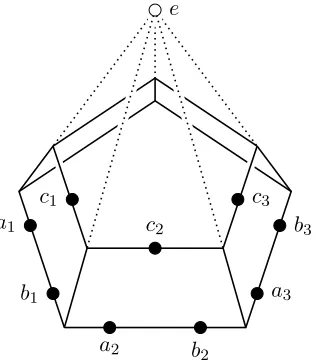
Example 5.4. Let Ψ be the free (5,3)-swirl with ai, bi, ci ∈ E(Ψ) such
P1
P2
P3
P4
P5
y3
x3
y4
x4
y5
x5
z3
z4
[image:17.612.240.372.116.303.2]z5
Figure 1. A representation of the 3-connected rank-9 pad-dleN.
{1,2,3,4,5}, where the subscripts are interpreted modulo 5. Let Ψ0 be the coextension of this matroid by an element e where {a1, b1, a2, b2}, {a2, b2, a3, b3}and{a1, b1, a2, b2, a3, b3}are the only dependent flats not
con-tainingein the coextension. LetM0 = Ψ0\e. An illustration of the resulting rank-6 matroid M0 is given in Figure 2, where the elements {ai, bi, ci} for
i ∈ {4,5} are suppressed. Take the direct sum of M0 with a copy of U2,2
having ground set{d4, d5}. Then, for eachi∈ {4,5}, freely add the elements
ei,fi,gi, andhi, in turn, to the flat spanned by{ai, bi, ci, di}. The resulting
rank-8 matroidM is 4-connected, and Φ = (P1, P2, P3, P4, P5) is a swirl-like
4-flower, where Pi ={ai, bi, ci} for i∈ {1,2,3} and Pi ={ai, bi, . . . , hi} for
i∈ {4,5}.
It is easy to check that the 4-flower Φ is tight and irredundant. The set P1∪P2 is 4-sequential, since it has a 4-sequential ordering ({a1, b1},{a2}, {b2},{c1, c2}); likewise,P2∪P3 is 4-sequential. Furthermore, (P1∪P2∪P3,
P4, P5) is a left-justified maximal 4-path.
Examples 5.3 and 5.4 show that an end part of a 4-path can break into three petals of a tightk-flower, even if thek-flower is also irredundant. Recall that an end part of a 3-path can break into at most two petals of a tight 3-flower. Thus, one might expect that an end part of a k-path could break into k−1 petals in a tight k-flower. Fortunately, this is not the case; an end part cannot break into more than three petals, even when k≥5. This follows from the fact that, for allk≥3, the union of three consecutive petals in a tightk-flower is not k-sequential. We shall prove this as Corollary 5.7. First, we require the following two lemmas.
Lemma 5.5. Let (U, Y, V) and (R, G) be partitions of the ground set E
a2 b2
c2
a1
b1
c1
a3
b3
c3
[image:18.612.229.387.117.297.2]e
Figure 2. A representation of the 4-connected rank-6 ma-troidM0= Ψ0\e.
Y ⊆ fclk(U) ∩R, and fclk(U) 6= E. If |U ∩R|,|V ∩G| ≥ k−1, then
Y ⊆fclk(U∩R).
Proof. By Lemma 3.6, there exists a partition (Y1, Y2, . . . , Yn) ofY such that
(U, Y1, Y2, . . . , Yn, V) is ak-sequence with|Yi| ≤k−2 for alli∈ {1,2, . . . , n}.
As|V∩G| ≥k−1, it follows, by uncrossing, thatU∩Rand (U∩R)∪Y1∪Y2∪ · · · ∪Yi arek-separating for eachiin{1,2, . . . , n}. SoY ⊆fclk(U∩R).
Lemma 5.6. Let M be a k-connected matroid, and let A and B be k -separating subsets ofE(M)such that|A∩B|,|E(M)−(A∪B)| ≥k−1, and
A∪B is a sequential k-separating set. Then, up to interchangingA and B, either
(i) B−A⊆fclk(A∩B), where A∩B is k-separating, or
(ii) A∩B⊆fclk(B−A), whereB−Aisk-separating and|B−A| ≥k−1. Proof. Let (Z1, Z2, . . . , Zs) be a sequential ordering of A∪B. We denote
Z1∪Z2∪· · ·∪ZxasZ[x]. Letibe the greatest index such that|A∩Z[i]| ≤k−2
and|B∩Z[i]| ≤k−2. Since|A|,|B| ≥k−1, the indexiis less than or equal
tos−1. Without loss of generality, we may assume that|A∩Z[i+1]| ≥k−1.
Suppose|(B−A)∩Z[i+1]| ≤k−2. By uncrossing,A∩Z[i+1] isk-separating, so (B −A)∩ Z[i+1] ⊆ fclk(A ∩Z[i+1]). Since B −A ⊆ fclk(Z[i+1]), we
have B −A ⊆ fclk(A∩Z[i+1]) ⊆ fclk(A). It follows, by Lemma 5.5, that
(i) holds. So we may assume that |(B −A)∩Z[i+1]| ≥ k−1. Now, if
|(A−B)∩Z[i+1]| ≤k−2, then, as above, (i) holds but with the roles of A
and B interchanged. Thus we may assume that|(A−B)∩Z[i+1]| ≥k−1.
and |Zi+1| ≤ k −2, it follows that |(A ∪B) ∩Z[i+1]| ≤ 3k−6. Thus |A∩B∩Z[i+1]| ≤k−2, in which case (ii) holds.
The next corollary generalises [2, Corollary 3.5] regarding 4-flowers.
Corollary 5.7. Let (P1, P2, . . . , Pn) be a k-flower Φ of order at least three in ak-connected matroid. Then no union of three consecutive tight petals of
Φ is ak-sequential set.
Proof. Suppose (P1, P2, . . . , Pn) is a k-flower where n ≥ 3, the petals P1,
P2 and P3 are tight, and P1∪P2∪P3 is k-sequential. If n = 3, then, by
Lemma 3.2,P2∪P3 isk-sequential, soP2∪P3 ⊆fclk(P1). HenceP2 andP3
are loose; a contradiction. So we may assume that n ≥4. By Lemma 3.2, P1∪P2 and P2∪P3 are k-sequential sets. It follows, by Lemma 5.6, that
P1⊆fclk(P2) orP2 ⊆fclk(P1), up to swapping P1 and P3. Thus one of P1,
P2 orP3 is loose; a contradiction. Hence the corollary holds.
The following is an analogue of [9, Lemma 3.13] for generalk.
Lemma 5.8. Let (X1, X2, . . . , Xm) be a maximal k-path in a k-connected matroid M with at least 8k−15 elements. Let (U, V) be a non-sequential
k-separation where U ∩Xm and V ∩Xm are k-separating sets, U −Xm and V −Xm are k-separating sets consisting of at least k−1 elements, and U ∩Xm * fclk(U −Xm) and V ∩Xm * fclk(V −Xm). Let (R, G) be a non-sequential k-separation such that both R∩Xm and G∩Xm are sequential k-separating sets. Then, by recolouring elements of Xm, there is a k-separation equivalent to (R, G) for which at least one of U ∩Xm and
V ∩Xm is monochromatic.
Proof. We begin by proving two sublemmas.
5.8.1. At least one of the sets U ∩R∩Xm, U∩G∩Xm,V ∩R∩Xm and
V ∩G∩Xm has at least k−1 elements.
Suppose each ofU∩R∩Xm,U∩G∩Xm,V ∩R∩Xm, and V ∩G∩Xm
has at mostk−2 elements. Then|Xm| ≤4k−8. Since |E(M)| ≥8k−15,
we may assume, without loss of generality, that |U −Xm| ≥ 2k−3 and |(U−Xm)∩R| ≥k−1. Suppose|V∩G| ≤k−2. If|(U−Xm)∩G| ≤k−2,
then, by uncrossingRandU−Xm, it follows that (U−Xm)∩G⊆fclk(R).
Moreover, as R∪U is also k-separating, by uncrossing, ((U −Xm)∩G,
U∩G∩Xm, V ∩G) is a partialk-sequence forR, contradicting the fact that
(R, G) is non-sequential. Thus|(U−Xm)∩G| ≥k−1. Since|V| ≥2k−2, by
Lemma 3.5,|V∩R| ≥k−1, soU∩Gisk-separating by uncrossing. It follows that (U∩G∩Xm, V∩G∩Xm, U∩R∩Xm, V∩R∩Xm) is a partialk-sequence
forXm−, soXm−isk-sequential; a contradiction. Now suppose|V∩G| ≥k−1. By uncrossing, U ∩R is k-separating. Thus Xm−∪(U ∩R) is k-separating. It follows that (U ∩R∩Xm, U ∩G∩Xm, V ∩R∩Xm, V ∩G∩Xm) is a
5.8.2. If|U∩R∩Xm| ≥k−1andV∩G∩Xm 6=∅, then either(U∪R)∩Xm is a sequentialk-separating set, orV∩G∩Xm can be recoloured red to obtain a k-separation equivalent to (R, G) where V ∩Xm is monochromatic.
SinceU∩XmandR∩Xmarek-separating, it follows, by uncrossing, that
(U ∪R)∩Xm isk-separating. Suppose (U∪R)∩Xm is non-sequential. As
(U∪R)∩Xm $Xm and thek-path (X1, X2, . . . , Xm) is maximal, the
non-empty setV ∩G∩Xmis contained in either fclk(Xm−) or fclk((U∪R)∩Xm).
By Corollary 3.7(i), V ∩G∩ Xm is contained in both of these sets. If |V∩R∩Xm| ≤k−2, thenV∩R∩Xm ⊆fclk(U∩Xm). SinceV∩G∩Xm⊆
fclk((U ∪R)∩Xm), we deduce that V ∩Xm ⊆fclk(U ∩Xm) ⊆fclk(U). It
follows, by Corollary 3.7(i), that V ∩Xm ⊆fclk(V −Xm); a contradiction.
So |V ∩R∩Xm| ≥k−1. Thus, sinceV ∩G∩Xm ⊆fclk((U ∪R)∩Xm),
and|U−Xm| ≥k−1, it follows by Lemma 5.5 thatV ∩G∩Xm⊆fclk(V ∩
R∩Xm) ⊆ fclk(R). Thus V ∩G∩Xm can be recoloured red to obtain a
k-separation equivalent to (R, G), thereby completing the proof of (5.8.2). 5.8.3. Up to swapping U andV, there is ak-separation (R1, G1) equivalent to (R, G) such that U∩Xm is monochromatic.
By (5.8.1), we can swapU andV, if necessary, so that eitherU∩R∩Xmor
U∩G∩Xm consists of at leastk−1 elements. Without loss of generality, we
assume that|U∩R∩Xm| ≥k−1. IfV∩G∩Xm =∅, then (5.8.3) holds. Thus
we may assume, by (5.8.2), that (U∪R)∩Xm is a sequential k-separating
set. By Lemma 3.2, the k-separating setU ∩Xm is also sequential. Hence,
by Lemma 5.6, one of the following holds, where the set on which the full k-closure operator is applied is k-separating and consists of at least k−1 elements.
(I) U∩G∩Xm ⊆fclk(U ∩R∩Xm), or
(II) U∩R∩Xm⊆fclk(U∩G∩Xm), or
(III) V ∩R∩Xm ⊆fclk(U∩R∩Xm), or
(IV) U∩R∩Xm⊆fclk(V ∩R∩Xm).
If (I) or (II) holds, then U∩G∩Xm orU ∩R∩Xm is in the fullk-closure
of R or G respectively, in which case this set can be recoloured to obtain (R1, G1) whereU ∩Xm is monochromatic, satisfying (5.8.3).
We now consider (III) and (IV). If U∩G∩Xm consists of at most k−2
elements, then this set can be recoloured red, satisfying (5.8.3); so assume otherwise. Suppose (IV) holds. By uncrossing,G∪(U∩Xm) isk-separating.
ThusR−(U∩Xm) isk-separating. It follows that U∩R∩Xm⊆fclk(V ∩
R∩Xm)⊆fclk(R−(U∩Xm)). Then, by Corollary 3.7(i), the setU∩R∩Xm
can be recoloured green, satisfying (5.8.3). In case (III), if|V ∩G∩Xm| ≤
k−2, then, by Corollary 3.7(i), V ∩Xm ⊆fclk(U) implies that V ∩Xm ⊆
fclk(V −Xm); a contradiction. Now, by a similar argument as for (IV)
but with U and V interchanged, the set R −(V ∩Xm) is k-separating,
V ∩R∩Xm ⊆fclk(R−(V ∩Xm)), and henceV ∩R∩Xm can be recoloured
Corollary 5.9. Let(X1, X2, . . . , Xm) be a maximalk-path in ak-connected matroid M with at least 8k−15 elements. Let (U, V) be a non-sequential
k-separation where U ∩Xm and V ∩Xm are k-separating sets, U −Xm and V −Xm are k-separating sets consisting of at least k−1 elements, and U ∩Xm * fclk(U −Xm) and V ∩Xm * fclk(V −Xm). Let (R, G) be a non-sequential k-separation such that both R∩Xm and G∩Xm are sequential k-separating sets. Suppose there is no recolouring of elements of
Xm that gives a k-separation equivalent to (R, G) such that both U ∩Xm and V ∩Xm are monochromatic. Then, up to swapping U andV, for some
(R0, G0) equivalent to (R, G) obtained by recolouring elements of Xm and possibly swapping R0 andG0:
(i) U∩Xm ⊆R0 andV ∩Xm is bichromatic, and
(ii) (V ∩Xm−, U∩Xm−, U∩Xm, R0∩V ∩Xm, G0∩V ∩Xm) is ak-flower where the last three petals are tight.
Proof. By Lemma 5.8, and by swapping U and V, andR0 and G0, if neces-sary, (i) holds. Let Φ = (V∩Xm−, U∩Xm−, U∩Xm, R0∩V∩Xm, G0∩V∩Xm).
By [4, Lemma 4.2], and since each of Xm, U, R0 ∩Xm and V ∩Xm is
k-separating, we deduce that Φ is a flower. If U ∩Xm ⊆ fclk(V), then
U ∩Xm ⊆ fclk(U −Xm) by Corollary 3.7(i); a contradiction. Thus, by
a cyclic shift of the petals and Lemma 3.12, U ∩Xm is tight. Similarly,
if G0 ∩V ∩Xm ⊆ fclk(Xm−), then G0 ∩V ∩Xm can be recoloured red by
Corollary 3.7(i); a contradiction. Thus, by Lemma 3.12, G0∩V ∩Xm is
tight. Since this petal consists of at least k−1 elements, R0 ∩U is k-separating by uncrossing. SupposeR0∩V∩Xm ⊆fclk(V−(R0∩Xm)). Then
R0∩V∩Xm ⊆fclk(U), by Corollary 3.7(i), and it follows, by Lemma 5.5, that
R0∩V∩Xm ⊆fclk(R0∩U). By uncrossing the setsU∪Xm−andR0, we deduce
thatR0−(V∩Xm) isk-separating. HenceR0∩V∩Xm ⊆fclk(R0−(V∩Xm)),
soR0∩V ∩Xm can be recoloured green by Corollary 3.7(i); a contradiction.
Thus, by Lemma 3.12,R0∩V ∩Xm is tight, and (ii) holds.
6. The Algorithm
At last we present the algorithm k-Tree for constructing ak-tree given a k-connected matroidM with|E(M)| ≥8k−15. We begin by describing the algorithm informally, then we give some additional definitions that are required for the subsequent formal description. We finish the section with an example to illustrate the algorithm.
calling the first of its two subroutines, ForwardSweep. Starting with the k-path (Y, Z), this subroutine repeatedly finds non-sequentialk-separations that are not equivalent to a k-separation currently displayed by thek-path. By refining the k-path methodically from the “rooted” end, outwards, we ensure thek-path returned by ForwardSweep is maximal. Then the sec-ond subroutine,BackwardSweep, is called. This subroutine starts at the unrooted end of the k-path, and works towards the rooted end, uncovering flower structure along the way. We use a “generalised k-path” to represent the k-path together with the related uncovered flower structure. Loosely speaking, a generalised k-path allows us to describe a number of flowers in series; thus describing the k-tree structure in one direction. From the generalised k-pathτ, we obtain the corresponding k-tree, which we call the “path realisation” ofτ. We formally define these terms presently. The algo-rithm adjoins the path realisation to the bag vertexB, and then recursively proceeds by finding another unmarked bag vertex. Finally, when all bag vertices are marked, it outputs thek-tree forM.
Now we require some additional terminology to present the algorithm. Our definition of a generalised k-path is consistent with a generalised 3-path of [9]; however, we need to allow for an end of a k-path to break into three petals, rather than just two, for the reasons discussed in Section 5.
Let M be a k-connected matroid with ground set E. Suppose τ = (P1, P2, . . . , Pn) is an ordered tuple where, for each i∈ {1,2, . . . , n}, either
(i) Pi is a subset ofE, or
(ii) 2 ≤i≤n−1 and Pi = [(Pi,1, Pi,2, . . . , Pi,j),(Pi,l, Pi,l−1, . . . , Pi,j+1)]
for some 1≤j ≤ l, where the Pi,x are mutually disjoint subsets of
E forx∈ {1,2, . . . , l}.
We say thatPi is aflower part when (ii) holds for somei∈ {2,3, . . . , n−1}.
Let µ = (X1, X2, . . . , Xn) be the ordered sequence obtained from τ by
re-placing each flower partPiwith the setXi, which is the union of all the sets
enclosed by its square brackets; we say thatµis theflattening ofτ. Suppose that for each flower part Pi = [(Pi,1, Pi,2, . . . , Pi,j),(Pi,l, Pi,l−1, . . . , Pi,j+1)],
the partition Φ = (Xi−, Pi,1, Pi,2, . . . , Pi,j, Xi+, Pi,j+1, Pi,j+2, . . . , Pi,l) is a
k-flower, whereXi−=X1∪X2∪ · · · ∪Xi−1 andXi+=Xi+1∪Xi+2∪ · · · ∪Xn.
We call Xi− and Xi+ the entry and exit petals, respectively, of Φ rela-tive to τ, and we call (Pi,1, Pi,2, . . . , Pi,j) and (Pi,l, Pi,l−1, . . . , Pi,j+1) the clockwise and anticlockwise petals, respectively, of Φ relative to τ. If j = l, then the flower part Pi is of the form [(Pi,1, Pi,2, . . . , Pi,l)] and
we say that Φ has no anticlockwise petals relative to τ. There are four variants of a generalised k-path. Firstly, if µ is a k-path, then τ is a generalised k-path. If µ is not a k-path, but P1 is k-sequential and
P2 = [(P2,1, P2,2, . . . , P2,j),(P2,l, P2,l−1, . . . , P2,j+1)] is a flower part such
that (P1 ∪P2,1, X2 −P2,1, X3, . . . , Xn) or (P1 ∪ P2,1 ∪ P2,2, X2 −(P2,1 ∪
P2,2), X3, . . . , Xn) is a k-path, then τ is a generalised k-path, and we say
P2,1∪P2,2, respectively, is thesplit part. Symmetrically, ifPnisk-sequential
and Pn−1 = [(Pn−1,1, Pn−1,2, . . . , Pn−1,j)(Pn−1,l, Pn−1,l−1, . . . , Pn−1,j+1)] is a
flower part such that either (X1, . . . , Xn−2, Xn−1−Pn−1,j, Pn−1,j∪Xn) or
(X1, . . . , Xn−2, Xn−1−(Pn−1,j−1∪Pn−1,j), Pn−1,j−1∪Pn−1,j∪Xn) is ak-path,
thenτ is also ageneralised k-path, and again we sayτ is obtained from the k-path via an end move, andPn−1,j∪XnorPn−1,j−1∪Pn−1,j∪Xn,
respec-tively, is the split part. A combination of the last two generalised k-paths also can arise: if τ = (P1,[(P2,1, P2,2, . . . , P2,p)], P3), where p ∈ {2,3,4},
and (P1 ∪P2,1 ∪P2,2 ∪ · · · ∪P2,j, P2,j+1 ∪ · · · ∪P2,p ∪P3) is a k-path for
some j ∈ {1, . . . , p−1}, then τ is a generalised k-path, we say τ is ob-tained from the k-path by end moves, and P1∪P2,1∪P2,2∪ · · · ∪P2,j and
P2,j+1∪ · · · ∪P2,p∪P3 are the split parts.
Let τ be a generalised k-path. We say that τ is left-justified if the flat-tening of τ is left-justified. Let Z be a term in τ and assume that Z is not in a flower part. We can then write τ as (τ(Z−), Z, τ(Z+)) so τ(Z−) and τ(Z+) denote, respectively, the portions of τ that occur before and after Z. In this case, as in a k-path, we shall denote by Z− and Z+ the
union of all of the sets in τ that occur, respectively, before and after Z. If τ = (τ(Zi−), Zi, Zi+1, τ(Zi+1+ )), where Zi is not a flower part and Zi+1 may
be a flower part, then we sometimes write τ(Zi+1+ ) as τ(Zi++).
Let τ1 = (P1, P2, . . . , Pn) be a generalised k-path of M. Suppose τ2 is
obtained from τ1 in one of the following ways:
(I) For some 1 ≤i < i0 ≤n, where each of Pi, Pi+1, . . . , Pi0 are subsets
ofE,τ2= (P1, P2, . . . , Pi−1, Pi∪Pi+1∪ · · · ∪Pi0, Pi0+1, Pi0+2, . . . , Pn).
(II) For some 2 ≤ i ≤ n − 1, where Pi = [(Pi,1, Pi,2, . . . , Pi,j),
(Pi,l, Pi,l−1, . . . , Pi,j+1)] is a flower part,τ2 = (P1, P2, . . . , Pi−1, Pi,1∪
Pi,2∪ · · · ∪Pi,l, Pi+1, Pi+2, . . . , Pn).
Clearly, τ2 is a generalised k-path. We say that τm, for some m ≥ 1, is
a concatenation of τ1 if there is a sequence τ1, τ2, . . . , τm where each τi+1
is obtained from τi by either (I) or (II). Conversely, we say that τ1 is a refinement of τm.
Let τ be a generalised k-path in a k-connected matroid M with ground set E, and let µ= (Y1, Y2, . . . , Yp) be the flattening of τ. Note that µ is a
k-path unless Y1 or Yp is sequential as may occur if we apply an end move
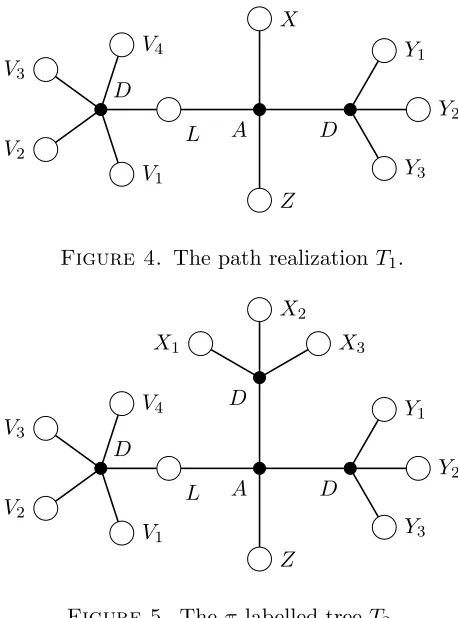
or end moves. Let P denote the π-labelled tree consisting of a path of p bag vertices labelled, in order,Y1, Y2, . . . , Yp. Now modify P as follows. For
each Yj that is the union ofsclockwise petals and tanticlockwise petals of
a flower, replace the bag vertex labelledYj with a flower vertexvand adjoin
s+t new bag vertices to v each via a new edge so that the cyclic ordering induced by the cyclic ordering on the edges incident with v preserves the ordering of the flower Φj to whichYj corresponds. Label the vertex vby D
or A depending on whether Φj is a daisy or an anemone, respectively. We
The algorithmk-Treefollows the approach taken in [9]; indeed, it gener-alises the algorithm 3-tree. However, because of the additional hurdles in going fromk= 3 to arbitraryk, necessary modifications have had to be made resulting in extra length in the description of the algorithm. These modi-fications are required in order to handle the more-complicated end moves, and to ensure the resultingk-flower is irredundant. The notable changes are inBackwardSweep, at lines 3–15, 23–26, and 57–60.
We now give an example of ak-connected matroid M, its corresponding k-tree T, and a brief walk-through of the algorithm when applied to M. This example is inspired by the corresponding example of a 3-tree for a 3-connected matroid in [9].
The Higgs lift of a matroid N, denoted L(N), is obtained by freely co-extending N by a non-loop element e, and then deleting e. Note that L(N) = (T(N∗))∗. By the next lemma, which is a consequence of Lemma 5.1 and duality, we can obtain a (k+ 1)-connected matroid by performing the Higgs lift on an appropriatek-connected matroid. The subsequent lemma [3, Lemma 2.6.2] states that the Higgs lift turnsk-flowers into (k+ 1)-flowers. Lemma 6.1. Let M be a k-connected matroid with r∗(M) > k and no
k-cocircuits. Then L(M) is(k+ 1)-connected.
Lemma 6.2. Let (P1, P2, . . . , Pn) be ak-flower Φin ak-connected matroid
M, with n≥4. If every petal of Φ is a dependent set, then Φ is a (k+ 1) -flower in L(M).
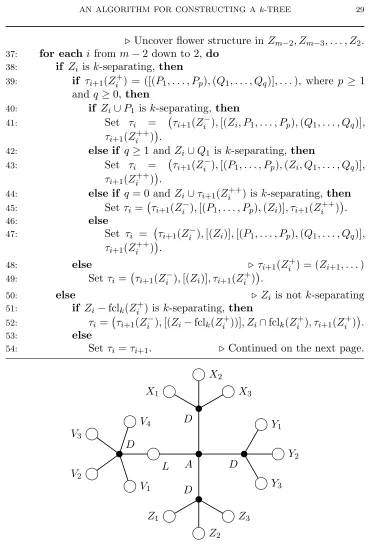
We start by constructing the matroidM0. Fixj≥k−1, and letSbe a free (5, j)-swirl (V1, V2, V3, V4, L), where each ofV1,V2,V3,V4, andL is a line of
S. UseLas the spine of a paddle to which we attach three free (4, j)-swirls (X1, X2, X3, L), (Y1, Y2, Y3, L), and (Z1, Z2, Z3, L). The resulting matroid
M0 is 3-connected.
We now repeatedly perform the Higgs lift to obtain L(M0), L2(M0), . . . , Lk−3(M0), for some k ≥ 4. It is easily verified that for i ∈ {0,1,2, . . . , k−4}, the matroid Li(M0) has corank greater than i+ 3 and has no (i + 3)-cocircuits, so Lk−3(M0) is a k-connected matroid. Moreover, for each 3-flower Φ in M0, every petal of Φ is dependent in L(M0), L2(M0), . . . , Lk−4(M0), so Φ is a k-flower in Lk−3(M0). A possi-blek-tree for this matroid, irrespective of the precise value of k, is given in Figure 3, where large open circles represent bag vertices.
Now suppose that k-Tree is applied to M. Let X = X1 ∪X2 ∪X3,
Y =Y1∪Y2∪Y3, andZ =Z1∪Z2∪Z3. If (V2∪V3∪V4, V1∪L∪X∪Y ∪Z)
is thek-separation found in line 3 ofk-Tree, then a possiblek-path returned by the first call to ForwardSweep is
(V2∪V3, V4, V1∪L, X, Z, Y1, Y2∪Y3).
Algorithm 1 k-Tree(M)
Input: Ak-connected matroidM with ground setE and|E| ≥8k−15. Output: A k-tree forM.
1: Construct the collection F of maximal sequential k-separating sets of M.
2: Let T0 denote the π-labelled tree consisting of a single unmarked bag
vertex labelledE.
3: if there exists ak-separation (U, V) for whichU andV contain mutually disjointk-element subsetsU0 and V0, respectively, such that no member ofF containsU0 orV0,then
4: Set X0 =∅, set X1 = fclk(U), set X2=V −fclk(U), and set i= 1.
5: Call ForwardSweep(M, (X0 ∪ X1, X2), F) and let (X0 ∪
Z1, Z2, . . . , Zm) be the resultingk-path.
6: CallBackwardSweep(M, (X0∪Z1, Z2, . . . , Zm),F), and letT1 be
the path realisation of the resulting generalisedk-path, with each bag vertex unmarked.
7: while there is an unmarked bag vertexB ofTi,do
8: if B is a non-terminal bag vertex,then
9: Find ak-separation (Y, Z) such thatY contains fclk(E−π(B)),
andZ contains ak-element subsetZ0⊆π(B)−fclk(E−π(B))
with no member of F containingZ0.
10: else . B is a terminal bag vertex 11: Find ak-separation (Y, Z) such thatY contains fclk(E−π(B))
and an element y∈π(B)−fclk(E−π(B)), and Z contains a
k-element subset Z0 ⊆π(B)−fclk(E−π(B))− {y} with no
member of F containingZ0.
12: if there exists such a k-separation (Y, Z),then
13: Set X0 = E −π(B), set X1 = π(B) ∩fclk(Y), set X2 =
π(B)−fclk(Y), and increasei by 1.
14: Call ForwardSweep(M, (X0 ∪X1, X2), F), and let (X0∪
Z1, Z2, . . . , Zm) be the resultingk-path.
15: Call BackwardSweep(M, (X0∪Z1, Z2, . . . , Zm), F).
16: Find the path realisation Ti0 of resulting generalised k-path. 17: Identify the vertex X0 ∪Z1 of Ti0 with the vertex B of Ti−1,
label the resulting composite vertex Z1, and, if Z1 = ∅ and
Z1 has degree two, then suppress this vertex. Let Ti be the
resulting tree, where each bag vertex originating from the path realisation, including the identified vertex, is unmarked. 18: else . There is no such k-separation (Y, Z)
19: Mark B.
20: output Ti.
Algorithm 2 ForwardSweep(M, (X0∪X1, X2), F)
Input: Ak-connected matroidM with ground setE and|E| ≥8k−15, ak-path (X0∪X1, X2) ofM, and the collectionF of maximal sequential
k-separating sets ofM.
Output: A k-path (X0∪X10, X20, . . . , Xm0 ) ofM that is a refinement of
(X0∪X1, X2).
1: Let τ0 = (X0 ∪X1, X2), set (i, s, m) = (0,1,2), and set (X10, X20) =
(X1, X2).
2: whiles≤m,do
.See if we can refine Xs0 inτi = (X0∪X10, X20, . . . , Xm0 )
3: if s= 1 andX0=∅,then
4: Find ak-separation (Y, Z) such thatY contains ak-element sub-setY0 ofX10 with no member ofF containing Y0, andZ contains X20 ∪ · · · ∪Xm0 and an element z of X10 with z 6∈ fclk(X20 ∪ · · · ∪
Xm0 )∪Y0.
5: else if s= 1 and X0 6=∅,then
6: Find a k-separation (Y, Z) such that Y contains fclk(X0), and Z
containsX20∪ · · · ∪Xm0 and an elementzofX10 withz6∈fclk(X20∪ · · · ∪Xm0 ).
7: else if s < m,then
8: Find a k-separation (Y, Z) such that Y contains X0∪X10 ∪ · · · ∪
Xs0−1 and an element y of Xs0 −fclk(X0∪X10 ∪ · · · ∪Xs0−1), and
Z contains Xs+10 ∪ · · · ∪Xm0 and an element z of Xs0 with z 6∈
fclk(Xs+10 ∪ · · · ∪Xm0 )∪ {y}.
9: else . s=m
10: Find a k-separation (Y, Z) such that Y contains X0∪X10 ∪ · · · ∪
Xs0−1 and an elementy ofXs0 −fclk(X0∪X10 ∪ · · · ∪Xs0−1), and Z
contains ak-element subsetZ0 ofXs0−fclk(X0∪X10∪ · · · ∪Xs0−1)− {y}with no member of F containingZ0.
11: if there exists such ak-separation (Y, Z), then
12: Increasem by 1 and, for each t > s, set Xt0 to beXt+10 .
13: SetXs+10 to beXs0∩(E−fclk(Y)) and setXs0 to beXs0∩fclk(Y).
14: Increaseiby 1 and set τi to be (X0∪X10, X20, . . . , Xm0 ).
15: else
16: Increasesby 1. 17: output τi.
BackwardSweepis
(V3,[(V2, V1),(V4)], L,[(X, Z)],[(Y1, Y2)], Y3).
Comparing thek-path and the generalisedk-path, bothV2∪V3 andY2∪Y3
are split parts. The splitting ofY2∪Y3andV2∪V3 is the result of end moves
Algorithm 3 BackwardSweep(M, (X0∪Z1, Z2, . . . , Zm), F)
Input: Ak-connected matroidM with ground setE and|E| ≥8k−15, a left-justified maximalk-path (X0∪Z1, Z2, . . . , Zm) ofM, wherem≥2,
and the collection F of maximal sequential k-separating sets of M. Output: A generalised k-path ofM.
1: if m= 2,then
2: if X0 is empty and there exists a k-separation (U, V) for which U
contains a subsetU0andV contains a subsetV0such that no member of F contains U0 or V0, and |U0 ∩Z1| = |U0 ∩Z2| = |V0 ∩Z1| = |V0∩Z2|=k−1,then
. See ifZ2 breaks into three petals.
3: if there exists a k-separation (S, T) for which S contains U∩Z2
and an element s0 ∈ Z2 −fclk(U ∩Z2), and T contains Z1 and |T ∩Z2| ≥ k−1; and there exists a k-separation (S1, T1) for
which S1 contains S and an element s ∈ Z1 −fclk(S), and T1
contains a subset T0 such that no member of F contains T0 and
|T0∩Z1|=|T0∩Z2|=k−1,then
4: Set τ2= (Z1,[(U∩Z2, S1∩V)], T1∩Z2).
5: else if there exists a k-separation (S, T) for which T contains V ∩Z2 and an element t0 ∈ Z2 −fclk(V ∩Z2), and S contains
Z1 and|S∩Z2| ≥k−1;andthere exists a k-separation (S1, T1)
for whichT1 contains T and an elementt∈Z1−fclk(T), andS1
contains a subset S0 such that no member of F contains S0 and
|S0∩Z1|=|S0∩Z2|=k−1,then
6: Set τ2= (Z1,[(S1∩Z2, T1∩U)], V ∩Z2).
7: else
8: Set τ2= (Z1,[(U∩Z2)], V ∩Z2).
9: Letτ2 = (Z1,[(P1, . . . , Pp)], Q) withp∈ {1,2}, and P =Spi=1Pi.
. See ifZ1 breaks into three petals.
10: if there exists a k-separation (S, T) such that S contains both V−P and an elements∈Z1−fclk(V−P); andT containsP, an
elementt∈Z1−(fclk(P)∪ {s}), and ak-element subsetT0 such
that no member of F contains T0,then
.(S, T) non-sequential, so corresponding flower irredundant. 11: output (V ∩Z1,[(S∩U, T ∩Z1, P1, . . . , Pp)], Q).
12: else if there exists a k-separation (S, T) such that S contains both (Z1∩U)∪P1 and an element s∈Z1−fclk((Z1∩U)∪P1);
andT containsZ2−P1, an elementt∈Z1−(fclk(Z2−P1)∪ {s}),
and ak-element subsetT0 such that no member ofF containsT0, then
13: output (T∩Z1,[(S∩V, U ∩Z1, P1, . . . , Pp)], Q).