MICROORGANISMS IN THE CONVERSION OF PRETREATED AGRICULTURAL WASTE TO
COMPOST AND VERMICOMPOST
*
1Prasanna Kumar, B.,
1Dr. S.
1
Department of Agricultural Microbiology and Bioenergy, Professor Jayashankar Telangana State Agricultural
University (PJTSAU), College of Agriculture, Rajendranagar, Hyderabad,
2
Department of Agricultural Microbiology, Acharya N.G
Post Graduate Centre, Lam, Guntur, Andhra Pradesh, India
ARTICLE INFO ABSTRACT
Compost is mixture of organic residues contain
as fodder ruminant, stubble, weeds and leaves. Composted organic material can be used as a source of important nutrients for sustainable crop productivity. Therefore the investigated study was designed to evaluate the maize straw to integrated management of composting and vermicomposting. Experimental trial was carried out at Agricultural college, Rajendranagar, Hyderabad. The experiment was laid out in Randomized Block Design (RBD) having three replica
treatments.
degrading microorganisms was identified, the outstanding isolates were used for the pretreatment of agricultural waste (maize straw).
essential for rapid degradation of lignocellulose. Vermicomposting results in significant decreased in pH, Total organic carbon (TOC), electrical conductivity (EC) and C:N ratio while signi
in total Kjeldahl nitrogen (TKN) available phosphorus, exchangeable potassium and calcium in vermicomposts/vermiwash. This study clearly indicates that vermicomposting of animal, agro/kitchen wastes not only produced a valuable vermicompost
growth supplements in final vermicompost.
Copyright © 2018, Prasanna Kumar et al. This is an open use, distribution, and reproduction in any medium, provided
INTRODUCTION
The excess uses of chemical fertilizers and pesticides have made our soil sick and problematic and cause environmental hazards which affect the human health and environment. Million of tons of animal, agro and kitchen wastes are produced annually and have odour and pollution problems (Suthar et al., 2005; Reinecke et al., 1992; Garg
Much attention has been paid in recent passed years to manage different organic wastes resources at low input as well eco friendly basis. Vermicomposting, through earthworms, is an Eco biotechnological process that transforms energy rich and complex organic substances in to a stabilized vermicomposts (Bentize et al., 2000). Composting is the conversion, by microorganisms, of complex mixtures of quickly degradable organic materials to more stable, humified materials, usually in a warm, moist, and relatively aerobic environment.
*Corresponding author:Prasanna Kumar, B.,
Department of Agricultural Microbiology and Bioenergy, Professor Jayashankar Telangana State Agricultural University (PJTSAU), College of Agriculture, Rajendranagar, Hyderabad,
500 030
ISSN: 0975-833X
Article History:
Received 30th January, 2018
Received in revised form
25th February, 2018
Accepted 28th March, 2018
Published online 30th April, 2018
Citation: Prasanna Kumar, B., Dr. S. Triveni, Dr. R. Subhash Reddy and Dr. A. Vijaya Gopal
agricultural waste to compost and vermicompost”, International Journal of Current Research
Key words: Cellulose, Lignocellulose, Agricultural waste, Horticultural waste, Thermophilic.
RESEARCH ARTICLE
MICROORGANISMS IN THE CONVERSION OF PRETREATED AGRICULTURAL WASTE TO
COMPOST AND VERMICOMPOST
Dr. S. Triveni,
1Dr. R. Subhash Reddy and
2Dr. A. Vijaya Gopal
Department of Agricultural Microbiology and Bioenergy, Professor Jayashankar Telangana State Agricultural
University (PJTSAU), College of Agriculture, Rajendranagar, Hyderabad,
Telangana, India-500 030
Department of Agricultural Microbiology, Acharya N.G Ranga Agricultural University (ANGRAU), Advanced
Post Graduate Centre, Lam, Guntur, Andhra Pradesh, India-522 034
ABSTRACT
Compost is mixture of organic residues contain animal dung and urine along with other residues, such as fodder ruminant, stubble, weeds and leaves. Composted organic material can be used as a source of important nutrients for sustainable crop productivity. Therefore the investigated study was designed to evaluate the maize straw to integrated management of composting and vermicomposting. Experimental trial was carried out at Agricultural college, Rajendranagar, Hyderabad. The experiment was laid out in Randomized Block Design (RBD) having three replica
treatments.Cellulose degrading microbes were isolated from different soil samples, efficient cellulose degrading microorganisms was identified, the outstanding isolates were used for the pretreatment of agricultural waste (maize straw). The elevated temperatures found during the thermophilic phase are essential for rapid degradation of lignocellulose. Vermicomposting results in significant decreased in pH, Total organic carbon (TOC), electrical conductivity (EC) and C:N ratio while signi
in total Kjeldahl nitrogen (TKN) available phosphorus, exchangeable potassium and calcium in vermicomposts/vermiwash. This study clearly indicates that vermicomposting of animal, agro/kitchen wastes not only produced a valuable vermicompost/vermiwash but also increased level of plant growth supplements in final vermicompost.
open access article distributed under the Creative Commons Attribution provided the original work is properly cited.
The excess uses of chemical fertilizers and pesticides have made our soil sick and problematic and cause environmental hazards which affect the human health and environment. Million of tons of animal, agro and kitchen wastes are odour and pollution problems ., 1992; Garg et al., 2006). Much attention has been paid in recent passed years to manage different organic wastes resources at low input as well
eco-earthworms, is an Eco biotechnological process that transforms energy rich and complex organic substances in to a stabilized vermicomposts ., 2000). Composting is the conversion, by microorganisms, of complex mixtures of quickly degradable rganic materials to more stable, humified materials, usually in a warm, moist, and relatively aerobic environment.
Department of Agricultural Microbiology and Bioenergy, Professor State Agricultural University (PJTSAU), College of Agriculture, Rajendranagar, Hyderabad, Telangana,
India-The borderline between waste and compost has not been precisely defined by generally agreed upon quantitative parameters, but it is assumed that composts should not reheat anaerobically during curing and storage, producing foul odours. Composting satisfies the health and aesthetic aspects of waste disposal by destroying almost all pathogens. In addition, the product is agriculturally or hor
beneficial as a soil conditioner and fertilizer. Much of the research on composting has focused on the changes in the physical and chemical parameters of the compost, primarily in an effort to find a simple and reliable indicator of compost maturity and to improve the efficiency of the process. However, it is important to remember that the compost microbiota determines the rate of composting and the quality of the product. Their actions will depend upon the nutrients available and the physical parameters surrounding them during the process. The purpose of thisstudy was to provide a better understanding of the physical and chemical factors which may influence microbial activity in composting and vermicomposting of agricultural waste. The moisture
pH, organic content, total nitrogen, total carbon, total protein, and temperature were examined at various stages of the
International Journal of Current Research Vol. 10, Issue, 04, pp.67519-67526, April, 2018
Prasanna Kumar, B., Dr. S. Triveni, Dr. R. Subhash Reddy and Dr. A. Vijaya Gopal. 2018. “Microorganisms in the conversion of pretreated International Journal of Current Research, 10, (04), 67519-67526.
Available online at http://www.journalcra.com
z
MICROORGANISMS IN THE CONVERSION OF PRETREATED AGRICULTURAL WASTE TO
Dr. A. Vijaya Gopal
Department of Agricultural Microbiology and Bioenergy, Professor Jayashankar Telangana State Agricultural
University (PJTSAU), College of Agriculture, Rajendranagar, Hyderabad,
Ranga Agricultural University (ANGRAU), Advanced
522 034
animal dung and urine along with other residues, such as fodder ruminant, stubble, weeds and leaves. Composted organic material can be used as a source of important nutrients for sustainable crop productivity. Therefore the investigated study was designed to evaluate the maize straw to integrated management of composting and vermicomposting. Experimental trial was carried out at Agricultural college, Rajendranagar, Hyderabad. The experiment was laid out in Randomized Block Design (RBD) having three replications and four Cellulose degrading microbes were isolated from different soil samples, efficient cellulose degrading microorganisms was identified, the outstanding isolates were used for the pretreatment of The elevated temperatures found during the thermophilic phase are essential for rapid degradation of lignocellulose. Vermicomposting results in significant decreased in pH, Total organic carbon (TOC), electrical conductivity (EC) and C:N ratio while significant increase in total Kjeldahl nitrogen (TKN) available phosphorus, exchangeable potassium and calcium in vermicomposts/vermiwash. This study clearly indicates that vermicomposting of animal, agro/kitchen /vermiwash but also increased level of plant
ribution License, which permits unrestricted
The borderline between waste and compost has not been defined by generally agreed upon quantitative ed that composts should not reheat anaerobically during curing and storage, producing foul Composting satisfies the health and aesthetic aspects of waste disposal by destroying almost all pathogens. In addition, the product is agriculturally or horticulturally beneficial as a soil conditioner and fertilizer. Much of the research on composting has focused on the changes in the physical and chemical parameters of the compost, primarily in an effort to find a simple and reliable indicator of compost turity and to improve the efficiency of the process. However, it is important to remember that the compost microbiota determines the rate of composting and the quality of the product. Their actions will depend upon the nutrients parameters surrounding them during the process. The purpose of thisstudy was to provide a better understanding of the physical and chemical factors which may influence microbial activity in composting and vermicomposting of agricultural waste. The moisture content, pH, organic content, total nitrogen, total carbon, total protein, and temperature were examined at various stages of the
INTERNATIONAL JOURNAL OF CURRENT RESEARCH
process with regard to the microbial biomass and activity in the compost and vermicompost. Although many of these parameters have previously been measured in composts, few data have been collected which would allow simultaneous correlations between all of these parameters.
MATERIALS AND METHODS
Bacterial strains isolation
Cellulolytic bacterial strains were isolated from soil by using serial dilutions and pour plate technique. The medium used for isolation of cellulolytic bacteriacontains 1.0 % peptone, 1.0 % carboxymethylcellulose (CMC), 0.2 % K2HPO4, 1 % agar, 0.03 % MgSO4.7H2O, 0.25 % (NH4)2SO4 and 0.2 % gelatin at pH 7 for 48 hours of incubation at 300 C (Yin et al., 2010). Bacterial colonies were purified by repeated streaking. The purified colonies were preserved at 40 C for further identification and screening for cellulase production.
Screening of Cellulolytic Bacteria
Pure cultures of bacterial isolates were individually transferred in CMC agar plates. After incubation for 48 hours, CMC agar plates were flooded with 1% congored and allowed to stand for 15 min at room temperature. One molar NaCl was thoroughly used for counterstaining the plates. Clear zones were appeared around growing bacterial colonies indicating cellulose hydrolysis (Andro et al., 1984). The bacterial colonies having the largest clear zone were selected for identification and cellulase production in submerged system.The formation of a clear zone of hydrolysis indicated cellulose degradation. The ratio of the clear zone diameter to colony diameter was measured in order to select for the highest cellulase activity producer. The largest ratio was assumed to contain the highest activity.
Identification of Cellulolytic Bacteria
Identification of cellulolytic bacteria was carried out by method as described by Cowen and Steel (Barrow and Feltham, 1993) and (Cullimore, 2000). The bacterial isolates were presumptively identified by means of morphological examination and some biochemical characterisation. The parameters investigated included colony characteristics, shape, size, spore, motility, Gram’s reaction, catalase production, urease production, Voges-Proskauer (V-P) reaction, Indole production, Nitrate reduction, citrate utilization, carbohydrate metabolism (acid-gas production), starch hydrolysis.
Inoculum development
Pure cultures of selected bacterial isolates were individually maintained on CMC supplemented minimal agar slants at 40 C, until used. Pure cultures of selected bacterial isolates were inoculated in broth medium containing 0.03 % MgSO4, 0.2 % K2HPO4, 1 % glucose, 0.25 % (NH4)2SO4 and 1 % peptone at pH 7 for 24 h of fermentation period. After 24 h of fermentation period these vegetative cells were used as inoculum source (Basavaraj et al. 2014).
Cellulase activity of the isolates
For the quantitative estimation of cellulase, the bacterial isolates were grown in carboxymethyl cellulose broth.
Cellulase activity was assayed using dinitrosalicylic acid (DNS) reagent (Miller, 1959) by estimation of reducing sugars released from CMC solubilized in 0.05 M phosphate buffer at pH 8 (Bailey et al., 1992). The culture broth was centrifuged at 14000×g for 10 min at 40 C and the clear supernatant served as crude enzyme source. Crude enzyme was added to 0.5 ml of 1 % CMC in 0.05 M phosphate buffer and incubated at 500 C for 30 min. After incubation, reaction was stopped by the addition of 1.5 ml of DNS reagent and boiled at 1000 C in water bath for 10 min. Sugars liberated were determined by measuring absorbance at 540 nm. Cellulase production was estimated by using glucose calibration curve (Shoham et al., 1999). One unit (U) of enzyme activity is expressed as the quantity of enzyme, which is required to release 1μmol of glucose per minute under standard assay conditions.
Maintenance of the efficient isolates
Bacterial isolates selected by the above method were maintained on nutrient agar plates for routine use and stored at 4° C. Bacterial isolates were transferred into fresh plats after every 15 days interval.
Procedure for pretreatment
First, 1 g dry ground corn straw powder was poured into a118 ml serum glass bottle, after which 10 ml distilled water was added into the bottle. After autoclaving for 120 min, the bottles were inoculated with the complex microbial agents in aseptic conditions. A 0.01% (w/w) dose of the complex microbial agents was used in our study. Each of 20 bottles was then covered and sealed with a plastic film. A sponge plug was inserted into the middle of the film to sparge air while preventing airborne microorganisms from entering the bottle. The control bottle was not inoculated with complex microbial agents. It only contained 1 g dry ground corn straw and 10 ml distilled water. The bottles were placed in an incubation chamber. Samples were obtained on the 0th, 5th, 10th, 15th, and 20th day of incubation for composition determination, chemical analyses and biochemical methane potential (BMP) assay (Prasanna et al. 2016).
Preparations of soil beds
The experiment was conducted as per method adopted by (Yasmin and D’Souza, 2007). Plastic tubs were used for preparations of soil beds for earthworm. Dried soil (from nearby farmland) was crushed and filtered through a fine mesh sieve. Weighed fine soil was then poured in each plastic tub and water was added to moistened the soil, then 500gm dried powdered cow dung (3 week old) was also added to each plastic tub to avoid starvation thus maintaining soil: cow dung ratio of 1:1.
Experimental set-up
20 mature earthworms were added to each plastic tub of different dose treatment of the fertilizers in addition to the control set. Thus one control set and four experimental sets were prepared. Three replicates were used for each set to get an average value of each parameter under study. To maintain up-to 70 percent moisture level, water was supplied regularly till the end of experiment. The tubs were covered with wet muslin cloth, so that the essential moisture level needed by the worms is maintained and also it prevented them to crawl out of the tub. By the end of 60 days, the soil samples were drawn for
analysis from each of the experiment tub excluding the earthworms and their cocoons and juveniles (Priyanka 2015).
Determination of soil Ph
For determination of pH, soil suspension in the ratio of 1:5 was prepared. The suspension was stirred at regular intervals for 30 minutes and the soil pH was recorded by the digital pH meter (Jackson, 1962).
Determination of soil available Nitrogen, Phosphorus and Potassium
For determining available nitrogen in soil sample method described by Subbiah and Asija, (1956) was adopted.
RESULTS AND DISCUSSION
Isolation screening of cellulose degrading bacteria
Cellulose is the main building block of plants and have major fraction of organic carbon in soil. Microorganisms, which live in soil, are accountable for recycling of this organ
the environment. Degradation of cellulosic materials is a complex process and requires participation of microbial cellulolytic enzymes. Habitats where these substrates are present are the best sources for isolation of cellulolytic microorganisms. About one fifth of fresh water and soil samples yield cellulose degrading bacteria after enrichment but some samples did not bear such kind of bacteria. This is due to existence of microenvironments where different growth conditions for cellulose degrading bacteria are present. These bacteria are generally found in well manure soils. Several microorganisms have been discovered for decades which have capacity to convert cellulose into simple sugars but the need for newly isolated cellulose degrading micr
continues. In the present study, seven cellulolytic bacteria were isolated from soil samples. These seven bacteria were screened for cellulase production in submerged fermentation process using suitable medium. Among all these seven tested
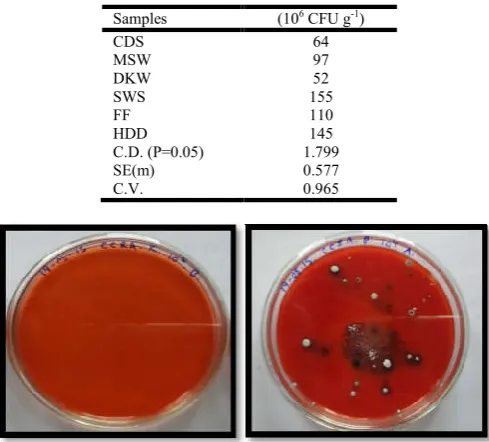
strains; ASN2 gave better yield as shown in Figure 1. ASN2 strain was further identified by using morphological and biochemical tests (Table 1 and Figure 2). Colonies of ASN2 on CMC agar were yellow white color, glistening; margins were entire, convex and circular and 1-2 mm in diameter at 30 When scraped with a loop, colonies were slimy or viscous and tend to clump. Fresh culture of this isolate consists of Gram negative, slender and rod shaped cells but the older cultures contain coccoid cells. Microscopic examination of this isolate revealed that it was gram negative, non-spore forming and motile. It was negative for indole production, Voges Proskauer test and citrate utilization and positive for catalase and nitrate reduction. It could ferment glucose, cellulose, lactose and sucrose. From these characteristics, isolate ASN2 was identified as Cellulomonas sp. Researchers studying on cellulolytic activity have isolated various bacteria from different environmental sources. CDS- Cow dung from cattle shed at Rajendranagar; MSW- Municipal solid waste from garbage disposal place of Rajendranagar; DKW
kitchen waste from hostel mess; SWS- Sewage water sample from sewage sludge of Rajendranagar; FF-Farmers’ Fields of college farm at Rajendranagar; HDD-Horse dung dump near veterinary college.
67521 International Journal of Current Research,
riment tub excluding the earthworms and their cocoons and juveniles (Priyanka et al,
For determination of pH, soil suspension in the ratio of 1:5 was prepared. The suspension was stirred at regular intervals for 30 minutes and the soil pH was recorded by the digital pH meter
Determination of soil available Nitrogen, Phosphorus and
For determining available nitrogen in soil sample method described by Subbiah and Asija, (1956) was adopted.
of cellulose degrading bacteria
[image:3.595.308.553.70.291.2]Cellulose is the main building block of plants and have major fraction of organic carbon in soil. Microorganisms, which live in soil, are accountable for recycling of this organic carbon to the environment. Degradation of cellulosic materials is a complex process and requires participation of microbial cellulolytic enzymes. Habitats where these substrates are present are the best sources for isolation of cellulolytic ms. About one fifth of fresh water and soil samples yield cellulose degrading bacteria after enrichment but some samples did not bear such kind of bacteria. This is due to existence of microenvironments where different growth ding bacteria are present. These bacteria are generally found in well manure soils. Several microorganisms have been discovered for decades which have capacity to convert cellulose into simple sugars but the need for newly isolated cellulose degrading microorganism still In the present study, seven cellulolytic bacteria were isolated from soil samples. These seven bacteria were screened for cellulase production in submerged fermentation process using suitable medium. Among all these seven tested bacterial strains; ASN2 gave better yield as shown in Figure 1. ASN2 strain was further identified by using morphological and biochemical tests (Table 1 and Figure 2). Colonies of ASN2 on CMC agar were yellow white color, glistening; margins were 2 mm in diameter at 30˚C. When scraped with a loop, colonies were slimy or viscous and tend to clump. Fresh culture of this isolate consists of Gram negative, slender and rod shaped cells but the older cultures s. Microscopic examination of this isolate spore forming and motile. It was negative for indole production, Voges Proskauer test and citrate utilization and positive for catalase and nitrate nt glucose, cellulose, lactose and sucrose. From these characteristics, isolate ASN2 was sp. Researchers studying on cellulolytic activity have isolated various bacteria from Cow dung from cattle Municipal solid waste from garbage disposal place of Rajendranagar; DKW- Domestic Sewage water sample Farmers’ Fields of Horse dung dump near
Table 4.1. Isolation of cellulose degrading bacteria
Samples CDS MSW DKW SWS FF HDD C.D. (P=0.05) SE(m) C.V.
Plate 1. Isolation of cellulose degrading bacterial isolates
CCRA- Control plateCCRA-degrading bacterial colonies
Cellulase activity of bacterial isolates
Maximum clearing zone ranged from 1.38 and 1.25 mm demonstrating that the isolates have the ability to degrade the carboxymethyl cellulose and indicating high ability of cellulase production. Among 15 bacterial isolates, the isolates CDB-30 and CDB-34 as evidenced by its maximum clearing zone value of 1.38 mm, followed by CD
CDB-36 (1.30 mm), CDB-10 (1.25 mm), CDB CDB-11, CDB-26, CDB-41, CDB
(1.13 mm). Similarly quantitative estimation of cellulose activity results revealed that same manner (CDB
ml-1, CDB-34: 0.148 mg ml CDB-36: 0.135 mg ml-1, CDB 4.1.3).
Biochemical characteristics of cellulose degrading bacterial isolates
After the morphological characterization, the isolates were tested for different biochemical characters like catalase and urease production, IMVIC (Indole test, Methyl red reaction, Voges-Proskauer reaction, Citrate utilization), Nitrate reduction, Carbohydrate fermentation (acid
Starch hydrolysis, Gelatin liquefaction and Casein hydrolysis (Table 4.1.1.B). The biochemical test were conducted for all 15 bacterial isolates 3 isolates were positive for indole reaction, 12 isolates positive ca
positive for oxidase activity, Voges Proskauer test and Denitrification tests. 13 isolates were positive for gelatine liquefaction, 11 isolates were positive for citrate utilization, 4 isolates were positive for starch hy
positive for H2S production, and in carbohydrate utilization tests 11 isolates utilized glucose, 6 isolates utilized galactose and 7 isolates used lactose. All isolates exhibited denitrification activity. The isolates were identi
gram reaction and colony morphology on different media. Fifteen isolates showed growth on specialized media. Observations recorded after streaking and incubation on different medium.
International Journal of Current Research, Vol. 10, Issue, 04, pp.67519-67526, April, 2018
Table 4.1. Isolation of cellulose degrading bacteria
(106 CFU g-1)
64 97 52 155 110 145 1.799 0.577 0.965
Isolation of cellulose degrading bacterial isolates
- Media plate with cellulose
Cellulase activity of bacterial isolates
Maximum clearing zone ranged from 1.38 and 1.25 mm the isolates have the ability to degrade the carboxymethyl cellulose and indicating high ability of cellulase production. Among 15 bacterial isolates, the isolates 34 as evidenced by its maximum clearing zone value of 1.38 mm, followed by CDB-43 (1.32 mm), 10 (1.25 mm), CDB-64 (1.25 mm), 41, CDB-31 (1.18 mm), CDB-15 (1.13 mm). Similarly quantitative estimation of cellulose activity results revealed that same manner (CDB-30: 0.149 mg 8 mg ml-1, CDB-10: 0.136 mg ml-1, 1, CDB-43: 0.129 mg ml-1) (Table
Biochemical characteristics of cellulose degrading bacterial
After the morphological characterization, the isolates were tested for different biochemical characters like catalase and urease production, IMVIC (Indole test, Methyl red reaction, Proskauer reaction, Citrate utilization), Nitrate drate fermentation (acid-gas production), Starch hydrolysis, Gelatin liquefaction and Casein hydrolysis (Table 4.1.1.B). The biochemical test were conducted for all 15 bacterial isolates 3 isolates were positive for indole reaction, 12 isolates positive catalase activity, all isolates were positive for oxidase activity, Voges Proskauer test and Denitrification tests. 13 isolates were positive for gelatine liquefaction, 11 isolates were positive for citrate utilization, 4 isolates were positive for starch hydrolysis, 14 isolates were S production, and in carbohydrate utilization tests 11 isolates utilized glucose, 6 isolates utilized galactose and 7 isolates used lactose. All isolates exhibited denitrification activity. The isolates were identified based on gram reaction and colony morphology on different media. Fifteen isolates showed growth on specialized media. Observations recorded after streaking and incubation on
Both morphological, cultural biochemical characters were used for identification of the isolates using the criteria mentioned in Bergey’s Manual of Systematic Bacteriology.
pH of different treatments
Among the different treatments the pH was found highest in T (Vermicomposting without pretreatment) (8.25) on 0th day and the result was found on par with the treatments of T (Composting with pretreatment), T4 (Vermicomposting w pretreatment) and T1 (Composting without pretreatment).
Indole test
Citrate utilization test
Starch hydrolysis
Plate 2. Biochemical characters of the cellulose degr
67522 Prasanna Kumar et al.Microorganisms in the conversion of pretreated agricultural waste to compost and vermicompost
Both morphological, cultural biochemical characters were used for identification of the isolates using the criteria mentioned in Bergey’s Manual of Systematic Bacteriology.
Among the different treatments the pH was found highest in T3 (Vermicomposting without pretreatment) (8.25) on 0th day and the result was found on par with the treatments of T2 (Vermicomposting with (Composting without pretreatment).
Among the different intervals the pH was slightly low initially and it was increased continuously up to 28th day and slightly reduced in other treatments in the respective intervals.
Nutrient status of different treatments at di of experiment
Nitrogen content during pretreatment of agricultural waste found on par at different intervals in all the treatments except T3 (Vermicomposting without pretreatment) (i.e. 0.84 to 1.65 %).
Voges proskauer test Methyl red test
Citrate utilization test Gelatin liquefaction Oxidase and catalase test
Starch hydrolysis Inoculum development
Biochemical characters of the cellulose degrading isolates
icroorganisms in the conversion of pretreated agricultural waste to compost and vermicompost
Among the different intervals the pH was slightly low initially and it was increased continuously up to 28th day and slightly
other treatments in the respective intervals.
Nutrient status of different treatments at different intervals
Nitrogen content during pretreatment of agricultural waste found on par at different intervals in all the treatments except micomposting without pretreatment) (i.e. 0.84 to 1.65
Oxidase and catalase test
Inoculum development
Table 2. Cellulase activity of bacterial isolates
S.No Isolates CDS MSW DKW SWS Zone (mm) Enzyme activity (mg/ml)
1 CDB-1 + - - - 0.75 0.032
2 CDB-4 - + - - 0.35 0.020
3 CDB-5 - + - - 0.20 0.016
4 CDB-7 - - + - 0.55 0.015
5 CDB-9 - - + - 0.53 0.015
6 CDB-10 - - - + 1.25 0.136
7 CDB-11 - - - + 1.18 0.126
8 CDB-15 - - - + 1.13 0.124
9 CDB-18 - - - - 0.25 0.018
10 CDB-21 - + - - 0.98 0.019
11 CDB-23 - + - - 0.75 0.020
12 CDB-24 - - + - 0.93 0.013
13 CDB-26 - - + - 1.18 0.125
14 CDB-28 - - - + 0.98 0.024
15 CDB-30 - - - + 1.38 0.149
C.D. 0.058 0.005
SE(m) 0.020 0.002
C.V. 4.225 5.493
[image:5.842.53.791.298.435.2]CDS- Cow dung sample; MSW- Municipal solid waste; DKW- Domestic kitchen waste; SWS- Sewage water sample.+ and – indicate : Source of sample for isolation of bacterial isolates
Table 3. B. Biochemical characteristics of cellulose degrading bacterial isolates
S.No Biochemical tests CDB-1 CDB-4 CDB-5 CDB-7 CDB-9 CDB-10 CDB-11 CDB-15 CDB-18 CDB-21 CDB-23 CDB-24 CDB-26 CDB-28 CDB-30
1 Indole test - - + - + + - - - -
2 Catalase test + + - + - + - + + + + + + + +
3 Oxidase test + + + + + + + + + + + + + + +
4 Gelatin liquifaction - + + + - + + + + + + + + + +
5 Methyl red test - - - - + - - - -
6 V-P test + + + + + + + + + + - + + + +
7 Citraye utilization - + - + + + + + + - + + + - +
8 Starch hydrolysis - + - + + - - - +
9 H2S + + + + + + + + + + + - + + +
10 Denitrification + + + + + + + + + + + + + + +
11 Glucose + - - + + + - + - + + + + + +
12 Galactose - - + + - + - - + + - + - - -
13 Lactose - + - + + - - + - + + - - + +
pH of different treatments
pH
Initial 14th Day 28th Day
T1 8.00 8.25 8.18
T2 8.20 8.38 8.26
T3 8.25 8.40 8.33
T4 8.20 8.36 8.28
Nutrient status of different treatments at different intervals of experiment
Nitrogen (%) Phosphorus (%) Potassium (%) Organic carbon (%)
Initial 14th Day 28th Day Initial 14th Day 28th Day Initial 14th Day 28th Day Initial 14th Day 28th Day
T1 0.60 0.65 0.70 0.15 0.24 0.17 0.65 0.71 0.72 25.50 28.15 26.70
T2 0.70 0.79 0.90 0.16 0.25 0.19 0.70 0.76 0.78 24.00 26.78 25.00
T3 1.65 0.84 1.91 1.00 1.28 1.06 0.99 1.15 1.01 21.60 24.50 22.00
T4 1.84 1.86 2.41 1.00 1.26 1.10 1.00 1.26 1.05 22.60 26.48 23.50
T1 - Composting without pretreatment T2 - Composting with pretreatment T3 - Vermicomposting without pretreatment T4 - Vermicomposting with pretreatment
Among all the intervals the N content gradually increased from 0th day to 28th day. Among the treatments the N content was found significantly highest with the treatment T4 (Vermicomposting with pretreatment) (i.e. 1.81 to 2.41 %) on 28th day followed by T3 (Vermicomposting without pretreatment). Lowest N content was observed in T1 (Composting without pretreatment) (Table 4.6). There was a significant variation in available nitrogen content in substrates between different treatments. This variation in available nitrogen content of substrates was noticed in all the stages of composting, vermicomposting and biogas production period. P content was found on par at different intervals in all the treatments. Among all the treatments P content was found significantly highest in T3 (Vermicomposting without pretreatment) and T4 (Vermicomposting with pretreatment) and least was found in the treatment T1 (Composting without pretreatment). Among all the intervals P content was increased up to the 14th day of pretreatment and gradual reduction was observed up to 28th day (Table 4.6). It is evident from this experiment that increase in phosphatase activity by microorganisms leads to increase in amount of phosphorus which support the phosphate availability in the substrates. Similarly the available potassium was on par from treatments of T4 (Composting without pretreatment) on 0th day (i.e. 1.00 to 1.00 %) And among all the treatments T4 (Vermicomposting with pretreatment) (i.e. 1.00 to 1.26 %) showed the highest K content was observed with treatment T1 (Composting without pretreatment) on 28th day. Among all the intervals the K content gradually increased from 0th day to 28th day in T2 (Composting with pretreatment) (Table 4.6). This could be attributed to the fact that with the passage of time the substrate composition changes and becomes suitable for microorganisms to work upon, in turn increasing the activity of potassium in substrates between different intervals.
DISCUSSION
The pH of both vermicompost and compost was found to be in the range of 8.25-8.00 initially and dropped to 8.14 during the process. The slight change in pH from slightly acidic to neutral is due to increase in N, P and K content or Organic matter content. The results found that pH of the substrate has a significant effect on composting, vermicomposting and biogas production, because it affects the activity of bacteria to degrade organic matter into biogas. A low pH in the digester inhibits the activity of microorganisms involved in the digestion process particularly methanogenic bacteria. The breakdown of organic matter during the composting process is dependent on several factors working in concert. These include moisture, microbial populations, Oxygen (O2), and a balance of Carbon (C) and Nitrogen (N). Microorganisms in the organic matter (OM) consume the readily available carbon. As it is metabolized, temperatures increase in the compost pile and Carbon dioxide (CO2) is released. As a result, the pile is newly populated with thermophilic, or heat-loving, bacteria that consume the rest of the degradable carbon. As microbial activity slows, temperature decreases, allowing for colonization by fungi that slowly consume much of the remaining recalcitrant forms of lignins and cellulose. The resulting crumbly, earthy humus is considerably more stable than manure, meaning that its nutrients are less likely to be lost to leaching or volatilization into the atmosphere. Nitrogen losses impact negatively on the manure composting process, by decreasing nutrient concentration and hence compost quality, and generate health and environmental problems.
Nitrogen losses through composting can occur by NH3-volatilisation, leaching and denitrification. Denitrification can occur as a result of the development of anaerobic microsites within the material. Thus, the aerobic conditions of the compost should be ensured throughout the process, indicated that emission rates of N2O–N were very much lower (about 10 times) than those of NH3–N during composting of cattle manure with maize straw.
Conclusion
Biological pretreatment with complex microbial agents proved to be an efficient method to improve biodegradability to enhance composting, vermicomposting of agricultural waste and horticultural waste. Compared to untreated controls the pretreated agricultural and horticultural waste yielded higher manurial value. Substrates were used for compost, vermicompost making in lab scale. In the present study, results revealed that agricultural and horticultural wastes pretreatment with efficient microbes helped aerobic composting, vermicomosting. By the pretreatment of agricultural waste, horticultural waste were easily degraded by enriched cultures and their enzyme activities. In the present study vermicompost with microbial pretreatment enhanced degradation and nutrient values compared to regular composting methods. Compared to aerobic composting, vermicomposting showed to be better. The N, P and organic carbon % increased in all the treatments of horticultural waste compared to agricultural waste. Considering the characteristics of the high moisture solid waste of agricultural and horticultural waste.
REFERENCES
Andro, T., Chambost, J.P., Kotoujansky, A., Cattaneo, J., Bertheau, Y., Barras, F., Van Gi-Isegem, F and Coleno, A. 1984. Mutants of plant cells by pectic enzymes: the lack of direct injurious interaction between pectic enzymes or their soluble reaction products and plant cells. Phytopathology. 141-153.
Bailey, M.J., Biely, P and Poutanen, K. 1992. Interlaboratory Testing of Methods for Assay of Xylanase Activity.
Journal of Biotechnology. 23 (3):257-270.
Barrow, G.I. and Feltham, R.K.A., Eds. 1993. Cowan and Steel’s Manual for the Identification of Medical Bacteria. 3rd Edition, Cambridge University Press, Cambridge. 331. Basavaraj, I.P., Shivasharan, C.T and Kaliwal. B.B. 2014.
Isolation and Characterization of Cellulase producing bacteria from Soil. International Journal of Current
Microbiology and Applied Sciences. 3 (5): 59-69.
Bentize, E., Nogales, R., Masciandro, G and Ceccanthi. B. 2000. Isolation by isoelectric focusing of humic urease complex from earthworm Eisenia foetida processed sewage sludge. Biology and Fertility of Soils. 31: 489-493.
Cullimore, D.R. 2000. Practical atlas for bacteria identification. [M]. USA: Lewis publishers.
Garg, V.K., Suthar, S and Yadav, A. 2011. Management of food industry waste employing vermicomposting technology. Bioresource Technology. 126: 437-443. Jackson, M. L. 1962. Soil chemical analysis. Prentice Hall.
Englewood Cliffs, New York, U.S.A.
Miller. 1959. Use of dinitrosalicylic acid reagent for detection of reducing sugars. Analytical Chemistry. 31 (3): 426-428. Prasanna, K.B., Triveni, S., Subhash Reddy, R and Vijaya
Gopal, A. 2016. Effect of Cellulolytic Pretreatment of Agricultural Waste on Organic Matter Degradation.
International Journal of Current Microbiology and Applied Sciences. 5 (12). 23-35.
Priyanka, A., Nidhi, R., Devendra, S.R and Sonika, J. 2015. Influence of Chemical fertilizers and Organic fertilizers on pH and available Nitrogen content of Vermicompost with earthworm Eisenia foetida. International Journal of
Advanced Research. 3 (7): 1030-1036.
Reinecke, A. J., Viljoen, S. A. and Saayman, R. J. 1992. The suitability of Eudrilus eugeniae, Perionyx excavatus and
Eisenia foetida (Oligocaeta) for vermicomposting in
Southern Africa in terms of their temperature requirements.
Soil Biology and Biochemistry. 24: 1295-1307.
Shoham, Y., Lamed, R and Bayer, E.A. 1999. The cellulosome concept as an efficient microbial strategy for the degradation of insoluble polysaccharides. Trends in
Microbiology. 7 (7): 275-281.
Suthar S., Watts J., Sandhu M., Rana S., Kanwal A., Gupta D., Meena M.S., 2005. “Vermicomposting of Kitchen Waste by using Eisenia Foetida (Savigny)”. Asian Journal of
Microbiology, Biotechnology & Environmental Sciences. 7:
541-544.
Yasmin, S and D'Souza, D. 2007. Effect of pesticides on the reproductive output of Eisenia fetida. Bulletin of
Environmental Contamination and Toxicology. 79 (5):
529-532.
Yin, H., Zhao, X., and Du, Y. 2010. Oligochitosan: a plant diseases vaccine-A review. Carbohydrate Polymers. 82: 1-8.