ISSN Online: 2333-9721 ISSN Print: 2333-9705
DOI: 10.4236/oalib.1105449 Jun. 11, 2019 1 Open Access Library Journal
Assessing the Performance of Student Teachers
in a Bachelor of Education Programmes at the
University of Technology, Jamaica
Cynthia Onyefulu, Grace Hughes, Richard Samuels
Faculty of Education & Liberal Studies, University of Technology, Jamaica
Abstract
Teaching practice is an integral part of teacher education programmes around the world. All student teachers at the University of Technology (UTech), Jamaica are required to do a series of teaching practice courses, namely, one week of school observation, two weeks of team teaching, and 12 weeks of individual teaching. The main purpose of this study was to assess the performance of the student teachers in the Bachelor of Education Pro-grammes at UTech, Jamaica. To answer the three research questions that guided the study, the ex-post facto research design was used. The scores from the theory lesson of 88 student teachers who participated in the 2011/12 teaching practice exercise were used. The results showed that some student teachers from the Business and Computing Studies programme got one to five visits during the teaching practice when compared to those in the Family and Consumer Studies, and the Industrial Technology groups who had three to five visits, respectively. The results showed that for Lesson Preparation, there was a statistically significant difference between the student teachers in the Business and Computing Studies and the Family and Consumer Studies. For Lesson Delivery, there was a statistically significant difference between the Business and Computing Studies and the Industrial Studies student teachers. There were no differences in the other two domains (Professional-ism & Classroom Management, & Communication Skills). The results also showed that there was a weak positive relationship between the scores awarded by the programme and education specialists to the student teachers in the Business and Computing Studies only. There were no significant rela-tionships for the scores awarded to the student teachers in the Industrial Technology, and Family and Consumer Studies programmes. Based on the findings, some recommendations were made on how to improve the teacher preparation programmes, including the teaching practice exercise.
How to cite this paper: Onyefulu, C., Hughes, G. and Samuels, R. (2019) Assessing the Performance of Student Teachers in a Bachelor of Education Programmes at the University of Technology, Jamaica. Open Access Library Journal, 6: e5449.
https://doi.org/10.4236/oalib.1105449
Received: May 7, 2019 Accepted: June 8, 2019 Published: June 11, 2019
Copyright © 2019 by author(s) and Open Access Library Inc.
This work is licensed under the Creative Commons Attribution International License (CC BY 4.0).
http://creativecommons.org/licenses/by/4.0/
DOI:10.4236/oalib.1105449 2 Open Access Library Journal
Subject Areas
Education
Keywords
Student Teachers, Teaching Practicum, Teaching Practice Performance
1. Introduction
Teaching practice is an internship period where student teachers perform some roles such as teaching, managing the classroom and students’ behaviours, as-sessing student learning, while reflecting on their practices (Ashraf [1], Andabai
[2], Edem [3]). Teaching practice is seen as an integral part of a teacher educa-tion programme (Henry [4], Richard, Role, & Makewa [5]), and considered as an essential component of teacher preparation, because it is seen as “the best way to acquire professional knowledge and competence as a teacher” (Cocard, & Moser [6], p. 626). This crucial component of a teacher preparation programme is sometimes referred to as field experience (Edge [7]), or teaching practice (Fraser [8]). Others prefer to use the term “practice teaching, student teaching, teaching practice, field studies, infield experience, school-based experience or internship” (Richard, Role, & Makewa [5], p. 43). In this study, it is referred to as teaching practice and/or practicum.
According to Ogonor and Badmus [9] and Richard, Role and Makewa [5], those who embank on this exercise are called student teachers. However, other authors use related terms. For instance, Edge [7] referred to them as “future teachers, prospective teachers, interns, rather than learners or students of teach-ing” (p. 37). Fraser [8] used the term “pre-service teachers” (p. 246), while Song
[10] referred to them as teacher candidates. The term “student teacher” is used in this study.
For student teachers to acquire this knowledge, they are assigned to schools to teach, and this learning experience is supervised and assessed (Maphosa & Ndamba [11]). During the practicum, student teachers are assigned to schools where they teach and participate in other school-related activities. These student teachers are also supervised and assessed during the practicum.
1.1. Background of the Study
DOI: 10.4236/oalib.1105449 3 Open Access Library Journal (B.Ed.) summer programme (Faculty of Education & Liberal Studies [12]). Both programmes were offered in three areas of specialisation, namely Business and Computing Studies, Family and Consumer Studies, and Industrial Technology. The Faculty also offers a Postgraduate Diploma in Education programme in dif-ferent subject areas during the summer semester. This study focused on the per-formance of student teachers in the full-time (four-year) B.Ed. in Technical, Vocational Education and Training programme in Business and Computing Studies, Family and Consumer Studies, and Industrial Technology.
All student teachers in the aforementioned programmes are required to do a series of teaching practice courses. These include one week of school observa-tion, two weeks team teaching, and 12 weeks of individual teaching. Each is ex-plained below.
1) One week of school observation (done in year 1, semester 1). This exer-cise is an initiation into the teaching profession for the student teachers. No university assessors are assigned to see the student teachers during the school observation exercise. However, student teachers are required to submit an ob-servation booklet and would discuss their findings in a Foundations of Educa-tion course (Faculty of EducaEduca-tion & Liberal Studies [13]).
2) Two weeks of team teaching (done in year 3, semester 1). This is an op-portunity for the student teachers to teach before assuming full solo responsibil-ity in their final year. The Universresponsibil-ity assessors are assigned to see the students during the team teaching and the individual teaching exercises (Faculty of Edu-cation & Liberal Studies [13]).
DOI:10.4236/oalib.1105449 4 Open Access Library Journal mentoring roles and providing feedback which would help the student teachers to improve their teaching skills and competencies. As indicated earlier, the coo-perating teachers are not expected to formally assess the student teachers (Fa-culty of Education & Liberal Studies [13]).
Lecturers from the three areas of specialisation mentioned earlier, as well as those from the education division, are referred to as supervisors or university
(internal) assessors. These supervisors are responsible for observing and
assess-ing as well as providassess-ing feedback to the student teachers who they have super-vised during the three teaching practice exercises. There are also external
asses-sors who are not employees of the university but are contracted to externally
as-sess and submit grades for all the student teachers who participated in the 12-week practicum. One of the external assessors is appointed as the chief ex-ternal assessor. The chief exex-ternal assessor has the responsibility of moderating both the internal and external grades and submitting a written report at the end of the exercise (Faculty of Education & Liberal Studies [13]).
5) Teaching Practice Prerequisite. To ensure that the student teachers are ready for the practicum exercise, they must pass two courses in the curriculum, namely, special methods and instructional methods. In these courses, the stu-dent teachers are taught competencies on how to use different teaching strate-gies, which could impact learning. They must also pass all courses in their area of specialisation (Faculty of Education & Liberal Studies [13]).
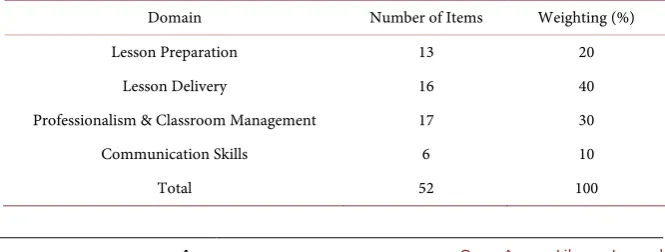
6) Teaching Practice Assessment. At the time of this study, the student teachers were assessed under four domains, namely, lesson preparation, lesson delivery, professionalism and classroom management, and communication skills by both the internal and external assessors in the three areas of specialisation. The response format for all four domains are as follows: Unable to Observe (U), Poor (1), Weak (2), Average (3), Good (4), and Excellent (5). See Table 1 for the number of items and weighting on the different domains.
1.2. Statement of the Problem
[image:4.595.205.538.619.745.2]Each year, student teachers are assigned to different high schools within and around Kingston and St. Andrew for the practicum experience, and there has always been a concern about how the students are performing based on the scores they earned at the end of each teaching practice period. There is also an
Table 1. Distribution of items and weighting.
Domain Number of Items Weighting (%)
Lesson Preparation 13 20
Lesson Delivery 16 40
Professionalism & Classroom Management 17 30
Communication Skills 6 10
DOI: 10.4236/oalib.1105449 5 Open Access Library Journal on-going perception of the differences in the ways scores are assigned by the programme specialists and the education specialists (internal assessors). This perception has resulted in some lecturers expressing the view that programme specialists, that is, those internal assessors from the three areas of specialisation are more stringent than those from the education unit. However, no formal study has ever been done to ascertain if these concerns are real.
A review of the literature revealed several studies have been done on student teachers on teaching practice. However, there is little of study on the assessment of the performance of student teachers in Jamaica. This study is designed to ad-dress this gap in the existing literature.
1.3. Purpose of the Study
The main purpose of this study was to assess the performance of the student teachers in a Bachelor of Education Programmes at the University of Technolo-gy, Jamaica. The study was also aimed at determining if there was any associa-tion between the scores given by the educaassocia-tion specialists and the programme specialists during the teaching practice exercise.
1.4. Research Questions
The following research questions were answered:
1) How frequently were student teachers assessed during the teaching practice exercise?
2) To what extent is there a difference in the performance of the student teachers from the three areas of specialisation in the four domains (lesson prep-aration, lesson delivery, professionalism and classroom management, & com-munication skills) during the teaching practice exercise?
3) To what extent is there a relationship between the scores given by the pro-gramme and education specialists during the teaching practice exercise?
1.5. Research Hypothesis
The following null hypotheses were tested by using One Way Analysis of Va-riance (ANOVA) and Pearson’s Product Moment (r), respectively:
Ho1: There is no difference in the performance of the student teachers from the three areas of specialisation in the four domains during the teaching practice exercise.
Ho2: There is no relationship between the scores given by the programme and education specialists during the teaching practice exercise.
2. Literature Review
DOI:10.4236/oalib.1105449 6 Open Access Library Journal Liu and Qi [20], Mahmood and Iqbal [21], Magope and Otukile-Mongwaketse
[22], Newton, Kadenyi, and Mukuna [23], Onyebukwa-Nwanoro [24], Onyefulu
[25], and Rauduvaite, Lasauskiene, and Barkauskaite [26], to name a few. Liu and Qi [20] assessed student teaching practice in two elementary teacher preparation programmes in China and the United States of America (USA) and found some similarities and differences between the two countries. For instance, more hours were allocated to student teaching in the US when compared to those in China. In terms of similarities, they also found that in both countries, student teachers used reflection journals in their professional portfolios, and in both countries, similar evaluation criteria were used for student teacher assess-ment. Other studies focused on the experiences and perceptions of student teachers. These include studies by Hyndman [18] that examined the differences in teaching perspectives of student teachers and graduates physical education teachers in Australia. The findings, among other things, found nurturing as the main teaching perceptive among the two groups. Rauduvaite, Lasauskiene, and Barkauskaite [26] who investigated the experiences of pre-service music teachers in a university in Northern Europe and found both positive (relationships with students, mentors, and other teachers, and self and professional development), and negative (lack of confidence, fear, and lack of professional readiness) expe-riences based on the teachers’ reflections. Kiggundu and Nayimuli [19] also ex-amined the experiences of student teachers during teaching practice in South Africa. In this qualitative study, the participants found their hands-on expe-riences in the classrooms to interesting due to constant supportive relation and guidance from most of their mentors, but difficult due to lack of self-confidence and intimated by some other teachers. In yet another qualitative study con-ducted by Magope and Otukile-Mongwaketse [22], they explored the teaching practice experiences of special education student teachers in a university in Botswana, and found that the participants also expressed both positive (e.g., valuable hands-on exercises) and negative (e.g., limited pedagogical knowledge & skills) experiences with regards to inclusive classrooms. While others as such as Mahmood and Iqbal [21] in India; Newton, Kadenyi, and Mukuna [23] in Kenya; Ebrahim, Eyadat, and Alshammari [16] in Kuwait; Onyebukwa-Nwanoro
[24] in Nigeria; and Abongdia, Adu, and Foncha [14] in South Africa, all ex-amined challenges that face student teachers during teaching practice. Some of the challenged revealed, among other things, were lack of resources, professional and academic issues, large class sizes, the host schools, and attitudes of school staff and cooperating teachers.
DOI: 10.4236/oalib.1105449 7 Open Access Library Journal continuous professional development for all involved in school” (p. 115).
There are also studies on the assessment of teaching practice. For instance, in South Africa, Fraser [8] explored issues related to competency-based assessment during teaching practice. According to Fraser [8], teaching practice calls for the assessment of competence in practice, and “the purpose of assessment is the col-lection of sufficient evidence of workplace performance to demonstrate that in-dividuals can perform or behave to the specified standards in a specific role” (p. 248). Still on the issue of assessment, in Kenya, Richard, Role, and Makewa [5]
investigated the differences in performance between male and female student teachers during the teaching practice exercise. Their findings showed that there were differences in the way the males viewed the feedback received, but there were also some similarities in the way the two groups viewed the collaborating teachers’ attendance to their classes. Another study done in Malawi, Kaphesi
[27] assessed the performance of final year undergraduate student teachers at their practicum. The findings showed that in some cases, the grades awarded by the assessors were lower than the written comments on the quality of the student teachers. The review of the literature also showed other assessment-related stu-dies done on student teachers in practice. For instance, Hall and West [28] ex-amined student teacher performance on emotional intelligence at a private uni-versity in the United States; in Africa, Nnenna and Olanrewaju [29] examined the relationship between teaching practice anxiety and performance in federal colleges of education in Southwestern Nigeria; similarly in Nigeria, Oluwatayo and Adebule [30] studied teaching practice performance by using Teaching Practice Assessment form designed by a Faculty of Education; and still in Nige-ria, Ogonor and Badmus [9] examined reflective teaching practice among stu-dent teachers, while Onyefulu [25] investigated the characteristics of the teach-ing practice programme at the University of Technology, Jamaica. The literature has shown that there is a need to explore student teacher performance other than just to examine their perceptions, beliefs, and experiences. There is an im-portant gap in the literature which this study was designed to fill.
3. Research Methodology
3.1. Design and Sample
DOI:10.4236/oalib.1105449 8 Open Access Library Journal
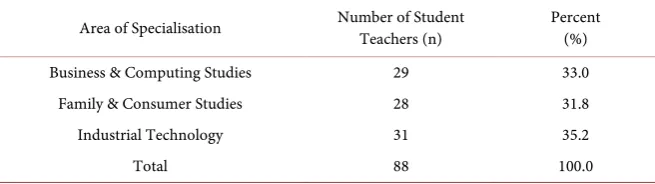
Table 2. Distribution of student teacher by Area of specialisation.
Area of Specialisation Number of Student Teachers (n) Percent (%)
Business & Computing Studies 29 33.0
Family & Consumer Studies 28 31.8
Industrial Technology 31 35.2
Total 88 100.0
3.2. Data Collection
Three different teaching practice scales were used for assessing student teachers at the University of Technology, Jamaica. These included the scales for assessing theory lesson, practical lesson, and test administration. The use of more than one instrument for assessing student teachers is supported by Fraser [8] who stated that “one assessment too or instrument will never be adequate enough to measure all the skills and competence of a student teacher” (p. 249).
Since this study was not aimed at assessing student teachers’ overall compe-tency, the scores used were obtained from the theory lesson assessment only. For the theory lesson, the student teachers were assessed using a scale with 52 items under the following sections: lesson preparation, lesson delivery, professionalism and classroom management, and communication skills. These items had the following response format: Unable to Observe without a value, No Attempt with a value of (0), Poor with a value of (1), Weak (2), Average (3), Good (4), and Excellent (5).
3.3. Reliability Coefficient Analysis
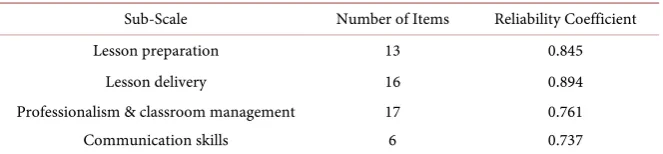
The Cronbach alpha reliability coefficient was computed with the scores from the teaching practice (theory) scale. This was done to ensure that the scores used in the study were reliable. The overall reliability coefficient was 0.919. The sub-scale reliability coefficients ranged from 0.737 to .894. Although several au-thors have quoted different acceptable reliability coefficients, Reynolds, Livings-ton, and Wilson (2006) [31] endorsed reliability estimates that are from 0.70 and above. See Table 3 for the reliability coefficients for the four sub-scales.
3.4. Data Analysis
The scores were coded and entered into SPSS version 21 and analysed using de-scriptive statistics (mean, standard deviation, frequency, & percentage), and in-ferential statistics (ANOVA & Pearson’s Product Moment). It should be pointed out that although the numbers of student teachers in the three groups were un-equal, the effects of violations of the ANOVA test assumptions were not consi-dered as serious because of its robustness (Glass & Hopkins [32]; Ravid [33]).
4. Results
DOI: 10.4236/oalib.1105449 9 Open Access Library Journal
Table 3. Sub-scale reliability coefficients.
Sub-Scale Number of Items Reliability Coefficient
Lesson preparation 13 0.845
Lesson delivery 16 0.894
Professionalism & classroom management 17 0.761
Communication skills 6 0.737
Jamaica schools were used. Thirteen of these schools are located in the parishes of Kingston and St. Andrew, while seven are outside these parishes. Three of these institutions where the student teachers did their practicum are referred to as technical high schools, while 17 were traditional high schools.
The student teachers from the Business and Computing Studies programme taught the following subjects: principles of accounting, principles of business, and information technology; those from the Family and Consumer Studies pro-gramme taught mostly home and family management, clothing and textiles, and food and nutrition; while those from the Industrial Technology programme taught electrical technology, industrial techniques, mechanical technology, tech-nical drawing, machine shop, metalwork, woodwork, and building construction. It should be noted that some of these subjects do have practical components; however, this study only focused on the theory aspect of the lesson delivery.
4.1. Frequency of Assessment during the Teaching Practice
Research Question One: How frequently were student teachers assessed during
the teaching practice exercise?
The number of times the student teachers were assessed during the three-month teaching practice was calculated from the assessors’ log. See Table 4 for the fre-quency of the student teachers’ teaching practice assessments. The log inspection revealed that a few student teachers in the Business and Computing Studies pro-gramme got only one visit during the teaching practice. The mode for this group was three assessments, indicating that 13 student-teachers were assessed three times. The mode for the Family and Consumer Studies group was four, which appeared 12 times, while the mode for the Industrial Technology group was three, which appeared 11 times.
4.2. Student Teachers’ Performance in the Four Domains
Research Question Two: To what extent is there a difference in the performance
of the student teachers from the three areas of specialisation in the four domains (lesson preparation, lesson delivery, professionalism and classroom manage-ment, & communication skills) during the teaching practice exercise?
DOI:10.4236/oalib.1105449 10 Open Access Library Journal
Table 4. Number of assessments received by student teachers.
Areas of Specialisation Number of Student Teachers Assessed Number of Assessments
Business & Computing Studies 29 1 - 5
Family & Consumer Studies 28 3 - 5
Industrial Technology 31 3 - 5
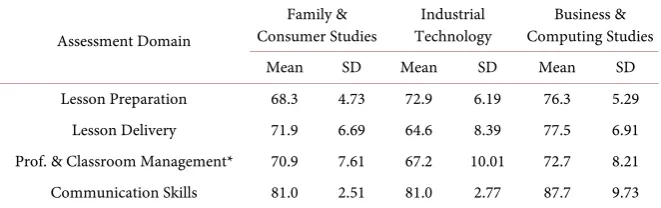
Table 5. Student teachers’ performance in the four domains.
Assessment Domain
Family &
Consumer Studies Technology Industrial Computing Studies Business &
Mean SD Mean SD Mean SD
Lesson Preparation 68.3 4.73 72.9 6.19 76.3 5.29
Lesson Delivery 71.9 6.69 64.6 8.39 77.5 6.91
Prof. & Classroom Management* 70.9 7.61 67.2 10.01 72.7 8.21
Communication Skills 81.0 2.51 81.0 2.77 87.7 9.73
*Professionalism & classroom management.
ranged from 5.29 to 9.73 when compared to the Industrial Technology and the Family and Consumer Studies scores, which ranged from 2.77 to 10.01, and 2.51 to 7.61, respectively. These figures showed that there was less spread in the scores obtained by the student teachers in the Business and Computing Studies programme.
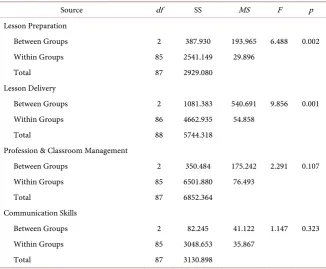
Furthermore, the analysis of variance (ANOVA) was used to determine if there were differences in the student teachers’ performance in the four domains. As shown in Table 6, there were significant differences in two domains, namely, Lesson Preparation F(2, 85) = 6.488, p = 0.002, and Lesson Delivery F(2, 85) = 9.856, p = 0.001, respectively. Tukey’s post-hoc multiple comparison test was used to determine which groups were different. The results showed that for Les-son Preparation, there was a statistically significant difference between the stu-dent teachers in the Business and Computing Studies and the Family and Con-sumer Studies. For Lesson Delivery, the Tukey test also showed there was a sta-tistically significant difference between the Business and Computing Studies and the Industrial Studies student teachers.
There were no differences in the other two domains, namely, Professionalism and Classroom Management, and Communication Skills. The null hypothesis, there is no difference in the performance of the student teachers from the three
areas of specialisation in the four domains during the teaching practice exercise,
was therefore rejected.
4.3. Relationship between Programme Specialists and
Education Specialists
Research Question Three: To what extent is there a relationship between the
[image:10.595.208.539.201.305.2]DOI: 10.4236/oalib.1105449 11 Open Access Library Journal
Table 6. ANOVA Summary table comparing three groups on four domains on teaching
practice.
Source df SS MS F p
Lesson Preparation
Between Groups 2 387.930 193.965 6.488 0.002
Within Groups 85 2541.149 29.896
Total 87 2929.080
Lesson Delivery
Between Groups 2 1081.383 540.691 9.856 0.001
Within Groups 86 4662.935 54.858
Total 88 5744.318
Profession & Classroom Management
Between Groups 2 350.484 175.242 2.291 0.107
Within Groups 85 6501.880 76.493
Total 87 6852.364
Communication Skills
Between Groups 2 82.245 41.122 1.147 0.323
Within Groups 85 3048.653 35.867
Total 87 3130.898
practice exercise?
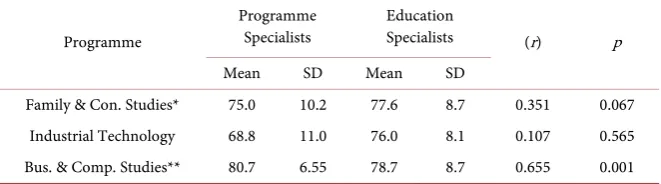
To answer the above research question bivariate (Pearson’s product moment) was computed. The overall (n = 88) obtained Pearson’s coefficient was (r = 0.329) significant at 0.001 level. This indicated that in general, there was a weak positive relationship between the scores given by the programme and education specialists during the teaching practice exercise. See Table 7 for the results of the relationship between the scores awarded by the programme and education spe-cialists during the teaching practice exercise.
As shown in Table 7, there were no significant relationships for the scores awarded to the student teachers in the Industrial Technology, and Family and Consumer Studies programmes, although the mean values for the scores by the education specialists were slightly higher when compared to those by the pro-gramme specialists for those in the Family and Consumer Studies propro-gramme. The null hypothesis, there is no relationship between the scores given by the
programme and education specialists during the teaching practice exercise, was
therefore rejected.
5. Discussion
DOI:10.4236/oalib.1105449 12 Open Access Library Journal
Table 7. Relationship between scores given by programme & education specialists.
Programme
Programme
Specialists Education Specialists (r) p
Mean SD Mean SD
Family & Con. Studies* 75.0 10.2 77.6 8.7 0.351 0.067
Industrial Technology 68.8 11.0 76.0 8.1 0.107 0.565
Bus. & Comp. Studies** 80.7 6.55 78.7 8.7 0.655 0.001
*Family & consumer studies, **Business & computer studies.
when compared to those in the Family and Consumer Studies, and Industrial Technology programmes. This finding is consistent with the study done by Mannathoko [34] in Botswana, which showed that some student teachers were not frequently assessed. This has serious implications for the quality of prepara-tions of the student teachers.
Regarding research question two, the student teachers in the Business and Computing Studies programme performed better in all four domains, namely, lesson preparation, lesson delivery, professionalism and classroom management, and communication skills. This is followed by the student teachers in the Family and Consumer Studies, who obtained scores that were higher in lesson delivery, and professionalism and classroom management when compared to those in the Industrial Technology programme. These findings were consistent with the study done by Hyndman [18] in Australia, which found differences between dis-ciplinary majors. Hyndman [18] stated that “comparing teaching perspectives will provide greater insight and reflection into the underlying values and com-ponents…” (p. 4).
It is important to note that the student teachers’ scores in communication skills were higher (in the 80s) more than the scores for the pedagogical compo-nents across the three programmes. Prozesky [35] considered communication skills as an important aspect of effective teaching. A similar view was expressed by Khan, Khan, Zia-Ul-Islam and Khan [36] who stated that “effective commu-nication skills are really important for a teacher in transmitting of education, classroom management and interaction with students in the class” (p. 18). It is, therefore, encouraging to know that these sets of student teachers performed well in communication skills.
DOI: 10.4236/oalib.1105449 13 Open Access Library Journal awarded to the student teachers in the Industrial Technology, and Family and Consumer Studies programmes, although the mean values for the scores by the education specialists were slightly higher when compared to those by the pro-gramme specialists for those in the Family and Consumer Studies propro-gramme. The null hypothesis was therefore rejected. Kaphesi [27] found a relationship between the assessment grades and the written comments by the assessors in Malawi. However, no other study was found to support these findings.
6. Conclusion
The main purpose of this study was to assess the performance of the student teachers in a Bachelor of Education Programmes at the University of Technolo-gy, Jamaica. The findings showed that the student teachers in the Business and Computing Studies programme performed well in the four domains (lesson preparation, lesson delivery, professionalism & classroom management, & communication skills). The results also showed that there was a weak positive relationship between the scores awarded by the programme and education spe-cialists for the student teachers in the Business and Computing Studies only. There were no significant relationships for the scores awarded to the student teachers in the Industrial Technology, and Family and Consumer Studies pro-grammes. These four areas of the theory lesson assessments are very important for the student teachers in training if they are to be good teachers. It is believed that the findings of this study will make a significant contribution to the way these student teachers are prepared for the teaching profession and how they are assessed by the internal university assessors.
Recommendations
The following recommendations are made based on the results:
1) It will be good to ensure that each student teacher gets more than one as-sessment. A student teacher who gets only one score shows that such a student will not benefit from the observation, assessments, and feedback from multiple assessors.
2) To minimize the difference in the grades awarded by the programme and education specialists, efforts should be made to ensure that the two sets of asses-sors are observing and providing feedback that are consistent with the know-ledge and training provided to the student teachers prior to the practicum.
3) There is a need to investigate further why some of the student teachers in the Family and Consumer Studies, and Industrial Technology programmes had slightly lower scores under lesson preparation and professionalism and class-room management.
DOI:10.4236/oalib.1105449 14 Open Access Library Journal
Conflicts of Interest
The authors declare no conflict of interest regarding the publication of this pa-per.
References
[1] Ashraf, M. (1999) Dictionary of Primary Education. A.P.H. Publishing Corporation, New Delhi.
[2] Andabai, P.W. (2013) The Impact of Teaching Practice on Trainee Teachers in the Nigerian Tertiary Institutions: The Niger Delta University Experience. Academic Journal of Interdisciplinary Studies, 2, 109-115.
https://doi.org/10.5901/ajis.2013.v2n5p109
[3] Edem, D.A. (2003) Introduction to Educational Administration in Nigeria. Leotina Nigeria Ltd., Onitsha.
[4] Henry, M. (1989) Change in Teacher Education: Focus on Field Experiences. In: Braun, J., Ed., Reforming Teacher Education: Issues and New Directions, Longman, New York, 69-95.
[5] Richard, T., Role, E. and Makewa, L.N. (2014) Student Teacher Evaluation on Prep-aration, Supervision, Teaching Environment and Teaching Practice. Journal of Culture, Society and Development: An Open Access International Journal, 3, 43-51. [6] Hascher, T., Cocard, Y. and Moser, P. (2007) Forget about Theory-Practice Is All?
Students’ Learning in Practicum. Teachers and Teaching: Theory and Practice, 10, 623-637. https://doi.org/10.1080/1354060042000304800
[7] Edge, C.U. (2015) On the Nature of Experience in Education of Prospective Teach-ers: A Philosophical Problem. International Journal of Learning, Teaching and Educational Research, 13, 29-41.
[8] Fraser, W.J. (1995) Teaching and Assessment of Competencies and Skills. Personnel Bulletin, 19, 2-17.
[9] Ogonor, B. and Badmus, M.M. (2006) Reflective Teaching Practice among Stu-dent-Teachers: The Case in a Tertiary Institution in Nigeria. Australian Journal of Teacher Education, 31, 1-11.https://doi.org/10.14221/ajte.2006v31n2.2
[10] Song, K.H. (2006) A Conceptual Model of Assessing Teaching Performance and In-tellectual Development of Teacher Candidates: A Pilot Study in the USA. Teaching in Higher Education, 11, 175-190.https://doi.org/10.1080/13562510500527701
[11] Maphosa, R. and Ndamba, G.T. (2012) Supervision and Assessment of Student Teachers: A Journey of Discovery for Mentors in Bulawayo, Zimbabewe. Journal of Emerging Trends in Educational Research & Policy Studies, 3, 76-82.
[12] Faculty of Education & Liberal Studies (2013) Programme Document. [13] Faculty of Education & Liberal Studies (2013) Teaching Practice Guidelines. [14] Abongdia, J.A., Adu, E.O. and Foncha, J.W. (2015) Pre-Service Teachers’
Chal-lenges during Teaching Practice in One University in the Eastern Cape, South Afri-ca. International Journal of Educational Sciences, 11, 50-56.
https://doi.org/10.1080/09751122.2015.11890374
[15] Babatunde, M.M. (2016) Teaching Practice Exercise and Classroom Performance of Ideal Teachers in Public Secondary Schools in Kwara State, Nigeria. Teacher Educa-tion and Curriculum Studies, 1, 49-53.
DOI: 10.4236/oalib.1105449 15 Open Access Library Journal The Case for Kuwait University. The New Educational Review, 49, 250-260. [17] Field, K. and Philpott, C. (2000) The Impact of Hosting Student Teachers on School
Effectiveness and School Improvement. Journal of In-Service Education, 26, 115-137. https://doi.org/10.1080/13674580000200107
[18] Hyndman, B.P. (2014) Exploring the Differences in Teaching Perspectives between Australian Pre-Service and Graduate Physical Education Teachers. Journal of Phys-ical Education and Sport, 14, 438-445.
[19] Kiggundu, E. and Nayimuli, S. (2009) Teaching Practice: A Make or Break Phase for Student Teachers. South African Journal of Education, 29, 345-358.
[20] Liu, P. and Qi, C. (2012) Student Teaching Practice in Two Elementary Teacher Preparation Programs. Australian Journal of Teacher Education, 37, 14-34. https://doi.org/10.14221/ajte.2012v37n1.7
[21] Mahmood, N. and Iqbal, Z. (2018) Challenges Faced by Prospective Teachers dur-ing Teachdur-ing Practice: Connectdur-ing Theory to Practice. Bulletin of Education Re-search, 40, 113-136.
[22] Magope, B. and Otukile-Mongwaketse, M. (2018) Teaching Practice Experiences in Inclusive Classrooms: The Voices of University of Botswana Special Education Stu-dent Teachers. International Journal of Whole Schooling, 14, 57-92.
[23] Newton, M.A., Kadenyi, M. and Mukuna, T. (2013) Challenges Facing Teacher Trainees on Teaching Practice: The Case of Maasai Mara University Students, Na-rok County, Kenya. African Journal of Education, Science and Technology, 2, 38-45.
[24] Onyebukwa-Nwanoro, C.J. (2017) Challenges of Student-Teachers during Teaching Practice in Nigeria. Journal of Educational Policy and Entrepreneurial Research, 4, 30-36.
[25] Onyefulu, C. (2002) The Characteristics of the Teaching Practice Program of the University of Technology, Jamaica: A Review. The Nigerian Academic Forum: A Multidisciplinary Journal, 2, 202-210.
[26] Rauduvaite, A., Lasauskiene, J. and Barkauskaite, M. (2015) Experience in Teaching Practice of Pre-Service Teachers: Analysis of Written reflections. Procedia—Social and Behavioural Sciences, 191, 1048-1053.
https://doi.org/10.1016/j.sbspro.2015.04.526
[27] Kaphesi, E. (2013) Assessing Final Year Undergraduate Student Teachers on School Based Teaching Practicum at the Polytechnic of the University of Malawi: A Dual Assessment Process. African Journal of Teacher Education, 3, 1-17.
https://doi.org/10.21083/ajote.v3i2.2732
[28] Hall, P.C. and West, J.H. (2011) Potential Predictors of Student Teaching Perfor-mance: Considering Emotional Intelligence. Issues in Educational Research, 21, 145-161.
[29] Nnenna, E.E. and Olanrewaju, M.K. (2015) Teaching Practice Anxiety Sources as Correlates of Teaching Performance among Student Teachers in Federal Colleges of Education in Southwestern Nigeria. European Scientific Journal, 11, 181-196. [30] Oluwatayo, J.A. and Adebule, S.O. (2012) Assessment of Teaching Performance of
Student-Teachers on Teaching Practice. International Education Studies, 5, 109-115.https://doi.org/10.5539/ies.v5n5p109
[31] Reynolds, C.R., Livingston, R.B. and Wilson, V. (2006) Measurement and Assess-ment in Education. Pearson, Boston.
Psy-DOI:10.4236/oalib.1105449 16 Open Access Library Journal chology. 3rd Edition, Allyn & Bacon, Boston.
[33] Ravid, R. (2005) Practical Statistics for Educators. 3rd Edition, University Press of America, Lanham.
[34] Mannathoko, M.C. (2013) Does Teaching Practice Effectively Prepare Student Teachers to Teach Creative and Performing Arts? The Case of Botswana. Interna-tional Journal of Higher Education, 2, 115-121.
https://doi.org/10.5430/ijhe.v2n2p115
[35] Prozesky, D.R. (2000) Communication and Effective Teaching. Community Eye Health, 13, 44-45. https://www.ncbi.nih.gov/pmc/articles/PMC1705977