1 RUNNING HEAD: Mental state reference in an inter-group context
1 2 3
Representing other minds: Mental state reference is moderated by group membership 4
5
Jennifer Susan McClung 1,2, & Stephen David Reicher 2 6
1 Institute of Biology, University of Neuchâtel, 2 School of Psychology and Neuroscience, 7
University of St Andrews 8
9 10 11 12 13 14
Authors’ Address: 15
16
J. S. McClung 17
University of Neuchâtel, Centre for Cognitive Science, Institute of Biology 18
Rue Emile-Argand 11, 2000 Neuchâtel, Switzerland 19
20
S. Reicher 21
School of Psychology and Neuroscience, University of St Andrews, South Street, St Andrews 22
KY16 9JP, Scotland, UK 23
24 25 26 27
Corresponding Author: 28
29
J. S. McClung 30
University of Neuchâtel, Centre for Cognitive Science, Institute of Biology 31
Rue Emile-Argand 11, 2000 Neuchâtel, Switzerland 32
2 Abstract
34 35
The ability to infer the psychological forces that drive others’ behavior is a 36
cornerstone of human cognition. This ‘theory of mind’ (ToM) we have has been extensively 37
studied in its developmental stages and non-human forms. However, how the fully developed 38
theory of mind functions on a daily basis is still the focus of ongoing research. One capacity 39
stemming from theory of mind involves overt linguistic mental state reference. We propose 40
that, rather than being a capacity that those with a fully developed ToM use consistently, 41
mental state reference is a function of our social relationship to others: specifically, whether 42
the other is perceived as an in-group or out-group member. We therefore examined 43
spontaneous mental state reference during casual conversation as a function of group 44
membership. Participants were divided into ‘in-group’ or ‘out-group’ pairs using a classic 45
minimal group paradigm. Next, they were allowed to converse casually with their partner 46
without the experimenter present and then subsequently asked to describe their partner in a 47
written format after interactions. We scored participants’ conversations and their written 48
descriptions of each other for frequency and complexity of mental state reference. Results 49
showed that, when interacting with presumed out-group members, participants referenced 50
their partners’ mental states significantly less often than when interacting with presumed in-51
group members. This effect was found both during conversations and in subsequent 52
descriptions of the partner. Spontaneous mental state reference is apparently not a consistent 53
psychological process but instead subject to social constructs, specifically group membership. 54
55 56 57
Key Words: theory of mind, inter-group, mental state attribution, mental state reference 58
3 Introduction
60 61
Theory of mind, or the ability to infer unobservable mental states and to use these 62
mental states to predict future behaviour, has long been investigated in its incomplete or 63
premature forms. Both from a developmental perspective (Alison & Astington, 1988; e.g. 64
Ensink & Mayes, 2010; Wellman, Cross, & Watson, 2001) and from an inter-species 65
comparative perspective (e.g. Call & Tomasello, 2008; Heyes, 1998; Premack & Woodruff, 66
1978) the ‘non-normal’ theory of mind has been thoroughly canvassed, somewhat to the 67
detriment of the study of the actual mechanism itself (Apperly et al., 2010; Apperly, Riggs, 68
Simpson, Chiavarino, & Samson, 2006). The normally functioning adult theory of mind has 69
received attention more recently in roughly the last decade. To date, evidence suggests that 70
the use of a normally developed theory of mind (and a host of related processes) is heavily 71
influenced by cognitive, cultural, and social factors. 72
First, in terms of the impact other cognitive processes have on theory of mind, people 73
have difficulty interpreting another person’s perspective without using their own knowledge 74
as a template (e.g. Fussell & Krauss, 1991; Keysar, Barr, Balin, & Brauner, 2000; Keysar, 75
Lin, & Barr, 2003; Nickerson, Baddeley, & Freeman, 1987; Royzman, Cassidy, & Baron, 76
2003). This process, sometimes termed epistemic egocentrism, can lead to misjudgments 77
about other’s knowledge and occurs even when people are motivated to make accurate 78
inferences (Keysar, Ginzel, & Bazerman, 1995). People also encounter difficulties in 79
interpreting others’ visual perspective in the face of high executive demands and distractions 80
(Epley, Morewedge, & Keysar, 2004; Lin, Keysar, & Epley, 2010), as well as with lower 81
moods (Converse, Lin, Keysar, & Epley, 2008). Furthermore, Apperly and colleagues have 82
shown that questions requiring theory of mind usage are answered less quickly than non-83
mentalistic, reality-matching questions (Apperly et al., 2006) an indication that theory of 84
mind processes may be a function of cognitive processing demands. 85
Second, cultural differences also seem to play a role in how effectively people take 86
another’s perspective, as shown by a study in which Chinese and American participants were 87
asked to infer a partner’s visual perspective (Wu & Keysar, 2007). The Chinese participants 88
inferred their partner’s visual perspective more accurately than their American counterparts. 89
Third, social factors, specifically group membership, may also alter perception, 90
making individuals less attendant to minds perceived as ‘other’ (Haslam, 2006) and more 91
4 people categorized as ‘other’, or out-group, may be infrahumanized and attributed fewer 93
uniquely human emotions (Leyens et al., 2001). Dehumanization research shows similar 94
effects, in that out-group members are attributed fewer human values and traits and more 95
animalistic qualities than are in-group members (for a review see Haslam, 2006). 96
Furthermore, Hackel and colleagues showed that out-group members are required to be more 97
human to be perceived as having a mind, in that shared group membership impacted how 98
participants perceived the presence of mind in not only actual humans but dolls as well 99
(Hackel, Looser, & Van Bavel, 2014). Group membership also affects how people empathise 100
with others: considerable research has shown that empathic responses are lowered when 101
observing out-group compared to in-group members (for a review see Cikara, Bruneau, & 102
Saxe, 2011). 103
The previously discussed evidence suggests that normal processing of others’ mental 104
states is neither automatic nor consistent, and that social factors play a role in how people 105
attribute emotions, perceive the presence of minds, and empathically respond. If group 106
membership can affect these processes related to theory of mind, we wanted to address 107
whether it would also impact the mechanism in its most basic and original form, the 108
attribution of mental states to others (Premack & Woodruff, 1978). 109
The present study attempts to address these gaps by investigating whether group 110
membership affects one aspect of theory of mind usage - mental state reference - in 111
cognitively normal adults during typical, daily interactions. Specifically, we were interested 112
in whether group membership plays a role in how people spontaneously reference others’ 113
mental states. The aim of this study was to gather data from the most natural contexts 114
possible: unlike previous studies, we did not want to prompt theory of mind usage but rather 115
to gauge one of its natural manifestations. We therefore examined natural social interactions 116
for evidence of one manifestation of theory of mind usage, spontaneous mental state 117
reference during casual conversation. We began by categorizing pairs of people using a 118
classic minimal group paradigm based on estimation abilities into in-group and out-group 119
pairs (Tajfel, Billig, Bundy, & Flament, 1971). After categorization participants were 120
allowed to freely converse with each other, after which we asked participants to describe their 121
partner in a written format. 122
Our aim was to compare participants’ conversations and their descriptions of each 123
other to assess the impact of group membership on spontaneous mental state reference. 124
5 processes children go through as they learn to form and use mental representations of others’ 126
mental states (Piaget & Inhelder, 1966). Even the usage of simple mental state verbs, such as 127
‘to remember’ or ‘to hope’, requires that the user form a mental representation of the target’s 128
mental state, specifically, what is being remembered or hoped (Antonietti, Liverta-Sempio, 129
Marchetti, & Astington, 2006). As such, this type of reference has been used to study 130
children’s developing theory of mind (e.g. Meins, Fernyhough, Johnson, & Lidstone, 2006; 131
Meins et al., 2002). This link between language and theory of mind has been exploited by 132
researchers to develop the ‘Spontaneous Theory of Mind Protocol’ (STOMP), which 133
measures spontaneous descriptions of the mental states of characters in videos to show that it 134
correlates with thickness of certain cortical areas of the brain (Rice & Redcay, 2014). The 135
STOMP approach used trained coders to differentiate between physical and mental state 136
reference, whereas our design used a finite list of mental state reference words, based on and 137
including words used to study mental-reference in children (Jenkins, Turrell, Kogushi, Lollis, 138
& Ross, 2003) as well as the ‘state verbs’ used in the linguistic category model (LCM) 139
approach (Semin & Fiedler, 1988). We used this list to examine participants’ conversations 140
and their subsequent written descriptions of each other to compare how participants 141
referenced the mental states of in-group and out-group partners. 142
143
Method 144
145
Participants 146
147
Participants were recruited using noticeboards around the University of St Andrews after the 148
study was approved by the university’s Ethics Committee. Participants from all departments 149
except psychology were accepted to take part in the study. 86 female undergraduates (age 150
range 17 – 20) took part in the study to form a total of 43 pairs. In this way we controlled for 151
the gender of our participants in order to avoid gender effects, or the possibility that 152
participants would use gender to categorise themselves on top of our group manipulation (Ito 153
& Urland, 2003). 154
Two pairs of participants were discarded from analysis: one because one of the 155
participants had previous experience with minimal group paradigms, and another because the 156
recording equipment did not function during the trial. In total this produced 41 pairs: 21 in 157
6 single session lasting approximately 30 minutes. All participants were naïve to the
159
experimental hypothesis, told that their data would be treated confidentially and used 160
anonymously in publication, gave informed consent, were fully debriefed at the end of each 161
experiment, and received £3 for participation. 162
163
Procedure 164
165
The experiment was conducted in the Social Immersion Lab in the Psychology 166
Department at the University of St Andrews. Prior to the experiment it was confirmed that 167
participants did not know each other in any way. Participants arrived at the lab at the same 168
time and were given instructions before any social chatting could take place. Participants 169
were given information forms describing the experiment and then asked to complete a 170
consent form. 171
As the minimal group paradigm, participants were told the cover story that the 172
experiment was designed to study the link between cognitive style and social interaction. To 173
that end, the experimenter would first assess their cognitive style and then ask them to 174
complete a social interaction task. Their cognitive style, they were told, would be assessed 175
using a test called the ‘Dot Estimation Task’ (DET), which was in reality the minimal group 176
paradigm used to categorize participants into out-group and in-group conditions (adapted 177
from Howard & Rothbart, 1980). Participants were told that using the DET the experimenter 178
would be able to tell whether they were over- or under-estimators, and that this categorization 179
was significant since estimation abilities correlated with such abilities as spatial computation 180
and mathematical skills. The DET itself involved estimating the amount of dots present on 181
three consecutive pictures (made using Power Point, see Fig. 1 for example below). Dot 182
pictures were presented for 3 seconds each using Microsoft Power Point and a projector. 183
184
Figure 1 about here 185
186
Figure 1. Representative illustration of a ‘Dot Estimation Task’ picture 187
188
Participants were asked to write down their estimates for each picture and to do the 189
task alone in order to ‘get a clear and true read-out’ of each of their cognitive styles. In actual 190
7 realizing that there was no actual correlation between estimates and assigned category. The 192
experimenter then made a brief show of calculating the average of their estimations, and then 193
arbitrarily assigned each participant to be either an over- or under-estimator. Participants 194
were asked to wear a badge with their estimation type displayed on it (two ‘over’ or ‘under’ 195
estimators in the in-group condition, and one of each in the out-group condition). 196
Participants were told this was so that ‘the experimenter would not forget who was what for 197
future analysis’ whereas it was in fact done to maintain the salience of the categorization. 198
Again, this categorization was in reality arbitrary. 199
Once categorized, participants were told that they would take a short break from the 200
experiment to allow the experimenter to set up the rest of the experiment before the social 201
interaction. Participants were told they were allowed to chat to pass the time before the 202
supposed upcoming social task if they wanted. The experimenter then left the room and 203
allowed the participants 7 minutes to freely converse, during which time the CCTV camera 204
system in the lab was recording. After the conversation, participants were separated and 205
asked to ‘solidify their impressions’ of each other by completing a free-form written 206
description of their partner before the supposed social interaction task. Participants were told 207
that their written descriptions would remain anonymous and that their only purpose was to 208
allow each participant to collect and focus their impressions of the other before the 209
interaction task. After completing the written descriptions the experiment was concluded and 210
participants were told that there was in actual fact no social interaction task. Participants 211
were then debriefed in full and paid. 212
213
Coding 214
215
Previous research has shown that the use of mental state verbs provides a useful 216
metric of theory of mind functioning (Bretherton, McNew, & Beeghly-Smith, 1981; Dunn, 217
Bretherton, & Munn, 1987). Mental state verb usage is correlated with children’s theory of 218
mind development as measured by false belief tasks (Brown, Donelan-McCall, & Dunn, 219
1996). Mental state talk has been coded in a variety of ways, usually tailored to the study’s 220
particular aims. The aim of the current study was to quantify differences in linguistic 221
manifestation of mental state reference as a function of our group manipulation. To this end, 222
a master list of mental state words was devised to identify all references participants made to 223
8 225
To devise the master word list, we began with previous research which analysed 226
spoken language to identify instances of mental state reference (e.g. Bartsch & Wellman, 227
1995; Jenkins et al., 2003; Shatz, Wellman, & Silber, 1983). The Jenkins list (2003) has 228
come to be the standard list used in developmental research. However, the terms that 229
constitute the Jenkins list are not exhaustive of all possible ways in which adults reference 230
mental states. We therefore added to the Jenkins list the ‘state verbs’ identified by the 231
Linguistic Category Model (Semin & Fiedler, 1988), except for those that did not fit the 232
following rule: the word was required to make sense if and only if the concept of a mental 233
state was invoked. The ‘state verbs’ that did not pertain solely to a mental state (but in some 234
cases could describe a behaviour or a personality) and that were therefore excluded from our 235
mental state term list were the following: aggressive, charismatic, impulsive, moody, 236
outgoing, reliable, and reserved. For example, ‘aggressive’ could be used to describe an 237
‘aggressive behaviour’ without reference to the person as such. Hence, these aforementioned 238
words were excluded from our coding system to avoid ambiguity. 239
The current corpus of transcribed speech showed that participants in the current study 240
used many more expressions to reference mental states than those listed by both Jenkins et al 241
(2003) and the LCM model. The first author and a second coder therefore submitted the 242
transcribed corpus to a two-stage analysis to form a more complete master list. First, all 243
terms that pertained to any mental state were identified by both the first coder (first author) 244
and a second coder separately. This involved each coder combing the manuscript for 245
statements that adhered to the aforementioned rule: the statement was required to make sense 246
if and only if the concept of a mental state was invoked. When this rule was met, the term 247
used was then added to the master list. We identified another 71 verbs used to reference 248
mental states (e.g. to be interested in, to be pleased to, to learn., etc). See table 1 for 249
complete master list. The two coders identified the same terms in the corpus except for three, 250
‘to reckon’, ‘to find’ (in the context of a sentiment or thought as opposed to an object), and 251
‘to be only joking’. After discussion the two coders agreed that these three terms each fit the 252
rule of necessitating the concept of a mental state to be understood and so were subsequently 253
added to the master list. 254
Some terms are more ambiguous, in that they can be used to actively refer to a mental 255
state or simply as conversation fillers that hold some social function. For instance, although 256
9 as an ambiguous filler (G. Brown, 1977), more recent work with adult discourse analysis 258
treats ‘you know’ as a referent to either shared knowledge (Edwards, 1997; Holmes, 1986; 259
Potter, Hepburn , & Tileagă, 2011) or knowledge the recipient alone holds (P. Brown & 260
Levinson, 1987). Therefore, in order to parallel recent content analysis techniques we have 261
coded every use of the term ‘to know’ as reference to a mental state. 262 263 to want to hope to wish to care
to be pleased to to be tempted to to be interested in to be bothered to to be keen on to look forward to to be bored of to have a crush on to be mad about to desire
to fancy to miss to need to enjoy to be fond of to hate to abhor to detest to loath
to hold in contempt to prefer
to feel _____ to be hurt to be angry to be happy to be excited to love to like to dislike to be afraid to enjoy to have fun to be glad to be mad to be scared to be upset to be surprised to fear
to be disgusted to worry to be anxious to be relieved to be shocked to be disappointed to be nervous to be sad
to think to know to believe to wonder to remember to forget to guess to pretend to understand to expect to have a clue to be confused to notice to assume to find out to underestimate to agree
to be sure to make sense to disagree
to be able to relate to judge
to be determined to be only joking to accept
to mean to be serious to realise to recognise to learn
to have an idea to be conscious of to imagine
to reckon to fathom to figure (out) to plan to to lie to be sorry to decide to choose to trust
to be intelligent to be
pessimistic/optimistic to esteem
to admire
10 to be glad to
to dread to pity
to commiserate to envy
to mourn for
to respect to suspect to intend
to be into (not in the physical sense)
[image:10.595.66.529.71.157.2]264
Table 1. Master list of words used to reference mental states. 265
266
Once the master list was formed, coding was carried out on the entire corpus. The first 267
coder coded the entire corpus of transcribed conversations and written descriptions while the 268
second coder coded 20% of each. Both coders were blind to experimental condition and the 269
second coder was blind to the hypothesis. First, each instance of mental state reference using 270
any of the terms on the master list was identified in the corpus. This consisted of using a 271
Microsoft Word XP ‘find’ function to locate every occurrence of each word on the master list 272
(and all related grammatical forms). All grammatical forms were located by inputting the 273
stem of a verb into the search function, or each grammatical form individually for irregular 274
verbs. For example, to find all references to the mental state ‘to want’, the word ‘want’ was 275
inserted into the search function and every instance of all grammatical forms, including to 276
want, wanted, wanting, and will want, were all highlighted. The same procedure was applied 277
to participants’ written impressions of each other. To be considered an instance of mental 278
state reference, the same rule was invoked requiring that the statement could be made sense if 279
and only if the concept of a mental state was invoked. For example, in one written 280
impression a participant wrote the following: ‘She was nervous. Lots of nervous laughter’. 281
The phrase ‘She was nervous’ was coded as a mental state reference (as it referred to the 282
partner’s mental state), while ‘Lots of nervous laughter’ was not coded as mental state 283
reference since here the word ‘nervous’ did not refer to the partner’s mental state but to the 284
laughter itself. 285
Next, once all usages of the mental state reference terms were located, each was 286
coded for complexity of mental state reference (as either ‘basic’, ‘complex’, or ‘highly 287
complex’) along with whether the object of the mental state attribution in the utterance was 288
the speaker or the partner (e.g. Baron-Cohen, 1989; Flavel, Botkin, Fry, Wright, & Jarvis, 289
1968; Wimmer & Perner, 1983). ‘Basic’ mental state reference is equivalent to what is 290
11 intentionality and references one mental state alone (Dennett, 1987). For example ‘You like 292
chocolate?’ contains reference to only one mental state and would qualify as a basic 293
reference. Basic mental state references included such statements as ‘What do you think of 294
it?’ (partner as object, trial 22) and ‘and I’m not like a hideously messy person, I like to have 295
a bit of mess’ (self as object, trial 35). ‘Complex’ mental state reference is equivalent to 296
what is also called ‘second order’ mental state reference: it involves a statement with two 297
degrees of intentionality realised by using two mental states in reference to each other within 298
the same expression (Dennett, 1987). This included such utterances as, ‘ok, you have to think 299
back to your first thoughts of me’ (partner as object, trial 37) and ‘I think I wasn’t quite so 300
sure before I came’ (self as object, trial 1). ‘Highly-complex’ mental state reference 301
(equivalent to Dennett’s ‘third order intentionality’) combines three mental state terms in one 302
utterance. Highly-complex mental state reference only occurred when participants were 303
speaking about themselves, such as in the statement, ‘I wish I knew what I wanted to do’ (self 304
as object, trial 5). Lastly, all references to both the self and the partner that did not involve 305
the use of one of the mental state terms in table 1 were located and coded. These ‘non-306
mentalistic’ references were required to make sense if and only if either the speaker or the 307
speaker’s partner was invoked as the referent of the statement without the use of a mental 308
state term from the master list. 309
Correlation between the two coders was assessed by calculating cohen’s kappa for 310
each of the categories of mental state and non-mentalistic reference in the conversations and 311
in the written descriptions. Inter-rater reliability was high with all kappas, > 0 .86. Given the 312
small sample size, all of the complex and highly-complex instances of mental state reference 313
were then coded by the second coder (still blind to condition and hypothesis) which produced 314
a high inter-rater reliability (kappa = 1.00). 315
316
Results 317
318
Data Analysis 319
320
To assess the impact of group membership on spoken conversation and written 321
descriptions we conducted generalized linear mixed models with the individual as the unit of 322
analysis, the fixed effect set as group membership, and the random effect set as the pair that 323
12 into the following sections 3.1) Natural conversations: 3.2) Writen impressions, and 3.3) 325
Correlation between mental state reference in conversations and written descriptions. 326
327
Natural Conversation Results 328
329
Analysis of participants’ spontaneous conversations is divided into the following 330
sections: A) ‘Overall conversation’, that is, amount of total speech as a function of group 331
membership, B) ‘Non-theory of mind reference’, including all reference that does not involve 332
attributing mental states to the partner, and C) ‘Theory of mind like reference’, including all 333
references to the partner’s mental states. 334
335
A) Overall conversation. 336
337
First, in comparing the overall amount of spoken conversation between conditions, we 338
see that group membership had no effect on total words spoken: out-group condition 339
(estimated marginal mean = 676.159) vs in-group condition (estimated marginal mean = 340
660.106; F(1, 80) = .46, p = .5). This is important because it indicates that any differences in 341
mental state referencing cannot be ascribed to absolute differences in the overall amount of 342
speech produced or the motivation to converse. However, we nevertheless analyse all 343
subsequent differences in conversation as a function of percentage of total utterances for the 344
sake of accurate comparability across conditions. 345
Also, to ensure that there was no effect of the specific categories used in our minimal 346
group paradigm (over- and under-estimators) we also conducted GLZMs on in-group pairs 347
alone to determine whether category type affected any of the referencing behaviours, 348
including mental state reference and non-mental state reference. We found no effect of 349
category type in any of the following analysis, in that over-estimators did not significantly 350
differ from under-estimators along any dimension. We therefore pooled both types of 351
estimators for the in-group condition in all analyses. 352
353
B) Non-‘theory of mind’ reference. 354
355
Regarding statements which require no theory of mind processing, we looked at the 356
13 as mentalistic reference to the self (using mental state verbs as defined above in the coding 358
section). For example, non-mentalistic references to the self included things like, ‘I tend to 359
leave things ‘til the last minute so…’ (trial 40), or, ‘I never saw a person faint in front of me’ 360
(trial 34). Non-mentalistic references to the partner included both statements and questions 361
that referenced the partner without using the mental state verbs listed in table 1. For example, 362
a non-mentalistic reference to the partner was, ‘Do you have brothers and sisters that you left 363
behind?’ (trial 10), or ‘You’re not from the UK, though’ (trial 36). Mentalistic reference to 364
the self included statements like ‘I miss not having animals around’ (trial 10, basic 365
reference), and ‘I knew that like at 18 or whatever I couldn’t fathom being in a different 366
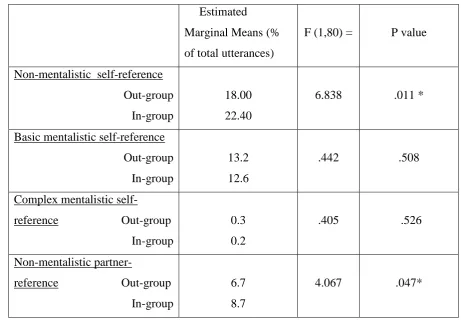
country from my parents’ (trial 29, complex reference). Table 2 summarises non-theory-of-367
mind reference as a function of group membership. 368
369 370
Estimated Marginal Means (% of total utterances)
F (1,80) = P value
Non-mentalistic self-reference Out-group
In-group
18.00 22.40
6.838 .011 *
Basic mentalistic self-reference Out-group
In-group
13.2 12.6
.442 .508
Complex mentalistic
self-reference Out-group In-group
0.3 0.2
.405 .526
Non-mentalistic
partner-reference Out-group In-group
6.7 8.7
4.067 .047*
[image:13.595.58.520.337.657.2]371
Table 2. Frequency of non-theory of mind reference to the self and partner. 372
14 Of the references participants made that required no theory of mind abilities, only the 375
non-mentalistic references to the self and the partner differed significantly between in-group 376
and out-group conditions. That is, shared group membership increased both non-mentalistic 377
reference to the self and the partner. No significant differences were found regarding 378
mentalistic reference to the self. 379
380
C) ‘Theory of mind-like’ reference to the partner. 381
382
We next analyzed the impact of group membership on how participants referenced 383
their partners’ basic mental states, indicated by the presence of any one of the words on the 384
master list used in reference to the partner’s mental state. First, participants talked about their 385
partners’ basic mental states less if their partner was an out-group member (estimated 386
marginal mean = 1.2%) than a presumed in-group member (estimated marginal mean = 3.8%; 387
F (1, 80) = 205.634, p = .000, fig. 2). That is, statements that referred to a partner’s basic 388
mental states, such as ‘So, would you like to be a lecturer?’ (Trial 12) were more common 389
when participants spoke with in-group than out-group members. 390
391
Figure 2 about here 392
393
Figure 2. Percentage of references to a partner’s basic mental states in natural conversations 394
(estimated marginal means ± SE) as a function of group membership. 395
396
Given the infrequency of complex reference to the partner’s mental states (eight times 397
in our entire data set with no pair using this type of reference more than once) we used a 398
simple Fisher’s exact test to assess whether this type of reference was more likely to occur in 399
the in-group or out-group conditions. In fact, participants referenced their partners’ complex 400
mental states less frequently when speaking with an out-group member (1 times total) than 401
with an in-group member (7 times total; p < .02, Fisher’s exact test). That is, statements 402
such as, ‘What you might find is that you enjoy it more’ (trial 39) were more likely to be used 403
between in-group members than between out-group members. 404
405
Figure 3 about here 406
15 Figure 3. Total references to a partner’s complex mental states in natural conversations as a 408
function of group membership. 409
410
Written Impressions Results 411
412
A) Overall amount of written words. 413
414
Questionnaire data from 6 pairs was unavailable as these pairs requested to leave 415
early due to time constraints. There was no statistical difference between the total number of 416
words participants wrote when describing an out-group partner (estimated marginal mean = 417
88.294) compared to describing an in-group partner (estimated marginal mean = 74.583; F(1, 418
68) = 2.578, p > .113). Again this is important as it shows that our minimal group 419
manipulation did not affect participants’ motivation to write about their partners. 420
421
B) Basic mental state reference to the partner. 422
423
Sentences written by participants were coded as either no mental state reference, basic 424
mental state reference (one mental state verb in the sentence), or complex mental state 425
reference (two mental state verbs in the sentence) according to the same coding scheme 426
described above for conversation. Amount of both basic and complex mental state reference 427
was calculated as a percentage of total sentences written. Out-group members were described 428
less frequently in terms of their basic mental states (estimated marginal mean = 9.70%) than 429
were in-group members (estimated marginal mean = 27.60%), F(1, 68) = 14.948, p = .000, 430
fig. 4). For example, statements such as ‘She doesn’t want to fly into a conversation quickly’ 431
(Trial 4) were more likely to be written about in-group than out-group members. 432
433
Figure 4 about here 434
435
Figure 4. Percentage of reference to the partner’s basic mental states in written impressions 436
(estimated marginal means ± SE) as a function of group membership. 437
438
16 Although participants used more complex forms of mental state reference more rarely, 440
the same pattern was found. That is, participants writing about presumed out-group members 441
referenced their complex mental states less frequently (estimated marginal mean = .5%) than 442
those writing about presumed in-group members (estimated marginal mean = 3.6%; F (1, 68) 443
= 8.457, p = .005; fig. 5). For example, participants were significantly more likely to write 444
complex statements referring to a partner’s mental states, such as ‘She’s not afraid to do what 445
she wants’ (Trial 28), about in-group than out-group members. 446
447
Figure 5 about here 448
449
Figure 5. Percentage of reference to the partner’s complex mental states in the written 450
impressions (estimated marginal means ± SE) as a function of group membership. 451
452
Correlation Between Mental State Reference in Conversation and Written Descriptions 453
454
It is possible that the level of mental state reference participants manifest during 455
conversation influenced their subsequent descriptions of their partner. That is, if people are 456
provided with more mental state information about a person they may then be more prone to 457
use that information preferentially over other information when describing a person, or they 458
may simply have had less non-mentalistic information to hand with which to describe a 459
person. Whichever is the case, it seems logical to assume that the conversations participants 460
engaged in might have influenced the way in which they considered and described their 461
partner afterward. However, we found no correlation between amount of total mental state 462
reference in conversation and amount of total mental state reference in participants’ 463
subsequent descriptions of each other (R = .03, p = .97). 464
465 466
Discussion 467
468
In this study we aimed to determine whether people reference other’s mental states 469
automatically and consistently, or whether different social contexts, for example group 470
membership, produce different referential behavior. To do this, we analyzed how people 471
17 written descriptions as a function of artificially manipulated group membership. Broadly, our 473
results showed that group membership affects how people overtly refer to another person’s 474
mental states, both immediately during an interaction and after it. 475
We first examined participants’ casual conversations in order to examine the effect of 476
group membership on spontaneous mental state reference as well as reference that would not 477
require theory of mind processes. For non-theory-of-mind reference, it seems that shared 478
group membership increases references to both the self and the partner that do not involve 479
use of mental state verbs. So, for example, in-group participants discussed their current and 480
past lives than out-group participants did. This could be because such references were aimed 481
at uncovering shared interests to solidify or expand their shared identity, or simply due to 482
participants in the in-group condition being more at ease with each other and hence more 483
likely to discuss more personal information. Regarding reference that required mentalising, 484
results revealed that, when interacting with an out-group member, participants referenced 485
their partner’s mental states less than when interacting with an in-group member. This effect 486
held for both conversations during immediate interactions and for descriptions participants 487
wrote about their partners even after interacting with them. Group membership also had the 488
same effect on different levels of referential complexity, in that participants talking with an 489
out-group member referenced both their basic and complex mental states less frequently than 490
participants talking with an in-group member. Similarly, in their written descriptions, 491
participants wrote less about out-group member’s basic and complex mental states than they 492
did about in-group members’ basic and complex mental states. Importantly, as we show 493
there is no correlation between mental state reference in conversation and mental state 494
reference in written descriptions, this suggests that group membership is independently 495
impacting these two processes. That is, we can rule out two alternative causes of increased 496
mental-state terms in in-group participants’ descriptions: a) that some individuals are simply 497
more prone to overtly reference others’ mental states regardless of the mode of reference, or 498
b) that group membership impacts only spoken mental state reference which could have then 499
primed in-group participants to increase their usage of mental state terms when describing 500
their partner. 501
These results suggest that people are less likely to overtly reference other people’s 502
mental states if they perceive those others as out-group members. Importantly, this effect 503
occurred despite the fact that groups were artificially created using arbitrary characteristics. 504
18 which could have led participants to stereotype or react to partners based on implicit
506
associations (Greenwald, McGhee, & Schwartz, 1998; Stott & Reicher, 1998). This suggests 507
that the difference in mental state reference shown here is a result of categorization based on 508
group membership itself and not any other social or individual factors. However, it is worth 509
noting a caveat of our design, that our minimal group paradigm could have impacted 510
perceived similarity (as a function of their assigned ‘cognitive style’). There is currently 511
conflicting evidence regarding the impact of perceived similarity on processes related to 512
theory of mind. For instance, while the accepted notion was that perceived similarity 513
increases empathy (Davis, 1994) more recent studies have shown that, in fact, basic drives to 514
nurture and protect have a bigger impact on empathy than perceived similarity (Batson, 515
Lishner, Cook, & Sawyer, 2005). Future research will be able to dissociate the impact of 516
shared group membership and perceived similarity on empathy and other processes linked to 517
theory of mind (as well as extend the sample to males to examine any possible gender 518
differences of this specific manifestation of theory of mind). 519
Our results also build on and extend research based on the Linguistic Category Model 520
(LCM) (Semin & Fiedler, 1991). First, we have extended the LCM ‘state verb’ list to 521
provide a more complete list of terms which people use to reference mental states. Secondly, 522
we have extended the application of this type of natural conversation and description 523
analysis. The LCM has been used to elucidate the typical inter-group biases shown in a vast 524
variety of behavioural studies. For example, Maass and colleagues (Maass, Salvi, Arcuri, & 525
Semin, 1989) showed that people used more abstract and dispositional terms to describe 526
positive in-group behaviour and negative out-group behaviour (which was interpreted as 527
furthering in-group favouritism and out-group discrimination). Along the same lines, Fiedler 528
and colleagues (Fiedler, Semin, & Finkenauer, 1993) showed that people used more 529
stereotypic language across all five of the LCM’s defined categories when describing a 530
gender out-group than a gender in-group, again suggesting a mode by which out-group 531
discrimination is perpetuated. The current results are the first, however, to show that the 532
actual quantity of mental state reference used in interaction and description differs as a 533
function of the partner’s group membership. As such our results expand on the LCM 534
literature by suggesting both cognitive and behavioural mechanisms by which out-group 535
19 While our results have shown an effect of group membership on mental state reference as a 537
behavior, we cannot conclusively say which cognitive process this stems from. That is, even 538
though mental state reference is commonly used as a proxy to gauge both mental state 539
attribution and theory of mind usage (Schwanenflugel, Henderson, & Fabricius, 1998; 540
Schwanenflugel, Martin, & Takahashi, 1999) , strictly speaking, a difference in this type of 541
referential behavior does not necessarily stem from a difference in underlying mental state 542
attribution. That is, participants may or may not be attributing mental states to their partners 543
regardless of how they overtly reference them in conversation. For example, participants may 544
be truly unconcerned with an out-grouper’s mental states and not even ‘turn on’ their theory 545
of mind when interacting with them. Alternatively, theory of mind processes may be alive 546
and active even with out-group members but people may choose not to show evidence of 547
such during interaction, specifically with out-groupers, by actively suppressing reference to 548
such processes. The explicit link between linguistic reference and actual mental 549
representation, along with the degree to which participants consciously engage (or disengage) 550
their theory of mind, remains to be shown by future research. However, taking other recent 551
research into account we would speculate that theory of mind cognition is curtailed at a more 552
fundamental level during interactions with out-group members, prior to any linguistic 553
reference in conversation. For example, a recent study has shown that during joint 554
interaction people fail to spontaneously form mental representations of out-group members 555
(McClung, Jentzsch, & Reicher, 2013). In this study, people who did a computerized joint 556
action task with a perceived in-group member showed altered reaction times due to the 557
computational demands of mentally representing their partner, whereas people who did the 558
task with a perceived out-group member reacted as if they were doing the task alone and 559
evidenced no alteration in reaction times. This result suggests that the less socially relevant 560
out-group member does not warrant mental representation even on a subconscious, 561
unintentional level, which has implications for the current study. While speculative, a lack of 562
basic mental representation of the out-group may be the source of the diminished linguistic 563
reference to out-group members’ mental states: without initial representation of a person one 564
could hardly use their theory of mind to develop representations of their mental states. That 565
is, if out-groupers are not even perceived as potentially intentional beings in the first place, 566
then this may consequently affect more complex psychological processes, including the 567
20 By showing that people reference mental states differently depending on the group 569
membership of their target, our results extend the growing body of literature which suggests 570
that actual theory of mind usage is not automatic or consistent. For instance, recent research 571
suggests that understanding another’s perspective or feelings does not happen spontaneously 572
but instead requires effortful cognitive adjustment (e.g. I. A. Apperly et al., 2010; Epley, 573
Keysar, Van Boven, & Gilovich, 2004; Nickerson, 1999). One benefit of the current study is 574
that the differential mental state reference we showed occurred totally spontaneously in actual 575
social interactions. Much of the previous research on theory of mind-related processes is 576
based on artificial paradigms in which participants are required to mentalise about characters 577
in a cartoon strip (e.g. Converse et al., 2008) or simply allowed to mentalise about a cartoon 578
character (Apperly et al., 2006). In the current study participants interacted naturally and 579
spontaneously with actual people without any prompts as to the direction of their attention. 580
This decrease in reference to out-group members’ mental states may also have a range 581
of consequences for ‘real-world’ social interactions. First, we would speculate that the 582
effects we show as a result of minimal categorisation would also carry over to real-life 583
groups. Given that such groups would be based on more relevant identities than minimal 584
groups, it would seem a logical consequence that they would also be more motivated to 585
maintain their bonds, which sharing more intimate knowledge of each other could facilitate. 586
Conversely, between members of different groups, decreased mental state reference may 587
facilitate out-group discrimination, even at its extremes of infrahumanization and 588
dehumanization (Haslam & Levy, 2006; Leyens et al., 2001). For example, even if we 589
assume that theory of mind is functioning normally, without overt reference to a person’s 590
mental states, it may become easier to perceive such a person as less than human, or at least 591
to treat them as such. However, the causal direction of such a link is as yet unclear: further 592
research is needed to clarify the link between overt mental state reference and different 593
aspects of out-group discrimination. For instance, the simple perception of a common 594
identity during an interaction may be sufficient to increase mental state reference, which may 595
in turn prohibit out-group discrimination entirely. 596
In sum, our results identify one social factor – group membership – as a major factor 597
in how cognitively normal adults manifest their theory of mind usage, specifically in how 598
they overtly refer to another person’s mental states during natural conversation. However, 599
this study does more than simply add to a list of contextual influences on different theory of 600
21 cognition and behavior within our social world. We do not wish to claim that people never 602
mentalize about the out-group. Our argument that mental state reference is contextual is just 603
that: there are obvious contexts in which it would behoove a person to understand and 604
reference the mental states of the out-group. Future research may identify other social factors 605
(such as extreme power differentials) that may interact with categorization to impact mental 606
state reference. 607
In conclusion, using the minimal group paradigm – a stripped down manipulation of 608
social group context – the current study shows that people are less willing to talk about the 609
mental states of anyone categorized ‘other’, and less willing to consider them even afterward 610
in mentalistic terms. In sum, whether a person merits overt mental state reference seems to 611
be a function of group membership. 612
613 614 615 616 617 618 619
Funding Sources 620
This work was supported by a departmental stipend to the first author from the University of 621
St Andrews, St Andrews, UK. 622
623
Open Practices 624
The research in this article earned Open Materials and Open Data badges for transparent 625
practices. Materials and data for the experiment are available at 626
https://figshare.com/articles/McClung_and_Reicher_Representing_Other_Minds_data/54016 627
22 References
635 636
Alison, G., & Astington, J. W. (1988). Children's Understanding of Representational Change 637
and Its Relation to the Understanding of False Belief and the Appearance-Reality 638
Distinction. Child Development, 59(1), 26-37. 639
Ames, D. R. (2004). Inside the Mind Reader's Tool Kit: Projection and Stereotyping in 640
Mental State Inference. Journal of Personality and Social Psychology, 87(3), 340-641
353. doi:10.1037/0022-3514.87.3.340 642
Antonietti, A., Liverta-Sempio, O., Marchetti, A., & Astington, J. W. (2006). Mental 643
language and understanding of epistemic and emotional mental states Theory of mind 644
and language in developmental contexts (pp. 1-30): Springer. 645
Apperly, Carroll, D. J., Samson, D., Humphreys, G. W., Qureshi, A., & Moffitt, G. (2010). 646
Why are there limits on theory of mind use? Evidence from adults' ability to follow 647
instructions from an ignorant speaker. The Quarterly Journal of Experimental 648
Psychology, 63(6), 1201-1217. 649
Apperly, I. A., Carroll, D. J., Samson, D., Humphreys, G. W., Qureshi, A., & Moffitt, G. 650
(2010). Why are there limits on theory of mind use? Evidence from adults' ability to 651
follow instructions from an ignorant speaker. Quarterly Journal of Experimental 652
Psychology, 63(6), 1201-1217. 653
Apperly, I. A., Riggs, K. J., Simpson, A., Chiavarino, C., & Samson, D. (2006). Is Belief 654
Reasoning Automatic? Psychological Science, 17(10), 841-844. doi:10.1111/j.1467-655
9280.2006.01791.x 656
Baron-Cohen, S. (1989). The Autistic Child's Theory of Mind: A Case of Specific 657
Developmental Delay. Journal of Child Psychology and Psychiatry, 30(2), 285-297. 658
Bartsch, K., & Wellman, H. (1995). Children talk about the mind. New York: Oxford 659
University Press. 660
Batson, C. D., Lishner, D. A., Cook, J., & Sawyer, S. (2005). Similarity and nurturance: Two 661
possible sources of empathy for strangers. Basic and applied social psychology, 27(1), 662
15-25. 663
Bretherton, I., McNew, S., & Beeghly-Smith, M. (1981). Early person knowledge as 664
expressed in gestural and verbal communication: when do infants acquire a 'theory of 665
mind'? In M. L. a. L. Sherrod (Ed.), Social Cognition in Infancy. Hillsdale, NJ: 666
Erlbaum. 667
Brown, Donelan-McCall, N., & Dunn, J. (1996). Why Talk about Mental States? The 668
Significance of Children's Conversations with Friends, Siblings, and Mothers. Child 669
Development, 67(3), 836-849. doi:10.1111/j.1467-8624.1996.tb01767.x 670
Brown, G. (1977). Listening to spoken English: Longman London. 671
Brown, P., & Levinson, S. (1987). Politeness: Universals in language usage. Cambridge: 672
CUP. 673
Call, J., & Tomasello, M. (2008). Does the chimpanzee have a theory of mind? 30 years later. 674
Trends in Cognitive Sciences, 12(5), 187-192. 675
Cikara, M., Bruneau, E. G., & Saxe, R. R. (2011). Us and them intergroup failures of 676
empathy. Current Directions in Psychological Science, 20(3), 149-153. 677
Converse, B. A., Lin, S., Keysar, B., & Epley, N. (2008). In the mood to get over yourself: 678
Mood affects theory-of-mind use. Emotion, 8(5), 725-730. doi:10.1037/a0013283 679
Davis, M. H. (1994). Empathy: A social psychological approach: Westview Press. 680
23 Dunn, J., Bretherton, I., & Munn, P. (1987). Conversations about feeling states between 682
mothers and their young children. Developmental Psychology, 23(1), 132-139. 683
doi:10.1037/0012-1649.23.1.132 684
Edwards, D. (1997). Discourse and cognition. London and Beverly Hills, CA: Sage. 685
Ensink, K., & Mayes, L. C. (2010). The Development of Mentalisation in Children From a 686
Theory of Mind Perspective. Psychoanalytic Inquiry, 30(4), 301-337. 687
Epley, N., Keysar, B., Van Boven, L., & Gilovich, T. (2004). Perspective Taking as 688
Egocentric Anchoring and Adjustment. Journal of Personality and Social 689
Psychology;Journal of Personality and Social Psychology, 87(3), 327-339. 690
doi:10.1037/0022-3514.87.3.327 691
Epley, N., Morewedge, C. K., & Keysar, B. (2004). Perspective taking in children and adults: 692
Equivalent egocentrism but differential correction. Journal of Experimental Social 693
Psychology, 40(6), 760-768. doi:10.1016/j.jesp.2004.02.002 694
Fiedler, K., Semin, G. R., & Finkenauer, C. (1993). The Battle of Words Between Gender 695
Groups A Language‐Based Approach to Intergroup Processes. Human 696
Communication Research, 19(3), 409-441. 697
Flavel, J. H., Botkin, P. T., Fry, C. L., Wright, J. W., & Jarvis, P. E. (1968). The development 698
of role-taking and communication skills in children. New York: Wiley. 699
Fussell, S. R., & Krauss, R. M. (1991). Accuracy and bias in estimates of others' knowledge. 700
European Journal of Social Psychology, 21(5), 445-454. 701
doi:10.1002/ejsp.2420210507 702
Greenwald, A. G., McGhee, D. E., & Schwartz, J. L. K. (1998). Measuring individual 703
differences in implicit cognition: The implicit association test. Journal of Personality 704
and Social Psychology, 74(6), 1464-1480. doi:10.1037/0022-3514.74.6.1464 705
Hackel, L. M., Looser, C. E., & Van Bavel, J. J. (2014). Group membership alters the 706
threshold for mind perception: The role of social identity, collective identification, 707
and intergroup threat. Journal of Experimental Social Psychology, 52, 15-23. 708
Haslam, N. (2006). Dehumanization: an integrative review. Personality and Social 709
Psychology Review, 10(3), 252-264. 710
Haslam, N., & Levy, S. R. (2006). Essentialist beliefs about homosexuality: structure and 711
implications for prejudice. Pers Soc Psychol Bull, 32(4), 471-485. 712
Heyes, C. M. (1998). Theory of mind in nonhuman primates. Behav Brain Sci, 21(1), 101-713
114; discussion 115-148. 714
Holmes, J. (1986). Functions of you know in women's and men's speech. Language in 715
society, 15(01), 1-21. 716
Howard, J. W., & Rothbart, M. (1980). Social categorization and memory for in-group and 717
out-group behavior. Journal of Personality and Social Psychology, 38(2), 301-310. 718
doi:10.1037/0022-3514.38.2.301 719
Ito, T. A., & Urland, G. R. (2003). Race and gender on the brain: Electrocortical measures of 720
attention to the race and gender of multiply categorizable individuals. Journal of 721
Personality and Social Psychology, 85(4), 616-626. doi:10.1037/0022-3514.85.4.616 722
Jenkins, J. M., Turrell, S. L., Kogushi, Y., Lollis, S., & Ross, H. S. (2003). A Longitudinal 723
Investigation of the Dynamics of Mental State Talk in Families. Child Development, 724
74(3), 905-920. doi:10.1111/1467-8624.00575 725
Keysar, B., Barr, D. J., Balin, J. A., & Brauner, J. S. (2000). Taking perspective in 726
conversation: the role of mutual knowledge in comprehension. Psychological Science, 727
24 Keysar, B., Ginzel, L. E., & Bazerman, M. H. (1995). States of affairs and states of mind: 729
The effect of knowledge of beliefs. Organizational Behavior and Human Decision 730
Processes, 64(3), 283-293. 731
Keysar, B., Lin, S., & Barr, D. J. (2003). Limits on theory of mind use in adults. Cognition, 732
89(1), 25-41. 733
Leyens, J. P., Rodriguez-Perez, A., Rodriguez-Torres, R., Gaunt, R., Paladino, M. P., Vaes, 734
J., & Demoulin, S. (2001). Psychological essentialism and the differential attribution 735
of uniquely human emotions to ingroups and outgroups. European Journal of Social 736
Psychology, 31(4), 395-411. 737
Lin, S., Keysar, B., & Epley, N. (2010). Reflexively mindblind: Using theory of mind to 738
interpret behavior requires effortful attention. Journal of Experimental Social 739
Psychology, 46(3), 551-556. doi:10.1016/j.jesp.2009.12.019 740
Maass, A., Salvi, D., Arcuri, L., & Semin, G. R. (1989). Language use in intergroup contexts: 741
the linguistic intergroup bias. Journal of personality and social psychology, 57(6), 742
981. 743
McClung, J. S., Jentzsch, I., & Reicher, S. D. (2013). Group Membership Affects 744
Spontaneous Mental Representation: Failure to Represent the Out-Group in a Joint 745
Action Task. PLoS ONE, 8(11), e79178. doi:10.1371/journal.pone.0079178 746
Meins, E., Fernyhough, C., Johnson, F., & Lidstone, J. (2006). Mind‐mindedness in 747
children: Individual differences in internal‐state talk in middle childhood. British 748
Journal of Developmental Psychology, 24(1), 181-196. 749
Meins, E., Fernyhough, C., Wainwright, R., Das Gupta, M., Fradley, E., & Tuckey, M. 750
(2002). Maternal mind–mindedness and attachment security as predictors of theory of 751
mind understanding. Child Development, 73(6), 1715-1726. 752
Nickerson, R. (1999). How we know—and sometimes misjudge—what others know: 753
Imputing one's own knowledge to others. Psychological Bulletin, 125(6), 737-759. 754
doi:10.1037/0033-2909.125.6.737 755
Nickerson, R., Baddeley, A., & Freeman, B. (1987). Are people's estimates of what other 756
people know influenced by what they themselves know? Acta Psychologica, 64(3), 757
245-259. doi:10.1016/0001-6918(87)90010-2 758
Piaget, J., & Inhelder, B. (1966). La psychologie de l'enfant: Presses universitaires de France 759
Paris. 760
Potter, J., Hepburn , A., & Tileagă, C. (2011). INEQUALITY IN ACTION. International 761
Journal of Education and Psychology in the Community, 19(2), 43-60. 762
Premack, D., & Woodruff, G. (1978). Does the chimpanzee have a theory of mind? 763
Behavioral and Brain Sciences, 1(04), 515-526. 764
doi:doi:10.1017/S0140525X00076512 765
Rice, K., & Redcay, E. (2014). Spontaneous mentalizing captures variability in the cortical 766
thickness of social brain regions. Social cognitive and affective neuroscience, 10(3), 767
327-334. 768
Royzman, E. B., Cassidy, K. W., & Baron, J. (2003). 'I Know, you know': Epistemic 769
Egocentrism in children and adults. Review of General Psychology, 7(1), 38-65. 770
Schwanenflugel, P. J., Henderson, R. L., & Fabricius, W. V. (1998). Developing organization 771
of mental verbs and theory of mind in middle childhood: Evidence from extensions. 772
Developmental Psychology, 34(3), 512-524. doi:10.1037/0012-1649.34.3.512 773
Schwanenflugel, P. J., Martin, M., & Takahashi, T. (1999). The organization of verbs of 774
knowing: Evidence for cultural commonality and variation in theory of mind. Memory 775
25 Semin, G. R., & Fiedler, K. (1988). The cognitive functions of linguistic categories in
777
describing persons: Social cognition and language. Journal of Personality and Social 778
Psychology, 54(4), 558. 779
Semin, G. R., & Fiedler, K. (1991). The linguistic category model, its bases, applications and 780
range. European review of social psychology, 2(1), 1-30. 781
Shatz, M., Wellman, H. M., & Silber, S. (1983). The acquisition of mental verbs: A 782
systematic investigation of the first reference to mental state. Cognition, 14(3), 301-783
321. doi:10.1016/0010-0277(83)90008-2 784
Stott, C., & Reicher, S. (1998). How Conflict Escalates: The Inter-Group Dynamics of 785
Collective Football Crowd `Violence'. Sociology, 32(2), 353-377. 786
doi:10.1177/0038038598032002007 787
Tajfel, H., Billig, M. G., Bundy, R. P., & Flament, C. (1971). Social Categorization and 788
Intergroup Behavior. European Journal of Social Psychology, 1(2), 149-177. 789
Tomasello, M., Carpenter, M., Call, J., Behne, T., & Moll, H. (2005). Understanding and 790
sharing intentions: The origins of cultural cognition. Behavioral and Brain Sciences, 791
28(5), 675-+. 792
Wellman, H. M., Cross, D., & Watson, J. (2001). Meta-analysis of theory-of-mind 793
development: The truth about false belief. Child Development, 72(3), 655-684. 794
Wimmer, H., & Perner, J. (1983). Beliefs About Beliefs - Representation and Constraining 795
Function of Wrong Beliefs in Young Childrens Understanding of Deception. 796
Cognition, 13(1), 103-128. 797
Wu, S., & Keysar, B. (2007). The effect of culture on perspective taking. Psychological 798
Science, 18(7), 600-606. 799