ISSN Online: 1947-3818 ISSN Print: 1949-243X
DOI: 10.4236/epe.2019.115012 May 24, 2019 201 Energy and Power Engineering
Progress in Analysis of Key Technologies for
Dynamic Wireless Charging of Electric Vehicles
Wanqing Li
1, Kai Wang
1, Pinduan Hu
21Department of Electrical Engineering and Automation, College of Electrical Engineering & New Energy, China Three Gorges
University, Yichang, China
2Department of Smart Grid, College of Electrical Engineering & New Energy, China Three Gorges University, Yichang, China
Abstract
At present, electric vehicles are very common means of transportation in our life. Contact charging is the main method of electric vehicles in China. With the continuous improvement of people’s awareness of environmental protec-tion, wireless charging technology is also under constant development. Cur-rently, there are more static wireless charging technologies, while dynamic charging mode is only a perfection and supplement to it, which is crucial to the promotion of electric vehicles and is able to make charging work faster and easier. China has been researching dynamic wireless charging technolo-gy, but it has been affected by many factors. Therefore, it is necessary for the relevant personnel to solve the existing obstacles according to the characteris-tics of dynamic wireless charging technology and apply dynamic wireless charging technology in an efficient manner.
Keywords
Electric Vehicle, Dynamic Wireless Charging, Key Technology
1. Introduction
The current society cannot be developed without the means of transportation, so cars are widely used in daily life. However, they constitute the most important factor causing the greenhouse effect. With the awakening and improvement of people’s awareness of environmental protection, electric vehicles have gradually been introduced as an energy-saving and environmentally friendly means of trans-portation. Yet in the development process of electric vehicles, the development of dynamic wireless power supply system with high efficiency and moderate cost has gradually become a research hotspot [1]. Therefore, it is necessary to analyze the How to cite this paper: Li, W.Q., Wang, K.
and Hu, P.D. (2019) Progress in Analysis of Key Technologies for Dynamic Wireless Charging of Electric Vehicles. Energy and Power Engineering, 11, 201-208.
https://doi.org/10.4236/epe.2019.115012
Received: April 22, 2019 Accepted: May 21, 2019 Published: May 24, 2019
Copyright © 2019 by author(s) and Scientific Research Publishing Inc. This work is licensed under the Creative Commons Attribution International License (CC BY 4.0).
DOI: 10.4236/epe.2019.115012 202 Energy and Power Engineering
dynamic wireless charging technology, summarize the key technical problems and further look forward to the development prospect of electric vehicles.
2. Research and Analysis on Dynamic Wireless Charging
Technology of Electric Vehicles
[image:2.595.286.463.578.704.2]At present, research teams in New Zealand, Japan, the United States, South Ko-rea and so on have all started to study the relevant technologies of dynamic wireless power transfer for electric vehicles, and have conducted a series of re-searches on the existing problems, including the system modeling method and the optimal design of electromagnetic coupling mechanism. New Zealand and Germany have jointly developed a prototype of a 100 kW wireless power transfer train with a track length of about 100 m and without battery pack installed. See
Figure 1 for details.
According to the coupling structure and medium damage of dynamic wireless charging of electric vehicles, the United States has conducted research, and fi-nally revealed that the transmission efficiency and power are affected by the po-sition of electric vehicles by using series connection and full bridge inversion. South Korea has designed and studied the entire rail train wireless power trans-fer system. The coupling mechanism strengthens the coupling performance through the long straight guide rail at the transmitting end and two small mag-netic cores, dispersing the capacitance in the transmitting coil to reduce the ca-pacitance voltage stress.
Many colleges and universities in China have studied dynamic radio technol-ogy at an earlier stage, mainly focusing on the technologies including changes of high-power power electronics and electric energy, the control and optimization of system modeling, the synchronous transmission of energy and information, electromagnetic compatibility and shielding, etc., and they have achieved effec-tive results in theory, technical difficulties and some key issues.
3. Analysis of Types and Characteristics of Dynamic
Wireless Charging Technology for Electric Vehicles
3.1. Characteristics
Wireless charging technology is featured with contactless charging by means of
DOI: 10.4236/epe.2019.115012 203 Energy and Power Engineering
wireless power transmission technology. Such technology can break the interface limits in contact charging and solve the safety problem in traditional charging mode. Compared with the traditional charging method, it is more mature, and is able to improve the efficiency of the rechargeable battery and simplify the process.
3.2. Classification
The wireless charging can be generally divided into three types based on its forms: 1) magnetic resonance charging technology. Magnetic resonance applica-tions include power supply, output, reception, rectifier, etc. According to its own technical characteristics, such technology is basically the same as electromagnet-ic induction in the actual applelectromagnet-ication process. During the charging process, the power supply current is converted into alternating magnetic flux for transmis-sion and reception. However, it is effectively adjusted through controllable cir-cuit and high-frequency drive power supply, while the power transmission and reception performance are improved through capacitors and coils. 2) Electro-magnetic induction charging transfers and converts electric energy through power transmission and electric coils to ensure that magnetic flux can be changed and alternated between coils, thus realizing induction electromotive force and alter-nating current acceptance of coils in the process of electromagnetic induction and wireless charging. At present, the development of wireless charging for electric vehicles is of great significance. 3) Microwave charging. Microwave charging realizes power transmission through a radio wave generator, and the microwave frequency is kept at 2.45 GHz, which is very similar to the principle of magne-tron. In the process of microwave transmission, AC power supply is mainly used, but in the process of transmission, current can be converted into DC charge through rectification circuit. However, special attention shall be paid to the setting of shielding devices in the actual application of this kind of wireless charging technology, so as to avoid microwave leakage during charging, which can be avoided by metal shielding devices.
4. Necessity of Developing Dynamic Wireless Charging
Technology for Electric Vehicles
DOI: 10.4236/epe.2019.115012 204 Energy and Power Engineering
It has become an important problem imperative to be solved in the application of dynamic wireless charging technology to dynamically charge electric vehicles in the process of driving in future development. Only by solving this problem can people’s travel structure be improved and dynamic wireless charging tech-nology be better developed and popularized [2].
5. Problems Existing in Developing Wireless Charging
Technology
5.1. Coupling Problem
The application of dynamic wireless charging technology has raised the re-quirements of the original technology. It is very important to set up the coupling mechanism by using bipolar power supply guide rail in the setting of the device. Generally speaking, such structure is superior to unipolar guide rail in practice, and the bipolar guide rail has higher application power in practice, and its own size is more suitable for the level of track magnetic field. The construction is simpler, the cost is lower, and the advantage is obvious. However, in the actual application, such technology still has the problem of coupling zero, which cannot be ignored. Due to the irregular distribution of the magnetic field in the bipolar guide rail, the magnetic field in each part is not uniform during power transmis-sion. The coupling problem has led to the problem of low power conversion effi-ciency in the transmission process. The whole system will have unstable power transmission and cannot realize the purpose of efficient and fast charging. Therefore, it is necessary to take effective measures for optimization [3].
5.2. Poor EMC Effect of Dynamic Wireless Charging Technology
Electro-magnetic compatibility (EMC) is a crucial link in dynamic wireless charging technology. It is directly related to the practical application efficiency of wireless charging system and will have a direct impact on power transmission. In practice, the poor EMC will affect the whole power system and the unstable power transmission will occur. At the same time, the EMC problem is also re-lated to people’s health. Given on this basis, it is necessary to effectively solve the EMC problems in practice so as to ensure the efficient and continuous operation of the dynamic wireless charging system device and improve the reliability of dy-namic wireless charging [4]. At present, for the problem of poor EMC effect, the negative impact of electromagnetic compatibility is mainly controlled within a certain range by effective means, so as to improve the overall safety of the system.
5.3. Robust Control of Energy Transmission
DOI: 10.4236/epe.2019.115012 205 Energy and Power Engineering
6. Analysis of Dynamic Wireless Charging Technology for
Electric Vehicles
6.1. Design and Optimization of Magnetic Coupling Mechanism
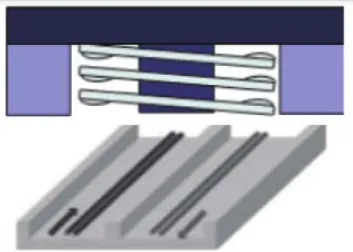
The current dynamic wireless power transfer guideway can be divided into the continuous single coil structure of rectangular long coil type, dual magnetic pole type and discrete type. Auckland University proposed the solution of rectangular long coil power supply guide rail, and the different forms of receiving end struc-ture, but the lateral displacement capability of this solution is relatively poor. Therefore, the new bipolar receiving end and double D form can obviously im-prove the lateral displacement capability of the coupling mechanism. Based on the research of Auckland University, KAIST added a magnetic core structure to the coil. The structure has been optimized and designed to improve the trans-mission distance and efficiency, but this has significantly increased the cost of the equipment [5]. From 2011 to mid-2015, researchers in KAIST proposed the fourth generation of bipolar magnetic core track with type I structure and the fifth generation of bipolar power supply track with type S structure, which are featured by longer transmission distance, narrower width and higher efficiency. The dual-pole power supply rail changes the direction from the direction per-pendicular to the vehicle to the direction of the vehicle. It has the characteristics such as higher power density, less construction difficulty, compact size, strong adaptability to lateral movement on both sides of the rail, etc., and is more suita-ble for dynamic wireless power transfer of electric vehicles. The advantages and disadvantages of long coil type and dual magnetic pole type guide rails are shown in Table 1.
[image:5.595.187.539.543.730.2]Researchers in KAIST proposed a bi-directional power supply rail structure targeted at the problem of zero coupling coefficient along the direction of travel. Although the zero coupling system problem can be solved, the DC chopper and phase locked loop are used to supply the amplitude and phase of the D-axis and
Table 1. Analysis of advantages and disadvantages of two types of common power supply guides.
Type of Guide Rail Advantages Disadvantages
Dual magnetic pole type The power density is relatively high, the lateral displacement adaptability is strong, and the size is very compact, hence the construction is less difficult, and the magnetic field exposure level on both sides of the track is relatively low
The distribution of magnetic field space is not uniform, the consumption of magnetic cores is relatively large, and the manufacturing cost is relatively high
Long coil type The spatial distribution of the magnetic field is very uniform, and there is no magnetic core; hence the transmission power is relatively stable, and the manufacturing cost is low
DOI: 10.4236/epe.2019.115012 206 Energy and Power Engineering
Q-axis dual power supply rail current according to the spatial movement posi-tion of the electric energy pickup mechanism, there are still many links in the whole control process, and an additional transmitting coil will be introduced, which will cause the problem of low system efficiency. Meanwhile, based on the coupling mechanism, the zero point problem of the coupling coefficient can be effectively solved [6].
6.2. Robust Control Technology for Energy Transmission
The dynamic wireless power transmission control technology is divided into three kinds, namely secondary side control, bilateral control and primary side control. In the system design, KAIST uses the original side constant current empty box to control the inverter output constant current by effectively adjust-ing the primary side DC bus voltage [7]. The primary side control is mainly to enable the constant magnetic field to be generated on the power supply guide rail so as to realize robust control. Tokyo University used the strategy of second-ary side control to add Buck converter to the rectifier circuit, and built a small signal model to achieve maximum efficiency control. The U.S. laboratories effec-tively combined with the original secondary side to realize wireless charging based on working frequency modulation and closed-loop control of bilateral wireless communication. The University of Hong Kong proposed the power control method of maximum efficiency dual-parameter synchronization and no need for bilateral communication. The minimum value of primary input power is searched to achieve the output of constant power control. The characteristics of different control strategies are also very obvious. The constant current of the power supply guide rail controlled by the primary side will generate the constant alternating magnetic field, which does not require the calculation of the reflected impedance. However, it is unable to control the maximum efficiency and the output of the load is limited, thus the actual demand of constant current charg-ing of energy storage equipment cannot be realized. The secondary side control can meet the charging requirements of energy storage equipment for constant current, constant voltage and maximum efficiency, but the input regulation range is relatively limited, and accurate mathematical models need to be estab-lished. The closed-loop communication in bilateral control can realize maxi-mum efficiency and power dual-parameter synchronization control, but addi-tional wireless communication links need to be introduced, which will signifi-cantly reduce the real-time and reliability of the system. The advantages of no closed-loop communication in dual-board control are the same as those with closed-loop communication, but it is relatively poor in the real-time control, and there would be conflicts in the bilateral adjustment [8].
6.3. Electromagnetic Compatibility Technology
DOI: 10.4236/epe.2019.115012 207 Energy and Power Engineering
environment is very complex, the EMC design based on which is very important, and it includes the magnetic shield design, frequency configuration, software an-ti-interference design, etc. [9]. The electric vehicle radio can transmit electro-magnetic interference, which has always been divided into active and passive shielding. The active shielding is by placing an active shielding coil near the coupling mechanism, which can counteract the magnetic field. Compared with metal shielding, it requires less space. In 2013, KAIST put forward to add reso-nant coil to actively cancel the magnetic field, and carried out experiments. In 2015, it proposed to place the shielding coil on one side of the coupling structure to generate induced current through the leakage magnetic field to realize the shielding function of the magnetic field. During this process, it will be affected by the control factors. It is difficult to generate a cancellation magnetic field with exactly the same amplitude, and it will reduce the overall efficiency of the sys-tem. In terms of passive shielding, ferromagnetic materials are used to provide an alternative low permeability metal conductor material for magnetic flux to gen-erate magnetic field, which is opposite to magnetic flux leakage [10]. Ferromagnetic materials can effectively improve the mutual inductance or self-inductance system of magnetic coupling coils, improve the coupling performance, and further op-timize the distribution constraints of magnetic field space. Although the loss is not much, the shielding effect is very limited. Metal shields are widely used in radio frequency applications and can suppress electromagnetic interference from high frequency magnetic fields. The utilization of metal conductor materials with low permeability can reduce electromagnetic interference of itself. The ad-vantage of this scheme is very obvious, and is easy to operate, but it cannot com-pletely cover the transmitting and receiving coils.
7. Conclusion
There are many problems in the actual development process of dynamic wireless charging technology. The effective solutions to be applied in practice can be found out after in-depth analysis and research, so as to ensure better develop-ment of dynamic wireless charging technology. However, at present, these theo-ries still need to be further explored in practice so that dynamic wireless charg-ing technology can be effectively applied in practice.
Conflicts of Interest
The authors declare no conflicts of interest regarding the publication of this pa-per.
References
[1] Fang, Q.Q. (2017) Research on Dynamic Wireless Power Transfer System Control of Electric Vehicles Based on Magnetic Positioning Detection Technology. Beijing Jiaotong University, Beijing.
Sys-DOI: 10.4236/epe.2019.115012 208 Energy and Power Engineering
tem & Hydroelectric Engineering, 34, 128-136.
[3] Zhang, X., Jin, Y., Yuan, C.Y., et al. (2017) Analysis of Tight-Strong Coupling Mode for Dynamic Wireless Charging of Electric Vehicle. Power System Automation, 41, 79-83, 93.
[4] Zhao, J.B., Cai, T., Duan, S.X., et al. (2017) A T-Type High Misalignment Tolerant Compensated Topology for Sectional Track-Based Dynamic Wireless Power Trans-mission System. Transactions of China Electrotechnical Society, 32, 36-43.
[5] Zhang, Q., Huang, Y.X., Niu, T.L., et al. (2017) Dynamic Wireless Charging Power Control of Electric Vehicle Based on Neural Network. Automotive Technology, 10, 1-5. https://doi.org/10.1109/ICICTA.2017.84
[6] Wang, S.C., He, H., Liu, X.Y., et al. (2018) Research on Application of Communica-tion Technology in Mobile Wireless Charging System for Electric Vehicle. Electric Power Information and Communication Technology, 16, 17-22.
[7] Zhao, J.Y., Zhao, J.X., Xing, Y.X., et al. (2018) Design and Characteristics Analysis on Dynamic Wireless Power Transfer System with Multi-Serial Primary Coils. Ad-vanced Technology of Electrical Engineering and Energy, 37, 67-74.
[8] Guo, Y.J., Wang, L.F., Li, S.F., et al. (2017) Dynamic Modeling and Characteristic Analysis on Dynamic Wireless Charging System of Electric Vehicle. Power System Automation, 41, 73-78.
[9] Wu, X.K., Yang, Q.X., Zhang, X., et al. (2016) Coil Structure Study and Efficiency Analysis for the Driving Wireless Charging System of Electric Car. Advanced Technology of Electrical Engineering and Energy, 35, 8-13.