2,4,6-Tri-
p
-tolylpyridine
Si-Ping Tang,* Dai-Zhi Kuang, Yong-Lan Feng, Man-Sheng Chen and Wei Li
Key Laboratory of Functional Organometallic Materials, Hengyang Normal Univer-sity, Hengyang, Hunan 421008, People’s Republic of China
Correspondence e-mail: [email protected] Received 20 May 2009; accepted 21 May 2009
Key indicators: single-crystal X-ray study;T= 295 K; mean(C–C) = 0.010 A˚;
Rfactor = 0.139;wRfactor = 0.342; data-to-parameter ratio = 15.4.
In the title compound, C26H23N, the complete molecule is generated by crystallographic mirror symmetry, with the N atom and four C atoms lying on the reflection plane. The dihedral angles between the pyridine ring and pendant benzene rings are 2.9 (1), 14.1 (1) and 14.1 (1). Neighbouring
molecules are stabilized through intermolecular – inter-actions along the c axis [centroid-to-centroid distance = 3.804 (2) A˚ ], forming one-dimensional chains.
Related literature
For the syntheses of related 2,4,6-triarylpyridine compounds, see: Houet al.(2005); Huanget al.(2005); Tewariet al.(1981); Yanget al.(2005).
Experimental
Crystal data
C26H23N
Mr= 349.45 Orthorhombic,Pnma a= 15.337 (5) A˚ b= 20.778 (7) A˚ c= 6.322 (2) A˚
V= 2014.8 (11) A˚3
Z= 4
MoKradiation = 0.07 mm 1
T= 295 K
0.240.160.15 mm
Data collection
Bruker SMART APEX area-detector diffractometer Absorption correction: multi-scan
(SADABS; Sheldrick, 1996) Tmin= 0.975,Tmax= 0.986
7912 measured reflections 2037 independent reflections 924 reflections withI> 2(I) Rint= 0.067
Refinement
R[F2> 2(F2)] = 0.139
wR(F2) = 0.342
S= 1.26 2037 reflections 132 parameters
47 restraints
H-atom parameters constrained max= 0.27 e A˚ 3
min= 0.20 e A˚ 3
Data collection:SMART(Bruker, 2002); cell refinement:SAINT
(Bruker, 2002); data reduction:SAINT; program(s) used to solve structure:SHELXS97(Sheldrick, 2008); program(s) used to refine structure: SHELXL97 (Sheldrick, 2008); molecular graphics:
SHELXTL(Sheldrick, 2008); software used to prepare material for publication:SHELXTL.
The authors thank the Key Discipline Construct Program of Hunan province and the Foundation of Hunan Province Education Office (grant No. 08 C178) for supporting this study.
Supplementary data and figures for this paper are available from the IUCr electronic archives (Reference: AT2790).
References
Bruker (2002).SMARTandSAINT. Bruker AXS Inc., Madison, Wisconsin, USA.
Hou, L., Li, D., Shi, W. J., Yin, Y. G. & Ng, S. W. (2005).Inorg. Chem.44, 7825– 7830.
Huang, X. Q., Li, H. X., Wang, J. X. & Jia, X. F. (2005).Chin. Chem. Lett.16, 607–608.
Sheldrick, G. M. (1996).SADABS. University of Go¨ttingen, Germany. Sheldrick, G. M. (2008).Acta Cryst.A64, 112–122.
Tewari, R. S., Dubey, A. K., Misra, N. K. & Dixit, P. D. (1981).J. Chem. Eng. Data,26, 106–108.
Yang, J. X., Tao, X. T., Yuan, C. X., Yan, Y. X., Wang, L., Liu, Z., Ren, Y. & Jiang, M. H. (2005).J. Am. Chem. Soc.127, 3278–3279.
Acta Crystallographica Section E
Structure Reports Online
supporting information
Acta Cryst. (2009). E65, o1412 [doi:10.1107/S160053680901931X]
2,4,6-Tri-
p
-tolylpyridine
Si-Ping Tang, Dai-Zhi Kuang, Yong-Lan Feng, Man-Sheng Chen and Wei Li
S1. Comment
2,4,6-Triarylpyridines are used as good building blocks in supramolecular chemistry because of their stacking ability,
directional H-bonding and coordination, and which have also been prepared by many procedures (Hou et al., 2005; Huang et al., 2005; Tewari et al., 1981; Yang et al., 2005). We here reported the synthesis and crystal structure of 2,4,6-tri-p-tolylpyridine.
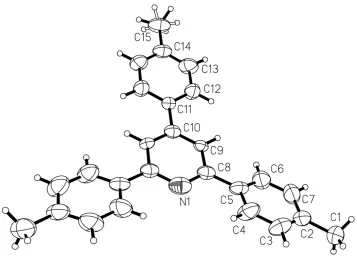
As shown in Fig.1, the title compound is a neutral organic molecule with a mirror symmetry through the methyl C15
atom and N1 atom of the central pyridine. The central pyridine is almost coplanar with the C11-14 benzene ring with a
dihedral angle of 2.9 (1) °, however, which form bigger dihedral angles of 14.1 (1) ° with the other two outer benzene
rings, thus the whole molecule is nonplanar. In the crystal packing, neighboring molecules form intermolecular π–π
interactions with the centroid- to-centroid distances of 3.804 (2) Å to give a one-dimensional chain along the c-axis.
S2. Experimental
The title compound was synthesized with a modified procedure (Yang et al., 2005). A mixture of 5-tri-p
-tolyl-pentane-1,5-dione (1.85 g, 5 mmol), ammonium acetate (3.85 g, 50 mmol) and ethanol (60 mL) was refluxed for 20 h.
Upon cooling to room temperature, a precipitate was filtered, washed with ethanol/water (1:1) and dried to afford the
product, purified by column chromatography on silica with petroleum/ethyl acetate. A white solid was obtained and was
further recrystallized from ethanol to give colourless crystals [yield: 0.85 g, 48.6%].
S3. Refinement
The carbon-bound H atoms were placed at calculated positions (C—H = 0.93 and 0.96 Å) and refined as riding, with
Figure 1
The title molecule with displacement ellipsoids drawn at the 30% probability level, and H atoms as spheres of arbitrary
radius.
2,4,6-Tri-p-tolylpyridine
Crystal data
C26H23N
Mr = 349.45
Orthorhombic, Pnma
Hall symbol: -P 2ac 2n
a = 15.337 (5) Å
b = 20.778 (7) Å
c = 6.322 (2) Å
V = 2014.8 (11) Å3
Z = 4
F(000) = 744
Dx = 1.152 Mg m−3
Mo Kα radiation, λ = 0.71073 Å Cell parameters from 562 reflections
θ = 2.7–22.4°
µ = 0.07 mm−1
T = 295 K Prism, colourless 0.24 × 0.16 × 0.15 mm
Data collection
Bruker SMART APEX area-detector diffractometer
Radiation source: fine-focus sealed tube Graphite monochromator
φ and ω scans
Absorption correction: multi-scan (SADABS; Sheldrick, 1996)
Tmin = 0.975, Tmax = 0.986
7912 measured reflections 2037 independent reflections 924 reflections with I > 2σ(I)
Rint = 0.067
θmax = 26.0°, θmin = 2.0°
h = −17→18
k = −20→25
Refinement
Refinement on F2 Least-squares matrix: full
R[F2 > 2σ(F2)] = 0.139
wR(F2) = 0.342
S = 1.26 2037 reflections 132 parameters 47 restraints
Primary atom site location: structure-invariant direct methods
Secondary atom site location: difference Fourier map
Hydrogen site location: inferred from neighbouring sites
H-atom parameters constrained
w = 1/[σ2(F
o2) + (0.0923P)2 + 1.1054P] where P = (Fo2 + 2Fc2)/3
(Δ/σ)max < 0.001 Δρmax = 0.27 e Å−3 Δρmin = −0.20 e Å−3
Special details
Geometry. All esds (except the esd in the dihedral angle between two l.s. planes) are estimated using the full covariance matrix. The cell esds are taken into account individually in the estimation of esds in distances, angles and torsion angles; correlations between esds in cell parameters are only used when they are defined by crystal symmetry. An approximate (isotropic) treatment of cell esds is used for estimating esds involving l.s. planes.
Refinement. Refinement of F2 against ALL reflections. The weighted R-factor wR and goodness of fit S are based on F2, conventional R-factors R are based on F, with F set to zero for negative F2. The threshold expression of F2 > 2sigma(F2) is used only for calculating R-factors(gt) etc. and is not relevant to the choice of reflections for refinement. R-factors based on F2 are statistically about twice as large as those based on F, and R- factors based on ALL data will be even larger.
Fractional atomic coordinates and isotropic or equivalent isotropic displacement parameters (Å2)
x y z Uiso*/Ueq Occ. (<1)
C1 0.4178 (6) 0.5536 (4) 0.7562 (16) 0.180 (4)
H1A 0.4197 0.5501 0.9076 0.270*
H1B 0.3776 0.5869 0.7165 0.270*
H1C 0.4749 0.5639 0.7038 0.270*
C2 0.3882 (5) 0.4900 (4) 0.6625 (15) 0.139 (3) C3 0.3948 (6) 0.4331 (5) 0.7686 (15) 0.158 (3)
H3 0.4171 0.4334 0.9053 0.190*
C4 0.3696 (5) 0.3750 (4) 0.6812 (13) 0.143 (3)
H4 0.3750 0.3378 0.7624 0.172*
C5 0.3376 (4) 0.3699 (4) 0.4833 (11) 0.098 (2) C6 0.3283 (6) 0.4267 (5) 0.3786 (13) 0.139 (3)
H6 0.3050 0.4261 0.2428 0.167*
C7 0.3522 (6) 0.4853 (4) 0.4650 (15) 0.163 (4)
H7 0.3435 0.5226 0.3866 0.196*
C8 0.3116 (4) 0.3075 (3) 0.3878 (9) 0.0859 (18) C9 0.2622 (3) 0.3058 (2) 0.2112 (8) 0.0646 (14)
H9 0.2455 0.3443 0.1479 0.077*
N1 0.3373 (5) 0.2500 0.4758 (13) 0.123 (3)
C10 0.2366 (5) 0.2500 0.1249 (12) 0.075 (2)
C11 0.1802 (4) 0.2500 −0.0662 (12) 0.0673 (19) C12 0.1525 (4) 0.3049 (3) −0.1594 (11) 0.107 (2)
H12 0.1713 0.3442 −0.1057 0.128*
C13 0.0972 (5) 0.3044 (3) −0.3317 (11) 0.121 (2)
H13 0.0794 0.3438 −0.3873 0.145*
C15 0.0081 (6) 0.2500 −0.6115 (15) 0.133 (3)
H15A 0.0335 0.2753 −0.7227 0.199* 0.50
H15B −0.0472 0.2681 −0.5722 0.199* 0.50
H15C −0.0001 0.2066 −0.6600 0.199* 0.50
Atomic displacement parameters (Å2)
U11 U22 U33 U12 U13 U23
C1 0.158 (7) 0.165 (7) 0.217 (9) 0.049 (6) −0.066 (7) −0.093 (7) C2 0.111 (5) 0.149 (7) 0.157 (7) 0.030 (5) −0.054 (5) −0.053 (5) C3 0.153 (5) 0.181 (7) 0.141 (6) −0.015 (5) −0.063 (5) −0.029 (5) C4 0.142 (5) 0.165 (6) 0.122 (5) −0.027 (4) −0.049 (5) −0.006 (5) C5 0.074 (4) 0.142 (5) 0.078 (4) 0.003 (4) −0.022 (3) −0.008 (4) C6 0.157 (7) 0.141 (7) 0.119 (7) 0.036 (6) −0.052 (5) −0.024 (6) C7 0.186 (9) 0.132 (7) 0.171 (9) 0.057 (6) −0.061 (8) −0.042 (6) C8 0.063 (3) 0.120 (5) 0.075 (4) 0.002 (4) 0.002 (3) 0.001 (4) C9 0.054 (3) 0.080 (3) 0.060 (3) 0.011 (3) −0.013 (3) −0.001 (3) N1 0.089 (6) 0.180 (9) 0.098 (6) 0.000 0.011 (5) 0.000 C10 0.055 (4) 0.103 (6) 0.065 (5) 0.000 0.011 (4) 0.000 C11 0.060 (4) 0.076 (5) 0.066 (5) 0.000 −0.002 (4) 0.000 C12 0.119 (5) 0.092 (4) 0.110 (5) −0.002 (4) −0.037 (4) 0.003 (4) C13 0.114 (5) 0.141 (6) 0.108 (5) 0.004 (4) −0.038 (4) 0.031 (4) C14 0.078 (5) 0.152 (7) 0.079 (5) 0.000 −0.020 (4) 0.000 C15 0.098 (6) 0.216 (9) 0.085 (6) 0.000 −0.022 (5) 0.000
Geometric parameters (Å, º)
C1—C2 1.518 (10) C9—C10 1.340 (6)
C1—H1A 0.9600 C9—H9 0.9300
C1—H1B 0.9600 N1—C8i 1.375 (5)
C1—H1C 0.9600 C10—C9i 1.340 (6)
C2—C3 1.361 (8) C10—C11 1.486 (10)
C2—C7 1.369 (8) C11—C12i 1.352 (6)
C3—C4 1.384 (10) C11—C12 1.352 (6)
C3—H3 0.9300 C12—C13 1.381 (8)
C4—C5 1.348 (9) C12—H12 0.9300
C4—H4 0.9300 C13—C14 1.352 (6)
C5—C6 1.361 (9) C13—H13 0.9300
C5—C8 1.484 (8) C14—C13i 1.352 (6)
C6—C7 1.384 (9) C14—C15 1.495 (12)
C6—H6 0.9300 C15—H15A 0.9600
C7—H7 0.9300 C15—H15B 0.9600
C8—C9 1.350 (7) C15—H15C 0.9600
C8—N1 1.375 (5)
C2—C1—H1A 109.5 N1—C8—C5 121.1 (6)
C2—C1—H1B 109.5 C10—C9—C8 121.5 (6)
C2—C1—H1C 109.5 C8—C9—H9 119.2
H1A—C1—H1C 109.5 C8i—N1—C8 120.6 (9)
H1B—C1—H1C 109.5 C9—C10—C9i 119.8 (7)
C3—C2—C7 114.7 (9) C9—C10—C11 120.1 (4)
C3—C2—C1 122.7 (8) C9i—C10—C11 120.1 (4)
C7—C2—C1 122.6 (9) C12i—C11—C12 115.0 (8)
C2—C3—C4 122.7 (8) C12i—C11—C10 122.5 (4)
C2—C3—H3 118.7 C12—C11—C10 122.5 (4)
C4—C3—H3 118.7 C11—C12—C13 122.1 (6)
C5—C4—C3 122.7 (9) C11—C12—H12 118.9
C5—C4—H4 118.6 C13—C12—H12 118.9
C3—C4—H4 118.6 C14—C13—C12 123.5 (7)
C4—C5—C6 114.9 (8) C14—C13—H13 118.2
C4—C5—C8 123.0 (7) C12—C13—H13 118.2
C6—C5—C8 122.1 (6) C13—C14—C13i 113.6 (9)
C5—C6—C7 122.9 (8) C13—C14—C15 123.2 (4)
C5—C6—H6 118.5 C13i—C14—C15 123.2 (4)
C7—C6—H6 118.5 C14—C15—H15A 109.5
C2—C7—C6 122.0 (9) C14—C15—H15B 109.5
C2—C7—H7 119.0 H15A—C15—H15B 109.5
C6—C7—H7 119.0 C14—C15—H15C 109.5
C9—C8—N1 118.2 (7) H15A—C15—H15C 109.5
C9—C8—C5 120.6 (5) H15B—C15—H15C 109.5
C7—C2—C3—C4 1.9 (14) C5—C8—C9—C10 −178.7 (6)
C1—C2—C3—C4 −178.5 (8) C9—C8—N1—C8i −1.3 (11)
C2—C3—C4—C5 0.8 (15) C5—C8—N1—C8i 178.9 (5)
C3—C4—C5—C6 −2.7 (12) C8—C9—C10—C9i −1.8 (10)
C3—C4—C5—C8 179.1 (7) C8—C9—C10—C11 178.3 (5)
C4—C5—C6—C7 1.8 (12) C9—C10—C11—C12i −179.9 (6)
C8—C5—C6—C7 180.0 (7) C9i—C10—C11—C12i 0.2 (10)
C3—C2—C7—C6 −2.8 (14) C9—C10—C11—C12 −0.2 (10)
C1—C2—C7—C6 177.6 (8) C9i—C10—C11—C12 179.9 (6)
C5—C6—C7—C2 1.0 (15) C12i—C11—C12—C13 2.5 (12)
C4—C5—C8—C9 164.8 (6) C10—C11—C12—C13 −177.3 (6)
C6—C5—C8—C9 −13.2 (10) C11—C12—C13—C14 −1.3 (12)
C4—C5—C8—N1 −15.4 (10) C12—C13—C14—C13i 0.0 (15)
C6—C5—C8—N1 166.6 (7) C12—C13—C14—C15 −179.6 (8)
N1—C8—C9—C10 1.5 (9)