(
E
)-3-(3-Chlorophenyl)-1-(4-methoxy-phenyl)prop-2-en-1-one
Naveed Ahmad,aHamid Latif Siddiqui,aMuhammad Zia-ur-Rehmanb* and Masood Parvezc
aInstitute of Chemistry, University of the Punjab, Lahore 54590, Pakistan,bApplied
Chemistry Research Centre, PCSIR Laboratories Complex, Lahore-54600, Pakistan, andcDepartment of Chemistry, The University of Calgary, 2500 University Drive
NW, Calgary, Alberta, Canada T2N 1N4
Correspondence e-mail: [email protected]
Received 9 May 2010; accepted 10 May 2010
Key indicators: single-crystal X-ray study;T= 173 K; mean(C–C) = 0.003 A˚; Rfactor = 0.026;wRfactor = 0.073; data-to-parameter ratio = 12.1.
The title molecule, C16H13ClO2, is trans with respect to the
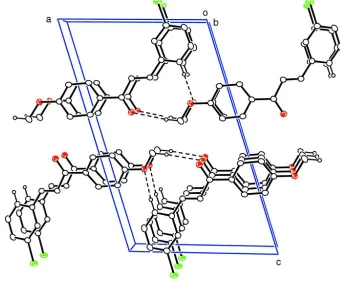
C C double bond. The dihedral angles between the mean plane of the prop-2-en-1-one unit and those of the 3-chloro-and 4-methoxy-substituted benzene rings are 20.93 (9) 3-chloro-and 20.42 (10), respectively, and the dihedral angle between the mean planes of the two benzene rings is 40.96 (5). The crystal structure is stabilized by weak intermolecular C—H O hydrogen bonds, forming chains along thebaxis.
Related literature
For the biological activity of chalcones, see: Dimmock et al.
(1999); Opletalova & Sedivy (1999); Linet al.(2002); Nowa-kowska (2007). For the synthesis and biological activity of related chalcone derivatives, see: Hussain et al. (2009). For non-linear optical studies of chalcones, see: Sarojini et al.
(2006); Poorneshet al.(2009); Shettigaret al.(2006; 2008). For related structures, see: Rosliet al. (2006); Patilet al.(2006); Harrisonet al.(2006); Funet al.(2008); Jasinskiet al.(2010).
Experimental
Crystal data
C16H13ClO2
Mr= 272.71 Monoclinic,P21
a= 10.3415 (6) A˚
b= 3.8938 (1) A˚
c= 16.9152 (10) A˚ = 107.582 (2)
V= 649.32 (6) A˚3
Z= 2
MoKradiation = 0.29 mm1
T= 173 K
0.180.160.04 mm
Data collection
Nonius KappaCCD diffractometer Absorption correction: multi-scan
(SORTAV; Blessing, 1997)
Tmin= 0.950,Tmax= 0.989
2099 measured reflections 2099 independent reflections 2075 reflections withI> 2(I)
Refinement
R[F2> 2(F2)] = 0.026
wR(F2) = 0.073
S= 1.15 2099 reflections 173 parameters 1 restraint
H-atom parameters constrained
max= 0.13 e A˚
3
min=0.14 e A˚
3
Absolute structure: Flack (1983), 687 Friedel pairs
Flack parameter: 0.08 (6)
Table 1
Hydrogen-bond geometry (A˚ ,).
D—H A D—H H A D A D—H A
C7—H7A O2i
0.98 2.58 3.545 (2) 168 C16—H16 O1ii 0.95 2.51 3.424 (2) 162
Symmetry codes: (i)xþ1;y;z; (ii)x1;yþ1;z.
Data collection: COLLECT (Hooft, 1998); cell refinement: DENZO (Otwinowski & Minor, 1997); data reduction: SCALE-PACK (Otwinowski & Minor, 1997); program(s) used to solve structure:SHELXS97(Sheldrick, 2008); program(s) used to refine structure: SHELXL97 (Sheldrick, 2008); molecular graphics: ORTEP-3 for Windows(Farrugia, 1997); software used to prepare material for publication:SHELXL97.
The authors are grateful to the Institute of Chemistry, University of the Punjab, Lahore, and the PCSIR Laboratories Complex, Lahore, for the provision of necessary facilities.
Supplementary data and figures for this paper are available from the IUCr electronic archives (Reference: LH5044).
References
Blessing, R. H. (1997).J. Appl. Cryst.30, 421–426.
Dimmock, J. R., Elias, D. W., Beazely, M. A. & Kandepu, N. M. (1999).Curr. Med. Chem.6, 1125–1149.
Farrugia, L. J. (1997).J. Appl. Cryst.30, 565. Flack, H. D. (1983).Acta Cryst.A39, 876–881.
Fun, H.-K., Jebas, S. R., Patil, P. S. & Dharmaprakash, S. M. (2008).Acta Cryst.
E64, o1525.
Harrison, W. T. A., Yathirajan, H. S., Sarojini, B. K., Narayana, B. & Indira, J. (2006).Acta Cryst.E62, o1647–o1649.
Hooft, R. (1998).COLLECT. Nonius BV, Delft, The Netherlands.
Hussain, T., Siddiqui, H. L., Zia-ur-Rehman, M., Yasinzai, M. M. & Pervez, M. (2009).Eur. J. Med. Chem.44, 4654–4660.
Jasinski, J. P., Butcher, R. J., Narayana, B., Samshuddin, S. & Yathirajan, H. S. (2010).Acta Cryst.E66, o269–o270.
Lin, Y. M., Zhou, Y., Flavin, M. T., Zhou, L. M., Nie, W. & Chen, F. C. (2002).
Bioorg. Med. Chem.10, 2795–2802.
Nowakowska, Z. (2007).Eur. J. Med. Chem.42, 125–137. Opletalova, V. & Sedivy, D. (1999).Ceska Slov. Farm.48, 252–255. Otwinowski, Z. & Minor, W. (1997). Methods in Enzymology, Vol. 276,
Macromolecular Crystallography, Part A, edited by C. W. Carter Jr & R. M. Sweet, pp. 307-326. New York: Academic Press.
Patil, P. S., Dharmaprakash, S. M., Fun, H.-K. & Karthikeyan, M. S. (2006).J. Cryst. Growth,297, 111–116.
Poornesh, P., Shettigar, S., Umesh, G., Manjunatha, K. B., Prakash Kamath, K., Sarojini, B. K. & Narayana, B. (2009).Opt. Mater.31, 854–859.
organic compounds
o1346
Ahmadet al. doi:10.1107/S1600536810017150 Acta Cryst.(2010). E66, o1346–o1347 Acta Crystallographica Section EStructure Reports
Online
Rosli, M. M., Patil, P. S., Fun, H.-K., Razak, I. A. & Dharmaprakash, S. M. (2006).Acta Cryst.E62, o1466–o1468.
Sarojini, B. K., Narayana, B., Ashalatha, B. V., Indira, J. & Lobo, K. J. (2006).J. Cryst. Growth,295, 54–59.
Sheldrick, G. M. (2008).Acta Cryst.A64, 112–122.
Shettigar, S., Chandrasekharan, K., Umesh, G., Sarojini, B. K. & Narayana, B. (2006).Polymer,47, 3565–3567.
supporting information
sup-1 Acta Cryst. (2010). E66, o1346–o1347
supporting information
Acta Cryst. (2010). E66, o1346–o1347 [https://doi.org/10.1107/S1600536810017150]
(
E
)-3-(3-Chlorophenyl)-1-(4-methoxyphenyl)prop-2-en-1-one
Naveed Ahmad, Hamid Latif Siddiqui, Muhammad Zia-ur-Rehman and Masood Parvez
S1. Comment
Chalcones are well known for their biological activities (Dimmock et al., 1999). These have been reported as potential anti-fungal chemotherapeutic (Opletalova & Sedivy, 1999), anti-tuberculosis (Lin et al., 2002) and infective & anti-inflammatory agents (Nowakowska, 2007). In addition, few among these have found their use as organic non-linear optical materials (NLO) due to their good SHG (second-harmonic generation) conversion efficiencies (Sarojini et al., 2006; Poornesh et al., 2009; Shettigar et al., 2006; 2008). In continuation of our work on chalcones (Hussain et al., 2009) and in view of the importance of chloro chalcones, the synthesis and crystal structure of the title compound, (I), is presented in this article.
The title molecule (Fig. 1) exhibits an E configuration with respect to the C═C double bond, the torsion angle C–C═C– C being -177.75 (17)°. The dihedral angle between the mean planes of the 3-chloro and 4-methoxy substituted benzene rings is 40.96 (5)°. The dihedral angles between the mean planes of the prop-2-en-1-one unit and those of the 3-chloro and 4-methoxy substitued benzene rings are 20.93 (9) and 20.42 (10)°, respectively. The geometrical parameters for (I) are consistent with those of some recently reported chalcone derivatives closely related to (I) (Rosli et al., 2006; Patil et al., 2006; Harrison et al., 2006; Fun et al.; 2008; Jasinski et al., 2010). The structure is stabilized by intermolecular interactions of the type C—H···O resulting in polymeric chains along the b-axis (Fig. 2, Tab. 1)
S2. Experimental
A mixture of 3-chlorobenzaldehyde (0.01 moles, 1.13 g), 4-methoxyacetophenone (0.01 moles, 1.37 ml) and sodium hydroxide solution (10%, 30 ml) was stirred at room temperature for 6 hrs. Precipitates obtained were poured into ice-cold water (500 ml) and left to stand for 2 hours followed by filtration of the resultant solid which was dried and crystallized from ethanol by slow evaporation.
S3. Refinement
Figure 1
The title molecule plotted with the displacement ellipsoids at 50% probability level (Farrugia, 1997).
Figure 2
Unit cell packing of the title molecule, viewed down the b-axis. Intramolecular interactions of the type C—H···O are shown as dashed lines and H-atoms not involved in hydrogen bonding interactions have been excluded.
(E)-3-(3-Chlorophenyl)-1-(4-methoxyphenyl)prop-2-en-1-one
Crystal data
C16H13ClO2 Mr = 272.71
Monoclinic, P21
Hall symbol: P 2yb
a = 10.3415 (6) Å
b = 3.8938 (1) Å
c = 16.9152 (10) Å
[image:4.610.131.471.281.563.2]supporting information
sup-3 Acta Cryst. (2010). E66, o1346–o1347
V = 649.32 (6) Å3 Z = 2
F(000) = 284
Dx = 1.395 Mg m−3
Mo Kα radiation, λ = 0.71073 Å Cell parameters from 1186 reflections
θ = 1.0–27.5°
µ = 0.29 mm−1 T = 173 K Plate, colourless 0.18 × 0.16 × 0.04 mm
Data collection
Nonius KappaCCD diffractometer
Radiation source: fine-focus sealed tube Graphite monochromator
ω and φ scans
Absorption correction: multi-scan (SORTAV; Blessing, 1997)
Tmin = 0.950, Tmax = 0.989
2099 measured reflections 2099 independent reflections 2075 reflections with I > 2σ(I)
Rint = 0.000
θmax = 25.0°, θmin = 2.1° h = −12→12
k = −4→4
l = −20→19
Refinement
Refinement on F2
Least-squares matrix: full
R[F2 > 2σ(F2)] = 0.026 wR(F2) = 0.073 S = 1.15 2099 reflections 173 parameters 1 restraint
Primary atom site location: structure-invariant direct methods
Secondary atom site location: difference Fourier map
Hydrogen site location: difference Fourier map H-atom parameters constrained
w = 1/[σ2(F
o2) + (0.0313P)2 + 0.151P]
where P = (Fo2 + 2Fc2)/3
(Δ/σ)max < 0.001
Δρmax = 0.13 e Å−3
Δρmin = −0.14 e Å−3
Absolute structure: Flack (1983), 687 Friedel pairs
Absolute structure parameter: 0.08 (6)
Special details
Geometry. All esds (except the esd in the dihedral angle between two l.s. planes) are estimated using the full covariance
matrix. The cell esds are taken into account individually in the estimation of esds in distances, angles and torsion angles; correlations between esds in cell parameters are only used when they are defined by crystal symmetry. An approximate (isotropic) treatment of cell esds is used for estimating esds involving l.s. planes.
Refinement. Refinement of F2 against ALL reflections. The weighted R-factor wR and goodness of fit S are based on F2,
conventional R-factors R are based on F, with F set to zero for negative F2. The threshold expression of F2 > σ(F2) is used
only for calculating R-factors(gt) etc. and is not relevant to the choice of reflections for refinement. R-factors based on F2
are statistically about twice as large as those based on F, and R- factors based on ALL data will be even larger.
Fractional atomic coordinates and isotropic or equivalent isotropic displacement parameters (Å2)
x y z Uiso*/Ueq
Cl1 0.28612 (5) 0.84356 (13) −0.07337 (2) 0.03991 (15) O1 1.26882 (11) 0.5880 (4) 0.35589 (7) 0.0330 (3) O2 0.67938 (12) 0.6392 (4) 0.39544 (8) 0.0413 (4) C1 0.85889 (16) 0.6328 (4) 0.33613 (10) 0.0247 (4) C2 0.90929 (17) 0.7521 (4) 0.27311 (10) 0.0267 (4)
H2 0.8490 0.8486 0.2242 0.032*
C3 1.04622 (18) 0.7304 (5) 0.28148 (10) 0.0290 (4)
H3 1.0797 0.8125 0.2385 0.035*
C5 1.08649 (17) 0.4606 (5) 0.41555 (10) 0.0264 (4)
H5 1.1465 0.3585 0.4637 0.032*
C6 0.94934 (17) 0.4851 (5) 0.40622 (10) 0.0261 (4)
H6 0.9158 0.3989 0.4488 0.031*
C7 1.36446 (17) 0.4448 (5) 0.42797 (12) 0.0365 (5)
H7A 1.4561 0.4645 0.4229 0.044*
H7B 1.3430 0.2022 0.4330 0.044*
H7C 1.3598 0.5697 0.4773 0.044*
C8 0.71475 (17) 0.6756 (5) 0.33309 (10) 0.0287 (4) C9 0.61392 (17) 0.7636 (5) 0.25241 (10) 0.0284 (4)
H9 0.6357 0.7207 0.2026 0.034*
C10 0.49465 (16) 0.9000 (5) 0.24782 (10) 0.0276 (4)
H10 0.4780 0.9468 0.2990 0.033*
C11 0.38516 (17) 0.9868 (5) 0.17214 (11) 0.0252 (3) C12 0.38969 (16) 0.8919 (5) 0.09297 (10) 0.0267 (4)
H12 0.4662 0.7735 0.0865 0.032*
C13 0.28167 (17) 0.9727 (5) 0.02468 (10) 0.0280 (4) C14 0.16803 (17) 1.1442 (5) 0.03152 (11) 0.0311 (4)
H14 0.0946 1.1960 −0.0164 0.037*
C15 0.16385 (18) 1.2383 (5) 0.10952 (12) 0.0325 (4)
H15 0.0870 1.3567 0.1154 0.039*
C16 0.27161 (17) 1.1606 (5) 0.17948 (11) 0.0290 (4)
H16 0.2677 1.2268 0.2328 0.035*
Atomic displacement parameters (Å2)
U11 U22 U33 U12 U13 U23
supporting information
sup-5 Acta Cryst. (2010). E66, o1346–o1347
Geometric parameters (Å, º)
Cl1—C13 1.747 (2) C7—H7C 0.9800
O1—C4 1.369 (2) C8—C9 1.486 (2)
O1—C7 1.431 (2) C9—C10 1.323 (2)
O2—C8 1.225 (2) C9—H9 0.9500
C1—C6 1.393 (2) C10—C11 1.470 (2)
C1—C2 1.400 (2) C10—H10 0.9500
C1—C8 1.485 (2) C11—C16 1.393 (2)
C2—C3 1.383 (2) C11—C12 1.404 (2)
C2—H2 0.9500 C12—C13 1.379 (2)
C3—C4 1.393 (2) C12—H12 0.9500
C3—H3 0.9500 C13—C14 1.387 (3)
C4—C5 1.395 (2) C14—C15 1.383 (3)
C5—C6 1.382 (2) C14—H14 0.9500
C5—H5 0.9500 C15—C16 1.392 (2)
C6—H6 0.9500 C15—H15 0.9500
C7—H7A 0.9800 C16—H16 0.9500
C7—H7B 0.9800
C4—O1—C7 117.56 (13) O2—C8—C9 120.56 (15)
C6—C1—C2 118.44 (15) C1—C8—C9 118.44 (14)
C6—C1—C8 118.99 (14) C10—C9—C8 121.97 (15)
C2—C1—C8 122.48 (14) C10—C9—H9 119.0
C3—C2—C1 120.48 (15) C8—C9—H9 119.0
C3—C2—H2 119.8 C9—C10—C11 127.06 (15)
C1—C2—H2 119.8 C9—C10—H10 116.5
C2—C3—C4 120.00 (15) C11—C10—H10 116.5
C2—C3—H3 120.0 C16—C11—C12 119.01 (16)
C4—C3—H3 120.0 C16—C11—C10 118.85 (15)
O1—C4—C3 115.28 (14) C12—C11—C10 122.11 (15) O1—C4—C5 124.30 (15) C13—C12—C11 119.15 (16)
C3—C4—C5 120.42 (15) C13—C12—H12 120.4
C6—C5—C4 118.77 (15) C11—C12—H12 120.4
C6—C5—H5 120.6 C12—C13—C14 122.17 (16)
C4—C5—H5 120.6 C12—C13—Cl1 118.86 (14)
C5—C6—C1 121.85 (15) C14—C13—Cl1 118.94 (13)
C5—C6—H6 119.1 C15—C14—C13 118.62 (15)
C1—C6—H6 119.1 C15—C14—H14 120.7
O1—C7—H7A 109.5 C13—C14—H14 120.7
O1—C7—H7B 109.5 C14—C15—C16 120.40 (16)
H7A—C7—H7B 109.5 C14—C15—H15 119.8
O1—C7—H7C 109.5 C16—C15—H15 119.8
H7A—C7—H7C 109.5 C15—C16—C11 120.65 (16)
H7B—C7—H7C 109.5 C15—C16—H16 119.7
O2—C8—C1 120.99 (15) C11—C16—H16 119.7
C8—C1—C2—C3 174.97 (16) C1—C8—C9—C10 −160.40 (17) C1—C2—C3—C4 0.2 (3) C8—C9—C10—C11 −177.75 (17) C7—O1—C4—C3 −179.98 (16) C9—C10—C11—C16 −173.68 (18) C7—O1—C4—C5 0.4 (2) C9—C10—C11—C12 8.1 (3) C2—C3—C4—O1 −178.27 (15) C16—C11—C12—C13 −0.1 (3) C2—C3—C4—C5 1.4 (3) C10—C11—C12—C13 178.09 (16) O1—C4—C5—C6 178.08 (17) C11—C12—C13—C14 −0.2 (3) C3—C4—C5—C6 −1.5 (2) C11—C12—C13—Cl1 −178.31 (13) C4—C5—C6—C1 0.2 (3) C12—C13—C14—C15 0.4 (3) C2—C1—C6—C5 1.4 (3) Cl1—C13—C14—C15 178.47 (14) C8—C1—C6—C5 −175.25 (16) C13—C14—C15—C16 −0.2 (3) C6—C1—C8—O2 12.6 (3) C14—C15—C16—C11 −0.1 (3) C2—C1—C8—O2 −163.87 (19) C12—C11—C16—C15 0.2 (3) C6—C1—C8—C9 −167.35 (17) C10—C11—C16—C15 −178.02 (16) C2—C1—C8—C9 16.2 (2)
Hydrogen-bond geometry (Å, º)
D—H···A D—H H···A D···A D—H···A
C7—H7A···O2i 0.98 2.58 3.545 (2) 168
C16—H16···O1ii 0.95 2.51 3.424 (2) 162