Original Research
Building capacity to use and undertake applied
health research: establishing a training programme
for the health workforce in the West of England
Abigail Sabey
a,b,*, Isabelle Bray
a,b, Selena Gray
a,baThe National Institute for Health Research Collaboration for Leadership in Applied Health Research and Care West
(NIHR CLAHRC West), University Hospitals Bristol NHS Foundation Trust, Bristol, UK bDepartment of Health and Social Sciences, University of the West of England, Bristol, UK
a r t i c l e i n f o
Article history: Received 14 May 2018 Received in revised form 16 October 2018
Accepted 5 November 2018
Keywords: Capacity building
Continuing professional develop-ment
Inter-professional training Research methods
a b s t r a c t
Objectives: Increasing research capacity is important for health services as part of improving the conduct of high-quality research, which addresses the needs of patients and the public. It is a core function of the 13 Collaborations for Leadership in Applied Health Research and Care (CLAHRCs) established in England between 2008 and 2013. This article reports on the development of an innovative capacity building programme in CLAHRC West over an 18-month period (May 2015 to December 2016). It aims to disseminate the learning from the initiative and share our experience with other CLAHRCs.
Study design:The study design was an evaluation of a training programme to build research capacity.
Methods:We carried out a training needs assessment among local stakeholders and scoped existing provision of research-related training. This informed the development of a pro-gramme of free short courses, which were targeted at health and social care professionals including those working in local authorities and the voluntary sector. We aimed to engage professionals working at all levels in these organisations and to promote interprofessional education, to build a research culture. We engaged a variety of educators to provide a range of 1-day courses at an introductory level, which were accessible to practitioners. Results:During the first 18 months of the training programme, we delivered 31 courses and trained 350 participants. Attendees came from secondary care (20%), voluntary sector (18%) and local authorities (18%). Professionals working in the mental health sector comprised 11% and commissioning 6%. Less well represented were primary care (3%) and community care (4%). The largest professional group was public health, followed by medical, nursing and allied health professionals in approximately equal proportions. Courses were evalu-ated on a scale of 1 (poor) to 4 (excellent) with the mean being 3.6 (range 3.3e4.0). Conclusions: The training programme has been highly successful with many courses oversubscribed, and all courses being well evaluated by participants. It has met the needs of local professionals for brief, applied training in research, as well as attracting those from other parts of the United Kingdom, suggesting the courses are both appropriate and
*Corresponding author. The National Institute for Health Research Collaboration for Leadership in Applied Health Research and Care West (NIHR CLAHRC West), University Hospitals Bristol NHS Foundation Trust, 9th Floor, Whitefriars, Lewins Mead, Bristol BS1 2NT, UK. Tel.:þ44 117 342 1262.
E-mail addresses:[email protected](A. Sabey),[email protected](I. Bray),[email protected](S. Gray).
Available online at
www.sciencedirect.com
Public Health
journa l hom epage: www.elsevier.com /puhe
https://doi.org/10.1016/j.puhe.2018.11.001
helping to fill a gap in provision. We are building on this work to further engage audiences working in areas such as the wider determinants of health and commissioning, as well as primary and community sectors. CLAHRCs are uniquely placed to drive a culture change in the use, understanding and application of research across the healthcare community. Crown Copyright©2018 Published by Elsevier Ltd on behalf of The Royal Society for Public
Health. This is an open access article under the CC BY-NC-ND license (http://creativecommons.org/licenses/by-nc-nd/4.0/).
Introduction
Efforts to improve health care and population health are facilitated by policymakers and practitioners who understand and are able to critique and apply research. In England, the National Institute for Health Research (NIHR) provides ‘a health research system in which the National Health Service (NHS) supports outstanding individuals working in world-class facilities, conducting leading-edge research focused on the needs of patients and the public’.1In October 2008, NIHR established nine Collaborations for Leadership in Applied Health Research and Care (CLAHRCs), and in January 2014, a further allocation established a total of 13 collaborations to bring together local providers of NHS services, health com-missioners, public health and other relevant local organisa-tions delivering health and social care, with universities to drive forward improvements in health and health care. CLAHRCs aim to carry out the most relevant research focused on patient outcomes and, importantly, translate the findings into improved services and outcomes for the local population. In addition, CLAHRCs have an explicit remit to increase ca-pacity to conduct high-quality applied health research, mak-ing skills development a core theme. CLAHRC West has taken an innovative approach to the capacity building agenda, and this article reports on how we have delivered this part of the CLAHRCs' remit and how this is engaging professionals working in the health, social and voluntary sectors.
The CLAHRCs have been described as a ‘natural experi-ment’,2sharing broadly similar goals but existing in different contexts and therefore varying in nature and scope. With this discretion, different CLAHRCs have approached capacity building in various ways (e.g., Cooke et al., 2016)3from intro-ductory training courses to PhDs, internships and research fellowships. At CLAHRC West, we set out to promote the development of skills in understanding, using and producing evidence for the health, public health and commissioning workforce and patients and members of the public. The ca-pacity development team, which consists of three part-time members of staff (a professor and two experienced senior lecturers from one of the universities in the CLAHRC West area), sought to address the needs of the workforce at all levels and not just those already engaged in a research career. We particularly wanted to include those parts of the sector where funding for training and research are more restricted, such as the voluntary sector. In line with Tooke's recommendation that the NHS should ‘embed a critical culture that is more receptive to change’,4we wanted to engage as many people as possible in education about research and evidence to build a
research culture in the healthcare community in its broadest sense and in this way help to close the ‘second gap in trans-lation’.5Our main focus has therefore been delivering educa-tion to individuals working in the local health and care system. A lack of skills to appraise and understand research evidence is a common barrier to evidence-informed health care, and ed-ucation intended to increase research literacy is an effective intervention.6 In addition, such skills may help staff to collaborate in determining the priorities for research and thus shape the research agenda so that it addresses service needs.7 CLAHRC West covers a geographical area in the West of England (Fig. 1). This area delivers health services to a popu-lation of around 2.4 million people.
Methods
Needs assessment
We began with a needs assessment exercise consisting of three elements: qualitative interviews with senior staff involved in learning and development in the CLAHRC's part-ner organisations; data from a survey of staff in a local commissioning group; and a review of existing research training provision.
Ten in-depth interviews were undertaken by the CLAHRC West Ethnography Team, with senior leaders representing public health, acute care, ambulance services, and mental health services. Participants were asked about their under-standing of the evidence-based culture in their organisation and access to training and barriers to using evidence and research. They were also asked about how such education and training could be best delivered for their staff by CLAHRC West. Data were transcribed and analysed thematically, with AS and SG confirming themes. Whilst initially it was intended to include a wider group of respondents, there were practical constraints in arranging times when these individuals could be interviewed. Although formal data saturation was not achieved, there were strong similarities in themes across different organisations.
Next, we had access to local survey data (unpublished) from a similar exercise recently completed with managers from clinical and other backgrounds in a clinical commis-sioning group. This asked about the evidence culture, current use of research evidence and facilitators and barriers to using evidence. The survey was administered to 134 people, of whom 48 replied (36%). A simple descriptive analysis was conducted, which we used to inform our needs assessment.
in our geographical area. This included contacting a range of providers, including universities and the NHS. Courses were recorded in a searchable database.8
Outcome of needs assessment
Interview data revealed that evidence-based practice is generally accepted as important. However, some very real practical constraints, such as staffing levels and budget cuts, were identified with respect to engaging staff in research-related training. Organisations felt that their primary focus was ensuring that staff were compliant with statutory and mandatory training requirementsdnone of which pertain to
research. They perceived that undergraduate training or postgraduate training in local universities was the main source of education and training for staff, and there was generally no systematic approach within their own organi-sation. These senior leaders identified that staff lack confi-dence in the subject, and many staff have not undertaken recent training in research (unless recently qualified) or do not perceive this to be relevant to their role. As a result, research concerns the few rather than the majority and typically those at higher levels in the organisation.
The data revealed that to help engage staff, there was a need to provide shorter (half- or 1-day) courses rather than multiple day courses; to provide 8e10 weeks’ notice of
training dates; ideally, local or on-site training, and the need to link content to issues of clinical importance rather than theory-based research. It also revealed the value of librarians as an underutilised resource.
Key themes from the local survey of Clinical Commissioning Group staff were that the majority of staff (90%) said they used research/evidence in their role and there was clear agreement with a statement that the organisation encourages the use of research and evidence. However, the overall mean was 2.68 on a scale from 1 (strongly agree) to 5 (strongly disagree), sug-gesting some scope for building this further. Staff confidence in finding evidence, determining the relevance of research/evi-dence and assessing trustworthiness were all around the midpoint or below on a scale of confidence, again suggesting
areas for development. The biggest barriers to using evidence were lack of time, a lack of skills and, finally, an uncertainty regarding resources. The most common training requirements included finding research and service evaluation skills.
The scoping exercise identified more than 50 courses relevant to research in the local area, which were collated in the searchable database to help promote opportunities for training; however, it revealed that many courses were of a longer duration (either multiple days or study over several months), and in general, a shortage of basic, introductory courses. There were also notable gaps around service evalu-ation and finding evidence.
Establishing the capacity development programme
Drawing on the priorities identified in the needs assessment, we developed a programme of new courses, which covered topics from finding relevant evidence to improving research and evaluation skills (e.g., service evaluation, designing questionnaires and data analysis) and to critiquing research for practice (see full list inTable 1).
[image:3.595.107.482.65.250.2]collaboration between public health and those working in the wider determinants of health.10
A range of training models was used. Some courses were run by the Capacity Development team, and some were developed by them in conjunction with colleagues in CLAHRC West (researchers, the Information Scientist, the Patient and Public Involvement Team and the Communications Manager) and partner organisations (Avon Primary Care Research Collaborative, University of Bristol and UWE, Bristol). Another model was to commission external trainers where a need was identified. This wide range of approaches gave us the flexibility to respond to training needs in the most efficient way possible, rather than being constrained by a ‘one-size-fits-all’approach. All courses were offered free to participants. Shortlisting of applicants was based on a ‘capacity to benefit’basis, and a list of criteria was drawn up to facilitate unbiased decision-making. These included giving priority to applicants from
within the CLAHRC West patch and to those working in the NHS, voluntary sector and in local authorities.
Where new courses were developed by CLAHRC West col-leagues, a pilot was often run to test timing and content. Pilots were advertised to postgraduate students and CLAHRC staff. Developing courses with CLAHRC West colleagues led to greater integration of our team within CLAHRC and the usual benefits of collaboration, such as shared learning for the trainers and a programme incorporating a range of expertise for the course participants.
We sought to maximise the accessibility of our training by not only delivering it in a range of locations, but by keeping it as short as possible, in line with findings from the needs assessment. Our scoping exercise identified that most courses provided by higher education institutions (HEI) were either longer credit-bearing modules or short courses of 3e5 days
[image:4.595.56.552.77.510.2]duration. We, therefore, offered shorter, introductory level courses, mostly of 1 day to complement other local provision, Table 1eAttendances and overall feedback for all courses delivered by CLAHRC West (May 2015 to December 2016).
Date Course Location Duration of
course
Number attending
Feedback: mean of overall ratinga
May 2015 Getting Your Article Published Bristol 2 d 10 3.8 July 2015 Public Health Economics: Social Return on Investment Bristol 1 d 16 3.5 July 2015 Introduction to Service Evaluation Bristol 1 d 14 3.8 September 2015 Finding the Evidence for Commissioning Bristol 2 h 8 3.7 October 2015 Writing an Article and Getting It Published Bristol 1 d 10 3.5 October 2015 Getting Your Article Published Cheltenham 2 d 7 3.8 November 2015 Using and Understanding Research Evidence Bristol 1 d 12 3.5 November 2015 Introduction to Critical Appraisal for Healthcare
Professionals
Bristol 1 d 8 4.0
December 2015 Introduction to Service Evaluation Bristol 1 d 11 3.6 December 2015 Using Evidence to Lead Bristol 1 d 21 3.5 February 2016 Public Health Economics and Social Return on
Investment
Bristol 1 d 12 3.4
February 2016 Using and Understanding Research Evidence Bristol 1 d 8 3.9 March 2016 Getting your Article Published Bristol 2 d 11 3.8 April 2016 Introduction to Critical Appraisal for Healthcare
Professionals
Cheltenham 1 d 13 4.0
April 2016 Introduction to Realist Evaluation Bristol 1 d 24 3.5 May 2016 Finding the Evidence for Public Health Bristol 2 h 5 3.6 June 2016 Introduction to Service Evaluation Bristol 1 d 7 3.3 June 2016 Public Health Economics: Social Return on Investment Bristol 1 d 15 3.3 June 2016 Introduction to Questionnaire Design and Delivery Bristol 1 d 12 3.6 June 2016 Introduction to Genetics and Epigenetics for Public
Health
Bristol 1 d 8 3.6
July 2016 Introduction to Critical Appraisal for Healthcare Professionals
Bristol 1 d 12 3.8
September 2016 Introduction to Basic Statistics Bristol 0.5 d 10 3.5 October 2016 Writing for a Lay Audience Bristol 2 h 12 3.7 October 2016 Finding the Evidence for Commissioning Bristol 2 h 7 3.3 October 2016 Writing an Article and Getting it Published Bristol 1 d 10 3.6 October 2016 Introduction to Service Evaluation for Public Health Bristol 1 d 10 3.9 November 2016 Introduction to Questionnaire Design and Delivery Bristol 0.5 d 16 3.9 November 2016 Project Evaluation for Voluntary Sector Organisations Bristol 1 d 8 3.8 November 2016 Using and Understanding Research Evidence Swindon 1 d 12 3.3 December 2016 Finding, Using and Understanding Evidencee
Workshop for NHS Graduate Management Trainees
Bristol 1 d 10 3.5
December 2016 Introduction to Basic Statistics Bristol 0.5 d 11 3.3
Total 350 3.6
and we reflected the introductory nature of our courses in their titles. The target audience for each course was included in the advertising material. Signposting to further courses was also sometimes given if a candidate was not selected at shortlisting, and at the end of our training courses.
Finally, for some courses, follow-up support was offered. We trialled Action Learning Sets at 3 and 6 months after two courses as a way to extend the learning and provide additional support for carrying out an evaluation project.
Course evaluation
Evaluation forms were given to participants at the end of training courses. These asked for ratings of content and de-livery on a scale from 1 to 4 (1 being ‘poor’ and 4 being ‘excellent’) and an overall rating for the event using the same scale, seeking to capture ‘reaction’to the training at level 1 in Kirkpatrick's evaluation model.11The form also invited com-ments about the most helpful and least helpful elecom-ments of the course; the first to gauge learning (level 2 in Kirkpatrick's model), and the second to help inform improvements to future courses. Immediate impact of the course on behaviour (level 3), also referred to as ‘transfer’in this context,11was captured in a question asking for one action they were plan-ning to take as a result of the traiplan-ning. As we did not have scope to follow-up all participants at a later date, this served as a proxy for measuring actual behaviour back in the work-place. The piloting of Action Learning Sets was also an op-portunity to explore how the participants had applied their learning (level 3) and the longer-term impact of training.
Results
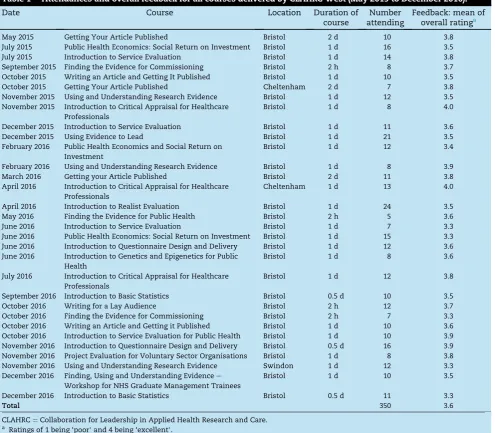
Table 1shows the titles and location of all courses delivered between May 2015 and December 2016, together with the numbers attending and mean overall rating for each course. Most courses (90%) were hosted in Bristol being a hub for healthcare research and teaching. We delivered 31 courses in this period with 350 participants attending; the number of people attending each course ranged from 5 to 24 (median¼11). The majority (68%) of these courses was 1 day in duration.
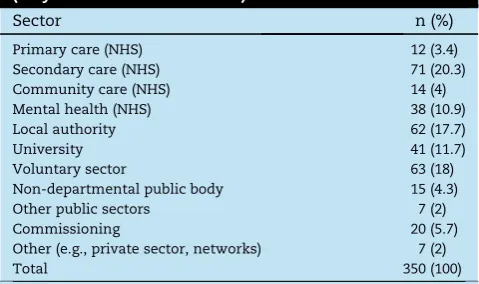
An assessment of the job titles of participants shows by far the largest group was public health professionals, followed by medical, nursing and allied health professionals (AHP) in approximately equal proportions. Dentists were not well represented.Table 2shows attendees most often came from secondary care (20%) followed by Local Authorities (18%) and the voluntary sector (18%). Professionals working in the mental health sector comprised 11% and in commissioning 6%. Less well represented were primary (3%) and community care (4%).
Table 3breaks down those who attended CLAHRC West courses by geographical location of employer. Almost half (47%) were based in organisations in Bristol. Another 19% represent organisations that work across the CLAHRC West area (Fig. 1). Most other unitary authorities in the area are well represented. It is also notable that 5% of attendees came from outside the CLAHRC West patch.
Course evaluation
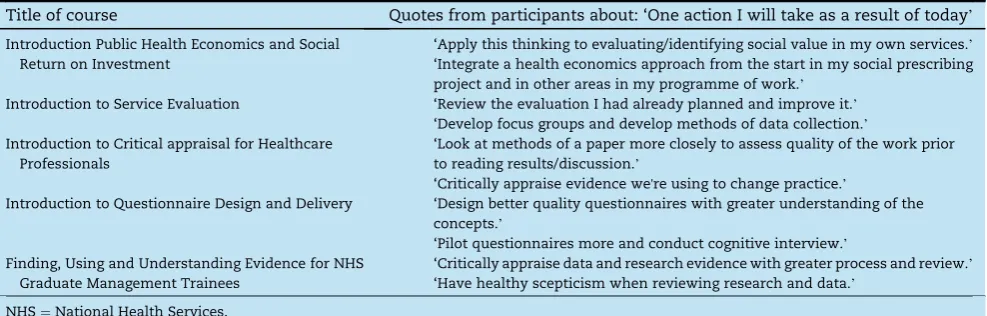
Completed forms were received from 86% of participants. The mean of overall ratings on course evaluation forms was 3.6 with the range from 3.3 to 4.0, representing very positive feedback across our programme. Comments on the evaluation forms were reviewed by the team and any external speaker involved. Negative comments were unusual, but cases were discussed and informed changes to the course where this was felt to carry weight; for example, if several comments were made about content being too difficult or about a particular activity not being helpful then adjustments were made. Common themes in positive feedback were around valuing the expertise of presenters and the practical focus of courses. We also analysed comments from the question about a planned action following the course. A selection is shown in
[image:5.595.304.544.89.231.2]Table 4. These highlight that individuals recognised the value of what they were learning and could see how to apply it within their own workplace showing clear intent to imple-ment new practices and methods learned during the training. The action learning sets, which were trialled after the first two service evaluation courses, were attended by 50% (course 1) and 25% (course 2) of participants. Although attendance was low, those who came gained help with progressing their data collection and analysis; no formal evaluation was carried out Table 2eOrganisational reach of CLAHRC West training (May 2015 to December 2016).
Sector n (%)
Primary care (NHS) 12 (3.4) Secondary care (NHS) 71 (20.3) Community care (NHS) 14 (4) Mental health (NHS) 38 (10.9) Local authority 62 (17.7)
University 41 (11.7)
Voluntary sector 63 (18)
Non-departmental public body 15 (4.3) Other public sectors 7 (2)
Commissioning 20 (5.7)
Other (e.g., private sector, networks) 7 (2)
Total 350 (100)
CLAHRC¼Collaboration for Leadership in Applied Health Research and Care; NHS¼National Health Services.
Table 3eGeographical reach of CLAHRC West training (May 2015 to December 2016).
Area n (%)
Gloucestershire 28 (8)
South Gloucestershire 15 (4.3)
Bristol 163 (46.6)
North Somerset 7 (2)
Bath and Northeast Somerset 21 (6)
Wiltshire 7 (2)
Swindon 22 (6.3)
Pan CLAHRC West area 68 (19.4) Outside CLAHRC West area 19 (5.4)
Total 350 (100)
but informally at the end of the sessions, participants reported that they found the process helpful in providing continuing momentum for their projects, and their progress was clear evidence of the impact of the training on their workplace practices. This was useful in deciding to continue the action learning sets with future cohorts.
Discussion
The programme of courses offered by the Capacity Develop-ment Team reached 350 participants in the first 18 months of CLAHRC West. Interestingly, a recent comprehensive survey of research training needs of healthcare staff identified similar priorities for training12to those addressed by our programme. Our participants represent many professions from a diverse range of sectors including NHS, local authorities and volun-tary organisations from across the CLAHRC West area. Five percent of participants came from outside the area (travelling up to 160 km to Bristol), suggesting that our provision has appeal in the wider region. The feedback obtained from par-ticipants suggests that the courses have been well received, and that the opportunity to attend this free training, the experience of the training environment and the educational content are all highly valued by this varied audience.
We believe there are a number of key features of our pro-gramme that have contributed to its success. These include the small group sizes, which engender a safe, open environ-ment for learning and opportunity to interact with the tutor. We have also seen the benefit of different professionals interacting with, and learning from, each other and in some cases building networks outside the course. Building re-lationships and collaborations is a desired outcome of ca-pacity building as a way to enhance the exchange of knowledge and promote research activity.13In addition, the space and time away from highly pressured workplace envi-ronments were positive factors that enabled people to focus and learn effectively. A further factor, which may have helped engage new audiences, was badging the courses as CLAHRC West training; with its close NHS partnerships, this may have helped the courses seem more accessible compared to university-based education, and similarly, the predominantly 1-day format increased accessibility to busy professionals.
Focus for improvements
Participants on our courses reported a positive evaluation of training including intention to take action in the workplace to improve the quality of research and evaluation practices. However, this was only a relatively superficial evaluation of courses due to the resourcing of the team, and we have since put in place more sophisticated processes for evaluating longer-term impact of training (level 4 of Kirkpatrick), which will include follow-up interviews.
Our courses have attracted staff in a range of public health roles and from the core healthcare professions such as med-icine, surgery, nursing and allied health professionals but with a notable gap among dentists. We have also reported that primary (3%) and community care (4%) were underrepre-sented on our courses. This could potentially be due to the current pressures on the workforce in primary care but also the wider opportunities in secondary care for doing research alongside clinical work. Given that we were unable to engage representatives from these sectors in our needs assessment exercise, further work is needed to understand the barriers to training in these areas and the training needs.
Engaging a significant number of staff from the voluntary sector, a trend which developed over the 18-month period on which we are reporting was a positive outcome. Several of our courses have been attractive to those working in this sector, and in addition, we developed the course on ‘Project Evalua-tion for the Voluntary Sector’. Similarly, we have delivered courses targeted at commissioning groups where the decision-making context and evidence culture are quite different to other areas of the health service.14,15Despite this, only 6% of our participants came from this sector, and we are continuing to develop ways of working successfully with these organisations to build an evidence culture; for example, shorter, on-site ‘taster’workshops and electronic formats.
[image:6.595.55.549.82.240.2]Although we have trained people who work outside the traditional health sectors (NHS, public health and voluntary sector), there is still scope to further engage those working in areas such as social care and the wider determinants of health. A recent development has been a new course, ‘Un-derstanding Evidence for Local Authorities’, which attracted people from across planning, housing and environmental Table 4eA sample of quotes from participants about planned actions following the course.
Title of course Quotes from participants about: ‘One action I will take as a result of today’
Introduction Public Health Economics and Social Return on Investment
‘Apply this thinking to evaluating/identifying social value in my own services.’ ‘Integrate a health economics approach from the start in my social prescribing project and in other areas in my programme of work.’
Introduction to Service Evaluation ‘Review the evaluation I had already planned and improve it.’ ‘Develop focus groups and develop methods of data collection.’ Introduction to Critical appraisal for Healthcare
Professionals
‘Look at methods of a paper more closely to assess quality of the work prior to reading results/discussion.’
‘Critically appraise evidence we're using to change practice.’
Introduction to Questionnaire Design and Delivery ‘Design better quality questionnaires with greater understanding of the concepts.’
‘Pilot questionnaires more and conduct cognitive interview.’ Finding, Using and Understanding Evidence for NHS
Graduate Management Trainees
‘Critically appraise data and research evidence with greater process and review.’ ‘Have healthy scepticism when reviewing research and data.’
health showing that we are delivering to new sectors not traditionally engaging in training in evidence-based prac-tice.16,17We note that this is a particular focus for the NIHR.18 The training needs assessment identified that librarians are a valuable resource in building an evidence-based culture, and our work coincided with a new NHS Library and Knowledge Services policy which set out for the first time a commitment to developing librarians to use their expertise to mobilise evi-dence in decision-making in health care.19We have, therefore, sought to engage with healthcare librarians to support our programme by funding two librarians from an NHS hospital on a course at the Centre for Evidence-Based Medicine in Oxford. Together we then developed an information-sharing work-shop for healthcare librarians in the CLAHRC West area, which was successfully delivered in April 2017. This model of training and collaboration will continue in the future.
Skills and expertise in appraising and undertaking research and evaluation are central to capacity development within the NHS. The work that we have done has identified an appetite for skill development across a range of different or-ganisations delivering health and social care and public health services across the CLAHRC West footprint. However, it is striking that whilst organisations recognise this as important, there is little or no systematic attempt to provide continuing professional development (CPD) training in research across different professional groups, and a belief that undergraduate and postgraduate training, mostly within HEIs, is the key vehicle for delivering this.
Although research skills are a critical part of the Faculty of Public Health's competences,20annual CPD does not have a specific research requirement. Other professions have also identified their own curricula around research, evidence and critical appraisal. Within nursing and midwifery, for example, research is compulsory within preregistration training, linked to the Nursing and Midwifery Council's Code of Conduct, which requires all staff to practise in line with the best available evidence,21but there is no compulsory CPD beyond this to deepen and embed skills in keeping up-to-date with evidence. The General Medical Council is developing the concepts of generic professional capabilities, which includes both research and scholarship,22 and this may drive the development of common curricula and educational materials across postgraduate medical training. Revalidation may boost demand for research-related CPD outside formal academic providers.
In conclusion, our interprofessional capacity building programme has successfully met a need for brief, practical training in evidence and research, as evidenced by strong demand and positive feedback, and we have shared these findings with other CLAHRCs nationally. We would suggest that engagement could be extended through a more system-atic approach to skill development in the critical use of evi-dence, research and evaluation within the health, social care and broader public health communities. The current strong reliance on undergraduate and postgraduate professional training, primarily in HEIs, is not meeting the more immedi-ate, practical and applied needs of a pressured workforce with many demands on their training budget and time. Because of the close working relationships between providers and applied health researchers, CLAHRCs are uniquely placed to
begin to address these needs in their local healthcare com-munities and contribute to the development of a workforce receptive to embedding the use of evidence into practice at local level.
Author statements
Acknowledgements
The authors are indebted to Louise Waters for her enthusiastic admin support for the capacity development team at the outset. They also acknowledge the invaluable work carried out by our colleague Dr Tracey Stone in completing and reporting on the interviews with senior leaders. They would also like to thank all other presenters who contributed to the CLAHRC West education and courses reported here.
The evaluation is supported by the National Institute for Health Research (NIHR) Collaboration for Leadership in Applied Health Research and Care West (CLAHRC West) at University Hospitals Bristol NHS Foundation Trust. The views expressed are those of the author(s) and not necessarily those of the NHS, the NIHR or the Department of Health and Social Care.
Ethics approval
Not applicable (this was an educational evaluation).
Funding
All authors are seconded part time from UWE, Bristol, with secondments funded by National Institute for Health Research Collaboration for Leadership in Applied Health Research and Care West (NIHR CLAHRC West).
Competing interests
None declared.
Authors’contributions
AS and IB collated the data, and all authors contributed to data analysis and interpretation. AS and IB wrote the first draft of the article and all authors contributed to editing and approved the final draft.
Availability of data
The database used to administer CLAHRC West training cannot be shared openly to protect the privacy of applicants. However, the authors will consider reasonable requests for access to anonymised data for specific purposes.
r e f e r e n c e s
2. Soper B, Yaqub O, Hinrichs S, Marjanovich S, Drabble S, Hanney S, et al. CLAHRCs in practice: combined knowledge transfer and exchange strategies, cultural change, and experimentation.J Health Serv Res Pol2013;18(suppl.3):53e64. 3. National Institute for Health Research.Mapping research
capacity activity in the CLAHRCs: supporting non-medical professionals. Executive summary. 2016.https://www. clahrcprojects.co.uk/sites/default/files/uploads/235% 20Summary%20report%20print.pdf. [Accessed 11 April 2018]. 4. Department of Health.Report on the high level group on clinical effectiveness. 2007.http://webarchive.nationalarchives.gov.uk/ 20130123192713/http://www.dh.gov.uk/en/
Publicationsandstatistics/Publications/
PublicationsPolicyAndGuidance/DH_079799. [Accessed 11 April 2018].
5. Cooksey SD.A review of UK health research funding. 2006.
https://www.gov.uk/government/uploads/system/uploads/ attachment_data/file/228984/0118404881.pdf. [Accessed 8 May 2018].
6. Grimshaw JM, Eccles MP, Lavis JN, Hill SJ, Squires JE. Knowledge translation of research findings.Implement Sci
2012;7:50.
7. Cooke J, Ariss S, Smith C, Read J. On-going collaborative priority-setting for research activity: a method of capacity building to reduce the research-practice translational gap.
Health Res Pol Syst2015;13:25.
8. National Institute for Health Research Collaboration for Leadership in Applied Health Research and Care West. Training and capacity building. 2018.https://clahrc-west.nihr. ac.uk/training-and-capacity-building/other-training-courses/
. [Accessed 8 May 2018].
9. World Health Organisation.Framework for action on
interprofessional education and collaborative practice. 2010.http:// www.who.int/hrh/resources/framework_action/en/.
[Accessed 29 October 2017].
10.Pilkington P, Grant M, Orme J. Promoting integration of the health and built environment agendas through a workforce development initiative.Publ Health2008;122:545e51. 11.Praslova M. Adaptation of Kirkpatrick's four level model of
training criteria to assessment of learning outcomes and
program evaluation in higher education.Educ Assess Eval Account2010;22:215e25.
12. Barrett H, Fulop NJ. Building capacity to use and undertake research in health organisations: a survey of training needs and priorities among staff.BMJ Open2016;6, e012557. 13. Cooke J. A framework to evaluate research capacity building
in health care.BMC Fam Pract2005;6:44.
14. Clarke A, Taylor-Phillips S, Swan J, Gkeredakis E, Mills P, Powell J, et al. Evidence-based commissioning in the English NHS: who uses which sources of evidence? A survey 2010/ 2011.BMJ Open2013;3, e002714.
15. Wye L, Brangan E, Cameron A, Gabbay J, Klein JH, Pope C. Evidence based policy making and the ‘art’of commissioning
ehow English healthcare commissioners access and use
information and academic research in ‘real life’ decision-making: an empirical qualitative study.BMC Health Serv Res
2015;15:430.
16. Dhesi S, Stewart J.The developing role of evidence-based environmental health: perceptions, experiences, and understandings from the front line. Sage Open; 2015 (Oct-Dec). p. 1e10. 17. McGill E, Egan M, Petticrew M, Mountford L, Milton S,
Whitehead M, et al. Trading quality for relevance: non-health decision-makers'use of evidence on the social determinants of health.BMJ Open2015, Apr 2;5(4), e007053.
18. Dorling H, Cook A, Ollerhead C, Westmore M. The NIHR Public Health Research Programme: responding to local authority research needs in the United Kingdom.Health Res Pol Syst
2015, Dec 11;13:77.
19. Health Education England.NHS library and knowledge services in England policy. 2016. http://kfh.libraryservices.nhs.uk/nhs-lks-policy/. [Accessed 8 May 2018].
20. Faculty of Public Health.Public health speciality training curriculum. 2015. https://www.fph.org.uk/media/1131/ph-curriculum-2015.pdf. [Accessed 8 May 2018].
21. Nursing and Midwifery Council.The code for nurses and midwives. 2018.https://www.nmc.org.uk/standards/code/. [Accessed 11 April 2018].