5
From Teaching to Learning – How eLearning can
Support Early Professional Development in a
Workplace Setting
John Ryan, University of the West of England, UK
John Dwyfor Davies, University of the West of England, UK
Julia Owens, HE Partnership and Strategy, Financial Services
Authority, UK
istorically, certainly prior to the 1980’s, the relationship between schools and Higher Education Institutions (HEI’s) in England was hierarchical. As Edwards (1995) argued, HEIs, overall, undertook little or no consultation with schools in designing their teacher training programmes, including the school based practical teaching element. The formal assessment of trainees was carried out by HEI’s and individual action plans and summary reports drawn up by them. Consequently, teachers had little or no voice in determining training programmes and played a supporting role in the assessment and recording of individual performance.
Circular 3/84 ended the freedom of HEIs to do things their way and from the 1990s onwards, the then Conservative Government promoted a move to more school-centred initial teacher training. Initially, this involved a more equal partnership between schools and HEIs, aiming to improve Initial Teacher Education by ensuring the schools took the lead in the ‘work based’ element. The early 1990s also saw the initiation of School Centred Initial teacher Training Schemes (SCITTS) where schools could work independently of HEIs. As a direct consequence of opening up of the market in this way, some in HE were concerned that over time the nature of training would become ‘skills based’ and lack the necessary grounding in pedagogical theory. Edwards (1995:164) refers to the debate at the time, in which some saw school-based training as a ‘descent into unreflective apprenticeship’ whilst others viewed the contribution of the HEIs as too remote and theoretical. Edward’s own view was most prophetic, he argued not that schools should leave the ‘theory’ to higher education, but that…
...they should not do it all. Theory, understood as generalisation from the critical scrutiny of practice, is an activity in which good schools regularly engage. The contribution of higher education is to add a wider frame of reference and a particular commitment to independent enquiry. (p164)
In the mid 1990’s there was then an on-going process of change in the relationship between HEIs and schools. Furlong et al (1996) referred to the emergence of three types of partnership: ‘HEI-led’, ‘Collaborative’ and ‘Separatist’ and as Penny and Houlihan (2003, 243) observed ‘each reflected very different approaches to ‘joint’ activities in the context of ‘partnership-based’ initial teacher training’.
The key responses to the policy changes introduced in the early 1990s were that the schools had taken on a much more active role in Initial Teacher Education (Furlong et al 2000). The DfEE, in December 1999, invited schools to bid to become Training Schools and as such to seek new innovative ways of improving the quality of Initial Teacher Training.
The first two phases of the Government’s training school programme were launched in 2000 and 2001 respectively and eighty-two schools were given training school status and were provided with extra funding by the DfES to develop and disseminate good practice in ITT and to train teachers to mentor trainees. As explained by Beardsworth and Lee (2004):
It was expected that the training schools would develop innovative approaches to teacher training, working with ITT partners in Higher Education and other areas. (p.367)
In its evaluation of the training schools programme, OFSTED’s (2003) focus was the success of the training schools in increasing the number of trainees in the school and the improvements in the quality of mentoring of those trainees. Other benefits identified included enhanced opportunities for on-going professional development of training school staff and the adoption of a more reflective and analytical approach to teaching. In other words, largely the initial benefits had been internal to the training school.
Interestingly other sections of the report highlighted a divergence in the development of the training school model. A small number of schools were enjoying the opportunity to act as their own provider through a School Centred Initial Teacher Training Scheme (SCITTS) or the Graduate Teacher Programme (GTP). Most schools however were unwilling to take on the full responsibility of an independent provider and were happy to acknowledge the HEIs ability to provide a wider frame of reference. As the Partnership model had evolved so the schools had come to value both the contribution of the HEIs and the expertise they bring. Edward’s (1995) view had indeed proved prophetic.
both sides of the partnerships that were emerging as schools began to perceive more clearly the demands of providing effective teacher education and HEIs worried about the possible marginalization of their role in training. However, within the OFSTED (2003) evaluation there was a sense that each of the partners in the evolutionary process was now able to appreciate the contribution that the other could make, thereby reducing the constraints of anxiety and paving the way for new and innovative partnerships between schools and HEIs.
With trainee teachers required to spend two thirds of time in a ‘work-place’ setting it is very important for HEI and School partners to have knowledge of effective practice in work-place learning and to be familiar with different ways of developing and supporting this practice. As identified above, HEIs have been brought into a partnership model of work-based training through government legislation that can be traced back over the last two decades. Arguably, this process is on-going with the common perception remaining that much of the pedagogical theory is cover by the HEI partner and that the teacher ‘craft-skills’ are developed through school based mentoring and teaching practice. The contribution of both partners in this collaborative process, how they overlap, integrate and support each other is an on-going challenges for all involved. This is a particularly so as programmes change over time in response to new demands and government agendas.
A particular concern raised within this paper relates to those areas of work where expertise and/or ownership are not clearly evident within either partner. One such area, identified through low scores achieved on the Newly Qualified Teacher (NQT) survey, is knowledge and understanding of multi-agency working, which was rated by 32% of trainees nationally as ‘very good or good’. It would appear that this is an area of work that may be falling between the two key partners. Neither one is taking a lead in developing the training programme to incorporate it fully.
Our own research with trainees nearing the end of their one-year Postgraduate programme of training revealed a serious lack of awareness of key practice – and significant ignorance about multi-professional practice when working with pupils experiencing special educational needs and/or vulnerability.
When asked what they understood by the term and concept of ‘multi-professional working’, some of the responses received included:
Working with the wider school - outside your subject specialism The ability to work within a number of subject areas, working
academically and pastorally
I think in the case of a teacher it would mean they take the role of teacher/social worker
Working within the wider school environment, not just the subject teaching but all elements of the job.
Working above and beyond the classroom?
Someone who has a number of skills in different areas
Others stated that they had absolutely no idea of this meant and had not heard the term used whilst on work-based placements
Our research with trainees also highlights concerns relating to wider issues around a workplace training model and draws attention to the ‘lottery’ that reflects the reality of workplace learning for trainee teachers. Within this, much depends on the school a trainee happens to be placed in and the mentor’s enthusiasm, experience and knowledge, for certain parts of the curriculum. Responding to a questionnaire that asked trainees to reflect their experience of school placement(s), and to identify the extent to which their subject mentor, Senior Professional Tutor (SPT), or other staff (e.g. Special Educational Needs Co-ordinator (SENCO) supported them in the area of multi-agency working, nearly 15% stated that they had received inadequate or no support.
Whilst some students had been fortunate in receiving high quality support from each placement school:
“Both schools were very supportive, particularly with regard to the standards highlighted above” (Trainee A) Others were not so fortunate, drawing attention to the fact that whilst they may well have received adequate support of this nature whilst working in one school, they had experienced little support in another:
“A-placement: SPT arranged speakers e.g. a support advisor present to visit the group. This was very useful and interesting.” (Trainee B)
“B-placement: SPT has only recently considered the Standards – the SPT asked us to identify gaps and offered to help us ‘plug’ any we did not have covered. As trainees, we managed to ‘plug’ gaps between us.” (Trainee C)
This raises concern about the inherent inability of guaranteeing high quality provision across all training sits and raises alarms about the potential ‘lottery’ of training placements and the challenge facing providers in ensuring quality support across all placements.
With the time spent at University now greatly reduced, it is increasingly difficult to find time to cover an ever-expanding curriculum within the university programme. Similarly, in schools, it may be difficult to provide trainees with sufficient opportunities to engage fully with all desirable aspects of the training, particularly those, such as multi-agency working, which are beyond teaching in the classroom.
responsibility for their own development whilst their mentors accept a wider role as providers of support and resources to facilitate that learning.
‘Workplace learning’ is itself an umbrella term that can assume a number of different forms and not all are appropriate for the task of preparing new entrants to the teaching profession acquire knowledge and skills in complex areas such as that of working as a part of a multi-professional team.
NIACE (1999) defines it as:
‘. . . that learning which derives its purpose from the context of employment. It should address the needs and interests of a variety of stakeholders including employees, potential employees, employers and government’
Others draw attention to the importance of ensuring that the experience of workplace learning is regulated since ‘the development of quality in workplace learning is heavily dependent on local initiative, as introducing connectivity is a practical process that has to be implemented and reflected on by networks of expertise.’ Virolainen, M (2007)
The National Workplace Learning Network site identifies the following forms of workplace learning opportunities and draws attention to the fact that learning opportunities come in many guises in the workplace - for example:
On-the-job
Sometimes called ‘sitting with Nellie’, where you watch someone more experienced than you to see how they do something. Within any school, there is little opportunity to observe this within the context of ‘multi-professional’ work since very few take place within a school setting – and even were they to, practical engagement would be difficult due to factors such as ‘confidentiality’.
Experiential Learning and Training Transfer
The former refers to learn from experience and interaction and the latter refers to finding opportunities to use new skills learned in a ‘real’ work situation. As is the case for ‘on-the-job’ training, difficulty in accessing experiences that relate to multi-professional working whilst on school placement means that there is very little likelihood that trainees can develop the necessary knowledge and skills during this phase of their professional development.
Informal Learning Activities
that will enable them to gain an insight into multi-professional working through such activities, the very nature of this (being primarily informal and coincidental) means that it does not lend itself to a form of learning that can be guaranteed or made accessible across large cohorts.
Formal Training and Development Opportunities
These are usually structured, often assessed and may well be led by an organisational training need. The time-pressures experienced by trainees whether at the workplace or at university, have already been acknowledged. Attempting to offer further taught elements to this is unlikely to be realistic.
Coaching and peer Support
Where someone either in a senior role or at the same level (peer) supports and encourages the learner to develop so they achieve their potential. .his has potential for supporting trainee development within the workplace - but again confronts the barriers that are experienced by other forms of work-place learning opportunities unless it is possible to provide those who are undertaking the coaching role with the information necessary to help trainees in specialist areas of the curriculum.
It is also challenging to provide programme staff, HEI and school based mentors, with appropriate Continuing Professional Development opportunities to up-skill them to deliver effective training in all areas. New and different ways of addressing this problem has led many within the education community to consider eLearning as an appropriate methodology. In the case of HEIs, there has certainly been a drive towards more flexible modes of learning, with eLearning being a desirable option with students recruited to programmes from very diverse geographical locations. Turney et al (2009, 71) drawing upon the work Jones and O’Shea, 2004, Laurillard, 2002, and Sharpe et al 2006, concludes that ‘Technology is increasingly being exploited for learning and teaching in universities around the world’. Although for trainee teachers, University attendance is normally a requirement with eLearning used to support this work, much of the trainees’ time is spend away from the university in schools and it is in this context that eLearning offers a real opportunity to support their training at a distance.
other things to take into account such as, the efficacy of technology in engaging learners/trainees, perhaps linked to trainees preferred learning styles, their access and use of ICT and the competing demands on their time.
Using online material to support work place learning would appear to be a pragmatic and relatively unproblematic way of delivering certain course content. It certainly provides the potential for access and learning opportunities for students off-campus as outlined by Biggs (2003), and it may also enable the programme delivery to engage in a more ‘blended’ approach to learning (Sharpe et la, 2006). It is, however, likely to create fewer difficulties than might be the case with other eLearning approaches and activities involving online teaching, and direct communication to provide guidance and support, see, for example, the eight different modes of eLearning delivery outlined by Harris (1999). However, Seol (2008), in discussing the transactional distance between the e-teacher and eLearners, highlights concerns about highly structured programmes that have low levels of dialogue between the instructor and learners, and these concerns might equally be applied to the provision online materials that are left for the learner to interpret.
In the case of trainee teachers who are based in a work place for a period of time online support material may not be a very effective tool without proper consideration of how both mentors and trainees interact with them. Where there is appropriate mentor-trainee engagement with online supporting stimulus material it is likely that positive learner development will take place.
Social and Constructivist learning theories, and in particular Vygotsky (1978) theory of a zone of proximal development, appear to be clearly reflected in this mentoring relationship. Humanist approaches developed by Carl Rogers (1983) also appear to be very relevant with much to reflect upon for trainee teachers, as others have found when exploring online teaching approaches in higher education:
‘Much of the (Humanist) theory is based on a belief that humans
have certain needs at varying points in their development, and that a focus must be placed upon those things that motivate individuals at various stages in their development. Humanists see people as essentially well intended beings, who seek self-actualisation through learning and understanding the world around them. (Quilter and Webe, 2004, p.65)’
assurance frameworks surrounding initial teacher training, not least the inspections carried out by the Office for Standards in Education (Ofsted) and within the self-evaluations carried out by ITT providers in reporting outcomes to the Teacher Development Agency (TDA).
With the school-based mentor having such an important training role, a further consideration, but beyond the scope of this paper, might be mentors preparedness for working in the --field of adult learning and their understanding of the principles of Andragogy (Caffarella and Knowles, 2001), when their backgrounds are likely to have been in the field of pedagogy.
With regard for the issues outlined above, and despite any concerns we had initially, we felt that it was important to explore the use of electronic resources as its potential had been identified in the process of carrying out our research into supporting trainee teachers in the field of multi-agency working. The Teacher Development Agency (TDA) made funding available to support this development and a research and development proposal was approved as one of sixteen related projects nationally.
Aims and Rationale
Within the aims and rationale of the proposed work, we identified the fact that teachers had become subject to statutory requirements to engage with and collaborate in multi-agency procedures for dealing with vulnerable and at-risk children and children with special educational needs. This project aimed to help school-based mentors to support and prepare student teachers with the capacity to take on such roles and to develop the necessary skills to coordinate and manage these agencies. The key rationale for this project, therefore, was to translate the evidence base from research on multi-agency action and the co-ordination of assessment for children and young people with special educational needs into practice-based learning materials that could be delivered in electronic form – and preferably, online.
This project therefore, aimed to build a competency base in ITT to respond to the challenge and opportunity of managing and coordinating multi-agency working at the service of children with special educational need.
The methodology that seemed most appropriate was that of a mixed methods approach that incorporated the following elements:
Desk survey of pertinent literature [meta-analysis of date] relating to multi- professional working
Semi-structured interviews with key professionals involved in working in multi- disciplinary teams in schools
Focus groups comprising key professionals working in managing multi- professional teams
an accessible summary of the literature on working within and managing multi-professional contexts.
summary of central and professional policies for children's services that impact on teacher responsibilities
guidance on the diverse values, practices and accountabilities across diverse agencies
information and guidance on how to engage and liaise with other agencies in the identification and verification of vulnerable children and how to orchestrate and, where appropriate, manage collaborative action across professional groups for 'combined assessment' practices
Critically however, the aim was to make such support material accessible and deliverable in a format that could would be easily available to mentors at the workplace. It also needed to be in a form that would engage trainees and that could be readily up-dated in response to the changing policy and practice contexts. The benefits of producing the material online meant that trainees and their mentors could access the materials at any time and work with them at a pace that best suited their needs. We were also conscious of the fact that the materials needed to be presented in a format that enabled both trainees and mentors to work with them irrespective of their preferred learning styles and to make the materials as interactive as possible. Finally, there was a need to ensure that any ‘material conforms to legal and ethical norms’ and is ‘up to date and located within an appropriate pedagogical environment’ (Connolly et al 2005, p66).
Our research indicated that to be useful, the material needed to be located within key sub-themes. These are illustrated below.
Figure 1 [please find this at the end of the essay], for example, was
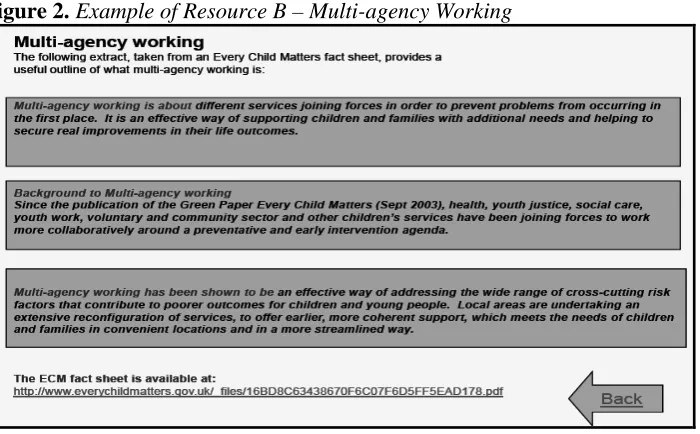
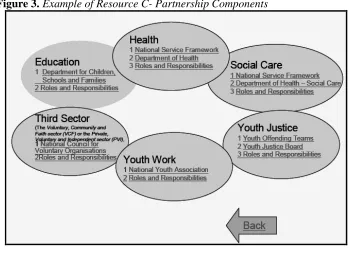
designed to provide an overview of key themes and issues relating to multi-agency working. This introductory page was then hyperlinked to other relevant resources that were either generated by the university team, in collaboration with other members of the extended workforce, or linked directly to specific websites and/or web pages that contained additional material and information. In this way, both mentors and tutees could pursue their enquiries at a level appropriate to their needs. This meant that where a mentor needed simply to raise awareness amongst tutees, this could be done quickly and easily. Where however, the tutee may wish to investigate particular issues and topics in more depth for example, to support a written assignment, this too was possible through the electronic links. Figures 2 and 3illustrate the type of material that was hyperlinked. [Please find these at the end of the essay]
themes and issues. Figure 4 illustrates these links. A number of case studies were also produced as a resource for tutors, that could facilitate collaborative, as well as individual learning opportunities as illustrated in Figure 5. [Please find these at the end of the essay]
In addition to the concern for ‘transactional distance’ Seok (2008) outlined above, there is also a concern that simply making resources available online will not be enough to enable learning to take place. It is also recognised that providing resources alone may not represent a ‘new form of pedagogy’ as suggested by Smith and Meyen (2003, p. 1). However, a method is worth considering in terms of the support it could provide for individuals working at a distance and/or in a work place setting.
Providing access to online materials may provide, at the very least, a framework, or a ‘scaffold’, for individual learner development to take place as Turney et al (2009) suggests:
Despite this, the ability of students to use technology to return repeatedly to resources was a clear benefit. The constant availability of resources allowed students to take responsibility for their own study at a pace appropriate for the learner. Turney et al (2009, p.81)
In considering the use of online materials it is possible to see some direct links to the comprehensive literature on learning styles (Entwistle, 1997; Gardner, 2000; Honey and Mumford, 1992 and 2001; and Silver et al, 2004). Online materials can provide opportunities for individuals to learn beyond the ‘taught’ classroom, on their own and/or in collaboration with peers and mentors. Learning styles is not however an uncontested area itself, for example, Coffield et al (2004) highlights a number of issues about the authenticity and significance of learning styles within the learning process, a caution to bear in mind when promoting the use of online materials to support preferred learning styles in the workplace.
Other concerns have also been raised about the significance of ICT in supporting and enhancing learning, in particular the context(s) in which supporting evidence has been gathered (see for example, Convery 2009, Somekh 2007, Reynolds et al 2003 and Selwyn 2002). Convery (2009, p27) raises concerns about the ‘cultural context in which educational technology research is commissioned.’ He describes how in countries such as, the UK, the USA and Australia government technology agencies stress the importance of the use of technology in education from the perspective of skills development for the future workforce.
emphasis within their research on more complex questions about the significance of technology in cognitive development and the learning process.
Somekh (2004) highlights a lack of impact resulting from enormous amounts of money spent by the UK Government on information technology initiatives within the field of education throughout the 1980’s and 1990’s and into the 21st Century. The lack of engagement with technology of many working within the education profession over such a long period is interesting, and it may have, however, more to do with the robustness of the technology available at that time than any particular pedagogical concerns. There is no doubt that as technology has advanced in recent years with, for example, Interactive Whiteboards and Internet use now evident in many learning situations, the significance of technology is not to be ignored.
The area of technology research may develop because of more active engagement with technology in learning and teaching, but Convery (2009) suggests that there remains a lack of critical debate within this area. Drawing upon Somekh’s experiences within the field of educational technology research over two decades, she highlights how, for example, at conferences ICT researchers can find themselves annexed off as a sub-group, left to present their research findings within ‘something of a closed shop’ (Selwyn 2006, p 418, cited in Convery 2009, p30).
Whilst recognising that the use of online resources has their limitations and that it remains a contentious area, we believe nevertheless, that it remains a vehicle that is well worth exploring to unable ITT providers to support the early professional development of trainees who are required to spend a substantial amount of their time in a workplace setting. It is our desire that the support materials will enable a dialogue between mentors and trainees that will lead to a ‘deep’ learning experience rather than engage with the topic at a ‘surface’ level (Ramsden 1992). Early indications from our work suggests that at the very least, it provides a framework for independent study and at best, it enables meaningful discourse between mentors and trainees in areas where neither have a substantial amount of expertise or confidence.
Bibliography
Beardsworth, R. and Lee, M. (2004) Developing Training Schools: an evaluation of
the initiative. Journal of In-Service Education. 30(4) pp 361-369
Biggs, J. (2003). Teaching for Quality Learning at University. Buckingham: Open
University Press.
Caffarella, R., & Knowles, M. (2001). Planning programs for adult learners; A
practical guide for educators, trainers, and staff developers (2nded). New York: John Wiley and Sons.
Coffield, F., Moseley, E., Hall, E., Ecclestone, K (2004) Should we be using learning
Connolly, M., Jones, N., O’Shea, J. (2005) Quality Assurance and E-Learning:
reflections from the front line. Quality in Higher Education, Vol 11, No. 1, April
2005.
Convery, A. (2009) The pedagogy of the impressed: how teachers become victims of
technological vision. Teachers and Teaching: theory and practice, Vol 15, No 1,
February 2009, 25-41
Edwards, T. (1995)‘The Politics of Partnership’ in Bines, H. and Welton, J. eds
(1995). Managing Partnership in Teacher Training and Development. 1st ed.
London, Routledge.
Entwistle, N, J. (1997) Styles of learning and teaching: An integrated outline of
educational psychology for students, and lecturers. London: David Fulton
Furlong, J., Barton, L., Miles, S., Whiting, C. and Whitty, G. (2000) Teacher
Education in Transition: re-forming professionalism. Buckingham OUP
Gardner, H (2000) Intelligence reframed: Multiple intelligences for the 21stcentury.
New York: Basic Books.
Harris, D. (1999) Internet-based learning tools. In French, D., Hale, C., Johnson, C.
and Farr, G. (Eds), Internet based learning(pp 165-177). Sterling, VA: Stylus.
Honey, P. and Mumford, A. (1992) The manual of Learning Styles. Maidenhead: Peter
Honey
Honey, P. and Mumford, A. (2001) The learning styles questionnaire: 80-item
version. Maidenhead: Peter Honey
Office for Standards in Education. (2003). An Evaluation of the Training Schools
Programme, Document no.HMI 1769. London. Ofsted.
Penny, D. and Houlihan, B. (2003). Higher Education Institutions and Specialist
Schools: potential partnerships.Journal of Education for teaching[online] 29(3)
http://ejournals.ebsco.com" [Accessed 11th April 2009]
Quilter, S., Weber, R. (2004) Quality Assurance for Online Teaching in Higher
Education: Considering and Identifying Best Practice for E-Learning.
International Journal on E-LearningApril-June 2004.
NIACE (1999) http://www.sflframework.org/workplace/wp_pop_ups/pps/sfl_wp_ pps
_pop_01.htm [accessed 12/06/2009]
Reynolds, D., Treharne, D. & Tripp, H. (2003) ICT – the hopes and the reality. British Journal of Educational Technology, Vol 34, No 2, 151-167
Selwyn, N. (2002) Learning to love the micro: The discursive construction of
‘educational’ computing in the UK, 1979-1989. British Journal of Sociology of
Education,Vol 23, No 3, 427-443
Rogers, C. (1983) Freedom to learn for the 80’s. Columbus, OH: Merill
Seok, S (2008) Teaching Aspects of E-Learning, International Journal on E-Learning,
Corporate, Government, Healthcare, & Higher Education, Vol 7, No 4, 725-741. Sharpe, R., Benfield, G., Roberts, G. & Francis, R. (2006) ‘The Undergraduate
Experience of Blended e-Learning: A Review of UK Literature and Practice’ The
Higher Education Academy. <http://www.heacademy.ac.uk/488.htm (accessed> 8 Feb 09).
Silver, H, F., Strong, R.W., Perini, M, J (2000) So each may learn: Integrating
learning styles and multiple intelligences. Alexandria, VA: Association for Supervision and Curriculum Development
Smith, S, J. and Meyen, E, L. (2003) Applications of online instruction: An overview
for teachers, students with mild disabilities, and their parents. Focus on
Exceptional ChildrenVol 35, No 6, 1-15
Somekh, B. (2007) Pedagogy and learning with ICT: Researching the art of
Turney, C.S.M., Robinson, D., Lee, M. & Soutar, A., (2009) ‘Using Technology to direct learning in higher education. The way forward? Active Learning in Higher Education, Sage Publications.
Virolainen, M. (2007) ‘Workplace Learning and Higher Education in Finland:
reflections on current practice, Education & TrainingVo.l 49 No4 pp290-309
Vygotsky, L. S. (1978) Mind in Society: The development of higher psychological
[image:13.612.133.493.186.440.2]processes. Cambridge; MA Harvard.
Figure 1. Example of Resource A – Introductory Stage
[image:13.612.141.491.454.671.2]Figure 3. Example of Resource C- Partnership Components
[image:14.612.123.472.81.335.2]