The Evaluation of Degraded Land by Application
of the Contingent Method
Jaroslava JANKŮ, Dagmar KUČEROVÁ, Jakub HOUŠKA, Josef KOZÁK
and Adéla RUBEŠOVÁ
Department of Soil Science and Soil Protection, Faculty of Agrobiology, Food and Natural Recources, Czech University of Life Sciences Prague, Prague, Czech Republic
Abstract
Janků J., Kučerová D., Houška J., Kozák J., Rubešová A. (2014): The evaluation of degraded land by applica-tion of the contingent method. Soil & Water Res., 9: 214–223.
Industrial activities in the Czech Republic have brought into existence many degraded and contaminated sites. Such areas are not suitable for farming, building or recreation purposes. The necessary reclamation is typically very expansive. In this study, the contingent valuation method (CVM) was used to estimate the public’s willing-ness to pay for soil reclamation, and also to find out the desire of habitants to live in a good environment with respect to soil quality, and generally to improve the publics awarness of soil protection. This study can help to improve understanding of the local public willingness to pay for reclamation of degradated land protection and can provide useful information for an effective land protection programme. The study was carried out on the locality of Březové Hory – a part of the old mining town Příbram. The chosen locality was used for the placement and storage of residual material after mining, but also includes different soils, which have been transported here as useless material. After the reclamation of a part of the locality, a forest park has been established. A random questionnaire survey was conducted with local resident and as well as holiday makers. The results of the survey indicated that protection of cultivated land was important to the local public. The mean willingness to contribute to reclamation of degraded and contaminated lands in Březové Hory was expressed as the following amount of money: 36.64 CZK (1.4 €) per habitant. The findings calculated suggested that the costs of reclamation of landfill soils on Březové Hory totaled 1528 CZK/m2. The results of the survey also showed that the willingness to pay increased according to the dependence on income, the gender and also residential address of respondents. The results have not confirmed the dependence on education. In order to increase the hypothetical willingness to pay, an increase of public awareness of soil degradation and harmful effects on the environment is necessary. Furthermore, it was shown that the market valuation of land can not be used for soil protection purposes. Keywords: contingent valuation method (CVM); land evaluation; land protection; land reclamation; public awareness
of soil protection; willingness to pay
Březové Hory has many large places covered by heaps of mining waste, which are contaminated es-pecially with risk elements. Contaminated material affects the environment in various ways, e.g water quality, and is a source of dust. Mining heaps also significantly affect the landscape character. Market valuation of these soils was not possible, but it was necessary to express their value to the society as a cost of implemented land reclamation. One of the
methods frequently used to evaluate the environment is the contingent valuation method (CVM).
surveys for asking individuals to report their personal maxi-mum willingness to pay (WTP) or willingness to accept (WTA) increments or decrements of en-vironmental goods and resources using contingent markets (Mitchell & Carson 1989). It represents a specially structured questionnaire where respond-ents disclose their preference for a particular issue of environmental quality (Seják et al. 1999).
Although CVM has been subjected to criticism and exhibits limitations, it is a promising method that can be applied to derive valuable information (García-Llorente et al. 2011a, b). In fact, some studies have used this technique to measure the use and non-use values of agricultural landscape and farmland protection (Pruckner 1995; Hackl & Pruckner 1997; Chang & Ying 2005; Hideo et al. 2006; Dorfman et al. 2008; Buckley et al. 2009). Therefore, one important objective of this study is the application of the CVM to estimate the local public’s willingness to pay for land reclamation of land that has been degraded by mining industry. Part of the reclamation is to create a city park. Results of this study will help to improve public understanding of soil protection and soil value.
MATERIAL AND METHODS
Březové Hory is a part of Příbram town. The town is located 60 km southwest of Prague in the central Brdy Highland along the river Litavka. The cadastral area of Příbram is 33.41 km² and includes 35 000 inhabitants. Příbram lies at an altitude of 502 m a.s.l. and its landscape is affected by long-time mining. There are many heaps in the area, which the city is trying to reclaim in succesive steps to landscape with recreational use. However, reclamation has taken place very slowly, on account of very high costs (Czech Statistical Office 2012).
The city is mainly known for its mining history, which represents an important place in the history of Příbram. In different periods over the centuries, the ore mining more or less influenced economic and social life of the city and its surroundings. The mining activity was also important for the develop-ment of Příbram after World War II, especially the mining of uranium ore, which, however, cased seri-ous environmental problems for today’s generations.
The environment of Příbram is also influenced by the relatively high number of industrial factories (Czech Statistical Office 2012). High levels of lead, cadmium and arsenic were found in agricultural soils in the Příbram district. neighborhood. These high
values of risk elements are primarily the result of historic mining and smelting activities in this area. The values were measured near Kovohutě Příbram, which represents about 4000 ha of contaminated land. Greatest contamination is within 1.5 km from its source. Příbram belongs among the most contami-nated areas in the country. (Trojáček & Tranti-nová 1999). Even though the area with the highest soil contamination is in line with the prevailing winds, Rieuwerts et al. (1999) have found another source of Zn, Cd and Cu soil contamination espe-cially from metallurgical material, which is prone to erosion, located outside the factory premises. High concentrations of monitored elements are also found in Fluvisols of the river Litavka basin. The river basin was contaminated during floods caused by the rupture of tailing ponds for ore processing (Janků 1987).
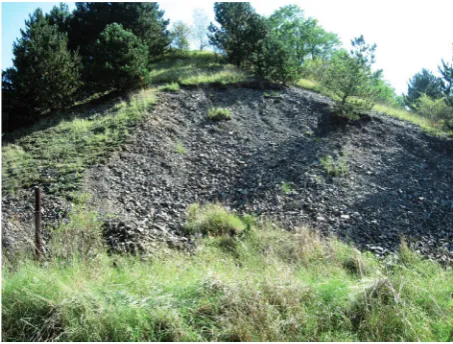
After extraction, heaps occupy a large area and have an adverse effect on the landscape. They affect airflow in the area, and also influence local climitic conditions. Ucovered surfaces of heaps are a source of radioactive dust and radon. In the case of more intensive rainfall, water erosion occurs and radioactive silt can clog up areas where it causes pollution and contamination of both soil and surface/groundwater. The merging of heaps with the surrounding landscape will continue for many years (the landscape pictures before and after reclamation, Figures 1 and 2). Based on exploration work and risk analysis, a risk to the Litavka surface stream ecosystem was found. The main cause of pollution of Litavka surface water is the leaching of metals (especially zinc) from the area of former ore treatment (Diamo 2013).
In the present CVM study, the dichotomous choice (DC) method was used to investigate survey par-ticipant‘s WTP.
The DC method was first used by Bishop and Heberlein (1979), and Hanemann (1984), who developed the conceptual and theoretical arguments. The key feature of this method was that individuals are asked whether they would pay a suggested price in a hypothetical market situation. The possible answers are usually ‘yes’ or ‘no’. Respondents find it easier to answer DC questions than open ended questions because most people are familiar with dis-crete choices in a real market situation (Hanemann 1984). The most challenging part of the CVM is the compilation tools for survey and data analysis.
to pay for the expansion of reclamation at Březové Hory. It was necessary to select a sufficient number of respondents and their specific socio-economic structure (Kučerová 2014).
The questionnaires of socio-economic structure were classified according to the level of income, edu-cation, age and gender. Age group was divided into three intervals (up to 18, 19–64, over 64), monthly gross income of respondents was divided into four intervals (up to 10 000, up to 15 000, 15 000–25 000, over 25 000 CZK) (Kučerová 2014).
The questionnaire consisted of fourteen questions, which mostly related to the problems associated with the possible reclamation of Přibram-Březové Hory. The first five questions in the questionnaire focused on issues of a socio-demographic nature. It was important to know the income, education and gender of the respondent, as they can all affect willingness to pay. The second part focused on issues of the problem of land reclamation. Respondents
were informed about the objectives of the study and the long term problem of degraded soils in Přibram (Kučerová 2014).
RESULTS AND DISCUSSION
[image:3.595.304.531.84.256.2]The contingent valuation survey was conducted by questionnaires. The data were collected in paper and electronic forms using the application Survio from December 2013 to January 2014. 140 respondents were randomly selected. The questionnaire was completed by 115 respondents, response rate was 82.14%, of which 108 questionnaires were suitable for statistical analysis. There were 7 questionnaires not eligible for processing for ambivalent answers, such as when a respondent wrote that he is not willing to pay and then filled the amount that he is. The survey involved 60 women and 48 men. 74 respondents were from Příbram and the surrounding areas, 25 from Prague and 9 respondents from other regions.
Figure 1. The heaps before reclamation
[image:3.595.65.291.86.255.2]The survey results are presented according to the character of the questions and answers in a table or graphical form. The chi-squared method was used for statistical evaluation, comparing willingness to pay with education, gender, income and residence.
Evaluation of the results of questionnaire survey
Statistical evaluation of the results using the relative frequencies was performed based on the qualitative sociological research, which focused on the evalu-ation of the willingness of society to pay for any further reclaimation in Březové Hory. Furthermore, willingness to pay for any further reclaimation in the Březové Hory and its dependence on of income, gen-der, education and place of residence was assessed. Data were statistically analyzed with STATISTICA software using χ2, at a selected level of significance
of α = 0.05. The validity of the null and alternative hypotheses was tested:
HO – there is no statistically significant relationship between the variables;
HA – there is a statistically significant relationship between the variables.
Evaluation of the socio-economic questions The 1st question related to gender. In Table 1
results are given on the differencies of willingness to pay some contribution to remediation of the area under study related to gender.
The results shown in Table 2 indicated that a higher number of women than men answered and rela-tively more women would be willing to pay at least the minimum amount for further reclaimation of Březové Hory. Statistically significant correlation between willingness to pay and gender exists because
P = 0.02484. It is necessary to refuse the null and to accept the alternative hypothesis. This is a direct dependency due to the positive value of φ. The force of dependence is medium. Gender therefore statisti-cally affects the willingness to pay for any further reclaiming in Březové Hory.
The 2nd question regarding age. Age was also
proven a very important factor in the decision of respondents (Table 3). The largest group consisted of respondents aged 19–64 years who fall into the productive age. This group of respondends was spe-cifically chosen.
[image:4.595.304.534.102.160.2]The 3rd question concerned the level of educa-tion of the respondents. Also the level of education seemed to be imporant in the decision of respond-ents (Table 4). According to education, the group
Table 1. Structure of respondents by sex and willingness to pay on dependence on gender
Gender Frequency Relative frequency (%) yes no total yes no total Woman 38 22 60 35.19 20.37 55.56 Man 20 28 48 18.52 25.93 44.44 Total 58 50 108 53.70 46.30 100
Table 2. Statistical evaluation of the willingness to pay, depending on the gender of the respondents
Statistics Genderχ2 Willingness to payP
Pearson χ2 5.035035 0.02484
ML χ2 5.065170 0.02441
φ for tables 2 × 2 0.2159182
[image:4.595.64.292.113.187.2]ML – the technique of maximum likelihood; φ – square contingency coefficient
Table 3. Age structure of respondents
Age group Total Relative frequency (%)
0–18 2 1.85
19–64 82 57.65
[image:4.595.305.532.512.635.2]65+ 24 22.22
Table 4. Structure of respondents by education and willing-ness to pay on dependence on their education
Education Frequency Relative frequency (%) yes no altogether yes no altogether Basic 1 1 2 0.93 0.93 1.86 Secondery 21 25 46 19.44 23.15 42.59 Higher
professional 8 2 10 7.41 1.85 9.26 University-
educated 28 22 50 25.92 20.37 46.29 Altogether 58 50 108 53.7 46.30 100
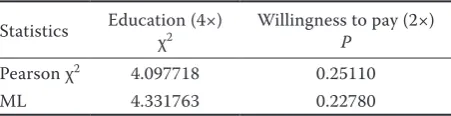
Table 5. Statistical analysis of willingness to pay, depending on the education of the respondents
Statistics Education (4×)χ2 Willingness to pay (2×)P
Pearson χ2 4.097718 0.25110
[image:4.595.63.291.663.734.2] [image:4.595.305.531.685.743.2]of university-educated respondents would be most willing to pay and, on the contrary the least willing to pay would be respondents with only secondary education. The statistical evaluation of willingness to pay in depandancy on education is shown in Ta-ble 5. In TaTa-ble 5 it can be seen that P-value, which reached 0.25110, is greater than the significance level α = 0.05. In this case, we accepted the null hypothesis, which says that there was no statistically significant relationship between respondents’ willingness to pay and their education.
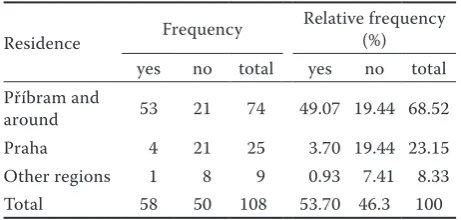
The 4th question concerned the place of resi-dence of respondents. The place of residence of respondents also proved to be important (Table 6). From the data given in Table 6 it was clear that the willingness to pay was tied to the respondent’s place of residence. It could be expected that the respond-ent’s residence affected willingness to pay. Mainly local habitants agreed to financially contribute to reclamation, as is apparent from Figure 3.
A statistical evaluation of the wilingness to pay in depandancy of the place of residence of respond-ents is given In Table 7. According to Table 7 the
P-value was 0.00000, allowing a rejection of the null hypothesis and acceptance of the alternative hypothesis, which indicated a statistically significant relationship between the respondent’s residence and their willingness to pay for any further reclamation in Březové Hory. This dependence was confirmed
by value of 0.5306930 and is therefore moderately strong and direct.
The 5th question regards to the income of re-spondents. The income level also played an important role in the decision (Table 8). The data in Table 8 shows that most of the respondents come from the middle class. This group of respondents would be most willing to pay.
[image:5.595.62.293.114.224.2]Results of the respective statistical evaluation are given in Table 9. According to the data in Table 9, a P-value of 0.03456 constituted a rejection of the null hypothesis and acceptance of the alternative hypotheses, which speaks of a statistically significant correlation between the amount of monthly gross income of the respondent and their willingness to pay for any further reclamation in Březové Hory. This dependence was manifested by a value of 0.2827570 and was classified as medium strong.
Table 6. Dependence of willingness to pay on place of residence
Residence Frequency
Relative frequency (%) yes no total yes no total Příbram and
[image:5.595.305.530.114.198.2]around 53 21 74 49.07 19.44 68.52 Praha 4 21 25 3.70 19.44 23.15 Other regions 1 8 9 0.93 7.41 8.33 Total 58 50 108 53.70 46.3 100
Table 7. Statistical evaluation of the willingness to pay, depending on the residence of the respondents
Statistics Residence (3×)χ2 Willingness to pay (2×)P
Pearson χ2 30.41658 0.00000
ML χ2 32.58344 0.00000
φ 0.5306930 Cramér,s V 0.5306930
ML – the technique of maximum likelihood; φ – square contingency coefficient
Figure 3. Residence of respondents (absolute values; %)
Table 8. Dependence of willingness to pay on the income of the respondents
Monthly gross income (CZK)
Frequency Relativefrequency (%)
yes no total yes no total
Up to 10 000 10 15 25 9.26 13.89 23.15
Up to 15 000 13 16 29 12.04 14.81 26.85
15 000–25 000 27 10 37 25.93 8.33 34.26
Over 26 000 8 9 17 7.41 8.33 15.74
Total 58 50 108 54.64 45.36 100
74;69% 25;23%
9;8% Příbram
Praha Others
74;69% 25;23%
9;8% Příbram
Praha Others
25; 23%
9; 8%
[image:5.595.307.529.498.596.2] [image:5.595.63.531.653.753.2]Evaluation of issues dealing with selected places and the willingness of respondents
to pay for any extension of the park in Březové Hory
The 6th question concerned the relationship to the area of Březové Hory. The number of re-spondents having a relationship to the area under study is depicted in Figure 4. The data in Figure 4 shows that about 70% of the respondents had some relation to the area of interest (i.e. 70 respondents, of which 39 had in current residence Březové Hory and for 35 of them stated Březové Hory to be their hometown). The remaining 30% had no relation to the selected region.
The 7th question asked whether current the restoration of the landscape was sufficient. The results of assessment of sufficiency of restoration of the landscape by respondents are shown in Figure 5. From the answers to this question it was clear that 76% of respondents would agree that further recla-mation would improve the environment.
The 8th question asked whether respondents of-ten visit the locality Březové Hory. The responses are given in graphical form as shown in Figure 6. This question examined how often random respondents have visited the locality Březové Hory and the newly reclaimed park, which was opened in the fall of 2013. The majority of respondents (56%) have not visited this locality.
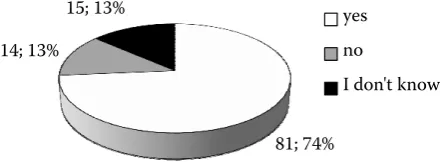
The 9th question of the survey asked whether respondents would welcome further expansion of the park Březové Hory. This question was also considered as very important, the results are given in Figure 7. Figure 7 showed that 74% of the 81 sur-veyed persons would appreciate further reclamation of Březové Hory, but many of them are in a situation that does not allow further financial participation. The remaining respondents either did not want further reclamation or did not care about it at all.
[image:6.595.313.521.89.161.2]Question number 10 asked whether respondents would be willing to contribute financially to an expand park. The results are given in Figure 8. This issue was considered as crucial in the questionnaire, because we had observed a willingness of respondents
Table 9. Statistical analysis of willingness to pay, depending on income
Statistics Income levels (4×)χ2 Willingness to pay (2×)P
Pearson χ2 8.634766 0.03456
MV χ2 8.895257 0.03072
φ 0.2827570
Cramér,s V 0.2827570
ML – the technique of maximum likelihood, φ – square contingency coefficient
31; 31%
39; 38% 31; 31%
[image:6.595.64.291.113.198.2]no relationship current residence hometown
Figure 4. Relationship with area (absolute values; %)
26; 24%
82; 76%
yes, this recultivation is sufficient
no, I mean there should be more recultivation projects in the surrounded landscape
26; 24%
82; 76%
yes, this recultivation is sufficient
no, I mean there should be more recultivation projects in the surrounded landscape
Figure 5. Do you think that the restoration of the landscape near Příbram is sufficient (absolute values; %)?
48; 44%
60; 56% yes
no
Figure 6. Do you visit the locality Březové Hory often (absolute values; %)?
81; 74%
14; 13%
15; 13% yes
no
[image:6.595.66.290.458.534.2]I don't know
[image:6.595.307.531.627.708.2]to pay for environmental value. The survey found that 58 respondents (54%) would be willing to financially contribute to the further expansion of reclamation at Březové Hory, while 50 respondents (46%) would not contribute anything.
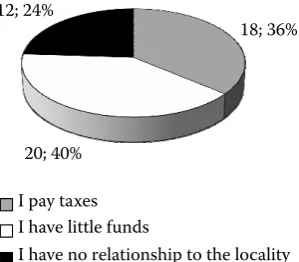
The 11th question concerns the respondents who answered the previous answer negatively. The results are given in Figure 9. This question only applied to those respondents who answered „no“ to the previous question. Figuere 9 was thus based on 50 respondents, the question was open and inter-viewees could write their opinion, why they do not want to pay. They have been selected for the three most common reasons for their unwillingness to pay, including low disposable income already paying taxes, and the third most common answer was that the respondent had no relationship to the locality.
The 12th question deals with the amount that the respondents were willing to contribute financially each month. The results of this question are shown in Figure 10. Only respondents willing to pay for any further reclamation asnwered this question. The four most frequently occurring amounts were as follows: 10, 25, 50 and 200 CZK. The largest group was the one where the interviewees would willing to con-tribute CZK 10 monthly (52% of respondents). The second largest amount was a contribution of 25 CZK, 22% of respondents would be willing to contribute
this amount. 9% of respondents would contribute 200 CZK per month. On average, the respondents were willing to pay CZK 36.64 per month. The av-erage willingness to pay in relation to the place of residence is given in Table 10.
Respondents who reported their residence in Příbram, or in the vicinity would be willing to pay significantly more for further expansion of the park in Březové Hory. On average, this amounted to CZK 38.30 per month.
Question number 13 determines how much re-spondents would be willing to contribute in a one off payment. The responses to this question are summarised in Figure 11. This question was answered by 58 respondents willing to contribute
58; 54%
50; 46%
[image:7.595.330.500.82.221.2]yes no
Figure 8. Are you willing to financially participate in the expansion of the park (absolute values; %)?
18; 36%
20; 40% 12; 24%
I pay taxes
I have little funds
I have no relationship to the locality
18; 36%
20; 40% 12; 24%
I pay taxes
I have little funds
I have no relationship to the locality
18; 36%
20; 40% 12; 24%
I pay taxes
I have little funds
I have no relationship to the locality
[image:7.595.72.284.84.160.2]Figure 9. If not, please give the reason why you are not willing to pay (absolute values; %)
[image:7.595.307.533.514.714.2]Figure 10. Please type in the following the maximum money amount you are able to regularly pay monthly for extensions of land reclamation (absolute values; %)
Table 10. Average willingness to pay (in CZK) dependence on residence
Residence Average willingness to pay No. Příbram and around 38.30 53
Praha 17.50 4
[image:7.595.108.258.593.724.2]The others 25 1
Figure 11. How much would you be willing to contribute in a one off payment one-off to the restoration of the landscape; including new trails and rest areas (absolute values; %)?
37; 64%
8; 14%
12; 20% 1; 2%
1 - 100 CZK 101 - 500 CZK 501 - 1000 CZK 5000 CZK and more
1–100 CZK 101–500 CZK 501–1000 CZK 5000 CZK and more
37; 64%
8; 14%
12; 20% 1; 2%
1 - 100 CZK 101 - 500 CZK 501 - 1000 CZK 5000 CZK and more
37; 64%
8; 14%
12; 20% 1; 2%
1 - 100 CZK 101 - 500 CZK 501 - 1000 CZK 5000 CZK and more
30 52%
13; 22% 10; 17%
5; 9%
contribution of 10 CZK contribution of 25 CZK contribution of 50 CZK
contribution of 200 CZK 30 52%
13; 22% 10; 17%
5; 9%
contribution of 10 CZK contribution of 25 CZK contribution of 50 CZK contribution of 200 CZK
financially towards the improvement of land at the locality Březové Hory. Respondents could choose from four answers. 63% would contribute a lump sum from 1 to 100 CZK, 21%, the amount of 501 to 1000 CZK, 14% from 101 to 500 CZK and at least one respondent would contribute CZK 5000 or more.
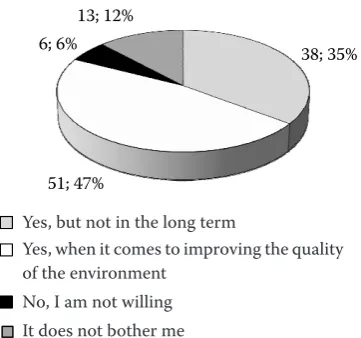
The last question relates to the finding that in the case of further reclamation, would the respondents be bothered by restrictions such as noise, dust, etc.
The responses to this question were summarised in Figure 12. From Figure 12 it was obvious that this ques-tion was answered by all respondents of the survey, i.e. 108 respondents. It was found that 47% of respondents would not mind if they had for some time to toler-ate noise, dust and traffic restrictions due to further reclamation. Another 35% of respondents would also not mind, but only in the short term. According to the survey, 6% of respondents would be bothered and do not consider reclamation to be important and 12% of respondents do not care.
DISCUSSION
This survey study focused on the evaluation of degraded – contaminated soils in Příbram-Březové Hory, Czech Republic. This work was specifically designed to accomplish the main objective of deter-mining how the local public perceives contamined soils and reclamation of contaminated soils.
Our results show that the majority of the respon-dents in Březové Hory recognized that reclamation of contamineted soils has a significant positive ef-fect on the urban environment, includig psyche of
the population, recreational function, and a positive effect for water management and control of dust.
The survey results indicate that 75% of respondents would like further expansion of the park in Březové Hory, but only 54% would be willing to financially contribute to it.
From this work it is also evident that the willing-ness of respondents to pay for additional reclama-tion is dependent on gender, age and income levels. Despite the conclusions of other authors, this study failed to show a dependence on education. Jin et al. (2013) have reported, that the probability of saying ‘yes’ to the willingness to pay question varies with a number of explanatory variables in an expected and reasonable manner. The bid level and the respondents’ household income, education level, urban status, career, and knowledge of cultivated land protec-tion were significant determinants of the Wenling households’ willingness to pay for cultivated land protection. These results are very useful because they record the direction and strength of the preferences of the local public.
Jin et al. (2013) also reported the following: Our estimates suggest that the mean WTP for cultivated land protection in Wenling City was 26.99 yuan (3.96 USD) per house-hold per month for 10 years. The mean WTP was approximately 0.4% of the total household income, which implies a realistic payment capability for these households (Loomis & Larson 1994; García-Llorente et al. 2011a, b).
We obtained similar results: 36 CZ per person per month represents approximately 0.2% of the average income per person. In the case that only 1000 local people will be willing to pay per month, it means approximately 400 000 CZK (15 000 EURO) per year as a contribution for reclamation. These results can provide policy makers with quantitative information to support the design of possible policies for reclama-tion. But mainly it is evidence of the interest of local people about land use and the environment. This finding is also significantly related to the protection of soil from degradation and contamination. Jin et al. (2013) present the same conclusion for the urban population and cultivated land protection.
One possible reason for the higher WTP of ur-ban respondents could be that their awareness and knowledge of cultivated land protection was greater. Earlier studies also find that respondents’ knowledge and awareness had a positive effect on their WTP (Jin et al. 2008; Uzochukwu et al. 2011).
[image:8.595.79.260.83.252.2]In this study, respondents who gave ‘no’ answers to the willing to pay question were asked about their
Figure 12. In the case that the implementation of the project could lead to partial restrictions such as closing of roads, noise and dust are you willing to endure these restrictions (absolute values; %)?
38; 35%
51; 47% 6; 6%
13; 12%
Yes, but not in the long term
Yes, when it comes to improving the quality of the environment
No, I am not willing
38; 35%
51; 47% 6; 6%
Yes, but not in the long term
Yes, when it comes to improving the quality of the environment
No, I am not willing
38; 35%
51; 47% 6; 6%
Yes, but not in the long term
Yes, when it comes to improving the quality of the environment
No, I am not willing
38; 35%
51; 47% 6; 6%
13; 12%
Yes, but not in the long term
Yes, when it comes to improving the quality of the environment
No, I am not willing
Yes, but not in the long term
Yes, when it comes to improving the quality of the environment
reasons. The most common response was paying taxes (from which these projects should be funded) In this study protest responses were also exluded. García-Llorente et al. (2011b), excluded respond-ents who indicated an unwillingness to pay at the beginning of the survey, and then specified the amount that they would be willing to contribute per month (a contradiction), this is the so-called protest response. Our study mainly focuses on the measurement of the benefits of reclamation of degraded and contamined land after mining.
Heaps of contaminated soil do not contribute to psychological well-being of the urban population, on contaminated surfaces there is no vegetation, which increases dust and pollution. Furthermore, the contamination also affects water quality in the area.
Via the method of contingent query, a hypothetical willingness to pay was determined, although, you can determine only a rough estimate of the environmental costs of the territory (Seják et al. 1999). This esti-mate, however, is important in terms of perception and understanding the value of land by society.
CONCLUSIONS
In our study, the Contingent value method was applied to measure the benefits of reclaimed land in the old mining city of Březové Hory, Příbram, Czech Republic. The information provided by this study could help to improve understanding of the local public’s preference for land protection in the city. The majority of survey respondents feel that the reclamation of land has a significant positive effect on the environment, psyche of habitants, recreational function, and mitigation of dust etc. The results of this paper also indicated that 75% of respondents would like further expansion of the park in Březové Hory, but only 54% would be willing to pay. The willingness to pay is 36 CZ per person, approximately 0.2% of the average income per person. In the case that only 1000 local people will be willing to pay per month, it means approximately 400 000 CZK (15 000 Euro) per year as a contribution to cover reclamation costs.
Our results showed with reasonable explanatory power that WTP increases with income, as expected. It is also evident that the willingness of respondents to pay for additional reclamation was dependent on gender and age. A similar dependence on education level has not been proven. Most respondents were poorly informed about events and ongoing recla-mation in the selected region. In order to increase
the hypothetical willingness to pay, greater public awareness of soil degradation and harmful effects on the environment is needed. It is also necessary to maintain the anonymity of the respondents.
These results can provide policy makers with quan-titative information to support the design of possible policies for reclamation. But mainly it is evidence of the interest of local people in land use and the environment. This finding was also significantly related to the protection of soil from degradation and contamination.
This article also presented the market value of the land at the locality, and the environmental value obtained on the basis of both methods – method of physical damage and CVM method. Based on our results, it appeared that methods for quantifying environmental values of land were very important in soil protection measures and implementation. Our results confirmed that land protection was important for the public and for further sustainable develop-ment, and that the market price of land alone is not enough for land evaluation.
Acknowledgments. The authors are especially grateful to
the anonymous reviewers for their help.
References
Bishop R., Heberlein A. (1979): Measuring values of ex-tramarket goods: Are indirect measures biased? American Journal of Agricultural Economics, 61: 926–930. Buckley C., Rensburg T.M., Hynes S. (2009).
Recre-ational demand farm common age in Ireland: A contin-gent valuation assessment. Land Use Policy, 26: 846–854. Chang K., Ying Y.H. (2005): External benefits of preserving agricultural land: Taiwan’s rice fields. The Social Science Journal, 42: 285–293.
Czech Statistical Office (2012): Characteristic of Příbram District. Available at http://www.czso.cz/xs/redakce. nsf/i/charakteristika_okresu_pribram (accessed Decem-ber 12, 2013). (in Czech)
Diamo (2013): Pribram-Březové Hory – Sanitation. Avail-able at http://www.bhsanace.spravcestavby.cz (accessed January 29, 2014). (in Czech)
Dorfman J.H., Barnett B.J., Bergstrom J.C., Lavigno B. (2008): Searching for farmland preservation markets: Evidence from the southeastern U.S. Land Use Policy,
26: 121–129.
García-Llorente M., Martín-López B., Nunes P.A.L.D., González J.A., Alcorlo P., Montes C. (2011b): Ana-lyzing the social factors that influence willingness to pay for the management of invasive alien species under two different strategies: Eradication and prevention. Environ-mental Management, 48: 418–435.
Hackl A.F., Pruckner G.J. (1997): Towards more efficient compensation pro-grammes for tourists’ benefits from agriculture in Europe. Environmental and Resource Eco-nomics, 10: 189–205.
Hanemann W.M. (1984): Welfare evaluations in contingent valuation experiments with discrete responses. American Journal of Agricultural Economics, 66: 332–341. Hideo A., Kazuo S., Hiroshi O. (2006): Contingent
valu-ation approach in measuringthe multifunctionality of agriculture and rural areas in Japan. Paddy and Water Environment, 4: 217–222.
Janků J. (1987): Heavy Metals in Soils. [Diploma Thesis.] VŠZ, Prague. (in Czech)
Jin J., Wang Z., Liu X. (2008): Valuing black-faced spoon bill conservation in Macao: A policy and contingent valu-ation study. Ecological Economics, 68: 328–335. Jin J., Jiang C., Li L. (2013): The economic valuation of
cultivated land protection: A contingent valuation study in Wenling City, China. Landscape and Urban Planning,
119: 158–164.
Loomis J.B., Larson D.M. (1994): Total economic values of increasing gray whale populations: Results from a
contingent valuation survey of visitors and house-holds. Marine Resource Economics, 9: 275–286.
Mitchell R.C., Carson R.T. (1989): Using Surveys to Value Public Goods. The Contingent Valuation Method. Resources for the Future, Washington, D.C.
Kučerová D. (2014): The Value of Land in the Region. [Diploma Thesis.] ČZU, Prague. (in Czech)
Pruckner G.J. (1995): Agricultural landscape cultivation in Austria: An application of the CVM. European Review of Agricultural Economics, 22: 173–190.
Rieuwerts J., Farago M., Cikrt M., Bencko V. (1999): Heavy metal concentrations in and around households near a secondary lead smelter. Environmental Monitoring and Assessment. 58: 317–335.
Seják J., Kokoška J. Pulkrab K., Šišák L. (1999): Evalu-ation of Land and Natural Resources. Grada Publishing. Prague. (in Czech)
Trojáček P., Trantinová M. (1999): The Contamina-tion of Agricultural Soil by Heavy Metals in the Příbram Region. Ekotoxa, Opava. (In Czech)
Uzochukwu B., Uguru N., Ezeoke U., Onwujekwe O., Sibeudu T. (2011): Voluntary counseling and testing (VCT) for HIV/AIDS: A study of the knowledge, aware-nessand willingness to pay for VCT among students in tertiary institutions in Enugu State Nigeria. Health Policy,
99: 277–284.
Received for publication October 10, 2014 Acepted after corrections October 27, 2014
Corresponding author: