A Systematic Exploration of the Feature Space for Relation Extraction
Jing Jiang and ChengXiang Zhai
Department of Computer Science University of Illinois at Urbana-Champaign
Urbana, IL 61801
{jiang4,czhai}@cs.uiuc.edu
Abstract
Relation extraction is the task of find-ing semantic relations between entities from text. The state-of-the-art methods for relation extraction are mostly based on statistical learning, and thus all have to deal with feature selection, which can significantly affect the classification per-formance. In this paper, we systemat-ically explore a large space of features for relation extraction and evaluate the ef-fectiveness of different feature subspaces. We present a general definition of fea-ture spaces based on a graphic represen-tation of relation instances, and explore three different representations of relation instances and features of different com-plexities within this framework. Our ex-periments show that using only basic unit features is generally sufficient to achieve state-of-the-art performance, while over-inclusion of complex features may hurt the performance. A combination of fea-tures of different levels of complexity and from different sentence representations, coupled with task-oriented feature prun-ing, gives the best performance.
1 Introduction
An important information extraction task is relation extraction, whose goal is to detect and characterize semantic relations between entities in text. For ex-ample, the text fragment “hundreds of Palestinians
converged on the square” contains the located rela-tion between the Person entity “hundreds of Pales-tinians” and the Bounded-Area entity “the square”. Relation extraction has applications in many do-mains, including finding affiliation relations from web pages and finding protein-protein interactions from biomedical literature.
Recent studies on relation extraction have shown the advantages of discriminative model-based sta-tistical machine learning approach to this problem. There are generally two lines of work following this approach. The first utilizes a set of carefully se-lected features obtained from different levels of text analysis, from part-of-speech (POS) tagging to full parsing and dependency parsing (Kambhatla, 2004; Zhao and Grishman, 2005; Zhou et al., 2005)1. The
second line of work designs kernel functions on some structured representation (sequences or trees) of the relation instances to capture the similarity be-tween two relation instances (Zelenko et al., 2003; Culotta and Sorensen, 2004; Bunescu and Mooney, 2005a; Bunescu and Mooney, 2005b; Zhang et al., 2006a; Zhang et al., 2006b). Of particular interest among the various kernels proposed are the convolu-tion kernels (Bunescu and Mooney, 2005b; Zhang et al., 2006a), because they can efficiently compute the similarity between two instances in a huge feature space due to their recursive nature. Apart from their computational efficiency, convolution kernels also implicitly correspond to some feature space. There-fore, both lines of work rely on an appropriately
de-1
Although Zhao and Grishman (2005) defined a number of kernels for relation extraction, the method is essentially similar to feature-based methods.
fined set of features. As in any learning problem, the choice of features can affect the performance signif-icantly.
Despite the importance of feature selection, there has not been any systematic exploration of the fea-ture space for relation extraction, and the choices of features in existing work are somewhat arbitrary. In this paper, we conduct a systematic study of the feature space for relation extraction, and evaluate the effectiveness of different feature subspaces. Our motivations are twofold. First, based on previous studies, we want to identify and characterize the types of features that are potentially useful for rela-tion extracrela-tion, and define a relatively complete and structured feature space that can be systematically explored. Second, we want to compare the effective-ness of different features. Such a study can guide us to choose the most effective feature set for relation extraction, or to design convolution kernels in the most effective way.
We propose and define a unified graphic repre-sentation of the feature space, and experiment with three feature subspaces, corresponding to sequences, syntactic parse trees and dependency parse trees. Experiment results show that each subspace is ef-fective by itself, with the syntactic parse tree sub-space being the most effective. Combining the three subspaces does not generate much improvement. Within each feature subspace, using only the basic unit features can already give reasonably good per-formance. Adding more complex features may not improve the performance much or may even hurt the performance. Task-oriented heuristics can be used to prune the feature space, and when appropri-ately done, can improve the performance. A com-bination of features of different levels of complex-ity and from different sentence representations, cou-pled with task-oriented feature pruning, gives the best performance.
2 Related Work
Zhao and Grishman (2005) and Zhou et al. (2005) explored a large set of features that are potentially useful for relation extraction. However, the feature space was defined and explored in a somewhat ad hoc manner. We study a broader scope of features and perform a more systematic study of different
feature subspaces. Zelenko et al. (2003) and Culotta and Sorensen (2004) used tree kernels for relation extraction. These kernels can achieve high precision but low recall because of the relatively strict match-ing criteria. Bunescu and Mooney (2005a) proposed a dependency path kernel for relation extraction. This kernel also suffers from low recall for the same reason. Bunescu and Mooney (2005b) and Zhang et. al. (2006a; 2006b) applied convolution string ker-nels and tree kerker-nels, respectively, to relation extrac-tion. The convolution tree kernels achieved state-of-the-art performance. Since convolution kernels correspond to some explicit large feature spaces, the feature selection problem still remains.
General structural representations of natural lan-guage data have been studied in (Suzuki et al., 2003; Cumby and Roth, 2003), but these models were not designed specifically for relation extrac-tion. Our feature definition is similar to these mod-els, but more specifically designed for relation ex-traction and systematic exploration of the feature space. Compared with (Cumby and Roth, 2003), our feature space is more compact and provides more guidance on selecting meaningful subspaces.
3 Task Definition
Given a small piece of text that contains two entity mentions, the task of relation extraction is to decide whether the text states some semantic relation be-tween the two entities, and if so, classify the tion into one of a set of predefined semantic rela-tion types. Formally, let r = (s,arg1,arg2) de-note a relation instance, wheresis a sentence,arg1 andarg2are two entity mentions contained ins, and
arg1 precedesarg2 in the text. Given a set of rela-tion instances{ri}, each labeled with a typeti∈ T,
whereT is the set of predefined relation types plus the type nil, our goal is to learn a function that maps a relation instancer to a typet ∈ T. Note that we do not specify the representation ofshere. Indeed,s
can contain more structured information in addition to merely the sequence of tokens in the sentence.
4 Feature Space for Relation Extraction
classification problem are included. (2) It should have a good structure so that a systematic search in the space is possible. Below we show how a unified graph-based feature space can be defined to satisfy these two properties.
4.1 A Unified View of Features for Relation Extraction
Before we introduce our definition of the feature space, let us first look at some typical features used for relation extraction. Consider the relation in-stance “hundreds of Palestinians converged on the
square” witharg1= “hundreds of Palestinians” and
arg2 = “the square”. Various types of information can be useful for classifying this relation instance. For example, knowing thatarg1 is an entity of type
Person can be useful. This feature involves the
sin-gle token “Palestinians”. Another feature, “the head word of arg1 (Palestinians) is followed by a verb (converged)”, can also be useful. This feature in-volves two tokens, “Palestinians” and “converged”, with a sequence relation. It also involves the knowl-edge that “Palestinians” is part of arg1 and
“con-verged” is a verb. If we have the syntactic parse tree
of the sentence, we can obtain even more complex and discriminative features. For example, the syn-tactic parse tree of the same relation instance con-tains the following subtree: [VP→VBD [PP→[IN
→on] NP] ]. If we know thatarg2is contained in the NP in this subtree, then this subtree states thatarg2
is in a PP that is attached to a VP, and the proposition is “on”. This subtree therefore may also a useful feature. Similarly, if we have the dependency parse tree of the relation instance, then the dependency link “squareÃon” states that the token “square”
is dependent on the token “on”, which may also be a useful feature.
Given that useful features are of various forms, in order to systematically search the feature space, we need to first have a unified view of features. This problem is not trivial because it is not immediately clear how different types of features can be unified. We observe, however, that in general features fall into two categories: (1) properties of a single token, and (2) relations between tokens. Features that in-volve attributes of a single token, such as bag-of-word features and entity attribute features, belong to the first category, while features that involve
se-quence, syntactic or dependency relations between tokens belong to the second category. Motivated by this observation, we can represent relation instances as graphs, with nodes denoting single tokens or syn-tactic categories such as NPs and VPs, and edges de-noting various types of relations between the nodes.
4.2 Relation Instance Graphs
We represent a relation instance as a labeled, di-rected graphG = (V, E, A, B), whereV is the set of nodes in the graph,Eis the set of directed edges in the graph, andA,B are functions that assign la-bels to the nodes.
First, for each node v ∈ V, A(v) =
{a1, a2, . . . , a|A(v)|}is a set of attributes associated
with nodev, whereai ∈Σ, andΣis an alphabet that
contains all possible attribute values. The attributes are introduced to help generalize the node. For ex-ample, if nodevrepresents a token, then A(v)can include the token itself, its morphological base form, its POS, its semantic class (e.g. WordNet synset), etc. Ifvalso happens to be the head word ofarg1or
arg2, thenA(v)can also include the entity type and other entity attributes. If nodevrepresents a syntac-tic category such as an NP or VP,A(v) can simply contain only the syntactic tag.
Next, functionB:V → {0,1,2,3}is introduced to distinguish argument nodes from non-argument nodes. For each nodev ∈ V, B(v) indicates how nodevis related toarg1 andarg2. 0 indicates that
vdoes not cover any argument, 1 or 2 indicates that
vcoversarg1 orarg2, respectively, and 3 indicates thatv covers both arguments. We will see shortly that only nodes that represent syntactic categories in a syntactic parse tree can possibly be assigned 3. We refer toB(v)as the argument tag ofv.
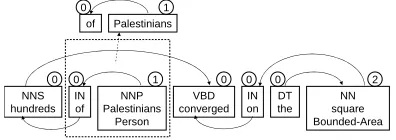
We now consider three special instantiations of this general definition of relation instance graphs. See Figures 1, 2 and 3 for examples of each of the three representations.
Sequence: Without introducing any additional
NNS hundreds IN of NNP Palestinians Person VBD converged IN on DT the NN square Bounded-Area 0
0 1 0 0 0 2
Person VBD
1 0
[image:4.612.85.289.58.116.2]Bounded-Area 2
Figure 1: An example sequence representation. The subgraph on the left represents a bigram feature. The subgraph on the right represents a unigram feature that states the entity type ofarg2.
NNS hundreds IN of NNP Palestinians Person VBD converged IN on DT the NN square Bounded-Area 0
0 1 0 0 0 2
NPB NPB PP NP 1 1 0 1 S VP PP NPB 3 2 2 2
on DT Bounded-Area
0 0 2
PP
NPB 2
2
Figure 2: An example syntactic parse tree represen-tation. The subgraph represents a subtree feature (grammar production feature).
arg2. Otherwise, it is assigned the argument tag 0. There is a directed edge fromu tov if and only if the token represented byvimmediately follows that represented byuin the sentence.
Syntactic Parse Tree: The syntactic parse tree
of the relation instance sentence can be augmented to represent the relation instance. First, we modify the tree slightly by conflating each leaf node in the original parse tree with its parent, which is a preter-minal node labeled with a POS tag. Then, each node is augmented with relevant attributes if necessary. Argument tags are assigned to the leaf nodes in the same way as in the sequence representation. For an internal node v, argument tag 1 or 2 is assigned if eitherarg1 orarg2 is inside the subtree rooted atv, and 3 is assigned if both arguments are inside the subtree. Otherwise, 0 is assigned tov.
Dependency Parse Tree: Similarly, the
depen-dency parse tree can also be modified to represent the relation instance. Assignment of attributes and argument tags is the same as for the sequence repre-sentation. To simplify the representation, we ignore
NNS hundreds IN of NNP Palestinians Person VBD converged IN on DT the NN square Bounded-Area 0
0 1 0 0 0 2
[image:4.612.328.526.59.129.2]of Palestinians 1 0
Figure 3: An example dependency parse tree rep-resentation. The subgraph represents a dependency relation feature between arg1 “Palestinians” and “of ”.
the dependency relation types.
4.3 Features
Given the above definition of relation instance graphs, we are now ready to define features. Intu-itively, a feature of a relation instance captures part of the attributive and/or structural properties of the relation instance graph. Therefore, it is natural to de-fine a feature as a subgraph of the relation instance graph. Formally, given a graphG = (V, E, A, B), which represents a single relation instance, a fea-ture that exists in this relation instance is a sub-graph G0 = (V0, E0, A0, B0) that satisfies the fol-lowing conditions: V0 ⊆ V, E0 ⊆ E, and ∀v ∈
V0, A0(v)⊆A(v), B0(v) =B(v).
We now show that many features that have been explored in previous work on relation extraction can be transformed into this graphic representation. See Figures 1, 2 and 3 for some examples.
Entity Attributes: Previous studies have shown
that entity types and entity mention types of arg1
andarg2are very useful (Zhao and Grishman, 2005; Zhou et al., 2005; Zhang et al., 2006b). To represent a single entity attribute, we can take a subgraph that contains only the node representing the head word of the argument, labeled with the entity type or entity mention type. A particularly useful type of features are conjunctive entity features, which are conjunc-tions of two entity attributes, one for each argument. To represent a conjunctive feature such as “arg1 is a Person entity andarg2is a Bounded-Area entity”, we can take a subgraph that contains two nodes, one for each argument, and each labeled with an en-tity attribute. Note that in this case, the subgraph contains two disconnected components, which is al-lowed by our definition.
[image:4.612.72.295.186.339.2]explore by Zhao and Grishman (2005) and Zhou et. al. (2005). To represent a bag-of-word feature, we can simply take a subgraph that contains a single node labeled with the token. Because the node also has an argument tag, we can distinguish between ar-gument word and non-arar-gument word.
Bigrams: A bigram feature (Zhao and Grishman,
2005) can be represented by a subgraph consisting of two connected nodes from the sequence represen-tation, where each node is labeled with the token.
Grammar Productions: The features in
convo-lution tree kernels for relation extraction (Zhang et al., 2006a; Zhang et al., 2006b) are sequences of grammar productions, that is, complete subtrees of the syntactic parse tree. Therefore, these features can naturally be represented by subgraphs of the re-lation instance graphs.
Dependency Relations and Dependency Paths:
These features have been explored by Bunescu and Mooney (2005a), Zhao and Grishman (2005), and Zhou et. al. (2005). A dependency relation can be represented as an edge connecting two nodes from the dependency tree. The dependency path between the two arguments can also be easily represented as a path in the dependency tree connecting the two nodes that represent the two arguments.
There are some features that are not covered by our current definition, but can be included if we modify our relation instance graphs. For example, gapped subsequence features in subsequence ker-nels (Bunescu and Mooney, 2005b) can be repre-sented as subgraphs of the sequence representation if we add more edges to connect any pair of nodesu andv provided that the token represented byu oc-curs somewhere before that represented byv in the sentence. Since our feature definition is very gen-eral, our feature space also includes many features that have not been explored before.
4.4 Searching the Feature Space
Although the feature space we have defined is rel-atively complete and has a clear structure, it is still too expensive to exhaustively search the space be-cause the number of features is exponential in terms of the size of the relation instance graph. We thus propose to search the feature space in the follow-ing bottom-up manner: We start with the conjunc-tive entity features (defined in Section 4.3), which
have been found effective in previous studies and are intuitively necessary for relation extraction. We then systematically add unit features with different granularities. We first consider the minimum (i.e. most basic) unit features. We then gradually include more complex features. The motivations for this strategy are the following: (1) Using the smallest features to represent a relation instance graph pre-sumably covers all unit characteristics of the graph. (2) Using small subgraphs allows fuzzy matching, which is good for our task because relation instances of the same type may vary in their relation instance graphs, especially with the noise introduced by ad-jectives, adverbs, or irrelevant propositional phrases. (3) The number of features of a fixed small size is polynomial in terms of the size of the relation in-stance graph. It is therefore feasible to generate all the small unit features and use any classifier such as a maximum entropy classifier or an SVM.
In our experiments, we consider three levels of small unit features in increasing order of their com-plexity. First, we consider unigram featuresGuni =
({u},∅, Auni, B), whereAuni(u) = {ai} ⊆ A(u).
In another word, unigram features consist of a sin-gle node labeled with a sinsin-gle attribute. Examples of unigram features include bag-of-word features and non-conjunctive entity attribute features. At the second level, we consider bigram features Gbi =
({u, v},{(u, v)}, Auni, B). Bigram features are therefore single edges connecting two nodes, where each node is labeled with a single attribute. The third level of attributes we consider are trigram fea-tures Gtri = ({u, v, w},{(u, v),(u, w)}, Auni, B) or Gtri = ({u, v, w},{(u, v),(v, w)}, Auni, B). Thus trigram features consist of two connected edges and three nodes, where each node is also la-beled with a single attribute.
combine the features from the three subspaces to see whether the performance can be improved, that is, we test whether the sequence, syntactic and depen-dency relations can complement each other.
5 Experiments
5.1 Data Set and Experiment Setup
We used the data set from ACE (Automatic Con-tent Extraction) 2004 evaluation to conduct our ex-periments. This corpus defines 7 types of relations:
Physical, Personal / Social, Empolyment / Memeber-ship / Subsidiary, Agent-Artifact, PER / ORG Affili-ation, GPE Affiliation and Discourse.
We used Collins parser to parse the sentences in the corpus because Collins parser gives us the head of each syntactic category, which allows us to trans-form the syntactic parse trees into dependency trees. We discarded sentences that could not be parsed by Collins parser. The candidate relation instances were generated by considering all pairs of entities that occur in the same sentence. We obtained 48625 candidate relation instances in total, among which 4296 instances were positive.
As in most existing work, instead of using the en-tire sentence, we used only the sequence of tokens that are inside the minimum complete subtree cov-ering the two arguments. Presumably, tokens out-side of this subtree are not so relevant to the task. In our graphic representation of relation instances, the attribute set for a token node includes the token it-self, its POS tag, and entity type, entity subtype and entity mention type when applicable. The attribute set for a syntactic category node includes only the syntactic tag. We used both maximum entropy clas-sifier and SVM for all experiments. We adopted one vs. others strategy for the multi-class classification problem. In all experiments, the performance shown was based on 5-fold cross validation.
5.2 General Search in the Feature Subspaces
Following the general search strategy, we conducted the following experiments. For each feature sub-space, we started with the conjunctive entity features plus the unigram features. We then incrementally added bigram and trigram features. For the syntac-tic parse tree feature space, we conducted an addi-tional experiment: We added basic grammar
produc-tion features on top of the unigram, bigram and tri-gram features. Adding production features allows us to study the effect of adding more complex and pre-sumably more specific and discriminative features.
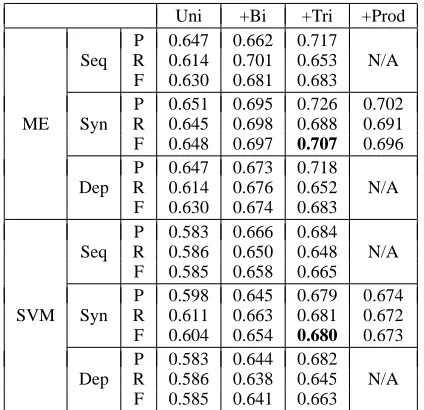
Table 1 shows the precision (P), recall (R) and F1 measure (F) from the experiments with the maxi-mum entropy classifier (ME) and the SVM classi-fier (SVM). We can compare the results in two di-mensions. First, within each feature subspace, while bigram features improved the performance signifi-cantly over unigrams, trigrams did not improve the performance very much. This trend is observed for both classifiers. In the case of the syntactic parse tree subspace, adding production features even hurt the performance. This suggests that inclusion of com-plex features is not guaranteed to improve the per-formance.
Second, if we compare the best performance achieved in each feature subspace, we can see that for both classifiers, syntactic parse tree is the most effective feature space, while sequence and depen-dency tree are similar. However, the difference in performance between the syntactic parse tree sub-space and the other two subsub-spaces is not very large. This suggests that each feature subspace alone al-ready captures most of the useful structural informa-tion between tokens for relainforma-tion extracinforma-tion. The rea-son why the sequence feature subspace gave good performance although it contained the least struc-tural information is probably that many relations de-fined in the ACE corpus are short-range relations, some within single noun phrases. For such kind of relations, sequence information may be even more reliable than syntactic or dependency information, which may not be accurate due to parsing errors.
Uni +Bi +Tri +Prod P 0.647 0.662 0.717
Seq R 0.614 0.701 0.653 N/A F 0.630 0.681 0.683 P 0.651 0.695 0.726 0.702 ME Syn R 0.645 0.698 0.688 0.691 F 0.648 0.697 0.707 0.696 P 0.647 0.673 0.718 Dep R 0.614 0.676 0.652 N/A
F 0.630 0.674 0.683 P 0.583 0.666 0.684 Seq R 0.586 0.650 0.648 N/A
F 0.585 0.658 0.665 P 0.598 0.645 0.679 0.674 SVM Syn R 0.611 0.663 0.681 0.672 F 0.604 0.654 0.680 0.673 P 0.583 0.644 0.682 Dep R 0.586 0.638 0.645 N/A
[image:7.612.80.292.57.262.2]F 0.585 0.641 0.663
Table 1: Comparison among the three feature sub-spaces and the effect of including larger features.
Seq+Syn Seq+Dep Syn+Dep All P 0.737 0.687 0.695 0.724 ME R 0.694 0.682 0.731 0.702
F 0.715 0.684 0.712 0.713
P 0.689 0.669 0.687 0.691 SVM R 0.686 0.653 0.682 0.686
F 0.688 0.661 0.684 0.688
Table 2: The effect of combining the three feature subspaces.
this suggests that since many of the ACE relations are local, there is likely much overlap between se-quence information and dependency information.
We also tried the convolution tree kernel method (Zhang et al., 2006a), using an SVM tree kernel package2. The performance we obtained was P = 0.705, R = 0.685, and F = 0.6953. This F mea-sure is higher than the best SVM performance in Ta-ble 1. The convolution tree kernel uses large subtree features, but such features are deemphasized with an exponentially decaying weight. We found that the performance was sensitive to this decaying fac-tor, suggesting that complex features can be useful if they are weighted appropriately, and further study of how to optimize the weights of such complex fea-tures is needed.
2http://ai-nlp.info.uniroma2.it/moschitti/Tree-Kernel.htm 3
The performance we achieved is lower than that reported in (Zhang et al., 2006b), due to different data preprocessing, data partition, and parameter setting.
5.3 Task-Oriented Feature Pruning
Apart from the general bottom-up search strategy we have proposed, we can also introduce some task-oriented heuristics based on intuition or domain knowledge to prune the feature space. In our ex-periments, we tried the following heuristics.
H1: Zhang et al. (2006a) found that using
path-enclosed tree performed better than using minimum complete tree, when convolution tree kernels were
applied. In path-enclosed trees, tokens beforearg1 and afterarg2as well as their links with other nodes in the tree are removed. Based on this previous finding, our first heuristic was to change the syntac-tic parse tree representation of the relation instances into path-enclosed trees.
H2: We hypothesize that words such as articles,
adjectives and adverbs are not very useful for rela-tion extracrela-tion. We thus removed sequence unigram features and bigram features that contain an article, adjective or adverb.
H3: Similar to H2, we can remove bigrams in the
syntactic parse tree subspace if the bigram contains an article, adjective or adverb.
H4: Similar to H1, we can also remove the
to-kens beforearg1 and afterarg2 from the sequence representation of a relation instance.
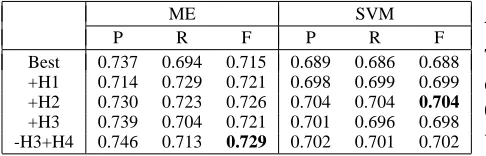
In Table 3, we show the performance after apply-ing these heuristics. We started with the best con-figuration from our previous experiments, that is, combing up to bigram features in the sequence sub-space and up to trigram features in the syntactic tree subspace. We then applied heuristics H1 to H4 in-crementally unless we saw that a heuristic was not effective. We found that H1, H2 and H4 slightly improved the performance, but H3 hurt the perfor-mance. On the one hand, the improvement suggests that our original feature configuration included some irrelevant features, and in turn confirmed that over-inclusion of features could hurt the performance. On the other hand, since the improvement brought by H1, H2 and H4 was rather small, and H3 even hurt the performance, we could see that it is in general very hard to find good feature pruning heuristics.
6 Conclusions and Future Work
[image:7.612.75.297.309.388.2]pro-ME SVM
P R F P R F
Best 0.737 0.694 0.715 0.689 0.686 0.688 +H1 0.714 0.729 0.721 0.698 0.699 0.699 +H2 0.730 0.723 0.726 0.704 0.704 0.704
[image:8.612.71.314.58.136.2]+H3 0.739 0.704 0.721 0.701 0.696 0.698 -H3+H4 0.746 0.713 0.729 0.702 0.701 0.702
Table 3: The effect of various heuristic feature prun-ing methods.
posed and defined a unified graphic representation of features for relation extraction, which serves as a general framework for systematically exploring fea-tures defined on natural language sentences. With this framework, we explored three different repre-sentations of sentences—sequences, syntactic parse trees, and dependency trees—which lead to three feature subspaces. In each subspace, starting with the basic unit features, we systematically explored features of different levels of complexity. The stud-ied feature space includes not only most of the ef-fective features explored in previous work, but also some features that have not been considered before.
Our experiment results showed that using a set of basic unit features from each feature subspace, we can achieve reasonably good performance. When the three subspaces are combined, the performance can improve only slightly, which suggests that the sequence, syntactic and dependency relations have much overlap for the task of relation extraction. We also found that adding more complex features may not improve the performance much, and may even hurt the performance. A combination of features of different levels of complexity and from different sentence representations, coupled with task-oriented feature pruning, gives the best performance.
In our future work, we will study how to auto-matically conduct task-oriented feature search, fea-ture pruning and feafea-ture weighting using statistical methods instead of heuristics. In this study, we only considered features from the local context, i.e. the sentence that contains the two arguments. Some ex-isting studies use corpus-based statistics for relation extraction (Hasegawa et al., 2004). In the future, we will study the effectiveness of these global features.
Acknowledgments
This work was in part supported by the National Sci-ence Foundation under award numbers 0425852 and 0428472. We thank Alessandro Moschitti for pro-viding the SVM tree kernel package. We also thank Min Zhang for providing the implementation details of the convolution tree kernel for relation extraction.
References
Razvan C. Bunescu and Raymond J. Mooney. 2005a. A shortest path dependency kenrel for relation extrac-tion. In Proceedings of HLT/EMNLP.
Razvan C. Bunescu and Raymond J. Mooney. 2005b. Subsequence kernels for relation extraction. In
Pro-ceedings of NIPS.
Aron Culotta and Jeffrey Sorensen. 2004. Dependency tree kernels for relation extraction. In Proceedings of
ACL.
Chad Cumby and Dan Roth. 2003. On kernel methods for relational learning. In Proceedings of ICML.
Takaaki Hasegawa, Satoshi Sekine, and Ralph Grishman. 2004. Discovering relations among named entities from large corpora. In Proceedings ACL.
Nanda Kambhatla. 2004. Combining lexical, syntactic, and semantic features with maximum entropy models for extracting relations. In Proceedings of ACL.
Jun Suzuki, Tsutomu Hirao, Yutaka Sasaki, and Eisaku Maeda. 2003. Hierarchical directed acyclic graph ker-nel: Methods for structured natural language data. In
Proceedings of ACL.
Dmitry Zelenko, Chinatsu Aone, and Anthony Richardella. 2003. Kernel methods for relation extraction. Journal of Machine Learning Research, 3:1083–1106.
Min Zhang, Jie Zhang, and Jian Su. 2006a. Exploring syntactic features for relation extraction using a con-volution tree kernel. In Proceedings of HLT/NAACL.
Min Zhang, Jie Zhang, Jian Su, and Guodong Zhou. 2006b. A composite kernel to extract relations be-tween entities with both flat and structured features. In Proceedings of ACL.
Shubin Zhao and Ralph Grishman. 2005. Extracting re-lations with integrated information using kernel meth-ods. In Proceedings of ACL.