JHEP04(2002)028
Published by Institute of Physics Publishing for SISSA/ISASReceived: April 12, 2002 Accepted: April 17, 2002
Implementation of supersymmetric processes in the
HERWIG event generator
∗Stefano Moretti
Theory Division, CERN and IPPP, University of Durham, UK E-mail: [email protected]
Kosuke Odagiri
Theory Group, KEK, Japan E-mail: [email protected]
Peter Richardson
Cavendish Laboratory and DAMTP, University of Cambridge, UK E-mail: [email protected]
Michael H. Seymour
Department of Physics & Astronomy, University of Manchester, UK E-mail: [email protected]
Bryan R. Webber
Cavendish Laboratory, University of Cambridge, UK E-mail: [email protected]
Abstract:We describe the implementation of supersymmetric processes in the HERWIG
Monte Carlo event generator. We define relevant parameter and mixing conventions and list the hard scattering matrix elements. Our implementation is based on the Minimum Super-symmetric Standard Model, with the option of R-parity violation. The sparticle spectrum is completely general. Both hadron-hadron and lepton-lepton collisions are covered. This
article supplements a separate publication in which the general features of HERWIG 6.2
are described, and updates the treatment of supersymmetry to version 6.4.
Keywords: Supersymmetry Phenomenology, Supersymmetric Standard Model, Higgs Physics.
∗Work supported in part by the U.K. Particle Physics and Astronomy Research Council and by the EU
JHEP04(2002)028
Contents
1. Introduction 1
2. Parameter and mixing conventions 2
2.1 Particle content 3
2.2 Parameter conventions 4
2.3 Mixing conventions 5
2.3.1 Charginos 5
2.3.2 Neutralinos 8
2.3.3 Left-right sfermion mixing 10
2.3.4 Higgs bosons 11
3. Matrix elements 12
3.1 Notation 12
3.2 Sparton pair production 13
3.3 Slepton pair production 13
3.4 Gaugino production 14
3.5 Neutral Higgs production 16
3.6 Charged Higgs production 21
3.7 R-parity violating processes 23
3.7.1 Single gaugino production 24
3.7.2 Slepton production in association with a gauge boson 25
3.7.3 Slepton production in association with a Higgs boson 25
3.7.4 SMparticle production by sparticle exchange 26
3.8 Decay matrix elements 27
4. Conclusions 27
A. Process codes 28
1. Introduction
HERWIG1 [1] is a general-purpose event generator for high-energy processes. A major
new feature is the inclusion of supersymmetric (SUSY) processes, made available for the
first time in HERWIG 6.1 and extended in subsequent versions. This article describes
the implementation, defines the parameter and mixing conventions, and lists the hard scattering matrix elements. For the details of the input file format and for a more general
description of our implementation, as well as the description of the Standard Model (SM)
1
JHEP04(2002)028
physics implemented in the generator, the reader should consult ref. [1]. This article supplements that paper and extends it to version 6.4. The exact version number of the code described in this article is 6.400.
The key features of theHERWIG6.4 supersymmetry implementation are as follows:
• A general Minimal Supersymmetric Standard Model (MSSM) particle spectrum.
• Both hadron-hadron and lepton-lepton collisions.
• MSSM 2→2 sparticle production subprocesses.
• 2 → 1, 2 → 2 and 2 → 3 Two Higgs Doublet Model (2HDM) Higgs boson
produc-tion subprocesses in hadron-hadron collisions, and 2 → 2 Higgs boson production
processes in lepton-lepton collisions.
• All R-parity violating 2 → 2 scattering subprocesses in hadron-hadron collisions
that can, but do not necessarily, have ans-channel resonance, and 2 →2 scattering
processes in lepton-lepton collisions, not necessarily with ans-channel resonance.
• Cascade decay of heavy objects according to branching fractions taken from an input
data file, incorporating 3-body and 4-body matrix elements.
• Colour coherence between emitted partons.
• Spin correlations in 2→2 R-parity conserving production processes and all cascade
decay processes.
• Beam polarisation in lepton-lepton collisions.
The masses, total decay widths and branching fractions, the mixings of gauginos, third generation sfermions and Higgs bosons, the bilinear, trilinear and R-parity violating
trilinear couplings, are read in from a data file. A separate program (ISAWIG) is available
(from the HERWIG web page) to convert the data from ISAJET [2] and HDECAY[3] to a
form suitable forHERWIG and modify it to include the R-parity violating sector.
In our implementation, supersymmetric particles do not radiate gluons. This assump-tion is reasonable if the decay lifetimes of the coloured sparticles (spartons) are much
shorter than theQCDconfinement scale. In particular, a stable gluino Lightest
Supersym-metric Particle (LSP) is not simulated. The simulation of a long-lived light top squark
would neglect effects due to gluon emission and hadronization.
CP-violating phases are not included for either the mixings or the couplings. R-parity violating lepton-gaugino and slepton-Higgs mixing is not considered.
2. Parameter and mixing conventions
There are several different conventions that are commonly adopted in the literature for
the MSSM lagrangian. While most authors have chosen to follow the conventions used in
JHEP04(2002)028
spin 0 spin 1/2 spin 1
down-type squarks down-type quarks
(deL,deR,esL,seR,eb1,eb2) (d, s, b)
up-type squarks up-type quarks
(ueL,ueR,ecL,ceR,et1,et2) (u, c, t)
charged sleptons charged leptons
(eeL,eeR,µeL,µeR,τe1,eτ2) (e−, µ−, τ−)
sneutrinos neutrinos
(eνe,eνµ,νeτ) (νe, νµ, ντ)
gluino gluon
e
g g
neutral Higgs neutralinos photon andZ0
(h0, H0, A0) χe0
i (i= 1−4) (γ, Z0)
charged Higgs charginos W±
H+ χe+i (i= 1−2) W+
Goldstino
e
[image:4.595.151.447.83.361.2]G
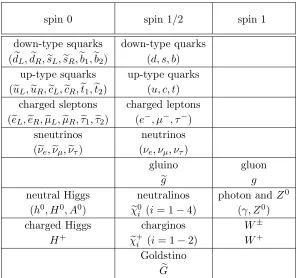
Table 1:Particle content of the MSSM, expressed in terms of its mass eigenstates. The GoldstinoGe is the spin-1/2 component of the gravitino. We neglect mixing for the first two generation sfermions.
we have used in general follow those of refs. [4, 5]. In this section we present our conventions for the mixing matrices for the charginos, neutralinos and sfermions, together with the conversion between the conventions of refs. [2, 4, 5].
2.1 Particle content
TheMSSMparticle content, expressed in terms of its mass eigenstates, is given in table 1.
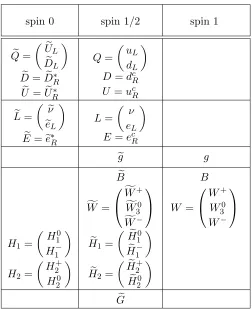
In defining our conventions we need to write the particle content in terms of the
interaction eigenstates. This is shown in table 2. Superscriptscrefer to charge conjugation,
which, stated in the four-component notation, is defined by:
ψc=Cψ¯T =iγ2γ0ψ¯T . (2.1)
We adopt the chirality basis. The two-component case, which we refer to when dis-cussing mixing conventions, follows trivially. Acting on chirality-left and chirality-right two-component spinors, we have:
(φL)c = iσ2φ∗L=εijφ∗jL,
(φR)c = −iσ2φ∗R=−εijφ∗jR. (2.2)
JHEP04(2002)028
spin 0 spin 1/2 spin 1
e
Q=µ eUeL
DL
¶
e
D=De∗ R
e
U =Ue∗ R Q= µu L dL ¶
D =dcR U =uc
R e L= µ e ν e eL ¶ e
E =ee∗ R L= µ ν eL ¶
E =ecR
e g g e B f W = f W+ f
W30
f W− B W = W+
W30 W−
H1=
µH0 1
H1−
¶ e
H1=
µ eH0 1
e
H1−
¶
H2=
µ
H2+ H0 2
¶ e
H2=
µ eH2+
[image:5.595.172.424.81.390.2]e H0 2 ¶ e G
Table 2: Field content of the MSSM, expressed in terms of its interaction eigenstates. Generation and colour indices are suppressed.
2.2 Parameter conventions
In terms of the scalar fields defined in table 2, we write our scalar superpotential as follows:
Ws=εij
h
µH1iH2j +f`H1iLejEe+fDH1iQejDe −fUH2iQejUe
i
. (2.3)
The above definition is consistent with refs. [5, 6]. The sign of the term proportional to the
up-type quark coupling Yukawa matrixfU is such that the Yukawa couplings are positive.
For the R-parity violating scalar superpotential, we take:
W6Rp =εij
·
κaLeiaH2j+
1
2λabcLe
i
aLejbEec+λabc0 LeiaQejbDec
¸
+1
2λ
00
abcεc1c2c3Ue
c1
a Debc2De c3
c . (2.4)
a, b, c are the generation indices. In the last term, c1, c2, c3 are the triplet colour indices
and the totally antisymmetric tensor is defined byε123= 1. Summation over colour indices
is implicit in the other terms. We omit the bilinear term proportional to κa.
We introduce our softSUSY-breaking bilinear and trilinear terms as follows:
VI=εij
h
µBH1iH2j +f`AτH1iLejEe+fDAbH1iQejDe−fUAtH2iQejUe
i
+ (h.c.). (2.5)
This is consistent with the definition in ref. [5]. We neglect A term contributions to the
first two generations. The contribution of the potential to the lagrangian is L = −V in
JHEP04(2002)028
Our soft SUSY-breaking masses are defined schematically as follows:
VM =
X
φ
Mφ2φ†φ+X
ψ
Mψψψ ,¯ (2.6)
where φ are the sfermion fields and ψ are the gaugino and gluino fields in the
four-component notation. Summations over colour and weak isospin indices are implicit. We
write the gaugino soft-breaking masses as MBe =M1 and MfW = M2. In the notation of
refs. [4, 5],M0 and M are used instead ofM
1 andM2, respectively. However, the notation
M1 and M2 has become more common.
The above conventions for the signs of the µ and the A terms are the same as those
adopted in ISAJET [2] and Haber and Kane [4]. This also agrees with the conventions
of the other major SUSY event generators, SPYTHIA [7] and SUSYGEN [8]. While these
conventions are the same internally,ISAJETuses a different notation which corresponds to
the following:
2m1 = −µ ,
µ1 = −M1,
µ2 = −M2, (2.7)
wherem1, µ1 and µ2 are in the notation of ISAJET.
2.3 Mixing conventions
While internallyHERWIGuses the conventions of refs. [4, 5, 6], the mass and decay spectra
are fed in from a data file. In particular, we have provided a separate code (ISAWIG) for
the conversion of data from ISAJET[2]. This way, the masses of the sparticles and their
R-parity conserving decay rates are calculated using ISAJET and the R-parity violating
section is added byISAWIG.ISAJETalso calculates the mixing matrices for the electroweak
gauginos and scalar fermions. ISAJETuses the conventions of refs. [2, 10] and it is essential
that the conversion between the two formalisms is done correctly.
We first consider the conversion between the two formalisms for the gauginos and then for the left-right sfermion mixing. We compare the lagrangian of ref. [2] against that of refs. [4, 5] to obtain the conversions between them. We adopt the conventions of refs. [4, 5] for the chargino and neutralino mixing matrices.
2.3.1 Charginos
In the notation of ref. [5], we define the following doublets of two-component spinors for the charginos in their interaction eigenstates:
ψ+ = ³−iλ+, ψH+2´,
ψ− = ³−iλ−, ψH−1´, (2.8)
where λ± are the charged Winos, ψ−
H1 is the charged Higgsino associated with the Higgs
JHEP04(2002)028
the Higgs doublet that gives mass to the up-type quarks. The mass term in the lagrangian from ref. [5, eq. (A.2)] is:
Lchargino=−1 2
¡
ψ+ ψ−¢
µ 0 XT
X 0
¶ µψ+
ψ−
¶
+ (h.c.), (2.9)
where the mass matrix is given by:
X =
µ
M2 MW√2 sinβ
MW √
2 cosβ µ
¶
. (2.10)
In ref. [5] this is diagonalized in the two-component notation by defining the mass eigen-states:
χ+i = Vijψj+,
χ−i = Uijψ−j , (2.11)
whereU andV are unitary matrices chosen such that
U∗XV−1=MD. (2.12)
MD is the diagonal chargino mass matrix. The four-component mass eigenstates, the
charginos, are defined in terms of the two-component fields as:
e
χ+1 =
µ
χ+1
(χ−1)c
¶
, χe+2 =
µ
χ+2
(χ−2)c
¶
. (2.13)
We need to express the chargino mass terms in the lagrangian in a four-component notation so that we can compare this lagrangian with the conventions of ref. [2]. We define the four-component spinors as in ref. [5]:
f
W+=
µ
−iλ+
(−iλ−)c
¶
, He+=
µ
ψH+2
(ψ−H1)c
¶
. (2.14)
Using this notation, we can express the lagrangian in the four-component notation:
Lchargino=−³fW+ He+´ £XP
L+XTPR¤
µ fW+
e
H+
¶
. (2.15)
The chirality projection operators are defined asPL/R = (1–/+γ5)/2. Equation (2.15)
has a similar form to the chargino mass term2 in ref. [2, eq. (2.1)]:
Lchargino=−¡λ¯ χ¯¢ £MchargePL+MchargeT PR¤
µ
λ χ
¶
, (2.16)
where
Mcharge =
µ
µ2 −gv0 −gv 2m1
¶
=−
µ
M2 √2MWcosβ √
2MWsinβ µ
¶
, (2.17)
JHEP04(2002)028
wherev andv0 are the vacuum expectation values for the Higgs fields that give mass to the
up- and down-type quarks, respectively. We now come to the problem of comparing the notation of ref. [5] against that of ref. [2]. The Wino and Higgsino fields of ref. [2] are the charge conjugates of those used in ref. [5], so that the following transformation is required:
f
W+ = λc,
e
H+ = χc. (2.18)
This gives the chargino mass matrix in the form:
Lchargino =³fW+,He+´ hM0
chargePL+M0TchargePR
i µ fW+
e
H+
¶
, (2.19)
where
Mcharge0 =
µ
−µ2 gv
gv0 −2m 1 ¶ = µ M2 √
2MWsinβ
√
2MW cosβ µ
¶
. (2.20)
This agrees with eq. (2.15) apart from the overall sign. We need to express the fields in
terms of the ISAJET mixing matrices. The ISAJET mixing matrices are given in ref. [2,
eqs. (2.10) and (2.11)] as:
µ fW+
f W− ¶ L = µ
θxcosγL −θxsinγL
sinγL cosγL
¶ µ λ χ ¶ L , µ
(−1)θ+Wf
+
(−1)θ−fW
−
¶
R
=
µ
θycosγR −θysinγR
sinγR cosγR
¶ µ λ χ ¶ R . (2.21)
The mixing angles γL and γR, and the sign functions θx, θy, θ+, and θ− are defined in
ref. [2].
We can transform these equations into the notation of ref. [4] with the identification:
e
χ+1 =Wf−c,
e
χ+2 =Wf+c. (2.22)
This gives:
PL
µ fW+
e
H+
¶
=PL
µ
−sinγR −θycosγR −cosγR θysinγR
¶ µ
(−1)θ−χe+
1
(−1)θ+χe+
2
¶
,
PR
µ fW+
e
H+
¶
=PR
µ
−sinγL −θxcosγL −cosγL θxsinγL
¶ µ e
χ+1
e
χ+2
¶
. (2.23)
These mixing matrices are now in a form that allows us to compare them with the notation of ref. [5, eq. (A.13)], :
PL
µ fW+
e
H+
¶
= PL
µ
V∗ 11 V21∗
V∗ 12 V22∗
¶ µ e
χ+1
e
χ+2
¶
,
PR
µ fW+
e
H+
¶
= PR
µ
U11 U21
U12 U22
¶ µ e
χ+1
e
χ+2
¶
JHEP04(2002)028
By comparing eqs. (2.23) and (2.24) we obtain the mixing matrices in the notation of ref. [5]:
U =
µ
−sinγL −cosγL −θxcosγL θxsinγL
¶
,
V =
µ
−sinγR(−1)θ− −cosγR(−1)θ+ −θycosγR(−1)θ− θysinγR(−1)θ+
¶
. (2.25)
It should be noted that we adopt the opposite sign convention for the chargino masses due to the sign differences in the two lagrangians.
2.3.2 Neutralinos
We define a quadruplet of two-component fermion fields for the neutralinos in the interac-tion eigenstate as:
ψ0 =¡−iλ0,−iλ3, ψ0H1, ψ0H2¢, (2.26)
where λ0 is the Bino, λ3 is the neutral Wino, ψ0
H1 is the Higgsino corresponding to the
neutral component of the Higgs doublet giving mass to the down-type quarks and ψ0H2 is
the Higgsino corresponding to the neutral component of the Higgs doublet giving mass to the up-type quarks. The lagrangian for the neutralino masses from ref. [5, eq. (A.18)] is:
Lneutralino=−1 2
¡
ψ0¢T Y ψ0+ (h.c.), (2.27)
where
Y = (2.28)
=
M1 0 −MZsinθWcosβ MZsinθWsinβ
0 M2 MZcosθWcosβ −MZcosθWsinβ
−MZsinθWcosβ MZcosθWcosβ 0 −µ
MZsinθW sinβ −MZcosθWsinβ −µ 0
.
In ref. [5], the lagrangian is diagonalized in this two-component notation to give the mass eigenstates. The diagonalization is performed by defining two-component fields:
χ0i =Nijψj0, i, j = 1, . . . ,4, (2.29)
whereN is a unitary matrix satisfyingN∗Y N−1 =N
D, andND is the diagonal neutralino
mass matrix. The four-component mass eigenstates, the neutralinos, can be defined in terms of the two-component fields:
e
χ0i =
µ
χ0i
(χ0
i)c
¶
. (2.30)
JHEP04(2002)028
in the four-component notation by defining four-component Majorana fields:
e
B =
µ
−iλ0
(−iλ0)c
¶
, Wf3 =
µ
−iλ3
(−iλ3)c
¶
,
e
H1 =
µ
ψH01
(ψ0
H1)
c
¶
, He2=
µ
ψH02
(ψ0
H2)
c
¶
. (2.31)
As defined in table 2, Be is the Bino field, fW3 is the neutral Wino field, He1 is the field for
the Higgsino associated with the neutral component of the Higgs doublet that gives mass
to the down-type quarks and He2 is the field for the Higgsino associated with the neutral
component of the Higgs doublet that gives mass to the up-type quarks. This gives the lagrangian in the four-component notation:
Lneutralino =−1 2
³ e
B Wf3 He1,He2
´
[Y PL+Y PR]
e B f W3 e H1 e H2
. (2.32)
We can now compare this with the relevant lagrangian, in the four-component notation,
given in ref. [2]. This lagrangian3 is from ref. [2, eq. (2.2)]:
Lneutralino =−1 2
³
¯
h0,¯h00,λ¯3,λ¯0
´
[MneutralPL+MneutralPR]
h0 h00
λ3
λ0
. (2.33)
h0 is the Higgsino partner of the neutral component of the Higgs doublet that gives mass
to the up-type quarks,h00is the Higgsino partner of the Higgs boson that gives mass to the
down-type quarks,λ3 is the neutral Wino andλ0 is the Bino. The mass matrix is given by:
Mneutral =
0 −2m1 −gv/√2 g0v/√2
−2m1 0 gv0/ √
2 −g0v0/√2
−gv/√2 gv0/√2 µ
2 0
g0v/√2 −g0v0/√2 0 µ 1
. (2.34)
It is easier to compare this with eq. (2.32) after reordering the entries and reexpressing
it in terms ofMZ, β and θW. This gives:
Lneutralino = 1 2
³
¯
λ0,¯λ3,h¯
00
,¯h0´ £Mneutral0 PL+Mneutral0 PR¤
λ0 λ3
h00
h0
, (2.35)
where:
Mneutral0 = (2.36)
=
M1 0 MZsinθWcosβ −MZsinθWsinβ
0 M2 −MZcosθW cosβ MZcosθW sinβ
MZsinθWcosβ −MZcosθW cosβ 0 −µ −MZsinθWsinβ MZcosθWsinβ −µ 0
.
JHEP04(2002)028
This equation then agrees with eq. (2.32) up to an overall sign, provided we make the following identification:
e
B =λ0, Wf3 =λ3,
e
H1 =−h00, He2 =−h0. (2.37)
The convention fromISAJETfor the mixing, taken from ref. [2, eq. (2.12)], is
(−iγ5)θ1Ze1
(−iγ5)θ2Ze2
(−iγ5)θ3Ze3
(−iγ5)θ4Ze4
=
v(1)1 v2(1) v3(1) v4(1) v(2)1 v2(2) v3(2) v4(2) v(3)1 v2(3) v3(3) v4(3) v(4)1 v2(4) v3(4) v4(4)
h0
h00 λ3
λ0
, (2.38)
where Zei are the mass eigenstates obtained by diagonalizing the mass matrix given in
eq. (2.34), vj(i) are the elements of the mixing matrix, andθi is zero (one) if the mass ofZei
is positive (negative).
After reordering, we get:
(−iγ5)θ1Ze1
(−iγ5)θ2Ze2
(−iγ5)θ3Ze3
(−iγ5)θ4Ze4
=
v(1)4 v(1)3 −v2(1) −v(1)1 v(2)4 v(2)3 −v2(2) −v(2)1 v(3)4 v(3)3 −v2(3) −v(3)1 v(4)4 v(4)3 −v2(4) −v(4)1
e
B
f
W
e
H1
e
H2
. (2.39)
We can therefore obtain the mixing matrix in the notation of ref. [5] by making the iden-tification:
Ni1 = v(i)4 , Ni2 =v3(i),
Ni3 = −v2(i), Ni4 =−v(i)1 . (2.40)
Again, we need to adopt the opposite sign convention for the neutralino masses.
2.3.3 Left-right sfermion mixing
In addition to the mixing of the neutralinos and charginos, we need to consider the left-right mixing of the sfermions. In general, as the off-diagonal terms in the mass matrices are proportional to the fermion mass, these effects are only important for the third generation sfermions, i.e. stop, sbottom and stau. We describe our convention for the top squarks. The others are treated analogously.
The following mass matrix for the top squarks uses the conventions4 of ref. [5] and is
taken from eq. (4.17) therein.
Met2= (2.41)
=
µM2
e
Q+M
2
Zcos 2β
¡1
2 −23sin2θW
¢
+m2
t mt(At−µcotβ)
mt(At−µcotβ) MU2e+23m2Zcos 2βsin2θW +m2t
¶
,
whereMQe andMUe are softSUSY-breaking masses for the left and right top squarks,
respec-tively. At is the trilinear softSUSY-breaking term for the interaction of the left and right
JHEP04(2002)028
stop squarks with the Higgs boson. This compares with the ISAJETmatrix from ref. [10]:
Met2= (2.42)
=
µM2
etL+M
2
Zcos 2β
¡1
2 −23sin2θW
¢
+m2t −mt(At−µcotβ)
−mt(At−µcotβ) Met2
R+
2
3m2Zcos 2βsin2θW +m2t
¶
,
where M2
etL = M
2
e
Q and M
2
e
tR = M
2
e
U. There is a difference in the sign of the off-diagonal
terms. This means that, as the sign conventions for theµand Aterms are the same, there
is a difference in the relative phases of the two fields in the different conventions. Hence
we should apply the following change to theISAJEToutput:
θt −→ −θt, (2.43)
i.e. change the sign of the stop mixing angle. The same argument also applies to the sbottom and stau mixing angles.
We adopt the following convention for the sfermion mixing matrices:
µ e
qiL
e
qiR
¶
=
µ
cosθi
q sinθqi −sinθiq sinθqi
¶ µ e
qi1
e
qi2
¶
=
µ
Qi
L1 QiL2
QiR1 QiR2
¶ µ e
qi1
e
qi2
¶
, (2.44)
whereqeiL and eqiR are the left and right squark fields, for theith quark, whereiruns over
quark flavours d, u, s, c, b, t. eqi1 and eqi2 are the squark fields for the mass eigenstates, for
the quarki, and θiq is the mixing angle obtained by diagonalizing the mass matrix.
Similarly, we denote the slepton mixing as above with the matrix Li
αβ where i runs
over the charged and neutral lepton flavour. βis the mass eigenstate andαis the left/right
eigenstate. As we do not include the right-handed neutrino we omit the left-right mixing for the sneutrinos. Note that our convention for the mixing matrix is opposite to that for
the gauginos, in the sense that here the mixing matricesQi act on mass eigenstates to give
the interaction eigenstates.
2.3.4 Higgs bosons
The Higgs doublets are diagonalised as follows. As in tables 1 and 2,Hi denote the SU(2)
doublet interaction eigenstates which form the physical eigenstates h0, H0, A0, H± after
the electroweak symmetry breaking. In the charged sector:
H2+=H+cosβ+G+sinβ , H1−=H−sinβ−G−cosβ , (2.45)
where G± are the Goldstone modes. The neutral Higgs sector is parametrised in the
interaction eigenstate as follows:
H10 = vcosβ+√η1+iζ1
2 ,
H20 = vsinβ+√η2+iζ2
2 . (2.46)
v is the vacuum expectation value. The diagonalisation is achieved by:
ζ2 =A0cosβ+G0sinβ , ζ1=A0sinβ−G0cosβ ,
η2 =H0sinα+h0cosα , η1 =H0cosα−h0sinα . (2.47)
JHEP04(2002)028
3. Matrix elements
3.1 Notation
For 2 → 2 hard scattering subprocesses of the form 12 → 34, let us define the usual
Mandelstam variables in terms of the partonic momenta as ˆs= (p1+p2)2, ˆt= (p1−p3)2
and ˆu = (p1 −p4)2. For simplicity, the “hat” will be omitted in the following. As initial
state partons are taken to have zero kinematic mass, it follows that s+t+u=m23+m24,
s+t3+u4 = 0, and ut−m23m24 = sp2T where t3 =t−m23, u4 = u−m24, and pT is the
outgoing transverse momentum.
The electromagnetic coupling ise, such thatαEM =e2/4π. The strong coupling isgs,
such thatαs=g2s/4π. TheQCDcolour factors areNC = 3 andCF = (NC2−1)/2NC = 4/3.
Colour flow directions are not stated explicitly as they are trivial in most of the pro-cesses whose matrix elements are given below. For a general treatment, see ref. [13]. Matrix elements given here are summed over the final state colour and spin, and averaged over the initial state colour and spin. As usual, this is indicated by a long overline. Statistical factors of two for identical neutralinos in the final state are written explicitly.
Let us now consider the widths Γ(q2) appearing in the propagators of unstable massive
particles with massM(q2). In order to simplify the notation, let us define a function Γ(q2),
which is defined for positive q2 by:
p
q2Γ(q2)≡M(q2)¯Γ(q2). (3.1)
For negative q2, the width is taken to be zero. The propagator is
f Qf If3
e −1 −1/2
ν 0 +1/2
d −1/3 −1/2
[image:13.595.86.512.366.557.2]u +2/3 +1/2
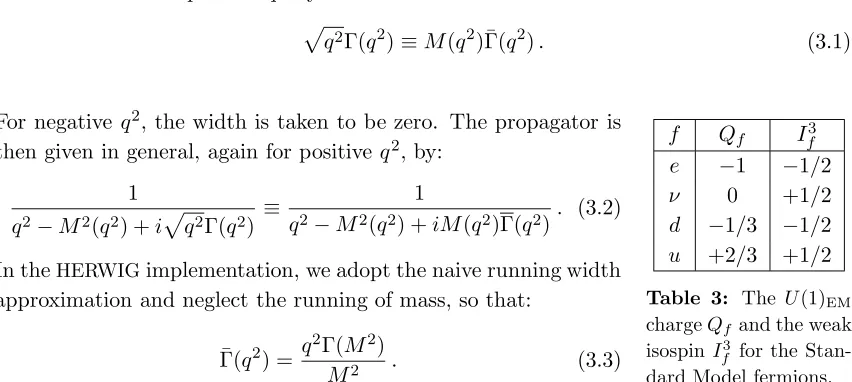
Table 3: The U(1)EM chargeQf and the weak isospin I3
f for the Stan-dard Model fermions.
then given in general, again for positive q2, by:
1
q2−M2(q2) +ipq2Γ(q2) ≡
1
q2−M2(q2) +iM(q2)Γ(q2). (3.2)
In theHERWIGimplementation, we adopt the naive running width
approximation and neglect the running of mass, so that: ¯
Γ(q2) = q
2Γ(M2)
M2 . (3.3)
The following coupling notations are used in processes involving electroweak interac-tions:
Qf =U(1)EMcharge ; (3.4)
If3 = weak isospin ; (3.5)
Lf =
(If3−Qfsin2θW)
cosθW sinθW
; (3.6)
Rf = −
Qfsin2θW
cosθWsinθW
. (3.7)
JHEP04(2002)028
sfermion coupling coefficients as:
e
Lf a = (Na1cosθW +Na2sinθW)Qf + (−Na1sinθW +Na2cosθW)Lf;
e
Rf a = (Na1cosθW +Na2sinθW)Qf + (−Na1sinθW +Na2cosθW)Rf. (3.8)
Following ref. [4], we have neglected the contribution of the Higgsino component, which is proportional to the Yukawa coupling. This affects the cross sections for sfermion-Higgsino
associated production, namely the Higgsino component of the processesgb→ etχe±,ebχe0.
3.2 Sparton pair production
The matrix elements and the colour decompositions for 2→2 parton-to-sparton scattering
are given in ref. [13]. The term “sparton” refers to coloured superparticles, namely the squarks and the gluino. Neglecting the squark left-right mixings, the lepton-annihilation
reaction `−`+→qeqe∗ is given by:
|M|2
(L,R) = e4NCsp2T × × ¯ ¯ ¯ ¯ ¯
Q`Qq
s +
L`(Lq, Rq)
s−MZ2 +iMZΓZ
¯ ¯ ¯ ¯ ¯ 2 + ¯ ¯ ¯ ¯ ¯
Q`Qq
s +
R`(Lq, Rq)
s−MZ2 +iMZΓZ
¯ ¯ ¯ ¯ ¯ 2
. (3.9)
The generalization to the case with left-right mixings is given by:
(Lq, Rq)−→LqQLiQLj+RqQRiQRj. (3.10)
The indicesi, j label the squarks that are produced.
3.3 Slepton pair production
The matrix elements are similar to eqs. (3.9) and (3.10). For the quark annihilation reaction
qq¯→ `e`e∗ one should interchange the indices (q ↔ `), and change the colour factor from
NC to 1/NC. In addition, for the charged current reaction qq¯0 →e`Leν∗ we have
|M|2(qq¯0 →e` Leν∗) =
e4sp2T
¡
2 sin2θW¢2NC
¯ ¯ ¯ ¯ ¯ 1
s−M2
W +iMWΓW
¯ ¯ ¯ ¯ ¯ 2 . (3.11)
For the lepton annihilation reaction the colour factor is 1, and there is an extrat-channel
gaugino contribution to the production of slepton pairs of the same generation as the colliding lepton pair, namely,
|M|2(e−e+
→eeLee∗L,eeRee∗R) = e4sp2T × (3.12)
× ¯ ¯ ¯ ¯ ¯ 1 s+
Le(Le, Re)
s−M2
Z+iMZΓZ
+ 4 X a=1 Ã e L2 ea
t−M2
e
χ0 a
,0!¯¯¯¯
¯ 2 + + ¯ ¯ ¯ ¯ ¯ 1 s+
Re(Le, Re)
s−M2
Z+iMZΓZ
+
4
X
a=1
Ã
0, Re
2 ea
t−M2
e χ0 a !¯¯¯ ¯ ¯ 2 ,
|M|2(e−e+
→eeLee∗R,eeRee∗L) = e4
à 4 X
a=1
Mχe0 a
√
s t−M2
e
χ0 a
e
LeaReea
!2
JHEP04(2002)028
The neutralino masses appearing above are the signed masses. The production of sneutrinos of the same generation as the colliding lepton pair is given by:
|M|2(e−e+
→eνeLνeeL∗ ) = e4sp2T
¯ ¯ ¯ ¯ ¯
LeLν
s−M2
Z+iMZΓZ
+
2
X
a=1
(Va1χe±)2/2 sin2θW
t−M2
e
χ±a
¯ ¯ ¯ ¯ ¯
2
+
+
¯ ¯ ¯ ¯ ¯
ReLν
s−M2
Z+iMZΓZ
¯ ¯ ¯ ¯ ¯
2
. (3.14)
3.4 Gaugino production
We consider the following seven processes in hadronic collisions:
qq¯−→ χe+aχe−b , (3.15)
qq¯−→ χe0iχe0j, (3.16)
qq¯0 −→ χe±aχe0i, (3.17)
qq¯−→ χe0ieg , (3.18)
gq −→ χe0ieq and c.c., (3.19)
qq¯0 −→ χe±aeg , (3.20)
gq −→ χe±aqe0 and c.c. (3.21)
c.c. refers to charge conjugation. The indices take the valuesa, b= 1,2 andi, j = 1, . . . ,4.
Only processes (3.15) and (3.16) are relevant to leptonic collisions, where the colour factors and electroweak coupling coefficient need trivial modifications. Processes (3.15), (3.16), (3.17), (3.18) and (3.20) are expressed conveniently following the notation of ref. [14]:
A= X
α,β=L,R
Cαβ(¯v2γµPαu1)(¯u3γµPβv4) =
X
α,β=L,R
CαβQµαXβµ, (3.22)
where, as before,PL = (1−γ5)/2 andPR= (1 +γ5)/2. The spin-averaged amplitudes are
given as:
|A|2 = [|C
LL|2+|CRR|2]u3u4+ [|CLR|2+|CRL|2]t3t4+
+ 2 Re[CLL∗ CLR+CRR∗ CRL](m3m4s). (3.23)
The masses appearing above as (m3m4s) are the signed masses.
The matrix elements squared for processes (3.19) and (3.21) have the following form,
whereα labels the chirality of the final state squark:
|M|2
α=
(gsgα)2
2NC
·
−ts3 − 2(m 2
4−m23)t3
su4
µ
1 + m
2 3
t3
+m
2 4
u4
¶¸
. (3.24)
When left-right squark mixing is considered, the above is modified as:
|M|2
JHEP04(2002)028
Process (3.15),qq¯→χe+aχe−b, is given by eq. (3.23) with the prefactor (e4/NC) and the
following coefficientsCαβ:
Cαβ =−δab
s −
1
sin 2θW ·
(δαLLq+δαRRq)(−2Oab0β)
s−MZ2 +iMZΓZ − − δαL
2 sin2θW
"
(1−δαβ)δquUa1Ub1
t−M2
e
dL
−δαβδqdVa1Vb1
u−M2
e
uL
#
. (3.26)
Here, following the notation of ref. [4], we have defined:
−2O0L
ab = −Va2Vb2+ 2δabcos2θW;
−2O0Rab = −Ua2Ub2+ 2δabcos2θW. (3.27)
Process (3.16), qq¯ → χe0
iχe0j, is given by eq. (3.22) with the prefactors (e4/NC) and
1/(1 +δij), and the following coefficients Cαβ:
CLL =
Lq
sin 2θW ·
Ni4Nj4−Ni3Nj3
s−MZ2 +iMZΓZ
+ LeqiLeqj
u−Meq2
L
;
CLR =
Lq
sin 2θW ·
Ni3Nj3−Ni4Nj4
s−M2
Z+iMZΓZ
− tLeqiLeqj −M2
e
qL
;
CRL =
Rq
sin 2θW ·
Ni4Nj4−Ni3Nj3
s−M2
Z+iMZΓZ −
e
RqiReqj
t−Mqe2
R
;
CRR =
Rq
sin 2θW ·
Ni3Nj3−Ni4Nj4
s−MZ2 +iMZΓZ
+ ReqiReqj
u−M2
e
qR
. (3.28)
Process (3.17),ud¯→χe+
aχe0i, is given by eq. (3.22). The prefactors are given by (e4/NC)
and (|VCKM|2/2 sin2θW) whereVCKMrefers to the relevant term of the
Cabbibo-Kobayashi-Maskawa (CKM) matrix, and the coefficients Cαβ are:
CLL =
1
sinθW ·
Ni2Va1−Ni4Va2/√2
s−M2
W +iMWΓW
+ Va1Leui
u−Mue2
L
;
CLR =
1
sinθW ·
Ni2Ua1+Ni3Ua2/√2
s−M2
W +iMWΓW
− Ua1Ledi
t−M2
e
dL
;
CRL = 0 ;
CRR = 0. (3.29)
Process (3.18), qq¯→ χe0ieg, is given by eq. (3.22) with the prefactor (e2gs2CF/NC) and
the following coefficients Cαβ:
CLL =
e
Lqi
u−M2
e
qL
; CLR =−
e
Lqi
t−M2
e
qL
;
CRL =
e
Rqi
t−Meq2
R
; CRR=−
e
Rqi
u−Mqe2
R
JHEP04(2002)028
Process (3.19),gq→χe0iqe, is given by eq. (3.24), with gα =e(δαLLeqi−δαRReqi).
Process (3.20),ud¯→χe+aeg, is given by eq. (3.22). The prefactors are (e2gs2CF/NC) and
(|VCKM|2/2 sin2θ
W), and the coefficients Cαβ are:
CLL =
Va1
u−Mue2
L
; CLR=−
Ua1
t−M2e
dL
;
CRL = 0 ; CRR= 0. (3.31)
Process (3.21),gq→χe±
aqeL0 , is given by eq. (3.24), withgL=e(δquUa1+δqdVa1).
Processes (3.17), (3.20) and (3.21) involve flavour-changing CKM matrix contributions. We assume that the CKM matrix is universal and applicable also to sfermion interactions. Process (3.15) involves two flavour-changing vertex contributions and, in principle, we should sum over the internal squark flavours and external quark pairs. However, we believe that to a good approximation this process can be treated correctly by substituting
an identity matrix for the CKM matrix and so this is done in HERWIG.
3.5 Neutral Higgs production
For hadronic collisions, the following five classes of production subprocesses are imple-mented:
(a) gluon-gluon fusion via loops of heavy quarks Q=b and tand squarks Qe=eband et,
(b) W±W∓, Z0Z0 fusion,
(c) associated production withW±, Z0 bosons,
(d) associated production with pairs of heavy quarksQQ¯,
(e) associated production with pairs of heavy squarksQeQe∗.
The scalar Higgs bosonsh0 and H0 can be produced by all five subprocesses (a)–(e),
whereas the pseudoscalarA0 is only produced via the first and the last two, as theA0V V
vertex, withV =W±, Z0, is absent at tree level. Higgs bosons are also produced in decays
of heavier sparticles.
For leptonic collisions, the following are implemented:
(f) W±W∓, Z0Z0 fusion,
(g) associated production withZ0,
(h) h0A0 and H0A0 production.
Of these, (f) and (g) are expressed by formulae that are obtained by changing theZ0boson
couplings in the corresponding hadronic subprocesses. In addition, for (g), the colour factor
JHEP04(2002)028
Higgs boson gu,ν gd,` gW±,Z0
SM φ 1 1 1
MSSM h0 cosα/sinβ −sinα/cosβ sin(β−α)
H0 sinα/sinβ cosα/cosβ cos(β−α)
[image:18.595.145.511.336.460.2]A0 1/tanβ tanβ 0
Table 4: Higgs coupling coefficients in the MSSM to isospin +1/2 and−1/2 fermions and to the gauge bosonsW±, Z0, as first appearing in eqs. (3.32) and (3.33).
In the following, let us denote the neutral Higgs bosons collectively by Φ. We define
the following notation for invariant mass squared. M2
[ab] is the invariant mass squared
of the particle pair [ab], M[a2
ibi] = M
2
[12] = (pa +pb)2 = s, M[a2fbf] = (pa +pb)
2 and
M2
[aibf]= (pa−pb)
2, where the subscripts iandf indicate particles in the initial and final
states, respectively. M[ab]2 is negative only in the last of these three cases.
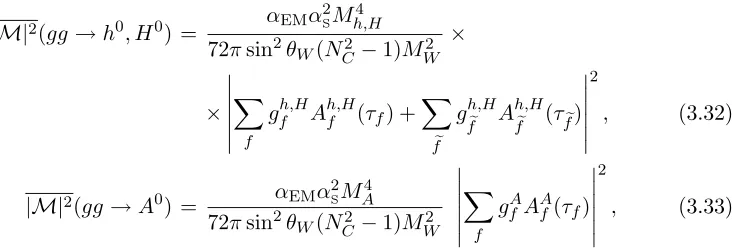
For the gluon-fusion subprocess class (a), the matrix elements are cast in the form seen in ref. [15]:
|M|2(gg →h0, H0) = αEMα 2
SM
4 h,H
72πsin2θW(NC2 −1)MW2
×
×
¯ ¯ ¯ ¯ ¯ ¯
X
f
gfh,HAh,Hf (τf) +
X
e
f
gh,He
f A
h,H
e
f (τfe)
¯ ¯ ¯ ¯ ¯ ¯
2
, (3.32)
|M|2(gg→A0) = αEMα2SMA4
72πsin2θW(NC2 −1)MW2
¯ ¯ ¯ ¯ ¯ ¯
X
f
gAfAAf(τf)
¯ ¯ ¯ ¯ ¯ ¯
2
, (3.33)
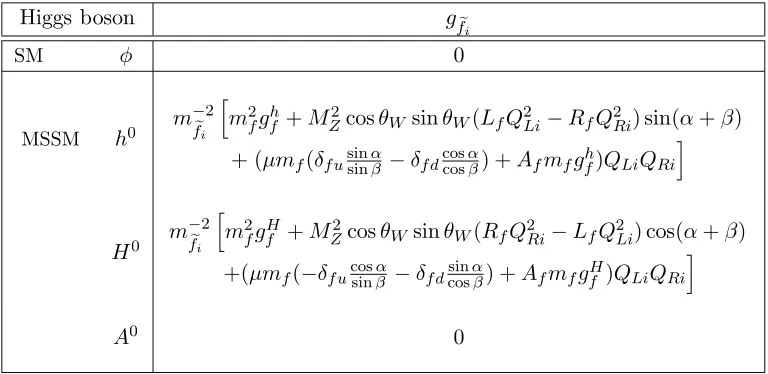
for scalar and pseudoscalar production, respectively. The couplings gf and gf˜ are those
appearing in tables 4 and 5, respectively. We have defined τ = 4m2/M2, where M is the
mass of the Higgs boson concerned and mis the mass of the particle inside the loop. The
functionsA are given by:
Ah,HQ (τ) = 3
2τ[1 + (1−τ)f(τ)],
Ah,He
Q (τ) = −
3
4[1−τ f(τ)], (3.34)
for the scalars and
AAQ(τ) =τ f(τ), (3.35)
for the pseudoscalar, with the function f(τ) given by
f(τ) =
arcsin2 1√
τ, τ ≥1 ,
−14
h
log1+√1−τ
1−√1−τ −iπ
i2
JHEP04(2002)028
Higgs boson gfe
i
SM φ 0
MSSM h0 m
−2
e
fi
h
m2fghf +MZ2cosθWsinθW(LfQ2Li−RfQ2Ri) sin(α+β)
+ (µmf(δf usinsinαβ −δf dcoscosαβ) +Afmfghf)QLiQRi
i
H0 m
−2
e
fi
h
m2fgHf +MZ2cosθWsinθW(RfQ2Ri−LfQ2Li) cos(α+β)
+(µmf(−δf ucossinβα −δf dcossinαβ) +AfmfgfH)QLiQRi
i
[image:19.595.106.490.84.271.2]A0 0
Table 5: MSSM Higgs coupling coefficients to sfermions ˜f = ˜q,`˜, as first appearing in eq. (3.32). For the leptonic case, the mixing matrices Qij should be replaced by the corresponding slepton mixing matricesLij.
For process (b), the matrix element for theW±W∓ fusion process is given by:
|M|2(q
1q02→q300q4000Φ5) = (gΦW±)2
µ
e2
2 sin2θW
¶3
(2MW2 )×
×|VCKM[qq 00]|2|V
CKM[q0q000]|2M[12]2 M[34]2
(M2
[13]−MW2 )(M[24]2 −MW2 )
, (3.37)
whereas forZ0Z0 fusion we have:
|M|2(q
1q02→ q3q40Φ5) = (gZΦ0)2
µ
e2
4 sin2θW cos2θW
¶3
(4MZ2)× (3.38)
×(L 2
qL2q0 +R2qR2q0)M[12]2 M[34]2 + (L2qR2q0 +R2qL2q0)M[14]2 M[23]2
(M2
[13]−MZ2)(M[24]2 −MZ2)
.
The coupling coefficients gVΦ are as given in table 4. The formulae are identical to those
for the case of leptonic collisions, with the replacement of the CKM matrix elements by
unity for theW±W∓fusion subprocess and the substitution of the couplingsL, Rwith the
appropriate leptonic couplings Le, Re for theZ0Z0 fusion subprocess.
For process (c), the matrix elements are given by:
|M|2(u
1d¯2 →W3+Φ4) = (gWΦ±)2
1
NC
µ
e2
2 sin2θW
¶2µ
1 2
¶
|VCKM[ud]|2×
× sp
2
T + 2MW2 s
(s−MW2 )2+M2
WΓ
2 W
, (3.39)
|M|2(q
1q¯2 →Z3Φ4) = (gZΦ0)2
1
NC
µ
e2
4 sin2θWcos2θW
¶2
(L2q+Rq2)×
× sp
2
T + 2MZ2s
(s−M2
Z)2+MZ2Γ 2 Z
JHEP04(2002)028
The coupling coefficients gΦV are again as given in table 4. The above formula, for the Z0
mediated subprocess, is immediately applicable to the leptonic case with the substitution of
the colour factor 1 to replace 1/NC. The couplingsLq, Rqare replaced byLe, Rein this case.
For process (d), the matrix element for theqq¯initiated subprocess is given by:
|M|2(q
1q¯2 →Q3Q¯4Φ5) =
e2gs4(gΦQ)2
2 sin2θWMW2 s
µ
CF
NC
¶
G × (3.41)
×
·
1
2G5 −
M2sG
2 +M
2(G3p2
T3+G4p2T4)− G5(s+M2)p2T5
¸
.
Here M2 = MΦ2 for A0 and M = MΦ2 −4m2Q for h0, H0. The pT’s are the transverse
momenta of the final state particles. These can be expressed asp2
Ti = 4p1·pi p2·pi/s−m
2 i
(where i = 3,4,5) as the incoming particles are considered massless. The propagator
factors are defined by:
G3 = 1
(M2
[35]−m2Q)
,
G4 = 1
(M2
[45]−m2Q)
,
G =G3+G4,
G5 = G3G4
G . (3.42)
For the case Q =b, the gg initiated subprocess is evaluated with 2 → 1, 2 → 2 and
2 → 3 matrix elements. In order to avoid double counting, it is recommended that the
user chooses only one of these, rather than sum over them, according to their need. For
the 2→1 subprocess the matrix element is given by:
|M|2(b
1¯b2 →Φ5) =
e2M2
Hm2b(gbΦ)2
8 sin2θWMW2 NC
. (3.43)
The 2→2 matrix element is given by:
|M|2(g
1b2 →b3Φ4) =
µ
g2 s
2NC
¶ µ
e2
2 sinθ2
W
¶ µ
m2b(gbΦ)2
2M2
W
¶
×
×
µ
−u24 st3
¶ ·
1 + 2m
2 4−m23
u4
µ
1 + m
2 3
t3
+m
2 4
u4
¶¸
. (3.44)
The inconsistency in treating the initial state bottom quark as being massless and the final state bottom quark as being massive is unavoidable. The subprocess implementation being
intended for highpT singleb-jet events only, the ambiguity in the treatment of the bottom
quark mass in the hard scattering matrix element is negligible.
We evaluated the 2→ 3 matrix element for gg → QQ¯Φ using helicity amplitudes as
JHEP04(2002)028
For process (e), the matrix element for theqq¯initated subprocess is given by:
|M|2(q
1q¯2 →Qe3Qe∗4Φ5) =
g
4 Se2gQΦe
2
M2e
Q
sin2θWMW2 s
µ
CF
NC
¶
×
×£|G3|2p2T3+|G4|2p2T4−2 Re (G∗3G4)pT3·pT4
¤
. (3.45)
The propagator factors are given by:
G3 = ¡ 1
(p4+p5)2−m23+im3Γ3¢
,
G4 = ¡ 1
(p3+p5)2−m24+im4Γ4¢
. (3.46)
The dot product of two transverse momenta is two dimensional, i.e.pT3·pT4 =px3px4+
py3py4.
The gg initiated subprocess is again calculated using helicity amplitudes in an
opti-mized basis. This time the two orthogonal polarisation vectors for the initial state gluons
are chosen to be in thex and y directions, yielding a relatively compact expression:
|M|2(g
1g2 →Qe3Qe∗4Φ5) =
g
4 Se2gQΦe
2
M2e
QNC
4 sin2θWMW2 (NC2 −1)
×
× X
i=x,y
X
j=x,y
·
|At(i, j)|2+|Au(i, j)|2− 1
N2 C
|At(i, j) +
+Au(i, j)|2
¸
. (3.47)
The colour flow components are distributed using the method of ref. [13], namely, the
(1/NC2) term is distributed amongst the t-channel and u-channel colour flow components
by their ratio. The two amplitude functionsAt andAu are given by:
At(i, j) = 2¡pi3pj4G24G13+pi3pj3G13G45+pi4pj4G24G35¢−
−√δij
s(pz3G45−pz4G35)− δij
2 (G35+G45),
Au(i, j) = 2¡pi4pj3G14G23+pi3pj3G23G45+pi4pj4G14G35¢+
+√δij
s(pz3G45−pz4G35)− δij
2 (G35+G45). (3.48)
The propagator factors are given by:
G13 = ¡ 1
(p1+p3)2−m23
¢, G23= ¡ 1
(p2+p3)2−m23
¢,
G14 = ¡ 1
(p1+p4)2−m24
¢, G24= ¡ 1
(p2+p4)2−m24
¢,
G35 = ¡ 1
(p3+p5)2−m24+im4Γ4¢
, G45= ¡ 1
(p4+p5)2−m23+im3Γ3¢
JHEP04(2002)028
For process (h), the matrix element is given by:
|M|2(e−
1e+2 →h03A04, H30A04) =e4sp2T ·
L2 ν
¡
L2 e+R2e
¢ ¡
cos2(β−α),sin2(β−α)¢
(s−M2
Z)2+MZ2Γ 2 Z
. (3.50)
We have used the same notation as in eqs. (3.9). The coupling factor cos2(β −α) is for
h0A0 production whereas sin2(β−α) is forH0A0 production.
3.6 Charged Higgs production
For hadronic collisions, the following production modes are implemented:
gb −→ tH−+ c.c. ; (3.51)
gg −→ t¯bH−+ c.c. ; (3.52)
qq¯−→ t¯bH−+ c.c. ; (3.53)
gg −→ eteb∗H−+ c.c. ; (3.54)
qq¯−→ eteb∗H−+ c.c. ; (3.55)
qq¯−→ H+H−; (3.56)
b¯b −→ W±H∓; (3.57)
qb −→ q0bH++ c.c.. (3.58)
Charged Higgs bosons are also produced through the decay of heavier objects including gauginos and third generation sfermions. Perhaps most notably, an important potential production mode for charged Higgs bosons is through the decay of top quarks and, as with other decay processes, this is achieved by specifying this decay mode in the input file. The decay is carried out using the three-body matrix element. This matrix element is not included in the spin correlation algorithm [17] which is the default treatment from
version 6.4. If this decay is required, the matrix element code NME=200 should be used
and spin correlations and supersymmetric three body decays should be switched off, i.e.
SYSPIN=.FALSE.andTHREEB=.FALSE..
When simulating processes (3.52), (3.53) and (3.58) one should bear in mind that there is potentially a large contribution from top quark decay when this decay mode is available. In this case the user should choose to simulate either the top quark production or the relevant three-body process in order to avoid double counting. In the limit in which the
bottom quark is generated by the collinear splitting g → b¯b, process (3.52) is described
by the two body process (3.51). This contribution becomes significant if the mass of the charged Higgs boson is comparable or greater than the top quark mass. Again, the user should choose to simulate either of the two processes in order to avoid double counting.
For leptonic collisions, in addition to the top quark decay, charged Higgs bosons can be produced in a process analogous to process (3.56):
e−e+−→H+H−. (3.59)
The matrix element is obtained immediately from the hadronic case by changing the
ap-propriate photon andZ0 couplings and removing the colour factor 1/N
JHEP04(2002)028
Process (3.51) is given by:
|M|2(g
1b2 →t3H4−) =
µ
g2 s
2NC
¶ µ
e2
2 sinθ2
W
¶
|VCKM[tb]|2
µ
m2btan2β+m2t cot2β
2M2
W
¶
×
×
µ
−u24 st3
¶ ·
1 + 2m
2 4−m23
u4
µ
1 + m
2 3 t3 +m 2 4 u4 ¶¸ . (3.60)
Process (3.52) is evaluated using helicity amplitudes in an optimized basis, similarly
to the evaluation of the neutral Higgs boson production processgg →QQ¯Φ in section 3.5.
Process (3.53) is evaluated using a more general formula for q1q¯2 → Q3Q¯4Φ which is
given by:
|M|2(q
1q¯2→Q3Q¯4Φ) =
=
µ
g4 sCF
2NC
¶
2φ2
H
s
" ¡
p2T3 +p2T4−p2T5¢+ 4p0·p3 p0·p4|G|2 +
+ 2 (p3·p4−λm3m4)£−s|G|2+ 2 Re¡GG∗3p2T4 +GG
∗
4p2T3− G3G
∗ 4p2T5
¢¤
−
− 4 Re
"
GG3∗p2T4+GG
∗
4p2T3+G(G
∗
3p0·p4+G4∗p0·p3)
p2T3+p2T4 −p2T5
2
#
−
−4 Im [GG3∗pz4 − GG∗4pz3]λ0
√
s(px4py3 −px3py4)
#
, (3.61)
with p0 = p1 +p2. Denoting the Q3Q¯4Φ vertex as (gS+gPγ5), the various coupling
coefficients appearing above are defined by:
φ2H =gS2+g2P, λ = g
2 S−g2P
φ2 H
,
λ0 = 2gSgP
φ2H . (3.62)
Process (3.54) is evaluated using helicity amplitudes. The expressions are the same as eqs. (3.47)–(3.49) but the coupling coefficient needs to be changed. Let us consider the
vertex involving an incoming H+ and outgoing et
ieb∗j. We have the following replacement:
gQeM2e
Q
M2 W
−→ √1
2
·µ
sin 2β−m
2
btanβ+m2t cotβ
M2 W
¶
QtLiQbLj−
− mtmb
M2 W
(tanβ+ cotβ)QtRiQbRj− mb
M2 W
(−µ+Abtanβ)QtLiQbRj−
−Mm2t W
(−µ+Atcotβ)QtRiQbLj
¸
. (3.63)
Process (3.56) is given by:
|M|2 = e4sp2T
NC ×
× ¯ ¯ ¯ ¯ ¯
QqQH+
s +
LqLH+
s−M2
Z+iMZΓZ
¯ ¯ ¯ ¯ ¯ 2 + ¯ ¯ ¯ ¯ ¯
QqQH+
s +
RqLH+
s−M2
Z+iMZΓZ
¯ ¯ ¯ ¯ ¯ 2
JHEP04(2002)028
We have used the same notation as in eq. (3.9). QH+ = +1, and LH+ is given by eq. (3.6)
withIf3= +1/2. For the leptonic case the subscriptsq should be replaced withe, and the
colour factor 1/NC should be replaced by 1.
The matrix element for process (3.57) is as given in [18].
Process (3.58) is given in [19]. We use a more compact expression which sets the
kinematic bottom quark mass to zero. For the processb1U2 →b3D4H5+ we have:
|M|2(b
1U2 →b3D4H5+) =
1 2
µ
e2
2xW
¶3
|VCKM[U D]|2
1
(M2
[24]−MW2 )2 ×
×h|VCKM[tb]|2|At|2+|AΦ|2+ ReVCKM[tb]·2A∗ΦAt)
i
;
|At|2 = 2M[12]|Gt|2 2
µmbtβ
mW
¶2
[3545]
2 +
Ã
mtt−β1
mW
!2
m2tM[34]2
;
|AΦ|2 = (Gh,H2 +GA2)
³
−M[13]2 ´[2545]
2 ;
Re(2A∗
ΦAt) =
mbtβ
MW
(Gh,H +GA)×
×h2 Re (Gt)³M[45]2 −MH2±
´ ³
M[12]2 ´ ³−M[13]2 ´−
−Re(Gt)M[45]2 [1243] + Im(Gt)M[45]2 ·4 det(1234)i. (3.65)
Here we have defined [abcd] = 4(pa·pb pc·pd+pa·pd pb·pc−pa·pcpb·pd) and det(abcd) =
det(pµa, pνb, p
ρ c, pσd) =
P
µνρσ²µνρσpµapνbp ρ
cpσd where²0123 = +1.
The propagators are defined by:
Gt = 1
M2
[35]−m2t +imtΓt
= M
2
[35]−m2t −imtΓt
(M2
[35]−m2t)2+m2tΓ 2 t
;
Gh,H = mbsinαcos(β−α)/MW cosβ
M2
[13]−Mh2
+mbcosαsin(β−α)/MWcosβ
M2
[13]−MH2
;
GA = mbtanβ/MW
M2
[13]−MA2
.
Processes with antiquarks in the initial state can be obtained by exchanging the subscripts
(1 ↔ 3) for the subprocess ¯bU → ¯bDH+, (2 ↔ 4) for the subprocess bD¯ → bU H¯ +, and
both for the subprocess ¯bD¯ → ¯bU H¯ +. Note that the definitions of the invariant masses
squared are such that these imply momentum substitutions of the form (p1↔ −p3).
3.7 R-parity violating processes
The cross sections for the implemented R-parity violating hadron-hadron processes are
presented in ref. [20]. In hadron-hadron collisions only those 2 → 2 processes that can
occur via a resonants-channel sparticle exchange are included, i.e. processes that can only
occur via a t-channel diagram or for which the s-channel resonance is not kinematically
JHEP04(2002)028
Ine+e− collisions we include all the possible 2→2 single sparticle production
mecha-nisms, even if there is nos-channel resonance, and a limited set of 2→2 processes where
the final state contains two SM particles. As with the hadron-hadron processes, there
are four types of process: single gaugino production; single slepton production in
associa-tion with a gauge boson; single slepton producassocia-tion in associaassocia-tion with a Higgs boson; SM
particle production.
3.7.1 Single gaugino production
In e+e− collisions, there are two possible production mechanisms for a gaugino and a
lepton, eithere+e− →χe0ν ore+e−→χe+`−. The matrix elements for these processes have
been calculated previously in refs. [21, 22, 23]. We have recalculated these matrix elements and the results are in agreement with [23]. We also agree with refs. [21, 22], which do not include sfermion mixing, if we set our mixing to zero. All matrix elements are averaged over the spins of the incoming leptons as before.
|M|2(e−
i e+i →νjχe0l) =
= λ
2 iji
2
"
|a(νe∗
j)|2sR(νej)
³
s−M2
e
χ0 l
´
+ 1
(u−M2
`iL)
2
h
|a(e`∗
i1)|2+|b(`e∗i1)|2
i
u³u−M2
e
χ0 l
´
+
+ 1
(t−M2
`iR)
2
h
|a(`ei2)|2+|b(`ei2)|2
i
t³t−Mχe20 l
´
+
+ 2
(u−M2
`iL)
a(eνj∗)a(`e∗i1)R(νej)
³
s−m2eνj´su+
+ 2
(u−M2
`iL)(t−M
2 `iR)
a(`e∗i1)a(`ei2)ut+
+ 2
(t−M2
`iR)
a(eνj∗)a(`ei2)R(eνj)
³
s−m2νej´st
#
,
|M|2(e−
i e+i →`+jχe−l ) =
= g
2λ2 iji
4
R(eνj)sh¡|a(eνj∗)|2+|b(eνj∗)|2
¢ ³
s−m2`j −M2
e
χ−l
´
−4a(eνj∗)b(νej∗)m`jMχe−l
i
+
+³ 1
u−M2
e
νi
´2
³
M2
e
χ−l −u
´ ³
m2`j −u´ £|a(eνi∗)|2+|b(νei∗)|2¤−
−³ 2s
u−M2
e
νi
´³s−Mνe2j´R(νej)a(νei∗)
h
a(νej∗)u+m`jMχe−l b(νej∗)
i
. (3.66)
The couplingsa, b of the sleptons to the gauginos are given in ref. [20], and
R(˜a) = ¡ 1
JHEP04(2002)028
3.7.2 Slepton production in association with a gauge bosonThere are a number of production processes for a slepton in association with a gauge boson. We have confirmed the cross section for these processes, which were first calculated in ref. [24]. The sneutrino resonance is not usually accessible for these processes as the charged
slepton-sneutrino mass difference is less than the W± mass. However, the resonance can
be accessible for the third generation due to left-right mixing of the staus.
The matrix elements for these processes are given below, including left-right sfermion mixing:
|M|2(e−
i e+i →γνej) =
e2λ2iji
2
·
u t +
t u +
2
ut
³
Mνe2j −u´ ³Meν2j −t´¸,
|M|2(e−
i e+i →W+`ejα) =
= g
2λ2iji|Lj 1α|2
2M2
W
·
s2p2cmR(eνj) +
1
4u2
h
2MW2 ³ut−MW2 Me2
`jα
´
+u2si−
−2suR(eνj)
³
s−Meν2j´ hMW2 ³2Me2
`jα−u
´
+u³s−Me2
`jα
´ii
,
|M|2(e−
i e+i →Z0νej) =
= g
2λ2 iji
cos2θ
WMZ2
"
|Zν11j|2s2p2cmR(eνj) +
Ze2R t2
h
2MZ2³ut−Mνe2jMZ2´+st2i+
+ Z
2 eL
u2
h
2MZ2³ut−Mνe2jMZ2´+su2i+
+ 2ZeLZeR
ut
h
2MZ2³Mνe2
j −t
´ ³
Mνe2
j −u
´
−suti− (3.68)
−Z 11
e
νjZeR
t sR(νej)
³
s−Meν2j´ hMZ2³2Mνe2j −t´+t³s−Mνe2j´i+
+Z
11
e
νjZeL
u sR(νej)
³
s−Meν2j´ hMZ2³2Mνe2j −u´+u³s−Meν2j´i
#
,
wherepcm is the momentum of the final-state particles in the centre-of-mass frame. As we
neglect the electron mass, the cross section for e−i e+i → γνej is divergent as u, t → 0, i.e.
in the limit that the photon is collinear with the incoming lepton beams, and therefore a cut on the transverse momenta of the outgoing particles is used to regularize the
diver-gence for this process. The couplings of the Z0 to the leptons and sleptons are given in
ref. [20].
3.7.3 Slepton production in association with a Higgs boson