ANNUAL
REPORT
Dublin 1.
Tel: 01 858 5800
Lo-call: 1890 315 015
Fax:01 858 5801
Email:[email protected]
Web: www.odce.ie
Copyright and Disclaimer Statement
The contents of this document are the copyright of the Director of Corporate Enforcement. All or part of this publication may be reproduced without further permission, provided the source is acknowledged.
Nothing herein should be construed as a representation by, or on behalf of, the Director of Corporate Enforcement as to his understanding or interpretation of any of the provisions of the Companies Acts 2014 to 2017 or as to the interpretation of any law. Independent legal advice should be sought in relation to the effects of any legal provision. The Director of Corporate Enforcement accepts no responsibility or liability howsoever arising from the contents of this publication or any errors, inaccuracies or omissions in the contents of this document. The Director reserves the right to take action, which may or may not be in accordance with the provisions of this document.
TABLE OF CONTENTS
PAGE
DIRECTOR’S INTRODUCTION 3
AT A GLANCE 8
CHAPTER 1: OVERVIEW OF THE ODCE 10
Statutory mandate 11
High level goals 11
Resources, organisational structure & principal workstreams 12
CHAPTER 2: PROMOTING A GREATER UNDERSTANDING OF
AFFECTED PARTIES’ RIGHTS AND DUTIES UNDER COMPANY LAW
17
Introduction 18
Publications and outreach activities 18
Managing and developing relationships with external stakeholders 19
CHAPTER 3: CONFRONTING UNLAWFUL AND IRRESPONSIBLE BEHAVIOUR INSOFAR
AS IT RELATES TO COMPANY LAW 21
Structure of this Chapter 22
PART A: INPUTS 22
EXTERNAL INPUTS 22
Liquidators’ section 682 reports 23
Sectoral distribution of other external inputs (i.e. external inputs other than liquidators’ section 682 reports) 27
Complaints 28
Auditors’ indictable offence reports 29
Examiners’ Reports 29
Referrals 29
Professional bodies’ indictable offence reports 30
Liquidators’ reports regarding possible criminality 30
Disclosures under the Protected Disclosures Act 2014 30
INTERNAL INPUTS 31
Introduction 31
Actions focussing on particular cohorts of persons, e.g., persons who are undischarged bankrupts, restricted or disqualitied 31
Investigations commenced on own initiative 31
Dissolved insolvent companies 32
Actions relating to liquidator performance/behaviour 32
Quantum of internal inputs - 2016 32
PART B: THROUGHPUTS 33
PART C: OUTPUTS 35
Outputs from the section 682 process 35
Outputs from enforcement work 38
Securing voluntary rectification/remediation 39
Securing compliance and progressing enquiries through the exercise of the Director’s statutory powers 39
Permitting/facilitating compliance through the exercise of the Director’s statutory functions 39
Civil remedies sought 40
Summary criminal proceedings 41
Indictable criminal proceedings 42
Referrals to other professional bodies 43
CHAPTER 4: PROVIDING QUALITY CUSTOMER SERVICE
TO INTERNAL AND EXTERNAL STAKEHOLDERS 44
Provision of a quality customer service to external stakeholders 45
Provision of a quality customer service to internal stakeholders 47
Compliance with obligations on foot of law, regulation and by virtue of the Office’s status as a public sector entity established by statute 48
APPENDICES 50
Appendix 1: Allocated vs. actual expenditure 2014 - 2016 51
Appendix 2: Presentations delivered and exhibitions/events attended - 2016 52
Appendix 3: Report under section 22 of the Protected Disclosures Act 2014 55
Appendix 4: Cases where Restriction Declarations were made by the High Court or Restriction Consent Undertakings were given by company directors pursuant to section 683 of the Companies Act 2014 56
Appendix 5: Cases where Disqualification Orders were made by the High Court or Disqualification Consent Undertakings were given by company directors pursuant to section 683 of the Companies Act 2014 61
Appendix 6: Cases where no Restriction or Disqualification Orders were made by the High Court pursuant to section 683 of the Companies Act 2014 62
GLOSSARY 63
DIRECTOR’S
INTRODUCTION
INTRODUCTION
In accordance with the provisions of section 954(1) of the Companies Act 2014, I am pleased to submit the 2016 Annual Report of the Office of the Director of Corporate Enforcement to the Minister for Jobs, Enterprise & Innovation, Ms. Mary Mitchell O’Connor, TD.
Having been appointed in August 2012, it is now approaching five years since I took up the role of Director. In that context, now is an opportune time to reflect on the more significant developments that have occurred over that period.
HISTORICAL CONTEXT
Enforcement
At the time of my appointment, the Office’s various investigations into matters relating to the former Anglo Irish Bank Corporation (“Anglo”) had been largely completed. Nevertheless, those matters continued to be highly resource intensive in that the Office had ongoing obligations to assist and support the Director of Public Prosecutions (“DPP”) in examining the various investigation files that had been submitted and, thereafter, in supporting the DPP in the discharge of her disclosure obligations to accused persons.
Insofar as other criminal enforcement activity was concerned, the focus was largely on a narrow range of suspected company law offences, which were being investigated with a view to prosecution in the District Court. Specifically, the majority of open cases at that time concerned suspected offences relating to smaller companies’ failure to maintain proper accounting records and to the activities of a number of individuals acting as auditors to smaller companies while not authorised to do so. Civil enforcement at that time comprised principally of a cohort of long standing disqualification applications/appeals to the High Court and Supreme Court relating to issues connected with National Irish Bank and Bovale Developments respectively and a separate workstream concerned with seeking the disqualification of directors of companies that had been struck off while insolvent.
Staffing and organisational structure
The Office had, at that time, a complement of staff comprising both civilians and members of An Garda Síochána, many of whom possessed significant experience in areas of relevance. However, as I have alluded to in previous Reports, a review of the Office’s capabilities and skills base in the latter half of 2012 identified that, in particular, the Office had at that time a significant deficit in the area of in-house accountancy expertise. That deficit gave rise to a significant constraint on our ability to progress cases and to embark upon other enforcement initiatives. Similarly, due to an absence of in-house expertise in the area of IT forensics, the Office was reliant upon the assistance of the Garda Computer Crime Unit - which had its own well documented workload pressures to contend with. In addition, certain aspects of what was then the Office’s structure also militated against organisational effectiveness.
Environmental analysis - principal external inputs
At that time, most enforcement activity was driven by auditors’ indictable offence reports and complaints from members of the public. Insolvent liquidations, which drive the liquidator statutory reporting process, were running at 1,400 per annum.
DEVELOPMENTS OVER THE PAST FIVE YEARS
Enforcement strategy & operations
In recent years, a conscious decision has been taken to shift the focus, insofar as criminal enforcement is concerned, away from summary prosecutions. District Court prosecutions tend to be concerned with wrongdoing of a less serious nature and, as such, the associated penalties can only be at the lower end of the spectrum, thereby providing limited dissuasive effect. In an effort to increase the Office’s effectiveness, the focus has, therefore, shifted towards the investigation of more serious indications of wrongdoing. This activity, if subsequently considered appropriate by the DPP, results in prosecutions being initiated in the Circuit Criminal Court, where the available penalties, and associated potential for deterrent effect, are considerably higher. That change in emphasis has resulted in a substantial increase in the number of files being submitted to the DPP for consideration. Allied to this, the way in which we conduct investigations – both civil and criminal - has also evolved, with our primary investigative tools, i.e., the power to require the production of books and documents from companies under investigation and from third parties, now being more readily utilised. Moreover, in a digital age, requiring the production of “books and documents”is no longer confined to seeking paper records. Rather, demands in that regard now extend as far as requiring the production of email, text message and instant messaging app communications.
A further consequence of shifting the emphasis towards investigating more serious indications of wrongdoing is that, in additional to identifying possible offences under company law, an increasingly regular feature of such investigations is the identification of possible offences under other legislative codes such as, for example, Criminal Justice legislation. These investigations, which tend to be larger and more complex than the historical District Court cases alluded to above, have taken us into new areas such as theft, deception, the use of false instruments and invoice discounting fraud. Insofar as the legacy civil litigation referred to above is concerned, all of those cases have now been brought to a conclusion.
Capability enhancement
A credible enforcement body must be self-sufficient in specialisms central to its remit and, as such, the absence of in-house expertise in the aforementioned areas of accountancy and IT forensics was not sustainable. Over recent years therefore, and with the support of successive Ministers and their officials, the Office’s pre-existing capabilities have been further enhanced through the recruitment of five new investigative accountants (with a further two such positions currently in the process of being filled). These new staff members have come from a variety of backgrounds - including other law enforcement agencies and professional services firms – and, as such, have substantially increased our capacity. More recently, and again with the support of the Minister and her Department, we have engaged in a process to recruit a digital forensics specialist - a role that will be pivotal given the ever increasing extent to which documentation and other material is provided to us, or otherwise obtained by us, in electronic form. That appointment is expected to be made shortly.
At the time of writing, through a combination of retirement, transfer and, in the case of the former Head of Enforcement, appointment as Chief Executive of the Irish Auditing & Accounting Supervisory Authority, we have three vacancies in key senior positions. With the Department’s support and assistance, we are currently working towards the filling of those positions. Until recently, we also had two vacancies at the more senior levels within our Garda contingent. In that context, I am pleased to be able to report that we have recently been assigned a new Detective Sergeant. At the time of writing, the key post of Detective Inspector remains vacant but the Garda authorities are fully aware of the necessity to fill that post as a matter of priority.
Environmental analysis – trends and developments
In the realm of insolvent companies, giving administrative and operational effect to the statutory undertakings regime introduced by the 2014 Act was a major challenge. The Office’s Insolvency team rose to that challenge admirably and that process is now fully embedded within the Office’s insolvency activities. The results have been significant. During 2016 in excess of one hundred undertaking offers were accepted, in each case resulting in significant savings to both liquidators and the directors who accepted those undertaking offers and who otherwise would have had to incur the time, cost and disruption associated with being a party to High Court litigation. The undertakings regime has, therefore, significantly increased the effectiveness of the whole process under which we supervise liquidators’ statutory reporting.
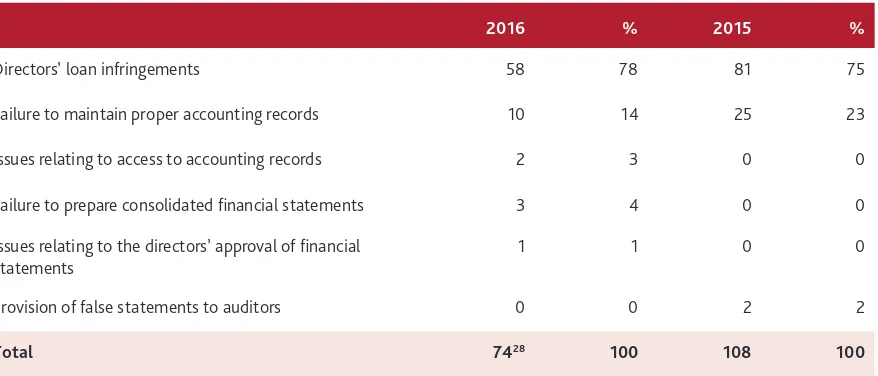
Increases in the audit exemption threshold have seen more companies avail of exemption, with a consequential reduction in the number of auditors’ indictable offence reports being received. This has led to, for example, a reduction in the number of issues coming to our attention relating to contraventions of directors’ loans provisions. This development, combined with our ongoing approach of seeking to address suitable cases through proportionate means (such as voluntary rectification, the issuing of cautions etc.), has enabled us to both focus on serial offenders and to devote resources towards new and emerging issues – such as, for example, issues arising from examiners’ reports, non-compliance with accounting standards in certain sectors and issues arising under protected disclosure legislation.
Issues relating to criminal investigation
Indications first emerged in late 2008 suggesting the existence of certain issues of concern regarding the conduct of the affairs of Anglo Irish Bank Corporation plc. As a licenced bank, Anglo was subject to the supervisory and enforcement remit of the then Financial Regulator. That being the case, the ODCE could, at that time, have sought to distance itself from events at the bank. However, it chose not to pursue such a course of action but, rather, to initiate an investigation - the scale, novelty and complexity of which could not have been envisaged and which ultimately transpired to be unprecedented in the history of both the ODCE and the State.
Following an initial assessment, several separate strands of inquiry were identified and a number of those strands of inquiry have subsequently resulted in persons being convicted before the Courts. Specifically, investigations undertaken by this Office have resulted in:
• the conviction during 2014 of both Mr. William McAteer and Mr. Pat Whelan for the giving of unlawful financial assistance by Anglo for the purchase of its own shares;
• the conviction of Mr. William McAteer during 2016 for fraudulent trading on foot of a plea of guilty; and
• the conviction of Mr. Pat Whelan during 2016 for failing to maintain a licensed bank’s register of loans to directors on foot of a plea of guilty.
A further strand of inquiry resulted in Mr. Sean FitzPatrick being indicted, by direction of the DPP, on 27 charges - including 21 charges relating to allegations of having made misleading, false or deceptive statements to Anglo’s then auditors Ernst & Young. The resultant trial, which is ongoing at the time of writing, has become the longest running criminal trial in the history of the State.
As has been widely reported in the media, during the course of that trial, the investigation that preceded those charges being directed has been the subject of significant criticism by counsel for the defence, particularly as regards the process by which witness statements were obtained from two Ernst & Young witnesses. Regrettably, certain aspects of that investigation, including the manner in which those statements were obtained, fell below appropriate standards. In that context, both this Office and counsel for the DPP have acknowledged that to be the case. Having carefully considered the matter after lengthy legal argument, the trial judge ruled that certain of those practices were unlawful. However, he further ruled that,
notwithstanding the deficiencies detailed above, it was nevertheless appropriate that the two witnesses concerned be heard by the jury.
It will ultimately be for the trial judge and the jury, in discharging their respective roles, to determine the outcome of that case. More broadly, there is however a risk that the case-specific criticisms referred to above could lead to a perception that this Office’s investigative procedures as they now exist are fundamentally flawed. Any such perception would not be supported by the facts. In that context, it is important to note that, quite aside from the extent to which the structure and capabilities of this Office and its investigative procedures have been enhanced over recent years, no such issues have arisen in the other trials that have resulted from this Office’s Anglo-related investigations. Rather, the underlying issues arose several years ago, in this particular strand of the investigation only, and for reasons that are elaborated upon below. By late 2008, and in an era when principles based/light touch regulation was being espoused - both nationally and internationally, and by regulators and the regulated alike - the ODCE had both firmly established its independence and, insofar as criminal investigation was concerned, had acquired significant experience of District Court prosecutions. Nevertheless, at this remove it is clear that, despite having acquired that experience, the Office was simply not equipped at that time to run multiple parallel investigations of the scale and complexity involved.
While the Office demonstrated a willingness at that time to initiate a series of investigations, it is clear that there was a significant underestimation of the scale and complexity respectively of that strand of the investigation that was initially prioritised, i.e., the investigation that resulted in the conviction of Mr. McAteer and Mr. Whelan for the provision of unlawful financial assistance. This, in turn, resulted in that strand continuing to absorb resources, and, critically, Garda resources, to a greater extent and for considerably longer than had initially been anticipated. Against that backdrop, a course of action was adopted under which the lead role in obtaining statements from the two Ernst & Young witnesses was assumed by a small number of senior civilian staff. However, none of these individuals had any training or experience of taking witness
statements. Moreover, the inappropriateness of the approach that was subsequently adopted in obtaining those statements was not sufficiently appreciated nor were the attendant risks responded to appropriately.
During the course of the trial, the jury has also heard of an earlier incident in which documents relating to the case were destroyed by an ODCE staff member. Further details of that incident, and the circumstances in which it occurred, have been ventilated in open court but not before the jury. Accordingly, I am at the time of writing precluded from commenting further on that matter. In the fullness of time all the facts concerning that incident will doubtless emerge.
No organisation is perfect and the pursuit of excellence, be it in the area of investigation or otherwise, is an ongoing
organisational challenge. Several years on, as an organisation we have a broader skills base, a greater depth of experience and a far greater appreciation of the necessity to employ appropriate procedures and manage risk. In that context, Anglo-related
cases are only one aspect of this Office’s criminal investigative activity. In that regard, as can be seen from the body of this Report, the DPP directed charges of deception, use of a false instrument and furnishing false information during 2016 based on one ODCE investigation file. On another file, the DPP the directed that the suspect be charged with fraudulent trading (based on an invoice discounting fraud) and, on 24 April 2017, the person charged with that offence was arrested by Gardaí from the ODCE and entered a plea of guilty to that charge. At the time of writing, the DPP is considering another file in which a range of serious charges have been recommended under both company law and Criminal Justice legislation. In addition to the foregoing, a number of other large scale and complex investigations are underway and are at various stages of advancement.
CHALLENGES AHEAD
Change is an integral, and indeed a healthy, aspect of every organisation and, as new staff join us and existing staff seek new opportunities elsewhere, that change will inevitably continue and we will continue to evolve as an organisation. The immediate priorities and challenges in that regard are the filling:
• of the senior level vacancies referred to above and the two additional accountant posts with suitably qualified and experienced candidates; and
• by the Garda authorities of the vacant Detective Inspector post.
We also face challenges in terms of ongoing training and development, and, in particular, sourcing suitably specialised training. In a similar vein, keeping abreast of technological developments is an ongoing challenge. The appointment in the near future of a digital forensics specialist will be an important step in that regard.
CONCLUDING REMARKS
For obvious reasons, much of the foregoing has dealt with our investigative activities. However, it is important not to lose sight of that fact that, alongside those activities, the Office:
• runs a large scale operation under which liquidators’ statutory reports are examined and adjudicated upon and, depending on the underlying circumstances, matters are referred to the High Court and company directors are afforded the opportunity to avoid court proceedings by way of statutory undertakings;
• engages in advocacy activities aimed at assisting stakeholders to comply with their obligations and vindicate their rights respectively;
• operates a range of support services, including:
- servicing freedom of information requests from members of the public; - servicing parliamentary questions from members of Dáil Éireann; - servicing press queries (within confidentiality parameters);
- maintaining a website and associated information services for stakeholders’ benefit; and - providing a full suite of support services to the Office and its staff complement.
In that context, I would once again like to thank my colleagues for their hard work and commitment during the year. I would also like to welcome those who have recently joined us, whose skills and experience will serve to enhance our existing skill sets. Similarly, I would like to thank those who left us during the year and subsequently, and who, by virtue of their expertise and experience, will be difficult to replace. In particular, I would like to thank Kevin Prendergast, whose endless willingness to assume greater responsibility is sorely missed. I would like to take this opportunity to wish them all the very best for the future.
Finally, I would like to thank most sincerely the Minister and her officials for their continued and ongoing support of the ODCE and of what we are seeking to achieve in terms of enhancing Ireland as a low risk economy in which to conduct business and in seeking to ensure that wrongdoing in a company law context is tackled and dealt with appropriately.
Ian Drennan
Director
28 April, 2017
9
ENFORCEMENT
Sources of our work
• In excess of 1,050 statutory reports and referrals received from liquidators, auditors, examiners, professional bodies and other regulatory and enforcement authorities
• Almost 250 complaints received from members of the public • Almost 130 internally generated inputs
Outputs from our work
• Following the scrutinising of reports submitted to the Office by liquidators of insolvent companies, 90 company directors restricted and a further 11 disqualified by the High Court
• 93 Restriction Undertakings obtained from directors of insolvent companies
• Directors’ loan infringements, in 60 cases and to an approximate aggregate value of €17m, rectified on foot of Office actions
• As a proportionate and cost effective alternative to formal enforcement actions, cautions issued to a total of 61 companies
• 108 directions issued to relevant parties requiring them to comply with their statutory obligations under company law
• 7 demands issued for the production of companies’ and third parties’ books and records and other relevant documents
• in keeping with the ongoing strategic shift towards the investigation of more serious indications of wrongdoing: - submission of 5 investigation files to the DPP for consideration, with the recommendations including charges
under both company law and the Criminal Justice (Theft and Fraud Offences) Act 2001
- an ongoing caseload of large scale investigations where the intention is, depending upon the sufficiency of available evidence, to refer the underlying matters to the DPP for consideration as to whether to direct charges on indictment
ADVOCACY
• 43 information presentations (to a combined audience of approximately 1,400) delivered and 14 exhibitions attended • revised information and guidance published regarding the reporting of company law offences to the ODCE
FINANCIAL
• The cost of running the Office during 2016 was €2.73m, some 54% of its allocation for the year and an decrease of 11% on the previous year
INVESTIVATIVE CAPABILITIES
• Recruitment of five new forensic accountants and the initiation of a process towards the recruitment of a digital forensics specialist
10
OVERVIEW OF THE ODCE
11 Office Of The Director of Corporate Enforcement Annual Report 2016
STATUTORY MANDATE
Companies Act 2014
The Companies Act 2014 (“the Act”) came into effect in 2015. Except where the circumstances otherwise require therefore, all statutory references in this Report are to the Act as opposed to the various Companies Acts that it replaced. The full text of the Act can be accessed on the Irish Statute Book website1.
Office of the Director of Corporate Enforcement
The position of Director of Corporate Enforcement (“Director”) is provided for in Part 15, Chapter 3 of the Act. The Director, who is appointed by the Minister for Jobs, Enterprise & Innovation (“the Minister”), is assisted in the furtherance of his statutory mandate by:
• staff assigned by the Minister; and
• members of An Garda Síochána seconded for that purpose.
Collectively, the foregoing make up the Office of the Director of Corporate Enforcement (“ODCE”/”the Office”).
Principal functions of the Director
The Director’s principal functions are set out in the Act2. They include to:
i. encourage compliance with the Act;
ii. investigate instances of suspected offences under the Act;
iii. enforce the Act, including by the prosecution of offences by way of summary proceedings3;
iv. refer cases, at his discretion, to the Director of Public Prosecutions (“DPP”) where the Director has reasonable grounds for believing that an indictable offence4under the Act has been committed; and
v. exercise, insofar as he feels it necessary or appropriate, a supervisory role over the activity of liquidators and receivers in the discharge of their functions under the Act.
In addition, section 192 of the Irish Collective Asset-management Vehicles Act 2015 (“ICAV Act”) provides that, in addition to the functions conferred upon him by company law, the Director may perform the functions conferred upon him by the ICAV Act and do such acts or things as are necessary or expedient in the performance of those functions.
Independence of the Director
The Act5provides that the Director shall be independent in the performance of his functions.
HIGH LEVEL GOALS
Based on the principal statutory functions as set out above, the ODCE’s high level goals during the year under review were to: i. Promote a greater understanding of affected parties’ rights and duties under company law;
ii. Confront unlawful and irresponsible behaviour insofar as it relates to company law; and iii. Provide a quality customer service to internal and external stakeholders.
The strategies and activities pursued and undertaken respectively during the year under review to achieve these goals are elaborated upon in the remainder of this Report as follows:
• Chapter 2 – Promoting a greater understanding of affected parties’ rights and duties under company law • Chapter 3 - Confronting unlawful and irresponsible behaviour insofar as it relates to company law • Chapter 4 - Providing quality customer service to internal and external stakeholders
1http://www.irishstatutebook.ie/eli/2014/act/38/enacted/en/pdf 2Section 949
3i.e. before the District Court
12
RESOURCES, ORGANISATIONAL STRUCTURE
& PRINCIPAL WORKSTREAMS
Human resources
The ODCE’s actual staff complements at the beginning and end of the year respectively are detailed in the Table below. Table 1 ODCE staff complement - 2016
6Whole Time Equivalent
7Includes 1 Legal Advisor, 1 Solicitor and 1 Principal Officer 8Includes 1 temporary Legal Secretary
Staff Numbers (WTE6) 31 December, 2016 31 December, 2015
Actual complement in place 37.5 37.5
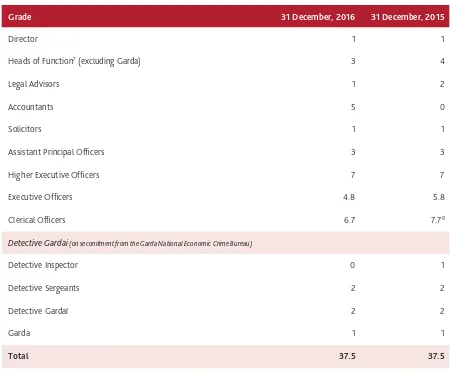
As is discussed in more detail elsewhere in this Report, 5 new accountants were recruited and appointed during 2016. However, a number of retirements and transfers out resulted in there being no net change in overall year-on-year numbers.
[image:14.595.72.522.328.702.2]The composition of the Office’s staff complement as at 31 December, 2016, together with comparative data, is set out in the Table below.
Table 2 Analysis of actual staff complement (WTEs)
Grade 31 December, 2016 31 December, 2015
Director 1 1
Heads of Function7(excluding Garda) 3 4
Legal Advisors 1 2
Accountants 5 0
Solicitors 1 1
Assistant Principal Officers 3 3
Higher Executive Officers 7 7
Executive Officers 4.8 5.8 Clerical Officers 6.7 7.78 Detective Gardai(on secondment from the Garda National Economic Crime Bureau) Detective Inspector 0 1
Detective Sergeants 2 2
Detective Gardaí 2 2
13 Office Of The Director of Corporate Enforcement Annual Report 2016
Financial resources
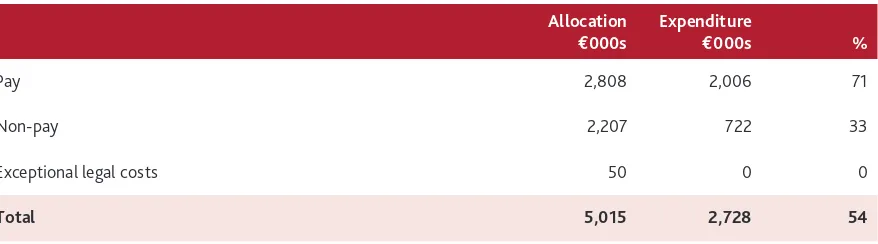
[image:15.595.83.522.151.273.2]The Office is funded viathe Department of Jobs, Enterprise & Innovation’s (“the Department”) Vote (Vote 32). The Table below sets out details of the Office’s 2016 allocation and expenditure respectively.
Table 3 Financial allocation and expenditure - 2016
Allocation Expenditure €000s €000s %
Pay 2,808 2,006 71
Non-pay 2,207 722 33
Exceptional legal costs 50 0 0
Total 5,015 2,728 54
The principal reasons as to why actual expenditure differed from the allocation were as follows:
• savings on Pay resulting from vacancies that arose during the course of the year (principally retirements and transfers out) and the delay in the recruitment of new staff in respect of whom sanction had previously been granted; and • the Non-pay allocation for the year included provision for estimated costs associated with litigation to which the
Office was a party. The costs incurred during the year on these cases were less than might have been anticipated. A more detailed analysis of expenditure incurred during the year is set out at Appendix 1 to this Report.
Organisational structure
During the year under review the Office was divided into seven Units, with each Unit coming under the responsibility of one of five Heads of Function. That organisational structure is set out in the organogram below.
15 Office Of The Director of Corporate Enforcement Annual Report 2016
Workstream Unit(s) principally involved Chapter
Encouraging compliance with the Companies Act
Responsibility for encouraging compliance with the Act resides in the first instance with the Advocacy Unit. However, the Advocacy Unit liaises with other relevant Units with a view to monitoring trends and identifying areas meriting focussed advocacy initiatives.
2
Advocating legislative and policy
enhancements
Depending upon the nature of the subject matter, the development of ODCE submissions is assigned to one or more Units. Generally speaking, however, the development of submissions will be co-ordinated through the Advocacy Unit.
2
Reviewing, and adjudicating upon, liquidators’ reports
Liquidators’ reports are processed by the Insolvency Unit. Decisions on individual reports are made by Case Officers, who principally, although not exclusively, reside within the Insolvency Unit. This workstream also
encompasses the recently implemented Undertakings regime, which is further elaborated upon later in this Report.
3
Examination of complaints and statutory reports
The examination of complaints and statutory reports (such as, for example, auditors’ indictable offence reports) is the responsibility of the Enforcement function. Dependent upon the nature of the issues arising, the Enforcement function may:
• address the issues itself, e.g., by way of voluntary
rectification/remediation or through the use of certain of the Director’s statutory powers;
• designate the matter as being one for further investigation; • refer the matter to the Insolvency Unit, e.g., where the issues in
question relate to an insolvent company in liquidation;
• following consultation with the Director, refer the matter to the Special Projects Unit;
• refer the matter to a third party, for example, another regulatory or enforcement body.
3
Civil enforcement litigation
For the most part, civil enforcement litigation is managed by the Enforcement Unit in conjunction with the Solicitors’ Unit.
Civil litigation, such as seeking the disqualification of directors of companies that have been struck off the Register of Companies9whilst having
undischarged debts, is managed jointly by the Insolvency and Principal Solicitor’s Units.
3
9See www.cro.ie for further information regarding the Register. Table 4 Principal workstreams
Principal workstreams
The nature of the Office’s principal workstreams is such that most of them require a multi-disciplinary approach involving ongoing interaction between Units and/or the active collaboration of Units with a view to achieving corporate objectives. Accordingly, effective communication between Units, and that each Unit take an organisation-wide perspective when performing its functions, is a critical success factor. Accordingly, this is an approach that is both encouraged and facilitated by the Office’s leadership team.
16
Workstream Unit(s) principally involved Chapter
Supervision of liquidators’ behaviour
Actions taken to supervise liquidators’ behaviour (such as, for example, reviewing liquidators’ books and records) is a collaborative effort between the Insolvency and Enforcement Units. In circumstances where such activities result in the necessity to engage in litigation, the Solicitors’ Unit becomes involved.
3
Provision of support services
The provision of support services to other areas of the Office is the primary responsibility of the Corporate Services Unit.
All Units have a responsibility to assist the Corporate Services Unit in ensuring that the ODCE’s obligations as a publicly funded Office (e.g. in the areas of procurement, tax clearance procedures etc.) are fully complied with.
4
Relationship management and development
Whilst certain Units, by virtue of the nature of their principal operations, have a greater degree of interface with certain external stakeholders than others, the interlinked nature of the organisation is such that all Units have a role in ongoing relationship management and development.
2 Criminal investigation
and prosecution
The investigation of possible criminal breaches of the Act is undertaken by the Enforcement Unit in conjunction with the Garda Unit.
Once a decision has been taken to initiate summary criminal proceedings, the prosecution becomes a collaborative exercise between the Enforcement, Garda and Solicitors’ Units. Investigations in which a prosecution on indictment is envisaged involve collaboration on the part of the Enforcement and Garda Units.
In circumstances where, having reviewed an investigation file as submitted by the Office, a decision is taken by the DPP to initiate a prosecution on indictment, the provision of subsequent support to the Office of the DPP (for example, regarding disclosure to the defence), is primarily the responsibility of the Enforcement and Garda Units.
CHAPTER 2
PROMOTING A GREATER
UNDERSTANDING OF
AFFECTED PARTIES’
RIGHTS AND DUTIES
UNDER COMPANY LAW
INTRODUCTION
This Chapter provides details of the principal strategies pursued, and activities undertaken, by the Office during the year under review in the furtherance of the above stated goal. In summary, those strategies and activities included:
• the development and promulgation of publications and other guidance material;
• engaging in a range of outreach activities, including the delivery of presentations, attendance at seminars and exhibitions and dealing with company law enquiries on a range of issues from members of the public; • advocating legislative and policy enhancements; and
• managing and developing relationships with external stakeholders.
PUBLICATIONS AND OUTREACH ACTIVITIES
Publications
Following on from 2015, during which the Office published an entirely revised suite of information and guidance publications to reflect the provisions of the Companies Act 2014, 2016 saw the publication of a further information publication directed towards company auditors. Specifically, Information Notice I/2016/1, which replaced the previously existing Information Notice I/2009/4 was published having been developed in conjunction with the accountancy profession. The revised document is available on the ODCE’s website10.
During the year under review, approximately 16,000 copies of the various ODCE publications, principally revised Information Books and Quick Guides, were issued to interested parties. In agreement with the ODCE, the Companies Registration Office (“CRO”) issued approximately half of these documents to persons registering new companies11. The remainder were, in the
main, issued in response to public demand, either at, or as a consequence of attendance at, events, exhibitions and presentations or as a result of persons contacting the Office directly.
In January 2016, the Office published a list of insolvent companies and the associated liquidators in respect of whom the ODCE had identified the requirement for the submission to the ODCE of a liquidator’s report in 2015. The purpose of publishing this list was to enable interested parties to bring any matters of concern in relation to an insolvent company in liquidation to the attention of the liquidator and/or the ODCE, in order that any such concerns could be taken into account in determining whether or not an application for restriction of the company’s directors should be made to the High Court. Further detail regarding this aspect of liquidators’ reporting obligations to the ODCE is set out in Chapter 3 of this Report. During the year, the ODCE also published six bi-monthly lists setting out details of (i) insolvent companies in liquidation; and (ii) the associated liquidators for whom a section 682 reporting obligation would arise during 2016. The purpose of publishing these lists is to enable interested parties to bring any matters of concern in relation to the companies listed to the attention of the liquidator and/or the ODCE, in order that any such concerns can be taken into account when determining whether or not an application for restriction of one or more of the company’s directors should be made to the High Court or whether a Restriction Undertaking should be sought by the ODCE from one or more of the company’s directors as an alternative to Court proceedings. Further detail regarding both the section 682 and Undertakings processes is set out in Chapter 3 of this Report.
Seminars and exhibitions
A key element of the Office’s advocacy strategy is its outreach programme. This consists of, amongst other things, the delivery of presentations and speeches to stakeholder groups, as well as attendance at exhibitions and events where the audience is likely to include one or more subsets of the Office’s target audience. The Office has identified certain constituencies as being its target audience, including:
• persons considering incorporation or persons that have recently incorporated companies;
• professionals engaged in the provision of advice to companies and company directors, who are, by virtue of those activities, well placed to relay the ODCE’s compliance message to clients and so considerably expand the Office’s reach;
• students currently enrolled in business programmes at undergraduate and postgraduate level, many of whom, it is anticipated, will ultimately become directors of companies or professional advisors themselves; and
• the community and voluntary sectors, who by their nature tend, as a general proposition, to have a less well developed knowledge of company law and, as a result, tend to need guidance on company law and associated corporate governance matters.
18
10http://www.odce.ie/Portals/0/EasyDNNNewsDocuments/633/Reporting%20Company%20Law%20Offences.pdf
During the year, Office staff delivered 43 presentations (2015: 70) to a combined audience of approximately 1,400 people. Many of these presentations dealt specifically with the, still relatively new, Act and the ODCE’s enhanced remit and enforcement policies in that context. During the year, the Office was also represented at a total of 14 exhibitions (2015: 15). Details of the presentations delivered and exhibitions attended respectively during the year are set out at Appendix 2 to this Report.
MANAGING AND DEVELOPING RELATIONSHIPS WITH
EXTERNAL STAKEHOLDERS
In furtherance of its statutory objectives and associated goals, the Office seeks to develop and maintain strong and effective relationships with a range of key stakeholders. In addition to the general public, the Office’s key stakeholders include the Oireachtas12, the Minister, the Department, other statutory/regulatory bodies and those providing professional services to
companies and company directors and officers. The Office’s interactions during the year with certain of its key stakeholders are summarised below.
Members of the Oireachtas
The Office, from time to time, receives communications from members of the Oireachtas. Typically, these communications constitute expressions of concern as to whether company law is being breached by particular parties or relate to cases under review. Whilst the Office is constrained in the extent to which it can respond to such communications by virtue of its statutory confidentiality obligations, it endeavours to provide whatever assistance it can to Deputies13and Senators14.
Department of Jobs, Enterprise & Innovation
Office staff continued to liaise with colleagues in the Department throughout the year on matters of mutual interest. The Office has been afforded representation at Departmental divisional management meetings and, outside of those formal structures, there are regular contacts as the need arises.
CRO
As the public repository of information on companies and company officers, the CRO plays a critically important role in supporting the Office in its work. In addition to meeting regularly on matters of mutual interest, CRO staff regularly supply evidence in ODCE proceedings and, where identified, of prima faciebreaches of company law.
Garda National Economic Crime Bureau (“GNECB”)
As referred to in Chapter 1 of this Report, the Office’s staff complement includes a number of Gardaí. These Gardaí are on secondment from the GNECB. The Office’s close working relationship with An Garda Síochána, and GNECB in particular, is critical to its criminal enforcement work. In that context, the Office meets with GNECB senior management on a regular basis on matters of mutual interest.
Irish Auditing and Accounting Supervisory Authority (“IAASA”)
In accordance with the provisions of the Act, the Director is a member of IAASA and has the consequential right to nominate a member to its Board of Directors. Mr. Conor O’Mahony, the Office’s Head of Insolvency & Corporate Services, is, in that context, a member of IAASA’s Board of Directors. Mr. O’Mahony attended all relevant meetings of IAASA’s Board held during 2016. IAASA’s 2016 Annual Report will be available on its website15once it has been laid before the Oireachtas by the
Minister.
In addition to this statutory relationship as outlined above, the Office engaged regularly with IAASA during the year on matters of mutual interest, and one formal meeting was held with senior staff of IAASA on matters of mutual interest during the year under review.
Company Law Review Group (“CLRG”)
The CLRG16is a statutorily established advisory body to the Minister on matters relating to company law. The Director is a
member of the CLRG and the ODCE is represented at both plenary meetings and at meetings of Committees whose work is pertinent to its remit. During the year, the Office contributed to, amongst others, the following issues as considered by the CLRG:
19 Office Of The Director of Corporate Enforcement Annual Report 2016
12Collective term for the Upper and Lower Houses of Parliament 13Members of the Lower House of Parliament
14Members of the Upper House of Parliament 15www.iaasa.ie
Corporate Insolvency
The Office’s Head of Insolvency & Corporate Services, Mr. Conor O’Mahony, is a member of the Corporate Insolvency Subcommittee, which has been examining, inter alia,the UNCITRAL Model Law on Cross-Border Insolvency, the European Proposal for a Directive on Insolvency, Restructuring and Second Chance, and has been tasked with reviewing the legislation on the winding up of companies.
Compliance & Enforcement
The Director is the Chairman of the Compliance & Enforcement Subcommittee, which has been charged with examining current compliance and enforcement aspects of company law and reporting its recommendations back to the plenary. Corporate Governance
The Office’s Head of Insolvency & Corporate Services, Mr. Conor O’Mahony, is a member of the Corporate Governance Subcommittee, which has been charged with examining certain submissions referred to the CLRG by the Department of Jobs, Enterprise and Innovation relating to measures (dealing with the governance of companies) contained in Part 4 of the Act and the appropriate chapters of Parts 16, 17, 18 and 19. The subcommittee will also consider other codes of best practice in corporate governance, as recommended and/or required by relevant regulators.
Central Bank
The ODCE and the Central Bank have in place a Memorandum of Understanding (“MoU”) which, based on their respective grounding legislation, allows each body to refer information to the other where they are satisfied that such information is relevant to the other’s remit.
Office of the Revenue Commissioners
The Revenue Commissioners are an important partner of the Office in the furtherance of its work, in particular in respect of insolvency related matters. In that context, the two bodies met on a number of occasions during the year. Moreover, the two bodies shared information in respect of five separate matters (2015: 4). This represents a reduced level of exchange compared with previous years and is explained by the decision to defer taking any new disqualification applications against the directors of struck-off companies pending the conclusion of an appeal taken by the Office to the Court of Appeal. This matter is elaborated upon further in Chapter 3 of this Report.
Accountancy profession
The accountancy profession plays an important role in assisting the work of the Office, through both auditors’ reporting obligations (which are elaborated upon in the next Chapter) and the profession’s wider support for, and communication of, the Office’s compliance message. As such, the Office seeks to work closely with the professional accountancy bodies to support them in ensuring that their members are fully informed of their statutory reporting obligations and to apprise them of the assistance that the Office can be to those of their members’ clients that occupy positions as company directors and officers.
Irish Stock Exchange
The Stock Exchange is another body with which the ODCE has an MoU in place and, in that context, one formal meeting was held with senior staff of the Irish Stock Exchange on matters of mutual interest during the year under review.
International Association of Insolvency Regulators (“IAIR”)
The IAIR is an international body that brings together the collective experiences and expertise of national insolvency regulators from 26 jurisdictions around the world. The IAIR, of which the Office has been a member since 2003, is a valuable forum for the promotion of liaison and co-operation between its members and for sharing information on areas of common interest and best practice.
Media
The Office typically deals with a substantial volume of media queries annually. Whilst the Office is mindful of the important role that the media can play in informing the debate on company law, compliance and governance issues generally, and strives where possible to assist the media in dealing with general queries, it must equally take great care in how it does so. The Office is precluded under its governing legislation from making any public comment on the conduct of investigations, except in respect of information which is already in the public domain. In addition, the Office is mindful of the rights of individuals and other persons coming before the Courts, and, as such, it does not issue progress reports or any other information on its enforcement activity if to do so could potentially prejudice any future legal actions.
Office Of The Director of Corporate Enforcement Annual Report 2016
STRUCTURE OF THIS CHAPTER
This Chapter is structured in a manner whereby, in the following three Parts, the Office’s inputs, throughputs and outputs respectively are detailed.
PART A: INPUTS
EXTERNAL INPUTS
The Office’s activities in confronting unlawful and irresponsible behaviour are driven to a substantial extent, both directly and indirectly, by inputs received from external sources. This is a function of the fact that:
• a number of parties, including liquidators, auditors, examiners and certain professional bodies, have statutory reporting obligations to the Office;
• the Office forms part of a broader statutory framework that provides for the referral of, otherwise confidential, information between regulatory and enforcement bodies where such information is considered to be relevant to those other entities’ functions; and
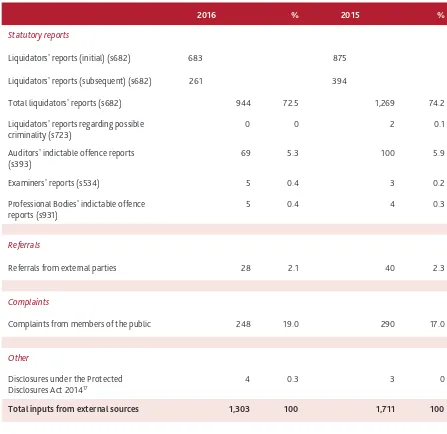
[image:24.595.72.519.346.780.2]• the Office receives a substantial number of complaints from members of the public annually. In that context, the principal inputs received from external sources during the year were as follows: Table 5 Inputs from external sources
22
Statutory reports
Liquidators’ reports (initial) (s682) 683 875 Liquidators’ reports (subsequent) (s682) 261 394
Total liquidators’ reports (s682) 944 72.5 1,269 74.2
Examiners’ reports (s534) 5 0.4 3 0.2
Referrals
Referrals from external parties 28 2.1 40 2.3
Complaints
Complaints from members of the public 248 19.0 290 17.0
Other
Total inputs from external sources 1,303 100 1,711 100 Liquidators’ reports regarding possible 0 0 2 0.1 criminality (s723)
Auditors’ indictable offence reports 69 5.3 100 5.9 (s393)
Professional Bodies’ indictable offence 5 0.4 4 0.3 reports (s931)
Disclosures under the Protected 4 0.3 3 0 Disclosures Act 201417
The principal external sources of inputs driving the Office’s activities over the year under review are elaborated upon below.
LIQUIDATORS’ SECTION 682 REPORTS
Introduction – overview of the liquidator reporting regime
As can be seen from Table 5 above, liquidators’ section 682 reports accounted for almost 73% of all external inputs received by the Office during 2016 (2015: 74%). In summary, liquidators of companies that are in insolvent19liquidation are required
by law19to report to the Office on the circumstances giving rise to the company’s demise and on the conduct of any person
who was a director of the company during the twelve months preceding the entry of the company into liquidation. The liquidator must also proceed to apply to the High Court for the restriction20 of each of the directors, unless relieved of that
obligation by the Office21.
The essential aims of this statutory reporting regime are to:
• afford the public a degree of protection by ensuring that persons who have been determined by the High Court as not having acted honestly and/or responsibly in the run up to a company’s entering insolvent liquidation may, in respect of the mandatory five year period of restriction, only act as directors of other companies that meet minimum capitalisation requirements; and
• ensure that persons who, in the run up to a company’s entering insolvent liquidation, have been judged to have acted honestly and responsibly can continue to engage in entrepreneurial activity through the medium of limited liability companies without sanction or penalty.
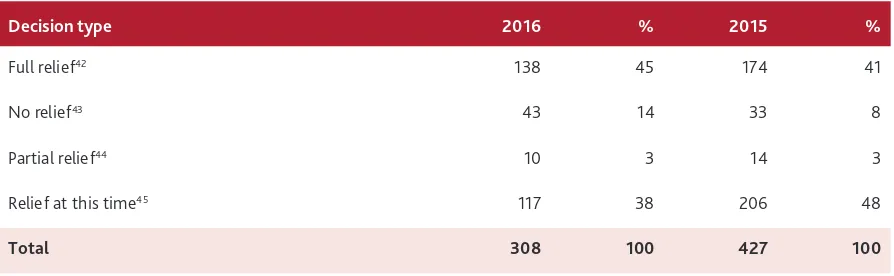
In discharging its role in this regard, the Office expects liquidators to provide it with all of the information which is relevant to the making of an appropriate decision. It also encourages liquidators to make evidence-based recommendations regarding relief/no relief by reference to the results of their investigations.
The Office considers granting relief where a liquidator advances an evidence-based justification in support of a claim that a director has acted honestly and responsibly in conducting the company’s affairs. In making its decisions, the Office is keen to ensure that no director needlessly bears the burden of a High Court hearing where he or she has clearly demonstrated honest and responsible behaviour in the conduct of the affairs of the failed enterprise. In practice, the Office acts as a filter to remove the need for consideration by the High Court of those cases which do not appear to warrant its attention.
It is important to note, however, that ODCE decisions of‘no relief’ or‘partial relief’ do not constitute a finding of dishonesty or irresponsibility in respect of the directors concerned, and it would be inappropriate for any such inference or imputation to be drawn. It is solely a matter for the High Court (having heard the submissions of the liquidator and director(s) respectively) to determine if a Restriction Declaration should be made in respect of any particular company director.
Restriction and Disqualification Undertakings
The Act22introduced, for the first time, a statutory framework under which individuals who might otherwise face the
prospect of Court proceedings can avoid having to go to Court by voluntarily agreeing to a restriction or disqualification as applicable (i.e., by providing a legally binding Undertaking to that effect).
In summary, the Act provides the ODCE with discretion as to whether to offer an Undertaking. Where an offer is made by the ODCE, it must be made on the prescribed form, the layout and content of which is stipulated by the Statutory Instrument (the offer document being referred to as a “Notice”). The Notice must set out, inter alia,an outline of the circumstances, facts and allegations establishing the grounds for a restriction or disqualification together with details of the legal effects of an Undertaking for the person providing same.
There is no obligation on the recipient of a Notice to accept the offer (i.e., to provide the Undertaking). However, where the recipient intends to accept the offer, they must do so within 21 days (or within such longer period as may be allowed by the ODCE). During this offer period, neither the ODCE nor any other person who is aware of the issuing of the Notice may initiate proceedings for the restriction or disqualification of the recipient of the Notice on foot of the circumstances, facts and allegations as set out in the Notice.
23 Office Of The Director of Corporate Enforcement Annual Report 2016
18A company is insolvent when it is unable to pay its debts as they fall due 19Section 682 Companies Act 2014
20Where an individual is restricted under section 819 of the Companies Act 2014, s/he may only act as the director or secretary of a company for a period of five years thereafter provided that the company concerned meets certain minimum capitalisation requirements. In the case of a public limited company a minimum called up share capital of €500,000 is required. In the case of any other company, the corresponding figure is €100,000.
21The process and scope of liquidator reporting are outlined in three main ODCE publications, Decision Notice D/2002/3 as supplemented by Decision Notice D/2003/1 and Information Notice I/2009/1. These documents are available at www.odce.ie
Where a recipient of a Notice decides to accept the offer and to return a duly signed Undertaking Acceptance Form, they will be subject to a Restriction or Disqualification Declaration/Order on the same basis as if a restriction or disqualification had been imposed by the High Court. Therefore, any subsequent breach of the terms of the restriction or disqualification will constitute a criminal offence and will be the same as a breach of a Court-imposed restriction or disqualification. Notwithstanding that company directors or other persons may have voluntarily provided Undertakings, they can, nevertheless, still apply to the Court – at any time during the currency of the restriction or disqualification – seeking to be relieved, in whole or in part, from the terms of the restriction or disqualification, as applicable. Whilst any such applications will be considered by the ODCE on a case by case basis in the context of the particular facts and circumstances, having regard to the need to uphold the integrity of the process, it is anticipated that the ODCE will, in most instances, oppose such applications.
With reference to disqualification, the legislation provides that the maximum duration of disqualification that the ODCE can offer by way of Undertaking is five years. Therefore, in circumstances where the ODCE forms the view that a period of disqualification of in excess of five years is warranted (a determination that is made by reference to the particular facts and circumstances of each case and any relevant jurisprudence), an offer will not be made. Rather, the matter will be dealt with by way of an application to the High Court.
Companies entering liquidation
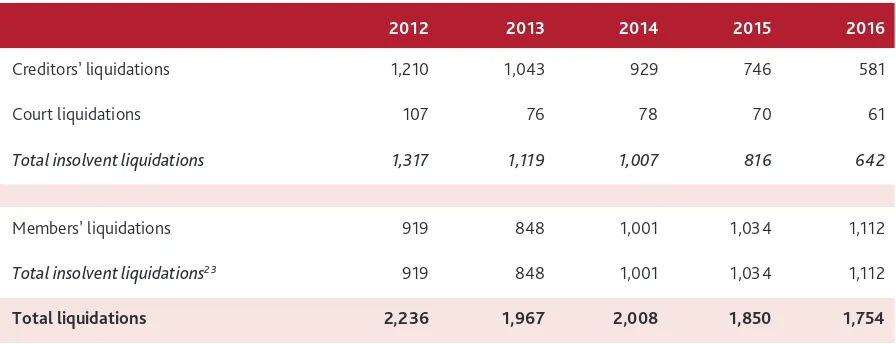
As can be seen from the Table below:
• the total number of insolvent liquidations (i.e. creditors’ and Court liquidations combined) continued to decline – with the 2016 levels representing 49% of the levels in 2012; and
[image:26.595.74.522.398.570.2]• during 2016, the level of solvent liquidations continued to increase, accounting for 63% of all liquidations.
Table 6 Companies entering liquidation: 2012 - 2016
24
2012 2013 2014 2015 2016
Creditors’ liquidations 1,210 1,043 929 746 581 Court liquidations 107 76 78 70 61
Total insolvent liquidations 1,317 1,119 1,007 816 642
Members’ liquidations 919 848 1,001 1,034 1,112
Total insolvent liquidations23 919 848 1,001 1,034 1,112
Total liquidations 2,236 1,967 2,008 1,850 1,754
Liquidators’ s682 reports received – 2016
As can be seen from Table 5 above, a total of 944 liquidators’ s682 reports were received during the year (2015: 1,269), of which:
• 683 were initial24reports (2015: 875); and
• 261 were subsequent24reports (2015: 394).
The continued decline in insolvent liquidations, which reflects the improving business environment more generally, is welcome. Based on current indications, a further reduction, in the order of approximately 15%, is anticipated over the course of 2017.
23Whilst the Office has no role in solvent (i.e. members’) liquidations, data in respect of same has been included in the interests of completeness.
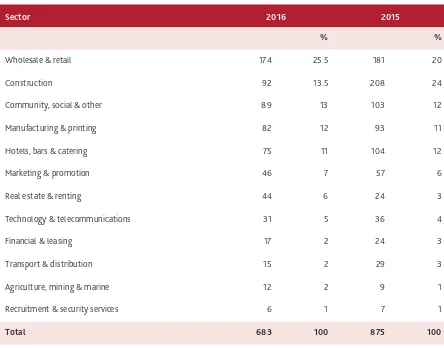
The Table below provides details of the sectoral distribution of companies in respect of which liquidators’ initial reports were received during the year.
Table 7 Sectoral analysis of liquidators’ initial section 682 reports received - 2016
25 Office Of The Director of Corporate Enforcement Annual Report 2016
% %
Wholesale & retail 174 25.5 181 20 Construction 92 13.5 208 24 Community, social & other 89 13 103 12 Manufacturing & printing 82 12 93 11 Hotels, bars & catering 75 11 104 12 Marketing & promotion 46 7 57 6 Real estate & renting 44 6 24 3 Technology & telecommunications 31 5 36 4 Financial & leasing 17 2 24 3 Transport & distribution 15 2 29 3 Agriculture, mining & marine 12 2 9 1 Recruitment & security services 6 1 7 1 Total 683 100 875 100
Sector 2016 2015
Timeliness of liquidators’ reporting
Over the course of the year, the Office issued 106 (2015: 124) notices to 57 (2015: 64) separate liquidators advising them that they were in default of their statutory reporting obligations. Most of these defaults were promptly rectified as a result of this action and, as a consequence, 96% of the first reports due during the year had been received by year end (2015: 96%). However, a small number of liquidators have been observed to repeatedly fail to comply with their reporting obligations. Appropriate enforcement action, up to and including criminal prosecution, may result from such persistent breaches of statutory obligations.
Standard of liquidators’ reporting
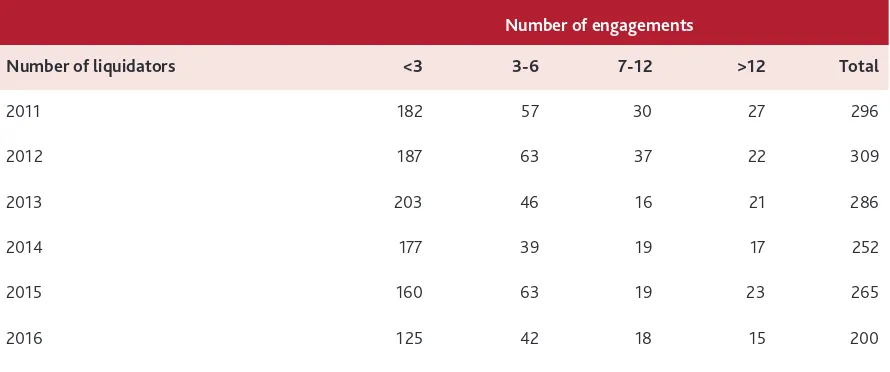
Table 8 Profile of liquidators undertaking insolvent liquidations by number of engagements 2011 – 2016
26
Number of liquidators <3 3-6 7-12 >12 Total
2011 182 57 30 27 296 2012 187 63 37 22 309 2013 203 46 16 21 286 2014 177 39 19 17 252 2015 160 63 19 23 265 2016 125 42 18 15 200
Number of engagements
Qualification for appointment as a liquidator or examiner
Also of relevance in the context of the foregoing is section 633 of the Act, which introduced new rules for qualification to act as a liquidator. The Act defines five categories of individuals who are entitled to act as a liquidator. These are:
i. members of a Prescribed Accountancy Body holding a practicing certificate; ii. solicitors holding a practicing certificate;
iii. members of any other professional bodies recognised for this purpose by IAASA (none currently); iv. persons qualified to act as a liquidator in another EEA25 state; and
v. persons with practical experience of windings-up and knowledge of relevant law prior to the commencement of the Act who are authorised by IAASA. Before granting an authorisation of this type, IAASA has to be satisfied, having consulted the ODCE, that the person is a fit and proper person to act as a liquidator.
An individual who has applied to IAASA for authorisation under (v) above may continue to act pending the determination of their application. As of the end of 2016, IAASA had advised the ODCE of the names of 24 individuals who have applied for authorisation under this provision. It is understood that these applications are currently under consideration by IAASA. In addition to the qualification requirements prescribed in section 633, section 634 provides that all liquidators must have in place adequate professional indemnity insurance (“PII”). IAASA has issued Regulations prescribing the required level of PII required and these Regulations are available on IAASA’s website26.
A related provision, section 519 of the Act, provides that a person can only act as an examiner if they are qualified to act as a liquidator.
25European Economic Area
SECTORAL DISTRIBUTION OF OTHER EXTERNAL INPUTS (I.E. EXTERNAL
INPUTS OTHER THAN LIQUIDATORS’ SECTION 682 REPORTS)
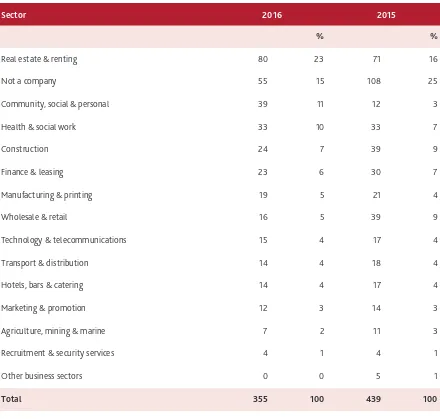
[image:29.595.79.519.184.603.2]As can be seen from Table 5, in aggregate those external inputs other than liquidators’ section 682 reports accounted for over 27% (2015: 26%) of total external inputs received during the year. The Table below provides an analysis of the sectoral distribution of those other external inputs.
Table 9 Sectoral distribution of external inputs other than liquidators’ section 682 reports
27 Office Of The Director of Corporate Enforcement Annual Report 2016
% %
Real estate & renting 80 23 71 16 Not a company 55 15 108 25 Community, social & personal 39 11 12 3 Health & social work 33 10 33 7 Construction 24 7 39 9 Finance & leasing 23 6 30 7 Manufacturing & printing 19 5 21 4 Wholesale & retail 16 5 39 9 Technology & telecommunications 15 4 17 4 Transport & distribution 14 4 18 4 Hotels, bars & catering 14 4 17 4 Marketing & promotion 12 3 14 3 Agriculture, mining & marine 7 2 11 3 Recruitment & security services 4 1 4 1 Other business sectors 0 0 5 1 Total 355 100 439 100
28
COMPLAINTS
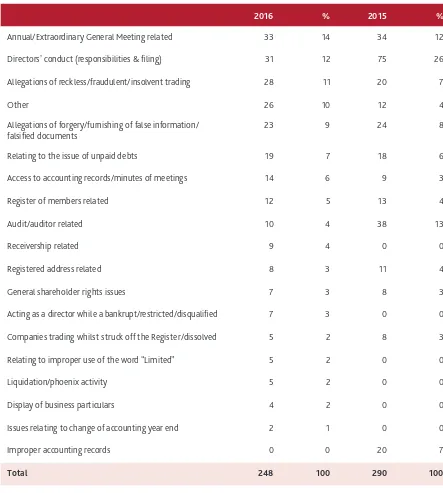
[image:30.595.73.516.166.659.2]The Office receives substantial numbers of complaints annually from members of the public. During the year a total of 248 complaints were received (2015: 290), which accounted for 19% (2015: 17%) of all external inputs received. The Table below provides an analysis of the subject matter of complaints received.
Table 10 Complaints received (analysed by character of primary reported default)
Annual/Extraordinary General Meeting related 33 14 34 12 Directors’ conduct (responsibilities & filing) 31 12 75 26 Allegations of reckless/fraudulent/insolvent trading 28 11 20 7 Other 26 10 12 4
Relating to the issue of unpaid debts 19 7 18 6 Access to accounting records/minutes of meetings 14 6 9 3 Register of members related 12 5 13 4 Audit/auditor related 10 4 38 13 Receivership related 9 4 0 0 Registered address related 8 3 11 4 General shareholder rights issues 7 3 8 3 Acting as a director while a bankrupt/restricted/disqualified 7 3 0 0 Companies trading whilst struck off the Register/dissolved 5 2 8 3 Relating to improper use of the word “Limited” 5 2 0 0 Liquidation/phoenix activity 5 2 0 0 Display of business particulars 4 2 0 0 Issues relating to change of accounting year end 2 1 0 0 Improper accounting records 0 0 20 7 Total 248 100 290 100 Allegations of forgery/furnishing of false information/ 23 9 24 8 falsified documents