20
13
Annual
Standards in Public Office Commission, 18 Lower Leeson Street, Dublin 2.
Tel: (01) 6395666 Fax: (01) 6395684 email: [email protected]
website: www.sipo.gov.ie
ISSN: 2009-3217
designed by designed by
designed by designed by arna dearadh ag
designed by
4
Standards in Public Office Commission Annual Report 2013Contents
Foreword 5
The Members 6
Introduction by the Chairperson 8
Chapter 1 - The Work of the Standards Commission
11
Ethics Acts 11
Electoral Acts 15
The Party Leaders Allowance Act 16
Chapter 2 - Ethics
19
Complaints 19
Public Sector Standards Bill 27
Scope of the Ethics Acts 27
Registration of Lobbying 28
Chapter 3 - Electoral
31
Political Party Accounts 31
Donations disclosed by TDs, Senators and MEPs 33
Donations disclosed by political parties 34
Donation Statements received from individual donors 35 Supervision of the Meath East Dáil Bye-election 35
Exchequer funding of political parties 36
Accounting Units 38
Third Parties 40
Corporate Donors 42
Reports of possible breaches 43
Appendix 1: Recommendations for change
45
Appendix 2: Standards Commission Publications in 2013
51
Appendix 3: Glossary of Terms
55
Appendix 4: Costs in 2013
63
Foreword
In accordance with the provisions of section 27(2)(a) of the Ethics in Public Office Act 1995, I am pleased to furnish the Annual Report of the Standards in Public Office Commission for 2013 to the Minister for Public Expenditure and Reform.
Justice Daniel O’Keeffe Chairperson
6
The Members
Standards in Public Office Commission Annual Report 2013
Justice Daniel O’Keeffe Chairperson
Deirdre Lane
Clerk of Seanad Éireann
Jim O’Keeffe
Former member of Dáil Éireann
Seamus McCarthy
Previous members of the Standards Commission
Justice M.P. Smith, Chairperson (term concluded December 2013).Michael Smith (term concluded December 2013).
Emily O’Reilly (resigned as Ombudsman, September 2013).
Kieran Coughlan (retired from his office as Clerk of Dáil Éireann, August 2013; appointed in October 2013 by the Minister for Public Expenditure and Reform to serve temporarily on the Commission until the appointment of a new Clerk of Dáil Éireann).
Ms Bernadette McNally, Director General, Office of the Ombudsman, served from June to July 2013 in the temporary absence from duties as a Commissioner of Ms O’Reilly and from October to December 2013 following Ms O’Reilly’s resignation as Ombudsman.
Peter Tyndall Ombudsman
Peter Finnegan
8
Introduction by the Chairperson
It is a pleasure to introduce the annual report of the Standards in Public Office Commission for 2013. I cannot comment in any detail on the work during the year, since it was not until February 2014 that I became Chairperson.
2013 saw very significant changes in the membership of the Standards Commission. The terms of office of long-serving Chairperson, Mr Justice M.P. Smith and member of the
Commission, Mr Michael Smith came to an end in December, while the new Ombudsman, Mr Peter Tyndall joined the Commission as an ex officio member in the same month.
I was very pleased to be appointed by President Michael D. Higgins on 11 February 2014 as Chairperson of Commission. On the same day, Mr Jim O’Keeffe was also appointed as a member of the Commission. Mr Peter Finnegan was appointed Clerk Assistant of Dáil Éireann on 16 April 2014 and he also became an ex officio member of the Commission, replacing Mr Kieran Coughlan, former Clerk of Dáil Éireann who had kindly continued to act as a member after his retirement on 5 August 2013.
Fortunately, the Clerk of Seanad Éireann, Ms Deirdre Lane and the Comptroller and Auditor General, Mr Seamus McCarthy continue to serve and provide some very necessary continuity.
On behalf of the Commission, I would like to thank each of the former members for their service to the Commission and to the public.
Mr Justice M.P. Smith had been Chairperson since the Commission was established in 2001 and he served with distinction for 12 years. Minister Brendan Howlin commented in the Dáil in January 2014 that Mr Justice Smith had served the country well in this important role; the Minister went on to wish him well in his retirement and the Commission would like to echo these sentiments.
Former Member of the Oireachtas and former Minister Michael Smith served for 6 years as a member of the Commission and our gratitude and best wishes also go to him.
Mr Kieran Coughlan served on the Standards Commission since 2001. He had also served on its predecessor, the Public Offices Commission since 1995. He served both Commissions with distinction bringing to bear his extensive experience in Leinster House and as Clerk of Dáil Éireann.
Ms Emily O’Reilly, the former Ombudsman, became European Ombudsman on 1 October 2013 and also left the Commission after 10 years of service. The Commission wishes her the very best in Europe.
Chapter
01
Chapter 1 - The Work of the Standards
Commission
The Standards Commission has a supervisory role under
-■
■ the Ethics in Public Office Act 1995, as amended by the Standards in Public Office
Act 2001, (the Ethics Acts);
■
■ the Electoral Act 1997, as amended, (the Electoral Acts); ■
■ the Oireachtas (Ministerial and Parliamentary Offices) (Amendment) Act 2001,
(the Party Leaders Allowance Act).
This chapter provides a brief description of the main features of the legislation and the functions of the Standards Commission.
Ethics Acts
Overview of the Ethics Acts
12
Chapter 1: The Work of the Standards CommissionEvidence of tax compliance must be furnished to the Standards Commission by all members of both Houses of the Oireachtas, the Attorney General and appointees to senior office in public bodies. The legislation requires the drawing up of codes of conduct for ordinary members of the Houses, for office holders (see definition in Appendix 3) and for public servants.
The Standards Commission has a role in relation to the Ethical Framework for the Local Government Service provided for in Part 15 of the Local Government Act 2001. The
Commission must be consulted by the Minister for the Environment, Community and Local Government in relation to the codes of conduct for local authority members or for local authority employees. It can also examine complaints about contraventions of Part 15 by local authority members or employees.
Functions of the Standards Commission under the Ethics Acts
The main functions of the Standards Commission are to provide advice and guidelines on compliance with the Ethics Acts, to administer the disclosure of interests and tax clearance regimes and to investigate and report on possible contraventions of the legislation. These functions of the Standards Commission apply to office holders and to public servants and, in relation to tax compliance measures, to all members of the Houses. Apart from matters relating to tax clearance, the Committees on Members’ Interests of both Houses have functions similar to those of the Standards Commission in relation to members of the Houses who are not office holders.
Statements of Interests
Under the disclosure of interests provisions of the Ethics Acts, the Standards Commission provides annual statement of registrable interests forms to members of the Oireachtas, who are required to furnish a statement of any registrable interests to the Commission. The Commission forwards these statements to the Clerk of Dáil Éireann or the Clerk of Seanad Éireann as appropriate, who publish registers of members’ interests.
The Ethics Acts require statements of interests to be furnished to the Standards
Commission by office holders (in relation to the interests of a spouse, a child or a child of a spouse), the Attorney General, designated directors (see definition in Appendix 3) and special advisers. The secretariat administers the receipt and retention of these statements, including returning incorrectly completed statements to individuals for amendment.
Codes of Conduct
The Standards Commission is consulted on proposed Codes of Conduct under the Standards in Public Office Act 2001 and is required to publish any such codes adopted under the
Tax Clearance
Members of the Oireachtas on election and senior public servants and directors on appointment to ‘senior office’ are required to provide a statutory declaration and either a tax clearance certificate or an application statement to the Standards Commission within 9 months of election or appointment.
The secretariat administers the tax clearance provisions, informs elected members and appointees to senior office notified to it by public bodies of their obligations under the legislation and ensures compliance with the requirements. The legislation provides for investigation and report in relation to contraventions.
Guidelines
The Standards Commission publishes statutory guidelines on compliance with the
provisions of the Ethics Acts for persons who have obligations under the legislation. Such persons are required to act in accordance with the guidelines unless by so doing, the act concerned would constitute a contravention of another provision of the Ethics Acts. The guidelines are revised periodically to take account of amended legislative provisions or to clarify matters which have arisen since the previous edition. The Standards Commission has published guidelines for office holders and for public servants. These are available on its website. Guidelines for members of the Oireachtas who are not office holders are published by the relevant Committee on Members’ Interests.
Advice
Designated members of the staff of the secretariat have responsibility delegated to them by the Standards Commission to provide advice to persons who request it in relation to their statutory obligations under the Ethics Acts. Such persons are required to act in accordance with advice given unless by so doing, the act concerned would constitute a contravention of another provision of the Ethics Acts. Where requested, advice must be provided within 21 days or, alternatively, it may decline to give advice. Normally, all advice of a substantive nature will be provided in writing.
Complaints
14
Chapter 1: The Work of the Standards CommissionAny person may make a complaint to the Standards Commission under the above headings, although the legislation makes particular provision for complaints by certain categories of persons, such as members, Ministers or heads of bodies.
On receipt of a complaint, the Standards Commission may consider whether an investigation is warranted under the legislation. It may do so on the basis of the evidence available to it. It may appoint an Inquiry Officer to assist it in its consideration by carrying out a preliminary inquiry. The Inquiry Officer can seek a statement from and/or interview the complainant and/or the person against whom the complaint has been made or from any other person whose evidence would or might, in the opinion of the Inquiry Officer, be relevant to the inquiry. He or she may also request the production of any documents considered to be relevant to the inquiry. Following such an inquiry, the Officer is required to prepare a report of the results of the inquiry and to furnish that report, together with any statements and other documents furnished to the officer in the course of the inquiry. The report must not contain any “determination or findings” but, if the Commission so requests, it shall contain an expression of the opinion of the officer as to whether there is prima facie evidence to sustain the complaint.
Own Initiative Inquiries
In addition to receiving complaints, the Standards Commission can decide to initiate an investigation into a contravention of the Ethics Acts or of Part 15 of the Local Government Act or a ‘specified act’, where it considers it appropriate to do so. While the legislation is not specific in this regard, it would only do so if it considered that there was prima facie
evidence of a contravention or a ‘specified act’. When considering whether an investigation is warranted in the absence of a complaint, the Standards Commission does not have the power to appoint an Inquiry Officer to assist it in its deliberations.
Investigations
Electoral Acts
Overview of the Electoral Acts
Among the purposes of the Electoral Acts are to make provision for disclosure of donations for political purposes, to regulate spending by candidates and political parties at elections, and to provide for payments to political parties and candidates.
Functions of the Standards Commission under the Electoral Acts
The Electoral Acts require the Standards Commission to monitor and, where it considers it appropriate to do so, report to the Chairman of Dáil Éireann on matters relating to
-■
■ the acceptance and disclosure of donations received by political parties, members
of both Houses of the Oireachtas and of the European Parliament and candidates at Dáil, Seanad, European Parliament and presidential elections;
■
■ the opening and maintenance of political donations accounts; ■
■ the limitation, disclosure and reimbursement of election expenses; ■
■ State financing of qualified political parties; ■
■ the maintenance of the Register of Corporate Donors; ■
■ the registration of “third parties” (i.e., campaign/lobby groups or individuals
which accept a donation for political purposes which exceeds €100 in value) and
other persons.
The Standards Commission may conduct whatever inquiries are necessary in the discharge of its statutory functions under the Electoral Acts.
The Standards Commission is required, from time to time, to draw up and publish guidelines and provide advice on compliance to persons who are covered by the provisions of the
Electoral Acts. A person must act in accordance with guidelines published or advice given by the Standards Commission, unless, by doing so, he or she would be contravening another provision of the Electoral Acts.
16
Chapter 1: The Work of the Standards CommissionThe Party Leaders Allowance Act
Overview of the Party Leaders Allowance Act
The Party Leaders Allowance Act provides for the payment of an annual allowance to the leaders of parliamentary parties in relation to expenses arising from the parliamentary activities, including research, of the party. The amount paid is based on the party’s
representation in Dáil and Seanad Éireann. The allowance is reduced where a party forms part of the government. The “parliamentary activities” to which the funding may be applied are set out in the legislation. The funding may not be used for electoral or referendum purposes.
The Party Leaders Allowance Act requires the party leader to prepare, or cause to be prepared, a statement of expenditure from the allowance received in respect of the preceding year. The statement must set out, under specific headings, the items on which the funding was spent. The statement must be audited by a public auditor and must be furnished together with the auditor’s report to the Standards Commission within 120 days of the end of the financial year for which the allowance has been paid (i.e., by 30 April). Failure to furnish the statement within this timeframe can result in a suspension of the Allowance.
Functions of the Standards Commission under the Party Leaders
Allowance Act
The Standards Commission must consider each statement and auditor’s report furnished to it and, if necessary, consult with the party leader on any matter contained in the statement. The Standards Commission is required to furnish a report to the Minister for Finance indicating whether the statement and auditor’s report have been submitted within the specified period. It must indicate whether any unauthorised expenditure is disclosed and whether the statement is adequate or inappropriate.
The Standards Commission must cause a copy of the report to the Minister for Finance to be laid before each House of the Oireachtas.
A copy of the statements and auditors’ reports must be retained by the Standards Commission for 3 years and must be made available for public inspection and copying.
Parliamentary Activities Allowance Act
18
Chapter 2: EthicsChapter
Chapter 2 - Ethics
Complaints
After an exceptional year in 2012, the number of complaints received by the Standards Commission in 2013 under the Ethics Acts fell to the pattern of previous years. A total of 29 complaints were received, of which 16 were valid. This was down from 427 in 2012 (of which 334 were valid). Of the 427 complaints, 388 had been referred for investigation to the Commission by the Committee on Members’ Interests of Dáil Éireann, concerning Deputy Michael Lowry. The Standards Commission found that one of the complaints received in 2013 (relating to Councillor Patrick Doherty, Donegal County Council) provided a basis on which to initiate an investigation.
Councillor Oisín Quinn Investigation
The Standards Commission reported in its Annual Reports for 2011 and 2012 on a complaint received from Mr Michael Smith and Councillor Cieran Perry, about Councillor Oisín Quinn, Dublin City Council. The complaint centred on alleged contraventions of Part 15 of the Local Government Act 2001 in relation to Councillor Quinn’s participation in motions and amendments before meetings of the council regarding the draft Dublin City Development Plan. The Commission found that Councillor Quinn had contravened the provisions of section 177(1) on four occasions. The report of the investigation, including the transcript of the investigation hearing, is available on the website of the Standards Commission
- www.sipo.gov.ie.
20
Chapter 2: EthicsSection 177(1) of the Local Government Act 2001 imposes an obligation on a member of a local authority that where a resolution, motion, question or other matter is proposed or otherwise arises, then such member of the local authority present at the meeting where he or she has actual knowledge that he or she or a connected person has a pecuniary or other beneficial interest in or which is material to the matter: (i) to disclose the nature of his or her interest, or the fact of a connected person’s interest at the meeting, and before discussion or consideration of the matter commences, and (ii) to withdraw from the meeting for so long as the matter is being discussed or considered, and, accordingly, he or she must take no part in the discussion or consideration of the matter and shall refrain from voting in relation to it.
At particular issue in this case was whether or not Councillor Quinn and his brothers and sisters had a pecuniary or other beneficial interest in the matters before the council meetings. Section 176(3)(a) of the Local Government Act 2001 provides:
“A person shall not be regarded as having a beneficial interest which has to be disclosed under this Part... because of an interest which is so remote or insignificant that it cannot be reasonably regarded as likely to influence a person in considering or discussing, or in voting on, any question with respect to that matter or in performing any function in relation to that matter...”
Councillor Quinn had sought and received advice from council officials who considered that the interest concerned was ‘remote’ and therefore not a pecuniary or other beneficial interest and that no obligations arose. The Standards Commission found that the test to be applied is not whether an interest is remote, but whether the interest is so remote or insignificant that it could not be reasonably be regarded as likely to influence Councillor Quinn in considering or discussing or voting on any question or in performing any function in relation to the matter. In this case, it found that the interest was not so remote or insignificant and that Councillor Quinn had contravened the provisions of section 177(1) on four occasions. The Commission was satisfied that the contraventions were committed inadvertently; that they were, in all the circumstances, minor in nature; that they were not continuing contraventions and that Councillor Quinn acted in good faith in relation to each of the contraventions.
Dublin City Council and Councillor Quinn initiated judicial review proceedings in June 2012 against the Commission. The case was heard over six days in the High Court in December 2013 before Mr Justice Hedigan who delivered his judgment on 29 January 2014. He found that the City Council had no locus standi in the proceedings. On the substantive issues in the matter, he found in favour of the Commission, noting:
In determining what might or might not be reasonably regarded as an interest too remote or insignificant, it is hard to imagine a body more qualified than the Commission. It is an ideal composition of experience, both legal, popular and political. It is likely to be a very rare case where this court in judicial review would find its conclusions irrational or unreasonable. I do not think I even need investigate these two concepts because I am in agreement with the determination reached by the Commission here.
Mr Justice Hedigan subsequently awarded costs to the Standards Commission and refused a stay on the costs order, other than a 21 day stay pending an appeal. Dublin City Council later informed the Commission that neither it nor Councillor Quinn intended to appeal the judgment. At the time of writing, the Standards Commission had been informed that its investigation report was due to be considered by the elected members of Dublin City Council on 23 June 2014.
The Standards Commission welcomes the decision of the court and in particular the strong terms in which it upheld the Commission’s role and decision in the investigation. The substantial liability to costs arising from these proceedings is regretted.
22
Chapter 2: EthicsMichael Lowry TD Investigation
In November 2012, Mr Kieran Coughlan, Clerk of Dáil Éireann, referred 388 complaints to the Committee on Members’ Interests of Dáil Éireann concerning alleged contraventions by Deputy Michael Lowry of the provisions of the Ethics Acts regarding his ownership of lands at Wigan, United Kingdom. The Committee, by resolution, determined that the complaints should be investigated by the Standards Commission. The Committee decided that the Commission was better placed to conduct an investigation into the complaints by virtue of the fact that the legislation provides for an Inquiry Officer to assist the Commission in its work by, inter alia, carrying out a preliminary inquiry into the complaints. The Ethics Acts do not make any provision for a Committee to appoint an Inquiry Officer.
Of the 388 complaints, it was found that 70 were invalid within the meaning of the Ethics Acts as the identity of the complainant in each case was not known to the Standards Commission because no address or an insufficient address was provided.
The Standards Commission appointed an Inquiry Officer to conduct a preliminary inquiry into the matters complained of. Having considered the report of the preliminary inquiry conducted by the Inquiry Officer, the Commission decided to discontinue its investigation into the complaints on the basis that there was not sufficient evidence to sustain them. In order for an interest in land to be registrable under the Ethics in Public Office Acts 1995 and 2001, its value must exceed €13,000. The Commission noted estimates of the land’s value
obtained by the Inquiry Officer from two independent professional valuers, which taken together did not confirm that Deputy Lowry’s interest in the lands in question exceeded the disclosure threshold. The Commission wrote to the Committee on 25 September 2013 enclosing a record of its decision to discontinue the investigation. The record of decision was published on the Commission’s website.
Senator Brian Ó Domhnaill Investigation
The County Manager and Mayor of Donegal County Council complained in May 2012 to the Standards Commission about a number of expenses claims made by Senator Brian Ó Domhnaill in his former capacity as a member of the Council and of Údarás na Gaeltachta. They also complained that he had not properly attended the whole of some conferences which he was delegated to attend, and in respect of which attendance he had been
reimbursed expenses. In their complaint, the Manager and Mayor alleged that he may have done specified acts within the meaning of the Ethics Acts in this regard.
It informed Senator Ó Domhnaill that it would sit for the purposes of the investigation on 11 March 2013. Following exchanges of correspondence between the Commission, Senator Ó Domhnaill and his legal representatives, the investigation was deferred until 8 April 2013 and the Commission was notified that Senator Ó Domhnaill had engaged new legal representatives. They indicated that they would be conducting the matter through the Irish language and sought assurances that the hearing would be conducted by an officer competent in Irish. The Commission put in place arrangements to facilitate the Senator’s request through the use of translators and indicated that it had further deferred the hearing. Further exchanges of correspondence took place regarding the arrangements for the hearing, including the provision of translated documents to Senator Ó Domhnaill’s legal representatives. They objected to the holding of the hearing on a number of grounds, including that the members of the Commission would not be in a position to hear the matter without the use of translators and that the complaints were received from anonymous complainants. They also stated that the Commission’s legal representatives were under an obligation to deal with the matter through Irish.
The Commission’s legal representatives replied saying that it was facilitating their client by providing translation services and also stated that the complaint under consideration was that made by the County Manager and Mayor of Donegal County Council and was not anonymous. Finally, they stated that they were not required by law to correspond in Irish as they were not a public body, but that they had in any event provided correspondence in both Irish and English.
Senator Ó Domhnaill subsequently made an application for judicial review of the Commission’s arrangements for the investigation hearing on the grounds that he was entitled to have the hearing held by Commissioners who were in a position to understand his evidence without the aid of translation. He further objected to the examination of the complaint in that the identity of the complainants was not disclosed in accordance with section 8 of the Standards in Public Office Act 2001.
The case was heard in the High Court in November 2013 before Mr Justice Hogan who delivered his judgment on 13 January 2014. The court found that while the initial complaints to Donegal County Council were anonymous, those before the Commission were not and the Commission had not acted contrary to the provisions of section 8 of the Standards in Public Office Act 2001 in this regard. The court rejected the argument that all the members of the Commission must be bilingual before being able to adjudicate in the matter. The court found that there was no need to adjudicate on the question of whether the Commission’s legal representatives were obliged to communicate in Irish in this matter, as it had in fact done so once Senator Ó Domhnaill indicated in March 2013 that he wished to correspond in that language.
24
Chapter 2: EthicsComplaints about Minister Alan Shatter
The Standards Commission received three complaints, one of which was from Mr Mick Wallace TD, concerning statements made by Mr Alan Shatter TD, then Minister for Justice and Equality on RTE’s Prime Time on 16 June 2013 about an incident involving Deputy Wallace and members of An Garda Síochána. The complaints alleged that, in making the statements, Minister Shatter had improperly disclosed personal information about Deputy Wallace and accordingly had done a ‘specified act’. The Commission also received a complaint from Deputy Luke ‘Ming’ Flanagan about an alleged ‘specified act’ by Minister Alan Shatter regarding the Minister’s release of confidential information about him.
A ‘specified act’ as referred to in section 4 of the Standards in Public Office Act 2001 (the 2001 Act) is:
“... an act or ... an omission after the commencement of section 2 that is, or the circumstances of which are, such as to be inconsistent with the proper performance by the specified person of the functions of the office or position by reference to which he or she is such a person or with the maintenance of confidence in such performance by the general public, and the matter is one of significant public importance,...”
Section 4(6)(b) of the 2001 Act provides:
“Without prejudice to the generality of the expression “significant public importance” in
subsection (1), a matter shall, if the Commission consider it appropriate to do so having regard to all the circumstances, be deemed by it, for the purposes of that subsection, to be of significant public importance if it relates to a benefit alleged to have been received by a specified person or a person who, in relation to a specified person, is a connected person and, in the opinion of the Commission, the value of the benefit was, is or might have been or be expected to be or to become not less than £10,000.” (i.e. €12,697)
The Commission appointed an Inquiry Officer to conduct a preliminary inquiry into the matters complained of. The Inquiry Officer gathered relevant evidence and statements and, having provided these to Minister Shatter, obtained a statement from him. He then presented his report of the preliminary inquiry to the Commission for its consideration.
Section 23(1A)(b) of the 1995 Act provides:
“The Commission shall not carry out an investigation under subsection (1) into a complaint under subsection (1) of section 4 of the Act of 2001 in relation to a matter referred to in paragraph (a) of that subsection unless... the Commission becomes of opinion, after consideration by it of any report of an inquiry officer in relation to the matter and any statements or documents accompanying the report, that there is sufficient evidence to establish a prima facie case in relation to the alleged specified act concerned and that, if it was in fact done, it is an act falling within the said paragraph (a).
The Commission decided that the matter which was the subject of complaint by Deputy Flanagan about the alleged ‘specified act’ by the Minister was not one of significant public importance. It could not therefore be considered a ‘specified act’ and accordingly, under the provisions of section 23(1A)(b) of the 1995 Act, the Commission decided not to carry out an investigation into the matters complained of.
The Commission informed the complainants and the Minister of its decision.
Councillor Pádraig Doherty Investigation
The Commission received a complaint from Councillor Frank McBrearty, then Mayor of Donegal County Council and Mr Seamus Neely, County Manager, concerning Councillor Pádraig Doherty. The complaint centred on alleged contraventions of Part 15 of the Local Government Act 2001 in relation to the claiming of expenses from both Donegal County Council and Údarás na Gaeltachta for attendance at conferences in Dungarvan, Co. Waterford, Dundalk, Co. Louth and at the offices of Údarás na Gaeltachta in Furbo, Co. Galway.
The Standards Commission appointed an Inquiry Officer to conduct a preliminary enquiry into the complaint. Following consideration of the Inquiry Officer’s report, the Commission decided that it was appropriate to carry out an investigation under section 23 of the
Ethics Act to determine whether Councillor Doherty had contravened Part 15 of the Local Government Act or had done a ‘specified act’ within the meaning of the Ethics Acts. An investigation hearing was held on 12 May 2014.
26
Chapter 2: EthicsThe Standards Commission also found that Mr Doherty contravened sections 168 and 169(3) of the Local Government Act 2001, acted in disregard of provisions of the Code of Conduct for Councillors and did a ‘specified act’ within the meaning of the Standards in Public Office Act 2001 by claiming travelling expenses from Donegal County Council in respect of his attendance at the Irish Central Border Area Network Conference at the Crowne Plaza Hotel in Dundalk, County Louth on 20 November 2008 and later also claiming travelling and subsistence expenses in respect of attendance at a meeting of Údarás na Gaeltachta in Furbo, County Galway on 21 November 2008.
The Commission found that Mr Doherty was not entitled to make separate claims for his journeys from home to Dundalk and then from home to Furbo and that he should have made a claim to Donegal County Council for his journey from home to Dundalk and then made a claim to Údarás na Gaeltachta for journeys from Dundalk to Furbo and from Furbo to his home.
The Standards Commission also found that Mr Doherty contravened sections 168 and 169(3) of the Local Government Act 2001, acted in disregard of provisions of the Code of Conduct for Councillors and did a ‘specified act’ within the meaning of the Standards in Public Office Act 2001 by claiming an overnight subsistence allowance from Údarás na Gaeltachta in respect of his attendance at meeting of Údarás na Gaeltachta in Furbo, County Galway on 21 November 2008 when he had not availed of accommodation to justify the claim.
The Standards Commission found that each of the contraventions was committed recklessly and was, in all the circumstances, a serious matter. The Commission also found that Mr Doherty did not act in good faith in relation to each of the contraventions.
The Commission has sent its report to Mr Doherty, to Mr Seamus Neely, Chief Executive, Donegal County Council and Councillor John Campbell, Mayor, Donegal County Council (whose predecessors made the complaint to the Standards Commission) and also to the Minister for Public Expenditure and Reform and to the Minister for Environment, Community and Local Government.
In his letter to the Minister for Public Expenditure and Reform, the Commission
Chairperson, Mr Daniel O’Keeffe, informed him that the Commission is concerned at the scope for abuse by persons making such claims to more than one public body and has requested that he give consideration to putting in place arrangements across the public service for cooperation by public bodies in ensuring that only the appropriate amounts within the relevant regulations are paid in response to claims by persons to more than one body in respect of the same period.
The investigation report, together with full details of the Standards Commission’s findings and determinations, is available on the Commission’s website - www.sipo.gov.ie
Public Sector Standards Bill
In its Annual Report for 2012, the Standards Commission reported that in the context of its response to the Final Report of the Mahon Tribunal the Government had decided, inter alia,
to take the opportunity to undertake a full review of how the existing legislative framework for ethics can be reformed in order to develop a single, comprehensive legislative
framework grounded on a clear and comprehensive set of principles. The Commission had first sought such a consolidation of the legislation in its 2009 Annual Report.
The Government announced in its legislative programme for the Spring/Summer Session that the Minister for Public Expenditure and Reform intends to publish a Public Sector Standards Bill during 2014. The Commission welcomes this announcement and looks forward to contributing to the development of the proposed legislation.
Scope of the Ethics Acts
The Standards Commission has reported in each of its Annual Reports since 2004 on the large increase in the scope of the Ethics Acts in terms of the numbers of public bodies in the public service in which the Minister for Finance and latterly the Minister for Public Expenditure and Reform has prescribed designated directorships and designated positions of employment. In its report for 2012, it stated that around 910 public bodies including subsidiaries were within remit.
The most recent regulations were made by the Minister for Public Expenditure and Reform in July 2013. These brought the Director and certain members of staff of the Insolvency Service of Ireland within the scope of the Ethics Acts. In line with practice since 2004, regulations would have been due to be made to come into effect on 1 January 2014. However, no such regulations were made. Since the most recent regulations in 2013, the process of public service rationalisation has led to the dissolution of a number of bodies and the creation of new bodies either newly created or by way of merger of existing bodies. 33 Vocational Education Committees have been replaced by 16 Education and Training Boards. FÁS has been replaced by SOLAS. In addition, bodies such as Irish Water have been set up. However, the disclosure of interests obligations of the Ethics Acts do not apply to their directors or employees. In light of the dissolution of a number of public bodies, there are now around 870 public bodies within the scope of the legislation.
28
Chapter 2: Ethicsnew regulations were in preparation. However, the Commission strongly recommends, as it has done on numerous previous occasions, that the regulations be kept as up to date as possible in order that any potential or actual conflicts between personal interests and public functions are disclosed and resolved in the public interest.
Registration of Lobbying
The Standards Commission reported in its 2012 Annual Report on the intention of the Government to publish legislation which will provide for the registration of lobbying and for related matters. The Registration of Lobbying Bill 2014 was published on 20 June 2014.
The purpose of the Registration of Lobbying Bill 2014 is to provide for a register of lobbying to make information available to the public on the identity of those communicating on specific policy, legislative matters or prospective decisions with designated public officials. The Bill defines the communications which constitute lobbying and those that are excluded and sets out who should be regarded as designated public officials. The Bill also allows for delayed publication of information on the Register in certain circumstances.
The Bill provides for the development of a Code of Conduct for lobbyists and a Transparency Code for working groups, task forces and other groups established by a Minister or public service body. The Bill also provides for restrictions and conditions on the taking up of certain employments by certain designated officials for a specified period of time where a possible conflict of interest arises.
The Bill provides that the Commission will establish and maintain a register of lobbyists. The Commission will be responsible for monitoring compliance and providing guidance and direction. The focus in the initial period of the operation of the Bill will be on education, guidance and information. Arrangements are being put in place for an Advisory Board and an IT Project Team to assist the Commission in the implementation of the Bill’s provisions.
The Commission will assist the Minister for Public Expenditure and Reform in reviewing the operation of the legislation and will report annually to the Houses of the Oireachtas on the operation of the legislation.
Chapter
03
Chapter 3 - Electoral
Political Party Accounts
The Electoral (Amendment)(Political Funding) Act 2012 requires the Commission to prepare and publish guidelines for the purpose of providing practical guidance to political parties with respect to keeping proper books of account and preparing an annual statement of accounts.
Acting on the advice of Counsel as to the scope of the legislative provisions and having considered the representations received during the statutory public consultation exercise, the Commission prepared draft guidelines which provided for the inclusion of certain subsidiary units in political party accounts.
An accounting unit is defined in section 22(2)(aa) of the Act as a branch or other subsidiary unit of a political party which in any particular year receives a donation the value of which exceeds €100. The responsible person of an accounting unit is required to furnish, by 31
March each year, a Certificate of Monetary Donations and Bank Statement to the Standards Commission. An accounting unit is not required to furnish a donation statement to the
Commission. The Commission, having analysed the returns submitted to it by the accounting units, was of the view that, to ensure that a reasonably accurate picture of political party finances was available to the public, the inclusion of subsidiary units in the draft guidelines for the purpose of preparing the annual statement of accounts was desirable. Significant sums of money are held by accounting units.
The Commission in its draft guidelines for Political Party Accounts proposed that the statement of accounts should, at a minimum, comprehend the financial transactions and assets and liabilities of any unit of a political party which, at any time during the relevant financial year, had a bank balance in excess of €2,500. The result of applying this standard
32
Chapter 3: ElectoralAccounting units with bank balance
€
2,500 during 2013
Political Party No of Accounting units with bank balance €2,500
during 2013
Opening bank balance
€
Year end bank balance
€
Fine Gael 32 352,237 505,195
Fianna Fáil 28 196,392 327,478
Labour Party 11 96,651 100,837
Total 71 645,280 933,510
The Commission recognised the practical administrative and organisational challenges that would arise for political parties in putting in place accounting systems to cater for this level of reporting requirement.
Requiring that the statement of accounts of a political party should include any unit of the party which has, at any time during the relevant financial year, had a bank balance in excess of €2,500 and a turnover (total gross lodgements) in excess of €10,000, or property or other
assets valued at in excess of €10,000, would have resulted in the inclusion in the political
party accounts for 2013 of the following number of accounting units:
Accounting units with bank balance
€
2,500 during 2013 and turnover
€
10,000
Political Party No of Accounting units with bank balance €2,500
during 2013 and turnover €10,000
Opening bank balance
€
Year end bank balance
€
Fine Gael 11 128,261 245,893
Fianna Fáil 9 86,474 166,172
Labour Party 1 40,533 46,691
Total 21 255,267 458,755
The Commission will submit revised guidelines, bearing in mind the parameters of Section IX and the Minister’s views, for consideration during autumn 2014. The Commission is anxious that some form of guidelines for political party accounts be put in place as soon as possible.
Section 86(2) of the Act specifies that the first accounts required to be audited shall be in respect of the first financial year which commences after the final guidelines are published. This means that the earliest period for which Political Party Accounts will be required will be the year 2015 and this information will not be available until some time in 2016.
Donations disclosed by TDs, Senators and MEPs
A person who was a TD, Senator or MEP during 2013 was required to furnish a Donation Statement to the Standards Commission by 31 January 2014. Donations received during 2013 which exceeded a value of €600 were required to be disclosed. Donations from the
same person in the same year must be aggregated for the purposes of observing the disclosure threshold and the maximum acceptance limit (€1,000).
In December 2013 the Standards Commission wrote to all 239 Members advising them that an email enclosing a Donation Statement/Statutory Declaration form for completion and return by 31 January 2014 would be sent to them in early January 2014. The total of 239 Members comprised 166 TDs, 60 Senators, 12 MEPs and 1 former Senator. 14 Members failed to adhere to the deadline. The 14 Members in question were:
Party Member Date DS Recieved
Fianna Fáil (3) Senator Brian Ó Domhnaill 13/02/2014
Senator Mary White 20/02/2014
Charlie McConalogue, TD 11/03/2014
Fine Gael (5) Ciaran Cannon, TD 05/02/2014
Liam Twomey, TD 24/02/2014
Seán Kelly, MEP 18/02/2014
Pat Breen, TD 18/02/2014
Pat Deering, TD 19/02/2014
The Labour Party (4) Senator Jimmy Harte Indisposed
Michael Conaghan, TD 04/03/2014
Senator James Heffernan 05/03/2014
Michael McNamara, TD 07/03/2014
Non-party (2) John Halligan, TD 11/02/2014
34
Chapter 3: ElectoralAll of the statutory documentation was returned to the Commission by 11 March 2014.
Donations with a total value of €17,000 were disclosed. Of this total, €1,000 was disclosed
by Deputy Niall Collins, TD (Fianna Fáil), €1,000 by Deputy Paschal Donohoe, TD (Fine
Gael), €12,000 by Senator Rónán Mullen (non-party) and €3,000 by Mr Paul Murphy, MEP
(Socialist Party). Details of the donations disclosed in respect of 2013 are available in a report to the Ceann Comhairle which was published in February 2014. The report is also available on the Commission’s website.
Donations disclosed by political parties
Each political party was required to furnish a Donation Statement to the Standards Commission by 31 March 2014. Donations received by a political party exceeding an aggregate value of €1,500 are required to be disclosed. The maximum value of donations
which a political party can accept from the same person in the same calendar year is
€2,500. Donations received from the same donor in the same calendar year must be
aggregated for the purposes of observing the disclosure and maximum acceptance limits. The total value of donations disclosed by parties during 2013 was €171,644. Donations
disclosed came to the following total amounts:
Party Total donations disclosed
€
Fine Gael 112,625
The Socialist Party 25,980
Sinn Féin 21,084
Workers & Unemployed Action 5,000
The Green Party 4,880
United Left 2,075
Total 171,644
Under section 25 of the Electoral Act 1997, it is an offence for the appropriate officer of a political party to fail to furnish a Donation Statement/Statutory Declaration and Certificate of Monetary Donations/Statutory Declaration to the Standards Commission by the specified date. The deadline for furnishing the required documentation was Monday, 31 March 2014. The Standards Commission referred a file to the Gardaí on the Communist Party’s failure to comply with the statutory requirements on 19 May 2014.
Donation Statements received from individual donors
Section 24(1A) of the Electoral Act provides that an individual must furnish a Donation Statement/Statutory Declaration to the Standards Commission, if he/she, in a particular year, makes donations exceeding €1,500 in aggregate value to two or more persons who
were members of the same political party when the donations were made, or to a political party, and to one or more of its members. The Donation Statement/Statutory Declaration must give details of the donations and the persons to whom they were made and must be furnished by 31 January of the following year.
If a donor does not intend to comply with this requirement and a Member or candidate at an election is aware of this, he/she is prohibited from accepting a donation from that individual. If such a donation is received, the Standards Commission must be notified within 14 days and the donation or its value remitted to the Standards Commission.
One donation statement was received from an individual donor in respect of donations to the Green Party in 2013.
Supervision of the Meath East Dáil Bye-election
Total expenditure disclosed by election agents and national agents at the Meath East bye-election amounted to €106,653. The total donations disclosed amounted to €763. The
spending limit per candidate in Meath East was €31,150. The highest expenditure incurred
was on behalf of Helen McEntee, Fine Gael (€29,843). The next highest spend was on
Thomas Byrne, Fianna Fáil (€28,914), followed by Eoin Holmes, Labour Party (€23,989) and
Darren O’Rourke, Sinn Féin (€15,451).
Four candidates (Deputy Helen McEntee, Thomas Byrne, Ben Gilroy, Direct Democracy Ireland and Darren O’Rourke) qualified for a reimbursement of election expenses (up to a maximum of €8,700 each).
36
Chapter 3: ElectoralExchequer funding of political parties
The Electoral Act 1997 as amended
In order to qualify for funding under the Electoral Acts, a political party must be included in the Register of Political Parties and must have obtained at least 2% of the first preference votes at the last Dáil general election. Funding was paid to four qualified parties (Fianna Fáil, Fine Gael, Sinn Féin and The Labour Party) during 2013 on the basis of the results of the 25 February 2011 general election.
Each qualified political party is paid a basic amount of €126,974 annually. In addition, each
qualified political party is also entitled to a share of an annual sum which was originally set at €3m and which increases in line with general pay increases in the civil service. The
Electoral (Amendment)(Political Funding) Act 2012 introduced a new requirement that the annual sum will decrease in line with general pay reductions in the civil service. There were no increases or decreases applied to the fund in 2013. The fund stood at €4,948,202 at 31
December 2013. The share of the fund payable to a qualified political party is determined by expressing the first preference votes of the qualified party as a percentage of the total first preference votes received by all qualified political parties.
The funding may not be used for electoral or referendum purposes. Details of the payments made to the qualifying political parties in respect of 2013 are shown below:
Qualified Political Parties Total funding received
Fianna Fáil €1,167,856
Fine Gael €2,281,055
Labour Party €1,287,267
Sinn Féin €719,919
Total €5,456,097
In its return for 2013 the Fine Gael party indicates an expenditure of some €879,567
The Commission is conscious of the very general nature of the legislation and of its current guidelines. The Act does not make any reference to capital or current expenditure and does not specify whether or not the expenditure of the funding received should be in respect of capital or current spending. The Commission is of the view that there is a need for greater clarity in this regard.
Section 4(6)(a) provides that the Commission shall from time to time draw up and publish guidelines concerning the steps to be taken by persons to ensure compliance by them with the Act. The Commission intends to write to the political parties concerned to put them on notice that it is the Commission’s intention to draw up and publicise more comprehensive and precise guidelines in respect of the future expenditure of Exchequer Funding by the political parties.
The Oireachtas (Ministerial and Parliamentary Offices) (Amendment) Act
2001 (Party Leaders Allowance Act)
The Oireachtas (Ministerial and Parliamentary Offices) (Amendment) Act 2001 provides for the payment of an annual allowance to the parliamentary leader of a qualifying party in relation to expenses arising from the parliamentary activities, including research, of the party. This allowance is known as the Party Leaders Allowance. A qualifying party is defined in the Act as a political party, registered in the Register of Political Parties, which contested the last preceding general election or any subsequent bye-elections and which had at least one member elected to Dáil Éireann or elected or nominated to Seanad Éireann. Following the general election of 2011, the parliamentary leaders of six political parties (Fianna Fáil, Fine Gael, People before Profit Alliance, Sinn Féin, The Labour Party and The Socialist Party) qualified to receive the allowance. The parties received a total of €7,453,329 under
the Party Leaders Allowance Act.
The funding may not be used for electoral or referendum purposes. Section 11A of the Ministerial and Parliamentary Offices Act 1938 (as inserted by the Ministerial, Parliamentary and Judicial Offices and Oireachtas Members (Miscellaneous Provisions) Act 2001) provides that the allowance shall increase in line with general Civil Service pay increases. There was no change in the Party Leaders Allowance during 2013. The Act is silent in relation to general pay reductions in the civil service. In December 2012 in the context of the
Expenditure Estimates for 2013, the Minister for Public Expenditure and Reform announced a 10% reduction to be applied to the rates of the Party Leaders Allowance. The Minister also declared his intention to extend the audit provisions to non-party members and to provide for an oversight role for the Commission in relation to this. The Commission suggested that the Minister provide for a statutory advice function in relation to the use of the allowance and that such advice would be legally binding. It also suggested that the Commission be given the power to publish legally binding guidelines on the expenditure of the allowance.
38
Chapter 3: ElectoralThe Act provides that the allowance will be renamed the Parliamentary Activities Allowance and that the Commission will, following consultation and Ministerial approval, be able to issue guidelines in relation to the use of and reporting on the allowance.
Qualified political parties must furnish to the Standards Commission Statements of
Expenditure of the funding received. Details of the payments made to the qualifying political parties in respect of 2013 are shown below:
Party Total funding received
Fianna Fáil €1,674,403
Fine Gael €2,687,389
People Before Profit Alliance €143,040
Sinn Féin €1,084,354
The Labour Party €1,789,783
The Socialist Party €74,360
Total €7,453,329
Non-party members of Dáil and Seanad Éireann also receive funding under the Party Leaders Allowance legislation. The amount payable during 2013 to each non-party member elected to Dáil Éireann was €41,152 and the amount payable to each non-party member elected or nominated to Seanad Éireann during the same period was €23,383. The total paid to non-party members was €878,389 (€617,279 to non-party members of
the Dáil and €261,110 to non-party members of the Seanad). Non-party members are not
required, however, to provide a Statement of Expenditure of the allowance to the Standards Commission, or to any other authority. This will change in line with the Oireachtas
(Ministerial and parliamentary Offices)(Amendment) Act 2014, the provisions of which will come into effect from 1 July 2014.
Reports on the exchequer funding received in 2013 by political parties under both pieces of legislation are available on the Commission’s website.
Accounting Units
As highlighted in previous Annual Reports, the Standards Commission continues to
experience difficulties in supervising the provisions of the legislation relating to accounting units (see definition in Appendix 3).
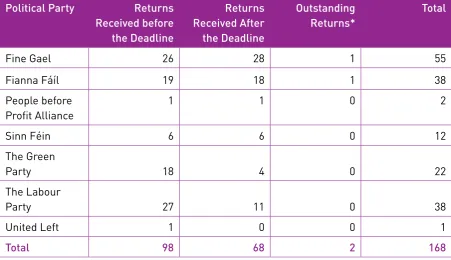
in this regard, as the following table shows. The documentation was required to be furnished to the Standards Commission by 31 March 2014.
Table of Accounting Units returns received in respect of 2013
Political Party Returns Received before the Deadline Returns Received After the Deadline Outstanding Returns* Total
Fine Gael 26 28 1 55
Fianna Fáíl 19 18 1 38
People before Profit Alliance
1 1 0 2
Sinn Féin 6 6 0 12
The Green
Party 18 4 0 22
The Labour
Party 27 11 0 38
United Left 1 0 0 1
Total 98 68 2 168
* Returns Outstanding at the time of writing.
The Standards Commission referred the non-compliant accounting units to the DPP/Gardaí on 4 June 2014.
In relation to the accounting unit returns for 2012 the Commission referred, on 22 May 2013, the following non-compliant accounting units to the DPP/Gardaí for investigation.
Table of non compliant Accounting Units referred in respect of 2012
Political Party Accounting Unit Outcome
Fine Gael (1) Partry Branch (Mayo) Gardaí unable to locate responsible person Sinn Féin (2) Allen, Larkin, O'Brien Complied 28 May 2013 Noel McCann (Ballinasloe) Complied 28 May 2013 The Green Party (1) Dublin South Complied 28 May 2013 The Labour Party (3) Dublin North Central Complied 24 May 2013 Wexford Constituency Complied 28 May 2013
[image:39.595.72.526.610.791.2]40
Chapter 3: ElectoralThe situation in relation to the Fine Gael Partry, Mayo, accounting unit is still with the Gardaí. It is a matter of regret that accounting units continue to fail to cooperate with the Commission and only comply with their statutory obligations subsequent to the matter being referred to the DPP/Gardaí.
Third Parties
From 1 January 2013, an organisation which receives a donation in excess of €100 in value
is considered to be a third party. On receipt of a donation for political purposes exceeding
€100 in value, a third party (see definition in Appendix 3), must register with the Standards
Commission and is subject to the same rules about acceptance of donations as political parties.
A third party, must, by 31 March each year, furnish the Standards Commission with:
■
■ a Certificate of Monetary Donations/Statutory Declaration (CMD) confirming that all donations were lodged to that account and that payments from the account were used for political purposes, and
■
■ a bank statement from the financial institution where its political donations
account is held.
One of the main differences between a third party and a political party, insofar as donations are concerned, is that a third party is not obliged to submit a Donation Statement/Statutory Declaration, whereas a political party is obliged to submit one.
On 22 January 2014 the Standards Commission wrote to 22 third parties seeking a CMD and a bank statement, if appropriate, in relation to their political donation accounts. All third parties were required to submit the relevant documents by 31 March 2014, in respect of 2013.
The table below identifies the registered third parties for 2014 along with those who have newly registered and those de-registered. In this regard some third parties continue with registration on the basis that donations continue to be received whereas some third parties opted to de-register because they are no longer active.
Third Parties Statutory Documentation received by 31 March
Current Status
Abortion Rights Campaign Yes (received 31 March 2014) Registered Alliance for Freedom and Democracy No (received 1 April 2014) Registered Alliance for Ireland No (received 7 April 2014) De-Registered Change Ireland Yes (received 13 March 2014) Registered Charter Group (The) Yes (received 24 March 2014) Registered Choice Ireland Yes (received 25 March 2014) Registered Christian Solidarity Yes (received 13 May 2014) Newly Registered
CÓIR Yes (received 20 March 2014) Registered
Future Matters Yes (received 31 March 2014) Registered Immigration Control Platform Yes (received 25 February 2014) Registered Libertas Yes (received 31 March 2014) Registered Mayo Reform Movement Yes (received 25 March 2014) Registered National Campaign for the Arts* No (received 1 April 2014) Registered National Independence Party Registered 30 January 2014 Newly Registered One House Yes (received 12 March 2014) De-Registered Peace and Neutrality Alliance** Yes (received 25 March 2014) Registered People's Movement Yes (received 30 January 2014) Registered Pro-Life Campaign Yes (received 31 March 2014) Registered RISE! Yes (received 31 March 2014) Registered Save Navan Hospital Campaign No (received 28 April 2014) Registered Seanad Reform Group/Democracy
Matters
Yes (received 12 February 2014) Registered
42
Chapter 3: Electoral* Having reviewed Bank Statements provided to the Standards Commission by the National Campaign for the Arts it was noted that Senator Fiach MacConghail donated €5,500 to the
National Campaign for the Arts (NCFA) during 2013. Section 23A(1)(ii) & Section 48A(1)(ii) of the Act states the maximum that may be accepted by a third party from an individual or a registered corporate donor in any calendar year is €2,500. When this issue was brought to
the NCFA’s attention it promised to refund to the Senator the donation received in excess of that allowed. The Standards Commission was later provided with proof of this refund.
** The Peace and Neutrality Alliance (PANA) engaged in correspondence with the Standards Commission concerning a donation bequeathed to it under the terms of a former member’s will. The Standards Commission advised PANA to submit their annual returns before the 31 March where the donations could be examined further. Having examined PANA’s bank statements the Standards Commission wrote and asked PANA to provide details (confirming Irish citizenship) of an individual who lodged a sterling cheque, to refund part of a donation from the trade union Transport Salaried Staffs’ Association (TSSA)which was in excess of that allowed and to refund part of the money bequeathed to it (under the terms of the will of a former member) which was in excess of that permissible. PANA were at the time of writing in the process of rectifying these issues and had been asked to provide evidence of any refunds made to the Standards Commission.
Corporate Donors
Register of Corporate Donors
A corporate donor is defined as including a body corporate and an unincorporated body of persons or a trust which makes a donation. A body corporate and any subsidiary thereof are deemed to be one person. In the case of a Corporate Donor, a donation in excess of the value of €200 cannot be accepted unless the Corporate Donor is registered in the Register
of Corporate Donors (maintained by the Commission) and a statement (i.e., a donation statement) is made on behalf of the Corporate Donor and furnished with the donation to the donee confirming that the making of the donation was approved by the Corporate Donor. The statement must be accompanied by a statutory declaration that to the best of the knowledge and belief of the person concerned, the statement is correct in every material respect and that the person has taken all reasonable action in order to satisfy him/herself as to the accuracy of the statement.
In January 2013 the Commission published Guidelines relating to the register of Corporate Donors which will be maintained by the Commission. Corporate donors who wish to make a donation for political purposes in excess of �200 must register with the Commission and
SIPTU registered with the Standards Commission as a Corporate Donor for 2014 on 31 March 2014. The Irish National Teachers Organisation (INTO) and UNITE the Union also registered as Corporate Donors for 2014 on 29 April and 23 May 2014 respectively. The TSSA has not yet registered as a Corporate Donor for 2014.
Reports of possible breaches
Media reports in March 2013 suggested that a number of Members of the Oireachtas intended to fly to the United States of America as part of a delegation funded and sponsored by
Family and Life, which declares itself to be a pro-life group. The Standards in Public Office Commission had concerns about the implications under electoral legislation of the acceptance by Members of such free travel. The donation of free/sponsored travel and accommodation falls within the definition of a donation and such a donation is subject to the normal
aggregation and reporting thresholds and donation limits. However, travel facilities and hospitality provided to a Member are not registrable interests within the meaning of the Ethics in Public Office Acts 1995 and 2001 where they are provided to a Member in the course and for the purpose of the performance of the functions of the person as a Member. The Commission wrote to the Members concerned and to the Committee on Members’ Interests of Dáil Éireann and the Committee on Members’ Interests of Seanad Éireann as it considered that members should take care to ensure that they did not breach the provisions of the Electoral Acts on the acceptance of donations.
44
Appendix 1: Recommendations for changeAppendix
Appendix 1: Recommendations for change
In previous Annual Reports, the Standards Commission summarised its recommendations for changes to ethics and electoral legislation. The major proposals are summarised in this Appendix, along with updates on any progress which may have taken place in the meantime. Minor proposals, such as technical amendments, are referred to in previous annual reports.Proposed procedural amendments to the Ethics Acts
■
■ The Standards Commission should directly lay its annual report before each
House of the Oireachtas rather than furnishing it to the Minister for Finance who then lays it (Introduction, Annual Report 2010);
■
■ power to appoint an Inquiry Officer to conduct a preliminary inquiry into a matter
in the absence of a complaint under the Ethics Acts (Chapter 1, ‘Own initiative inquiries’, Annual Report 2004);
■
■ provision for a quorum of not less than three members (including in all cases, the
Chairperson) be provided for the hearing of an investigation under the Ethics Acts
46
Appendix 1: Recommendations for changeOther proposed amendments to the Ethics Acts and
related legislation
■
■ a comprehensive act consolidating the Ethics Acts and all other legislation
providing for disclosure of interests and related provisions for public officials
(Chapter 2, ‘Overlapping Ethics Frameworks’ Annual Report 2009); the Minister for Public Expenditure and Reform is undertaking a full review of how to reform the existing ethics framework in order to develop a single, comprehensive
legislative framework, which the Government intends will be published in 2014 as the Public Sector Standards Bill (Chapter 2, ‘Public Sector Standards Bill’ Annual Report 2013);
■
■ amendment of the provisions for complaints about a ‘specified act’ to allow
reference to a high level statement of the ethical principles to be followed by public servants and public representatives (Chapter 2, ‘High Level Statement of Ethical Principles’, Annual Report 2009);
■
■ amendment of the definition of ‘connected person’ (see definition in Appendix 3)
to provide that a person is a “connected person” to a company (see definition in Appendix 3) of which he or she is a director and that the other directors of that company are also “connected persons” to that person (Chapter 2, ‘Connected Persons’, Annual Report 2009);
■
■ requirement that liabilities be disclosed as ‘registrable interests’ (Chapter 2,
‘Disclosure of Liabilities’, Annual Report 2009);
■
■ proposal that motions be initiated in the Houses of the Oireachtas to designate
the Chairpersons of Oireachtas Committees as office holders for the purposes of the Ethics Acts (Chapter 1, ‘Ethics Acts’ Annual Report 2005); the Minister for Finance decided not to move the resolutions (Chapter 4, ‘Proposed amendments to the Ethics Acts’, Annual Report 2008);
■
■ amendments to the time limits within which statutory declarations, tax clearance
certificates and application statements are to be made or issued and furnished to the Standards Commission by elected members and by appointees to senior positions and directorships in the public service (Chapter 1, ‘Tax Clearance Provisions - observations to the Minister for Finance ‘ Annual Report 2003);
the Civil Law (Miscellaneous Provisions) Act 2008 amends the deadline for the making of a statutory declaration by a person recommended for appointment to judicial office from one month to three; a similar provision for elected members and senior public servants is required (Appendix 4, ‘Proposed amendments to the Ethics Acts and related legislation’, Annual Report 2009);
■
■ adoption of a code of conduct for public servants and members of state boards