How to Memorize a Random 60-Bit String
Marjan Ghazvininejad Information Sciences Institute Department of Computer Science University of Southern California
Kevin Knight
Information Sciences Institute Department of Computer Science University of Southern California
Abstract
User-generated passwords tend to be memo-rable, but not secure. A random, computer-generated 60-bit string is much more secure. However, users cannot memorize random 60-bit strings. In this paper, we investigate meth-ods for converting arbitrary bit strings into En-glish word sequences (both prose and poetry), and we study their memorability and other properties.
1 Introduction
Passwords chosen by users (e.g., “Scarlet%2”) are easy to remember, but not secure (Florencio and Herley, 2007). A more secure method is to use a system-assigned 60-bit random password, such as 0010100010100...00101001. However, this string is hard to memorize. In this paper, we convert such strings into English phrases, in order to improve their memorability, using natural language process-ing to select fluent passphrases.
Our methods are inspired by an XKCD cartoon1
that proposes to convert a randomly-chosen 44-bit password into a short, nonsensical sequence of En-glish words. The proposed system divides the 44-bit password into four 11-bit chunks, and each chunk provides an index into a 2048-word English dictio-nary. XKCD’s example passphrase iscorrect horse battery staple:
1http://xkcd.com/936
44-bit password English phrase --- ---10101101010 -> correct
10010110101 -> horse 01010101010 -> battery 10110101101 -> staple
The four-word sequence is nonsense, but it is easier to memorize than the 44-bit string, and XKCD hy-pothesizes that users can improve memorability by building an image or story around the four words.
In this paper, we investigate other methods for converting a system-generated bit string into a mem-orable sequence of English words. Our methods pro-duce whole sentences, e.g.
Fox news networks are seeking views from downtown streets. as well as short poems, e.g.
Diversity inside replied, Soprano finally reside.
We also move to 60-bit passwords, for better secu-rity. One source claims:
As of 2011, available commercial prod-ucts claim the ability to test up to 2,800,000,000 passwords a second on a standard desktop computer using a high-end graphics processor.2
If this is correct, a 44-bit password would take one hour to crack, while a 60-bit password would take 11.3 years.
Our concrete task is as follows:
2http://en.wikipedia.org/wiki/Password cracking
Method Name Average Number of Words
Average Number of Characters
AVG LM
Score Capacity Sample Passwords
XKCD 4 31.2 -62.42 1 fees wesley inmate decentralizationphoto bros nan plain embarrass debating gaskell jennie
First Letter
Mnemonic 15 87.7 -61.20 2·1051
It makes me think of union pacific resource said it looks like most commercial networks . Some companies keep their windows rolled down so you don’t feel connected to any community .
Contains extreme violence and it was a matter of not only its second straight loss .
All Letter
Method 11.8 70.8 -58.83 3·1056
Parking and utilities have been searching for a third straight road win .
It was the same girl and now a law professor in the former east german town .
I know a man who said he was chief of staffs in a real and deep conversation .
Frequency
Method 9.7 55.5 -52.88 6·1014
Fox news networks are seeking views from downtown streets .
The review found a silver tree through documents and artifacts .
These big questions are bothering me a bit stronger .
Poetry 7.2 52.7 -73.15 106
[image:2.612.74.544.154.558.2]Joanna kissing verified soprano finally reside Diversity inside replied retreats or colors justified Surprise celebrity without the dragging allison throughout
• Input: A random, system-generated 60-bit password.
• Output: An English word sequence with two properties:
– It is memorable.
– We can deterministically recover the orig-inal input 60-bit string from it.
This implies that we map 260 distinct bit strings into260distinct English sequences. If a user memo-rizes the English word sequence supplied to them, then they have effectively memorized the 60-bit string.
2 Password Generation Methods
We now describe our baseline password generation method, followed by four novel methods. In Sec-tion 3 we experimentally test their memorability.
2.1 XKCD Baseline
Our baseline is a version of XKCD. Instead of a 2048-word dictionary, we use a 32,7868-word dic-tionary. We assign each word a distinct15-bit code. At runtime, we take a system-assigned 60-bit code and split it into four15-bit sequences. We then substitute each15-bit segment with its correspond-ing word. By docorrespond-ing this, we convert a random 60-bit code into a 4-word password.
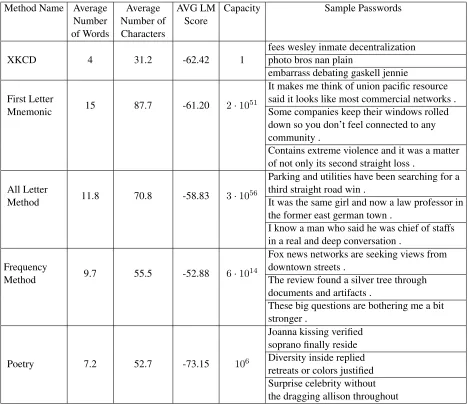
The first row of Table 1 shows three sample XKCD passwords, along with other information, such as the average number of characters (including spaces).
2.2 First Letter Mnemonic
XKCD passwords are short but nonsensical, so we now look into methods that instead create longer but fluent English sentences. We might think to guaran-tee fluency by selecting sentences from an already-existing text corpus, but no corpus is large enough to contain260 (∼ 1018) distinct sentences. Therefore, we must be able to synthesize new English strings.
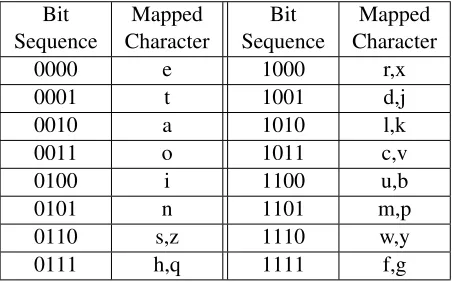
In our first sentence generation method (First Let-ter Mnemonic), we store our input 60-bit code in the first letters of each word. We divide the 60-bit code into 4-bit sections, e.g., ‘0100-1101-1101-...’. Every 4-bit sequence type corresponds to an English letter
Bit
Sequence CharacterMapped SequenceBit CharacterMapped
0000 e 1000 r,x
0001 t 1001 d,j
0010 a 1010 l,k
0011 o 1011 c,v
0100 i 1100 u,b
0101 n 1101 m,p
0110 s,z 1110 w,y
[image:3.612.314.541.60.201.2]0111 h,q 1111 f,g
Table 2: Mapping function between 4-bit sequences and English letters in the First Letter Mnemonic method.
or two, per Table 2. We build a word-confusion net-work (or “sausage lattice”) by replacing each 4-bit code with all English words that start with a corre-sponding letter, e.g.:
0100 1101 1111 ... 0011
---- ---- ----
----income my frog ... octopus
is miner feast ... of
inner priest gratuitous ... oregon
... ... ... ...
This yields about 1074 paths, some good (is my frog. . .) and some bad (income miner feast. . .). To select the most fluent path, we train a 5-gram language model with the SRILM toolkit (Stolcke, 2002) on the English Gigaword corpus.3 SRILM
also includes functionality for extracting the best path from a confusion network.
Table 1 shows sample sentences generated by the method. Perhaps surprisingly, even though the sen-tences are much longer than XKCD (15 words ver-sus 4 words), the n-gram language model (LM) score is a bit better. The sentences are locally flu-ent, but not perfectly grammatical.
We can easily reconstruct the original 60-bit code by extracting the first letter of each word and apply-ing the Table 2 mappapply-ing in reverse.
2.3 All Letter Method
Most of the characters in the previous methods seem “wasted”, as only the word-initial letters bear in-formation relevant to reconstructing the original
Bit Sequence Mapped Characters 0 e, o, i, h, r, c, u, f, g, b, v, x ,q 1 t, a, n, s, d, l, m, w, y, p, k, j, z
Table 3: Mapping function between bits and English characters in the All Letter Method.
bit string. Our next technique (All Letter Method) non-deterministically translateseverybit into an En-glish letter, per Table 3. Additionally, we non-deterministically introduce a space (or not) between each pair of letters.
This yields4·1084possible output strings per in-put,3·1056of which consist of legal English words. From those3·1056strings, we choose the one that yields the best word 5-gram score.
It is not immediately clear how to process a letter-based lattice with a word-letter-based language model. We solve this search problem by casting it as one of ma-chine translation from bit-strings to English. We cre-ate a phrase translation table by pairing each English word with a corresponding “bit phrase”, using Ta-ble 3 in reverse. Sample entries include:
din ||| 1 0 1
through ||| 1 0 0 0 0 0 0 yields ||| 1 0 0 1 1 1
We then use the Moses machine translation toolkit (Koehn et al., 2007) to search for the 1-best transla-tion of our input 60-bit string, using the phrase table and a 5-gram English LM, disallowing re-ordering.
Table 1 shows that these sentences are shorter than the mnemonic method (11.8 words versus 15 words), without losing fluency.
Given a generated English sequence, we can de-terministically reconstruct the original 60-bit input string, using the above phrase table in reverse.
2.4 Frequency Method
Sentence passwords from the previous method con-tain 70.8 characters on average (including spaces). Classic studies by Shannon (1951) and others esti-mate that printed English may ultiesti-mately be com-pressible to about one bit per character. This im-plies we might be able to produce shorter output (60 characters, including space) while maintaining nor-mal English fluency.
Our next technique (Frequency Method) modifies the phrase table by assigning short bit codes to fre-quent words, and long bit codes to infrefre-quent words. For example:
din ||| 0 1 1 0 1 0 1 0 0 through ||| 1 1 1 1
yields ||| 0 1 0 1 1 1 0 1
Note that the word din is now mapped to a 9-bit sequence rather than a 3-bit sequence. More pre-cisely, we map each word to a random bit sequence of length bmax(1,−α ×log P(word) + β)c. By changing variables α and β we can vary between smooth but long sentences (α = 1 andβ = 0) to XKCD-style phrases (α= 0andβ= 15).
Table 1 shows example sentences we obtain with α = 2.5 andβ = −2.5, yielding sentences of 9.7 words on average.
2.5 Poetry
In ancient times, people recorded long, historical epics using poetry, to enhance memorability. We fol-low this idea by turning each system-assigned 60-bit string into a short, distinct English poem. Our for-mat is therhyming iambic tetrameter couplet:
• The poem contains two lines of eight syllables each.
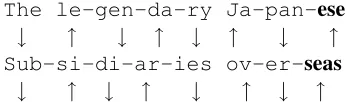
• Lines are in iambic meter, i.e., their syllables have the stress pattern 01010101, where 0 rep-resents an unstressed syllable, and 1 reprep-resents a stressed syllable. We also allow 01010100, to allow a line to end in a word likeAngela.
• The two lines end in a pair of rhyming words. Words rhyme if their phoneme sequences match from the final stressed vowel onwards. We obtain stress patterns and phoneme se-quences from the CMU pronunciation dictio-nary.4
Monosyllabic words cause trouble, because their stress often depends on context (Greene et al., 2010). For example,eighthis stressed ineighth street, but not in eighth avenue. This makes it hard to guar-antee that automatically-generated lines will scan as intended. We therefore eject all monosyllabic words
from the vocabulary, except for six unstressed ones (a,an,and,the,of,or).
Here is a sample poem password:
The le-gen-da-ry Ja-pan-ese
↓ ↑ ↓ ↑ ↓ ↑ ↓ ↑
Sub-si-di-ar-ies ov-er-seas
↓ ↑ ↓ ↑ ↓ ↑ ↓ ↑
Meter and rhyme constraints make it difficult to use the Moses machine translation toolkit to search for fluent output, as we did above; the decoder state must be augmented with additional short- and long-distance information (Genzel et al., 2010).
Instead, we build a large finite-state acceptor (FSA) with a path for each legal poem. In each path, the second line of the poem is reversed, so that we can enforce rhyming locally.
The details of our FSA construction are as fol-lows. First, we create a finite-state transducer (FST) that maps each input English word onto four se-quences that capture its essential properties, e.g.: create -> 0 1
create -> 0 1 EY-T create -> 1r 0r create -> EY-T 1r 0r
Here,EY-T represents the rhyme-class of words likecreateanddebate. Therindicates a stress pat-tern in the right-to-left direction.
We then compose this FST with an FSA that only accepts sequences of the form:
0 1 0 1 0 1 0 1 X X 1r 0r 1r 0r 1r 0r 1r 0r
where X and X are identical rhyme classes (e.g., EY-T and EY-EY-T).
It remains to map an arbitrary 60-bit string onto a path in the FSA. Letk be the integer representa-tion of the 60-bit string. If the FSA contains exactly 260 paths, we can easily select the kth path using the following method. At each node N of the FSA, we store the total number of paths from N to the final state—this takes linear time if we visit states in reverse topological order. We then traverse the FSA deterministically from the start state, usingkto guide the path selection.
Our FSA actually contains 279 paths, far more than the required 260. We can say that the informa-tion capacity of the English rhyming iambic tetram-eter couplet is 79 bits! Some are very good:
Sophisticated potentates misrepresenting Emirates.
The supervisor notified
the transportation nationwide.
Afghanistan, Afghanistan, Afghanistan, and Pakistan.
while others are very bad:
The shirley emmy plebiscite
complete suppressed unlike invite
The shirley emmy plebiscite
complaints suppressed unlike invite
The shirley emmy plebiscite
complaint suppressed unlike invite
Fortunately, because our FSA contains over a mil-lion times the required 260paths, we can avoid these bad outputs. For any particular 60-bit string, we have a million poems to choose from, and we out-put only the best one.
[image:5.612.111.284.111.162.2]More precisely, given a 60-bit input stringk, we extract not only the kth FSA path, but also the k+i·260 paths, with i ranging from 1 to 999,999. We explicitly list out these paths, reversing the sec-ond half of each, and score them with our 5-gram LM. We output the poem with the 1-best LM score. Table 1 shows sample outputs.
To reconstruct the original 60-bit stringk, we first find the FSA path corresponding to the user-recalled English string (with second half reversed). We use depth-first search to find this path. Once we have the path, it is easy to determine which numbered path it is, lexicographically speaking, using the node-labeling scheme above to recoverk.
3 Experiments
We designed two experiments to compare our meth-ods.
The first experiment tests the memorability of passwords. We asked participants to memorize a password from a randomly selected method5and
re-call it two days later. To give more options to users,
Method Participants Recalls Correct Recalls
XKCD 16 12 58.3%
All Letter
Method 15 9 33.3%
Frequency
Method 15 10 40.0%
[image:6.612.78.295.60.161.2]Poetry 16 13 61.5%
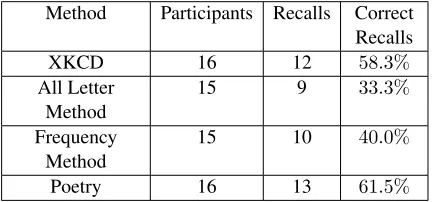
Table 4: Memorability of passwords generated by our methods. “Recalls” indicates how many participants re-turned to type their memorized English sequences, and “Correct Recalls” tells how many sequences were accu-rately remembered.
Method Name User preference
XKCD 5%
All Letter Method 39%
Frequency Method 37%
[image:6.612.74.302.246.311.2]Poetry 19%
Table 5: User preferences among passwords generated by our methods.
we let them select from the 10-best passwords ac-cording to the LM score for a given 60-bit code. Note that this flexibility is not available for XKCD, which produces only one password per code.
62 users participated in this experiment, 44 re-turned to recall the password, and 22 successfully recalled the complete password. Table 4 shows that the Poetry and XKCD methods yield passwords that are easiest to remember.
In the second experiment, we present a separate set of users with passwords from each of the four methods. We ask which they would prefer to use, without requiring any memorization. Table 5 shows that users prefer sentences over poetry, and poetry over XKCD.
4 Analysis
Table 4 shows that the Poetry and XKCD methods yield passwords that are easiest to memorize. Com-plete sentences generated by the All Letter and Fre-quency Methods are harder to memorize. At the same time Table 5 shows that people like the sen-tences better than XKCD, so it seems that they over-estimate their ability to memorize a sentence of 10-12 words. Here are typical mistakes (S =
system-generated, R = as recalled by user):
(S) Still looking for ruben sierra could be in central michigan
(R) I am still looking for ruben sierra in central michigan
(S) That we were required to go to college more than action movies (R) We are required to go to
college more than action movies
(S) No dressing allowed under canon law in the youth group
(R) No dresses allowed under canon law for youth groups
Users remember the gist of a sentence very well, but have trouble reproducing the exact wording. Post-experiment interview reveal this to be partly an effect of overconfidence. Users put little mental work into memorizing sentences, beyond choosing among the 10-best alternatives presented to them. By contrast, they put much more work into mem-orizing an XKCD phrase, actively building a mental image or story to connect the four otherwise unre-lated words.
5 Future Directions
Actually, we can oftenautomaticallydetermine that a user-recalled sequence is wrong. For example, when we go to reconstruct the 60-bit input string from a user-recalled sequence, we may find that we get a 62-bit string instead. We can then automati-cally prod the user into trying again, but we find that this is not effective in practice. An intriguing di-rection is to do automatic error-cordi-rection, i.e., take the user-recalled sequence and find the closest match among the 260English sequences producible by the method. Of course, it is a challenge to do this with 1-best outputs of an MT system that uses heuristic beam search, and we must also ensure that security is maintained.
6 Related Work
Gasser (1975), Crawford and Aycock (2008), and Shay et al. (2012) describe systems that produce meaningless but pronounceable passwords, such as “tufritvi” . However, their systems can only assign
∼230distinct passwords.
Jeyaraman and Topkara (2005) suggest generat-ing a random sequence of characters, and findgenerat-ing a mnemonic for it in a text corpus. A limited cor-pus means they again have a small space of system-assigned passwords. We propose a similar method in Section 2.2, but we automatically synthesize a new mnemonic word sequence.
Kurzban (1985) and Shay et al. (2012) use a method similar to XKCD with small dictionaries. This leads to longer nonsense sequences that can be difficult to remember.
7 Conclusion
We introduced several methods for generating cure passwords in the form of English word se-quences. We learned that long sentences are seem-ingly easy to remember, but actually hard to repro-duce, and we also learned that our poetry method produced relatively short, memorable passwords that are liked by users.
Acknowledgments
We would like to thank James Bedell, Aliya Deri, Tomer Levinboim, Jonathan May, Nima Pour-damghani and the anonymous reviewers for their very helpful comments. This work was supported in part by DARPA contract FA-8750-13-2-0045.
References
Heather Crawford and John Aycock. 2008. Kwyjibo: au-tomatic domain name generation. Software: Practice and Experience, 38(14):1561–1567.
Dinei Florencio and Cormac Herley. 2007. A large-scale study of web password habits. InProceedings of the 16th international conference on World Wide Web, pages 657–666. ACM.
Morrie Gasser. 1975. A random word generator for pronounceable passwords. Technical report, Elec-tronic Systems Division, Air Force Systems Com-mand, USAF.
Dmitriy Genzel, Jakob Uszkoreit, and Franz Och. 2010. Poetic statistical machine translation: rhyme and me-ter. InProceedings of the 2010 Conference on Empir-ical Methods in Natural Language Processing, pages 158–166. Association for Computational Linguistics. Erica Greene, Tugba Bodrumlu, and Kevin Knight. 2010.
Automatic analysis of rhythmic poetry with applica-tions to generation and translation. In Proceedings of the Conference on Empirical Methods in Natural Language Processing, pages 524–533. Association for Computational Linguistics.
Sundararaman Jeyaraman and Umut Topkara. 2005. Have your cake and eat it too–infusing usability into text-password based authentication systems. In Pro-ceedings of ACSAC.
Philipp Koehn, Hieu Hoang, Alexandra Birch, Chris Callison-Burch, Marcello Federico, Nicola Bertoldi, Brooke Cowan, Wade Shen, Christine Moran, Richard Zens, et al. 2007. Moses: Open source toolkit for sta-tistical machine translation. InProceedings of the 45th Annual Meeting of the ACL, Demo and Poster Ses-sions, pages 177–180. Association for Computational Linguistics.
Stanley A Kurzban. 1985. Easily remembered passphrases: a better approach. ACM SIGSAC Review, 3(2-4):10–21.
Claude E. Shannon. 1951. Prediction and entropy of printed English. Bell System Technical Journal, 30(1):50–64.
Richard Shay, Patrick Gage Kelley, Saranga Koman-duri, Michelle L Mazurek, Blase Ur, Timothy Vidas, Lujo Bauer, Nicolas Christin, and Lorrie Faith Cranor. 2012. Correct horse battery staple: Exploring the us-ability of system-assigned passphrases. In Proceed-ings of the Eighth Symposium on Usable Privacy and Security, page 7. ACM.