Mode locking and mode competition in a nonequilibrium solid-state condensate
P. R. Eastham
Blackett Laboratory, Imperial College London, London SW7 2BW, United Kingdom
共Received 20 March 2008; revised manuscript received 12 May 2008; published 21 July 2008兲
A trapped polariton condensate with continuous pumping and decay is analyzed using a generalized Gross– Pitaevskii model. Whereas an equilibrium condensate is characterized by a macroscopic occupation of a ground state, here the steady states take more general forms. Some are characterized by a large population in an excited state; others by large populations in several states, which may overlap spatially. In the latter case, the highly populated states synchronize to a common frequency above a critical density. At intermediate densities, they can drive condensation in other trap modes by parametric scattering. Estimates for the critical density of the synchronization transition are consistent with experiments.
DOI:10.1103/PhysRevB.78.035319 PACS number共s兲: 71.36.⫹c, 03.75.Kk, 42.55.Sa, 71.35.Lk
I. INTRODUCTION
Recent experiments1–3have provided substantial evidence for a new type of Bose–Einstein condensate, formed from polaritons in semiconductor microcavities.4 Although in
many respects these results parallel those of condensation in atomic gases, the similarities conceal some fundamental dif-ferences. In particular, the lifetime of a polariton is typically only a few picoseconds and is less than the lifetime of the condensate.2 The condensate is therefore a nonequilibrium
steady state in which the decaying polaritons are continually being replenished.
Several consequences of the nonequilibrium aspect of the system have now been predicted based on both microscopic calculations and generalizations of the Gross–Pitaevskii approach.5–10While these predictions are undoubtedly
inter-esting, more dramatic departures from the physics of equi-librium condensates are seen experimentally. An equiequi-librium condensate is characterized by a macroscopic occupation at the chemical potential; for a trapped ideal Bose gas, this is the ground-state energy of the trap, while more generally it is the lowest eigenvalue of the Gross–Pitaevskii equation. In some experiments, there is indeed evidence for equilibrated polariton distributions and large occupations of the kជ= 0 ground state of untrapped polaritons,1–3 but in others there
are massive occupations associated with excited states. This has been observed in pillar traps,11 lattices,12 and disorder.13,14Such results have been argued to be evidence of
polariton lasing,11 distinct from condensation, but this
dis-tinction is clear only to the extent that condensation is re-stricted to equilibrium.
The aim of this paper is to outline a theory of the trapped polariton condensate with pumping and decay. The treatment is based on a recently proposed generalized Gross–Pitaevskii equation共gGPE兲.6,7Motivated by the recent experiments, we
go beyond the assumption5–8,15,16of condensation at a single
ground-state energy and systematically investigate how the dynamics of the pumped system can lead to more general forms. We first consider a small trap at low densities and show that the gGPE reduces to kinetic equations for the oc-cupations of the trap states. The ococ-cupations of the states are determined by gain and loss processes which are indepen-dent of energy, i.e., a laserlike mode competition. Thus, the
steady-state solutions can include massive occupations of an excited state or of several states simultaneously; the charac-ter of the steady states in this limit can be predicted from the wavefunctions of the trap.
Having established the steady-state structure at low den-sities, we then numerically explore how it changes away from this limit. We demonstrate that if the trap is such that there are several massively occupied states at low densities, then above a threshold density, the steady state reverts to a massive occupation at a single energy. This can be under-stood as the classical phenomenon of synchronization共mode locking兲 of coupled nonlinear oscillators.17 Supposing that
the dominant nonlinearity is the polariton-polariton interac-tion, we predict that, for realistic parameters, polariton sys-tems could be tuned through the synchronization transition. They thus give access to both an interaction dominated re-gime and a rere-gime of laserlike mode competition.
A recent independent paper of Wouters18 discusses the
synchronization of two nonequilibrium polariton condensates in a double-well trap. He found a threshold nonlinearity where the condensates lock to a single frequency, in general agreement with our results. However, that analysis assumes a double well with two separate regions for condensation. For such a trap, modeled on the usual Josephson weak link, there are no mode-competition effects. In contrast, we present an analysis of the low-density regime in an arbitrary trap. This analysis predicts that spatial separation is not needed to ob-tain coexisting condensates, in agreement with a recent experiment.13 Our numerical work then predicts synchroni-zation between such spatially coexisting condensates with increasing density.
We consider the order-parameter equation,7
it=兵H0+U兩兩2+i关␥eff共r兲−⌫兩兩2兴其. 共1兲
This complex Ginzburg–Landau form has been argued6,7 to be the generic mean-field description of a polariton conden-sate with continuous pumping and decay. The first two terms on the right form the standard Gross–Pitaevskii mean-field equation, with local density 兩兩2. H
0 includes a quadratic
Bohr radius. The polarization degeneracy of the polaritons has been neglected for simplicity; it could be treated using a two-component order-parameter equation.15
The last two terms on the right of Eq.共1兲account for the pumping and decay. The pumping model involves a reservoir of high-energy particles created by some external excitation. The condensate is populated by stimulated scattering from this reservoir, contributing a linear gain termi␥共r兲, where
␥共r兲 is related to the reservoir density. This term combines with a similar term from the decay of the polaritons, giving the overall linear gain term, with coefficient␥eff, in Eq.共1兲. However, the rate of condensate growth should reduce with increasing density as the pump reservoir becomes depleted. This effect, modeled using a single gain-saturation coeffi-cient⌫, gives the final term in Eq.共1兲. Physically, this form of pumping can be interpreted in terms of a pump which tries to locally enforce a steady-state density␥eff共r兲/⌫.
II. STRONG-TRAPPING LIMIT
The steady states of Eq. 共1兲 can be determined analyti-cally in the limit of strong trapping, where the nonlinearities are weak compared with the single-particle level spacing. We may then treat them with degenerate perturbation theory. We expand 共r,t兲 in terms of the eigenstates of H0, n0, and retain only the resonant terms in the resulting equations. To simplify the notation, we analyze a trap with only two single-particle states, so共r,t兲=1共t兲10共r兲+2共t兲20共r兲, and assume
homogeneous pumping. The amplitude1共t兲 关2共t兲兴obeys
i˙1共2兲=关E1共2兲+i␥eff+共U−i⌫兲共1共2兲兩1共2兲兩2
+ 2兩2共1兲兩2兲兴1
共2兲. 共2兲
Here,Eiis the single-particle energy, and the wavefunctions have been taken to be normalized and real. 1=u1111, 2
=u2222, and=u1122are matrix elements for a local
nonlin-earity,
uppqq=
冕
共p0兲2共q0兲2dr. 共3兲They parametrize the inhomogeneous density profile of the trap states, with 1 and2 describing the inhomogeneity of the states and their overlap.
Introducing number and phase variables in a rotating frame,
1共2兲共t兲=e−it␥effU/⌫
冑
n1共2兲共t兲e−i1共2兲共t兲, 共4兲separates the number and phase dynamics. The former obeys the rate equations,
n˙1共2兲= 2⌫n1共2兲共␥eff/⌫−1共2兲n1共2兲− 2n2共1兲兲, 共5兲
with terms describing the stimulated scattering from the res-ervoir and the spontaneous decay, and the resres-ervoir deple-tion. This result can be understood as a generalization of the kinetic description of polariton lasing19–22to treat the spatial structure of the trap. It describes the extensive component of the occupation, and hence effects such as spontaneous pump-ing are misspump-ing. They would be important for a finite system close to the threshold.23
The phase dynamics is straightforward, obeying
˙
1共2兲=E1共2兲−U共␥eff/⌫−1共2兲n1共2兲− 2n2共1兲兲. 共6兲
Each mode oscillates freely at a single-particle energy, which is shifted by the repulsive interactions.
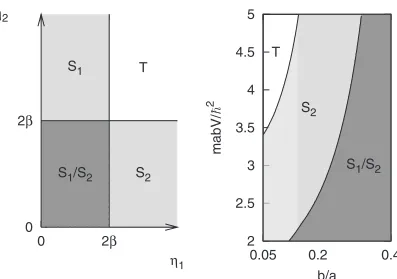
Equation 共5兲 has several steady-state solutions above the bulk condensation threshold ␥eff= 0. There are always two solutions corresponding to condensation in each of the trap states: eithern1s=␥eff/共1⌫兲is finite andn2s= 0 vanishes共state
S1兲, or vice versa共stateS2兲. However, if either1,2⬎2or 1,2⬍2, there is also a steady stateT with massive oc-cupations of both trap states
n1共2兲=␥eff⌫
冉
2−2共1兲
42−12
冊
. 共7兲The left panel of Fig. 1 shows the parameter regions in which the different steady states are stable. Linearizing Eq. 共5兲about the steady stateS1, we find that population
fluctua-tions decay with rates 1= 2␥ and2= 2␥共2/1− 1兲. Thus, this solution is stable for1⬍2. This is the condition that the occupation of the first trap state alone, determined by the pumping and the self-gain-saturation parameter 1, is suffi-cient to keep the second below threshold. The analogous condition2⬍2holds for the existence of a stable solution in which only the second trap state is occupied,S2. If neither
criterion is satisfied, both states must be occupied, and this is where the two-mode solution T is stable—fluctuations there decay with rates 2␥and −2␥共2−1兲共2−2兲/共42−12兲.
The different steady-state solutions can be realized in many different potentials. For two widely separated states, we generically have →0 and hence obtain two coexisting condensates. While this result is perhaps expected for sepa-rated traps, it can nonetheless also occur when there is sub-stantial spatial overlap. A simple model which demonstrates this is a one-dimensional hard-wall trap of sizeawith a finite
0 2β
0 2β η2
η1
T S1
S2 S1/S2
2 2.5 3 3.5 4 4.5 5
0.05 0.2 0.4
mabV/
2
b/a S1/S2
[image:2.609.338.537.65.205.2]S2 T
FIG. 1. Left panel: steady-state structure for condensation in a two-state trap for the generalized Gross–Pitaevskii model, neglect-ing nonresonant terms关Eq.共2兲兴. Lettering denotes the stable steady states in each region: condensation in both trap states共T兲, state 1 alone共S1兲, or state 2 alone共S2兲. In the lower left region, bothS1and
trap of sizeband depthVat its center. The right panel of Fig. 1shows the different steady-state regions for the two lowest eigenstates of this potential.
Experimentally, the presence of massively occupied states in polariton systems is shown by bright luminescence peaks. The characteristic frequencies in such optical spectra follow from Eq. 共6兲. In S1共S2兲, the massively occupied states will
lead to strong emission at the frequency U␥eff/⌫+E1共2兲,
while inTboth peaks appear simultaneously. Note that here the blueshift of the condensing modes is U␥eff/⌫,
irrespec-tive of which steady state we consider. Physically, this is because the energy shifts are determined by the density, which is fixed by the pumping.
In addition to the strong emission associated with the con-densing states, we also expect peaks in the optical response associated with the noncondensing trap states. These peaks can be understood as the confined quasiparticle excitations above the condensate. For the mean-field model 共1兲 in the resonant approximation, these states are not populated and hence would appear in the absorption but not the lumines-cence. However, they could be populated by effects beyond that model, in which case they would appear weakly in lu-minescence. These peaks are shifted by the mean-field repul-sion with the condensate, so inS1the absorption peak will be
atE2+ 2Un1. Since its width will be proportional to2, the
mode is narrow close to the critical line 1= 2, where it goes unstable.
III. BEYOND STRONG-TRAPPING
Having established the physics of Eq. 共1兲 in the strong-trapping regime, we now investigate how it develops with increasing nonlinearity. To do this we use real-space discreti-zation to solve Eq. 共1兲 directly for the one-dimensional model described above. This potential is chosen as a simple few-parameter model, which can be tuned into the different steady-state regions. We choosea=m=⌫= 1, takinga as the unit of length,ប2/共ma2兲 as the unit of energy, and working with a rescaled density兩兩2→兩兩2/⌫. Both the repulsive
in-teractionUand the gain saturation ⌫are believed to be sig-nificant for polaritons,1,6,7and so for this demonstration, we
takeU/⌫= 1.
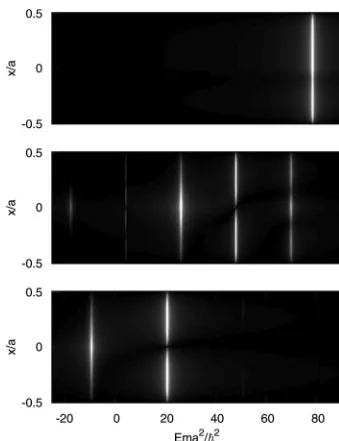
Figure 2 illustrates how the steady-state spectra develop with increasing pumping. The analysis above, applied to the two lowest states of this potential, predicts the two-mode steady stateT. This is in agreement with the results at weak pumping共lowest panel兲. Increasing the pumping, there is the overall blueshift associated with the increased density. The lowest two modes still dominate the spectrum, but their en-ergy splitting has reduced slightly, and several further emis-sion peaks appear 共middle panel兲. Further increasing the pumping, the spectrum switches to emission at a single fre-quency共top panel兲.
These effects are due to the nonresonant terms dropped from Eq. 共2兲. In a two-mode model with states of opposite parity, for example, there is the additional Josephson term
共U−i⌫兲1ⴱ共2兲2共1兲2共1兲 共8兲
in the Eq.共2兲for1共2兲. Thus, the nonresonant terms couple together the phases of the condensing modes, leading to
fre-quency pulling and eventually synchronization.17 They also
couple the phases of the condensed and uncondensed trap states, modifying the normal-mode frequencies of the latter. This can be understood as a renormalization of the quasipar-ticle spectrum by the condensate共s兲, which in the limit of an equilibrium, untrapped condensate leads to the usual Bogo-liubov spectrum. Finally, we note that the nonresonant terms allow the condensing states to drive nonlinear emission at other frequencies. The highest energy line in the middle panel of Fig.2, for example, can be interpreted as a conden-sate in the third trap state, generated by parametric scattering from the condensates in the two lowest trap states.
Coupled oscillators synchronize to a common frequency when the phase-phase couplings become comparable to their energy splitting ⌬. Since here the states have similar and overlapping density profiles, the matrix elements 共3兲 are all of order one. The scale of the phase-dependent couplings, which would appear in Eq. 共6兲, is then set only by the non-linearity
冑
U2+⌫2 and the polariton density ⬇␥eff/⌫. We may thus estimate the critical densitycor pump strength␥c from⌬⬃c
冑
U2+⌫2⬃␥c冑
1 +U2/⌫2. 共9兲 This form is consistent with Fig. 2 and with simulation re-sults共not shown兲for other values of the nonlinearitiesUand ⌫. In particular, in the same model, the synchronization oc-curs between ␥eff/⌫= 20 and 40 when U= 0, and betweenU/⌫= 20 and 40 at fixed ␥eff/⌫= 1.
[image:3.609.350.520.65.286.2]Synchronization due to nonlinear gain is well known as the basis for mode-locked lasers. However, an important dif-ference between the polariton condensate and a laser is the FIG. 2. Spectral analysis of the polariton field in the steady states of the generalized Gross–Pitaevskii model with the potential described in the caption of Fig. 1. The pump strength increases through ␥eff= 1 , 30, 60 from the lowest panel to the highest. The grayscale is the computed amplitude兩共E,x兲兩, normalized by
冑
␥eff to account for the overall increase in density.U/⌫= 1,b= 0.05 andpresence of strong interactions Ubetween the particles due to the excitonic component of the polariton. Thus, frequency pulling and synchronization could be expected to have a much wider role in the physics of polariton condensates than they do in lasers, occurring on large energy scales at low intensities.
Let us estimate the critical polariton density c for syn-chronization, supposing it is controlled by the real nonlinear-ity U. Estimates of this interaction are available for plane-wave excitons in a perfect quantum well and the localized exciton states of a disordered quantum well.24 For current experiments, a plausible upper limit is the result U
⬃⍀R共mxW兲−1from the disordered models, with disorder en-ergy scale W⬃1 meV. mx⬃0.5me is the exciton mass and ⍀R⬃20 meV the Rabi splitting. Thus, the phase boundary for synchronization in a trap of scaleLtis
⍀R共mxW兲−1c⬃1/共mLt
2兲. 共10兲
For a trap of Lt⬃5 m 共Refs. 11 and13兲 and a polariton mass m⬃10−5m
e, this gives c⬃1011 cm−2 or nc⬃Lt2c ⬃103. This estimate is about one order of magnitude larger
than the densities usually reported for polariton condensates. Thus, with a suitable potential, coexisting polariton conden-sates of different frequencies should be expected in tight traps. The synchronization transition could then be observed with increasing density, if necessary using larger traps to reducecinto the experimentally accessible range.
Since we do not expect synchronization at current densi-ties in tight traps, the present theory is consistent with the observations there of well-resolved emission lines.11,13It also
appears to be consistent with the existence of long-range coherence1,14at current densities with softer traps formed by disorder.
IV. CONCLUDING REMARKS
Because the tightly trapped polariton condensate has well-resolved emission lines, it could provide a sensitive probe of the physics of nonequilibrium condensates. In particular, the
present results will allow the order parameter Eq. 共1兲to be tested. While this form certainly captures much of the physics,6,7 effects that are important elsewhere are missing.
Most obviously, there is no thermalization with the reservoirs,25,26 which exchange particles with the system
ir-respective of energy and do not directly cause transitions between trap states. Such effects would appear in generali-zations of the kinetic Eq. 共5兲. Since some groups1,2 report
thermalized distributions, such generalizations may prove necessary.
To conclude, we have considered the trapped polariton condensate in the framework of a generalized Gross-Pitaevskii model. At low densities, this model admits solu-tions that, differently from an equilibrium condensate, in-volve massive occupations of excited states or of several states simultaneously. We have derived criteria for predicting the nature of the steady states in a given geometry and shown that the steady states are selected by gain-competition ef-fects. At a general level, such physics is of course familiar in lasers, although it has not previously been considered for the polariton system. Moreover, the direct interactions between polaritons create differences compared with the photon laser: blueshifting the modes in the weak-nonlinearity regime and enhancing frequency pulling and synchronization in the strong-nonlinearity regime. Our estimates for the critical density of the synchronization transition suggest that it could be cleanly observed in tight traps11and is likely to be
respon-sible for the observations of long-range coherence across dis-order potentials.1,14This latter conclusion could be
strength-ened by extending the present work to include共i兲a realistic model of the states in a disorder potential,共ii兲thermalization processes, and 共iii兲 fluctuations beyond the mean-field theory23—which lead to linewidths13 for the condensing
modes and hence compete with the synchronization.
ACKNOWLEDGMENTS
This work was supported by EPSRC-GB Grant No. EP/ C546814/01. I acknowledge helpful correspondence with M. Wouters.
1J. Kasprzaket al., Nature共London兲 443, 409共2006兲.
2H. Deng, D. Press, S. Gotzinger, G. S. Solomon, R. Hey, K. H.
Ploog, and Y. Yamamoto, Phys. Rev. Lett. 97, 146402共2006兲. 3R. Balili, V. Hartwell, D. Snoke, L. Pfeiffer, and K. West,
Sci-ence 316, 1007共2007兲.
4M. S. Skolnick, T. A. Fisher, and D. M. Whittaker, Semicond.
Sci. Technol. 13, 645共1998兲.
5M. H. Szymanska, J. Keeling, and P. B. Littlewood, Phys. Rev.
Lett. 96, 230602共2006兲.
6M. Wouters and I. Carusotto, Phys. Rev. Lett. 99, 140402 共2007兲.
7J. Keeling and N. G. Berloff, Phys. Rev. Lett.共to be published兲. 8K. G. Lagoudakis, M. Wouters, M. Richard, A. Baas, I.
Caru-sotto, R. André, L. S. Dang, and B. Deveaud-Plédran, arXiv:0801.1916共unpublished兲.
9H. Vinck-Posada, B. A. Rodriguez, P. S. S. Guimaraes, A. Cabo,
and A. Gonzalez, Phys. Rev. Lett. 98, 167405共2007兲. 10P. R. Eastham, J. Phys.: Condens. Matter 19, 295210共2007兲. 11D. Bajoni, P. Senellart, E. Wertz, I. Sagnes, A. Miard, A.
Lemaître, and J. Bloch, Phys. Rev. Lett. 100, 047401共2008兲. 12C. W. Laiet al., Nature共London兲 450, 529共2007兲.
13A. P. D. Love, D. N. Krizhanovskii, D. M. Whittaker, R.
Bouchekioua, D. Sanvitto, S. Al Rizeiqi, M. S. Skolnick, P. R. Eastham, R. André, and L. S. Dang, Phys. Rev. Lett. 共to be published兲.
14A. Baas, K. G. Lagoudakis, M. Richard, R. André, L. S. Dang,
and B. Deveaud-Plédran, Phys. Rev. Lett. 100, 170401共2008兲. 15I. A. Shelykh, Y. G. Rubo, G. Malpuech, D. D. Solnyshkov, and
A. Kavokin, Phys. Rev. Lett. 97, 066402共2006兲.
and I. Shelykh, Phys. Rev. Lett. 98, 206402共2007兲.
17A. Pikovsky, M. Rosenblum, and J. Kurths, Synchronization 共Cambridge University Press, Cambridge, 2001兲.
18M. Wouters, Phys. Rev. B 77, 121302共R兲 共2008兲.
19D. Porras, C. Ciuti, J. J. Baumberg, and C. Tejedor, Phys. Rev. B 66, 085304共2002兲.
20F. Tassone and Y. Yamamoto, Phys. Rev. B 59, 10830共1999兲. 21G. Malpuech, A. Kavokin, A. Di Carlo, and J. J. Baumberg,
Phys. Rev. B 65, 153310共2002兲.
22D. Sarchi and V. Savona, Phys. Rev. B 75, 115326共2007兲. 23P. R. Eastham and P. B. Littlewood, Phys. Rev. B 73, 085306
共2006兲.
24J. Keeling, F. M. Marchetti, M. H. Szymanska, and P. B.
Little-wood, Semicond. Sci. Technol. 22, R1共2007兲. 25M. O. Scully, Phys. Rev. Lett. 82, 3927共1999兲.
26H. T. Cao, T. D. Doan, D. B. Tran Thoai, and H. Haug, Phys.