www.ijpes.com
International Journal of Psychology and Educational
Studies
Predictors of the Social Validity Judgments of Early Childhood
Intervention Performance Checklists and Practice Guides
Carl J. Dunst
1& Deborah W. Hamby
11Orelena Hawks Puckett Institute, Asheville, NC, US
ARTICLE INFO ABSTRACT
Article History: Received 10.09.2016 Received in revised form 21.11.2016
Accepted 20.12.2016 Available online 01.01.2017
Early childhood intervention practitioners (N = 42) reviewed three early intervention performance checklists and three intervention practice guides and made social validity judgments of the acceptability and importance of the products. Both the checklists and practice guides included evidence-based characteristics and indicators that are known to be related to improved child learning and development. Hierarchical regression analyses of the relationship between five predictor variables and the study participants’ social validity judgments and found that only practitioners’ cognitive appraisals of the checklists and practice guides accounted for significant amounts of variance in their social validity judgments beyond that accounted for by the other predictors (education, years of experience, primary role, and type of program). The importance of cognitive appraisals for understanding their influence on practitioner social validity judgments are described as are the limitations of the study.
Keywords:1
Early childhood intervention, social validity judgments, performance checklists, practice guides, practitioner cognitive appraisals
1.Introduction
Early childhood intervention practices for young children with developmental disabilities or delays include different kinds of activities, experiences, and events designed to enhance child learning and development (Dunst, 2007). The extent to which intervention practices are used with fidelity is dependent, in part, on practitioners’ or parents’ judgments of the acceptability and importance of the practices and the expected outcomes of the practices (Dunst, Trivette, & Raab, 2013). These types of value statements have been described as social validity judgments (Foster & Mash, 1999; Schwartz & Baer, 1991). According to Strain et al. (2012), evidence “suggests that there is a positive correlation between [end-users] ‘liking’ an intervention (i.e., finding it acceptable and doable) and implementing the intervention with fidelity” (p. 197).
Findings from studies of the relationships between social validity judgments and the fidelity of use of different kinds of intervention practices (Pittenger, Barahona, Cavalari, Parent, & K., 2014; Vancel, Missall, & Bruhn, 2016; Wehby, Maggin, Moore Partin, & Robertson, 2011), including studies of early childhood intervention practices (e.g., Dunst, Raab, & Hamby, 2016; Strain et al., 2012), show that positive judgments of the acceptability and importance of the practices account for significant amounts of variance in adherence to the use of the key characteristics of different kinds of intervention practices. Little is known, however, about the personal and situational characteristics that influence practitioners’ judgments of the social validity judgments of different kinds of intervention practices. Vancel et al. (2016), in one of the few studies investigating factors associated with variations in the social validity judgments of school-based practices, found that school level
1 Corresponding author’s address:Orelena Hawks Puckett Institute, Asheville, NC, US e-mail:[email protected]
differences (e.g., elementary vs. high school) but not teacher personal characteristics (e.g., gender) were associated with differences in teacher social validity ratings.
There is reason to expect that practitioners’ cognitive appraisals of intervention practices might contribute to variations in their social validity judgments of different kinds of practices. Cognitive appraisals are a person’s personal interpretation of life experiences and events (Yap & Tong, 2009). According to self-efficacy and cognitive appraisal theories, these beliefs can be either positive or negative and differentially affect personal interpretations of the same or similar life events and experiences (e.g., Bandura, 1993; Tong, 2013). Findings from a number of studies indicate that positive and negative cognitive appraisals in fact result in different interpretations of the same life events and experiences (e.g., Nyer, 1997; Paškvan, Kubicek, Prem, & Korunka, 2016; Silvia, 2005).
1.1.Purpose of the Study
The purpose of the analyses described in this brief report was to determine if early childhood practitioner personal characteristics (e.g., years of experience, educational degree), practitioner primary intervention role, type of early childhood program (U.S. Department of Education Early Childhood Intervention vs. U.S. Health and Human Services Early Head Start), or early childhood practitioner cognitive appraisals, were associated with variations in practitioners’ judgments of early childhood intervention performance checklists and practice guides. The data were collected as part of field-tests of the importance and acceptability of three different early childhood intervention performance checklists and three different early childhood intervention practice guides.
The performance checklists were developed using a conceptualization-operationalization-measurement framework (Dunst, Trivette, & Raab, 2015) to delineate subsets of evidence-based intervention practices for several of the Division for Early Childhood (2014) recommended practices. The checklists include internally consistent sets of practice indicators that, taken together, are the key characteristics of a particular intervention practice (e.g., practices for strengthening adult-child interactions). The checklist indicators in turn were used to develop practice guides that included specific activities for using the checklist indicators to influence child outcomes. The two different products (checklists and practice guides) are intended to be used by early childhood intervention practitioners with the children with whom they work or with parents to promote their use of the practices with their children.
2. Method 2.1. Participants
Table 1. Background characteristics of the early childhood intervention field-test participants
Respondent characteristics Number Percent
Education degree
Associates degree 8 19.0
Bachelors degree 15 35.7
Masters degree 17 40.5
Doctorate degree 2 4.8
Professional discipline
Early childhood education 24 57.1
Early childhood special education/special education 10 23.8
Othera 8 19.1
Years of experience
< 1 1 2.4
2-5 10 23.8
6-10 12 28.6
11-15 7 16.7
16-20 7 16.7
21+ 5 11.9
Type of Program
Early childhood intervention programs 24 57.2
Early head start program 18 42.8
aSpeech and language pathologists, child and family specialists, and early interventionists.
2.2. Field Test Survey
Each participant reviewed a performance checklist and companion practice guide and then completed a survey that included social validity judgments of the (a) checklists, (b) the practice guides, and (c) the relationship (compatibility) between the checklists and practice guides. The three sections each included four social validity items that were developed using Foster and Mash’s (1999) framework for assessing the importance and acceptability of intervention practices and the outcomes of the practices. Each item was rated on a 5-point scale ranging from do-not-agree-at all to agree-a-great-deal with the social validity statements (e.g., “The checklist items are easy to understand and follow,” “The practice guide would be worth my time and effort to use”). Factor analysis of each set of ratings produced single factor solutions with coefficient alphas of 0.90, 0.85, and 0.92 for the checklist, practice guide, and compatibility items respectively.
The survey also included questions about the background characteristics of the participants shown in Table 1, a 5-point scale for ascertaining each practitioner’s primary role providing early intervention to young children, and a series of open-ended questions asking participants for suggestions to improve the checklists and practice guides. The responses for identifying the practitioners’ primary role choices were: (1) work directly with children on a one-to-one basis, (2) work directly with children in groups, (3) explain my interventions to the parents of the children, (4) illustrate my interventions to the children’s parents, and (5) build parent capacity to implement my interventions with their children. The scale is modeled after one used by Dunst et al. (2014) to represent contrasting types of intervention practices (child-focused vs. parent-focused).
checklists and practice guides. The measure was computed as a balance score for the number of positive comments minus the number of suggestion comments for each practitioner.
2.3. Predictor Variables
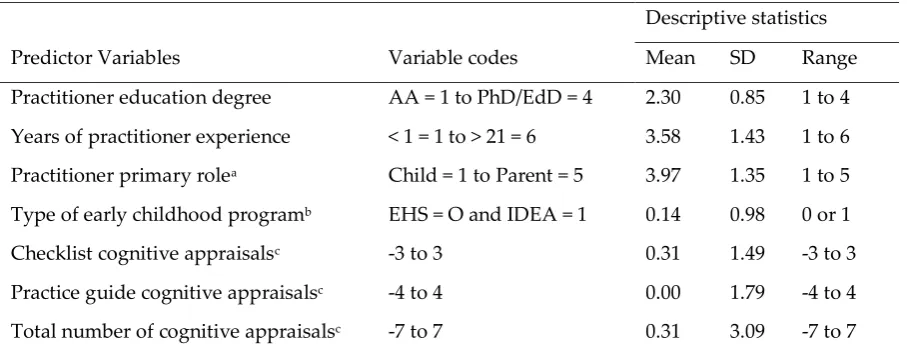
Table 2 shows the means, standard deviations, ranges for five predictor variables, and the variable codes used in data analysis. All of the predictor variables except type of early childhood program were coded at an ordinal or interval scale level, whereas program type was coded as a nominal scale for ascertaining type of program differences on practitioner social validity judgments.
2.4. Method of Analysis
Hierarchical multiple regression analysis (Cohen, Cohen, West, & Aiken, 2003) was used to evaluate the relationships between the predictor variables and the practitioners’ social validity judgments. The variables were entered into the analyses in the following order: Practitioner education level, practitioner years of experience, practitioner primary role, program type, and practitioner cognitive appraisals. Three regressions were performed: One for the checklist social validity judgments with the number of practitioner checklist cognitive appraisals as the predictor variable, one for the practice guide social validity judgments with the number of practitioner practice guide cognitive appraisals as the predictor variable, and one for the checklist-practice guide relationship social validity judgments with the total number of practitioner checklist and practice guide cognitive appraisals as the predictor variable.
Table 2. Predictor variables for the social validity analyses
Descriptive statistics
Predictor Variables Variable codes Mean SD Range
Practitioner education degree AA = 1 to PhD/EdD = 4 2.30 0.85 1 to 4 Years of practitioner experience < 1 = 1 to > 21 = 6 3.58 1.43 1 to 6 Practitioner primary rolea Child = 1 to Parent = 5 3.97 1.35 1 to 5 Type of early childhood programb EHS = O and IDEA = 1 0.14 0.98 0 or 1
Checklist cognitive appraisalsc -3 to 3 0.31 1.49 -3 to 3
Practice guide cognitive appraisalsc -4 to 4 0.00 1.79 -4 to 4 Total number of cognitive appraisalsc -7 to 7 0.31 3.09 -7 to 7 aScored on a continuum from primarily child-focused to primarily parent-focused interventions.
bEHS = Early Head Start Program
IDEA = Individuals with Disabilities Education Act Early Childhood Programs.
c The balance scores were computed as the number of positive comments minus the number of suggestions for each practitioner.
3. Results
3.1. Correlations
Table 3. Correlations between the predictor variables and the practitioner social validity judgments
Social validity Predictor variables
Study measures PC PG CP ED YE PR TP CA
Social validity judgments
Performance checklists (PC) - .53e .58e .08 .03 -.24 -.04 .54e
Practice guides (PG) - .73e .29 -.05 .08 .01 .37b
Checklist-practice guides (CP) - .27 -.06 .04 .06 .42d
Predictor variables
Education degree (ED) - -.25 .16 .61e -.13
Years of experience (YE) - -.15 -.40c -.18
Practitioner primary role (PR) - .32a .10
Type of program (TP) - .12
Cognitive appraisals (CA) -
ap = .041, bp = .015, cp = .008, dp = .006, ep = .000 (two-tailed tests).
To be assured multicollinearity among the predictor variables would likely not affect the regression analysis results we first ran diagnostic tests to determine if the VIFs (Variance Inflation Factors) were below a recommended threshold of three. This was done by treating each predictor variable as a dependent measure and the other four variables as predictors. Five analyses were run with each predictor variable as a dependent measure. The median VIF was 1.19 (Range = 1.04 to 1.84) indicating that multicollinearity was minimally present among the predictor variables.
3.2. Regression Analyses
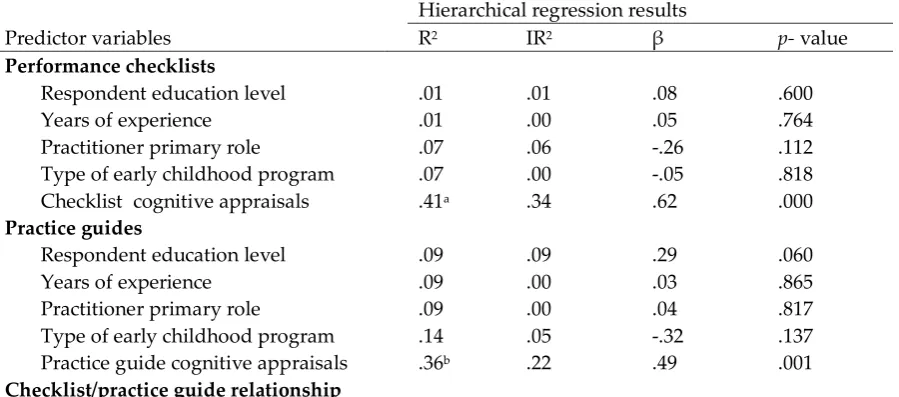
The results for the three regression analyses are shown in Table 4. In each analysis, R2 was significant only at the last step in the regression analyses. Between 36% and 41% of the total variance in the practitioners’ social validity judgments was explained by the five predictor variables.
Practitioner cognitive appraisals of the checklists and practice guides were the only predictor variables significantly related to variations in the social validity judgments in each of the three analyses. Between 22% and 34% of the variance in social validity ratings were accounted for by the practitioners’ cognitive appraisals after the effects of the other predictor variables were partialled from the analyses. In all three analyses, the more positive the practitioners’ cognitive appraisals, the more socially valid they rated the checklists and practice guides as evidenced by the direction of the signs of the standardized regression coefficients for cognitive appraisals.
Table 4. Predictors of the social validity judgments of the early childhood intervention practitioners
Hierarchical regression results
Predictor variables R2 IR2 β p- value
Performance checklists
Respondent education level .01 .01 .08 .600
Years of experience .01 .00 .05 .764
Practitioner primary role .07 .06 -.26 .112
Type of early childhood program .07 .00 -.05 .818
Checklist cognitive appraisals .41a .34 .62 .000
Practice guides
Respondent education level .09 .09 .29 .060
Years of experience .09 .00 .03 .865
Practitioner primary role .09 .00 .04 .817
Type of early childhood program .14 .05 -.32 .137
Practice guide cognitive appraisals .36b .22 .49 .001
Respondent education level .07 .07 .27 .085
Years of experience .07 .00 .01 .934
Practitioner primary role .07 .00 .00 .998
Type of early childhood program .09 .02 -.20 .363
Total number of cognitive appraisals .36c .26 .54 .000
NOTES. IR2 = Increment in R2 at each step of the hierarchical regression analyses. The p-values for the regression analyses are for IR2. β =
The standardized regression coefficient at the step of entry into the regression analyses.
ap = .002, bp = .006, and cp = .005.
4. Discussion
The analyses reported in this paper showed that cognitive appraisals of the early childhood intervention performance checklists and practice guides that were targets of evaluation were the only predictor variables that accounted for significant amounts of variance in practitioners’ social validity judgments. In contrast, none of the practitioner background characteristics or type of early childhood program proved important in terms of accounting for significant amounts of variance in the practitioners’ social validity judgments.
Cognitive appraisals play central roles in a number of theories where personal evaluations are viewed as determinants of how individuals interpret life experiences and events (e.g., Bandura, 1986; Berlyne, 1960; Scherer, 1999). Different individuals often interpret the same life experiences and events differently, where cognitive appraisals represent a person’s unique evaluation of those events and experiences. Bandura (1997), for example, argued that past experiences that result in outcomes confirming or disconfirming expectations shape and influence subsequent beliefs about and evaluations of new experiences or events.
The analyses described in this paper were undertaken to a large degree by the fact that the study participants viewed the early childhood intervention performance checklists and practice guides differently as evidenced by the diverse nature of their comments, feedback, and evaluation of the products. These appraisals proved highly predictive of the practitioners’ judgments of the importance and acceptability of the checklists and practice guides. Including cognitive appraisal measures in studies of both the social validity and fidelity of use of intervention practices could help identify why practitioners do and do not see the value of different kinds of early intervention practices (see e.g., Dunst et al., 2016). Cognitive appraisal measures might also prove important as mediators or moderators of the relationship between social validity judgments, fidelity of use of intervention practices, and outcomes of interest (e.g., Dunst, Pace, & Hamby, 2007; Swanson, Roper, Raab, & Dunst, 2006).
There are a number of limitations to the methodology used in the study that need to be highlighted to place the findings in context. First, the use of respondent comments to open-ended questions as a proxy measure was not a direct assessment of cognitive appraisals which may have influenced the study results. Second, the small sample size and the fact that the participants were from only three early childhood intervention programs limits generalizability of the results. Third, other predictor variables not included in the study might prove to be important determinants of social validity judgments. Despite these limitations, the strength of the study is highlighted by the fact that social validity judgments are not made in a vacuum but rather are influenced by personal evaluations shaped by the previous experiences, beliefs, and values of early childhood intervention practitioners as our results indicate.
Acknowledgements
References
Bandura, A. (1986). Social foundations of thought and action: A social cognitive theory. Englewood Cliffs, NJ: Prentice-Hall.
Bandura, A. (1993). Perceived self-efficacy in cognitive development and functioning. Educational Psychologist, 28, 117-148. doi:10.1207/s15326985ep2802_3
Bandura, A. (1997). Self-efficacy: The exercise of control. New York: Freeman.
Berlyne, D. E. (1960). Conflict, arousal, and curiosity. New York: McGraw-Hill.
Cohen, J., Cohen, P., West, S. G., & Aiken, L. S. (2003). Applied multiple regression/correlation analysis for the behavioral sciences (3rd ed.). Mahwah, NJ: Erlbaum.
Division for Early Childhood. (2014). DEC recommended practices in early intervention/early childhood special education. Retrieved from http://www.dec-sped.org/recommendedpractices
Dunst, C. J. (2007). Early intervention with infants and toddlers with developmental disabilities. In S. L. Odom, R. H. Horner, M. Snell, & J. Blacher (Eds.), Handbook of developmental disabilities (pp. 161-180). New York: Guilford Press.
Dunst, C. J., Bruder, M. B., & Espe-Sherwindt, M. (2014). Family capacity-building in early childhood intervention: Do context and setting matter? School Community Journal, 24(1), 37-48.
Dunst, C. J., Pace, J., & Hamby, D. W. (2007). Evaluation of the Games for Growing tool kit for promoting early contingency learning. Asheville, NC: Winterberry Press.
Dunst, C. J., Raab, M., & Hamby, D. W. (2016). Interest-based everyday child language learning. Revista de Logopedia, Foniatria y Audiologia, 36, 153-161. doi:10.1016/j.rlfa.2016.07.003
Dunst, C. J., Trivette, C. M., & Raab, M. (2013). An implementation science framework for conceptualizing and operationalizing fidelity in early childhood intervention studies. Journal of Early Intervention, 35(2), 85-101. doi:10.1177/1053815113502235
Dunst, C. J., Trivette, C. M., & Raab, M. (2015). Utility of implementation and intervention performance checklists for conducting research in early childhood education. In O. N. Saracho (Ed.), Handbook of research methods in early childhood education: Vol.1. Research methodologies (pp. 247-276). Charlotte, NC: Information Age Publishing.
Foster, S. L., & Mash, E. J. (1999). Assessing social validity in clinical treatment research issues and procedures. Journal of Consulting and Clinical Psychology, 67, 308-319. doi:10.1037/0022-006X.67.3.308
Improving Head Start for School Readiness Act of 2007, P.L. 110-134. (2007).
Individuals with Disabilities Education Improvement Act of 2004, Pub. L. No. 108-446, 118 Stat. 2647. (2004).
Nyer, P. U. (1997). A study of the relationships between cognitive appraisals and consumption emotions. Journal of the Academy of Marketing Science, 25 (4), 296–304. doi:10.1177/0092070397254002
Pittenger, A., Barahona, C., Cavalari, R. N. S., Parent, V., & K., L. J. (2014). Social validity assessment of job satisfaction, resources, and support among educational service practitioners for students with intellectual and developmental disabilities. Journal of Developmental and Physical Disabilities, 26(6), 737-745. doi:10.1007/s10882-014-9389-x
Scherer, K. R. (1999). Appraisal theory. In T. Dalgleish & M. J. Power (Eds.), Handbook of cognition and emotion (pp. 637-664). Chichester, UK: John Wiley & Sons.
Schwartz, I. S., & Baer, D. M. (1991). Social validity assessments: Is current practice state of the art? Journal of Applied Behavior Analysis, 24, 189-204.
Silvia, P. J. (2005). Cognitive appraisals and interest in visual art: Exploring an appraisal theory of aesthetic emotions. Empirical Studies of the Arts, 23(2), 119-133. doi:10.2190/12av-ah2p-mceh-289e
Strain, P. S., Barton, E. E., & Dunlap, G. (2012). Lessons learned about the utility of social validity. Education and Treatment of Children, 35, 183-200. doi:10.1353/etc.2012.0007
Swanson, J., Roper, N., Raab, M., & Dunst, C. J. (2006). Practitioner judgments of the usefulness of contextually mediated practices training activities. CASEinPoint, 2(9), 1-7. Retrieved from
http://fipp.org/static/media/uploads/caseinpoint/caseinpoint_vol2_no9.pdf.
Tong, E. M. W. (2013). Cognitive appraisals can differentiate positive emotions: The role of social appraisals. In J. R. J. Fontaine, K. R. Scherer, & C. Soriano (Eds.), Components of emotional meaning: A sourcebook (pp. 507-511). Oxford, England, UK: Oxford University Press. doi: 10.1093/acprof:oso/9780199592746.003.0043.
Vancel, S. M., Missall, K. N., & Bruhn, A. L. (2016). Teacher ratings of social validity of schoolwide positive behavior interventions and supports: A comparison of school groups. Preventing School Failure: Alternative Education for Children and Youth, 60(4), 320-328. doi:10.1080/1045988X.2016.1157784
Wehby, J. H., Maggin, D. M., Moore Partin, T. C., & Robertson, R. (2011). The impact of working alliance, social validity, and teacher burnout on implementation fidelity of the Good Behavior Game. School Mental Health, 4(1), 22-33. doi:10.1007/s12310-011-9067-4