LSTM-based Mixture-of-Experts for Knowledge-Aware Dialogues
Phong Le∗ University of Amsterdam
Marc Dymetman, Jean-Michel Renders Xerox Research Centre Europe {firstname.lastname}@xrce.xerox.com
Abstract
We introduce an LSTM-based method for dynamically integrating several word-prediction experts to obtain a conditional language model which can be good simul-taneously at several subtasks. We illus-trate this general approach with an appli-cation to dialogue where we integrate a neural chat model, good at conversational aspects, with a neural question-answering model, good at retrieving precise infor-mation from a knowledge-base, and show how the integration combines the strengths of the independent components. We hope that this focused contribution will attract attention on the benefits of using such mix-tures of experts in NLP and dialogue sys-tems specifically.
1 Introduction
The mainstream architecture for virtual agents in dialogue systems (McTear, 2004; Jokinen and McTear, 2009; Rieser and Lemon, 2011; Young et al., 2013) involves a combination of several com-ponents, which require a lot of expertise in the different technologies, considerable development and implementation effort to adapt each compo-nent to a new domain, and are only partially train-able (if at all). Recently, Vinyals and Le (2015), Serban et al. (2015), Shang et al. (2015) pro-posed to replace this complex architecture by a single network (such as a Long Short Term Mem-ory (LSTM) (Hochreiter and Schmidhuber, 1997)) that predicts the agent’s response from the dia-logue history up to the point where it should be produced: this network can be seen as a form of conditional neural language model (LM), where ∗Work performed during Phong Le’s internship at XRCE in 2015.
the dialogue history provides the context for the production of the next agent’s utterance.
Despite several advantages over the traditional architecture (learnability, adaptability, better ap-proximations to human utterances), this approach is inferior in one dimension: it assumes that all the knowledge required for the next agent’s utterance has to be implicitly present in the dialogues over which the network is trained, and to then be pre-cisely memorized by the network, while the tra-ditional approach allows this knowledge to be dy-namically accessed from external knowledge-base (KB) sources, with guaranteed accuracy.
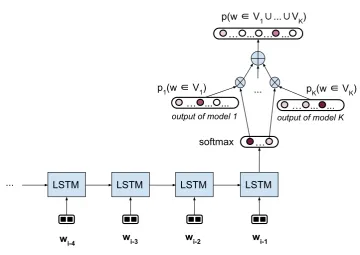
To address this issue, we propose the following approach. As in Vinyals and Le (2015), we first do train a conditional neural LM based on exist-ing dialogues, which we call ourchat model; this model can be seen as an “expert” about the con-versational patterns in the dialogue, but not about its knowledge-intensive aspects. Besides, we train another model, which this time is an expert about these knowledge aspects, which we call our QA model, due to its connections to Question Answer-ing (QA). We then combine these two expert mod-els through an LSTM-based integration model, which at each time step, encodes the whole his-tory into a vector and then uses a softmax layer to compute a probability mixture over the two mod-els, from which the next token is then sampled.
While here we combine in this way only two models, this core contribution of our paper is im-mediately generalizable to several expert mod-els, each competent on a specific task, where the (soft) choice between the models is done through the same kind of contextually-aware “attention” mechanism. Additional smaller contributions con-sist in the neural regime we adopt for training the QA model, the way in which we reduce the mem-orization requirements on this model.
It is worth noting that concurrently with our
work, Yin et al. (2015) have proposed a similar idea focusing only on QA in a traditional set-up. Our case is more difficult because of the chat inter-action; and the integration framework we propose is generally applicable to situations where a pool of word-prediction “experts” compete for atten-tion during the generaatten-tion of text. Outside of di-alogue applications, also independently and even more recently, Ling et al. (2016) have proposed a “Latent Predictor Network for Code Generation”, which has some close similarities to our LSTM-based mixture of experts.
2 LSTM-based Mixture of Experts The method is illustrated in Figure 1. Let wt
1 =
w1...wt be a history over words. We suppose
that we have K models each of which can com-pute a distribution over its own vocabulary Vk : pk(w∈Vk|w1t), fork∈[1, K]. We use an LSTM to encode the history word-by-word into a vector
ht which is the hidden state of the LSTM at time
stept. We then use a softmax layer to compute the probabilities
p(k|wt1) = PKeu(k,ht) k0=1eu(k0,ht)
where[u(1,ht), ..., u(K,ht)]T =Wht+b,W∈
RK×dim(ht),b ∈RK. The final probability of the
next word is then:
p(w|wt
1) =
K X
k=1
p(k|wt
1)pk(w|wt1). (1)
Our proposal can be seen as bringing together two previous lines of research within an LSTM framework. Similar to themixture-of-experts tech-nique of Jacobs et al. (1991), we predict a label by using a “gating” neural network to mix the pre-dictions of different experts based on the current situation. Similar to the approach of Florian and Yarowsky (1999), we dynamically combine dis-tributions on words to produce an integrated LM. However Florian and Yarowsky (1999) focus on the combination of topic-dependent LMs, while in our case, the components can be arbitrary distri-butions over words — we later use a component that produces answers to questions appearing in the text. In our case, the labels are words, the gat-ing neural network is an LSTM that stores a rep-resentation of a long textual prefix, and the com-bination mechanism is trained by optimizing the
parameters of this LSTM.
3 Data
Our corpus consists of 165k dialogues from a “tech company” in the domain of mobile tele-phony support. We split them into train, devel-opment, and test sets whose sizes are 145k, 10k, and 10k dialogues. We then tokenize and low-ercase each dialogue, and remove unused infor-mation such as head, tail, chat time (Figure 2). For each response utterance found in a dialogue, we create a context-response pair whose context consists of all sentences appearing before the re-sponse. This process gives us 973k/74k/75k pairs for training/development/testing.
Knowledge-base The KB we use in this work consists of 1,745k device-attribute-value triples, e.g., (Apple iPhone 5; camera megapixels; 8.0). There are 4729 devices and 608 attributes. Be-cause we consider only numeric values, only triples that have numeric attributes are chosen, re-sulting in a set of 65k triples of 34 attributes.
Device-specification context-response pairs
Our target context-response pairs are those in which the client asks about numeric value at-tributes. We employ a simple heuristic to select target context-response pairs: a context-response pair is chosen if its response contains a number and one of the following keywords: cpu, pro-cessor, ghz, mhz, memory, mb(s), gb(s), byte, pixel, height, width, weigh, size, camera, mp, hour(s), mah. Using this heuristic, we col-lect 17.6k/1.3k/1.4k pairs for training/dev/testing. These sets are significantly smaller than those ex-tracted above.
4 KB-aware Chat Model 4.1 Neural Chat Model
Ouur corpus is comparable to the one described in Vinyals and Le (2015)’s first experiment, and we use here a similar neural chat model.
wi-4 wi-3 wi-2
…
wi-1
LSTM LSTM LSTM LSTM
… ... ... … ... ... ...
… ... … ...
p1(w ∈ V1) pK(w ∈ VK) p(w ∈ V1∪...∪VK)
output of model 1 output of model K
softmax
[image:3.595.119.480.119.374.2]...
Figure 1: LSTM-based mixture-of-experts for Language modelling.⊗denotes multiplication,⊕denotes sum.
7760 | 121686798 | log started fri may 06 10:50:43 pdt 2011 -lsb- 10:51:33 -rsb- you have been connected to X .
-lsb- 10:51:49 -rsb- X : hello and thanks for contacting Z ! my name is X , how can i assist ---you today ?
-lsb- 10:52:13 -rsb- Y : how do i change the text notification on my htc evo
-lsb- 10:53:06 -rsb- X : sorry you are having problems with that but you are in the right ---place . before we begin can i start with you name please ?
-lsb- 10:53:28 -rsb- Y : Y test
-lsb- 10:53:55 -rsb- X : thank you Y . one moment while i pull up the information on that ---device .
-lsb- 10:54:36 -rsb- Y : i am using this to showcase the shack support to an employee if you ---guys are busy we can try this later
-lsb- -- end of transcript as seen by customer -- -rsb--lsb- 10:55:10 -rsb- the customer has ended the chat session . ...
head
tail time
[image:3.595.96.503.523.674.2]sentence” is played by the dialogue prefix, and that of “target sentence” by the response utterance.
4.2 Neural Question Answering Model
In a standard setting, a question to query a KB must be formal (e.g., SQL). However, because a human-like QA system should take natural ques-tions as input, we build a neural model to translate natural questions to formal queries. This model employs an LSTM to encode a natural question into a vector. It then uses two softmax layers to predict the device name and the attribute. This model is adequate here, since we focus on the QA situation where the client asks about device speci-fications. For more complex cases, more advanced QA models should be considered (e.g., Bordes et al. (2014), Yih et al. (2015)).
Given questionwl
1, the two softmax layers give us a distribution over devicespd(•|w1l)and a dis-tribution over attributes pa(•|wl1). We can then compute a distribution over the setVqa of all
val-ues found in the KB, by marginalizing overd, a:
pqa(v|wl1) =
X
hd,a,vi∈T
pd(d|wl1)pa(a|w1l), (2)
whereT is the set of all triples in the KB.
Initial experiments showed that predicting val-ues in this indirect way significantly improves the accuracy compared to employing a single softmax layer to predict values directly, because it does not require the hidden states to directly memorize the value for each device-attribute pair.
Data Generation One serious difficulty is that we do not have a corpus of natural questions on which to train the QA model, so we have to re-sort to a method for generating virtual question/an-swer pairs, on which to train our QA model. How-ever, existing corpora and methods for generating such data (e.g., Fader et al. (2013)) hardly meet our needs here. This is because our case is very different from (and somewhat more difficult than) traditional QA set-ups in which questions are inde-pendent. In our case several scenarios are possible, resulting from the chat interaction (e.g., in a chat, questions can be related as in Figure 3). We there-fore propose a simple heuristic method for gener-ating artificial QA data that can cover several sce-narios.
For each pair <device name, attribute>, we paraphrase the device name by randomly dropping some words (e.g., “apple iphone 4”
becomes “iphone 4”), and paraphrase the attribute using a small handcrafted dictionary and also randomly dropping some words (“battery talk time” becomes “battery life” which can become “battery”). We then draw a sequence of lwords from a vocabulary w.r.t word frequency, where
l ∼ Gamma(k, n) (e.g., “i what have”), and shuffle these words. The output of the final step is used as a training datapoint like:have iphone
4 what battery i → apple iphone 4
battery talk time. To make it more re-alistic, we also generate complex questions by concatenating two simple ones. Such questions are used to cover the dialogue scenario where the client continues asking about another device and attribute. In this case, the system should focus on the latest device and attribute. Using this method, we generate a training set of 7.6m datapoints and a development set of 10k.
4.3 Integration
We now show how we integrate the chat model with the QA model using the LSTM-based mixture-of-experts method. The intuition is the following: the chat model is in charge of gener-ating smooth responses into which the QA model “inserts” values retrieved from the KB. Ideally, we should employ an independent LSTM for the purpose of computing mixture weights, as in Sec-tion 2. However, due to the lack of training data, our integration model makes use of the chat model’s hidden state to compute these weights. Because this hidden state captures the uncertainty of generating the next word, it is also able to detect whether or not the next word should be generated by the chat model.
The chat model is the backbone because it gen-erates most tokens. The QA model, on the other hand, is crucial since we want the system to gen-erate correct values. (E.g., the chat model alone cannot provide the precise information shown in Figure 3.) More importantly, in the future when new devices are released, we do not need to col-lect new chat data, which are often expensive, to retrain the chat model.
LetCandwt
1be a context and words generated up to this point.pc(•|w1t, C)andpqa(•|wt1, C)are given by the chat model and the QA model. We then compute the distributionp(•|wt
Vqaas a mixture ofpcandpqa: p(w|wt
1, C) =α.pc(w|w1t, C) + (1−α).pqa(w|wt1, C) whereα=σ(wThc
t+b),hctis the hidden state of
the chat model, σ is the sigmoid function; w ∈
Rdim(hc
t) and b ∈ R. Note that the sigmoid is equivalent to the softmax for two output units.
Training To train this integration model, we keep the chat model and the QA model frozen, and minimize the objective:
J(θ) =− X
(C,wl
1)∈D l−1
X
t=0
β(wt+1) logp(wt+1|wt1, C;θ)
+ λ2||θ||2
w.r.t.θ= (w, b), whereβ(w) = 100ifw∈Vqa\ Vc, β(w) = 1otherwise. λ is the regularization
parameter andDis the training set. We setβ(w∈
Vqa\Vc)high because we want the training phase
to focus on those tokens representing values in the KB but not supported by the chat model.
Decoding To find the most probable re-sponses, our decoder employs the uniform-cost-search algorithm (Russell and Norvig, 2003), which is guaranteed to find optimal solutions and is feasible with our search space. We stipulate a constraint that a response is to answer not more than one question.
5 Experiments
We implement our models in C++ using CUDA. Since automatically evaluating a conversation sys-tem is still challenging, we, following Vinyals and Le (2015), use word perplexity only. In our exper-iments, every LSTM has 1024 hidden units and 1024 memory cells. The vocabulary of the chat model has 19.3k words, that of the QA model 12.7k words.
We firstly train the chat model on all chat data with the learning rate 0.01, and continue training it on the device-specification data with the learn-ing rate 0.001. Uslearn-ing this smaller learnlearn-ing rate we expect that the model will not forget what it has learnt on all the chat corpus. Next, we train the QA model on the data generated in Section 4.2 with the learning rate 0.01. Finally, we train the inte-gration model on the device-specification training data also with the learning rate 0.01.
Our initial results are as follows. The integra-tion slightly increases the perplexity on all tokens (15.4, compared to 14.7 of the chat model), but it does help to significantly decrease perplexity 38% on thenumerictokens (46.8, compared to 75.8 of the chat model). This decrease is due to the im-proved ability of the integration model to detect places where a numeric value associated with a device-attribute information request should be in-serted and to predict this value. Not all numeric values are associated with information requests of this type, but the reported perplexities are over all numeric values. The decrease in perplexity over the numeric values is not enough to decrease over-all perplexity because the numeric tokens repre-sent only 6.7% of the tokens, and the integration model wrongly puts some small probability mass on the QA expert also in the case of the many non-numeric tokens. However, the fact that the per-plexity decreases over the numeric tokens shows that the integration model is useful for predicting correct values, which are informationally much more critical to the user than general words (ad-mittedly, perplexity is here a weak proxy for what a human evaluation of usefulness would provide.) Figure 3 shows a chat example with our integra-tion model.
6 Conclusions
We introduce a general LSTM-based mixture-of-experts method for language modelling and illus-trate the approach by integrating a neural chat model with a neural QA model. The experimen-tal results, while limited to measures of perplex-ity, do show that the integration model is capable of handling chats inside of which the user may ask about device specifications; a more thorough and convincing evaluation would require human asses-ments of the quality of the produced responses.
Client: i want to know about how fast is the processor of apple ipad 2
Machine: that 's an excellent question , i can definitely help you with that ! 1 ghz
was there anything else i could help you out with today ?
Client: and its ram ?
Machine: 0.5 gigabytes
Client: thanks
Machine: was there anything else i could help you out with today ?
Figure 3: A dialogue with the integration model. The first value is produced by the pair<apple ipad 2, cpu maximum frequency>, the second value by<apple ipad 2, internal ram>.
References
Antoine Bordes, Sumit Chopra, and Jason Weston. 2014. Question answering with subgraph embed-dings. In Proceedings of the 2014 Conference on Empirical Methods in Natural Language Process-ing (EMNLP), pages 615–620, Doha, Qatar, Octo-ber. Association for Computational Linguistics. Anthony Fader, Luke S Zettlemoyer, and Oren Etzioni.
2013. Paraphrase-driven learning for open question answering. InACL (1), pages 1608–1618. Citeseer. Radu Florian and David Yarowsky. 1999. Dynamic
nonlocal language modeling via hierarchical topic-based adaptation. InProceedings of the 37th annual meeting of the Association for Computational Lin-guistics on Computational LinLin-guistics, pages 167– 174. Association for Computational Linguistics. Sepp Hochreiter and J¨urgen Schmidhuber. 1997.
Long short-term memory. Neural computation, 9(8):1735–1780.
Robert A Jacobs, Michael I Jordan, and Andrew G Barto. 1991. Task decomposition through compe-tition in a modular connectionist architecture: The what and where vision tasks. Cognitive Science, 15(2):219–250.
Kristiina Jokinen and Michael F. McTear. 2009. Spo-ken Dialogue Systems. Synthesis Lectures on Hu-man Language Technologies. Morgan & Claypool Publishers.
Wang Ling, Edward Grefenstette, Karl Moritz Her-mann, Tom´as Kocisk´y, Andrew Senior, Fumin Wang, and Phil Blunsom. 2016. Latent pre-dictor networks for code generation. CoRR, abs/1603.06744.
Michael F. McTear. 2004. Spoken Dialogue Tech-nology: Towards the Conversational User Interface. Springer.
Verena Rieser and Oliver Lemon. 2011. Reinforce-ment learning for adaptive dialogue systems : a data-driven methodology for dialogue management and natural language generation. Theory and appli-cations of natural language processing monographs. Springer, Heidelberg, New York.
Stuart J. Russell and Peter Norvig. 2003. Artificial In-telligence: A Modern Approach. Pearson Education, 2 edition.
Iulian V Serban, Alessandro Sordoni, Yoshua Bengio, Aaron Courville, and Joelle Pineau. 2015. Hierar-chical neural network generative models for movie dialogues. arXiv preprint arXiv:1507.04808. Lifeng Shang, Zhengdong Lu, and Hang Li. 2015.
Neural responding machine for short-text conver-sation. In Proceedings of the 53rd Annual Meet-ing of the Association for Computational LMeet-inguistics and the 7th International Joint Conference on Natu-ral Language Processing of the Asian Federation of Natural Language Processing, ACL 2015, July 26-31, 2015, Beijing, China, Volume 1: Long Papers, pages 1577–1586.
Ilya Sutskever, Oriol Vinyals, and Quoc VV Le. 2014. Sequence to sequence learning with neural net-works. InAdvances in neural information process-ing systems, pages 3104–3112.
Oriol Vinyals and Quoc Le. 2015. A neural conversa-tional model. arXiv preprint arXiv:1506.05869. Wen-tau Yih, Ming-Wei Chang, Xiaodong He, and
Jianfeng Gao. 2015. Semantic parsing via staged query graph generation: Question answering with knowledge base. InProceedings of the 53rd Annual Meeting of the Association for Computational Lin-guistics and the 7th International Joint Conference on Natural Language Processing (Volume 1: Long Papers), pages 1321–1331, Beijing, China, July. As-sociation for Computational Linguistics.
Jun Yin, Xin Jiang, Zhengdong Lu, Lifeng Shang, Hang Li, and Xiaoming Li. 2015. Neural genera-tive question answering. CoRR, abs/1512.01337. Steve Young, Milica Gasic, Blaise Thomson, and