Rectified ALS Algorithm for Multidimensional
Harmonic Retrieval
R´
emy Boyer, Pierre Comon
To cite this version:
R´
emy Boyer, Pierre Comon. Rectified ALS Algorithm for Multidimensional Harmonic
Re-trieval. 9th IEEE Sensor Array and Multichannel Signal Processing Workshop (SAM 2016),
2016, Rio de Janeiro, Brazil.
<
hal-01314702
>
HAL Id: hal-01314702
https://hal-supelec.archives-ouvertes.fr/hal-01314702
Submitted on 11 May 2016
HAL
is a multi-disciplinary open access
archive for the deposit and dissemination of
sci-entific research documents, whether they are
pub-lished or not.
The documents may come from
teaching and research institutions in France or
abroad, or from public or private research centers.
L’archive ouverte pluridisciplinaire
HAL, est
destin´
ee au d´
epˆ
ot et `
a la diffusion de documents
scientifiques de niveau recherche, publi´
es ou non,
´
emanant des ´
etablissements d’enseignement et de
recherche fran¸cais ou ´
etrangers, des laboratoires
publics ou priv´
es.
Rectified ALS Algorithm for Multidimensional
Harmonic Retrieval
R´emy Boyer
Signals and Statistics Departement Laboratory of Signals and Systems (L2S) Universit´e Paris-Sud, CNRS, CentraleSupelec
Gif-SurYvette, France [email protected]
Pierre Comon
GIPSA-Lab
CNRS, University Grenoble Alpes France
Abstract—MultiDimensional (MD) Harmonic Retrieval is a challenging multi-parameter estimation problem and is useful for a plethora of operational applications as for instance channel sounding or MIMO radar processing. The MD-harmonic model follows a structured Canonical Polyadic Decomposition (CPD) in the sense that the factors of the CPD are Vandermonde. A standard and popular estimation scheme to derive the CPD is the Alternating Least Squares (ALS) algorithm. Unfortunately, the ALS algorithm does not exploit the a priori known factor struc-ture, which considerably degrades the estimation performance. In this work, a modified ALS-type algorithm is proposed. This new algorithm, called Rectified ALS (RecALS), is able to take into account the Vandermonde structure of the factors. The RecALS algorithm belongs to the Lift-and-Project family and exploits iterated projections on the set of Toeplitz rank-1 matrices. It exhibits a fast convergence and is very accurate in the sense that its Mean Square Error (MSE) is close to the Cram´er-Rao Bound for a wide range of Signal to Noise Ratio (SNR).
Index Terms—Structured Canonical Polyadic Decomposition, Vandermonde factors, MultiDimensional Harmonic Retrieval, modified Alternating Least Squares algorithm, Toeplitz rank-1 matrix approximation
I. INTRODUCTION
An increasing number of signal processing applications deal with multidimensional data. In particular, MultiDimensional (MD)-harmonic retrieval [1]–[4] is an important and challeng-ing multi-parameter estimation problem. Multilinear algebra provides a powerful framework to exploit these data [5]–[7] by conserving the multidimensional structure of the information. Nevertheless, generalizing matrix-based algorithms to the multilinear algebra framework is not a trivial task. In partic-ular, there exist several multilinear extensions of the matrix Singular Value Decomposition (SVD) [8], each enjoying only some properties of the matrix SVD. The Canonical Polyadic Decomposition (CPD), also sometimes referred to as Cande-comp/Parafac may be seen as one possible extension of the SVD to the multilinear case; see [6] and references therein. Recall that a rank-M matrix is defined as the sum ofM rank-1 matrices and the best low-rank approximation is provided by the truncated-SVD [25]. The CPD straightforwardly extends this principle, i.e., a rank-M tensor follows a CPD of order
M or equivalently can be expressed as the sum of M rank-1 tensors, which can be stored in matrix factors. In addition,
like SVD, it is essentially unique under mild conditions. Unfortunately, in contrast to matrices, the set of tensors of rank at most M is in general not closed, which renders the problem of finding a tensorial best low-rank approximation ill-posed [27]. As a consequence, we have to resort to sub-optimal algorithms to derive the CPD.
Despite of this difficulty, the Alternating Least Squares (ALS) algorithm [7,9,10] has proven to be powerful in a wide range of operational contexts. To such an extent that the ALS algorithm is now considered as the gold standard method to estimate the factors entering the CPD. However, in the standard ALS algorithm, all factor entries are estimated independently while ignoring an a priori known structure. In addition, practical problems are encountered when factor matrices have a linear structure [11,12] such as Toeplitz, circulant or Hankel. In order to fill this gap, several algorithms have been proposed and their estimation accuracies have been studied in [13]. But less attention has been dedicated to Vandermonde structured factors [1]–[3] involved in the CPD of the MD-harmonic model.
A class of well-known methods called projections onto convex sets (POCS) continues to receive great attention [15,17,24,26]. The POCS method is based on an infinite sequence of iterated projections onto closed convex subsets. This method is simple to implement and its convergence has been proved in [28] for instance. Unfortunately, in many operational applications, the considered subsets are nonconvex and generally no convergence guarantees exist. A typical ex-ample of nonconvex problem is the well-known phase recovery problem [29]. Despite this, a method called Lift-and-Project has been the subject of many publications [16] and has been used successfully in several operational contexts [18,23]. In this work, we propose a new methodology belonging to the Lift-and-Project algorithm family to tackle the MD-Harmonic Retrieval problem, breaking with the standard approaches as proposed for instance in [14].
II. MD-HARMONIC MODEL ANDALSALGORITHM A. Structured Canonical Polyadic Decomposition (CPD)
The MD-harmonic model assumes that the measurements can be modeled as the superposition of M undamped
expo-nentials sampled on aP-dimensional grid according to [X]n1...nP = M X m=1 αm P Y p=1 znp m,p, 0≤np≤Np−1 (1) in which the m-th complex amplitude is denoted by αmand
zm,p = eiωm,p where ωm,p is the m-th angular-frequency along the p-th dimension. Tensor X can be expressed as the linear combination of M rank-1 tensors, each of size
N1×. . .×NP (the size of the grid), and follows a generalized Vandermonde decomposition:
X = (V1, . . . ,VP)·A
whereAis aM×. . .×M diagonal tensor with[A]m,...,m=
αm and Vp =
v(z1,p) . . . v(zM,p)
is a Np × M Vandermonde matrix, where each columnv(zm,p)depends on a single parameter, zm,p, of unit modulus. We define a noisy MD-harmonic tensor model of orderP as:Y =X+σEwhere
σE is the noise tensor, σ is a positive real scalar, and each entry [E]n1...nP follows an i.i.d. circular complex Gaussian
distributionN(0,1), andX has rankM.
B. Limit of the ALS algorithm for structured CPD
The CPD of any order-P rank-M tensor X involves the estimation of P factorsFp of size Np×M. As pointed out above, in the context of the MD-harmonic model, the factors Fp of the CPD are Vandermonde matrices. Consider,Yp, the
p-th mode unfolding [6] of tensorY, at thek-th iteration with
1≤k≤I,I denoting the maximal number of iterations. The ALS algorithm solves alternatively for each of the P dimen-sions the minimization problem [7,9]:minFp||Yp−FpGp||
2
whereGT
p =F1. . .Fp−1Fp+1. . .FP, where denotes the Khatri-Rao product [6]. It aims at approximating tensorY by a tensor of rankM, hopefully close toX. The LS solution conditionally to matrixGp is given by Fp=YpG†p where † stands for the pseudo-inverse. Now, remark that there is no reason that the above LS criterion promotes the Vandermonde structure in the estimated factors in the presence of noise. In other words, ignoring the structure in the CPD leads to estimate an excessive number of free parameters. This mismatched model dramatically decreases the estimation performance [13]. Hence there is a need to rectify the ALS algorithm to take into account the factor structure.
III. RECTIFICATION STRATEGIES A. Iterated projections and splitted LS criterion
LetVbe the set of the complex Vandermonde vectors. The
structured LS optimization problem is the following [15]–[17]:
min
Vp
Tracen(Fp−Vp)(Fp−Vp)H
o
s.t. Vp∈VM (2)
where VM is the set of Vandermonde matrices with M
columns. The proposed strategy is to split the optimization problem (2) into the resolution of M independent LS sub-problems: min v ||f (p) m −v|| 2 s.t. v∈V (3)
wherefm(p) is the m-th column ofF(p).
Assume that set V is the intersection of K closed convex subsets{V1. . . ,VK} in which each subset encodes a desired algebraic property. Then the solution of eq. (3) can be rewritten asv=πV1∩...∩VK(f
(p)
m ), whereπVdenotes the projector onto V. A standard approach to solve this optimization problem is
the method of iterated projections. More precisely, define the following recursion:
fm(p)(h) = (πVK. . . πV1)(fm(p)(h−1)) = (πVK. . . πV1)h(fm(p))
withfm(p)(0) =f
(p)
m . Under rather mild conditions, convergence is ensured: [15,16]: lim h→∞||(πVK. . . πV1) h(f(p) m )−πV1∩...∩VK(f (p) m )|| 2= 0.
Unfortunately, many operational applications involve non-convex sets, as for instance the set of rank deficient matrices. In this case, the projection may be multivalued, and there is no guarantee of convergence, even if numerical convergence has often been observed [18].
B. Standard strategies
1) Column-averaging: The most intuitive way to exploit the Vandermonde structure is to note thatω = n1∠zn where
∠stands for the angle function. Define the sets
J= v= f [f]1 :f ∈CN A`= ( v(z=eiω¯) : ¯ω=1 ` ` X n=1 1 n∠[f]n+1 )
where1≤`≤N−2. This method exploits the Vandermonde structure in a heuristic way. So, the rectified strategy is to consider the iterated vectorf(h) = (πA`πJ)h(f).
2) Periodogram maximization: Under Gaussian noise and for a single toneαmz
np
m,p, the maximum likelihood estimator (MLE) is optimal and is given by the location of the maxi-mal peak of the Fourier-periodogram [2,19]. To increase the precision of the estimation, it is standard to use the well-known zero-padding technique at the price of an increase in computational cost.
IV. RECTIFIEDALS (RECALS)ALGORITHM
The RecALS algorithm belongs to the family of Lift-and-Project Algorithms [16,17]. The optional lift step computes a low rank approximation and the projection step performs a rectification toward the desired structure. In Section IV-A the basic RecALS algorithm is described. In Section IV-B, an improved version of the RecALS algorithm is proposed.
A. Principles of the RecALS algorithm
The RecALS algorithm is based on iterated projections and splitted LS criteria. Its algorithmic description is provided in Algorithm 1 for P = 3. We insist that several iterations in the while loops are necessary, since restoring the struc-ture generally increases the rank, and computing the low-rank approximation via truncated SVD generally destroys the structure.
Algorithm 1 Rectified ALS (RecALS) Require: Y1,Y2,Y3,I,F1,F2,{V1, . . . ,VK},CritStop Ensure: {z1,p, . . . , zM,p}for 1≤p≤3 1: fork= 1, . . . , I do 2: —————————————————– 3: F3=Y3 (F1F2)T † 4: form= 1, . . . , M do 5: f := [F3]m
6: while(CritStopis false)do 7: f =πVK. . . πV1(f) 8: end while 9: zm,3= minz||v(z)−f||2 10: end for 11: F3:=v(z1,3) . . . v(zM,3) 12: —————————————————– 13: F2=Y2 (F3F1)T † 14: form= 1, . . . , M do 15: f := [F2]m
16: while(CritStopis false)do 17: f =πVK. . . πV1(f) 18: end while 19: zm,2= minz||v(z)−f||2 20: end for 21: F2:= v(z1,2) . . . v(zM,2) 22: —————————————————– 23: F1=Y1 (F2F3)T † 24: form= 1, . . . , M do 25: f := [F1]m
26: while(CritStopis false)do 27: f =πVK. . . πV1(f) 28: end while 29: zm,1= minz||v(z)−f||2 30: end for 31: F1:= v(z1,1) . . . v(zM,1) 32: end for
B. Toeplitz Rank-1 Approximation (TR1A)
In this section, we propose better strategies than brute-force ALS. This is made possible by noting that columns of Vandermonde matrices can be computed one by one, and that the outer product between a Vandermonde vector and its Hermitian transpose is a rank-one Toeplitz matrix.
1) Equivalent matrix-based criterion:
Property 4.1: LetT be the set of Hermitian Toeplitz
rank-1 matrices of size N ×N. For x ∈ R×CN−1, define the
Hermitian Toeplitz matrix:
Toep(x) = x1 x2 x3 . . . xN x∗2 x1 x2 . . . xN−1 x∗3 x∗2 x1 . . . xN−2 .. . ... ... . .. ... x∗N x∗N−1 x∗N−2 . . . x1 .
Forv(z)∈V, it is straightforward to prove that:
T(z) = Toep(v(z)) =v(z)∗v(z)T ∈T.
Property 4.2: Recall that in virtue of the Carath´eodory’s theorem [20], there exist a one-to-one mapping between T(z) ∈ T and v(z) ∈ V with a unique z. This means that
minimizing criteria ||v(ˆz)−v(z)||2 or ||T(ˆz)−T(z)||2 are
equivalent.
So, thanks to the two above properties, we propose the following estimation methodology.
Result 4.3:The aim is to find the minimizer,ˆz, of criterion ||T(ˆz)−T(z)||2 conditionally to T(z) for unknown z. The
solution is given byzˆ=ei∠([u]1[u]∗2)whereT(z) = Toep(u).
Proof As matrixT(z)is by construction Toeplitz and rank-1, we have T(z)SVD= λuuH. Identifying the (n, n0)-th term of
the Toeplitz matrixT(ˆz)and the(n, n0)-th term of the SVD of T(z) we have zˆ−n+n0 =eiω(−n+n0) =λ[u]
n+1[u]∗n0+1. So,
forn= 0andn0= 1, we havezˆ=eiωˆ withωˆ=
∠([u]1[u]∗2). 2) Iterated projections: In preamble, the two following sets are introduced.
• Define the set of Hermitian Toeplitz matrices:
D=T= Toep(x)∈CN×N,x∈R×CN−1 .
• Introduce the non-convex set of Hermitian rank-1N×N
matrices:
Q=Q∈CN×N,rankQ= 1 .
Clearly, the setTis nothing else butQ∩D. From Property 4.1, we consider the sequence(πDπQ)h(Toep(π
Jf)). AsπJf ∈/ V, Toep(πJf) is full-rank with probability one. In practice,
projector πQ is implemented by just retaining the dominant singular triplet, which is known to yield the optimal rank-1 approximation [8,21]:Q? =πQ(Q) =λmax(Q)ssH wheres
is the singular vector of matrix Qassociated with the largest singular value,λmax(Q).
In the remainder, we shall use the following iterates, with T= Toep(f)as initialization:
T←πDπQ(T).
Once(πDπQ)h(T) has converged to a matrix in set
T, we
use Result 4.3 to estimate parameterz. V. NUMERICAL SIMULATIONS
We fix M = 2 sources with α1 = eiπ/3 and α2 =eiπ/4
andP = 3 in eq. (1). In Fig. 1, the MSE with respect to the SNR is drawn for
1) the RecALS algorithm using the column-averaging de-fined in section 3.2.1.
2) The RecALS-T R1A algorithm exploiting iterated
pro-jections on the set of Toeplitz rank-1 matrices described in section 4.2.
3) The standard ALS algorithm rectified in a post-processing way with the maximization periodogram pro-cedure, called ALS+max Perio.
4) The deterministic CRB has been derived in several publications as for instance [4,22] and we use the scalar
expressions given in [3] defined by Trace{CRB} = P p,mCRB(ωm,p)whereCRB(ωm,p) = 6σ 2 N2 p Q p6=p0Np0.
−20
0
20
40
10
−1010
−510
010
5SNR [dB]
MSEALS+max Perio
.
RecALS
RecALS+
T R
1A
Trace
{
CRB
}
Fig. 1. MSEVs.SNR in dB withN1=N2=N3= 6. The zero-padding factor in the ALS+max Periois210.
SNR [dB] -20 0 10 20 40 50
ALS+max Perio 204.8 48.2 33.5 50.5 44.9 66.9
RecALS 20 19.9 20 20 20 20
RecALS +T R1A 20 19 19 18.9 19 18.6 TABLE I
MEAN NUMBER OF ITERATIONSVs.SNRIN DB
As shown in Fig. 1, the accuracy of the ALS+max Perio
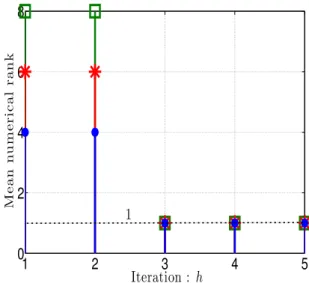
is saturated in the high SNR regime due to the zero-padding processing. Conversely, the two RecALS algorithms do not suffer from this drawback. In addition, according to Table I, the RecALS algorithms converge much faster than the ALS+max Perio. Fig. 2 illustrates the fast convergence of the iterated projections on the set of Toeplitz rank-1 matrices. Finally thanks to Fig. 1, we can observe the RecALS-T R1A
algorithm has the smallest MSE remaining close to the CRB for a wide range of SNR.
VI. CONCLUSION
MultiDimensional (MD) Harmonic Retrieval is a challeng-ing multi-parameter estimation problem. The MD-harmonic model can be decomposed as a Vandermonde-structured Canonical Polyadic Decomposition (CPD). A popular way to derive the CPD is the Alternating Least Squares (ALS) algorithm. Unfortunately, this scheme ignores the structure in the CPD factors and thus the number of free parameters is overestimated. As a consequence, discarding this a priori knowledge considerably degrades the estimation performance. In this work, we propose a modified ALS-type algorithm, called Rectified ALS (RecALS), which enforces the Vander-monde structure of the CPD factors at each iteration. We
1 2 3 4 5 0 2 4 6 8 Iteration : h M e a n n u m e r i c a l r a n k 1
Fig. 2. Mean numerical rank of(πQπD)h(f1(p))withN1= 6,N2= 8and N3= 4andSNR = 10dB
first show that the RecALS algorithm converges much faster than the ALS algorithm. Next, an improved RecALS scheme, based on iterated projections on the set of Toeplitz rank-1 matrices, is introduced. This last scheme is shown to have a fast convergence and its MSE is close to the CRB for a wide range of SNR values.
VII. ACKNOWLEDGEMENT
This work was supported by the following projects: MAG-ELLAN (ANR-14-CE23-0004-01), MI-CNRS TITAN, ICode blanc and by the ERC grant AdG-2013-320594 DECODA.
REFERENCES
[1] M. Haardt, F. Roemer, and G. D. Galdo, “Higher-order SVD-based subspace estimation to improve the parameter estimation accuracy in multidimensionnal harmonic retrieval problems,”IEEE Trans. on Proc. Sig. Proc., vol. 56, no. 7, pp. 3198–3213, July 2008.
[2] D. Nion and N. D. Sidiropoulos, “Tensor algebra and multidimensional harmonic retrieval in signal processing for mimo radar,”IEEE Transac-tions on Signal Processing, vol. 58, no. 11, pp. 5693–5705, 2010. [3] R. Boyer, “Deterministic asymptotic Cram´er-Rao Bound for the
multi-dimensional harmonic model,”Signal Processing, vol. 88, no. 12, pp. 2869–2877, 2008.
[4] J. Liu and X. Liu, “An eigenvector-based approach for multidimensional frequency estimation with improved identifiability,”IEEE Transactions on Signal Processing, vol. 54, no. 12, pp. 4543–4556, 2006.
[5] A. Cichocki, D. Mandic, L. De Lathauwer, G. Zhou, Q. Zhao, C. Caiafa, and H. A. Phan, “Tensor decompositions for signal processing applica-tions: From two-way to multiway component analysis,” IEEE Signal Processing Magazine, vol. 32, no. 2, pp. 145–163, 2015.
[6] P. Comon, “Tensors: a brief introduction,” IEEE Signal Proc. Mag., vol. 31, no. 3, pp. 44–53, May 2014.
[7] P. Comon, X. Luciani, and A. L. De Almeida, “Tensor decompositions, alternating least squares and other tales,” Journal of Chemometrics, vol. 23, no. 7-8, pp. 393–405, 2009.
[8] G. H. Golub and C. F. Van Loan,Matrix computations. JHU Press, 2012, vol. 3.
[9] P. Kroonenberg and J. Leeuw, “Principal component analysis of three-mode data by means of alternating least squares algorithms,” Psychome-trika, vol. 45, no. 1, pp. 69–97, 1980.
[10] N. D. Sidiropoulos, R. Bro, and G. B. Giannakis, “Parallel factor analysis in sensor array processing,” IEEE Trans. on Proc. Sig. Proc., vol. 48, no. 8, pp. 2377–2388, Aug. 2000.
[11] D. Nion and L. De Lathauwer, “A block component model based blind DS-CDMA receiver,”IEEE Transactions on Signal Processing, vol. 56, no. 11, pp. 5567–5579, 2008.
[12] A. L. F. de Almeida, G. Favier, and J. C. M. Mota, “Parafac-based unified tensor modeling for wireless communication systems with ap-plication to blind multiuser equalization,”Signal Proc., vol. 87, no. 2, pp. 337–351, Feb. 2007.
[13] J. H. Goulart, M. Boizard, R. Boyer, G. Favier, and P. Comon, “Tensor CP Decomposition with structured factor matrices: Algorithms and Performance,”IEEE Journal of Selected Topics in Signal Processing, p. accepted, 2016.
[14] M. Sorensen and L. De Lathauwer, “Blind signal separation via tensor decomposition with vandermonde factor: Canonical polyadic decompo-sition,”IEEE Transactions on Signal Processing, vol. 61, no. 22, pp. 5507–5519, 2013.
[15] P. L. Combettes, “The foundations of set theoretic estimation,” Proceed-ings of the IEEE, vol. 81, no. 2, pp. 182–208, 1993.
[16] I. Markovsky, Low rank approximation: algorithms, implementation, applications. Springer Science & Business Media, 2011.
[17] J. P. Boyle and R. L. Dykstra, “A method for finding projections onto the intersection of convex sets in hilbert spaces,” inAdvances in order restricted statistical inference. Springer, 1986, pp. 28–47.
[18] J. A. Cadzow, “Signal enhancement-a composite property mapping algo-rithm,”IEEE Transactions on Acoustics, Speech and Signal Processing, vol. 36, no. 1, pp. 49–62, 1988.
[19] D. C. Rife and R. R. Boorstyn, “Single tone parameter estimation from discrete-time observations,”IEEE Transactions on Information Theory, vol. 20, no. 5, pp. 591–598, 1974.
[20] V. F. Pisarenko, “The retrieval of harmonics from a covariance function,”
Geophysical Journal International, vol. 33, no. 3, pp. 347–366, 1973. [21] C. Eckart and G. Young, “The approximation of one matrix by another
of lower rank,”Psychometrika, vol. 1, no. 3, pp. 211–218, 1936. [22] S. Sahnoun and P. Comon, “Joint source estimation and localization,”
IEEE Transactions on Signal Processing, vol. 63, no. 10, pp. 2485–2495, 2015.
[23] F. Alberge, “Iterative decoding as Dijkstra’s algorithm with alternate I-projection and reverse I-projection,”EUSIPCO, 2008.
[24] H.H. Bauschke, and J.M. Borwein, “On projection algorithms for solving convex feasibility problems,”SIAM review, vol. 38, no. 3, pp. 367–426, 1996
[25] C. Eckart and G. Young, “The approximation of one matrix by another of lower rank,”Psychometrika, vol. 1, no. 3, pp. 211–218, 1936. [26] L. Dykstra, “An iterative procedure for obtaining I-projections onto the
intersection of convex sets,”The annals of Probability, vol. 13, no. 3, pp. 975–984, 1985
[27] V. De Silva, and L. Lek-Heng, “Tensor rank and the ill-posedness of the best low-rank approximation problem.” SIAM Journal on Matrix Analysis and Applications, vol. 30, no. 3, pp. 1084–1127, 2008. [28] L.M. Bregman, “The method of successive projection for finding a
common point of convex sets,”Soviet Math. Dokl., vol. 6, pp. 688–692, 1965.
[29] E. J. Candes, Y. C. Eldar, T. Strohmer, and V. Voroninski, “Phase retrieval via matrix completion,”SIAM Review, vol. 57, no. 2, pp. 225– 251, 2015.