IKE - An Interactive Tool for Knowledge Extraction
Bhavana Dalvi, Sumithra Bhakthavatsalam, Chris Clark, Peter Clark, Oren Etzioni, Anthony Fader, Dirk Groeneveld
Allen Institute for Artificial Intelligence
{bhavanad,sumithrab,chrisc,peterc,orene,dirkg}@allenai.org
Abstract
Recent work on information extraction has suggested that fast, interactive tools can be highly effective; however, creating a us-able system is challenging, and few publi-cally available tools exist. In this paper we present IKE, a new extraction tool that per-forms fast, interactive bootstrapping to de-velop high-quality extraction patterns for tar-geted relations. Central to IKE is the
no-tion that anextraction pattern can be treated
as a search query over a corpus. To oper-ationalize this, IKE uses a novel query lan-guage that is expressive, easy to understand, and fast to execute - essential requirements for a practical system. It is also the first interactive extraction tool to seamlessly in-tegrate symbolic (boolean) and distributional (similarity-based) methods for search. An initial evaluation suggests that relation ta-bles can be populated substantially faster than by manual pattern authoring while retain-ing accuracy, and more reliably than fully automated tools, an important step towards practical KB construction. We are making IKE publically available (http://allenai.org/ software/interactive-knowledge-extraction).
1 Introduction
Knowledge extraction from text remains a funda-mental challenge for any system that works with structured data. Automatic extraction algorithms, e.g., (Angeli et al., 2015; Carlson et al., 2009; Nakashole et al., 2011; Hoffmann et al., 2011), have proved efficient and scalable, especially when lever-aging existing search engine technologies, e.g.,
(Et-zioni et al., 2004), but typically produce noisy re-sults, e.g., the best F1 score for the KBP slot filling task was 0.28, as reported in (Angeli et al., 2015). Weakly supervised automatic bootstrapping meth-ods (Carlson et al., 2010; Gupta and Manning, 2014) are more precise in the initial bootstrapping itera-tions, but digress in later iteraitera-tions, a problem gen-erally referred to as semantic drift.
More recently there has been work on more in-teractive methods, which can be seen as a “machine teaching” approach to KB construction (Amershi et al., 2014; Amershi et al., 2015; Li et al., 2012). For example, (Soderland et al., 2013) showed that users can be surprisingly effective at authoring and refin-ing extraction rules for a slot fillrefin-ing task, and (Freed-man et al., 2011) demonstrated that a combination of machine learning and user authoring produced high quality results. However, none of these approaches have evolved into publically available tools.
In this paper we present IKE, a usable, general-purpose tool for interactive extraction. Central to IKE is the notion that anextraction patterncan be treated as a search query over a corpus, building on earlier work by (Cafarella et al., 2005). It ad-dresses the resulting requirements of expressiveness, comprehensibility, and speed with a novel query language based on chunking rather than parsing, and is the first tool to seamlessly integrate sym-bolic (boolean) and distributional (similarity-based) methods for search. It also includes a machine learn-ing component for suggestlearn-ing new queries to the user. A preliminary evaluation suggests that relation tables can be populated substantially faster with IKE than by manual pattern authoring (and more reliably than fully automated tools), while retaining
racy, suggesting IKE has utility for KB construction.
Query Interpretation
the dog matches “the” followed by “dog”
NP grows an NP followed by “grows”
(NP) grows Capture the NP and place in column 1 (1 column table)
(NP) conducts (NP)
Capture the two NPs into columns 1 and 2 (2 column table)
(?<Energy>NP) is conducted by (?<Material>NP)
Capture the two NPs and place in columns named Energy and Material
the{cat,dog} “the” followed by “cat” or “dog”
cats and{NN,NNS}
“cats and” followed by NN or NNS
JJ* dog Zero or more JJ then “dog”
JJ+ dog One or more JJ then “dog”
JJ[2-4] dog 2 to 4 JJ then “dog”
dog .[0-4] tail “dog” followed by any 0 to 4 words followed by ‘tail”
dog∼50 Matches “dog” and the 50 words
most distributionally similar to “dog”
. dog Any word then “dog”
$colors Any entry in the single-column “col-ors” table
$colors∼100 same plus 100 most similar words
[image:2.612.69.298.76.409.2]$flower.color Any in the “color” column of “flower” table
Table 1:IKE’s Query Language, described by example.
2 Interactive Knowledge Extraction (IKE)
We first overview IKE and a sample workflow us-ing it. IKE allows the user to create relation tables, and populate them by issuing pattern-based queries over a corpus. It also has a machine learning compo-nent that suggests high-quality broadenings or nar-rowings of the user’s queries. Together, these allow the user to perform fast, interactive bootstrapping. 2.1 IKE’s Query Language
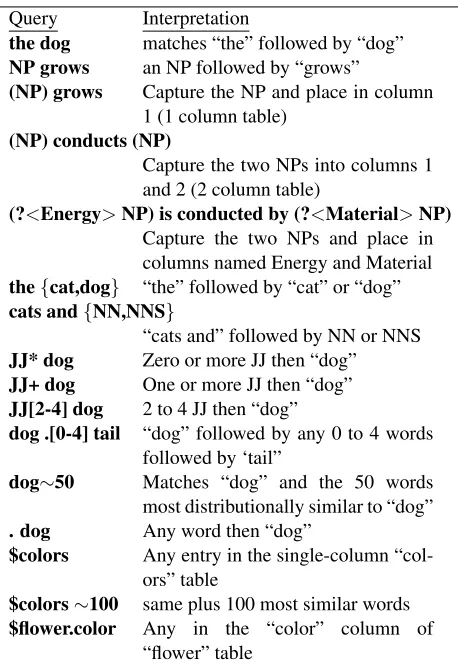
A key part of IKE is treating an extraction pat-tern as a search query. To do this, the query lan-guage must be both comprehensible and fast to exe-cute. To meet these requirements, IKE indexes and searches the corpus using a chunk-based rather than dependency-based representation of the text corpus. IKE’s query language is presented by example in Ta-ble 1. The query language supports wildcards, win-dow sizes, POS tags, chunk tags, and general regular
expression queries similar to TokenRegex (Chang and Manning, 2014) and Lucene, ElasticSearch’s (Gormley and Tong, 2015) query language. Addi-tionally, IKE supports distributional similarity based search (e.g. dog∼50 would find 50 words similar to “dog”). “Capture groups”, indicated by parenthe-ses, instruct IKE to catch the matching element(s) as candidate entries in the table being populated. The user can also reference data in other already-constructed tables using the $ prefix.
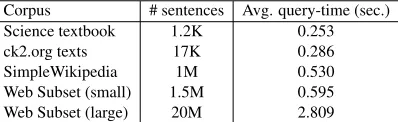
The use of a chunk-based representation has sev-eral advantages over a dependency-based one (e.g., (Freedman et al., 2011; Gamallo et al., 2012; Hoff-mann et al., 2015; Akbik et al., 2013)). First, both indexing and search are very fast (e.g., <1 sec to execute a query over 1.5M sentences), essential for an interactive system. Second, authoring queries does not require detailed knowledge of dependency structure, making the language more accessible. Fi-nally, the system avoids parse errors, a consider-able challenge for dependency-based systems. Cor-responding challenges with chunk-based representa-tions, e.g., defining constituent boundaries in terms of POS chunks, are partially alleviated by providing predefined, higher-level POS-based patterns, e.g., for verb phrases.
2.2 Machine Learning
IKE also has a ML-based Query Suggestor to pro-pose improved queries to the user. This module performs a depth-limited beam search to explore the space of query variants, evaluated on the user-annotated examples collected so far. Variants are generated by broadening/narrowing a query.
Narrowing a query involves searching the space of restrictions on the current query, e.g., replacing a POS tag with a specific word, adding prefixes or suffixes to the query, adjusting distributional simi-larity based queries etc. Similarly, the broaden fea-ture generalizes the given user query e.g. replac-ing a word by its POS tag. In both cases the can-didate queries are ranked by the weighted sum of the number of positive np, negative nn, and unla-beled nu instances it matches, the weights being user-configurable (default 2, -1, -0.05 respectively). For example, for the query
the top three suggested narrowings are:
($conducts.Material) conducts ($conducts.Energy) ($conducts.Material) absorbs ($conducts.Energy) ($conducts.Material) produces ($conducts.Energy)
all patterns that distinguish positive examples from negatives well.
2.3 Example Workflow
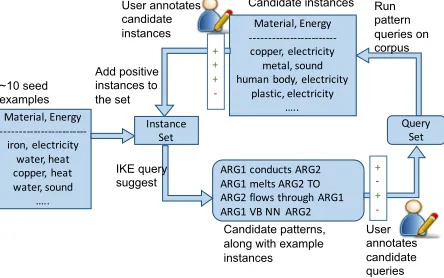
We now describe these features in more de-tail by way of an example. Consider the task of acquiring instances of the binary pred-icate conducts(material,energy), e.g., con-ducts(“steel”,“electricity”). In IKE, relations are visualized as tables, so we treat this task as one of table population. A typical workflow is illustrated in Figure 1, which we now describe. 2.3.1 Define the typesmaterialandenergy
First, the user defines the argument typesmaterial
andenergy. To define a type, IKE lets a user build a single column table, e.g., for typematerial, the user: 1. Creates a single column table called Material. 2. Manually adds several representative examples
in the table, e.g., “iron”, “wood”, “steel”. 3. Expands this set by searching for
cosine-vector-similar phrases in the corpus, and mark-ing valid and invalid members, e.g., the query
$Material∼20
searches for the 20 phrases most similar to any existing member in the Material table, where similar is defined as the cosine between the phrase embeddings. Here we use 300
di-ARG1 conducts ARG2 ARG1 melts ARG2 TO ARG2 flows through ARG1 ARG1 VB NN ARG2 Material, Energy
-‐-‐-‐-‐-‐-‐-‐-‐-‐-‐-‐-‐-‐-‐-‐-‐-‐-‐-‐-‐-‐-‐-‐-‐ iron, electricity
water, heat copper, heat water, sound
…..
IKE query suggest ~10 seed
examples
Candidate patterns, along with example instances
User annotates candidate queries
Run pattern queries on corpus
Material, Energy -‐-‐-‐-‐-‐-‐-‐-‐-‐-‐-‐-‐-‐-‐-‐-‐-‐-‐-‐-‐-‐-‐-‐-‐ copper, electricity metal, sound human body, electricity
plastic, electricity …..
Candidate instances
Add positive instances to the set
Instance Set
+ + + -‐
User annotates candidate instances
+ -‐ + -‐
Query Set
Figure 1:IKE interactive bootstrapping workflow
mensional word2vec embeddings learned us-ing (Mikolov et al., 2013)’s implementation of word2vec on a science document corpus. 4. Repeat step 3 until the table adequately
charac-terizes the intended notion ofmaterial
The process is repeated for the type Energy. Note that here we are using only embedding-based fea-tures to populate a type. We could also use Hearst-style patterns (Hearst, 1992; Snow et al., 2004; Tur-ney, 2006) to populate the type, e.g.,:
materials such as (NP)
materials such as $Material and (NP)
or a combination of patterns and word2vec expres-sions.
2.3.2 Create and Seed the conducts Table The user next creates a two-column table con-ducts, and then uses a seed pattern to find initial pairs to populate it, e.g., the pattern
($Material) conducts ($Energy)
extracts pairs of materials and energies they con-duct. The user selects valid pairs to initially populate the table. Invalid pairs (negative examples) are also recorded by IKE.
[image:3.612.76.298.537.676.2]2.3.3 Bootstrapping to Expand the Table The user can now bootstrap by invoking the ML-based Query Suggestor to find additional patterns (queries) expressing the target relation (Section 2.2). It does so by searching for narrowings or broaden-ings of the current query that cover a large number of positive pairs and few of the negative pairs in the table so far. The user then clicks on one of these pat-terns to select and execute it (with edits if desired) to find more instances of the relation, marks good/bad pairs, and expands the table (Figure 2). By repeating this process, the user rapidly populates the table.
2.4 Execution Speed
conducts ($conducts.Material ~500) absorbs ($conducts.Energy)
Figure 2: Search for examples of “X absorbs Y”, where X is distributionally similar (∼500) to existing entries in the Material column of theconductstable. The user then annotates examples for inclusion in the table.
Corpus # sentences Avg. query-time (sec.) Science textbook 1.2K 0.253 ck2.org texts 17K 0.286 SimpleWikipedia 1M 0.530 Web Subset (small) 1.5M 0.595 Web Subset (large) 20M 2.809
Table 2:Avg. query-times with different sized corpora.
3 Preliminary Evaluation
3.1 Experiments
Although IKE is still under development, we have conducted a preliminary evaluation, comparing it with two other methods for populating relation ta-bles. Our interest is in how these different methods compare in terms of precision, yield and time:
• Manual: The user manually authors and refines patterns (without any automatic assistance) to populate a table.
• Automatic: The user provides an initial table with a few entries, and then lets the system boot-strap on its own, without any further interaction.
• Interactive (IKE): Interactive bootstrapping, as described earlier.
The manual system was implemented in IKE by
dis-abling the embedding-based set expansion and ML-based query suggestion features. The automatic ap-proach was simulated in IKE by removing both user annotation steps in Figure 1, and instead adding all machine-learned patterns suggested by the Query Suggestor (Section 2.2) and instances that occur at leastktimes in the corpus (using k= 2). This is a simple baseline method of bootstrapping, compared with more sophisticated methods such as co-training (Collins and Singer, 1999; Neelakantan and Collins, 2014). For a fair comparison, we compared results after 3 bootstrapping iterations (for Automatic, IKE) and a similar amount of user time (∼30 mins, for Manual and IKE). The number of iterations were limited to 3 to keep the annotation time within rea-sonable limits.
3.2 Tasks and Datasets
[image:4.612.86.285.371.432.2]Simple Wikipedia, and the Web. For each relation, two (different) users familiar with IKE were asked to construct these tables. The numbers presented in Ta-ble 3 and TaTa-ble 4 are averaged over these two users. Although this study is small, it provides helpful in-dicators about IKE’s utility.
Method Acquired Patterns Extractions Time No. of Average Number Yield in min. patterns Precision (total) (+ves)
Manual 7 25.5 106 27 30
Automatic 108 34.4 183 63
[image:5.612.79.293.147.210.2]-IKE 31 52.7 112 59 20
Table 3: conducts(material,energy) table after 3 iterations or ∼30 minutes user time. IKE helps the user discover substan-tially more patterns than the manual method (31 vs. 7), with better precision and in less time, resulting in the overall yield of 59 relation instances. Fully automatic bootstrapping produced a large number of lower precision (34.4%) patterns compared to IKE (52.7%) patterns.
Method Acquired Patterns Extractions Time No. of Average Number Yield in min. patterns Precision (total) (+ves)
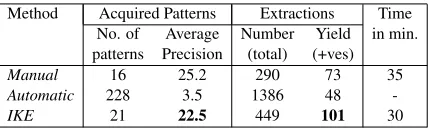
Manual 16 25.2 290 73 35
Automatic 228 3.5 1386 48
-IKE 21 22.5 449 101 30
Table 4: has-part(organism,bodypart) table after 3 iterations or∼30 minutes user time. Again, IKE produces the highest yield by helping the user discover 21 patterns with precision (22.5%) comparable to manual patterns (25.2%). Note that fur-ther use of IKE continues to expand the yield (e.g., after 3 more iterations of IKE the yield rises to262while maintaining aver-age precision).
3.3 Results
Table 3 shows the results for building the con-ducts(material,energy) table. Most importantly, with IKE the user was able to discover substan-tially more patterns (31 vs. 7) with higher accuracy (52.7% vs. 25.5%) than the manual approach, result-ing in a larger table (59 vs. 27 rows) in less time (20 vs. 30 mins). It also shows that fully automatic boot-strapping produced a large number of low quality (34.4% precision) rules, with an overall lower yield (63 rows).
Note that for both Manual and IKE, users have to decide how to spend their time budget, in particu-lar between work on creating high-quality patterns vs. work on annotating examples found by those
patterns. Thus the precision scores in the Tables re-flect how the users chose to make this tradeoff, while the yield reflects their success at the overall goal, namely building a good table.
Table 4 shows similar results for constructing the has-part(organism,bodypart) table, IKE having the highest overall yield. Although this is a small case study, it suggests that IKE has value for rapid knowl-edge base construction.
4 Conclusion
We have presented IKE, a usable, general-purpose tool for interactive extraction. It has an ex-pressive, easily comprehensible query language that integrates symbolic (boolean) and distribu-tional (similarity-based) methods for search, and has a fast execution time. A preliminary evalua-tion suggests that IKE is effective for the task of knowledge-base construction compared to manual pattern authoring or using fully automated extrac-tion tools. We are currently using this tool to ex-pand the KB used by the Aristo system (Clark et al., 2016), and are making IKE publically avail-able on our Web site at http://allenai.org/software/ interactive-knowledge-extraction.
Acknowledgments
We are grateful to Paul Allen whose long-term vision continues to inspire our scientific endeavors. We would also like to thank Carissa Schoenick and Satwant Rana for their critical contributions to IKE.
References
[Akbik et al.2013] Alan Akbik, Oresti Konomi, and Michail Melnikov. 2013. Propminer: A workflow for interactive information extraction and exploration
us-ing dependency trees. InACL.
[Amershi et al.2014] Saleema Amershi, Maya Cakmak, W. Bradley Knox, and Todd Kulesza. 2014. Power to the people: The role of humans in interactive machine
learning. InAI Magazine.
[Amershi et al.2015] Saleema Amershi, Max Chickering, Steven M. Drucker, Bongshin Lee, Patrice Y. Simard, and Jina Suh. 2015. Modeltracker: Redesigning
per-formance analysis tools for machine learning. InCHI.
[Angeli et al.2015] Gabor Angeli, Melvin Jose Johnson Premkumar, and Christopher D. Manning. 2015. Leveraging linguistic structure for open domain
[image:5.612.78.292.322.386.2][Cafarella et al.2005] Michael J. Cafarella, Doug Downey, Stephen Soderland, and Oren Etzioni. 2005. Knowitnow: Fast, scalable information extraction
from the web. InNAACL.
[Carlson et al.2009] Andrew Carlson, Justin Betteridge, Estevam R Hruschka Jr, and Tom M Mitchell. 2009. Coupling semi-supervised learning of categories and
relations. In Proceedings of the NAACL HLT 2009
Workshop on Semi-supervised Learning for Natu-ral Language Processing, pages 1–9. Association for Computational Linguistics.
[Carlson et al.2010] Andrew Carlson, Justin Betteridge, Richard C Wang, Estevam R Hruschka Jr, and Tom M Mitchell. 2010. Coupled semi-supervised learning
for information extraction. InProceedings of the third
ACM international conference on Web search and data mining, pages 101–110. ACM.
[Chang and Manning2014] Angel X Chang and Christo-pher D Manning. 2014. Tokensregex: Defining cas-caded regular expressions over tokens. Technical Re-port CSTR 2014-02, Stanford University.
[Clark et al.2016] Peter Clark, Oren Etzioni, Tushar Khot, Ashish Sabharwal, Oyvind Tafjord, Peter Turney, and Daniel Khashabi. 2016. Combining retrieval, statis-tics, and inference to answer elementary science ques-tions. InProc. IJCAI’16.
[Collins and Singer1999] Michael John Collins and Yoram Singer. 1999. Unsupervised models for named
entity classification. InEMNLP&VLC’99.
[Etzioni et al.2004] Oren Etzioni, Michael J. Cafarella, Doug Downey, Stanley Kok, Ana-Maria Popescu, Tal Shaked, Stephen Soderland, Daniel S. Weld, and Alexander Yates. 2004. Web-scale information
ex-traction in knowitall: (preliminary results). InWWW.
[Freedman et al.2011] Marjorie Freedman, Lance A. Ramshaw, Elizabeth Boschee, Ryan Gabbard, Gary Kratkiewicz, Nicolas Ward, and Ralph M. Weischedel. 2011. Extreme extraction - machine reading in a week. InEMNLP.
[Gamallo et al.2012] Pablo Gamallo, Marcos Garcia, and Santiago Fern´andez-Lanza. 2012. Dependency-based
open information extraction. In Proceedings of the
Joint Workshop on Unsupervised and Semi-Supervised Learning in NLP, pages 10–18. Association for Com-putational Linguistics.
[Gormley and Tong2015] Clinton Gormley and Zachary
Tong. 2015. Elasticsearch: The Definitive Guide. ”
O’Reilly Media, Inc.”.
[Gupta and Manning2014] Sonal Gupta and Christo-pher D. Manning. 2014. Improved pattern learning
for bootstrapped entity extraction. InCONLL.
[Hearst1992] Marti A. Hearst. 1992. Automatic
acqui-sition of hyponyms from large text corpora. In
COL-ING.
[Hoffmann et al.2011] Raphael Hoffmann, Congle
Zhang, Xiao Ling, Luke Zettlemoyer, and Daniel S Weld. 2011. Knowledge-based weak supervision for information extraction of overlapping relations. In Proceedings of the 49th Annual Meeting of the Association for Computational Linguistics: Human Language Technologies-Volume 1, pages 541–550. Association for Computational Linguistics.
[Hoffmann et al.2015] Raphael Hoffmann, Luke S. Zettlemoyer, and Daniel S. Weld. 2015. Extreme
extraction: Only one hour per relation. CoRR,
abs/1506.06418.
[Institute Dutch Lexicology2016] INL Institute
Dutch Lexicology. 2016. Blacklab: A corpus
search engine. https://github.com/INL/BlackLab. [Li et al.2012] Yunyao Li, Laura Chiticariu, Huahai Yang,
Frederick Reiss, and Arnaldo Carreno-Fuentes. 2012. Wizie: A best practices guided development
environ-ment for information extraction. InACL.
[Mikolov et al.2013] Tomas Mikolov, Ilya Sutskever, Kai Chen, Greg Corrado, and Jeffrey Dean. 2013. Dis-tributed representations of words and phrases and their
compositionality. InNIPS.
[Nakashole et al.2011] Ndapandula Nakashole, Martin Theobald, and Gerhard Weikum. 2011. Scalable knowledge harvesting with high precision and high
re-call. InProceedings of the fourth ACM international
conference on Web search and data mining, pages 227–236. ACM.
[Neelakantan and Collins2014] Arvind Neelakantan and Michael Collins. 2014. Learning dictionaries for named entity recognition using minimal supervision.
InEACL.
[Snow et al.2004] Rion Snow, Daniel Jurafsky, and An-drew Y. Ng. 2004. Learning syntactic patterns for
automatic hypernym discovery. InNIPS.
[Soderland et al.2013] Stephen Soderland, John Gilmer, Robert Bart, Oren Etzioni, and Daniel S. Weld. 2013. Open information extraction to kbp relations in 3
hours. InTAC.
[Turney2006] Peter D. Turney. 2006. Similarity of