76
Graph convolutional networks for exploring authorship hypotheses
Tom Lippincott
Johns Hopkins University / Baltimore, MD [email protected]
Abstract
This work considers a task from traditional lit-erary criticism: annotating a structured, com-posite document with information about its sources. We take the Documentary Hypoth-esis, a prominent theory regarding the com-position of the first five books of the He-brew bible, extract stylistic features designed to avoid bias or overfitting, and train several classification models. Our main result is that the recently-introduced graph convolutional network architecture outperforms structurally-uninformed models. We also find that includ-ing information about the granularity of text spans is a crucial ingredient when employ-ing hidden layers, in contrast to simple logis-tic regression. We perform error analysis at several levels, noting how some characteristic limitations of the models and simple features lead to misclassifications, and conclude with an overview of future work.
1 Background
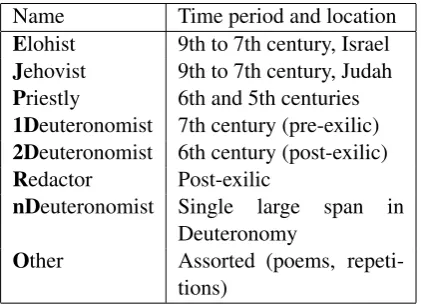
In this paper, we consider the Documentary Hy-pothesis (DH),which proposes a specific combina-tion of sources underlying the existing form of the first five books of the Hebrew Bible known as the Torah (Friedman, 1987).1 Table 1 lists the eight sources in the DH and short description. We use “sources” in a more general sense than in straight-forward author attribution literature: the labels may resolve to original material from particular authors, but could also be insertions from contem-porary sources, redaction by a new liturgical com-munity, translation of another document, and so forth.
Related areas such as authorship attribution and plagiarism detection, that rely on characterizing
1The DH has 150 years of history, exists in several forms,
and is by no means universally accepted: for the purposes of this study, it is a reasonable starting point.
Name Time period and location Elohist 9th to 7th century, Israel Jehovist 9th to 7th century, Judah Priestly 6th and 5th centuries 1Deuteronomist 7th century (pre-exilic) 2Deuteronomist 6th century (post-exilic) Redactor Post-exilic
nDeuteronomist Single large span in Deuteronomy
[image:1.595.312.523.221.373.2]Other Assorted (poems, repeti-tions)
Table 1: Standard sources for the Documentary Hy-pothesis of Torah authorship
documents according tostyle, have a long history in the NLP research community (Potthast et al.,
2017;Stamatatos, 2009; Potthast et al., 2010) as a text classification (Sari et al., 2018) or cluster-ing/outlier detection (Seidman and Koppel,2017;
addition to the linguistic features.
Linguistic features for determining a docu-ment’s source are often designed for robustness and generalization, e.g. word length, puctuation, function words (Mosteller and Wallace, 1963;
Sundararajan and Woodard,2018). Some studies employ full vocabulary or character n-gram fea-tures (Sari et al., 2018), which increase the po-tential for overfitting on topic and open-class vo-cabulary, but can also capture additional stylistic aspects. Recent work has begun to apply neu-ral models to the author attribution task: Sari et al. (2018), for example, combine character n-gram embeddings with a single hidden layer feed-forward network. These features and models do not take into account document structure.
A B C
D
A B C D
A 1 1 0 1
B 1 1 1 0
C 0 1 1 0
[image:2.595.76.286.305.373.2]D 1 0 0 1
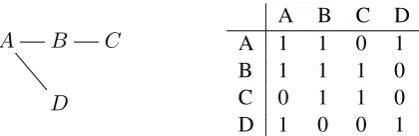
Figure 1: In a GCN, each layer receives input from the previous according to the node adjacency matrix. Ini-tially, nodeC’s representation is based only on it’s own features. After the first convolutional layer, it is also based on features from its predecessorB. By the third layer, it has access to information propagated from its two-hop ancestorA.
The recently-introduced graph convolutional network (GCN) (Kipf and Welling,2016) allows nodes, withLlayers of convolution, access to rep-resentations of their neighbors up toLhops away. This is accomplished by using a function of the adjacency matrix A0 = f(A), which describes the connections between nodes, to determine how the representations from one layer feed into the next. Figure 1 shows a four-node graph and its associated adjacency matrix, plus self-connections (the diagonal) so that nodes employ their own fea-tures. Each layernin the corresponding GCN has a4xHnoutput, whereHnis the size of that layer’s
representations. Before passing the output of layer nto layern+ 1, it is multiplied byA0, which for suitable functions (e.g. f = norm) effectively mixes the output for a given node with that of its neighbors. Thus, at layerl, each node’s represen-tation has been combined to some degree with it’s l-size neighborhood.
2 Experimental setup
Our goal is to train a model to recover the DH us-ing stylistic features: the followus-ing sections de-scribe our data, features, and models.
Data
Our experiments use the Westminster Leningrad Codex (WLC) (Lowery, 2016), available at
http://tanach.us/Tanach.zip, a publicly-available TEI document (editors, 2019) of the oldest complete Masoretic text of the Hebrew Bible. The WLC encodes the DH as described in Friedman (2003), mapping spans (fragments of the Torah document tree) to sources. Spans can be at different levels of granularity, from book down to token, e.g “Num:20:1.1-Num:20:1.5” or “Lev:23:44-Lev:26:38”. Each span corresponds to one or more consecutive nodes in the WLC tree and their children. There are 378 spans with associated source labels, cov-ering the entire Torah. The Torah portion of the WLC consists of 5 books, split into 929 chapters, 5,853 verses, and 79,915 tokens. Furthermore, tokens are segmented into morphs (stems, pre-fixes, and suffixes), with 6,625 unique morphs averaging 1.5 per token. Our most significant data preprocessing is the removal of vowel pointing, which was not introduced until the middle of the first millenium A.D., at earliest. The WLC is tree-structured, and any location can be specified with a tuple of(book, chapter, verse, token, morph), where the latter two are indices calculated from the data. In this paper we construct our fea-tures from morphs, not tokens, as most Hebrew function-words occur at the prefix/suffix level.
The data points are the labeled spans of the DH: the categorical source value, and some linguis-tic or structural features extracted from the cor-responding fragment of the WLC. As recognized by much previous work (Mosteller and Wallace,
Is-rael, and Jehovah.
We also consider two structural features: first, indicator variables for the span’s level of gran-ularity (books, chapters, verses, or words), with the idea that sources differ in the processes that inserted them, e.g. broad original narratives ver-sus surgical edits. Second, and separate from the feature vectors, we construct asibling adjacency matrix for the spans, where a span is connected to another if they share the same parent in the WLC (e.g. if the span is a sequence of chapters in Gen-esis, the parent is the Genesis book node). This will allow graph-aware models to consider how a source is situated relative to nearby sources. Models2
Our baseline models are logistic regression (LR), a standard non-neural classification model capa-ble of handling heterogeneous and potentially-correlated features, and multi-layer perceptrons (MLP), the structure-unaware corrolary to the sim-ple GCN architecture we employ:
LR Logistic regression is equivalent to a neural network with a single fully-connected linear mapping feature vector to label distribution MLP A multi-layer perceptron maps the input
feature vector throughLfully-connected hid-den layers of dimensionality d1, d2. . . dL,
each followed by an activation function GCN Graph convolutional networks (Kipf and
Welling, 2016) are similar to MLPs, but at each hidden layer the currentmatrix contain-ing hidden states ofall data points is multi-plied by the adjacency matrix, allowing a data point to take its neighbors’ states into account The final layer (or, in the case ofLR, the input) is fed to a fully-connected linear layer that projects it to the number of labels, followed by softmax to get a valid distribution. For MLP and GCN, We experiment with linear and non-linear (ReLU) activations, with 32-unit hidden representations based on dev set grid search over possible sizes in (16,32,64,128). All models can be trained with or without the granularity indicator variables (gran). TheGCNmodels are also passed the sib-ling adjacency matrix: combined with one hidden
2Code available at www.github.com/ FirstAuthor/documentary-hypothesis
layer, this allows the models to take into account properties of adjacent spans.
The labeled spans are randomly split into 80/10/10 train/dev/test. Because the data set is very small, we can treat it as a single large batch, which also simplifies the GCN approach, and train by only back-propagating error from the training set loss. We use the Adam optimizer with default parameters (lr = 0.001, betas = (0.9,0.999) ) and allow up to 10k epochs, and monitor the dev set loss for early stopping after 100 epochs with-out improvement. We report macro F-scores on the test set, which gives equal weight to the eight source labels.
3 Results
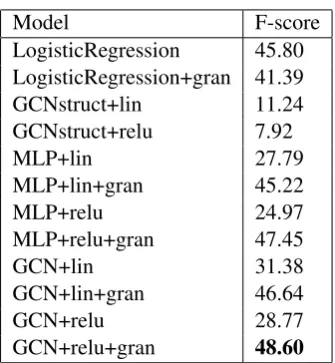
Table2 shows the performance of the model and feature combinations described in Section2. Our primary result is thatGCN, with ReLU activation and the granularity features, outperforms the other configurations. Perhaps most striking is the im-portance of the granularity features for the mod-els with hidden layers. While these indicator vari-ables hurt performance of logistic regression, the rest of the models all see ~10-20 point improve-ments. Interestingly, when using the full feature set (i.e. allowing the model to consider topic), in-cluding granularity features dramatically and con-sistentlylowersperformance: with only word fea-tures, all GCN and MLP models manage an F-score ~77, but with the granularity indicators this drops to ~56. The granularity features may allow for particularly damaging overfitting, and we plan to explore this in follow-up work.
Model F-score
LogisticRegression 45.80 LogisticRegression+gran 41.39 GCNstruct+lin 11.24 GCNstruct+relu 7.92
MLP+lin 27.79
MLP+lin+gran 45.22
MLP+relu 24.97
MLP+relu+gran 47.45
GCN+lin 31.38
GCN+lin+gran 46.64
GCN+relu 28.77
GCN+relu+gran 48.60
[image:3.595.333.501.547.729.2]Table3shows the confusion matrix of the best model (GCN+relu+gran). The P source is more than twice as likely to be misclassified as J than as E, perhaps reflecting their shared provenance in Judah and concern with the Aaronic priesthood. The P and R sources also show affinity, again, with the latter thought to have arisen in Judah (or Baby-lon) long after Israel ceased to exist.
Gold Guess
J E P 1D 2D nD R O
J 100 8 7 0 0 0 3 0
E 22 53 8 0 0 0 0 0
P 13 5 77 0 1 0 4 0
1D 2 0 2 7 1 0 0 0
2D 2 2 1 0 5 0 0 0
nD 0 0 0 1 0 0 0 0
R 3 3 11 0 0 0 33 0
O 2 0 1 0 0 0 1 0
Table 3: Confusion matrix of the eight labels for GCN+relu+gran, where entry (r, c) is the number of times labelrwas misclassified as labelc
Table 4 lists the ten most-misclassified spans, based on the difference between the probability of the guessed label and the correct label. Look-ing closely at a few misclassified spans, we make some (amateur) observations: the P and J sources share an affinity for the word “wife”,3 some-times inserting a clarification of the E source that otherwise paints a less-than-monogamous picture. However, combined with our bag-of-words as-sumption this can create problems: Genesis:25:1-4 is labeled E but misclassified P, using the word “wife” in the context of “took an addi-tional wife”. For Numbers:13:21-22 (P, misclas-sified as J), the model misses the discontinuity introduced between the preceding and succeed-ing spans, whose specific focus on “grapes” is strangely interrupted (though this feature is also inaccessible due to the initial feature selection). Finally, Deuteronomy:32:48-52 (O, misclassified as P) is interesting because it is a direct copy of Numbers:27:12-14, which is indeed P.
4 Future work
Along with graph convolutional networks, sev-eral graph-aware neural models have recently been introduced (e.g. graph attention networks
3One of the common nouns that met the filter criterion.
Span True Guess Diff
Exodus:14:8 P R 88.42
Numbers:13:21-22 P J 88.10
Genesis:37:28.11-20 J P 83.88
Genesis:30:4.1-6 J P 81.32
Deuteronomy:32:48-52 O P 78.96
Genesis:21:2.1-6 J P 66.48
Genesis:25:1-4 E P 62.54
Numbers:26:9-11 R P 60.95
Exodus:14:25.1-6 E J 60.61
[image:4.595.310.531.61.215.2]Genesis:22:11.1-16.5 R J 59.36 Table 4: Top ten misclassifications based on difference between the probability of the true label and the proba-bility of the (incorrectly) guessed label
(Veliˇckovi´c et al., 2017), tree-structured varia-tional autoencoders (Yin et al., 2018)), and their effectiveness should be tested on this task. In par-ticular, vanilla GCNs are limited in how they in-tegrate information from other nodes, and the ex-pressivity of these models may prove useful for the more complex relationships involved in com-positional forces. Active research into augmented GCNs (Lee et al.,2018) is another avenue for ad-dressing the current limitations.
There are existing resources for Hebrew NLP (Multiple, 2019) that, in principle, could facil-itate feature engineering. Authors often have strong positive or negative dispositions regarding people, places, activities, and the like. Moses vs. Aaron is the most obvious for the DH, but characters like Baalam and many of the pre-exilic judges/kings have striking mixtures of praise and condemnation. Sentiment detection (Amram et al.,2018) might provide a window into these differences. Several DH justifications in-volve concept-realization (most famously, the use of Elohim vs Jehovah for the Deity), and being able to tie two words as alternate expressions of the same concept would be very useful. How-ever, we are hesitant to incorporate modern re-sources due to potential bias, both in general lan-guage (given Hebrew’s long existence as a litur-gical language and subsequent revival) and spe-cific resources created by scholars who may un-intentionally encode their own conclusions. We therefore are experimenting with training unsu-pervised distributional models (Blei et al., 2003;
[image:4.595.73.295.183.323.2]contem-porary texts to produce low-bias probablistic lin-guistic resources.
There is a far richer space of traditional schol-arly hypotheses regarding the Bible that we plan to consider in future work. For example, the Deuteronomist sources are historically entangled with the historical books (Judges through Kings), and the prophet Jeremiah and his scribe, Baruch, which ties them to a number of spans outside the Torah (Friedman, 1987). Other annotations in-clude: spans thought to be written in the closely-related Aramaic language, links between narrative doublets, information on poetic meter, and obser-vations on antiquated linguistic markers. We are augmenting the initial TEI document with these annotation layers.
We framed our task as supervised span classi-fication of a source-critical hypothesis, with the spans themselves (and hence their structural re-lations) taken for granted. Our longer-term goal is hypothesis generation, in which a model can be applied to unseen documents and propose their compositional structure. This will involve com-bining a linguisticly-driven model with a structural model that encourages parsimonious hypotheses. Data for training such a structural model is an open question: version control for collaborative writ-ing is a natural modern choice, but only partially overlaps with the phenomena in the centuries-long transmission of historical text.
5 Conclusion
We have demonstrated that a simple graph con-volutional network outperforms graph-unaware models on a task from traditional source criticism. Our error analysis revealed several characteristic shortcomings of the model and feature set, and we discussed future directions to address these.
This study is also a first step towards a more general approach to studying compositional forces in richly-structured historical texts. The basic as-sumptions of a tree-structured document with tra-ditional annotations attached to nodes fits many situations, and in fact an immediate next step is to adopt these procedures to arbitrary TEI-encoded data sets and metadata. This will open up a broad range of existing documents and hypotheses (Smith et al.,2000;Tom Elliott,2017;Association for Literary and Linguistic Computing,1977; Uni-versity of Ulster,2017), and encourage collabora-tion with domain experts via e.g. common
visual-ization and annotation tools.
References
Adam Amram, Anat Ben-David, and Reut Tsarfaty. 2018. Representations and Architectures in Neural Sentiment Analysis for Morphologically Rich Lan-guages: A Case Study from Modern Hebrew. In Proceedings of the 27th International Conference on Computational Linguistics, pages 2242–2252.
Association for Literary and Linguistic Computing. 1977.Oxford Archive of Electronic Literature.
David M Blei, Andrew Y Ng, and Michael I Jordan. 2003. Latent Dirichlet allocation. Journal of ma-chine Learning research, 3(Jan):993–1022.
TEI Consortium editors. 2019. TEI P5: Guidelines for Electronic Text Encoding and Interchange.
Richard Elliott Friedman. 1987. Who Wrote the Bible? Simon and Schuster.
Richard Elliott Friedman. 2003. The Bible with Sources Revealed. HarperCollins.
Thomas N Kipf and Max Welling. 2016. Semi-supervised classification with graph convolutional networks. arXiv preprint arXiv:1609.02907.
John Boaz Lee, Ryan A Rossi, Xiangnan Kong, Sungchul Kim, Eunyee Koh, and Anup Rao. 2018. Higher-order graph convolutional networks. arXiv preprint arXiv:1809.07697.
Thomas Lippincott. 2009. A Framework for Multilay-ered Boundary Detection.Digital Humanities 2009.
Thomas Lippincott, Diarmuid O S´eaghdha, and Anna Korhonen. 2012. Learning syntactic verb frames us-ing graphical models. In Proceedings of the 50th Annual Meeting of the Association for Computa-tional Linguistics: Long Papers-Volum e 1, pages 420–429. Association for Computational Linguis-tics.
Kirk E. Lowery. 2016. A Reference Guide to the West-minster Leningrad Codex.
Tomas Mikolov, Ilya Sutskever, Kai Chen, Greg S Cor-rado, and Jeff Dean. 2013. Distributed Representa-tions of Words and Phrases and their Composition-ality. In C. J. C. Burges, L. Bottou, M. Welling, Z. Ghahramani, and K. Q. Weinberger, editors, Ad-vances in Neural Information Processing Systems 26, pages 3111–3119. Curran Associates, Inc.
Frederick Mosteller and David L. Wallace. 1963. In-ference in an Authorship Problem. Journal of the American Statistical Association, 58(302):275–309.
Martin Potthast, Francisco Rangel, Michael Tschug-gnall, Efstathios Stamatatos, Paolo Rosso, and Benno Stein. 2017. Overview of PAN’17: Au-thor Identification, AuAu-thor Profiling, and AuAu-thor Obfuscation. In Experimental IR Meets Multilin-guality, Multimodality, and Interaction. 7th Interna-tional Conference of the CLEF Initiative (CLEF 17), Berlin Heidelberg New York. Springer.
Martin Potthast, Benno Stein, Alberto Barr´on-Cede˜no, and Paolo Rosso. 2010. An evaluation framework for plagiarism detection. In Proceedings of the 23rd international conference on computational lin-guistics: Posters, pages 997–1005. Association for Computational Linguistics.
Mohammad Sadegh Rasooli, Thomas Lippincott, Nizar Habash, and Owen Rambow. 2014. Unsupervised Morphology-Based Vocabulary Expansion. InACL (1), pages 1349–1359.
Yunita Sari, Mark Stevenson, and Andreas Vlachos. 2018. Topic or Style? Exploring the Most Useful Features for Authorship Attribution. InProceedings of the 27th International Conference on Computa-tional Linguistics, pages 343–353.
Shachar Seidman and Moshe Koppel. 2017. De-tecting pseudepigraphic texts using novel similarity measures. Digital Scholarship in the Humanities, 33(1):72–81.
Yanir Seroussi, Ingrid Zukerman, and Fabian Bohnert. 2011. Authorship attribution with latent Dirichlet allocation. In Proceedings of the fifteenth confer-ence on computational natural language learning, pages 181–189. Association for Computational Lin-guistics.
DA Smith, JA Rydberg-Cox, and GR Crane. 2000.The Perseus Project: a digital library for the humanities. Literary and Linguistic Computing, 15(1):15–25.
Efstathios Stamatatos. 2009. A survey of modern au-thorship attribution methods. Journal of the Ameri-can Society for information Science and Technology, 60(3):538–556.
Kalaivani Sundararajan and Damon Woodard. 2018. What represents ”style” in authorship attribution? InProceedings of the 27th International Conference on Computational Linguistics, pages 2814–2822.
Hugh Cayless et al. Tom Elliott, Gabriel Bodard. 2017.
EpiDoc: Epigraphic Documents in TEI XML.
University of Ulster. 2017.CELT: Corpus of Electronic Texts.
Petar Veliˇckovi´c, Guillem Cucurull, Arantxa Casanova, Adriana Romero, Pietro Lio, and Yoshua Bengio. 2017. Graph attention networks. arXiv preprint arXiv:1710.10903.