Hierarchical Attention Networks for Document Classification
Zichao Yang1, Diyi Yang1, Chris Dyer1, Xiaodong He2, Alex Smola1, Eduard Hovy1 1Carnegie Mellon University,2Microsoft Research, Redmond
{zichaoy, diyiy, cdyer, hovy}@cs.cmu.edu [email protected] [email protected]
Abstract
We propose a hierarchical attention network for document classification. Our model has two distinctive characteristics: (i) it has a hier-archical structure that mirrors the hierhier-archical structure of documents; (ii) it has two levels of attention mechanisms applied at the word-and sentence-level, enabling it to attend dif-ferentially to more and less important con-tent when constructing the document repre-sentation. Experiments conducted on six large scale text classification tasks demonstrate that the proposed architecture outperform previous methods by a substantial margin. Visualiza-tion of the attenVisualiza-tion layers illustrates that the model selects qualitatively informative words and sentences.
1 Introduction
Text classification is one of the fundamental task in Natural Language Processing. The goal is to as-sign labels to text. It has broad applications includ-ing topic labelinclud-ing (Wang and Manninclud-ing, 2012), senti-ment classification (Maas et al., 2011; Pang and Lee, 2008), and spam detection (Sahami et al., 1998). Traditional approaches of text classification repre-sent documents with sparse lexical features, such as n-grams, and then use a linear model or kernel methods on this representation (Wang and Manning, 2012; Joachims, 1998). More recent approaches used deep learning, such as convolutional neural net-works (Blunsom et al., 2014) and recurrent neural networks based on long short-term memory (LSTM) (Hochreiter and Schmidhuber, 1997) to learn text representations.
pork belly = delicious .||scallops? ||I don’t even like scallops, and these were a-m-a-z-i-n-g .||fun and tasty cocktails. ||next time I in Phoenix, I will go back here.||Highly recommend.
Figure 1: A simple example review from Yelp 2013 that con-sists of five sentences, delimited by period, question mark. The first and third sentence delivers stronger meaning and inside, the worddelicious, a-m-a-z-i-n-gcontributes the most in defin-ing sentiment of the two sentences.
Although neural-network–based approaches to text classification have been quite effective (Kim, 2014; Zhang et al., 2015; Johnson and Zhang, 2014; Tang et al., 2015), in this paper we test the hypoth-esis that better representations can be obtained by incorporating knowledge of document structure in the model architecture. The intuition underlying our model is that not all parts of a document are equally relevant for answering a query and that determining the relevant sections involves modeling the interac-tions of the words, not just their presence in isola-tion.
Our primary contribution is a new neural archi-tecture (§2), the Hierarchical Attention Network (HAN) that is designed to capture two basic insights about document structure. First, since documents have a hierarchical structure (words form sentences, sentences form a document), we likewise construct a document representation by first building represen-tations of sentences and then aggregating those into a document representation. Second, it is observed that different words and sentences in a documents are differentially informative. Moreover, the
tance of words and sentences are highly context de-pendent, i.e. the same word or sentence may be dif-ferentially important in different context (§3.5). To include sensitivity to this fact, our model includes two levels of attention mechanisms (Bahdanau et al., 2014; Xu et al., 2015) — one at the word level and one at the sentence level — that let the model to pay more or less attention to individual words and sentences when constructing the representation of the document. To illustrate, consider the example in Fig. 1, which is a short Yelp review where the task is to predict the rating on a scale from 1–5. In-tuitively, the first and third sentence have stronger information in assisting the prediction of the rat-ing; within these sentences, the worddelicious, a-m-a-z-i-n-g contributes more in implying the positive attitude contained in this review. At-tention serves two benefits: not only does it often result in better performance, but it also provides in-sight into which words and sentences contribute to the classification decision which can be of value in applications and analysis (Shen et al., 2014; Gao et al., 2014).
The key difference to previous work is that our system usescontextto discoverwhena sequence of tokens is relevant rather than simply filtering for (se-quences of) tokens, taken out of context. To evaluate the performance of our model in comparison to other common classification architectures, we look at six data sets (§3). Our model outperforms previous ap-proaches by a significant margin.
2 Hierarchical Attention Networks
The overall architecture of the Hierarchical Atten-tion Network (HAN) is shown in Fig. 2. It con-sists of several parts: a word sequence encoder, a word-level attention layer, a sentence encoder and a sentence-level attention layer. We describe the de-tails of different components in the following sec-tions.
2.1 GRU-based sequence encoder
The GRU (Bahdanau et al., 2014) uses a gating mechanism to track the state of sequences without using separate memory cells. There are two types of gates: the reset gatertand the update gatezt. They
together control how information is updated to the
h21 h21 hh2222
!
h22
!
h22
h2T h2T
! h2T ! h2T uw
uw
w21
w21 ww2222 w2w2TT
word encoder word attention h1
h1
! h1
! h1
h2 h2
!
h2 !
h2
hL hL
! hL !
hL us
us
s1
s1 ss22 ssLL
↵L ↵L
sentence encoder
sentence attention vv
softmax
↵21
↵21 ↵↵2222 ↵↵2T2T
!
h21
!
h21 ↵1
[image:2.612.316.534.61.313.2]↵1 ↵↵22
Figure 2:Hierarchical Attention Network.
state. At timet, the GRU computes the new state as
ht= (1−zt)⊙ht−1+zt⊙h˜t. (1)
This is a linear interpolation between the previous state ht−1 and the current new state ˜ht computed
with new sequence information. The gateztdecides
how much past information is kept and how much new information is added.ztis updated as:
zt=σ(Wzxt+Uzht−1+bz), (2)
wherextis the sequence vector at timet. The
can-didate state˜htis computed in a way similar to a
tra-ditional recurrent neural network (RNN):
˜
ht= tanh(Whxt+rt⊙(Uhht−1) +bh), (3)
Herertis the reset gate which controls how much
the past state contributes to the candidate state. Ifrt
is zero, then it forgets the previous state. The reset gate is updated as follows:
rt=σ(Wrxt+Urht−1+br) (4)
2.2 Hierarchical Attention
si and each sentence contains Ti words. wit with
t ∈ [1, T]represents the words in theith sentence. The proposed model projects the raw document into a vector representation, on which we build a classi-fier to perform document classification. In the fol-lowing, we will present how we build the document level vector progressively from word vectors by us-ing the hierarchical structure.
Word Encoder Given a sentence with words wit, t ∈ [0, T], we first embed the words to vectors
through an embedding matrix We, xij = Wewij.
We use a bidirectional GRU (Bahdanau et al., 2014) to get annotations of words by summarizing infor-mation from both directions for words, and therefore incorporate the contextual information in the anno-tation. The bidirectional GRU contains the forward GRU −→f which reads the sentence si from wi1 to wiT and a backward GRU←f−which reads fromwiT
towi1:
xit=Wewit, t∈[1, T],
− →h
it=−−−→GRU(xit), t∈[1, T],
←−h
it=←−−−GRU(xit), t∈[T,1].
We obtain an annotation for a given word wit by
concatenating the forward hidden state −→hit and
backward hidden state ←h−it, i.e., hit = [→−hit,←−hit],
which summarizes the information of the whole sen-tence centered aroundwit.
Note that we directly use word embeddings. For a more complete model we could use a GRU to get word vectors directly from characters, similarly to (Ling et al., 2015). We omitted this for simplicity.
Word Attention Not all words contribute equally to the representation of the sentence meaning. Hence, we introduce attention mechanism to extract such words that are important to the meaning of the sentence and aggregate the representation of those informative words to form a sentence vector. Specif-ically,
uit= tanh(Wwhit+bw) (5)
αit= exp(u
⊤
ituw)
∑
texp(u⊤ituw) (6)
si =
∑
t
αithit. (7)
That is, we first feed the word annotationhitthrough
a one-layer MLP to get uit as a hidden
represen-tation of hit, then we measure the importance of
the word as the similarity ofuit with a word level
context vectoruw and get a normalized importance
weightαit through a softmax function. After that,
we compute the sentence vectorsi(we abuse the
no-tation here) as a weighted sum of the word annota-tions based on the weights. The context vectoruw
can be seen as a high level representation of a fixed query “what is the informative word” over the words like that used in memory networks (Sukhbaatar et al., 2015; Kumar et al., 2015). The word context vectoruwis randomly initialized and jointly learned
during the training process.
Sentence Encoder Given the sentence vectorssi,
we can get a document vector in a similar way. We use a bidirectional GRU to encode the sentences:
− →h
i =−−−→GRU(si), i∈[1, L],
←−
hi =←−−−GRU(si), t∈[L,1].
We concatenate−→hi and←−hj to get an annotation of
sentencei, i.e.,hi = [−→hi,←h−i]. hi summarizes the
neighbor sentences around sentenceibut still focus on sentencei.
Sentence Attention To reward sentences that are clues to correctly classify a document, we again use attention mechanism and introduce a sentence level context vectorusand use the vector to measure the
importance of the sentences. This yields
ui = tanh(Wshi+bs), (8)
αi = exp(u
⊤
i us)
∑
iexp(u⊤i us), (9)
v=∑
i
αihi, (10)
where v is the document vector that summarizes all the information of sentences in a document. Similarly, the sentence level context vector can be randomly initialized and jointly learned during the training process.
2.3 Document Classification
doc-ument classification:
p=softmax(Wcv+bc). (11)
We use the negative log likelihood of the correct la-bels as training loss:
L=−∑
d
logpdj, (12)
wherejis the label of documentd.
3 Experiments
3.1 Data sets
We evaluate the effectiveness of our model on six large scale document classification data sets. These data sets can be categorized into two types of doc-ument classification tasks: sentiment estimation and topic classification. The statistics of the data sets are summarized in Table 1. We use 80% of the data for training, 10% for validation, and the remaining 10% for test, unless stated otherwise.
Yelp reviews are obtained from the Yelp Dataset Challenge in 2013, 2014 and 2015 (Tang et al., 2015). There are five levels of ratings from 1 to 5 (higher is better).
IMDB reviews are obtained from (Diao et al., 2014). The ratings range from 1 to 10.
Yahoo answers are obtained from (Zhang et al., 2015). This is a topic classification task with 10 classes: Society & Culture, Science & Mathe-matics, Health, Education & Reference, Com-puters & Internet, Sports, Business & Finance, Entertainment & Music, Family & Relation-ships and Politics & Government. The docu-ment we use includes question titles, question contexts and best answers. There are 140,000 training samples and 5000 testing samples. The original data set does not provide validation samples. We randomly select 10% of the train-ing samples as validation.
Amazon reviews are obtained from (Zhang et al., 2015). The ratings are from 1 to 5. 3,000,000 reviews are used for training and 650,000 re-views for testing. Similarly, we use 10% of the training samples as validation.
3.2 Baselines
We compare HAN with several baseline meth-ods, including traditional approaches such as lin-ear methods, SVMs and paragraph embeddings us-ing neural networks, LSTMs, word-based CNN, character-based CNN, and Conv-GRNN, LSTM-GRNN. These baseline methods and results are re-ported in (Zhang et al., 2015; Tang et al., 2015).
3.2.1 Linear methods
Linear methods (Zhang et al., 2015) use the con-structed statistics as features. A linear classifier based on multinomial logistic regression is used to classify the documents using the features.
BOW and BOW+TFIDF The 50,000 most fre-quent words from the training set are selected and the count of each word is used features. Bow+TFIDF, as implied by the name, uses the TFIDF of counts as features.
n-grams and n-grams+TFIDF used the most fre-quent 500,000 n-grams (up to 5-grams).
Bag-of-means The average word2vec embedding (Mikolov et al., 2013) is used as feature set.
3.2.2 SVMs
SVMs-based methods are reported in (Tang et al., 2015), including SVM+Unigrams, Bigrams, Text Features, AverageSG, SSWE. In detail, Uni-gramsandBigramsuses of-unigrams and bag-of-bigrams as features respectively.
Text Features are constructed according to (Kir-itchenko et al., 2014), including word and char-acter n-grams, sentiment lexicon features etc.
AverageSG constructs 200-dimensional word vec-tors using word2vec and the average word em-beddings of each document are used.
SSWE uses sentiment specific word embeddings according to (Tang et al., 2014).
3.2.3 Neural Network methods
The neural network based methods are reported in (Tang et al., 2015) and (Zhang et al., 2015).
CNN-word Word based CNN models like that of (Kim, 2014) are used.
Data set classes documents average #s max #s average #w max #w vocabulary
Yelp 2013 5 335,018 8.9 151 151.6 1184 211,245
Yelp 2014 5 1,125,457 9.2 151 156.9 1199 476,191
Yelp 2015 5 1,569,264 9.0 151 151.9 1199 612,636
IMDB review 10 348,415 14.0 148 325.6 2802 115,831
Yahoo Answer 10 1,450,000 6.4 515 108.4 4002 1,554,607 Amazon review 5 3,650,000 4.9 99 91.9 596 1,919,336 Table 1: Data statistics: #s denotes the number of sentences (average and maximum per document), #w denotes the number of words (average and maximum per document).
LSTM takes the whole document as a single se-quence and the average of the hidden states of all words is used as feature for classification.
Conv-GRNN and LSTM-GRNN were proposed by (Tang et al., 2015). They also explore the hierarchical structure: a CNN or LSTM provides a sentence vector, and then a gated recurrent neural network (GRNN) combines the sentence vectors from a document level vector representation for classification.
3.3 Model configuration and training
We split documents into sentences and tokenize each sentence using Stanford’s CoreNLP (Manning et al., 2014). We only retain words appearing more than 5 times in building the vocabulary and replace the words that appear 5 times with a special UNK token. We obtain the word embedding by training an un-supervised word2vec (Mikolov et al., 2013) model on the training and validation splits and then use the word embedding to initializeWe.
The hyper parameters of the models are tuned on the validation set. In our experiments, we set the word embedding dimension to be 200 and the GRU dimension to be 50. In this case a com-bination of forward and backward GRU gives us 100 dimensions for word/sentence annotation. The word/sentence context vectors also have a dimension of 100, initialized at random.
For training, we use a mini-batch size of 64 and documents of similar length (in terms of the number of sentences in the documents) are organized to be a batch. We find that length-adjustment can accelerate training by three times. We use stochastic gradient descent to train all models with momentum of 0.9. We pick the best learning rate using grid search on the validation set.
3.4 Results and analysis
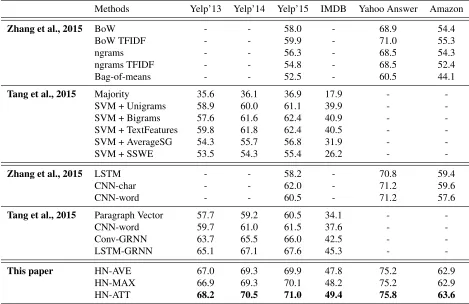
The experimental results on all data sets are shown in Table 2. We refer to our models as HN-{AVE, MAX, ATT}. Here HN stands for Hierarchical Network, AVE indicates averaging, MAX indicates max-pooling, and ATT indicates our proposed hi-erarchical attention model. Results show that HN-ATT gives the best performance across all data sets. The improvement is regardless of data sizes. For smaller data sets such as Yelp 2013 and IMDB, our model outperforms the previous best baseline meth-ods by 3.1% and 4.1% respectively. This finding is consistent across other larger data sets. Our model outperforms previous best models by 3.2%, 3.4%, 4.6% and 6.0% on Yelp 2014, Yelp 2015, Yahoo An-swers and Amazon Reviews. The improvement also occurs regardless of the type of task: sentiment clas-sification, which includes Yelp 2013-2014, IMDB, Amazon Reviews and topic classification for Yahoo Answers.
From Table 2 we can see that neural network based methods that donotexplore hierarchical doc-ument structure, such as LSTM, word, CNN-char have little advantage over traditional methods for large scale (in terms of document size) text clas-sification. E.g. SVM+TextFeatures gives perfor-mance 59.8, 61.8, 62.4, 40.5 for Yelp 2013, 2014, 2015 and IMDB respectively, while CNN-word has accuracy 59.7, 61.0, 61.5, 37.6 respectively.
Methods Yelp’13 Yelp’14 Yelp’15 IMDB Yahoo Answer Amazon
Zhang et al., 2015 BoW - - 58.0 - 68.9 54.4
BoW TFIDF - - 59.9 - 71.0 55.3
ngrams - - 56.3 - 68.5 54.3
ngrams TFIDF - - 54.8 - 68.5 52.4
Bag-of-means - - 52.5 - 60.5 44.1
Tang et al., 2015 Majority 35.6 36.1 36.9 17.9 -
-SVM + Unigrams 58.9 60.0 61.1 39.9 -
-SVM + Bigrams 57.6 61.6 62.4 40.9 -
-SVM + TextFeatures 59.8 61.8 62.4 40.5 -
-SVM + AverageSG 54.3 55.7 56.8 31.9 -
-SVM + SSWE 53.5 54.3 55.4 26.2 -
-Zhang et al., 2015 LSTM - - 58.2 - 70.8 59.4
CNN-char - - 62.0 - 71.2 59.6
CNN-word - - 60.5 - 71.2 57.6
Tang et al., 2015 Paragraph Vector 57.7 59.2 60.5 34.1 -
-CNN-word 59.7 61.0 61.5 37.6 -
-Conv-GRNN 63.7 65.5 66.0 42.5 -
-LSTM-GRNN 65.1 67.1 67.6 45.3 -
-This paper HN-AVE 67.0 69.3 69.9 47.8 75.2 62.9
HN-MAX 66.9 69.3 70.1 48.2 75.2 62.9
[image:6.612.71.540.61.365.2]HN-ATT 68.2 70.5 71.0 49.4 75.8 63.6
Table 2:Document Classification, in percentage
combined with hierarchical structure improves over previous models (LSTM-GRNN) by 3.1%, 3.4%, 3.5% and 4.1% respectively. More interestingly, in the experiments, HN-AVE is equivalent to us-ing non-informative global word/sentence context vectors (e.g., if they are all-zero vectors, then the attention weights in Eq. 6 and 9 become uniform weights). Compared to HN-AVE, the HN-ATT model gives superior performance across the board. This clearly demonstrates the effectiveness of the proposed global word and sentence importance vec-tors for the HAN.
3.5 Context dependent attention weights
If words were inherently important or not important, models without attention mechanism might work well since the model could automatically assign low weights to irrelevant words and vice versa. How-ever, the importance of words is highly context de-pendent. For example, the wordgoodmay appear in a review that has the lowest rating either because users are only happy with part of the product/service or because they use it in a negation, such as not
good. To verify that our model can capture context dependent word importance, we plot the distribution of the attention weights of the wordsgoodandbad
from the test split of Yelp 2013 data set as shown in Figure 3(a) and Figure 4(a). We can see that the dis-tribution has a attention weight assigned to a word from 0 to 1. This indicates that our model captures diverse context and assign context-dependent weight to the words.
For further illustration, we plot the distribution when conditioned on the ratings of the review. Sub-figures 3(b)-(f) in Figure 3 and Figure 4 correspond to the rating 1-5 respectively. In particular, Fig-ure 3(b) shows that the weight ofgoodconcentrates on the low end in the reviews with rating 1. As the rating increases, so does the weight distribution. This means that the word good plays a more im-portant role for reviews with higher ratings. We can observe the converse trend in Figure 4 for the word
0.0 0.3 0.6 0.9 0.0 0.3 0.6 0.9 1.2 (a)
0.0 0.3 0.6 0.9 0.0 0.5 1.0 1.5 2.0 (b)
0.0 0.3 0.6 0.9 0.0
0.5 1.0 1.5
2.0 (c)
0.0 0.3 0.6 0.9 0.0
0.4 0.8 1.2
1.6 (d)
0.0 0.3 0.6 0.9 0.0
0.4 0.8 1.2
1.6 (e)
[image:7.612.75.298.63.241.2]0.0 0.3 0.6 0.9 0.0 0.3 0.6 0.9 1.2 (f)
Figure 3:Attention weight distribution ofgood. (a) — aggre-gate distribution on the test split; (b)-(f) stratified for reviews with ratings 1-5 respectively. We can see that the weight distri-bution shifts tohigherend as the rating goes higher.
0.0 0.3 0.6 0.9 0.0
0.6 1.2 1.8
2.4 (a)
0.0 0.3 0.6 0.9 0.0 0.4 0.8 1.2 1.6 (b)
0.0 0.3 0.6 0.9 0.0 0.3 0.6 0.9 1.2 (c)
0.0 0.3 0.6 0.9 0.0
0.8 1.6 2.4
3.2 (d)
0.0 0.3 0.6 0.9 0.0 0.7 1.4 2.1 2.8 (e)
[image:7.612.75.297.305.487.2]0.0 0.3 0.6 0.9 0.0 0.7 1.4 2.1 2.8 (f)
Figure 4:Attention weight distribution of the wordbad. The setup is as above: (a) contains the aggregate distribution, while (b)-(f) contain stratifications to reviews with ratings 1-5 respec-tively. Contrary to before, the wordbadis considered impor-tant for poor ratings and less so for good ones.
3.6 Visualization of attention
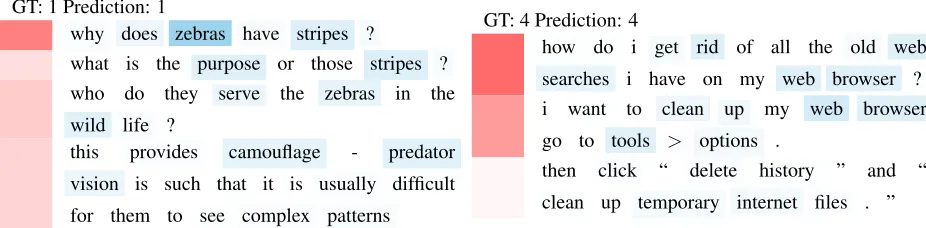
In order to validate that our model is able to select in-formative sentences and words in a document, we vi-sualize the hierarchical attention layers in Figures 5 and 6 for several documents from the Yelp 2013 and Yahoo Answers data sets.
Every line is a sentence (sometimes sentences spill over several lines due to their length). Red de-notes the sentence weight and blue dede-notes the word
weight. Due to the hierarchical structure, we nor-malize the word weight by the sentence weight to make sure that only important words in important sentences are emphasized. For visualization pur-poses we display√pspw. The√psterm displays the
important words in unimportant sentences to ensure that they are not totally invisible.
Figure 5 shows that our model can select the words carrying strong sentiment likedelicious, amazing, terrible and their corresponding sentences. Sentences containing many words like cocktails, pasta, entree are disre-garded. Note that our model can not only select words carrying strong sentiment, it can also deal with complex across-sentence context. For example, there are sentences like i don’t even like scallopsin the first document of Fig. 5, if look-ing purely at the slook-ingle sentence, we may think this is negative comment. However, our model looks at the context of this sentence and figures out this is a positive review and chooses to ignore this sentence. Our hierarchical attention mechanism also works well for topic classification in the Yahoo Answer data set. For example, for the left document in Figure 6 with label 1, which denotes Science and Mathematics, our model accurately localizes the words zebra, strips, camouflage, predatorand their corresponding sentences. For the right document with label 4, which denotes Computers and Internet, our model focuses onweb, searches, browsersand their corresponding sentences. Note that this happens in amulticlass set-ting, that is, detection happens before the selection of the topic!
4 Related Work
GT: 4 Prediction: 4
pork belly = delicious . scallops ?
i do n’t . even . like .
scallops , and these were a-m-a-z-i-n-g . fun and tasty cocktails .
next time i ’m in phoenix , i will go back here .
highly recommend .
GT: 0 Prediction: 0 terrible value .
ordered pasta entree . .
$ 16.95 good taste but size was an appetizer size .
.
no salad , no bread no vegetable . this was .
[image:8.612.71.535.61.225.2]our and tasty cocktails . our second visit . i will not go back .
Figure 5:Documents from Yelp 2013. Label 4 means star 5, label 0 means star 1.
GT: 1 Prediction: 1
why does zebras have stripes ?
what is the purpose or those stripes ? who do they serve the zebras in the wild life ?
this provides camouflage - predator
vision is such that it is usually difficult for them to see complex patterns
GT: 4 Prediction: 4
how do i get rid of all the old web searches i have on my web browser ? i want to clean up my web browser go to tools > options .
then click “ delete history ” and “ clean up temporary internet files . ”
Figure 6:Documents from Yahoo Answers. Label 1 denotes Science and Mathematics and label 4 denotes Computers and Internet.
explore the structure of a sentence and use a tree-structured LSTMs for classification. There are also some works that combine LSTM and CNN struc-ture to for sentence classification (Lai et al., 2015; Zhou et al., 2015). Tang et al. (2015) use hierarchi-cal structure in sentiment classification. They first use a CNN or LSTM to get a sentence vector and then a bi-directional gated recurrent neural network to compose the sentence vectors to get a document vectors. There are some other works that use hier-archical structure in sequence generation (Li et al., 2015) and language modeling (Lin et al., 2015).
The attention mechanism was proposed by (Bah-danau et al., 2014) in machine translation. The en-coder deen-coder framework is used and an attention mechanism is used to select the reference words in original language for words in foreign language be-fore translation. Xu et al. (2015) uses the attention mechanism in image caption generation to select the relevant image regions when generating words in the captions. Further uses of the attention mechanism include parsing (Vinyals et al., 2014), natural lan-guage question answering (Sukhbaatar et al., 2015;
Kumar et al., 2015; Hermann et al., 2015), and im-age question answering (Yang et al., 2015). Un-like these works, we explore ahierarchicalattention mechanism (to the best of our knowledge this is the first such instance).
5 Conclusion
In this paper, we proposed hierarchical attention net-works (HAN) for classifying documents. As a con-venient side-effect we obtained better visualization using the highly informative components of a doc-ument. Our model progressively builds a document vector by aggregating important words into sentence vectors and then aggregating important sentences vectors to document vectors. Experimental results demonstrate that our model performs significantly better than previous methods. Visualization of these attention layers illustrates that our model is effective in picking out important words and sentences.
[image:8.612.72.535.257.371.2]References
Dzmitry Bahdanau, Kyunghyun Cho, and Yoshua Ben-gio. 2014. Neural machine translation by jointly learning to align and translate. arXiv preprint arXiv:1409.0473.
Phil Blunsom, Edward Grefenstette, Nal Kalchbrenner, et al. 2014. A convolutional neural network for mod-elling sentences. InProceedings of the 52nd Annual Meeting of the Association for Computational Linguis-tics. Proceedings of the 52nd Annual Meeting of the Association for Computational Linguistics.
Qiming Diao, Minghui Qiu, Chao-Yuan Wu, Alexan-der J Smola, Jing Jiang, and Chong Wang. 2014. Jointly modeling aspects, ratings and sentiments for movie recommendation (jmars). In Proceedings of the 20th ACM SIGKDD international conference on Knowledge discovery and data mining, pages 193– 202. ACM.
Jianfeng Gao, Patrick Pantel, Michael Gamon, Xiaodong He, Li Deng, and Yelong Shen. 2014. Modeling inter-estingness with deep neural networks. InProceedings of the 2013 Conference on Empirical Methods in Nat-ural Language Processing.
Karl Moritz Hermann, Tom´aˇs Koˇcisk`y, Edward Grefen-stette, Lasse Espeholt, Will Kay, Mustafa Suleyman, and Phil Blunsom. 2015. Teaching machines to read and comprehend. arXiv preprint arXiv:1506.03340. Sepp Hochreiter and J¨urgen Schmidhuber. 1997. Long
short-term memory. Neural computation, 9(8):1735– 1780.
Thorsten Joachims. 1998. Text categorization with sup-port vector machines: Learning with many relevant features. Springer.
Rie Johnson and Tong Zhang. 2014. Effective use of word order for text categorization with convolutional neural networks. arXiv preprint arXiv:1412.1058. Yoon Kim. 2014. Convolutional neural networks for
sen-tence classification. arXiv preprint arXiv:1408.5882. Svetlana Kiritchenko, Xiaodan Zhu, and Saif M
Moham-mad. 2014. Sentiment analysis of short informal texts. Journal of Artificial Intelligence Research, pages 723– 762.
Ankit Kumar, Ozan Irsoy, Jonathan Su, James Bradbury, Robert English, Brian Pierce, Peter Ondruska, Ishaan Gulrajani, and Richard Socher. 2015. Ask me any-thing: Dynamic memory networks for natural lan-guage processing. arXiv preprint arXiv:1506.07285. Siwei Lai, Liheng Xu, Kang Liu, and Jun Zhao. 2015.
Recurrent convolutional neural networks for text clas-sification. InTwenty-Ninth AAAI Conference on Arti-ficial Intelligence.
Yann LeCun, L´eon Bottou, Yoshua Bengio, and Patrick Haffner. 1998. Gradient-based learning applied to
document recognition. Proceedings of the IEEE, 86(11):2278–2324.
Jiwei Li, Minh-Thang Luong, and Dan Jurafsky. 2015. A hierarchical neural autoencoder for paragraphs and documents. arXiv preprint arXiv:1506.01057. Rui Lin, Shujie Liu, Muyun Yang, Mu Li, Ming Zhou,
and Sheng Li. 2015. Hierarchical recurrent neural network for document modeling. In Proceedings of the 2015 Conference on Empirical Methods in Natural Language Processing, pages 899–907.
Wang Ling, Tiago Lu´ıs, Lu´ıs Marujo, Ram´on Fernan-dez Astudillo, Silvio Amir, Chris Dyer, Alan W Black, and Isabel Trancoso. 2015. Finding func-tion in form: Composifunc-tional character models for open vocabulary word representation. arXiv preprint arXiv:1508.02096.
Andrew L Maas, Raymond E Daly, Peter T Pham, Dan Huang, Andrew Y Ng, and Christopher Potts. 2011. Learning word vectors for sentiment analysis. In Pro-ceedings of the 49th Annual Meeting of the Associa-tion for ComputaAssocia-tional Linguistics: Human Language Technologies-Volume 1, pages 142–150. Association for Computational Linguistics.
Christopher D Manning, Mihai Surdeanu, John Bauer, Jenny Finkel, Steven J Bethard, and David McClosky. 2014. The stanford corenlp natural language process-ing toolkit. InProceedings of 52nd Annual Meeting of the Association for Computational Linguistics: System Demonstrations, pages 55–60.
Tomas Mikolov, Ilya Sutskever, Kai Chen, Greg S Cor-rado, and Jeff Dean. 2013. Distributed representa-tions of words and phrases and their compositionality. InAdvances in neural information processing systems, pages 3111–3119.
Bo Pang and Lillian Lee. 2008. Opinion mining and sentiment analysis. Foundations and trends in infor-mation retrieval, 2(1-2):1–135.
Mehran Sahami, Susan Dumais, David Heckerman, and Eric Horvitz. 1998. A bayesian approach to filter-ing junk e-mail. InLearning for Text Categorization: Papers from the 1998 workshop, volume 62, pages 98– 105.
Yelong Shen, Xiaodong He, Jianfeng Gao, Li Deng, and Gregoire Mesnil. 2014. A latent semantic model with convolutional-pooling structure for information retrieval. In Proceedings of the 23rd ACM Interna-tional Conference on Conference on Information and Knowledge Management, pages 101–110. ACM. Richard Socher, Alex Perelygin, Jean Y. Wu, Jason
Sainbayar Sukhbaatar, Arthur Szlam, Jason Weston, and Rob Fergus. 2015. End-to-end memory networks. arXiv preprint arXiv:1503.08895.
Kai Sheng Tai, Richard Socher, and Christopher D. Man-ning. 2015. Improved semantic representations from tree-structured long short-term memory networks. In Proc. ACL.
Duyu Tang, Furu Wei, Nan Yang, Ming Zhou, Ting Liu, and Bing Qin. 2014. Learning sentiment-specific word embedding for twitter sentiment classification. In Proceedings of the 52nd Annual Meeting of the Association for Computational Linguistics, volume 1, pages 1555–1565.
Duyu Tang, Bing Qin, and Ting Liu. 2015. Document modeling with gated recurrent neural network for sen-timent classification. InProceedings of the 2015 Con-ference on Empirical Methods in Natural Language Processing, pages 1422–1432.
Oriol Vinyals, Lukasz Kaiser, Terry Koo, Slav Petrov, Ilya Sutskever, and Geoffrey Hinton. 2014. Grammar as a foreign language. arXiv preprint arXiv:1412.7449.
Sida Wang and Christopher D Manning. 2012. Baselines and bigrams: Simple, good sentiment and topic classi-fication. InProceedings of the 50th Annual Meeting of the Association for Computational Linguistics: Short Papers-Volume 2, pages 90–94. Association for Com-putational Linguistics.
Kelvin Xu, Jimmy Ba, Ryan Kiros, Aaron Courville, Ruslan Salakhutdinov, Richard Zemel, and Yoshua Bengio. 2015. Show, attend and tell: Neural im-age caption generation with visual attention. arXiv preprint arXiv:1502.03044.
Zichao Yang, Xiaodong He, Jianfeng Gao, Li Deng, and Alex Smola. 2015. Stacked attention net-works for image question answering. arXiv preprint arXiv:1511.02274.
Xiang Zhang, Junbo Zhao, and Yann LeCun. 2015. Character-level convolutional networks for text clas-sification.arXiv preprint arXiv:1509.01626.