1
Language Identification and Morphosyntactic Tagging:
The Second VarDial Evaluation Campaign
Marcos Zampieri1, Shervin Malmasi2, Preslav Nakov3, Ahmed Ali3, Suwon Shon4 James Glass4, Yves Scherrer5, Tanja Samardˇzi´c6, Nikola Ljubeˇsi´c7,8, J¨org Tiedemann5
Chris van der Lee9, Stefan Grondelaers10, Nelleke Oostdijk10, Dirk Speelman11 Antal van den Bosch10,12, Ritesh Kumar13, Bornini Lahiri14, Mayank Jain15
1University of Wolverhampton,2Harvard Medical School
3Qatar Computing Research Institute, HBKU,4Massachusetts Institute of Technology (MIT) 5University of Helsinki,6University of Zurich,7Joˇzef Stefan Institute,8University of Zagreb
9Tilburg University,10Radboud University,11University of Leuven,12Meertens Institute 13Bhim Rao Ambedkar University,14Jadavpur University,15Jawaharlal Nehru University
Abstract
We present the results and the findings of the Second VarDial Evaluation Campaign on Natural Language Processing (NLP) for Similar Languages, Varieties and Dialects. The campaign was organized as part of the fifth edition of the VarDial workshop, collocated with COLING’2018. This year, the campaign included five shared tasks, including two task re-runs – Arabic Dialect Identification (ADI) and German Dialect Identification (GDI) –, and three new tasks – Mor-phosyntactic Tagging of Tweets (MTT), Discriminating between Dutch and Flemish in Subtitles (DFS), and Indo-Aryan Language Identification (ILI). A total of 24 teams submitted runs across the five shared tasks, and contributed 22 system description papers, which were included in the VarDial workshop proceedings and are referred to in this report.
1 Introduction
The interest in applying Natural Language Processing (NLP) methods to similar languages, varieties, and dialects has been growing in recent years. This is evidenced by the growing number of publications and the organization of well-attended workshops co-located with the major NLP conferences such as LT4CloseLang at EMNLP’2014 and the now well-established VarDial workshop series, which is cur-rently in its fifth edition and has been co-located with conferences such as COLING and EACL.
Since its first edition, shared tasks have been organized as part of VarDial. The Discriminating Be-tween Similar Languages (DSL) shared task (Zampieri et al., 2014) was run continuously from 2014 to 2018. In 2016, the DSL task was split into two sub-tasks: a second iteration of the DSL task and the first iteration of the Arabic Dialect Identification (ADI) shared task (Malmasi et al., 2016). In the fol-lowing year, the organizers decided to broaden the scope of the workshop and to organize an evaluation campaign with four shared tasks (Zampieri et al., 2017): along with iterations of the ADI and the DSL shared tasks, new tasks were started such as the first German Dialect Identification (GDI) and the shared task on Cross-lingual Dependency Parsing (CLP). This year, we continue with a similar setup, covering five shared tasks as part of the Second VarDial Evaluation Campaign.
The remainder of this paper is organized as follows: Section 2 describes this year’s shared tasks, Sec-tion 3 presents the teams who participated in each task including references to their system descripSec-tions, Section 4 briefly summarizes the related work on the topics of the campaign and on the previous itera-tions of the ADI and GDI shared tasks. Secitera-tions 5, 6, 7, 8, and 9, present the data, the task setup, and the results for each of the shared tasks. Finally, Section 10 concludes this report and points to possible directions for future work.
This work is licensed under a Creative Commons Attribution 4.0 International License:
2 Shared Tasks at VarDial 2018
The VarDial Evaluation Campaign 2018 featured five shared tasks including two task re-runs and three new shared tasks. The two task re-runs were the following:
Third Arabic Dialect Identification (ADI): This year’s third edition of the ADI task addressed the multi-dialectal challenge in spoken Arabic in the broadcast domain. Previously, we shared acoustic features and lexical word sequences extracted from large-vocabulary speech recognition (LVCSR). This year, we added phonetic features, aiming at enabling the use of both prosodic and phonetic features, which are helpful for distinguishing between different dialects. We have seen many researchers combine acoustic with linguistic features in previous years (Malmasi et al., 2016; Zampieri et al., 2017), and thus we thought it would be interesting to explore the contribution of phonetic features in overall dialect identification systems.
Second German Dialect Identification (GDI): Following a successful first edition of the (Swiss) German Dialect Identification task in 2017, a second iteration of the GDI task has been organized. We provided updated data on the same Swiss German dialect areas as last year (Basel, Bern, Lucerne, Zurich), and added a fifth “surprise dialect”, for which no training data was made available. The participants could take part in two sub-tracks: one on the traditional four-way classification (without the surprise dialect), and another one on five-way classification (with the surprise dialect).
Along with the two task re-runs, the VarDial evaluation campaign included three new shared tasks:
Morphosyntactic Tagging of Tweets (MTT):This task focused on morphosyntactic annotation (900+ labels) of non-canonical Twitter varieties for three South-Slavic languages: Slovene, Croatian, and Serbian. Task participants obtained large manually annotated and raw canonical datasets, as well as small manually annotated Twitter datasets. The task allowed participants to exploit the varieties on two dimensions: (i) a comparison of canonical vs. non-canonical language, and (ii) the overall proximity of the three languages.
Discriminating between Dutch and Flemish in Subtitles (DFS): The task focused on determining whether a text is written in the Netherlandic vs. the Flemish variant of the Dutch language. For this task, participants were provided with a dataset consisting of over 50,000 subtitle phrases. Since there is a lack of automatic classification studies on the Netherlandic and the Flemish Dutch varieties, and no Netherlandic/Flemish corpus of this size existed, we believe the task was a scientifically interesting step towards developing and comparing language variety classification models using subtitles, and thereby analyzing the proximity of the language varieties in a new way. The latter is not only of interest for improving computational linguistics applications, but it also adds to insights in variational linguistics in general.
3 Participating Teams
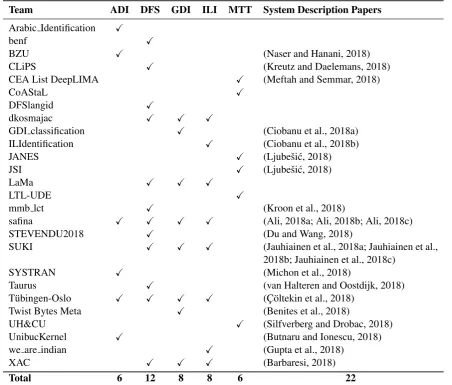
The VarDial Evaluation Campaign received a very positive response from the NLP community. A total of 54 teams registered to participate in the five shared tasks, which is an absolute record for VarDial. Eventually, 24 teams submitted runs and 22 of them also contributed system description papers. The participants were free to participate in one or more tasks, and the number of submissions varied widely across the tasks, ranging from 6 entries for ADI and MTT to 12 entries for DFS. Table 1 lists the partici-pating teams, the shared tasks they took part in, and a reference to the system description paper.
Team ADI DFS GDI ILI MTT System Description Papers
Arabic Identification X
benf X
BZU X (Naser and Hanani, 2018)
CLiPS X (Kreutz and Daelemans, 2018)
CEA List DeepLIMA X (Meftah and Semmar, 2018)
CoAStaL X
DFSlangid X
dkosmajac X X X
GDI classification X (Ciobanu et al., 2018a)
ILIdentification X (Ciobanu et al., 2018b)
JANES X (Ljubeˇsi´c, 2018)
JSI X (Ljubeˇsi´c, 2018)
LaMa X X X
LTL-UDE X
mmb lct X (Kroon et al., 2018)
safina X X X X (Ali, 2018a; Ali, 2018b; Ali, 2018c)
STEVENDU2018 X (Du and Wang, 2018)
SUKI X X X (Jauhiainen et al., 2018a; Jauhiainen et al.,
2018b; Jauhiainen et al., 2018c)
SYSTRAN X (Michon et al., 2018)
Taurus X (van Halteren and Oostdijk, 2018)
T¨ubingen-Oslo X X X X (C¸ ¨oltekin et al., 2018)
Twist Bytes Meta X (Benites et al., 2018)
UH&CU X (Silfverberg and Drobac, 2018)
UnibucKernel X (Butnaru and Ionescu, 2018)
we are indian X (Gupta et al., 2018)
XAC X X X (Barbaresi, 2018)
[image:3.595.75.528.178.563.2]Total 6 12 8 8 6 22
Table 1: The teams that participated in the VarDial’2018 evaluation campaign.
4 Previous Shared Tasks
Since the first DSL challenge, the shared tasks organized within the scope of the VarDial workshop have enjoyed substantial increase in the number of participants and in the overall interest from the NLP community. This motivated the organizers to turn the shared tasks at VarDial into a more comprehensive evaluation exercise with four shared tasks in 2017. This year, the VarDial workshop featured the second edition of the VarDial evaluation campaign with five shared tasks.
4.1 Previous ADI tasks
The first ADI task was introduced in 2016 (Malmasi et al., 2016). It offered as input only lexical in-formation extracted from Arabic LVCSR. The second iteration of the ADI task (Zampieri et al., 2017) introduced multi-modality for dialect identification, using i-vectors for the acoustic representation in addition to lexical features.
The Arabic Multi-Genre Broadcast MGB-3 challenge (Ali et al., 2017) built on the success of the previous two VarDial ADI tasks and introduced the challenge to the speech community, where more attention was paid to the raw audio data using various acoustic representations as well as unsupervised techniques. It is worth noting that all previous challenges used data from the broadcast news domain, with ten hours per dialect for training and two hours per dialect for development and two hours for testing. In contrast, we had fifty hours for training, ten hours testing, and ten hours for development.
4.2 Previous GDI task
The previous GDI task was part of the first VarDial evaluation campaign (Zampieri et al., 2017). It provided manual transcriptions of recorded interviews from four dialect areas of the German-speaking Switzerland, namely Bern, Basel, Lucerne, and Zurich. The training and the test data was extracted from the ArchiMob corpus (Samardˇzi´c et al., 2016). The training data consisted in 3,000–4,000 utter-ances from 3–5 different speakers per dialect; the test data consisted of about 900 utterutter-ances by a single speaker per dialect. A total of ten teams participated in the 2017 GDI task and the two best-performing systems (Bestgen, 2017; Malmasi and Zampieri, 2017b) achieved weighted F1-measure of up to 0.66. Transcribers were shown to affect the performance of the systems, e.g., for the Lucerne dialect, whose test set was transcribed by a different person than the training set, recall figures were only around 0.3.
5 Third Arabic Dialect Identification (ADI)
This year’s third edition of the ADI task addressed the multi-dialectal challenge in spoken Arabic in the broadcast domain. Last year, in the second edition of the ADI task (Zampieri et al., 2017), we offered the input represented as (i) automatic text transcriptions generated using large-vocabulary speech recognition (LVCSR), and (ii) acoustic features. This year, we further added phonetic input, which enabled researchers to use both prosodic and phonetic features, which have been shown to be helpful for distinguishing between different dialects (Najafian et al., 2018). We have seen many researchers combine acoustic and lexical features, and thus it was interesting to explore the potential contribution of phonetic features in an overall dialect identification system.
5.1 Dataset
For training and development, we released the same data as for last year’s VarDial evaluation campaign (Zampieri et al., 2017). For testing, we prepared two new datasets: (i) an in-domain one as in 2017, and (ii) an out-of-domain one from YouTube. The duration of the utterances in the YouTube dataset was uniformly distributed between 5 and 30 seconds. We did not inform the participants that there would be an out-of-domain test dataset; we just merged (i) and (ii) to make a combined test set, but we then evaluated the two parts separately. Each dataset consisted of five Arabic dialects: Egyptian (EGY), Levantine (LEV), Gulf (GLF), North African (NOR), and Modern Standard Arabic (MSA). Detailed statistics about all ADI datasets are shown in Table 2.
For all datasets, we provided to the participants already extracted acoustic features, ASR output, and phonetic features. For acoustic features, we extracted dialect embeddings using an end-to-end dialect identification system, as studies have shown that embeddings from end-to-end models outperform the conventional i-vectors. We used four convolutional layers and two fully connected layers. The parame-ters for the DNN structure and the training setup were as described in (Shon et al., 2018). We extracted embeddings from the last fully connected layer which was 600-dimensional.
For the phoneme features, we used the BUT phoneme recognizer (Matejka et al., 2005), which supports languages such as Czech, Russian, Hungarian and English. Despite the language mismatch, the recog-nizer made predictions for each phoneme label. This is consistent with a previous study that has shown that the Hungarian phoneme recognizer can be useful for Arabic dialect identification (Shon et al., 2017).
Training
Development
Testing
Testing
(Broadcast)
(YouTube)
Dialect
Ex.
Dur.
Ex.
Dur.
Ex.
Dur.
Ex.
Dur.
EGY
3,093
12.4
298
2.0
302
2.0
1,143
5.5
GLF
2,744
10.0
264
2.0
250
2.1
1,147
5.6
LAV
2,851
10.3
330
2.0
334
2.0
1,131
5.5
MSA
2,183
10.4
281
2.0
262
1.9
944
4.6
NOR
2,954
10.5
351
2.0
344
2.1
980
4.8
Total
13,825
53.6
1,524
10.0
1,492
10.1
5,345
26.0
Table 2: The ADI data: examples (Ex.) in utterances, duration (Dur.), in number of hours.
5.2 Participants and Approaches
In this section, we present a short description of the systems that competed in the ADI shared task: • UnibucKernelsystem (Butnaru and Ionescu, 2018) combines three kernel matrices: one calculated
using just the lexical features, another one computed on embeddings, and a combined kernel com-puted on the phonetic features. The final matrix is the mean of these three matrices. As a classifier, they used Kernel Ridge Regression. The approach is similar to the systems that ranked second and first in the previous two ADI tasks (Ionescu and Popescu, 2016; Ionescu and Butnaru, 2017). • Safinasystem (Ali, 2018a) accepts a sequence of 256 characters as input in addition to the acoustic
embedding vectors. First, the sequence of characters is one-hot encoded, then it is passed to a GRU layer, which is followed by a convolutional layer with different filter sizes ranging from 2 to 7. The convolutional layer is followed by batch normalizations, max-pooling, and dropout layers, and finally a softmax layer. In contrast, the acoustic embedding vectors go directly to another softmax layer. The final output is the average between these two softmax layers, which represents the probability distribution over the labels.
• BZUsystem (Naser and Hanani, 2018) fuses four models, two feed-forward neural networks and two multiclass support vector machines. All models use embedding of size 600 as features, and the training is conducted on the union of the development and of the training data.
• SYSTRAN system (Michon et al., 2018) uses a multi-input convolutional neural network. The system first learns character-based embeddings of sentences and phoneme-based embeddings of phoneme representations by running one-dimension convolutions and max-pooling with various filter sizes. Subsequently, it concatenates the output and the given acoustic embeddings for the sentences. Then, it adds several fully-connected layers, and finally makes a prediction.
• T ¨ubingen-Oslosystem (C¸ ¨oltekin et al., 2018) is trained on word and charactern-grams using a single SVM classifier, which is fine-tuned using cross-validation. It is similar to the submissions by the same authors to previous VarDial shared tasks (C¸ ¨oltekin and Rama, 2017; C¸ ¨oltekin and Rama, 2016). They also tried an approach based on RNN, which worked worse.
5.3 Results
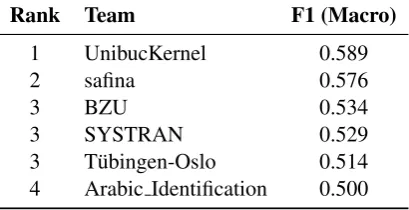
Six teams submitted runs for the ADI shared task and the results are shown in Table 3. The best result, an F1 score of 0.589, was achieved byUnibucKernel,1 followed bysafina, with an F1 score of 0.575. The following three teams are tied for the third place as they are not statistically different.
Rank Team F1 (Macro)
1 UnibucKernel 0.589
2 safina 0.576
3 BZU 0.534
3 SYSTRAN 0.529
[image:6.595.197.402.135.240.2]3 T¨ubingen-Oslo 0.514 4 Arabic Identification 0.500
Table 3: ADI results: ranked taking statistical significance into account.
5.4 Summary
We introduced multi-phoneme representation for the dialectal data, thus enriching the multi-modal aspect of the dialectal challenge. For the acoustic data, we introduced new dialectal embedding features from an end-to-end dialect identification system. For the evaluation, we used a new surprise test set collected from YouTube, with the aim to test whether the participating systems are robust with respect to new domains, different from broadcast news. The results show that participants did benefit both from the linguistic and from the acoustic features. In the future, we plan to add more data from different domains.
6 Second German Dialect Identification (GDI)
Following the first edition of the (Swiss) German Dialect Identification task in 2017, we organized a sec-ond iteration this year. We provided cleaned and updated data on the same Swiss German dialect areas as last year (Basel, Bern, Lucerne, Zurich), and we also added a fifth “surprise dialect” for which no train-ing data was made available. The participants could take part in the traditional four-way classification (without the surprise dialect) or in the five-way classification (with it). We received eight submissions for the four-way classification task, and one submission for the five-way classification task.
6.1 Dataset
As in 2017, we extracted the training and the test datasets from the ArchiMob corpus of Spoken Swiss German. The last publicly available release of the corpus (Samardˇzi´c et al., 2016) contains 34 oral history interviews with informants speaking different Swiss German dialects, with nine additional transcriptions currently available, some of which were included in this year’s GDI task.
Each interview was transcribed by one of four transcribers, using the writing system “Schwyzert¨utschi Dial¨aktschrift” proposed by Dieth (1986). The transcription is expected to show the phonetic proper-ties of the variety, but in a way that is legible for everybody who is familiar with the standard German orthography. Although its objective is to keep track of the pronunciation, Dieth’s transcription method is orthographic and partially adapted to the spelling habits in standard German. Therefore, it does not provide the same precision and explicitness as phonetic transcription methods do. Moreover, the tran-scription choices are dependent on the dialect, the accentuation of the syllables and – to a substantial degree – also the dialectal background of the transcriber. Following the findings of last year’s GDI task, we identified several transcriber-specific idiosyncrasies and unified them wherever possible, so that tran-scriber effects could be reduced.2 The transcriptions exclusively used lowercase. Also note that Dieth’s system is hardly known to laymen, and thus Swiss German data extracted from social media would look fairly different from our transcripts.
1
Dialect Set Document IDs Utterances Tokens Transcribers
BE Train 1142, 1170, 1215 3,889 28,558 P, M
Dev 1121 1,067 7,404 M
Test 1203 1,191 12,013 A
BS Train 1044, 1073, 1075 3,349 27,421 A, P
Dev 1263 1,572 9,544 A
Test 1224 1,200 9,802 A
LU Train 1007, 1261, 1008 3,514 29,441 A, P
Dev 1195 1,079 8,887 P
Test 1138, 1235 1,186 11,372 A
ZH Train 1082, 1087, 1143, 1244, 1270, 1055 3,894 28,820 A, P, M
Dev 1225 940 8,099 M
Test 1188, 1083 1,175 9,610 A, M
[image:7.595.84.514.63.268.2]XY Test 1212 790 8,938 P
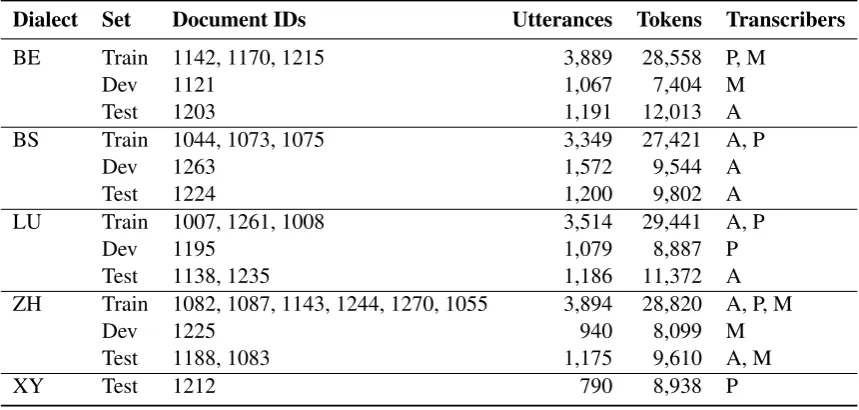
Table 4: ArchiMob interviews used for the GDI task. The surprise dialect is labeled XY.
We provided the updated versions of the GDI 2017 training data for training, the updated GDI 2017 test data for development, and yet unseen data for testing (see Table 4).3 The training set contains utterances from at least three interviews per dialect, and the development and the test sets each contain utterances from at least one other interview per dialect (see Table 4). For the surprise dialect, we provided a slightly smaller test set. We encouraged the participants to include the development data as additional training data in their final systems.
As surprise dialect, we chose a text from the Valais region. The Valais Swiss German dialect is known to be very distinct from the other Swiss German dialects in terms of pronunciation and lexicon (Scherrer and Stoeckle, 2016). The Valais dialect is geographically closest to Bern and Lucerne; linguistically, it is most closely related to the Bern dialect, although it also shares some linguistic features with the Basel and the Lucerne dialects.
6.2 Participants and Approaches
• The SUKI submissions are generated using the HeLI method with language models containing only character 4-grams. The HeLI method is based on a product of relative frequencies with a backoff function between different language models, but the backoff function was not used in the submissions for the GDI task. The winning submission used adaptive language models, which were updated while recursively analyzing the test data.
• TheTwist Bytes Metasystem is trained on multiple features such as words and charactern-grams (1-7 words and character bigrams). A linear SVM is trained on each feature set and on top of that, a linear SVM meta classifier using cross-validation was trained to gather the predictions.
• safinais based on character-level convolutional neural networks. This model accepts a sequence of 256 characters as input. The sequence of characters are one-hot encoded then go to a recurrent GRU layer (which works as an embedding layer), followed by a convolutional layer with different filter sizes ranging from 2 to 7. The convolutional layer is followed by batch normalization, max-pooling, dropout, and finally a softmax layer. The output of the softmax layer represents the probability distribution over the labels.
• T ¨ubingen-Oslosubmitted one system based on a linear SVM classifier and another one based on an RNN as previously described in Section 5.
• TheLaMasystem is a blend (weighted vote) of eight classifiers being stochastic gradient descent (hinge and modified Huber), multinomial Na¨ıve Bayes, both counts and tf-idf, FastText, and mod-ified Kneser-Ney smoothing. The classifiers were trained using wordn-grams (1-6) and character
n-grams (1-8). The hyperparameters were determined with cross-validation and searching on the development set.
• XACsystem is a refined version of the n-gram-based Bayesline system described in last year’s XAC submission to the VarDial shared tasks (Barbaresi, 2017), and previously used as a baseline for the DSL shared task (Tan et al., 2014). The XAC team achieved their best results using a Na¨ıve Bayes classifier.
• TheGDI classificationsystem is based on an ensemble of multiple SVM classifiers. The system was trained on various word- and character-level features.
• The dkosmajacsystem is based on a normalized Euclidean distance measure. The distances are calculated between a sample and each class profile. The class profiles are generated by selecting the most frequent features for each class, which results in profiles that are of the same length for all the classes.
6.3 Results
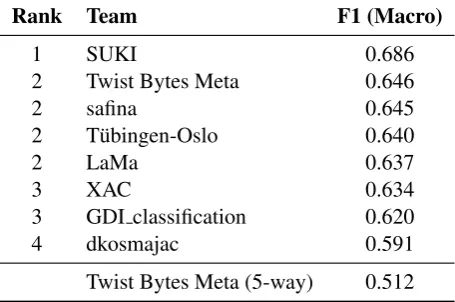
For the standard 4-way classification, we received a total of eight submissions presented in Table 5.
Rank Team F1 (Macro)
1 SUKI 0.686
2 Twist Bytes Meta 0.646
2 safina 0.645
2 T¨ubingen-Oslo 0.640
2 LaMa 0.637
3 XAC 0.634
3 GDI classification 0.620
4 dkosmajac 0.591
[image:8.595.185.413.340.491.2]Twist Bytes Meta (5-way) 0.512
Table 5: GDI results: ranked taking statistical significance into account.
This year, theSUKIsystem is the clear winner, achieving significantly higher results than the other seven teams, with an F1 score of 0.686. Four teams ended the competition tied in the second place: Twist Bytes Meta, safina,T¨ubingen-OsloandLaMa. This year’s results are in the same range as last year’s, even though the test data is different. With 5 out of 8 teams in an F1 bracket of 0.012, one could argue that a plateau has been reached for this type of transcription data, but the clear win of theSUKI system suggests that further improvements can be achieved.
For the extended 5-way classification, we received one submission, which achieved an F1 score of 0.512. It was able to identify the surprise dialect with 22.8% precision and 11.6% recall, suggesting that identifying unseen dialects is still a hard task. The surprise dialect utterances were most often identified as BE or LU, which are the two dialect areas that are geographically closest.
6.4 Summary
7 Morphosyntactic Tagging of Tweets (MTT)
The task on morphosyntactic tagging of tweets focused on annotating each token of utterances in non-canonical Twitter varieties of three South-Slavic languages (Slovene, Croatian, and Serbian) with the correct morphosyntactic label out of more than 900 possible ones. The task participants were provided both with large manually annotated and raw canonical datasets, as well as small manually annotated Twitter datasets. Two dimensions of variety could be exploited in the task: (i) the dimension of canonical vs. non-canonical language, and (ii) the overall proximity of the three languages.
7.1 Datasets
The provided datasets consisted of three types of data: (i) standard manually annotated data (standard.train), (ii) automatically annotated web data (web.auto), and (iii) Twitter variety manually annotated data (twitter.*). The latter were split into train, dev and test sets, with the test data being withheld for the final evaluation. We give an overview of the different datasets (in number of tokens) in Table 6.
Thetwitter.*datasets come from the Janes-Tag manually annotated dataset of Slovene computer-mediated communication (Erjavec et al., 2017) and the ReLDI-NormTagNER-* manually annotated datasets of Croatian (Ljubeˇsi´c et al., 2017a) and Serbian (Ljubeˇsi´c et al., 2017b) tweets. These datasets are all similar in size, with around 40 thousand tokens available for training, 8 thousand for development and 20 thousand for testing.
Thestandard.traindatasets mostly cover the general domain. While the Slovene and Croatian datasets are similar in size with around 500 thousand tokens, the Serbian dataset is significantly smaller, with just 87 thousand tokens.
The web.auto datasets are large web-based datasets: slWac for Slovene (Erjavec et al., 2015), hrWaC for Croatian, and srWaC for Serbian (Ljubeˇsi´c and Klubiˇcka, 2014). They are automatically annotated with state-of-the-art taggers for standard Slovene (Ljubeˇsi´c and Erjavec, 2016), Croatian, and Serbian (Ljubeˇsi´c et al., 2016), respectively.
twitter.train twitter.dev twitter.test standard.train web.auto
[image:9.595.100.497.442.506.2]Slovene 37,756 7,056 19,296 586,248 895,875,492 Croatian 45,609 8,886 21,412 506,460 1,397,757,548 Serbian 45,708 9,581 23,327 86,765 554,627,647
Table 6: MTT task: size of the datasets (in number of tokens).
7.2 Participants and Approaches
The following teams handed in their system descriptions:
• TheUH&CUsystem uses a bidirectional LSTM system for sequence modeling, representing words via word embeddings and character embeddings encoding the character-level word representation with a separate BiLSTM. They use an intriguing approach to emitting tags: they generate tags as character sequences using an LSTM generator in order to handle unknown tags and complex tags (combinations of several tags for one token as a result of conflating tokens in the non-standard varieties).
• The JANES system uses a conditional random field for sequence labeling, with carefully engi-neered context-level, word-level, and character-level features. The authors further enrich the repre-sentation of each word with Brown clusters that were calculated on the available web data. They train their system on a combination of standard and non-standard data, in which they overrepresent non-standard data by repeating the non-standard instances. They also heavily borrow data between Croatian and Serbian.
• The DeepLIMA system uses a BiGRU modeling technique, representing words as a combina-tion of word-level and character-level embeddings. The latter generate a word representacombina-tion from character-level embeddings with a separate BiGRU. They exploit both the non-standard (in-domain) and the standard (out-of-domain) training data by training the network first on the standard data, and then on the non-standard data.
7.3 Results
The MTT shared task received seven submissions by six teams, each of the teams submitting results for all the three languages of the shared task.
We used token-level accuracy as an evaluation measure, and we ranked the systems, taking statistical significance into account, based on the McNemar test whether the results of two neighbouring submis-sions are statistically significantly different at thep <0.05level.
The results are shown in Table 7. We can see that the three best-performing teams, UH&CU, JSI andJANESshare the first position in all languages except for Slovene, where theJANESteam achieved statistically significantly worse results than the two other teams. All other teams performed below the HunPosbaseline system, which was trained on a concatenation of all the available manually annotated data per language.
Given that the results for three teams are very close to each other, it is reasonable to assume that these results represent the state of the art in morphosyntactic annotation.
The high ranking of theJANESsystem, which is not neural but CRF-based, has shown that the im-provements yielded by using neural networks are rather small. Ljubeˇsi´c (2018) has also noted that his JANESsystem comes closer to the neural approaches as the level of non-standardness of the test data drops off. Namely, the most similar results between JANESand the neural approaches were obtained on Serbian and Croatian, for which 10% and 13% of the tokens, respectively, are non-standard, while significantly lower results were obtained for Slovene, where the percentage of non-standard tokens is about 17%.4
Slovenian Croatian Serbian
Team Acc Rank Acc Rank Acc Rank
UH&CU 0.884 1 0.887 1 0.900 1
JSI 0.883 1 0.890 1 0.900 1
JANES 0.871 4 0.893 1 0.900 1
CEA List DeepLIMA 0.826 6 0.829 6 0.821 6
LTL-UDE 0.627 7 0.752 7 0.773 7
CoAStaL 0.626 8 0.632 8 0.524 8
[image:10.595.133.464.545.684.2]HunPos baseline 0.832 5 0.834 5 0.832 5
Table 7: MTT results: ranked taking statistical significance into account.
7.4 Summary
The experimental results have shown that by combining standard (out-of-domain) and non-standard (in-domain) training data, as well as training data from closely related languages by using neural approaches or conditional random fields, the traditionalHunPos baseline can be beaten by a wide margin, with the error reduction lying somewhere around 45%.
Moreover, the improvements when replacing traditional sequence labeling approaches such as CRFs with corresponding neural ones are quite small. However, conditional random fields need the features to be manually engineered, which requires a good knowledge of the target languages. The results also demonstrate that improvements can be achieved with neural approaches on datasets where the level of non-standardness is highest, showing that, as expected, the more complex modeling approaches start to pay off as the problems get harder.
8 Discriminating between Dutch and Flemish in Subtitles (DFS)
The DSF shared task focused on determining whether a text is written in the Netherlandic or in the Flemish variant of the Dutch language. The participants were provided with professionally produced subtitles written for either a Northern Dutch or a Flemish audience. Since there is a lack of automatic classification studies on Netherlandic and Flemish Dutch varieties, and no Netherlandic/Flemish corpus of this size exists, we believe it is a scientifically interesting step forward to develop and to compare language variety classification using subtitles, and thereby analyze the proximity of the language varieties in a new way. The latter is not only of interest for improving computational linguistics applications, but also for finding insights in variational linguistics in general.
8.1 Dataset
As stated above, the dataset consisted of subtitles from an international media localization company that produces, among others, subtitles for television channels in The Netherlands and Belgium. These subtitles range from documentaries, television shows, and movies. These raw subtitles were originally converted into linguistically annotated text in the original SUBTIEL corpus (van der Lee and van den Bosch, 2017). The dataset used for the current shared task was based on this corpus. A total of 320,500 lines were provided to the participants (300,000 for training, 20,000 for testing, and 500 for develop-ment). These lines were randomly taken from the SUBTIEL corpus, while keeping a 50/50 split of Netherlandic and Flemish Dutch lines. Each line consisted of about two to three sentences or parts of a sentence: about the length of a tweet. This resulted in a total of 11,102,274 word tokens for all three sets.
8.2 Participants and Approaches
• T ¨ubingen-Osloteam used one system based on a linear SVM classifier and another one based on RNN as previously described in Section 5.
• Taurusteam used a voting-based system that used charactern-grams andn-grams containing syn-tactical information derived from Frog, Alpino and a custom surfacing procedure.
• CLiPSteam used an ensemble of two Linear SVMs, one trained on wordn-grams and another one trained on part-of-speechn-grams. The prediction for a document was made by the classification method that outputs the highest probability for a label.
• LaMateam had a system that is a weighted vote blending 8 classifiers: stochastic gradient de-scent (hinge and modified huber), multinomial Na¨ıve Bayes, both counts and TF.IDF, FastText, and modified Kneser-Ney smoothing, as previously described in Section 6
• XACteam used the “Bayesline” system as described in Section 6. In the DFS shared task,XAC’s best result was obtained using a Ridge classifier.
• STEVENDU2018team used a Linear SVM trained on wordn-grams and a Convolutional Neural Network with pre-trained word embeddings built for Netherlandic and Flemish Dutch each, which were subsequently concatenated.
• mmb lctteam used a Na¨ıve Bayes classifier using word unigrams and bigrams.
• SUKIteam submitted identification results from an identifier using the basic HeLI method with words and charactern-grams from 1 to 8. Note that using adaptive language models with the DFS dataset did not improve the results as it did for the GDI and the ILI tasks.
• DFSlangidteam usedn-grams, skip-grams, and clustering-based word representations.
• dkosmajacteam used normalised Eucledian distance measure using Adaptive Gradient Descent to optimize weights. The features used were charactern-grams, as previously described in Section 6.
• benfteam submitted a system trained on a separate Linear SVM on word and on charactern-grams. Then they trained a Linear SVM on the output for the two feature sets.
8.3 Results
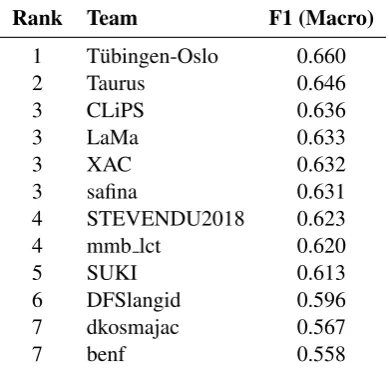
The DFS shared task received the highest number of submissions across the five tasks, and it was also the most competitive shared task this year with nine out of twelve teams achieving an F1 score between 0.61 and 0.66. The results are presented in Table 8.
Rank Team F1 (Macro)
1 T¨ubingen-Oslo 0.660
2 Taurus 0.646
3 CLiPS 0.636
3 LaMa 0.633
3 XAC 0.632
3 safina 0.631
4 STEVENDU2018 0.623
4 mmb lct 0.620
5 SUKI 0.613
6 DFSlangid 0.596
7 dkosmajac 0.567
[image:12.595.202.397.366.552.2]7 benf 0.558
Table 8: DFS results: ranked taking statistical significance into account.
The best-performing system was the one byT¨ubingen-Oslo, and it achieved an F1 score of 0.66, followed byTauruswith 0.646. Four teams: CLiPS,LaMa,XAC, andsafinaended up tied in the third position. Even though the task proved to be very challenging, all teams achieved scores over 0.5, which is the expected baseline for this task.
8.4 Summary
9 Indo-Aryan Language Identification (ILI)
Organized for the first time in VarDial 2018, the ILI shared task focused on identifying five closely-related languages from the Indo-Aryan language family: Hindi (also known as Khari Boli), Braj Bhasha, Awadhi, Bhojpuri, and Magahi. These languages form part of a continuum starting from Western Uttar Pradesh (Hindi and Braj Bhasha) to Eastern Uttar Pradesh (Awadhi and Bhojpuri) and the neighbouring Eastern state of Bihar (Bhojpuri and Magahi).
For this task, participants were provided with a dataset of approximately 15,000 sentences in each language, mainly from the literature domain, published on the web or in print. It is the first dataset that is made available for these languages (except for Hindi), and we believe it would be useful not only for automatic identification of languages and for developing NLP applications, but it could also help in gaining insights into the proximity level of these languages, which are hypothesised to form a continuum and are often wrongly considered to be varieties of Hindi, especially outside scholarly linguistic circles.
9.1 Dataset
The data for this task was collected from both hard printed and digital sources. Printed materials were obtained from different institutions that promote these languages. We also gathered data from libraries, as well as from local literary and cultural groups. We collected printed stories, novels and essays in books, magazines, and newspapers. We scanned the printed materials, then we performed OCR, and finally we asked native speakers of the respective languages to correct the OCR output. Since there are no specific OCR models available for these languages, we used the Google OCR for Hindi, part of the Drive API. Since all the languages used the Devanagari script, we expected the OCR to work reasonably well, and overall it did. We further managed to get some blogs in Magahi and Bhojpuri.
There are several corpora already available for Modern Standard Hindi (Kumar, 2012; Kumar, 2014a; Kumar, 2014b; Choudhary and Jha, 2011). However, in order to keep the domain the same as for the other languages, we collected data from blogs that mainly contain stories and novels. Thus, the Modern Standard Hindi data collected for this study is also from the literature domain.5
9.2 Participants and Approaches
• TheSUKIteam used HeLI with adaptive language models based on charactern-grams from 1 to 6, as previously described in Section 5. The also used an iterative version of the language model adaptation technique, with three additional adaptation epochs.
• T ¨ubingen-Osloteam submitted a system using a linear SVM and another one based on an RNN, as previously described in Section 5.
• XACteam used the “Bayesline” system, as described in Section 6. In the ILI shared task, XAC’s best result was obtained using a Ridge classifier.
• ILIdentificationteam used features such asn-grams, skip-grams, and clustering-based word rep-resentations. They tried both single classifiers as well as ensembles and stacked generalization.
• safinateam used one-hot encoded character-level convolutional neural network, as previously de-scribed in Section 6.
• dkosmajacused character n-grams with a normalized Eucledian distance measure and Adaptive Gradient Descent to optimize weights, as previously described in Section 6.
• we are indianteam combined an RNN-sequence model with bidirectional LSTMs. They created word embedding for all the languages present in the dataset.
• TheLaMateam used a Multinomial Na¨ıve Bayes classifier with both word and charactern-grams, of size 1-8 and 1-6 respectively, for which the raw counts are the feature values.
9.3 Results
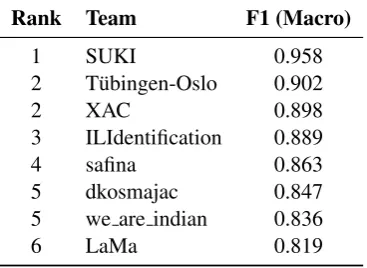
The ILI shared task received eight submissions, and the results are shown in Table 9.
Rank Team F1 (Macro)
1 SUKI 0.958
2 T¨ubingen-Oslo 0.902
2 XAC 0.898
3 ILIdentification 0.889
4 safina 0.863
5 dkosmajac 0.847 5 we are indian 0.836
[image:14.595.208.392.106.240.2]6 LaMa 0.819
Table 9: ILI results: ranked taking statistical significance into account.
The highest ranked team wasSUKI, which achieved an F1 score of 0.958, while theLaMateam had the lowest F1 score of 0.819. Two teams were tied for the second place:T¨ubingen-OsloandXAC. There was a tie between two teams for the fifth place as well.
9.4 Summary
The first ILI shared task was successful in terms of participation with eight submissions. In terms of performance, all submissions achieved an F1 score of more than 0.81, which is a high score for a 5-class classification set-up, and higher than the results achieved in the other VarDial shared tasks. One of the interesting aspects of the task was the wide variety of approaches used by the participants.
In future work, we plan to increase the dataset of these less-resourced languages: Braj Bhasha, Awadhi, Bhojpuri and Magahi.
10 Conclusion and Future Work
We have presented the results and the findings for the five shared tasks that were organized as part of the VarDial Evaluation Campaign in 2018. Two tasks were re-runs from previous years (ADI and GDI), and there were also three new tasks (DFS, ILI, and MTT).
We included a short description for each participant’s systems. For a complete description, we included references to the system description papers, which were presented in the VarDial workshop and published in the workshop proceedings.
The VarDial evaluation campaign was introduced in 2017, following the organization of successful shared tasks that have been co-located with VarDial since 2004. In its second edition, the campaign featured a record number of shared tasks and attracted a record number of participants. Participation in each individual task ranged from six teams competing in the ADI and MTT tasks to 12 teams for the DFS task.
In a potential third edition of the VarDial evaluation campaign, we aim to bring more diversity by organizing competitions on other relevant NLP tasks such as lexical variation or machine translation, to name a few. With the exception of MTT, the shared tasks this year dealt mostly with the problem of discriminating between similar languages, varieties, and dialects. Even though this topic has been attracting a lot of attention from the research community (Jauhiainen et al., 2018d), we believe that there is room for shared tasks on other relevant topics in future iterations of the VarDial evaluation campaign.
Acknowledgements
References
Ahmed Ali, Stephan Vogel, and Steve Renals. 2017. Speech recognition challenge in the wild: Arabic MGB-3. In
Proceedings of the IEEE Automatic Speech Recognition and Understanding Workshop (ASRU).
Mohamed Ali. 2018a. Character level convolutional neural network for Arabic dialect identification. In Proceed-ings of the Fifth Workshop on NLP for Similar Languages, Varieties and Dialects (VarDial).
Mohamed Ali. 2018b. Character level convolutional neural network for German dialect identification. In
Pro-ceedings of the Fifth Workshop on NLP for Similar Languages, Varieties and Dialects (VarDial).
Mohamed Ali. 2018c. Character level convolutional neural network for Indo-Aryan language identification. In
Proceedings of the Fifth Workshop on NLP for Similar Languages, Varieties and Dialects (VarDial).
Adrien Barbaresi. 2017. Discriminating between similar languages using weighted subword features. In
Proceed-ings of the VarDial Workshop (VarDial).
Adrien Barbaresi. 2018. Computationally efficient discrimination between language varieties with large feature vectors and regularized classifiers. InProceedings of the Fifth Workshop on NLP for Similar Languages, Vari-eties and Dialects (VarDial).
Fernando Benites, Ralf Grubenmann, Pius von D¨aniken, Dirk von Gr¨unigen, Jan Deriu, and Mark Cieliebak. 2018. Twist Bytes – German dialect identification with data mining optimization. InProceedings of the Fifth Workshop on NLP for Similar Languages, Varieties and Dialects (VarDial).
Yves Bestgen. 2017. Improving the character ngram model for the DSL task with BM25 weighting and less frequently used feature sets. InProceedings of the VarDial Workshop (VarDial).
Andrei M. Butnaru and Radu Ionescu. 2018. UnibucKernel Reloaded: First place in Arabic dialect identification
for the second year in a row. InProceedings of the Fifth Workshop on NLP for Similar Languages, Varieties
and Dialects (VarDial).
C¸ a˘grı C¸ ¨oltekin and Taraka Rama. 2016. Discriminating similar languages with linear SVMs and neural networks. InProceedings of the VarDial Workshop (VarDial).
C¸ a˘grı C¸ ¨oltekin and Taraka Rama. 2017. T¨ubingen system in VarDial 2017 shared task: Experiments with language identification and cross-lingual parsing. InProceedings of the VarDial Workshop (VarDial).
C¸ a˘grı C¸ ¨oltekin, Taraka Rama, and Verena Blaschke. 2018. T¨ubingen-Oslo team at the VarDial 2018 evalua-tion campaign: An analysis of n-gram features in language variety identificaevalua-tion. InProceedings of the Fifth Workshop on NLP for Similar Languages, Varieties and Dialects (VarDial).
Narayan Choudhary and Girish Nath Jha. 2011. Creating multilingual parallel corpora in Indian languages. In
Proceedings of LTC.
Alina Maria Ciobanu, Shervin Malmasi, and Liviu P. Dinu. 2018a. German dialect identification using
classi-fier ensembles. InProceedings of the Fifth Workshop on NLP for Similar Languages, Varieties and Dialects
(VarDial).
Alina Maria Ciobanu, Marcos Zampieri, Shervin Malmasi, Santanu Pal, and Liviu P. Dinu. 2018b. Discriminating
between Indo-Aryan languages using SVM ensembles. InProceedings of the Fifth Workshop on NLP for Similar
Languages, Varieties and Dialects (VarDial).
Eugen Dieth. 1986.Schwyzert¨utschi Dial¨aktschrift. 2 edition.
Steven Du and Yuan Yuan Wang. 2018. STEVENDU2018’s system in VarDial 2018: Discriminating between Dutch and Flemish in subtitles. InProceedings of the Fifth Workshop on NLP for Similar Languages, Varieties and Dialects (VarDial).
Tomaˇz Erjavec, Nikola Ljubeˇsi´c, and Nataˇsa Logar. 2015. The slWaC corpus of the Slovene web. Informatica,
39(1):35–42.
Tomaˇz Erjavec, Darja Fiˇser, Jaka ˇCibej, ˇSpela Arhar Holdt, Nikola Ljubeˇsi´c, and Katja Zupan. 2017. CMC
training corpus Janes-Tag 2.0. Slovenian language resource repository CLARIN.SI.
Radu Tudor Ionescu and Andrei Butnaru. 2017. Learning to identify Arabic and German dialects using multiple kernels. InProceedings of the VarDial Workshop (VarDial).
Radu Tudor Ionescu and Marius Popescu. 2016. UnibucKernel: An approach for Arabic dialect identification based on multiple string kernels. InProceedings of the VarDial Workshop (VarDial).
Tommi Jauhiainen, Heidi Jauhiainen, and Krister Lind´en. 2018a. HeLI-based experiments in discriminating
between Dutch and Flemish subtitles. InProceedings of the Fifth Workshop on NLP for Similar Languages,
Varieties and Dialects (VarDial).
Tommi Jauhiainen, Heidi Jauhiainen, and Krister Lind´en. 2018b. HeLI-based experiments in Swiss German
dialect identification. In Proceedings of the Fifth Workshop on NLP for Similar Languages, Varieties and
Dialects (VarDial).
Tommi Jauhiainen, Heidi Jauhiainen, and Krister Lind´en. 2018c. Iterative language model adaptation for
Indo-Aryan language identification. InProceedings of the Fifth Workshop on NLP for Similar Languages, Varieties
and Dialects (VarDial).
Tommi Jauhiainen, Marco Lui, Marcos Zampieri, Timothy Baldwin, and Krister Lind´en. 2018d. Automatic language identification in texts: A survey. arXiv preprint arXiv:1804.08186.
Sameer Khurana and Ahmed Ali. 2016. QCRI advanced transcription system (QATS) for the Arabic Multi-Dialect
Broadcast Media Recognition: MGB-2 Challenge. InProceedings of SLT.
Tim Kreutz and Walter Daelemans. 2018. Exploring classifier combinations for language variety identification. InProceedings of the Fifth Workshop on NLP for Similar Languages, Varieties and Dialects (VarDial).
Martin Kroon, Maria Medvedeva, and Barbara Plank. 2018. When simple n-gram models outperform syntactic
approaches: Discriminating between Dutch and Flemish. In Proceedings of the Fifth Workshop on NLP for
Similar Languages, Varieties and Dialects (VarDial).
Ritesh Kumar, Bornini Lahiri, Deepak Alok, Atul Kr. Ojha, Mayank Jain, Abdul Basit, and Yogesh Dawar. 2018. Automatic identification of closely-related Indian languages: Resources and experiments. InProceedings of the Eleventh International Conference on Language Resources and Evaluation (LREC).
Ritesh Kumar. 2012. Challenges in the development of annotated corpora of computer-mediated communication
in Indian languages: A case of Hindi. In Proceedings of the Eight International Conference on Language
Resources and Evaluation (LREC).
Ritesh Kumar. 2014a. Developing politeness annotated corpus of Hindi blogs. In Proceedings of the Ninth
International Conference on Language Resources and Evaluation (LREC).
Ritesh Kumar. 2014b. Politeness in Online Hindi Texts: Pragmatic and Computational Aspects. Ph.D. thesis,
Jawaharlal Nehru University.
Nikola Ljubeˇsi´c and Filip Klubiˇcka. 2014. {bs,hr,sr}wac - web corpora of Bosnian, Croatian and Serbian. In
Proceedings of the 9th Web as Corpus Workshop (WaC-9), pages 29–35.
Nikola Ljubeˇsi´c, Tomaˇz Erjavec, Maja Miliˇcevi´c, and Tanja Samardˇzi´c. 2017a. Croatian Twitter training corpus ReLDI-NormTagNER-hr 2.0. Slovenian language resource repository CLARIN.SI.
Nikola Ljubeˇsi´c, Tomaˇz Erjavec, Maja Miliˇcevi´c, and Tanja Samardˇzi´c. 2017b. Serbian Twitter training corpus ReLDI-NormTagNER-sr 2.0. Slovenian language resource repository CLARIN.SI.
Nikola Ljubeˇsi´c. 2018. Comparing CRF and LSTM performance on the task of morphosyntactic tagging of
non-standard varieties of South Slavic languages. In Proceedings of the Fifth Workshop on NLP for Similar
Languages, Varieties and Dialects (VarDial).
Nikola Ljubeˇsi´c and Tomaˇz Erjavec. 2016. Corpus vs. lexicon supervision in morphosyntactic tagging: the case of
Slovene. InProceedings of the Tenth International Conference on Language Resources and Evaluation (LREC).
Nikola Ljubeˇsi´c, Filip Klubiˇcka, ˇZeljko Agi´c, and Ivo-Pavao Jazbec. 2016. New inflectional lexicons and
train-ing corpora for improved morphosyntactic annotation of Croatian and Serbian. In Proceedings of the Tenth
International Conference on Language Resources and Evaluation (LREC).
Shervin Malmasi and Marcos Zampieri. 2016. Arabic dialect identification in speech transcripts. InProceedings
Shervin Malmasi and Marcos Zampieri. 2017a. Arabic dialect identification using iVectors and ASR transcripts. InProceedings of the VarDial Workshop (VarDial).
Shervin Malmasi and Marcos Zampieri. 2017b. German dialect identification in interview transcriptions. In
Proceedings of the VarDial Workshop (VarDial).
Shervin Malmasi, Marcos Zampieri, Nikola Ljubeˇsi´c, Preslav Nakov, Ahmed Ali, and J¨org Tiedemann. 2016. Discriminating between similar languages and Arabic dialect identification: A report on the third DSL shared task.
Pavel Matejka, Petr Schwarz, Jan Cernock`y, and Pavel Chytil. 2005. Phonotactic language identification using high quality phoneme recognition. InProc. Interspeech.
Sara Meftah and Nasredine Semmar. 2018. Using neural transfer learning for morpho-syntactic tagging of
South-Slavic languages tweets. InProceedings of the Fifth Workshop on NLP for Similar Languages, Varieties and
Dialects (VarDial).
Elise Michon, Minh Quang Pham, Josep Crego, and Jean Senellart. 2018. Neural network architectures for
Arabic dialect identification. InProceedings of the Fifth Workshop on NLP for Similar Languages, Varieties
and Dialects (VarDial).
Maryam Najafian, Sameer Khurana, Suwon Shon, Ahmed Ali, and James Glass. 2018. Exploiting convolutional neural networks for phonotactic based dialect identification. InIEEE ICASSP, pages 5174–5178.
Rabee Naser and Abualsoud Hanani. 2018. Birzeit Arabic dialect identication system for the 2018 VarDial chal-lenge. InProceedings of the Fifth Workshop on NLP for Similar Languages, Varieties and Dialects (VarDial).
Tanja Samardˇzi´c, Yves Scherrer, and Elvira Glaser. 2016. ArchiMob – a corpus of spoken Swiss German. In
Proceedings of LREC.
Yves Scherrer and Philipp Stoeckle. 2016. A quantitative approach to Swiss German – dialectometric analyses and comparisons of linguistic levels. Dialectologia et Geolinguistica, 24(1):92–125.
Suwon Shon, Ahmed Ali, and James Glass. 2017. MIT-QCRI Arabic dialect identification system for the 2017
multi-genre broadcast challenge. In IEEE Workshop on Automatic Speech Recognition and Understanding
(ASRU), pages 374–380.
Suwon Shon, Ahmed Ali, and James Glass. 2018. Convolutional neural network and language embeddings for
end-to-end dialect recognition. InProceedings of the Speaker and Language Recognition Workshop (Odyssey).
Miikka Silfverberg and Senka Drobac. 2018. Sub-label dependencies for neural morphological tagging – the joint submission of University of Colorado and University of Helsinki for VarDial 2018. InProceedings of the Fifth Workshop on NLP for Similar Languages, Varieties and Dialects (VarDial).
Liling Tan, Marcos Zampieri, Nikola Ljubeˇsic, and J¨org Tiedemann. 2014. Merging comparable data sources for
the discrimination of similar languages: The DSL corpus collection. InProceedings of the BUCC Workshop.
Chris van der Lee and Antal van den Bosch. 2017. Exploring lexical and syntactic features for language variety
identification. InProceedings of the Fourth Workshop on NLP for Similar Languages, Varieties and Dialects
(VarDial).
Hans van Halteren and Nelleke Oostdijk. 2018. Identification of differences between Dutch language varieties
with the VarDial2018 Dutch-Flemish subtitle data. InProceedings of the Fifth Workshop on NLP for Similar
Languages, Varieties and Dialects (VarDial).
Marcos Zampieri, Liling Tan, Nikola Ljubeˇsi´c, and J¨org Tiedemann. 2014. A report on the DSL shared task 2014. InProceedings of the VarDial Workshop (VarDial).
Marcos Zampieri, Liling Tan, Nikola Ljubeˇsi´c, J¨org Tiedemann, and Preslav Nakov. 2015. Overview of the DSL
shared task 2015. InProceedings of the LT4VarDial Workshop (LT4VarDial).
Marcos Zampieri, Shervin Malmasi, Nikola Ljubeˇsi´c, Preslav Nakov, Ahmed Ali, J¨org Tiedemann, Yves Scherrer,
and No¨emi Aepli. 2017. Findings of the VarDial evaluation campaign 2017. In Proceedings of the Fourth