IN GROUP PRESENTATIONS
Peter Philip Campbell
A Thesis Submitted for the Degree of PhD
at the
University of St Andrews
2003
Full metadata for this item is available in
St Andrews Research Repository
at:
http://research-repository.st-andrews.ac.uk/
Please use this identifier to cite or link to this item:
http://hdl.handle.net/10023/15048
G R O U P PR ESEN TA TIO N S
Peter Philip C am pbell
Ph.D. Thesis University of St Andrews
All rights reserved
INFORMATION TO ALL USERS
The quality of this reproduction is dependent upon the quality of the copy submitted.
In the unlikely event that the author did not send a com plete manuscript and there are missing pages, these will be noted. Also, if material had to be removed,
a note will indicate the deletion.
uest
ProQuest 10166192
Published by ProQuest LLO (2017). Copyright of the Dissertation is held by the Author.
All rights reserved.
This work is protected against unauthorized copying under Title 17, United States C ode Microform Edition © ProQuest LLO.
ProQuest LLO.
789 East Eisenhower Parkway P.Q. Box 1346
I
To my parents
and
Declaration v
Acknowledgements vil
Abstract viii
1 Introduction 1
1 Group presentations: Theory and procedures... 1
2 Definitions and results from number theory ... 14
2 Introduction to Fibonacci length and generalizations 19 1 Introduction and apology... 19
2 G eneralizations... 30
2.1 Maximum lengths... 31
2.2 A;-nacci sequences... 43
3 Practical computing considerations... 47
3.1 Fibonacci length ... 47
3.2 Wall n u m b ers... 50
3 The Fibonacci length of m etacyclic groups 52
1 Introduction... 52
2 Preliminaries ... 53
3 A family of presentations due to R. H. F o x ... 54
4 The Fibonacci groups F(r, 2), r o d d ... 66
4 The Fibonacci length of direct powers of dihedral groups 73 1 Introduction... 73
2 The Fibonacci orbit of % > 2 ... 75
3 The Fibonacci length of i> 2 ... 85
4 Other dihedral group generators... 100
5 The efficiency of direct powers of the group defined by {a, b\ bP, {abalFY ) 107 1 Introduction...107
2 Preliminaries ... 108
3 The efficiency of G(p)^, p an odd p rim e ...113
4 The efficiency of G(p)^, p an odd p rim e ...124
6 An efficient presentation for PGL{2,p) and a related group 130 1 Introduction...130
2 B ackground...130
3 An efficient presentation for PGL{2,p)^ p and odd p r im e ...133
A N um erical results 145
B A form for th e Fibonacci o rb it of 148
C G A P C ode 154
1 The fpfl code and explanations... 154
1.1 E x a m p le s... 161
2 Wall n u m b ers... 162
2.1 E x a m p le s... 165
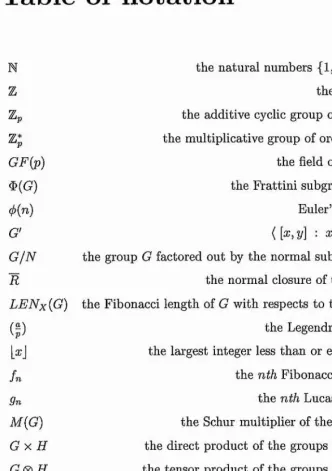
Table of n o tatio n 167
I, Peter Philip Campbell, hereby certify that this thesis has been written by me, that it is the record of work carried out by me and that it has not been submitted in any previous application for a higher degree.
Nam e: Peter P. Campbell Signature:.,..., ___ D ate:
I was admitted as a research student in September 1999 and as a candidate for the degree of Doctor of Philosophy in September 1999; the higher study for which this is a record was carried out in the University of St Andrews between 1999 and 2003.
Nam e: Peter P. Campbell Signature:. ....--- D ate:
I hereby certify that the candidate has fulfilled the conditions of the Resolution and Regulations appropriate for the degree of Doctor of Philosophy in the Uni versity of St Andrews and that the candidate is qualified to submit this thesis in application for that degree.
In submitting this thesis to the University of St Andrews I understand that I am giving permission for it to be made available for use in accordance with the regulations of the University Library for the time being in force, subject to any copyright vested in the work not being affected thereby. I also understand that the title and abstract will be published, and that a copy of the work may be made and supplied to any bona fide library or research worker.
I would like to take this opportunity to thank all those who have helped me during my time as a PhD student.
Firstly I would like to thank my family who have always helped me when I needed it. I would especially like to mention my mother, father, brother, Janet, Thomas and Charlotte. Saying thank you does not seem enough.
Next I would like to mention Professor E. F. Robertson who gave me guidance and friendship from the first day I arrived in the department. I would also like to thank Doctors C. M. Campbell, N. Ruskuc and H. Doostie who have been instrumental in helping me mature mathematically. Together the above have taught me the truth of the phrase
It is only by challenging and refining the activity that it can be kept brimfull of meaning, and thus bring profound satisfaction. [44]
I would also like to thank all my friends and colleagues who have known me during this period. They are too numerous to mention here, but they know who they are. I am grateful for having the honour of calling them friends.
In this thesis we shall consider two topics that are contained in combinatorial group theory and concern properties of finitely presented groups. The first prob lem we examine is that of calculating the Fibonacci length of certain families of finitely presented groups. In pursuing this we come across ideas and unsolved problems from number theory. We mainly concentrate on finding the Fibonacci length of powers of dihedral groups, certain Fibonacci groups and a family of metacyclic groups.
The second problem we investigate in this thesis is finding if the group PG'T(2, p), for p a prime, is efficient on a minimal generating set. We find various presen tations that define PGL{2,p) or C2 x P5L(2,p) and direct products of these groups. As in the previous sections we come across number theoretic problems. We also have occasion to use results from tensor theory and homological algebra in order to obtain our results.
Introduction
In this chapter we will introduce the basic concepts that will be used in subsequent chapters of this thesis. Most of the results here will be from (combinatorial) group theory and will pertain to finitely presented groups. With this in mind we first define a (group) presentation:
1 Group presentations: Theory and procedures
D efinition 1.1 Let X be a set, F(%) be the free group on X and R Ç F{X).
Then a (group) presentation is a pair ( % | R ).
Having defined a group presentation we now say what is meant for a group to be defined by a given presentation.
times writing G = ( X | R ). In the definition above, the set R contains only relators i.e. just elements of the free group F{X). In this thesis we will use relators and relations as appropriate, i.e. instead of writing the relator uv, with u^v e F{X), we may write uv ~ 1 or even u = v~^. When rewriting words we use the convention found in [62], namely the use of underscores to highlight the subwords which are replaced in passing from one word to the next.
We say that in a presentation ( X | R ) the set X is the set of generators and the set R is the set of relators.
D efinition 1.4 A group G is said to be finitely presented if it can be defined by a presentation ( X | R ) where both X and R are finite sets.
R em ark 1.5 It must be stated here that not all groups possess the finiteness property of being finitely presented. Obviously if G is not finitely generated then it cannot be defined by a finite presentation. An example of such a group is the rationals Q under the normal addition of rational numbers. On the other hand there are some groups that are finitely generated but cannot be finitely presented. This result follows from the following two theorems:
T heorem 1.6 There exist 2^° nonisomorphic 2-generator groups.
Proof. See [56] for a, relatively long, proof. □
T heorem 1.7 There exist only countably many nonisomorphic finitely presented groups.
Proof. This follows when we consider the possibilities for the number of finite
rather difficult, as given a finitely presented group G one cannot in general decide if it is finitely presentable or not. A standard example of a finitely generated group that is not finitely presentable is the standard wreath product of two infinite cyclic groups; a rather long and complicated proof may be found in [56].
E xam ple 1.8 The following will be called standard presentations for the named groups:
(1) ( æ I æ” = 1 ), the cyclic group of order n,
(2) ( x, p I = 1, = 1, (xyŸ = 1 ), the dihedral group of order 2n,
(3) ( Æ, p I ^ = 1, ^,xyx = y ), n > 3, the generalized quaternion group Q2n.
The notion of a finitely presentable group is one of the cornerstones of com binatorial group theory. A fundamental theorem within this area is commonly called von Dyck’s Lemma:
Lem m a 1.9 (von D yck’s Lem m a) Let F{X) be the free group on the set X and let R denote the normal closure of the set R in F{X). If G = { X \ R ) and H ~ { X \ S ), where R C S C F{X), then there exists an epimorphism
(j) : G — )■ H fixing every x E X and such that Ker ^ — S \ R , Conversely, every factor group of G ~ { X \ R ) has a presentation ( X | S' ) with RÇ. S.
Proof. See [45]. □
homomorphisms such that
(1) Im(z/) = G,
(2) Ker(z/) Ç Ker(a).
Then there is a homomorphism a! : G — y H such that v d — a.
Proof. See [45]. □
Lemma 1.11 (Substitution Test) Let G — { X \ R ) , H be a group and 9 : X — y H a mapping. Then 9 extends to a homomorphism 9' : G — y H if and only if for all x E X and all r E R, the result of substituting x9 for x in r
yields the identity of H.
Proof. See [45]. □
Prom these results we introduce the notion of Tietze transformations:
Lemma 1.12 Let F = F{X), G = { X \ R ) and suppose that w ,r E F with w
arbitrary and r E R \ R . If y is a symbol not in X , then both the “inclusions”
X ( X | E , r >
X — } ( X, y I R, ) extend to isomorphisms with domain G.
Proof. See [45]. □
[45]) :
adding a relator
where r E R \ R .
R~, removing a relator
X ' = X, R' = R \ { r } where r E RC\ R \ {r}.
X + , adding a generator
X ' = X U {y } R' = R U {y-^ w }
where y 0 X and w E F.
X —, removing a generator
r = X \{ y } , R' = R \{y-^tu}
where y E X, w E { X \ {y}) and y~^w is the only element of R involving y.
Lemma 1.13 Let G be the finitely presented group with finite presentation { X | ) and let the group H be defined by the finite presentation ( F | 5 ), where X and Y are disjoint sets. A presentation for the direct product of G and H, namely G X H, is
( x , y |R ,6 ',[x ,y ]> , where [X, Y] = {x~^y~^xy : x E X , y E Y}.
Proof. See [45] or [62]. □
Another group we will be interested in is the group G jG \ the group G factored out by its derived subgroup {G' = ( [æ,y] \ x ,y e G)'). Fortunately there are two
main ways to find information about this group.
A way of finding a presentation for GjG' given a presentation for G is:
Lemma 1.14 Let the group G be defined by the finite presentation { X | i? ). A presentation for G/G' is
( X | R , C > ,
where if X = {xi, æg,..., Xn} then C — {[æ^, xfi : 1 < i < j < n}.
Proof. See [45]. □
Using this presentation we may use Tietze transformations to help us find \G/G'\ and more information.
V - (æi,æ2,... I rijTg,... ).
The relation matrix of P is an m x n matrix where the entry bij is the sum of the exponents of the generator Xj in the relator
E xam ple 1.16 Let G be the group defined by the presentation V = { x , y , z \ x^ = zxz~^ = y, {zx)^ — 1, {zy^ = 1 ). The relation matrix of V is
3 - 3 0 ^ 1 - 1 0 3 0 3
0 2 2
Given an m x n relation matrix M we can perform specific row and column
( d \
operations to reduce M to a matrix of the form (D 0) or I 1, where D is a
V 0 /
diagonal matrix with D =diag(di, dg,..., dmin(m,n))j d* € NU {0} and 1 < i < min(m, n). The operations we may apply to reduce our relation matrix to this standard form are:
(1) Interchange any two rows (columns).
(2) Add any integer multiple of one row (column) to another.
/ q - q n \ / 0 0 0 ^ 1 - 1 0 0 3 3
0 2 2
/
0 0 0\
1 - 1 0
0 1 1
0 0 0
3 - 3 0 1 -1 0 3 0 3 0 2 2
0 0 0
1 - 1 0
0 1 1
^ 0 2 2 ^ 0 0 0 ^
1 0 0
o i l
0 0 0
0 0 0
1 0 0
0 1 0
0 0 0
1 0 0
0 1 0
0 0 0
0 0 0
So we have shown that G/G' = Ci x C \ X Coo — Goo, the infinite cyclic group.
E xam ple 1.18 We now use the other ‘standard’ method to calculate G /G' where G is the group defined by the presentation
{ x , y , z \ zxz~^^ = y, { z x f = 1, (zy)^ = 1 ).
First we form the presentation (X | R, C ), where G = [X, X] — { [x, y] : x, y E X} as follows,
Now applying Tietze transformations we get:
{ x, y , z \ x ^ = zxz~'^ = y, (zx)^ = 1, {zy)‘^ = 1, [a;, y] = 1, [a;, z] = l,[y,z] = 1 >, — ( ^ I ^ ~ y , X — y , z X ~ 1, z y = 1 , [a:, y] — 1, [a:, z] = 1, [y, 0] = 1 ),
— ~ f 5 [^j y] ~ I5 [^} ~ f , [y, ■^] ” f ) J
= (a7,y,2:|a7 = y ,2: = x~'^,[x,y] = 1, [x,z] = l,[y,z] = 1 >, = { x , z \ z — x~^, [x, = 1 ),
= ( ^ 1) , '—' ^OO'
So we obtain the same result, as expected.
We now turn out attention to trying to find a ‘smallest’ presentation for a given group.
Definition 1.19 The deficiency of a finite group presentation (X \ R ) , written def(( X I R )), is the quantity |jR| — |X|. The deficiency of the finitely presented group G, def(G), is the minimum of the deficiency over all finite presentations for G.
A natural question to ask is what is the minimum possible value of the defi ciency of a finite group G? To answer this we will first need to introduce a group invariant called the Schur multiplier of the finite group G, written M(G).
Definition 1.20 Let G be a finite group defined by the finite presentation ( X | R ). Let F{X) be the free group on the set X and R be the normal closure of the set R i n F {X). The Schur multiplier of G, written M(G), is defined as
The above definition is due to Hopf, see [41].
We also take this opportunity to record the following:
D efinition 1.21 Let G be a finite group. If a group H has a subgroup A such that
(1) A < H ' n Z { H ), (2) R /A ^ G, (3) |A| = |M(G)|,
then H is called a covering group of G. If H satisfies just the first two conditions then H is a, stem extension of G.
R em ark 1.22 1. By the first condition above, the subgroup A is abelian. 2. The Schur multiplier may also be defined in terms of stem extensions. A
defining pair for G, {H, A), is an ordered pair of groups such that the first two conditions in the above list hold. It can be shown that the orders of the first members H of defining pairs for G, are bounded. The subgroups A that are paired with the groups H of maximal order are all isomorphic to M(G). Using the language of cohomology theory the Schur multiplier is the factor of the group of 2-cocycles by the group of 2-coboundaries; see [58] for a, relatively, clear description of these terms.
The following theorem justifies us taking the time to discuss the Schur mul tiplier.
The above theorem gives us information about a group G with the presenta tion ( X I i? ) where \R\ < \X\.
Corollary 1.24 Let the group G be defined by the finite presentation V — { X \ R ) with |i?| < |X| i.e. V has negative deficiency. Then G has infinite order.
Proof. See [45] for a proof or alternatively use the relator matrix. □
Definition 1.25 A finite group G is called efficient if it has a presentation ( X I R ) where \R\ - |X| = d{M{G)).
Showing that a group G is efficient is, in general, undecidable, as shown by bin Ahmad in [1].
Having an important group invariant like the Schur multiplier led people to find ways of calculating it. One such way is presented below, due to Johnson [45]:
Let the finite presentation ( X | i? ) define the finite group G. Consider JT = ( X I [X, Ü] ) where [X, R] = { [æ, r] : x E X , r E R } . Now the subgroup N = { R ) is clearly central and abelian in H. Using the fundamental theorem of finitely generated abelian groups we may split N up into a torsion part (i.e. the elements of N of finite order) T and a torsion free subgroup T F {TF is free abelian), so that N ^ T x T F . Using the Reidemeister-Schreier procedure we can find a presentation for N. Now we may use matrix methods to identify M{G), as this is the torsion part of N.
Another practical method that can be used to calculate M{G), based on rewriting systems, is presented in [51].
case, but before we see it we will need to introduce the tensor product of two groups.
D efinition 1.26 Let A and B be two groups. The tensor product A 0 B is the group generated by the formal pairs a 0 6, where a E A and b E B, that satisfy
(a 0 6 i ) ( a (g) 62) — a 0 ( 6 1 6 2 ) (<%i 0 6) ((%2 0 6) = (%%) 0 6
It can be shown that A 0 B forms an abelian group isomorphic to A /A '0 B jB ', see [73]. It has also been shown that A 0 B is isomorphic to [A, B]/[A, B, B], where A * B is the free product of the groups A and B; again see [73].
We list below some more properties of the tensor product.
Lem m a 1.27 Let G and H be groups. Then the following are all true: G 0L 7 ^ R 0 G ,
0 0 7:7 ^ G /G '0 77/B% G 0 ( B x X ) ^ ( G 0 R ) x ( G 0 X ) ,
Cfi 0 Cfn —
Proof. See [15] □
We can use the above results for the tensor product to calculate the Schur multiplier of the direct product of two finite groups using the following theorem.
Proof. See [73]. □
The above formula is called the Schur-Künneth formula and will be used in several chapters of this thesis. It can obviously be used in an iterative manner as follows:
Example 1.29 The ‘standard’ presentation for the cyclic group of order 2, writ ten G2, is ( a I — 1 ) and so it has trivial Schur multiplier. Now
M(G2 X C2) ^ M (G2) X M (G2) x (Gg 0 Gg),
= Gg
and so Gg x Gg requires at least one more relator than the number of generators. In fact in this case the bound can be reached since ( a, 6 | = 1,6^ = 1, [a, 6] = 1 ) is a presentation defining Gg x Gg.
Now M(Gg X Gg X Gg) can be calculated by M ( G 2 x G 2 x G g ) ^ M (G # x G g ),
^ M ( G | ) x M ( G g ) x ( G ^ 0 G g ) , — Gg X (Gg 0 G2) X (G2 0 Gg),
— Gg X Gg X Gg.
Thus rank (M (G|)) = 3 and an efficient presentation for G | on a minimal gener ating set is
( a, 6, c I = 1,6^ = 1, = 1, [a, b] = 1, [a, c] = 1, [6, c] = 1 ).
we restrict ourselves to examining only finite groups. The following texts explain the procedure from different view points; the traditional way of introducing the procedure is presented in [54]; in [62] we see the procedure reformulated in terms of automata theory, and finally in [60] we see the Todd-Coxeter coset enumera tion procedure as a specific example of a more general procedure carried out on semigroups.
The heart of the procedure is the coset table. If we carry out a Todd-Coxeter enumeration on the finite group G using the normal subgroup N < G and if N
satisfies certain requirements then we may read from the coset table, amongst other things, permutation generators for the group G/N] see [54] [58] and [62] for more information.
Most of the results in this thesis were suggested by results gained while car rying out machine implementations of the Todd-Coxeter procedure.
All computer calculations were carried out on a dual processor Athlon XP 1800+ (1.53GHz) machine with 3GB DDR 266 memory.
2 D efinitions and results from num ber theory
We now define the well known Fibonacci numbers and the Lucas numbers: oo
CX3
D efinition 2.1 The Fibonacci numbers are members of the sequence (/„) defined by the recurrence relation /„ = fn- 2 + / n - i for n > 0, /„ = fn+2 ~ fn+i if n < 0 and we ‘seed’ the sequence with /o = 0 and /i = 1. The Lucas numbers (yn)Too are defined by an analogous recurrence relation but with ‘seeds’ yo = 2 and Qi = 1.
We will need the following result in a later chapter.
Lem m a 2.2 For the integer m, we have fm = A/m- 4 +
A/m-G-Proof. We use induction on m.
Starting with the base cases we get
m = 0 0 = /o = fbf-A + AZ-s = 5(—3) + 3(5) = 0, m = l 1 = A = A /-3 + A /-4 = 5(2) + 3(-3) = 1.
Now assume the result holds for all values less than m. We have by the induction hypothesis, fm -i = A /m- 5 + A /m -e and fm- 2 = A /m -e + A /m- 7 so
f m f m —1 "h An—2 A(An—5 An—e) “t~ A(An—6 "f" An—?) “ ZsAn—4
AZm—5-□
We will also introduce some standard number theory functions together with some examples, where appropriate, in order to elucidate the main ideas. Our first definition will be concerned with solving the equation a = mod p with (fl,p) = 1. If a solution of the congruence a ~ mod p with (a,p) = 1 exists then a is said to be a quadratic residue modulo p; otherwise a is a quadratic nonresidue modulo p.
D efinition 2.3 The Legendre symbol (^) is defined for all a which are not di visible by p; it is equal to 1 if there exists an x such that a = x"^ mod p with (a,p) = 1; otherwise it is equal to -1.
Theorem 2.4 Let p^pi^p2, ... ,Pm be distinct odd prime numbers, ai,a2, numbers that are not divisible by p,Pi,P2, • • - Pm- Then
( ^ ) = mod p,
be
/ axtt2 • • • Oifi \
P
I f a = ai mod ppiP2 ■■ - Pm then
_
ai
Pi
(
7
)
)■ • Pm
(f)
(^1 \ / (%2. / a^i.
P P P
---) = ( PPlP2..«Pm
7^’
ai
PPlP2...P m ),
E xam ple 2.5 Can the congruence = 219 mod 383 hold? Using the above we get
383,
( - ) 219' :) ( - )4'219' i9^ ' 219 — ) = - ( — ) = - ( H )
2 1 9/ ^41^ MU
f ) = - ( 5 ) = - ( A
_ l(7 -l)/2 ) ^ I
Hence x'^ = 219 mod 383 has a solution {x = 169 or æ = 383 — 169 — 214 will do).
D efinition 2.6 A primitive root in GF{p), where p is a prime number, is an element r of GF{p) such that (r) = where Z*_^ is the multiplicative cyclic group of order p — 1.
We will sometimes say that r is a primitive root mod p to mean that r is a primitive root in GF{p).
E xam ple 2.7 If p = 11 then the primitive'roots of G F (ll) are 2,6,7 and 8.
Before we give known results for primitive roots we will first need the following definition:
D efinition 2.8 Let a, a > 0, be an integer. Then 0(a) is the number of integers in the range [0,a —1] that are coprime to a. The symbol 0 is called Euler’s function or Euler’s Totient
From the definition it is obvious that if p is an odd prime 0(p) = p — 1. Also if Pi,P2, . •. ,Pn are different prime numbers, a = pj^pj^.. .pg" and € N then
0(a) = a(l — l/p i)(l — l/p s ) ... (1 — 1/pn); see any basic number theory text
book, e.g. [69], for proofs of these standard results.
Related to Euler’s function is the group theoretic idea of Hall’s Eulerian func tion of a group.
D efinition 2.9 Let (7 be a finitely generated group. We define Hall’s Eulerian function of the group G, written 0«(G), to be the number of n-tuples from G that can generate G.
Theorem 2.10 Let r be a primitive root in GF{p) where p is an odd prime. Then:
(1) There are 0(0(p)) = 0(p — 1) primitive roots in GF{p).
(2) I f p — A k p l i s a prime such that 0(p — l)/(p — 1) > 1/4 and b is a quadratic residue modulo p, then there is at least one primitive root of p among the integers
Z = {gi + b,g2 b, . . . , + 5,pi + b' ,pg 4-&%--')
where p< are the primitive roots of p, and b' denotes the solution o f the congruence bb' = 1 mod p.
(3) I f p = A k - ^ 3 > 3 i s a prime such that 0(p — l)/(p — 1) > 1/3 and b is an integer^ p Kb, then there is at least one primitive root o f p among the set Z.
Proof. The first result is obvious while the other results are proved in [68]. □
There are several conjectures regarding primitive roots, for example:
C onjecture; For virtually all n, given arbitrary a,/3 ^ 0 in GF{n) there exists a primitive root r such that a r + /? is also a primitive root in GF{n). See [26] for more information about this conjecture.
We note here that we are using the phrase “virtually all” in the technical sense, i.e. for all but a finite number of exceptions.
Finally we will introduce the floor function.
Introduction to Fibonacci length
and generalizations
1 Introduction and apology
In 1960 D. D. Wall investigated the length of the period of the Fibonacci numbers modulo a given positive integer n, see [71]. In his paper he introduced the Wall number symbol, k{n), into the mathematical lexicon, defined as follows:
D efinition 1.1 The minimal length of the period of the series (A mod is denoted by k{n) and is called the Wall number of n.
E xam ple 1.2 If n = 5 then the Wall number of 5 is 20, written k{5) — 20. To see this we use the table below:
n 1 2 3 4 5 6 7 8 9 10 11 12 13
fn mod 5 1 1 2 3 0 3 3 1 4 0 4 4 3
n 14 15 16 17 18 19 20 21 22 23 24
fn mod 5 2 0 2 2 4 1 0 1 1 2 • • •
A list of k{pi) for all primes Pi with pi < 1000 is given in Appendix A.
In his paper Wall gave several interesting results:
Lem m a 1.3 If n and e are positive integers, n > 2, and p is a prime number then:
(1) k{n) is an even integer,
(2) fk{n)+m = f m Hiod n, for any natural number m, (3) fmk{n) = 0 mod n, for any natural number m, (4) if k{p‘^) 7^ k{p), then k{p^) = p^~^k(p),
(5) if t is the largest integer with k{p^) = k{p), then k{p^) = p^~^k{p) for e > t, (6) if m has the prime factorization m = JJpf" and if hi = &(pp)
then k{m) is the lowest common multiple of the hi, (7) if p = lOe ± 1, then k{p) divides p — 1,
(8) if p = lOe ± 3, then k(p) divides 2p + 2.
Proof See [71]. □
Wall made a conjecture in [71] which is far deeper than it first appears: W all conjecture ; For p a prime, /c(p^) ^ k{p).
This conjecture can be reformulated as
W all conjecture II : For p a prime, p^|A,_(i) is always impossible, where (-) is the Legendre symbol; see [75].
This conjecture has been tested for all primes p where p < 10®, see [75]. The non-triviality of the conjecture follows from work carried out by Sun and Sun, see [63]. They used the following definition:
D efinition 1.5 Let p be an odd prime. If has no integer solution with p Kxyz then we say that the first case of Fermat’s last theorem, written
(FLTl), holds for the exponent p, otherwise FLTl fails for p.
In [63] it is shown that:
T heorem 1.6 A positive answer to Wall’s conjecture ==^ FLTl holds for all prime exponents.
Proof. See [63]. □
It was not until 1986 that the ideas of Wall’s paper were generalized to the area of group theory. In his paper H. J. Wilcox, see [74], placed Wall’s results in the context of abelian groups and more specifically Some of Wilcox’s results are:
Lem m a 1.7 (1) For m > 2, k{m) = 2t where
t = min({n : n even and m |/„} U {n : n odd and m\gn}),
(2) any sequence of the form a, b, ab, ab"^,..., ... in an abelian group G will have odd period > 3 only if it does not contain the identity element,
(3) a sequence of the form a, a, a^,..., ... in a group G will have period 2n > 5 if a has order fn, for n even, or pn, for n odd.
Proof. See [74]. □
Then in 1990 C. M. Campbell, H. Doostie and E. F. Robertson, see [19], gave a natural generalization of Wilcox’s work. This paper rigorously defined the notion of the Fibonacci orbit and Fibonacci length of a finite group G with respect to a generating set A of G (they restricted themselves to the case |A| = 2 but we will consider any finite generating set). Here we define the notion of Fibonacci orbit and length of a group G with respect to a finite generating set A.
Defilnition 1,8 Let G be a finitely generated group with generating set A = {&!, 0 2, . . . , 0%}. Then the Fibonacci orbit of G with respect to the (generating) set
A, where A is written as the ordered n-tuple ( 0 1 ,0 2 , -..,(%%), denoted by Fa{G),
is the sequence = Oi, a;i = 0 2, ..., Xn-i = o„ and Xn+i = Yl]=i > 0.
It may be convenient to start the Fibonacci orbit from x\ rather than xq\ in this case the orbit has the natural analogous definition.
In the subsequent chapters whenever the word set is used in conjunction with Fibonacci orbit or length we will mean ordered tuple, the reason for this will become apparent later on. The orbit is ‘seeded’ with n generators because of the following lemma that gives us a nice property of n consecutive members of the Fibonacci orbit:
Lemma 1.9 Let G be a group generated by the set A. If \A\ = n, then any n consecutive members of the Fibonacci orbit of G with respect to A is a generating set ofG.
Proof. The proof is a natural generalization of Lemma 2 in [19]. □
D efinition 1.10 If, for a group G and (generating) set A, Fa{G) is periodic, then the minimal length of the period of the sequence is called the Fibonacci length of G with respect to the (generating) set A, written LENa{G). When it is clear which (generating) set is being used we will write LEN{G) for LENa{G).
If Fa(G) is not periodic then G is said to have infinite Fibonacci length with respect to A.
E xam ple 1.11 Wall’s results are equivalent to finding the Fibonacci length of the cyclic group Cn = (a) using the generator a together with the identity ele ment, so k{n) =
LEN^id^a){Cn)-E xam ple 1.12 The dihedral groups, of order 2m defined by the presenta tion { a,b \ a?, 6"*, (o6)^ ) have Fibonacci length 6. To see this we calculate the orbit
(a, b, ab,bab — a, aba — b~^.ab~^. b~^ab~^ ~ a,ab~fa, = 6,...). So LEN(^a,b){D2m) —
6-All finite groups have finite Fibonacci length (since if G = (X), with |X| = n then LENx{G) < |G|”; this is a crude bound and will be sharpened later). Infinite groups may have finite or infinite Fibonacci length.
E xam ple 1.13 Let F(x,y) be the free group on the generators x and y. Then the Fibonacci orbit starts with
generators, x and y say, that follow the recurrence relation xi = x,X2 = y and X{j^2 = for % > 1. Fibonacci words can also be defined by the deterministic Lindenmayer system without interactions (DOL system)
({a, 6}, {a — > b, b — ^ ab}, a),
so we get a, b, ab, {b){ab), (ab){b){ab), {b){ab){ab){b){ab),..., see [59]. Combinato rial properties of Fibonacci words have been studied extensively e.g. see [50], [66] and [33].
In Example 1.12 the relation 6"^ = 1 is never used in the calculation of the orbit. Thus the infinite dihedral group Dqo with presentation (a, b\a^ — 1, {ab)^ = 1) has Fibonacci length 6.
Below we present a family of groups that, in certain circumstances, have finite Fibonacci length and in other circumstances have infinite Fibonacci length.
Lemma 1.14 Let G{l,x,y) be the group defined by the presentation B(l, X, y) — {a, b | a^ and b^ are central, a® = 6^ = 1).
I f n e N then LEN{G{2, /ic/(An, fen-i ~ 1), An+i - 1)) = 6n. / / / = 3 then G{3, x, y) has infinite Fibonacci length.
Proof. Let y be an odd integer. We have ab^ — b^a but p = 2r + 1 so ab^’’"^^ — = bah'^’’' giving ab = ba and the group is abelian and thus finite. So in this case the Fibonacci length of the group is finite.
So let p be a positive even integer. Using the notation of the lemma we calculate the Fibonacci orbit of G{2,x,y).
(a;o = a,xi = b, X2 = ab, xs = bab, x^ = b{cPfi^),x^ = ba{a^b^), Xq — a{a%^),X'j = b[afb^‘^),x% = ab{of‘^fi^^),x^ = bab{d^^b^^),
It is easy to see that for n > 0 the Fibonacci orbit of G{2,x,y) can be split into segments of the form
X6n+4 ~ b{at^""^^bt^^+‘^~'^),XQn+5 =
Thus if \a\ = h c f { f e n ~ i ~ 1,/en) and |6| = h c f i f s n j e n + i ~ 1) then
LEN{G{2, h c f {fQ n } f e n - i ~ 1), h c f { f Q n , An+i “ 1)) =
To see that G{3,x,y) has infinite Fibonacci length we calculate the orbit. If xq = a and xi = b then rcio = bababab{p}^b^^) and æn = oKbabab{a^^b^'^). Now if we keep calculating the members of the orbit and ‘moving’ all occurrences of and b"^ to the right we will obtain entries of the form x^n = babwmbab{a^'’'b^^), if m is even, and Xm = aHwmbab{a^’'b‘^^), if m is odd, where r and t are integers and Wm € {a, 6}*. If m is even, Xm = babwmbab{a^’'b‘^^) and Xm+i — a^bwm+ibab{a^'^b'^^)
where r, t, u, v are positive integers then:
x-m+2 ~ babWmbabaKbwm+ibab{a^^^'^'^^b^^^^^^),
Xm+3 = a‘^bWm+ibabbabWmbabaKbWm+ibab{a^^’''^^'^^b'^^^'^'^'"'^),
— bwm+i boK bwmbaboK bwm,+i ^2(t+2v+i) ^ ^
It follows that as m increases so does the length of the WmS and the number of occurrences of ab. Hence the orbit never repeats. □
free product of Q with Cg) with presentations
{ a,b \ = l,b‘^ = 1 ), {a,b \ — l,b^ = 1 ).
As a consequence of von Dyck’s Lemma the groups G{1,2,2) and G (/,3,2) are epimorphic images of C2 * Cg and C3 * Gg resp.
The Fibonacci orbit and length of a group is a very finely balanced idea. For example the order in which the generators of a group are considered matters when calculating the Fibonacci length of a group as the following table illustrates:
n 3 4 5 6 7 8 9 10 i l 12 13 14 15
LE N xiA n ) 8 16 12 14 60 104 28 176 180 260 60 56 324
L E Ny{A„) 8 16 14 10 44 16 48 40 108 260 156 424 384
3re X = [(1,2,3,. . .,n ),(n --2, n--1, n)] and Y —[Cn -2, n - l,n ),(l,2 ,3 , . . . , ^)]* In the above A„ represents the alternating group on n symbols.
R em ark 1.16 Thus in the definition of a Fibonacci orbit we need an ordered n-tuple, A, rather than a set.
It would be nice if one could give a general theory regarding the Fibonacci orbit or length of a group G. Unfortunately this has proved elusive in general. We do know that there is no simple formula that, given the Fibonacci length of a group G, can calculate the Fibonacci length of a subgroup. IfG > H or G > H any of the following are possible:
The following table gives examples of each of the above possible cases:
n 3 4 5 6 7 8 9 10 11 12 13 14 15
TEXCS») 6 18 54 216 42 150 432 900 252 720 720 252 300
LEX(A») 8 16 12 14 60 104 28 176 180 260 60 56 324
where = ((1 ,2 ,3 ,..., n), (1,2)) and A„ = ((1 ,2 ,3 ,..., n), (n - 2, n - 1, n)) if n is odd and An — ((1 ,2 ,3 ,..., n — 1), (n — 2, n — 1, n)) if n is even.
We now look at the resulting Fibonacci length when one removes a generator of a group to obtain a subgroup.
Firstly the expected can happen i.e LEN{{A)) > LEN{{A \ ai)), where ai G A. An example of this is LEN{{{1,2,3,4), (1,2), (5,6,7,8), (5,6))) = 90 while TEW (((1,2,3,4), (1,2), ((5,6,7,8)» = 24.
To prove that the other inequality may hold, i.e LEN{{A)) < L E N {{A \ai)) for ai e A, let
u = (1,13,4,16)(2,15,5,18)(3,14,6,17)(7,19,10,22)(8,21,11,24)(9,20,12,23), & = (1,7)(2,8)(3,9)(4,10)(5,11)(6,12)(13,19)(14,20)(15,21)(16,22)(17,23)(18,24), c = (1,2,3) (4,5,6)(7,8 ,9)(10,11,12) (13,14,15)(16,17,18) (19,20,21) (22,23,24). The nonabelian group generated by a, b and c has order 24 with a proper normal subgroup generated by b and c of order 6. Then LEN({a, b,c)) = LEN{{b, c,a)) =
8 but LEN{{b,c)) = 24. So by this example we see that it is possible to have LE Na{{A)) < LENA\ai({A \ ai)), where A = {ai, ag,..., a„} and i e { 1 ,2 ,3 ,..., n }.
the above phenomenon; n = 3 will do since A;(3) = 8.
Since we have given results concerning the Fibonacci orbit and length a nat ural question to ask is, why study this area? A reason for studying this area is that it gives information regarding the connections between the group being studied and a Fibonacci group. A Fibonacci group is defined by:
Definition 1.17 The Fibonacci group F{r,n) is the group defined by the cyclic presentation
, 0/2, . . , Oji I — ^r+l, — ^r4*2} « . • , Ofi—lO/nO^ . . . O/p—2 —' Oip— . . ■ Op—j — Op ),
where r > 0, n > 0, and all subscripts are assumed to be reduced modulo n.
Fibonacci groups have been studied by many people. Typical questions that have been studied are trying to identify if F{r,n) is finite or not, identifying F{r,n)/F{r,nY, etc.; see [24], [46] and [64] for more information.
We now show the connection between the Fibonacci length of a group and a Fibonacci group.
Theorem 1.18 Let G be a group with generating set A — {a \,... ,a„} and let
LE Na{G) = m for finite m. Then G is a epimorphic image of F{n,m).
Proof. This is a direct consequence of von Dyck’s Lemma and [46]. □
Example 1.19 Let the dihedral group of order 2n be given as the finite presen tation:
So F (2,6) has as an epimorphic image this family of groups. To see this we give
the presentation of F [2,6):
( , (%2, • • • j Ur0 I U3 = UjClg, — ®2^3, ^5 ~ ®'3^4, ^6 ~ (^4(^5, ^1 ~ OqOiQ, Ug “ U6^1 )
The group can obviously be generated by «i and ag. To obtain a presentation for jP(2, 6) on two generators we combine the relations given above as follows:
as = dittg,
tt4 = Ugn3 — aga^ag.
as = a^a^ — a4a2a%ag, ag — a^ ag — aga]^aga%a2a^ ag,
a% — a^aQ a4a2aia2a% aga%a2a4a2 ag = agai = agaiagaia^aiagai-Now a presentation for F (2,6) is
( Ui, Ug I Cbi — ttg = ttgdiflgfliUgflidgfli ).
In calculating the Fibonacci orbit of Dg^, we have shown that ah‘^ab‘^abab‘^ab = a
and babab^aba = b hold in the group, so Dg„ has a presentation { a, 6 I = 6” = (u6)^ = 1, ab^ab^abab^ab = a, babab^aba = b).
The result follows from von Dyck’s Lemma.
Having established that G is an epimorphic image of some Fibonacci group F{r, n) we can use some results from general group theory to glean some infor mation concerning F(r,n), for example:
Theorem 1.20 If f : G — > Q is a homomorphism, then
(1) /(G )« = /(G « ),
(2) 7^(/(G)) = /(7i(G)),
Proof. See [62]. □
This result leads us to:
Corollary 1.21 Let the Fibonacci length of G with respect to the generating set A = {gi, ag,..., ttn} be m, m finite. If G has nilpotency class c (resp. derived length i) then f{'yc+i{F{n,m))) G Ker(f) (resp. /(F (n , G Ker(f)/.
Proof. Let G be as in the statement of the corollary. By Theorem 1.18 we know that there exists an epimorphism / : F{n, m) G. So by Theorem 1.20 we have
7c+i(/(F(n,m ))) = 7c+i(G) = {id} = / (7c+i(F(n, m))).
The proof of the derived length statement follows from an analogous argu
ment. □
There are still many open questions about Fibonacci lengths and orbits. Open questions: Let G and H be groups.
1. Let X and Y generating sets of G. Can LENx{G) be finite while LE N y{G )
is infinite?
2. Does knowing about the Fibonacci orbit of G and H give us information about the orbit, or length, of G x H7
3. Let G be an extension of X by Q. If we know the Fibonacci orbit or length of G what can we say about the orbit or length of Q, or K7
2
G eneralizations
relation that one uses, see [57]. Ideas related to the Fibonacci length but carried out in finite semigroups, rather than groups, have been shown to be related to regularity preserving functions in automata theory, see [76].
Below we introduce two sections that investigate two generalizations of the Fibonacci length.
2.1 M a x im u m le n g th s
There are several possible generalizations of the definition for Fibonacci length. Below we define a special type of Fibonacci orbit of cyclic p-groups:
Definition 2.1 Let G — {a) be a cyclic group of order p^, p a prime. A Fibonacci orbit of G with respects to the generating set {id, a} will be said to be maximal
if the orbit contains p’^ — 1 elements.
We start by saying when an orbit will not be maximal. Lem m a 2 . 2 Let p be a prime and n an integer, n > 1. If
X € {0,1,2,.. . ,p” — 1} is not in the sequence (A mod p")gQ then x will not be
in the sequence (A modp^'^^)gq.
Proof. Let x not appear in the sequence (A mod p”)go* Then x ^ An-i mod p"+ fm- 2 mod p". Now every entry in the sequence (A mod is of the form z+/tp" where z G (A mod p " ) g g and h G {0 ,1 ,... ,p - l} . If a; G (A mod p ^ + ^ ) g o
then it can be written in the following form: x — z\ -{■ /iip^ + % + hip^. But
0 ^ ^ < P^, so a: = + Zg a contradiction and hence the result. □
We now use this result to find all maximal orbits of Cpn.
Proof. Using direct calculation we see that:
n = 1 (0,1,1,0,1,...),
n = 2 (0,1,1,2,3 ,1,0,1,...),
n = 3 (0,1,1,2,3,5,0,5, 5,2,7,1,0,1,...).
From the last lemma the result holds. □
Having dealt with the prime 2 we now proceed to the prime 5.
Definition 2.4 Let A = (a„)^i be an infinite sequence of integers. For integers r and m, m > 2, let A{N ,r,m ) denote the number of terms of such that
n < N and O n ^ r mod m. If
A{N ,r,m ) __ 1 iv-Hoo N ~ m
for r = 0,1,.. ., m — 1 then the sequence A is uniformly distributed modulo m.
Lemma 2.5 The Fibonacci numbers are not uniformly distributed modulo p for
any prime p > 2 and p 7^ 5. Also (A) is uniformly distributed modulo 5* for
i — 1,2,....
Proof. See [53]. □
We now use a result from Wall’s original paper to eliminate a large number of primes.
Lemma 2.6 Ifp is a prime of the form lOæ ± 1 then k{p)\{p — 1).
Proof. See [71]. □
C orollary 2.7 If p is a prime of the form lOæ ± 1 then Cp does not have a maximal Fibonacci orbit.
So we are left with primes of the form lOrr it 3. These will fall into several categories.
Lem m a 2 . 8 The Fibonacci orbit of C3 and G-j are maximal, but C32 and C72 do
not yield maximal orbits.
Proof. Let us examine Cj. The results follow by direct calculation and the use of Lemma 2 . 2 as follows:
j = 3 (0,1,1,2,0,2,2,1,0.1,...),
j = 3 2 (0 ,1 ,1 ,2 ,3 ,5 ,8 ,4 ,3 ,7 ,1 ,8 ,0 ,1 ,...),
j = 7 (0,1 ,1 ,2 ,3 ,5 ,1 ,6 ,0 ,6 ,6 ,5 ,4 ,2 ,6 ,1 ,0 ,1 ,...),
j = 7^ (0,1,1,2,3,5,8,13,21,34,6,40,46,37,34,22,7,29,36,16,3,19,22,41,
14,6,20,26,46,23,20,43,14,8,22,30,3,33,36,20,7,27,34,12,46,9,6, 15.21.36.8.44.3.47.1.48.0.48.48.47.46.44.41.36.28.15.43.9.3.12, 15,27,42,20,13,33,46,30,27,8,35,43,29,23,3,26,29,6,35,41,27,19, 46.16.13.29.42.22.15.37.3.40.43.34.28.13.41.5.46.2.48.1.0.1....).
When j = 7^ the numbers 4,10,11,17,18,24,25,31,32,38,39 and 45 are miss
ing. □
Before we deal with the remaining primes we illustrate a property of the Fibonacci sequence when it is considered modulo p, where p is a prime of the form 10a; it 3, for a; > 1, and p > 7.
n 1 2 3 4 5 6 7 8 9 10 11 12 13 14 15 16
f n mod 13 1 1 2 3 5 8 0 8 8 3 11 1 12 0 12 12
n 17 18 19 20 2 1 22 23 24 25 26 27 28 29 30
f n mod 13 11 10 8 5 0 5 5 10 2 12 1 0 1
Now let p = 23 :
n 3 4 5 6 7 9 10 11 1 2 13 14 15 16
f n mod 23
/n/n-5 mod 23
1 1 2 3 5 15 12 21 3
-13 21 11 9 20 6 13 22 19 11 14 4
3 9 12 21 10 5 9 16 n 17 18 19 20 21 22 23 24 25 26 27 28 29 30
f n mod 23
/n/nis mod 23
10 8 18 3 21 1 22 0 22 22 21 20 18 15
17 18 2 6 1 7 20 0 15 12 21 3 - 8
n 31 32 33 34 35 36 37 38 39 40 41 42 43 44
f n mod 23
/n/n-5 mod 23
10 2 12 14 3 17 20 14 11 2 13 15 5 20 13 22 19 11 14 4 10 5 9 16 17 18 2 6
n 45 46 47 48 49 50
f n mod 23
f n f n- 5 mod 23
2 22 1 0 1 1
1 7 20 0 15 12
The important pattern in the above sequences is that at n = p + 1 we have f n+ k = (“ l)^‘^Vn-fe mod p, for fc e Z. This is an ‘almost symmetric’ property. This property induces a related effect at the points n = (p + l) / 2 and n =
3(p+l)/2, because fi = 1 = —fp mod p andp+1 is even, where fn+k = (~l)^/n-fc mod p.
Lem m a 2.9 If p is a prime of the form 10a; ± 3, p > 7, then Cp does not have a maximal Fibonacci orbit.
Proof. Let p be a prime of the form 10a; ± 3, p > 7, and let all congruences be modulo p.
It is shown in [71] that if p = 10a; ± 3 then fp = —1, fp+i = 0, fp+a =
-/(p+a)_(p+i) and k{p)\{2p-\-2). Assume that LEN{Cp) = 2(p+l). From fp+i = 0
and fp = — 1 we get A -i = l?/p- 2 = -“2, . . . , /(p+i)_^ = (—l)”’'‘^^/(p_i-i)-i-^ =
{—l)^fm- So we have the ‘almost symmetric’ property pointed out above. We have two possibilities for /(p+i) /2 •
• /(p+l)/2 = 0
We examine the terms /o = 0, A = 1,..., /(p+i) /2 = 0. This is a collection
of ^ T 1 numbers, but A = f(p+i)/2 = 0 and A = A = 1 so there are at least ^ + 1 — 2 = ^ different numbers in the collection. By the ‘almost symmetric’ property the other entries of the Fibonacci orbit can only be numbers from the collection or their negative values. Thus there are, at most, p—1 different numbers in the Fibonacci orbit. In this case Cp does not have a maximal Fibonacci orbit. • /(p+i)/2 = m , m ^ O
Again we examine the collection, A = 0? A = 1, . . ., Z(p+i) /2 = m. This
time we can only say that A = A = 1 and so the collection contains, at most,
^ + 1 — 1 = ^ different numbers.
Now we show that, for two different entries of the collection, we have
A = ±A
for some a, b where 1 < a < 6 < (p+ l)/2. Showing this, together with the ‘almost
symmetric’ property of the sequence, means that the orbit cannot contain every member of the set {0,1,2, ..., p — 1} and so Cp will not have a maximal Fibonacci
First note that fmfm-5^m G {5,6 ,... ,p + 4} are ail different. We prove this by contradiction. Assume that for n ^ m, where n ,m e {5,6,... ,p+4}, we have
fmfmU = / n / n -5 - By Writing fm = fhfm-A + fifm -^ We get ifsfm-A + A/m-sj/m-G = (A/n-4 + A /n -5 )/n i
fôfm-ifm-b + A = hfn-4fn-5 + A fm—ifn—5 ~ /n —4/m —5
-More generally this gives
/m —i—4/71—1—5 “ A —i—4/m —t—5
-Put Î = m - 6 in the above to give A A - m + i = A -m + 2 /1 , that is, A -m + i = fn-m+2- By using the recurrence relation of the Fibonacci numbers we obtain fn-m = 0 but m > 5 so we must have n = m, a contradiction to the assumption. So the values of fmfm-5, G {5,6,... ,p + 4}, are all different.
So for a certain m , 5 < m < p + 4we have fm = /m-s- To finish the proof we examine the four possible cases for the value of m.
• 'oi> p
In this case we use the ‘almost symmetric’ property about the point and then again about the point /(p-t-i) /2 to get A = =•=/& for some 1 < a, b < ( p +1) /2,
and the result follows from this. • p > m > m — 5 > (p — l)/2
By the ‘almost symmetric’ property of the sequence we have fm = /m- 5 for
l < m < ( p + l ) /2, the desired result.
• m > (p — l)/2 > m — 5
Let m = (p — l)/2 + r where 1 < r < 4. We have /( p - l) /2+r = /(p -l)/2- ( 5-r) Siuce fm = A -5 ,
hence
/(p -l)/2-{5-r) =
=h/(p-l)/2-r-So we have two Fibonacci numbers of the form A = for 1 < a < 6 <
(p + l ) /2, and so the result holds in this case.
• (p - 1 ) / 1 > m
This gives Ai = /m- 5 for 1 < m < (p + l)/2, the desired result. □
We now turn our attention to looking at nonabelian groups. To do this we will need to alter our definition of a maximal Fibonacci orbit, but first we will need some more definitions.
Definition 2.10 If G is a group, then its Frattini subgroup #(G) is defined as the intersection of all the maximal subgroups of G.
Definition 2.11 An element a; G G is called a nongenerator if it can be omitted from any generating set: if G = (æ. Y) then G = (Y).
We now give some well known results concerning the Frattini subgroup.
Theorem 2.12 Let G he a group.
(1) The Frattini subgroup $(G) is the set o f all nongenerators o f G.
(2) G ' n Z ( G ) < $ ( G ) .
(3) I fG is finite then 0(G) is nilpotent.
(4) A finite group G is nilpotent i f and only i f G' < 0(G).
Proof. See [58]. □
D efinition 2.13 Let G be a nonabelian group and let X be a generating set for G. Then a Fibonacci orbit with respect to X is said to be maximal if it contains
|G \ 0(G)I different elements.
N ote: In this section we will deal with minimal generating sets X, i.e. X is a
minimal generating set for G if G = (X) and Y" C X then (Y) ^ G . If we relax this condition we obtain a definition that is equivalent to a /c-nacci sequence, see the next section for definitions and results concerning ^-nacci sequences.
Such maximal orbits do exist, but not always, as the following examples il lustrate.
E xam ple 2.14 The dihedral group of order six, written I>2(3), can be defined by
the presentation {a,b | (a6)^ ). The Fibonacci orbit of this is easily seen
to be (a, b, ab, bab, b, ba, a, 6,...). Now 0 (T>2(3)) = { id }. So the Fibonacci orbit
given is maximal. In fact, by the results in [19], all Fibonacci orbits of D2(3) will
be maximal.
E xam ple 2.15 The generalized quaternion group Q2^, n > 3, can be presented
by:
(a, 6 I = 1,6^ = ^,b~^ab = a~^ ).
It is known that 0 (Q2«) = {cP) and so |0 (Q2»^)| = . From [19] the Fibonacci
orbit of Q^n is seen to be (a, b, ab, oF ab, o, 6,...). Thus Q2" does
not have a maximal Fibonacci orbit on that generating set.
To overcome this problem we turn our attention to the study of p-groups. This area of group theory has some nice results concerning the Frattini subgroup. Also, by the Burnside Basis Theorem i.e. if G is a finite p-group, then any two minimal generating sets have the same cardinality, namely dim G /0(G ). Moreover, every X ^ 0(G) belongs to some minimal generating set of G, see [58], the notion of a minimal generating set and a generating set of minimal cardinality coincide ( in general this is not true e.g. if Gg = (a) and Gg = {h) then Gg x G3 has minimal
generating set {a, 6} but {ab} is a generating set of smallest cardinality).
Theorem 2.16 Let G be a p-group. Then (1) 0(G) = G W .
(2) G /0(G ) is a vector space over Zp.
Proof. See [58]. □
The class of p-groups is huge so we restrict ourselves to the study of a subclass of them, namely the extra-special p-groups.
Definition 2.17 A finite p-group G is called extra-special if Z(G) = G' and \Z{G)\/=p.
This gives:
Lemma 2.18 If G is an extra-special p-group then 0(G) = G'.
Proof. Write Z{G) = G' = (æ). Let g,h G G then [h,g^] — [h,p]^. Now [h,g] G G' and since |G'| = p, [h,gf = 1. Thus [h,g^] = 1, so G^ < Z{G) giving
0(G) = G’GP = G'. □
Theorem 2.19 Let G be a nonabelian group of order p^, where p is an odd prime. Then G is extra-special and is isomorphic to the group defined by one of the following presentations:
{ x , y I = l,y^ = l ,[ x ,y f =^[x,y]=^[x,yf ), { x , y I x^^ = = l,x'^ — x^'^^ ).
The groups defined by these presentations have exponent p and p^ respectively. If p = 2 then G = £>2(4) or Qg.
Proof. See [56]. □
So to see if an extra-special p-group of order p^ has a maximal Fibonacci orbit we first need to calculate its Fibonacci length.
Lemma 2.20 Let p be an odd prime. The group defined by the presentation
V p ~ { x , y I x‘‘^^ = 1, y'^ = 1, = x^'^^ ) is isomorphic to the group defined by the presentation
P"p = {a^b I ab ~ b'^'^^a, ba ~ a^~^^b ).
Proof. The proof follows once we have the results of Theorem 2.19. In [21] it is shown that the group defined by the presentation
7^(n, i) = {a,b | ab^ = b^a, ba^ ~ a^b )
has order \£ — n\^ and the generators have order (n — £)^. So the presentation 7^(1, p + 1) defines a nonabelian group of order p^ whose generators have order
and so is isomorphic to the group defined by Vp by Theorem 2.19. □
Corollary 2.21 Let G he a nonabelian group of order p^, where p is an odd prime. Then G is isomorphic to the group defined by one of the following pre sentations:
{ x , y I x^ = l,yP = l,[x,y]^ = [x,y] = [x,y]y ), { x , y I xy — yx = x^^'^y ).
The groups defined by these presentations have exponent p and respectively. If p — 2 then G = £>2(4) or Q^.
Now a final theorem we will need is:
Theorem 2.22 Let p > 3 be a prime number. Then, if G is a nontrivial finite p-group of exponent p and nilpotency class 2, LEN{G) = k{p).
Proof. See [3]. □
Having this result we can say if the above groups have maximal Fibonacci orbits.
Theorem 2.23 Let p be an odd prime. The groups of order p^ defined by the presentations
Vp = { x , y I x^ ^ 1, yP = 1, [x, y]"^ = [x, y] = [x, y f ),
Tp = {x, y I xy yx = ).
do not have maximal Fibonacci orbit. / / p = 2 then G = £>2(4) or Qs and these
groups do not have maximal Fibonacci orbit.
Proof. We first deal with the case p = 2. By Lemma 2.19 and the definition of an extra-special p-group we know that |#(£>2(4))| = 2 and |#(Qg)| = 2. By results
orbit of Z?2(4) contains 5 different elements while the orbit of Qg has 3 distinct
elements. Thus neither £>2(4) nor Qg have maximal Fibonacci orbits.
Let p be an odd prime. We consider each presentation separately; .V p .
Firstly let p > 3. Then by Theorem 2.19 we see that the group Dp defined by Vp has exponent p. Since Dp is extra-special we have {£>^, Dp] = [Z{Dp), Dp] = 1 and so Dp has class 2. We also know that \Dp — 0(Dp)| = p^ — p. So we have LEN{Dp) = k(p) < (p^ —1) <p ^ —p and so Dp cannot have a maximal Fibonacci orbit.
If p = 3 we have |£> 3 — ^(£>3)! = 24 and LEN{Df) = k{3) — 8. So £>3 does
not have maximal Fibonacci orbit. • Ep.
Let the group defined by Ep be Fp. By a result from Chapter 3 we have LEN{Fp) = /c(p^); see Theorem 3.16 from Chapter 3 for further information and proofs. Now, for any prime p, either /c(p^) = k{p) or k{p^) = p/c(p), so we have one of the following;
(1) LEN(F^) = & (/) = % ) < ( p ' - l ) < p " - p = |Fp - $(F p)|, (2) LEN{F^) = & (/) = pkip) < l ) < p ^ p = \ F ^
-We may have equality in (2) but by a result in [67] we have k{p) = p^ — 1 for p = 2 or 3 only. The case p = 2 has already been dealt with. If p = 3 then
LEN{Ff) = fc(9) = 24 = [ £ 3 — # (£3)! so in this case we may have a maximal
orbit. A simple calculation shows that the Fibonacci orbit of £ 3 has 20 distinct
elements and so £ 3 does not have a maximal orbit. □
Theorem 2.24 A finite p-group has exactly one subgroup of order p if and only
if it is cyclic or a generalized quaternion group.
Proof. See [56]. □
Having dealt with cyclic groups of prime power order we concentrate on non abelian groups with a single subgroup of order p.
T heorem 2.25 If G is a noncyclic p-group with a single subgroup of order p then G does not have a maximal Fibonacci orbit.
Proof. The case n = 3 has already been dealt with. Let G be a generalized quaternion group. So |G| = 2” for some n, n > 3. By Theorem 2.24 we need only examine generalized quaternion groups. Using the result of [19] we have
LEN{G) = 6 for any generating pair. From Example 2.15 we have |4>(G)| =
So putting all this together we have:
LEN{G) = 6 < 2"-^ = 2" - 2”"^ = |G\4>(G)|
since n > 3. □
O pen question : Another family of groups that would be interesting to investi gate are the elementary groups (these are defined as groups G with $(£T) = { id } for each subgroup H < G); see [9] and [1 0] for more information.
2.2 /u-nacci se q u e n c e s
In this section we concentrate on a generalization of a maximal Fibonacci orbit first presented in [48] by S. W. Knox.
remaining elements of the sequence are calculated using the following recurrence relation
{
X q X i . . . X n - l ÎOY j < n < kX n —k X f i—k + l • " • 1 f o r 7Ï ^ k
We also require that the elements Xo,Xi,..., x j-i generate G.
The /u-nacci sequence of G with seed set XoyXi,..., Xj-i is denoted by
Ffi{G;xo,Xi,... ,Xj-i). It is easy to see that this sequence repeats in a finite group.
R em ark 2.27 It is easy to see that Fk{G; xq, x i ,. .. , Xj-i) is the Fibonacci orbit of G with respect to the generating set {rco? Xj = æo^i... Xj-i, ajj+i — xqXi ... Xj-iXj, ..., Xk~i — XqXi ... Xk-iXk-2}> For example F4{G; Xq, Xi) is the sequence
( æo, Xi,X2 = Xs = XqXiX2 = XqXiXqXi,
X/i — XqXiX2X8,X^ — XiX2X2,X4,,Xq ~ X2X8X^X^, . . .),
which is the Fibonacci orbit of G with respect to {xq,xi,X2,X8}.
D efinition 2.28 A group G is k - n a c c i s e q u e n c e a b l e if there exists a /j-nacci se quence in which every element of the group is present.
R em ark 2.29 With Remark 2.27 in mind we see that G is /c-nacci sequenceable on an (ordered) seed set a;o, , Xj-i if and only if G has a maximal Fibonacci orbit with respect to the (ordered) set Xq,Xi,..., Xj-i, Xn ~ XqXi ... Xn-i where j < n < k .