sustainable
development
commission
The role of nuclear power in a
low carbon economy
Paper 5:
Waste and
decommissioning
An evidence-based report by the
Sustainable Development Commission
with contributions from Nirex and AMEC NNC
Table of contents
1 EXECUTIVE SUMMARY AND INTRODUCTION... 3
2 RADIOACTIVE WASTE MANAGEMENT POLICY DEVELOPMENT AND IMPLEMENTATION... 2
2.1 Pre 1997 ... 2
2.2 Post 1997... 3
2.3 Decommissioning policy ... 4
2.4 The MRWS programme ... 5
2.4.1 General ... 5
2.4.2 CoRWM and options... 6
2.4.3 Option selection and societal implications ... 8
2.4.4 Post CoRWM and future policy implementation ... 9
3 RADIOACTIVE WASTE MANAGEMENT IN PRACTICE ... 13
3.1 General ... 13
3.2 Inventory of radioactive materials ... 13
3.2.1 Radioactive waste... 13
3.2.2 Other radioactive materials and VLLW... 14
3.2.3 Issues surrounding plutonium ... 15
3.2.4 Scenario variations... 16
3.3 Waste packaging and storage ... 17
3.3.1 The letter of compliance process ... 17
3.3.2 Repository concept ... 18
3.3.3 Waste storage ... 18
3.4 Decommissioning... 19
3.4.1 General ... 19
3.4.2 Decommissioning approach ... 19
3.4.3 Current UK decommissioning experience... 20
3.5 Role of spent fuel reprocessing... 21
3.6 Partitioning and transmutation ... 22
3.7 Costs and funding... 23
3.7.1 Introduction ... 23
3.7.2 Long-term waste management costs... 23
3.7.3 Decommissioning costs and funding ... 25
4 RADIOACTIVE WASTE MANAGEMENT IN OTHER COUNTRIES... 26
4.1 General ... 26
4.2 Low and intermediate level waste disposal... 26
4.3 Long-lived waste disposal ... 26
4.4 International decommissioning experience ... 28
4.5 Financing radioactive waste management in other countries ... 29
4.5.1 Belgium ... 29
4.5.2 France ... 29
4.5.3 Finland ... 29
4.5.4 Germany ... 29
4.5.5 Netherlands... 30
4.5.6 Spain ... 30
4.5.7 Sweden... 30
4.5.8 Switzerland... 30
4.5.9 USA... 30
4.5.10 Other Countries... 30
4.6 Case Study –Vandellós I NPP decommissioning... 31
4.6.2 Stakeholder engagement... 32
4.7 Case study: Finland... 32
4.7.1 Introduction ... 32
4.7.2 Overview nuclear power in Finland ... 33
4.7.3 Waste management funding and costs... 33
4.7.4 Waste management implementation... 34
4.7.5 Discussion ... 35
5 NEW BUILD ... 37
5.1 Introduction ... 37
5.2 The MRWS programme and new-build ... 37
5.3 Inventory implications ... 38
5.3.1 Volume implications ... 38
5.3.2 Activity implications... 38
5.4 Spent fuel and operational waste management implications ... 38
5.5 Repository design implications... 39
5.6 Implications of burning plutonium in new reactors ... 39
5.7 Decommissioning implications... 40
5.8 Reprocessing and recycling ... 41
5.9 Waste management cost and funding implications... 41
5.9.1 Waste management costs ... 41
5.9.2 Financing ... 42
6 TABLES AND FIGURES ... 43
1 EXECUTIVE SUMMARY AND INTRODUCTION
This report is concerned with the radioactive waste management and decommissioning implications of the construction of new reactors in the UK.
Radioactive waste and spent nuclear fuel is currently stored in the short and medium term (of the order decades) in interim storage facilities. These stores are regulated by the Health and Safety Executive (HSE), and the Environment Agency (EA -England and Wales) or Scottish Environmental Protection Agency (SEPA)-Scotland). Most low-level waste (LLW) is currently disposed of in the national low level waste disposal facility at Drigg, in Cumbria which has been in operation since 1959. Some LLW is stored, as it does not meet the facility acceptance criteria. However, the UK currently has no long-term policy for the management of intermediate and high level and
intermediate level radioactive wastes (HLW, ILW) and this is the subject of the ongoing Managing Radioactive Waste Safely (MRWS) programme being run under the aegis of Defra and the Devolved Administrations.
Any decision to build new nuclear power stations will be controversial. The inability to demonstrate and implement an adequate long-term waste management policy has been seen by many as the “Achilles heel” of the nuclear industry. The debate on new nuclear build has often been centred around issues of waste management; this is
expected to continue. For example, is it right to produce the additional wastes, which a new build programme would create, when no current long-term management solution exists for the wastes already in existence? The costs and timing of decommissioning nuclear power stations have also been the subjects of arguments for and against new build. However, irrespective of a new build programme, the current waste legacy exists and has to be dealt with.
Section 2 of the report provides a summary of the development of radioactive waste management policy and its implementation over the years. In particular it traces, the history in terms of Government policy announcements on long-term management against the efforts to attempt to site
disposal facilities, culminating in the 1997 failure of the deep repository siting programme.
This led to a number of initiatives post-1997 to address the issue which eventually led to Defra and the Devolved Administrations’ Managing Radioactive Waste Safely programme, designed to allow the UK to address its long-term radioactive waste management legacy. The current phase of this process is being overseen by the Committee on Radioactive Waste
Management (CoRWM) who are to make recommendations on long-term
management options in July 2006.
Lessons learned from past siting failures play a part in future progress, and Section 2 indicates the legal and social contextual changes that have taken place which may allow decisions on progress to be seen as legitimate. Defra and the Devolved Administrations are also currently undertaking a consultation programme looking at the Future Policy for the Management of Low Level Radioactive Waste in the UK, which has been established in recognition of the fact that the future LLW arising is expected to exceed the existing capacity of the Drigg disposal facility. The Government’s current decommissioning policy is also summarised in this section and this exemplifies increased stakeholder involvement in industry decisions.
some radioactive materials not yet classified as waste, and other scenarios. Despite a lack of Government policy on the long-term management of wastes, they still have to be dealt with, and Section 3 describes the arrangements for packaging wastes. Decommissioning is also discussed here, including cost aspects. The role of spent fuel reprocessing is also described.
Decommissioning and waste management costs and funding are also discussed.
Summaries of overseas’ decommissioning and radioactive waste management programmes are provided in section 4. This covers both near-surface and deep
repository projects, examples of decommissioning and a summary of financing arrangements. The section contains two case studies: one for the decommissioning of the Spanish Vandellós I reactor and one for the whole Finnish programme.
Section 5 considers new build in the UK and the implications for various aspects of waste management and decommissioning
2 RADIOACTIVE WASTE MANAGEMENT POLICY DEVELOPMENT AND
IMPLEMENTATION
This section provides a summary of the development and implementation history of radioactive waste management policy in the UK. In this respect it considers two principal periods: pre 1997 and post 1997.
In March of that year the Secretary of State for the Environment refused to give Nirex the go-ahead to construct an underground research facility at its preferred repository location of Sellafield – a decision which the House of Lords select Committee on Science and Technology said “stopped dead in its tracks” the UK programme for the deep disposal of radioactive waste [1].
This section also considers current decommissioning policy and the future implementation of policy following any change in policy.
2.1 Pre
1997
The first major Government review of radioactive waste management in the UK was carried out in the late 1950s but the next review did not take place until the 1970s when the Royal Commission on Environmental Pollution issued the "Flowers Report" [2].
As a result [3], the Government made the
Department of the Environment responsible for radioactive waste management policy, increased HLW disposal research, but recognised the need for a national ILW disposal facility. A further consequence was the establishment of Radioactive Waste Management Advisory Committee (RWMAC) to provide independent advice to
Government.
As part of the HLW programme, the drilling of boreholes began at Altnabreac, Scotland in 1979 and later at Harwell in Oxfordshire
but was discontinued in 1981 as a result of public opposition.
A 1982 policy White Paper [4] acknowledged
that the lack of ILW disposal facilities was a “major gap” and indicated the need to have one “by the end of the decade”. The paper also announced the setting up of the Nuclear Industry Radioactive Waste Executive (i.e. NIREX) by the nuclear industry. NIREX, which was incorporated as United Kingdom Nirex Limited (Nirex) in 1985, had the remit to develop new land based facilities for LLW and ILW and run the annual sea dumping operation. No organisation had the responsibility to look at HLW (or spent nuclear fuel) disposal and the Government stated in the White Paper that HLW would be stored for about 50 years.
Sea disposal was halted in 1983 as a result of the meeting of international London Dumping Convention. The Government later announced it would keep open the option for disposal of large items of waste from decommissioning of nuclear plant, before eventually accepting a full ban.
In 1983, Nirex announced its choice of Elstow for a near-surface facility for LLW and short-lived ILW, and Billingham for a deep facility for long-lived ILW. Following much local opposition at Billingham, in January 1985 the Secretary of State for the Environment invited the Executive not to proceed further at Billingham and asked it to select further sites for investigation for shallow disposal [5]. In 1986 Nirex
announced its choice of four sites:
Killingholme, Fulbeck, Bradwell and Elstow.
In 1986 the House of Commons Select Committee on the Environment published "The Rossi Report" [6]. It concluded that the
geological disposal and recommended that near-surface disposal facilities would only be publicly acceptable for short-lived LLW. The Government accepted the recommendation [7] but noted there were no technical
reasons behind this . They further reaffirmed the policy of storing HLW for 50 years and the commitment to develop a deep facility for long-lived ILW, saying that Nirex would identify potential sites.
In early 1987 Nirex and the Secretary of State for the Environment agreed that work on the four shallow sites be taken no further as there was not much cost difference between disposing of LLW with ILW in a deep repository and the cost of disposing of it in a new shallow repository. The Secretary of State announced in May 1987 that Nirex would concentrate on identifying a "suitable location for a deep multi-purpose facility" for both ILW and LLW marking the start of the deep repository site selection programme [8]. Nirex carried out this process in just less
than two years eventually leading to the shortlisting of 12 sites. Nirex announced in 1989 its intention to investigate first Sellafield and Dounreay, an approach that was endorsed by the Government following consultation with RWMAC.
In the1990 White Paper, This Common Inheritance [9], the Government confirmed
the choice of disposal in a deep repository as the long-term management option for ILW.
In 1991, Nirex announced that it proposed to concentrate its investigations on Sellafield because of the advantages it offered in terms of waste transport, with the majority of ILW for disposal arising from BNFL's operations at Sellafield.
In 1992 Nirex stated its intention to construct a Rock Characterisation Facility (RCF) (known in some countries as an underground rock laboratory or URL), submitting a planning application in July 1994. The application was refused by Cumbria County Council in December 1994, a decision which triggered the Public Inquiry into the RCF, held between September 1995 and February 1996.
Also in 1992 the Department of Environment published a policy statement [10] saying that
“early disposal in a deep facility is the right answer” and “on-site storage is an
unacceptable long-term option … because decisions on disposal should not be left to future generations…”.
A Government review of radioactive waste management policy was carried out in parallel with the 1994 commercial and economic review of nuclear power. The conclusions of this review were published in 1995 as Cm 2919 [11].
In summary, they were that the policy for radioactive waste management should be based on the same basic principles as apply to environment policy and sustainable development. Further, that radioactive wastes should not be unnecessarily created and are “disposed of at appropriate times and in appropriate ways so as to safeguard the interests of existing and future
generations”. The conclusions also
reaffirmed the policy of ILW disposal rather than indefinite storage.
Other relevant conclusions of the Review were that reprocessing should be a commercial judgment of the owner of the fuel; HLW and spent fuel (if not reprocessed) should be decay stored for 50 years prior to deep disposal and it would develop an HLW research strategy for this.
On Partitioning and Transmutation it would keep just a watching brief. Further,
decommissioning of nuclear power stations should be undertaken as soon as reasonably practicable and that segregated funds should be established by the privatised nuclear industry, whilst it would examine the provisioning policies of the unprivatised industry.
2.2 Post
1997
the Environment. In March 1997 the Secretary of State announced that he supported the Inspector’s recommendation [12] that the appeal be dismissed.
The Inspector’s grounds for recommending dismissal of the appeal concerned
straightforward planning matters, which might apply to any type of development; and reasons particular to the RCF and to the repository which might have followed it. The planning matters included the adverse environmental impact of the development. He also stated that the proposal to build the RCF was premature as more needed to be known about the hydrogeology and geology of the site and the underground impact of constructing the RCF. The Inspector also concluded that the site had not been selected in an objective and methodical manner.
Active public debate on issues surrounding the decision took place in the aftermath of the 1997 announcement. Perhaps the most significant initial step was the House of Lords’ Select Committee Enquiry [1]. They said the decision “stopped dead in its tracks” the UK programme for the deep disposal of radioactive waste. Their report made some 14 recommendations including: the need for a fully comprehensive policy for all nuclear waste; co-ordination of all UK research; the site selection process; the need for a clear policy for the UK's stock of separated plutonium; waste substitution; and that the Government should act without delay noting that “the programme for repository
development is a long one and cannot be rushed …”.
Following the publication of the House of
Lords’ Select Committee report, a Consensus Conference of “informed citizens” was held in London in May 1999 [13]. They concluded,
inter alia, that radioactive waste must be stored underground in a monitorable and retrievable way regardless of cost; a neutral body should deal with waste management; the criteria for site selection should be open and publicised; decision making must be open and transparent; nuclear power should
not be expanded until a way is found to deal adequately with the waste.
In October 1999 the Government gave its initial response to the House of Lords Select Committee’s report [14]. One major aspect of
that response was that the Department of Environment Transport and the Regions (DETR) announced that a Government consultation would be established. The consultation paper (Managing Radioactive Waste Safely “MRWS”) was issued in
September 2001 [15] by the new Department
of Environment, Food and Rural Affairs (DEFRA, now “Defra”) and the Devolved Administrationsi. A key point was that whilst
previous policy (and indeed the House of Lords’ report) centred on disposal as the long-term radioactive waste management option, the consultation paper assumed that all options would be under consideration.
In April 2005, the Nuclear Decommissioning Authority (NDA), a non-departmental Government body, was formally established under the 2004 Energy Act, with the task decommissioning and cleaning up nuclear sites. At the same time Nirex was made independent of the nuclear industry through a Ministerial decision. Its shares, previously held by UKAEA, BNFL and British Energy, transferred to a Company Limited by Guarantee, jointly owned by Defra and DTI. Under the arrangements Nirex remains independent of and separate from the NDA, but its funding comes through a funding agreement between the two parties.
2.3 Decommissioning policy
When each of the UK’s operational nuclear power stations and other nuclear facilities come to the end of their operational life they have to be decommissioned. Over a period of time (which may be several decades) the plant will be dismantled andi Note that long-term radioactive waste
radioactive waste will be removed and managed in a staged process, leading to the eventual demolition of the plant and site clearance to an agreed end-state.
The policy of the Government and Devolved Administrations [16] was published in September 2004 and replaces that given in Cm 2919. Some key points of the policy are that:
• Decommissioning should be carried out as soon as reasonably practicable taking all relevant factors into account
(including knowledge and skills) on a case-by-case basis;
• Each nuclear site operator is expected to produce and maintain decommissioning strategies and plans which will be reviewed by the Regulators every 5 years, take into account the views of local stakeholders and the proposed future use of the site;
• The plans should be presented in a transparent way and take account of safety, security, waste minimisation through Best Practicable Means (BPM), environmental impact, resources etc.;
• The site’s end-state and future use should be considered along with the wishes of the local community. An overriding consideration will be whether it represents the “Best Practicable Environmental Option” (BPEO);
• Consideration needs to be given to the policy development under the MRWS programme and avoid waste creation of forms that would foreclose future management options;
• If possible waste should not be created until there is a management route, but [it is recognised] that some waste will need to be packaged for storage rather than disposal and in a manner which does not preclude disposal. This should be done in accordance with the regulatory arrangements for the
conditioning of ILW and the Nirex Letter of Comfort system (see Section 3.3.1);
• Radioactive discharges to the
environment should reflect application of
ALARA (As low as reasonably achievable) and BPM principles;
• Operators are expected to ensure that decommissioning is adequately funded, noting that the NDA will be funded directly by the Government;
• Under BE’s restructuring plan they will pay into the Nuclear Liabilities Fund (NLF) to cover their decommissioning costs. The fund will be underwritten by Governmentii.
• The Government are committed to ensure that the application of regulatory controls is transparent, the key parts of which are the site licence and discharge authorisations, and the requirements of the Nuclear Reactors (Environment Impact Assessment for
Decommissioning) Regulations 1999;
• Operators should maintain the
knowledge base and skills necessary for decommissioning and waste
management;
• New facilities should be designed and built so as to minimise decommissioning wastes and costs, thus minimising the liabilities for future generations.
2.4 The MRWS programme
2.4.1 General
The Government responded to the House of Lords Select Committee report in October 1999, and recognized the need for a period of reflection [17] and detailed their intention
to consult widely on the issues arising. The Government confirmed the need for openness and transparency in its approach. As a result the Managing Radioactive Waste Safely (“MRWS”) programme was launched in September 2001 [].
An initial consultation posed questions on:
• The size and scale of the problem;
ii Note: the NDA draft strategy document
• How the views of the public will
contribute to the policy making process;
• Any organisational changes needed to ensure that a sound policy is chosen and implemented;
• The programme for the development and implementation of policy.
The Government recognised the need to “inspire public confidence” in future decisions on policy development and proposed to set up an independent
authoritative body (which became CoRWM) to advise it on information requirements for future decision making on options.
A proposed “rough guide” five-stage programme was set out for “illustrative purposes” in the MRWS document. Following initial consultation it was amended to a four-stage process. The programme has also slipped by about six months and the amended timetable is shown in Table 1.
The Government acknowledged that the shape and speed of the programme was dependant on many factors but said “we must press ahead as quickly as we can. But we must also get the decisions right, and ensure that the strategy wins public confidence”.
The MRWS paper also recognised that issues other than process needed to be addressed:
• the principle of segregating UK waste types by half-lives;
• management of spent sealed sources;
• the link between waste substitution and the availability of a repository or other facility;
• the general approach to
decommissioning, recognising the lack of a national disposal facility;
• consideration of the UK stockpile of plutonium, including whether some (other than for “minimal” defence requirements) should be declared a waste or be regarded as a potential
resource through MOX fuel fabrication; and
• consideration of the long-term management of uranium, including whether some proportion should be declared as waste; again the issue is determining between waste and resource
The first stage of the consultation was completed in March 2002 and in order to oversee Stage 2 the Committee on
Radioactive Waste Management (CoRWM) was established in November 2003 as an independent review body to oversee the evaluation of long-term waste management options and to make recommendations to Government.
Note that with regard to LLW, the policy is for near surface disposal at the National Low Level Waste Repository at Drigg, Cumbria. Defra and the Devolved Administrations are currently implementing a consultation programme looking at the future policy for the management of LLW, which has been established in recognition of the fact that future LLW arising, e.g. from
decommissioning nuclear power stations, is expected to exceed the existing capacity of the National LLW disposal facility. This will also consider how to give extra flexibility to deal with the wide-ranging wastes, including very low level wastes. Such LLW also has to be managed in the long-term, although in this area, in contrast to higher activity radioactive waste, the key issue is how best to do this using a range of solutions which already exist.
the UK's high and intermediate level waste; there is a separate Government review for management options for low-level waste. As a result of the creation of CoRWM, the Radioactive Waste Management Advisory Committee (RWMAC) was suspended.
CoRWM is an independent committee appointed jointly by the UK Government and Devolved Administrations to oversee a review of options and to recommend the option, or combination of options, that can provide a long-term radioactive waste management solution. Details of the Committee’s workings, membership details etc. can be found on its website
www.corwm.org.uk. Note that CoRWM was
not asked in its terms of reference to consider new build, but it recognised that if it was to address stakeholder concerns during its process, the issue was unavoidable.
CoRWM was asked to ensure that the review of options was carried out in an open, transparent and inclusive manner, engaging members of the UK public and key
stakeholders, and providing them with the opportunity to express their views. It is explicitly not considering potential sites as part of its work, but is considering generic issues that could affect the siting process. CoRWM will make recommendations to the Government in July 2006 but will publish its initial findings in April 2006.
Notably, CoRWM was specifically asked to consider all options starting with a “blank sheet of paper”, and to eliminate as soon as practicable those which stood no realistic chance of implementation. CoRWM and the MRWS programme in general has come under some criticism, notably by the House of Lords Science and Technology Select Committee [18]. They criticised, inter alia, the
“blank sheet of paper” approach and the make-up of the Committee. They also said that “The Government must no longer allow delays in developing a long-term radioactive waste management strategy to be used as a pretext for deferring decisions on the future of nuclear power”.
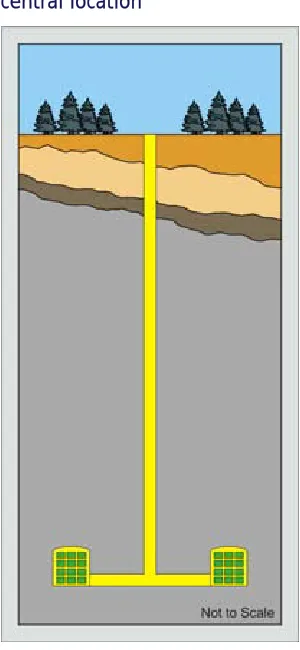
In July 2005, CoRWM short-listed the following options for detailed assessment (see schematic diagrams in Figure 1):
1 Long term interim storage and its variants:
Local to current waste location, above ground, protected (e.g. from “9/11” style attack);
Local, above ground, unprotected; Local, below ground, protected; Centralised, above ground, protected;
Centralised, above ground, unprotected;
Centralised, below ground, protected;
2 Deep geological disposal: Deep disposal;
Disposal in boreholes;
3 Phased deep geological disposal (the Nirex approach);
4 Non geological disposaliii (near surface)
for reactor decommissioning wastes only:
Near surface engineered vault, local to current wastes, protected; Near surface engineered vault, centralised, protected;
Mounded over reactors;
“Forsmark” (as in Sweden) type vault (shallow, less than 100m) disposal, centralised;
“Forsmark” type vault (shallow, less than 100m) disposal, local;
iii If this option was implemented. In addition,
r
l
2.4.3 Option selection and societal
implications
Int oduction
The disposal options are the only
“permanent” waste management options being discussed by CoRWM. The storage options are not permanent solutions, and are only being considered for up to 300 years. The length of time that active management of a facility would need to be maintained will depend on the option chosen and the way it is implemented. For example, if indefinite storage was implemented, active management will be required for hundreds of thousands of years. If disposal is
implemented it could take about a hundred years to construct the facility, emplace all the radioactive wastes and then backfill and close the facility. If a phased approach to disposal is chosen the facility could be maintained as an underground store for several hundred years before being closed.
The longevity of human organisations or civilisations and likelihood of societal collapse is therefore a factor to be considered when assessing the options. Nirex undertook a study [19] to outline
examples of societies, organisations and archives that have been maintained and/or lost and some implications this may have for long-term radioactive waste management. The following paragraphs summarise the findings and conclusions. In summary, a range of factors were identified in the study as being important for the survival or loss of civilisations, organisations and objects. It was found that survival is strongly
influenced by the wider context, or chance, or being in the right place at the right time.
Surviva of civilisations and organisations In the study no examples were found of societies or organisations existing over timescales that radioactive waste will remain hazardous (i.e. hundreds of
thousands of years). Therefore, it does not appear to be possible to rely on an
organisation or society to manage radioactive waste over these timescales.
Survival of information
Long-term radioactive waste management will rely on the preservation and transfer of information and is a major consideration by radioactive waste management
organisations worldwide and by the IAEA. The study showed that the management system is more important for survival than the media used, and showed that the greatest threat to information transfer will be institutional change.
External events
The study gave examples of a number of external events that could influence stability, such as wars, collapses of civilisation and climate change. However, it cautioned that it was the more ‘trivial’ causes that could lead to problems, such as the destruction of archives by paper decay.
The examples were:
• Climate change has brought about civilisation collapse in the past for example, the Vikings. Current climate change will be a major threat to global stability, causing conflict and chaos.
• Disease, and overuse of resources have caused civilisation collapse in for example Easter Island. Water is an increasingly scarce resource and is thought to be a likely cause of future major conflict. Disease, such as avian influenza, is a continuing threat to civilisation through pandemic.
• The UK is currently dependent on trade links with other countries and even if it were safe from collapse due to its advanced technology, collapse in more vulnerable could have a major impact here.
In the case of a radioactive waste
management facility that requires ongoing management, the time collapse takes, from the first warnings to the end would be extremely important, as would
understanding and acting upon the earliest warning signs. The report concluded that if a management option requiring long-term societal control were to be implemented, it might be instructive to consider what, if any, consistent warning signals exist.
r Resou ces
Long-term radioactive waste management will require skills and funding over the time period when active maintenance of the facility is required.
• Skills and personnel loss in the nuclear field has already occurred following the collapse of the USSR and is already a concern in the UK nuclear industry.
• Funding continuity for long-term radioactive management is important if the facility requires active maintenance over thousands of years. To fulfil the principle of intergenerational equity, the financial burden of waste produced by our generation must not be passed on to future generations. However, even if the money were invested now to be used in the future the likelihood of a bank surviving over the timescales involved is low and it is possible that this basic ethical principle can not be fulfilled.
2.4.4 Post CoRWM and future policy
implementation
CoRWM will make its recommendation to Government in its final form in July 2006. Stage 2 of the MRWS programme will end with an announcement by Government on whether to accept, reject, or otherwise take on board that recommendation (possibly by the end of 2006). Stage 3 will be a
consultation on implementation of the chosen policy. If needed, new legislation setting out the implementation programme will be put in place at the start of Stage 4.
In the MRWS document, the Government indicated that the Stage 3 consultation should consider the site selection process. The failures of the past site selection processes in summary include the HLW programme of the 1970’s, the initial shallow and deep siting programmes which ended in 1987, and finally, the deep repository programme which ended at Sellafield in 1997. However, it is important to note the context for the past site selection exercises and how this would be different if siting of a deep geological repository (or other
centralised facility, or even a new nuclear power station) were to be considered again under the Government’s MRWS consultation process. The following paragraphs
summarise the main changes that have taken place since the previous site selection process and how they could affect a future site selection process. Input here includes work done by Nirex to review the last site selection programme [20].
The repository concept
The repository concept under consideration in the last siting exercise was based on one intended to be backfilled and sealed as soon as possible after waste emplacement. In response to extensive stakeholder demands, Nirex has since developed the Phased Geological Repository Concept which is one of the options being considered by CoRWM (see also section 3.3.2). This allows the monitoring of the waste in underground storage for up to several hundred years until society takes the decision to backfill, seal and close the repository or manage the waste in some other way.
There has also been a significant amount of repository research in the UK and overseas such that the understanding of a host site’s requirement has been refined which may affect the geological characteristics that would be sought for potential sites.
Stakeholder involvement in the site selection process
undoubtedly be applied in any future site selection process, to ensure that it is open, transparent and inclusive and that there is stakeholder involvement and influence. As implied above, Stage 3 may not begin to consider a new site selection process until 2007/8. Therefore, a number of aspects could be different in any future site selection process to encourage and ensure greater stakeholder involvement, including how local community and other stakeholders are involved, site evaluation criteria and their relative weights (which would need to be agreed before the site selection phase itself); the ability to volunteer and the power to veto siting decisions, and community benefits.
The volume and types of waste being considered
The volume of intermediate-level waste and low-level waste under consideration in the 1980s totalled two million cubic metres. The volume of waste under consideration now is significantly smaller. The Nirex note
indicated that under the 2001 Inventory assumptions, the total volume to be emplaced in a repository (if that were the chosen option) would be 237,000m3 of ILW
and 15,000m3, of LLW. The latest 2004
assumptions would, of course, revise these estimates further (see section 3.2). The decrease in estimated volumes is due to taking account only of committed LLW and
ILW, rather than also projected volumes under various scenarios and the routing of all but a small volume of LLW to Drigg.
In addition, no consideration was given historically to HLW, spent fuel and other materials not yet declared as wastes such as plutonium and uranium. These wastes could also be considered for inclusion in the repository concept. These changes will affect the size of the repository, and therefore the size of the site that is required and also the geological requirements of the site. (See also section 3.3.2).
Advances in understanding
The UK’s geology has, of course, not changed over the past 20 years, but the ability to investigate and model deep geology and the understanding of deep geological processes has improved significantly. Therefore, there are more favourable indicators of geological suitability, in addition to those recognised previously.
Improved surveying methods as used in the French and Swiss radioactive waste
management programmes could bring in geological settings that were previously viewed as difficult to investigate. Major advances in computer technology mean that geological settings previously excluded as ‘too complex to model’ could now be considered and produce different results when screening sites against geological criteria. Also there is an improved understanding of the geological barrier which together with a better understanding of relevant geological processes means that different geological settings could now be included or excluded.
Legislative developments
The Aarhus Convention [21] came into force in
2001. It aims to protect and improve the environment and ensure sustainable and environmentally sound development. The convention aims to allow public access to information, enable citizen participation in decisions, give them access to
environmental justice with provision of assistance to exercise their rights, increase accountability and transparency in decision making and increase public support forn decisions.
The requirements of the Aarhus Convention are transposed in UK legalisation [ 22] that
implements the European Union’s Strategic Environmental Assessment Directive [23] (see
also guidance published by the Office of the Deputy Prime Minister, [24]) and the
Environmental Impact Assessment Directive [25]. Sustainability appraisals also have to be
undertaken for developments in the UK [26]
economic impacts of proposals are assessed and mitigated if possible.
Together these pieces of legislation make stakeholder involvement in the early stages of a decision-making process compulsory, they give stakeholders the right to influence the scope of the assessments to be
undertaken and the decision-making process itself.
Stepwise decision-making
International experience [27, 28, 29, 30] shows
that EIA and SEA can be used to:
• Engage stakeholders in dialogue about a long-term solution to radioactive waste and structure the work undertaken;
• Define and communicate the scientific and technical work;
• Integrate scientific and social research on radioactive waste management into the decision-making process; and
• Encourage and enable stakeholder involvement in the decision-making process.
Research [31, 32, 33, 34] has shown that a
stepwise approach to decision-making regarding long-term radioactive waste management is important because it:
• Enables flexibility to be built into the process;
• Provides clear decision points;
• Enhances stakeholder involvement, transparency and auditability;
• Enables steps to be reversed if necessary.
SEA and EIA provide frameworks with clearly defined steps. Therefore, they could be used to structure the decision-making process relating to long-term radioactive waste management in the UK. Moreover, a Sustainability Appraisal (SA) could be undertaken to ensure that all the relevant issues are addressed. The UK guidance on Sustainability Appraisal [26] aims to align the requirements of SA and SEA in a single
assessment. Both processes have similar stages, but Sustainability Appraisal considers social and economic as well as
environmental issues.
Siting has been seen as the most controversial and difficult stage in
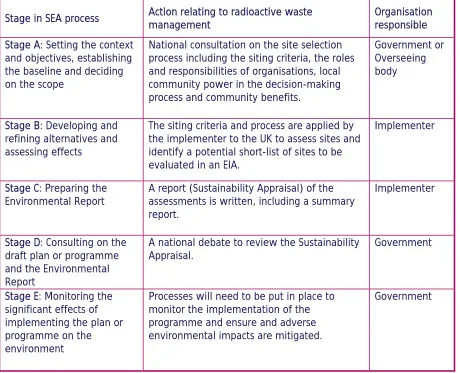
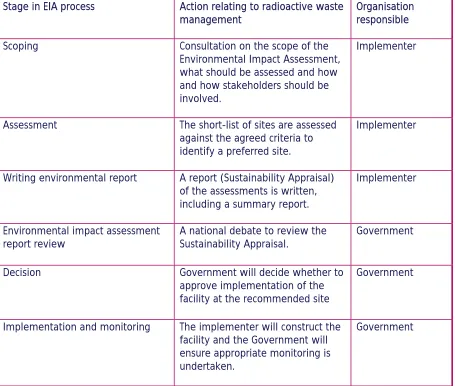
developing a long-term radioactive waste management facility. Therefore, it is important that the process of site investigation and selection is seen as legitimate and has stakeholder support. Nirex believes that the site selection process should be structured using the SEA and EIA frameworks as outlined in Figure 2.
UK Guidance on SEA outlines the stages in the process as follows can be mapped onto the decision-making process for identifying a short-list of potential sites as outlined in Table 2. The steps involved in an EIA are outlined in a European Commission Report on EIA and geological repositories [27] can be mapped onto the process for
recommending a preferred site as shown in Table 3. Working groups could be set up in potential host communities to enable the local community to scrutinise the work of the implementer and make inputs into the decision-making process. Mechanisms similar to those used in Belgium [35] and
Sweden [36] could be used and funding for
these would need to be provided.
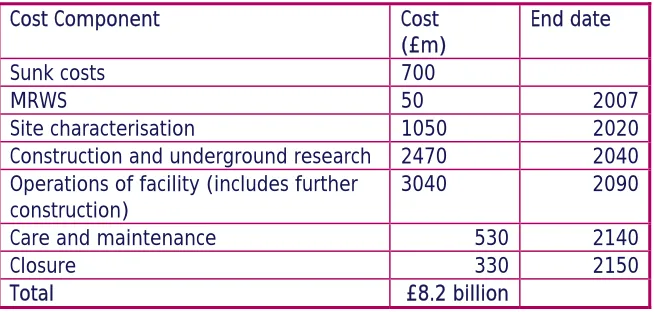
To provide provisioning advice to radioactive waste producers, Nirex has developed a baseline programme that outlines the stages needed to implemented a deep geological repository and estimates of how long that would take. It is estimated that a site could be selected for underground research by 2020 and a repository could be available by 2040. The Finnish experience, outlined in section 4.7.4, indicates some 18 years to get to a final site choice.
The NDA has called for a repository to be available by 2025 to allow their plans for reactor decommissioning in 25 years to be delivered. Even if CoRWM were to
policy, it is unlikely that a permanent solution to long-term waste management will be available on the NDA timescale. This is due to the necessary siting, R&D, planning and construction programmes which must be implemented, including the necessary legislative requirements as outlined above. The repository siting programme would be more than just a scientific exercise, it would involve an important social and ethical dimension and stakeholder interaction. As such, 2025 may not be unachievable if due process leads to a willing host community coming forward, and that the overall progress is at the speed desired by
3 RADIOACTIVE WASTE MANAGEMENT IN PRACTICE
3.1 General
Radioactive waste is generated in the UK by a range of nuclear and non-nuclear activities. Waste has been generated and continues to be generated from nuclear power
generation, spent fuel reprocessing, research, industrial and military
programmes. Further, wastes will also result from future decommissioning of nuclear facilities. The waste itself contains a wide range of levels of radioactivity (see Box 1 [37]).
Wastes are currently stored in interim storage facilities on regulated nuclear sites over the short and medium term (of the order decades). The HSE expects nuclear site licensees to manage radioactive waste such that it is compatible with future potential disposal options, and unless justified on safety grounds, does not foreclose
foreseeable management options. A Nirex “Letter of Compliance” issued for a particular processed waste form and packaging is an important part of this demonstration. This system has developed since the late 1980’s and has been used to judge the acceptability of all intermediate level waste packages produced in the UK.
There are a number of “unconditioned” waste streams (legacy wastes which are not in a passively safe form), particularly at the Sellafield reprocessing site, which are stored in facilities that whilst considered acceptable at the time, now pose a number of
significant challenges with respect to management and decommissioning of the facilities – see Box 1 [38].
3.2 Inventory of radioactive
materials
3.2.1 Radioactive waste
Defra and Nirex periodically publish an inventory of radioactive waste in the UK. This inventory provides a reference source of information for Government and its agencies, Nirex, and others with a role or interest in the management of radioactive waste. The latest version considers stocks of wastes in store and predicted to arise in the future under current plans as at April 2004 and was published in October 2005 [39].
The report includes all the higher activity materials which have been declared as wastes. For a discussion on material not yet declared as wastes see the next section. As reported in the 2004 Inventory, the total volume of radioactive waste that exists today and is forecast to arise in the future is 2.3 million m3, comprising 2.1 million m3 of
LLW (mainly unconditioned); 220,000m3 of
ILW and 1,300m3 of vitrified HLW. Note the
ILW volume of 220,000m3 is a combination
of conditioned waste in stock and future arisings; the estimated final conditioned volume is 240,000m3
.
A further 1 million m3 has already been
produced and disposed of. This is primarily LLW disposed of at Drigg and Dounreay, but includes a small amount of ILW disposed of at sea. Under existing scenarios about 95% (2.2 million m3) of the radioactive waste
total already exists and is being held in stores as noted above, but much of it, 1.6 million m3, will arise as waste when facilities
are decommissioned.
The other 5% (100,000m3) of the total has
programmes and continued use of radioactivity for medical and industrial purposes. The volumes referred to assume the following scenario:
• Nuclear power stations
Remaining operational power stations shut down over the period from 2006 to 2035;
No new nuclear power stations are constructed;
Main reactor structures left on site for about 100 years before final site clearance;
• Spent fuel reprocessing continues until financial year 2012/13;
• The Joint European Torus fusion experiment shuts down in 2006;
• Defence:
A continuing nuclear defence capability to 2040;
A continuing nuclear-powered submarine programme to 2100
• Medical and industrial sources usage continues as today.
3.2.2 Other radioactive materials and
VLLW
Spent nuclear fuel, plutonium and uranium are not currently classified as wastes due to their potential use as resource, but they too also require safely managing pending availability of a long-term management route. CoRWM are addressing this subject as part of their programme. Spent nuclear fuel from the UK’s Magnox and AGR nuclear power stations is transported to Sellafield for reprocessing, where the waste products (HLW, ILW) are stored in interim storage facilities; LLW arisings are consigned to Drigg. Spent fuel is stored in ponds where the water provides both shielding and cooling. The separated plutonium and uranium arising from reprocessing is also stored. Spent nuclear fuel from Sizewell B PWR power station is not reprocessed and is stored in storage ponds.
In 2003 Nirex undertook a study [40] to look
at what additional materials there were which could be declared as radioactive wastes. The report identified volumes of wastes not included in the Inventory reference case as described above. A summary of the findings of that report, updated as appropriate was presented in Nirex report N/122 [41] and has been used to
provide the information below.
Plutonium
Plutonium is a radioactive element created as a by-product in nuclear reactors. It can be separated from nuclear fuel by reprocessing. Separated plutonium can be used as a nuclear fuel and in nuclear weapons.
There are currently 93te of separated plutonium in the UK, most of this material is held in store at Sellafield in oxide form as a powder. A small quantity may be returned to overseas countries. Some plutonium is held for military purposes. The total quantity of separated plutonium will increase to approximately 140te under current
reprocessing assumptions. In addition there is plutonium within spent fuel. For more discussion on the plutonium issue, see the next section.
Uranium
Uranium is a radioactive element that occurs in natural form as an ore which is mined and can be used for the manufacture of nuclear fuel and nuclear weapons. It is also a by-product of spent fuel reprocessing. Less radioactive uranium (called depleted
uranium) has more commonplace uses, such as counterweights in aircraft. Most uranium is stored either as gaseous uranium
hexafluoride or as an oxide powder.
150,000te under current reprocessing assumptions. In addition there is uranium within spent fuel.
Spent fuel
Spent nuclear fuel is fuel that has been irradiated in a nuclear reactor. By activity content it comprises 1% Pu, 96% U and 3% fission products. It can be reprocessed (to separate out plutonium and “unburnt” uranium) or managed in some other way. Like HLW, spent nuclear fuel is intensely radioactive and generates heat. It usually comprises uranium oxide, and contains fission products.
Approximately 5,000te of UK spent nuclear fuel is currently held in stores at Sellafield, Dounreay and a number of reactor sites. Some of this fuel is planned to be
reprocessed. There will also be more spent fuel generated from continued power generation. Under current plans it is
estimated that 4,700te of spent fuel will not be reprocessed.
Contaminated land
Estimates of land contaminated with radioactivity have been made but are very uncertain. RWMAC [42] estimated the total
amount in the UK to be of the order of 18 million m3 (equivalent to 36 million te) of
unconditioned material. Most of it is at Sellafield, Dounreay and Aldermaston.
Radioactive sources
Approximately 10,000 sources are in use in the UK now, mainly for medical and industrial purposes. Most of these are returned to the manufacturers after use. Record keeping in this area has often been poor, resulting in the loss of sources.
Radioactive sources exist in a wide variety of forms, from small metallic objects to gases and liquids.
VLLW
Small quantities of waste can be routinely disposed of to domestic landfills. There are approximately 5 such sites in use in UK. VLLW may be lightly contaminated
miscellaneous items such as laboratory equipment, gloves and medical wastes.
Miscellaneous
Some organisations have disposed of
radioactive waste under other arrangements, either on a nuclear licensed site or local tips (estimated to be 10,000m3), or (before it
was banned) in the sea (33,000m3).
Some radioactive waste can be incinerated either at purpose built incinerators located on nuclear sites or domestic incinerators.
All nuclear facilities may discharge
radioactivity to the environment via liquid and aerial effluents under strictly controlled authorisations set by the UK regulators.
3.2.3 Issues surrounding plutonium
Plutonium is currently classed by the nuclear industry [50] as an asset with zero value, andnot as a waste. UK-owned civil plutonium stocks have been created through the reprocessing of spent nuclear fuel with the original intention of re-using this material in a future fast breeder reactor programme.
It was believed in the 1950s and 1960s that a “closed” nuclear fuel cycle was the most desirable option for future energy supply. Fuel from nuclear reactors would be
reprocessed after first use and the recovered plutonium would be recycled as fuel in fast breeder reactors. The fast breeder reactors would produce more plutonium, which could fuel other types of reactors.
The UK fast breeder reactor programme, was however, formally cancelled in the early 1990’s, closing this option for the use of plutonium, as the predicted uranium shortages did not occur. As a result, significant stockpiles of plutonium have arisen as a result of reprocessing operations.
build in its potential use as MOX fuel (see section 5.6). The NDA has declared that reclassifying plutonium as a waste would add several billions of pounds to the total cost of dealing with the UK’s nuclear legacy. The NDA is planning to discuss with
Government what proportion of plutonium should be regarded as a strategic stock, which could be used as a potential future energy source, leaving the remainder as waste. Further details of the implications of reclassifying plutonium as a waste can be seen in references [43] and [44].
CoRWM’s position paper on plutonium [45]
notes that plutonium storage arrangements at Sellafield are satisfactory for the
immediate future (approximately 25 years). They are only viewed as an interim measure for two reasons:
• The storage of plutonium dioxide powder cannot be considered as ‘passively safe’. There are maintenance and monitoring requirements. Human intervention Is required to maintain safety.
• There is increasing international pressure to reduce stockpiles of separated
plutonium.
If plutonium were to be classified as a waste, for security reasons it would need immobilizing in a stable wasteform, suitable for long-term management, and does not necessarily discount recycling options in the future, although it is recognised that
immobilisation would make recycling much more difficult. Immobilised plutonium, however, would require additional
processing steps to enable its re-extraction.
Two of the aims of immobilisation are:
• Proliferation resistance: the plutonium is rendered unattractive to any potential illegal use, for example, as the nuclear explosive in an atomic device or radioactive ‘dirty’ bomb.
• Disposability: the plutonium will be conditioned in an acceptable way for possible disposal.
There are a range of different immobilization methods, including cementation, vitrification and ceramification, which are described in more detail in the CoRWM position paper.
3.2.4 Scenario variations
CoRWM established a baseline inventory of radioactive wastes and materials on which it will make its recommendations [46]. As
acknowledged in the reference, this was principally derived from the draft 2004 Inventory data and whilst some of the underpinning data may have been modified in the move to the final version, this is not expected to materially affect either this analysis or conclusions.
CoRWM made the following principal assumptions.
Nuclear power reactors:
• All operating Magnox reactors are shut down by 2010;
• AGRs operate for up to 35 years, with the last shutdown in 2023;
• Sizewell B PWR operates for 40 years and is shutdown in 2035;
• No new nuclear power reactors are constructed.
Spent fuel reprocessed:
• All Magnox fuel (55,000tU);
• AGR fuel covered by existing contracts (5,000tU);
• Overseas LWR fuel covered by existing contracts (4,500tU);
• Return of overseas Pu, U and HLW, with ILW & LLW substitution.
Radioactive materials if these are to be managed as wastes:
• All UK stockpile of separated plutonium (102te);
• AGR fuel not covered by existing reprocessing contracts (3,500tU);
• Sizewell B PWR fuel (1,200tU).
• All radioactive wastes, including spent fuel, are packaged so that they are in a form suitable for long-term
management.
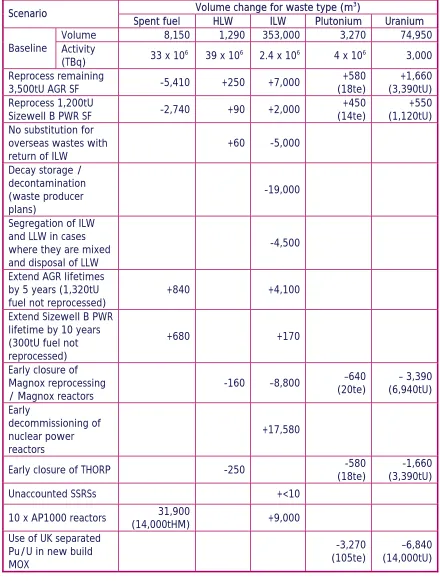
The baseline inventory includes all wastes both in existence and forecast to arise in the future (from e.g. decommissioning). Their baseline volume was 477,860m3 as
indicated below. [Note, care should be taken in comparing these figures, which represent packaged volumes, with the ones in the previous section.] CoRWM further considered changes in the above assumptions to the baseline scenario as follows:
• The building of new nuclear power reactors (discussed in more detail later in section 5.1);
• The quantity of spent fuel reprocessed;
• ILW and LLW substitution (return additional HLW in place of ILW from reprocessing overseas spent fuel);
• Lifetimes of existing nuclear power reactors;
• Decay storage and decontamination of ILW (for disposal as LLW);
• Early decommissioning of nuclear power reactors;
• Waste segregation (of short-lived ILW; of mixed ILW/LLW streams);
• Quantity of unaccounted spent sealed radiation sources (SSRSs).
They concluded the potential for changes (+/-) in the baseline volume of 477,860m3
for various scenarios on spent fuel, HLW,ILW, plutonium, uranium and LLW could be as shown in the following table which has been adapted from their inventory summary document – see Table 4. Volume and activity comparisons are summarised in section 5.3.
Regarding non-Drigg LLW, baseline volume 37,200m3
, CoRWM noted that the nature of
most of the waste - activated reactor core
graphite – would make it difficult to treat in order that it would be acceptable for disposal to Drigg. There may be some uncertainty in the relative quantities of ILW and LLW reactor graphite, but this will not affect the inventory.
3.3 Waste packaging and storage
3.3.1 The letter of compliance process
Prior to the Government making any decision on future radioactive wastemanagement policy, they and the regulators have deemed it appropriate that
unconditioned and decommissioning ILW should continue to be packaged under the Nirex Letter of Compliance (LoC) system. Endorsement of this process during the period for which CoRWM is deliberating was given by the Governments
cross-Government Radioactive Waste Management Policy Group, which noted that the LoC process gave a good level of compatibility with the likely options being considered by CoRWM, and that packaging should not be delayed during the review of options.
Since it was established in 1982 the Nirex role has included development of ILW waste package standards and specifications
necessary to produce waste packages compatible with a planned repository.
Since the mid-1980s, many waste producers have invested in conditioning and packaging plants to process waste immediately after creation and to treat initiate retrieval of historic legacy wastes, using the standards and specifications to guide their
development. Through issuing a Letter of Compliance (“LoC”, originally “Letter of Comfort”) Nirex indicated when the
proposed waste packages were compatible with the disposal concept being developed.
In January 2004 improved arrangements were introduced by the regulators [47]
requiring that safety cases covering the ILW conditioning plants also address the
increased confidence to regulators and other stakeholders that the long-term
management of waste packages is
considered before they are manufactured. The process comes under the regulatory scrutiny of the Environment Agency of England and Wales (EA), and its counterpart in Scotland, the Scottish Environment Protection Agency (SEPA) which advises the Nuclear Installations Inspectorate (NII) on waste package disposability.
As noted earlier, the revised arrangements are also recognised within the Government’s updated policy on decommissioning of UK nuclear facilities issued in September 2004 . The policy update confirms that operators should continue to process decommissioning wastes in accordance with Nirex LoC
arrangements.
In March 2005, NII, EA and SEPA issued “Guidance to Industry” [48] on the operation
of the improved arrangements requiring that site operators set out the strategy for
retrieving, conditioning, storage and ultimate disposal of wastes. The ILW Conditioning Proposal is required to justify the selected packaging option based on consideration of BPEO (Best Practicable Environmental Option) and BPM (Best Practicable Means) and a disposability case as described previously.
3.3.2 Repository concept
A fundamental principle of the LoC system is that in the absence of a repository, and thus the absence of waste acceptance criteria, there is still a repository concept against which the disposability of ILW packaging proposals can be assessed. Part of the Nirex remit since its inception has therefore involved the development of the repository concept. This has evolved over the years to take account of changing waste volumes and other factors, principally the inclusion of monitoring and retrievabilty, to what is now described as the Phased Geological
Repository Concept (PGRC). This is described in more detail in Nirex Report N/122, [41]
referred to earlier, and in Nirex Report N/074 [49].
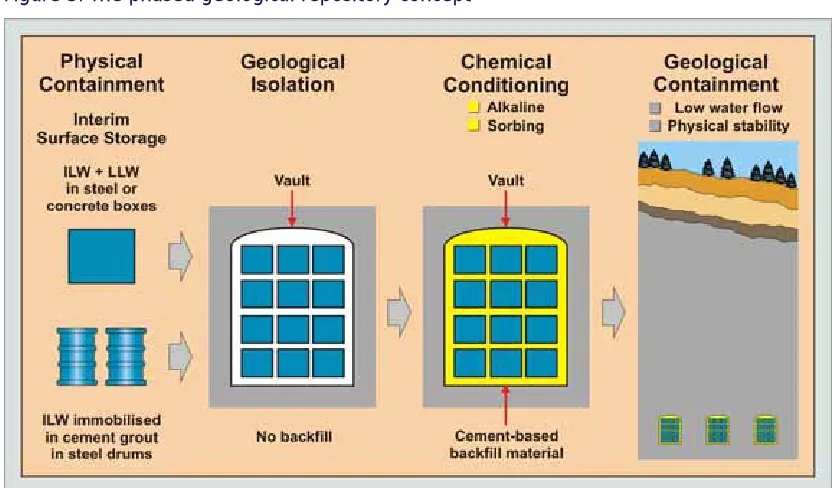
In summary, the PGRC is a multi-barrier system comprising physical, chemical and geological barriers to ensure any
radioactivity that returns to the human environment in the future is within
acceptable levels (see The phased geological repository concept). Retrievability is a component part of the concept, as mentioned, and is achieved initially by operating the facility as a retrievable store in which the wastes can be maintained and if necessary retrieved. Decisions about how and if to proceed towards closure of the facility are offered to future generations without placing an undue burden on them. See Figure 3: The phased geological repository concept.
Note that this concept is only for ILW and LLW not suitable for Drigg. With the encouragement of Government, Nirex has developed a repository concept for HLW and spent fuel. This is based on the Swedish KBS-3 concept as being implemented in both Sweden and Finland. Again this is described in more detail in Nirex Report N/122 [41]. In addition Nirex is investigating the
disposability of other materials such as separated stock of plutonium and uranium, and spent fuel from submarines and research reactors.
3.3.3 Waste
storage
Interim storage is the status quo in the UK and it is the first stage of a long-term
management strategy. In principle, there is a difference in the more recent design of stores (which take packaged wastes) that anticipate that a disposal option will be implemented in some tens of years, and historical stores (which were for untreated waste) whose lifetime represented the longest that technology could then achieve.
the 1950’s and 60’s at, for example Sellafield, for which plans are now being drawn up to empty, treat and package the wastes and decommission, to more recent purpose built facilities, built in the last decade for packaged wastes. The design life for these newer facilities is of the order 50 years, although it may be possible to extend their lifetime to 100 years given appropriate maintenance.
3.4 Decommissioning
3.4.1 General
As noted above, the NDA are responsible for the decommissioning of nuclear facilities which in terms of civilian reactors currently applies to the Magnox fleet. The NDA has produced a draft strategy for consultation [50]
for which the consultation period closed in November 2005. Although not published, the NDA had to submit the (revised) draft
strategy following the consultation to Ministers by mid-December 2005 for which the Government must give its approval by the end of March 2006.
The strategy document notes there are at least three main approaches to
decommissioning reactor sites:
1. The current approachis based on Government policy and the five-yearly review process:
This strategy is based on a period 20 to 25 year period during which ancillary buildings are cleared an the reactor(s) placed into a care and maintenance regime. This would include for example construction of an interim ILW storage facility on site. This stage would then be followed by 80 to 100 years of care and
maintenance, before reactor dismantling and final site clearance.
Decommissioning of AGRs would adopt a similar approach. With the design of Sizewell B (PWR), similar principles apply but with
potentially differing timescales. (There is no graphite, it is a physically smaller reactor and easier to decommission.)
2. British Nuclear Group’s proposed ‘Magnox Innovation’ approach:
as little as five years to reach care and maintenance and at a cost of £100m or less;
up to 100 years in care and maintenance.
3. The NDA’s proposed approach:
defuelling, decommissioning and release of the site for alternative use in 25 years or less.
3.4.2 Decommissioning approach
British Energy ApproachA British Energy review of the early Safestore strategy for their AGR & PWR reactors has recently been undertaken in response to the Regulator’s requirements for a review of all operators decommissioning strategies [51]. The overall conclusions of this
study were:
• Recent work on worker doses, waste volumes and types, underpins the various AGR decommissioning options, which acted as a driver for the early Safestore.
• Assessments against legislation and Government policy showed that the early Safestore remains consistent and robust, but also flexible.
• Assessments against potential changes in legislation that may be implemented in the future will not significantly impact on early Safestore strategy.
• None of the recently highlighted issues foreclose the current British Energy early Safestore strategy.
BNG Magnox Approach
The Magnox Decommissioning Dialogue [52]
range of stakeholders with the aim of identifying and exploring implications of decommissioning options. It focused on three scenarios:
• prompt, uninterrupted decommissioning;
• some prompt decommissioning with medium-term deferral of complete decommissioning;
• some prompt decommissioning with long-term deferral of complete
decommissioning. In the analysis of the scenarios, some variations were
identified, e.g. on-site waste storage, and a rolling programme of
decommissioning to completion across all sites.
The resulting recommendations constituted BNG’s proposed “Magnox Innovation Approach”, with approximately 5 years to reach care and maintenance, at a cost of <£100M, with up to 100 years in care and maintenance. This would include:
• Removal of fuel;
• Retrench all radiological
facilities/activities into one area of site;
• Store operational ILW in the reactor building;
• Dispose of LLW on site.
This approach would achieve care and maintenance in about 5 years, and would provide one approach to the interim ILW storage problem.
The NDA Approach
The NDA’s long-term objective is to
complete the decommissioning and clean up of sites for which it is responsible, and to make them available for other uses. The key issues for the NDA in waste management arising from the decommissioning of power stations are:
• Whether and how to rationalise the interim storage of ILW
• How to dispose of increasing volumes of LLW and to reduce the costs of disposal
• How to manage the future capacity of the National Low Level Waste repository at Drigg, whose capacity is limited, and will not be able to take all LLW from decommissioning and cleanup operations
• The NDA’s proposed approach for decommissioning is for defuelling, decommissioning and release of the site within 25 years.
The strategy report suggests the main advantages of the NDA approach to include:
• use of the existing knowledgeable workforce and associated socio-economic benefits for the local area;
• earlier availability of the site for other uses;
• fewer ILW interim stores needed with consequential cost savings;
• visible signs of decommissioning and clean up,
• mitigation of the potential threat of coastal erosion and climate change at a number of sites;
They go on to say that the NDA’s proposed approach is similar to that adopted by EDF in France for the decommissioning of their gas-cooled reactors and they note that in Japan, operators propose to decommission their Magnox reactor in 17 years, subject to the availability of a disposal solution.
3.4.3 Current UK decommissioning
experience
In the UK, a number of research (non-commercial power station) reactors have been fully decommissioned and the sites delicenced. These include the Risley
Research Reactor and the Royal Naval JASON reactor at Greenwich.