A STUDY ON THE BIOEFFICACY OF
CARYOTA URENS
L.
D. Vanaja1 and *Dr. S. Kavitha2
1
Department of Plant Biology and Plant Biotechnology, Ethiraj College for Women, Chennai
– 600 008.
2
Assistant Professor, Department of Plant Biology and Plant Biotechnology, Ethiraj College
for Women, Chennai – 600 008.
ABSTRACT
The present study is aimed to investigate the popular palm Caryota
urens leaves for its phytochemical composition, oxidant,
anti-microbial, anti-inflammatory and FT-IR evaluation. Three different
solvents aqueous, methanol and hexane were used in this study. The
qualitative tests for phytochemicals confirmed the presence of
terpenoids, alkaloids, steroids, saponins, glycosides, phytosterols,
resins, phenols, flavonoids and oxalic acid. The quantitative analysis of
methanolic leaf extract of C. urens revealed the presence of phenols
(29.6 mg GAE/g), terpenoids (70mg/g) and oxalic acid (0.0612mg/g).
In vitro anti-oxidant activities were evaluated by DPPH, hydrogen
peroxide and reducing power methods. The antimicrobial activity of
different concentrations (25, 50, 75, 100 µg/g) of methanol leaf extract
were tested against two gram positive and two gram negative bacterial strains (Bacillus
subtilis, Staphylococcus aureus, Escherichia coli and Pseudomonas aeruginosa﴿ and 4
fungal strains (Rhizopus sp., Aspergillus niger, Penicillium sp. and Fusarium sp﴿. The
larvicidal activity of methanol leaf extracts against Aedes aegypti was studied by direct
contact method. In vitro anti-inflammatory activity of methanol leaf extract was studied by
inhibition of protein denaturation method. The FTIR spectroscopic studies showed the
characteristic peak values for various functional compounds in the methanol extract. The
present study suggests that, C. urens has therapeutic potential that can be used as a resource
of different bioactive compounds and antioxidants.
KEYWORDS: Phytochemicals, anti-oxidants, anti-microbials, larvicidal, anti-inflammatory and FT-IR.
Volume 6, Issue 4, 1381-1398. Research Article ISSN 2277– 7105
*Corresponding Author
Dr. S. Kavitha
Assistant Professor,
Department of Plant Biology
and Plant Biotechnology,
Ethiraj College for Women,
Chennai – 600 008.
Article Received on 09 Feb. 2017,
Revised on 29 Feb. 2017, Accepted on 21 March 2017
INTRODUCTION
Plants have provided humans with medicines since time immemorial. The majority of world
populations still rely on plant based medicine due to their easy availability, safe use and
affordability. Medicinal plants, the world’s oldest known health care products, play a key role
in traditional medicine. These plants are not only used for primary health care, but also as
pharmaceuticals. Traditional knowledge on medicinal plants is of great significance and
forms the basis for the development of plant based drugs. Majority of the hints to plant based
drugs come from ethnobotanical studies and traditional knowledge. The traditional system of
medicine still continues to serve, in spite of the advent of modern medicine, a large portion of
the population, particularly in the rural areas.[1]
Though traditional medicine is used the world over, it is particularly relied on in developing
countries.[2] India is one such country which is endowed with a rich mega diversity of flora
due to the extreme variations in geographical and climatic conditions prevalent in it. India is
bestowed with a rich herbal heritage dating back to 3000 B.C. The pharmacopeias of these
systems have mainly drawn upon the indigenous flora for the preparation of wide variety of
herbal medicaments and about 800 plants are mentioned in the relevant systems. One such
popular ornamental plant Caryota urens L. (Fishtail palm) used in ancient medicinal systems
was chosen for the present study.
Caryota urens is a lofty handsome palm growing up to a height of 22m and a girth of 2.8 m
with a smooth, cylindrical annulated trunk. The tip innate leaves are triangular in shape
resembling a fish tail and the plant bears clusters of white, unisexual flower at maturity. The
fruit matures to round, 1cm (0.39) drupe and is red in colour.[3] The tender leaves are sweet
and cooling and are useful in vitiated condition of pitta. The pulp of fruit is good for
hyperdipsia and fatigue. A paste made from the nut is good for hemicrania. A porridge
prepared from the seed flour is prescribed by local physicians to treat gastric ulcers, migraine
headaches, snake-bite poisoning and rheumatic swellings. The root is used for treating tooth
ailments. The bark and seed are used to treat boils. The tender flowers are used for promoting
hair growth. C. urens flower is used to treat gastric ulcer, migraine headaches, snake bite
poisoning as well as rheumatic swellings. In Ayurveda, it is recommended for seminal
weakness and urinary disorders. Palm heart is used locally as flour, especially for control of
diabetes and in ayurvedic medicines.[4] The plant is less exploited medicinally and hence in
MATERIALS AND METHODS
PLANT COLLECTION AND IDENTIFICATION
Healthy leaves of Caryota urens L.were collected from Ethiraj College for Women, Chennai.
The plant samples were identified by Dr. D. Narasimhan, a taxonomist, Department of
floristic research, Madras Christian College, Chennai.
PREPARATION OF PLANT EXTRACT
The plant samples were shade dried for 2 weeks. After shade drying, the samples were
ground into a fine powder using an electrical blender. 10 g of sample was extracted with 100
ml of each solvent -methanol, aqueous and hexane separately using Soxhlet apparatus and the
extract was concentrated using rotary evaporator at 50 C.[5]
QUALITATIVE ANALYSIS OF PHYTOCHEMICALS (SECONDARY
METABOLITES)
Phytochemical tests were performed to identify the phytoconstituents present in leaf extracts
of different solvents prepared in Methanol, Hexane and Aqueous medium using standard
procedures.[6][7][8]
Estimation of total phenolic content
The total phenolic content of methanolic leaf extracts of Caryota urens was determined by
Folin-ciocalteu reagent method.[9]
Estimation of total terpenoids
The total terpenoids was calculated by Ferguson’s method.[10]
Estimation of oxalic acid
Oxidation of KMnO4 by oxalic acid
Standard oxalic acid solution (1 mg/ml) was prepared with distilled water. 100 ml of 0.003 M
KMnO4 was prepared from appropriate dilution of 0.01 M KMnO4 in distilled water and 50
ml of 2 N H2SO4 was prepared in distilled water. Assay mixtures contained different
concentrations of oxalic acid ranging from 0.1 to 1 mg, 5 ml of 2 N H2SO4 and 2 ml of 0.003
M KMnO4. This mixture was incubated for 10 min. at room temperature (27 ± 2 C). After 10
min. absorbance was recorded at 528 nm using Shimadzu, UV 1650 spectrophotometer.
Reagent blank was prepared with distilled water. Absorbance for blank solution was recorded
concentration range of 0.1 to 1 mg/ml of oxalic acid. The concentration of oxalic acid is
calculated using difference in the absorbance ∆A=∆b- ∆s.[11]
ANTI-OXIDANT ACTIVITY
Hydrogen peroxide scavenging activity
The hydrogen peroxide (H2O2) scavenging activity was determined by Ruch et al., 1989
method.[12] Ascorbic acid was used as standard. The extent of H2O2 scavenging activity of the
leaf extract was calculated as
H2O2 scavenging effect (%) = Aс-Aо/Aс ×100
Where Aс is the absorbance of control and Aо is the absorbance of leaf extract.
Reducing power assay
The reducing power assay was carried out according to the method of Oyaizu (1986).[13] The
assays were carried out in triplicates. The activity was compared with ascorbic acid standard.
DPPH ASSAY
The antioxidant activity was measured in terms of hydrogen donating or radical scavenging
ability using the stable radical DPPH (α, α-diphenyl-β-picrylhydrazyl). The reduction of the
radical is followed by a decrease in the absorbance at 517 nm. The methanol extract of
Caryota urens leaves of varying concentration (100 – 500 µg / ml) was taken into test tubes
and 2 ml of 1 mM DPPH solution was added. The tubes were kept in the dark for 30 min.
Absorbance at 517 nm was measured with a UV-VIS spectrophotometer and compared to an
ascorbic acid calibration curve.[14] The percentage inhibition of the DPPH radical was
calculated using the following formula:
DPPH inhibition (%) = Aс-Aо/Aс ×100
Where Aс is the absorbance of control and Aо is the absorbance of sample
ANTIMICROBIAL STUDY Antibacterial activity
Antibacterial activities of C. urens extract were carried out against different bacterial
pathogens such as Bacillus subtilis, Escherichia coli, Pseudomonas aeruginosa and
Staphylococcus aureus. The bacterial cultures were obtained from the Department of
Microbiology, Ethiraj College for Women.Antibacterial activity of methanol leaf extract was
used as positive control and methanol was used as negative control and all the experiments
were carried out in duplicates.
Antifungal Activity
Antifungal activity of methanolic leaf extract was carried out against four fungal species
-Rhizopus sp., Aspergillus niger, Penicillium sp. and Fusarium sp. The fungal cultures were
obtained from the Department of Microbiology, Ethiraj College for women and maintained as
pure culture in potato dextrose agar (PDA﴿ medium.
The methanol leaf extracts were screened for antifungal activity by agar well diffusion
method. Fungal cultures (48 hold ﴿ grown on PDA medium, were used for plate assays.
Carbendazim was used as positive control. All experiments were repeated twice and the
results were recorded after 48-78 h.
LARVICIDAL ACTIVITY
The Aedes aegypti mosquito larvae were obtained from the Entomology Department, Loyola
College, Chennai. The insecticidal activity was determined by direct contact application.[16]
Small sized petridishes (60 mm﴿ were used for conducting direct contact activity. The
positive and negative controls used were DMSO and methanol respectively. Various
methanol concentrations of C. urens (100-500 µg﴿ was used to test the larvicidal activity. 1
ml of leaf extract and 25 ml of water was added in a petriplate and in each petriplate 10
larvae were placed. The mortality rate of larvae was calculated after 24 h. Percentage
mortality was calculated using the formulae.
Percentage mortality = No. of dead larvae ×100
No. of larvae introduced
EVALUATION OF IN VITRO ANTI-INFLAMMATORY ACTIVITY Inhibition of protein denaturation method
Anti-inflammatory activity of the C. urens extract was evaluated by protein denaturation
method.[17] Diclofenac sodium, a powerful non-steroidal anti-inflammatory drug was used as
a standard. The reaction mixture consisting of 2 ml of different concentrations of C. urens
methanol leaf extract (100-500 µg/mL) or standard diclofenac sodium (100 and 200 µg/ml)
and 2.8 ml of phosphate buffered saline (pH 6.4) was mixed with 2 ml of egg albumin (from
the reaction mixture at 70 C in a water bath for 10 min. After cooling, the absorbance was
measured at 660 nm by using double distilled water as blank. Each experiment was done in
triplicate and the average was taken. The percentage inhibition of protein denaturation was
calculated by using the following formula:
Percentage of inhibition = Aс-Aо/Aс ×100
Where Aс is the absorbance of control and Aо is the absorbance of leaf extract.
UV-SPECTROPHOTOMETRIC ANALYSIS
The methanol extracts were analyzed for the confirmation of secondary metabolites using
UV-1650 Shimadzu spectrophotometer in the range set between 200-400 nm.
FTIR SPECTROSCOPIC ANALYSIS
Dried methanol leaf extract of C. urens was used for FTIR analysis. 10 mg of dried extract
powder was mixed with KBr salt using a mortar and pestle. The mixture was then
compressed into a thin pellet. Infrared spectra and peak values were recorded on a Shimadzu
IR (Japan), between 4000 – 400 cm -1.
RESULTS AND DISCUSSION
The constant rising demand of plant-based drugs is unfortunately creating heavy pressure on
some selected high-value medicinal plant populations in the wild due to over-harvesting.
Several of these medicinal plant species have slow growth rates, low population densities,
and narrow geographic ranges and therefore they are more prone to extinction.[18] [19]
Furthermore, the indigenous knowledge on the use of lesser-known medicinal plants is also
rapidly declining. Continuous erosion in the traditional knowledge of many valuable plants
for medicine in the past and with a renewal interest, currently there is a need to review the
valuable knowledge with the expectation of developing the medicinal plants sector.[20] Much
easily grown and propagated ornamental plants with potential phytocompounds provide a
better solution to overcome such problems. Hence, the ornamental palm Caryota urens,
which has been reported in traditional medicine but much exploited for its therapeutic
potential was used in the present study.
PHYTOCHEMICAL ANALYSIS
The phytochemical screening of the leaf extract of C. urens in various solvents revealed the
presence of alkaloids, terpenoids, steroids, glycosides, phytosterols, oxalic acids and phenols.
A moderate presence of saponins, tannins, flavonoids, gum and mucilage were observed in
the aqueous extracts of C. urens. In hexane extract, terpenoids, phytosterols, saponins,
steroids were present in trace amounts (Table1﴿.
Table 1: Phytochemical analysis of C. urens leaf extracts
S.NO PHYTOCHEMICAL
CONSTITUENTS AQUEOUS METHANOL HEXANE
1 Alkaloids + _ _
2 Carbohydrates _ _ _
3 Terpenoids + + +
4 Saponins + + +
5 Steroids and Triterpenoids + + _
6 Anthroquinone _ _ _
7 Glycosides + + _
8 Protein and Aminoacids _ _ _
9 Phlobatannin _ _ _
10 Cardiac glycosides + + _
11 Gums and Mucilage + _ _
12 Fixed oils and Fats _ _ _
13 Phytosterol + + +
14 Anthocyanin and Betacyanin _ _ _
15 Resin + + _
16 Fatty acids _ _ _
17 Coumarin _ _ _
18 Phenols + + _
19 Flavonoids + _ _
20 Tannins + + _
21 Oxalic acid + + +
22 Inorganic acids _ _ _
Key: (+) indicates presence; (-) indicates absence.
QUANTITATIVE ANALYSIS OF PHYTOCHEMICALS Estimation of phenol, terpenoids and oxalic acid content
The total phenolic content of methanolic leaf extract was expressed in terms of gallic acid
equivalents (standard curve equation y= 0.001+0.014, R² = 0.993). The dry weight of
terpenoid present in leaf extracts was represented in mg/g. The amount of oxalic acid in
leaves of C. urens per 100 g was estimated using the regression equation ΔA = 0.966C -
Table 2 Estimation of phenol, terpenoid and oxalic acid
Caryota leaf extract
TPC
mg GAE/g Terpenoid mg/g
Oxalic acid mg/100g
29.6 70 6.12
Phenolic compounds have redox properties, which allow them to act as antioxidants, as their
free radical scavenging ability is facilitated by their hydroxyl groups.[21] Terpenes play an
important role as signal and growth regulators of plants. Since, terpenoids promote
glutathione s-transferase and cell apoptosis, they have been used for their anti-cancer
properties.[22] Traditionally, plant- based terpenoids have been used by humans in the food,
pharmaceutical and chemical industries and more recently in the development of biofuel.[23]
Oxalic acid is a primary chelator of calcium. Oxalic acid has been detected in various
organisms, plants and fungi. It has long been investigated from a medicinal view point.
Besides this, it has been receiving much attention for its various ecological qualities such as
bioremediation of a wide variety of organic pollutants.[24] The present study indicated that
methanolic leaf extracts of Caryota urens contains such potential metabolites in considerable
quantities.
ANTIOXIDANT ACTIVITY
The role of free radicals and tissue damage in diseases such as atherosclerosis, heart failure,
neuro degenerative disorders, aging, cancer, diabetes mellitus, hypertension and several other
diseases, is gaining a lot of recognition.[25] In recent years, considerable attention has been
directed towards the identification of plants with antioxidant ability that may be used for
human consumption. Therefore, much research has been focused on the use of antioxidants
with particular emphasis on naturally derived antioxidants, which may inhibit reactive
oxygen species production and may display protective effects.[26]
In the present study, the methanolic leaf extract of C. urens was investigated for its
antioxidant activity at different concentration using H2O2, reducing power and DPPH
methods.
Hydrogen scavenging activity
H2O2 has strong oxidizing properties. The percentage of inhibition of C. urens leaf extract at
various concentrations (100-500µg) was evaluated and compared with ascorbic acid using Ms
.
Fig.1 H2O2 scavenging activity showing % of inhibition of ascorbic acid and C. urens at
various concentrations
Hydrogen peroxide occurs naturally at low concentration levels in the air, water, human
body, plants and microorganisms. H2O2 is rapidly decomposed into oxygen and water and
this may produce hydroxyl radicals (OH) that can initiate lipid peroxidation and cause DNA
damage. The assay revealed that the methanolic fraction of C. urens leaf (LC50 value of
276.45 µg/ml) efficiently scavenged H2O2 and this may be due to the presence of phenols and
terpenoids.
Reducing power assay
The reducing power activity of methanolic extract of C. urens was evaluated and compared
with ascorbic acid. The maximum absorbance observed in C. urens is 0.146 at 500 µg/ml
concentration.
Fig.2 Reducing power assay of C. urens and ascorbic acid
In reducing power assay, the presence of the reductants in the solution causes the reduction of
to exert antioxidant action by donating a hydrogen atom to break the free radical chain.
Increasing absorbance indicates an increase in reducing ability.[27] The reducing property of
methanolic extract and ascorbic acid were found to be nearly equivalent with increasing
concentration.
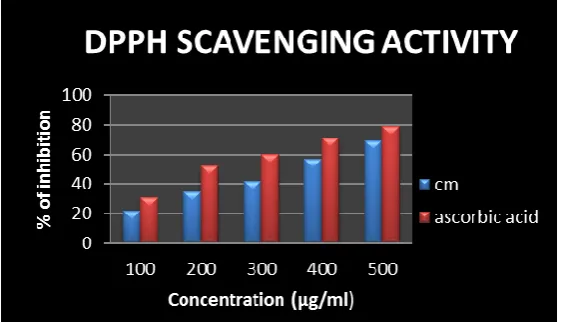
DPPH ASSAY
In the DPPH assay, the antioxidants were able to reduce the stable radical DPPH to the
yellow colored 1, 1-diphenyl-1, 2-picryl hydrazine. The graph of C. urens and ascorbic acid
[image:10.595.158.439.265.426.2]showing % of inhibition of DPPH is represented in fig.3.
Fig.3 DPPH assay of C. urens and ascorbic acid
The electron donation ability of natural products can be measured by 2,2 – diphenyl
1-picrylhydrazyl radical (DPPH﴿ purple – colored solution bleaching. The method is based on
scavenging of DPPH through the addition of a radical species or antioxidant that
decolourized the DPPH solution. The degree of colour change is proportional to the
concentration and potency of antioxidants. Methanolic leaf extract of C. urens showed
considerable inhibition percentage with a LC50 value of 266.6 µg/ml. Results of this study
suggest that the plant extract contain phytochemical constituents that are capable of donating
hydrogen to a free radical that may cause potential damage.
ANTIMICROBIAL ACTIVITY Antibacterial activity
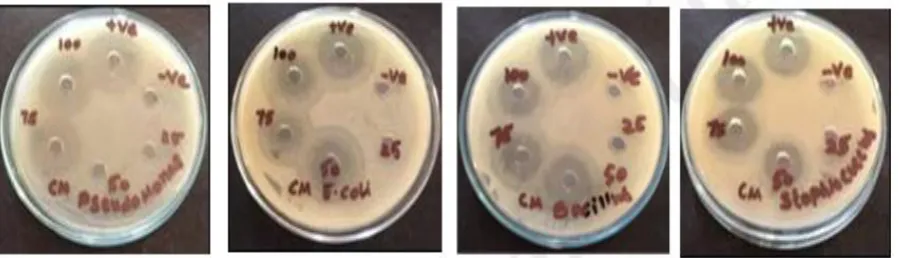
The antibacterial activity of the methanol extracts of C. urens was studied in different
concentrations (25, 50, 75 and 100 μg/ml) against four pathogenic bacterial strains viz.
Staphylococcus aureus, Bacillus subtilis, Escherichia coli and Pseudomonas sp. (Table 3 and
Table 3. Antibacterial activity of methanol leaf extracts of C. urens
S.no Bacterial strains
Diameter of inhibition zone (mm﴿ Positive
control 25 µg/ml 50 µg/ml
75 µg/ml
100 µg/ml
1. E.coli 24 5 13 14 16 2. S.aureus 20 6 15 18 22 3. Pseudomonas sp. 28 - 9 16 21 4. B.subtilis 22 6 14 16 17
Positive control: Streptomycin; Negative control: methanol
Fig. 4 Antibacterial activity of Caryota urens methanol leaf extracts against
Pseudomonas sp., Escherichia coli, Bacillus subtilis and Staphylococcus aureus
In C. urens methanol extract maximum growth suppression was observed against
Staphylococcus aureus (22 mm) at 100 µg/ml concentration among the four bacterial
organisms. The presence of phytocompounds like terpenoids, steroids, phenolics and oxalic
acid was responsible for the antibacterial activity.[28] [29] Moreover, it is also reported that
such compounds in lower quantities might be involved in some type of synergism with the
active compound which might be the reason behind the high activity of antimicrobial and
antioxidant in the leaf extracts.[5]
Antifungal activity
The antifungal activity of methanol leaf extracts of C. urens showed the effective inhibition
against Fusarium sp. (19 mm﴿ and poor inhibition against Penicillium sp.(15 mm﴿. The
results are represented in Table 4 and fig. 5.
Table 4. Antifungal activity of methanol leaf extracts of C. urens
S.no Fungal strains
Diameter of inhibition zone (mm﴿ Positive
control 25 µg/ml 50 µg/ml
75 µg/ml
[image:11.595.76.526.229.358.2]2. Aspergillus niger 20 - 6 10 18 3. Penicillium sp. 23 - - 8 12 4. Fusarium sp. 18 6 9 12 14 Positive control: Carbendazim; Negative control: methanol.
Fig.5 Antifungal activity of Caryota urens methanolic leaf extract against Rhizopus sp., Aspergillus niger, Penicillium sp. and Fusarium sp.
The activity of C. urens could be attributed due to presence of terpenoids, phenols and
saponins.[30] [31] The mechanism of inhibition by terpenoids involves membrane disruption by
the lipophilic compounds. Phenols are effective against bacteria and fungi because they
inhibit enzymes by the oxidized compounds possibly through reactions with sulfhydryl group
or through more non-specific interactions with proteins.
LARVICIDAL ACTIVITY
Though chemical larvicides play a vital role in controlling mosquitoes in their breeding sites,
these also show a negative impact in areas of beneficial and non-target organisms. In view of
an increasing interest in developing plant origin insecticides as an alternative to chemical
insecticide, this study was undertaken to assess the larvicidal potential against species of
dengue vector Aedes aegypti. The larvicidal activity of methanol leaf extracts of C. urens at
various concentrations (100-400 µg/ml) was studied. The percentage of mortality rate of leaf
extract against Aedes aegypti is shown in Fig.6. The LC50 values of the leaf extracts were
Fig.6 Larvicidal activity of C. urens and DMSO
The high larvicidal activity of methanol leaf extracts of Caryota leaves is supported by the
presence of phytochemicals such as steroids, saponins and triterpenoids which are known to
have insecticidal and pesticidal properties.
IN VITRO ANTI-INFLAMMATORY ACTIVITY Inhibition of protein denaturation
In the present investigation, the in vitro anti-inflammatory effect of leaf extract was evaluated
against denaturation of egg albumin. Diclofenac sodium was used as the reference drug. The
maximum percentage of inhibition observed in C. urens was 68 % at 500 µg/ml. The results
are shown in Fig.7.
Protein denaturation is a process in which proteins lose their tertiary structure and secondary
structure by application of external stress or compound. Most biological proteins lose their
biological function when denatured. Denaturation of protein is a well-documented cause of
inflammation. The ability of methanol leaf extracts of C. urens to inhibit protein denaturation
was studied. The standard anti-inflammatory drug diclofenac sodium showed maximum
inhibition of 82.78% at the concentration of 400 µg/ml. The maximum percentage of
inhibition 62.6% was observed in the extract at 400 µg/ml. The methanolic leaf extracts of
Caryota showed significant results due to its antioxidant property.[17] It has been reported that
the presence of phenols, terpenoids and saponins in plants are related to anti-inflammatory
activity.[32]
THIN LAYER CHROMATOGRAPHY
The presence of phenols and oxalic acid in C. urens leaf extracts were confirmed by TLC
technique. The Rf values 0.36 and 0.46 confirms the presence of phenol and oxalic acid in C.
urens leaf extracts.
UV-VIS SPECTRAL ANALYSIS
The secondary metabolites present in methanol leaf extracts of Caryota were confirmed using
UV-Vis spectroscopy. The UV-Vis spectrum showed the peaks at 209.8 nm, 270.2 nm, 329.4
nm and 341.4 nm with the absorption of 1.729, 0.532, 0.539 and 0.527 respectively. The
spectrum of the extract is shown in Fig.8. The UV spectrum of C. urens confirmed the
presence of oxalic acid, phenols, flavonoids and terpenoids with the peak values 209.8, 270.2,
329.4 and 341.4 respectively.
FTIR SPECTRAL ANALYSIS
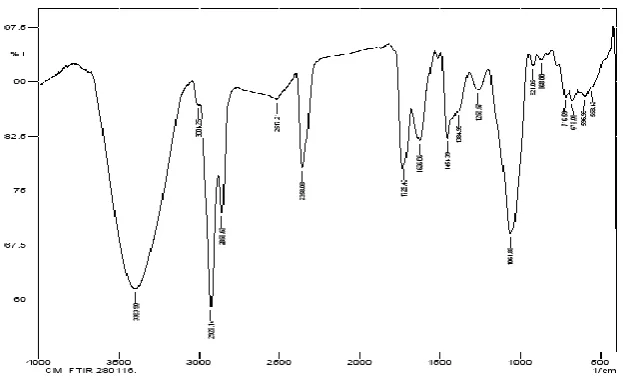
The FTIR spectrum of Caryota leaf extracts confirmed the presence of alkyl halides,
aromatics, amines, alkanes, aldehydes, carboxylic acids and phenol. The data on the peak
[image:15.595.143.455.167.360.2]values and functional groups are represented in Table 5 and spectrum is given in Fig.9.
Fig .9: FTIR spectrum of C. urens leaf extract
Table 5: FTIR spectral peak values and functional groups of C. urens methanolic leaf extract
S.No Peak Value Stretch Functional Groups
1 558.42, 596.99, 676. 08 C-Br Alkyl halides
2 716.59, 868 C-H Aromatics and amines
3 1259.47,1384.95,
2858.63, 2926.14 C-H Alkanes
4 1061.86, 1259.57 C-O Esters and ethers
5 1725.4 C=O Aldehydes and Carboxylic
acids
6 921. 05, 2858. O-H Carboxylic acids
7 3393.9 O-H Phenol
The presence of various functional groups may be attributed to the existence of variety of
potential phytochemicals. The multiple functional groups reflect either the complex structure
or it indicates the nature of sample as mixture.[33]
CONCLUSION
The present study suggests that methanolic leaf extracts of Caryota urens L. reveals the
presence of potential phytochemical constituents. The palm exhibited multidimensional
characters as it possessed antioxidants, antimicrobials, anti-inflammatory and larvicidal
anti-inflammatory and antimicrobial agents. Also, it can serve as a potential larvicidal agent
against the dengue vector A. aegypti, which can be promoted in the dengue vector control
program. However, the bioactive compounds can be further analyzed for their therapeutic
properties.
ACKNOWLEDGEMENT
The authors wish to thank Mrs. Prema Sampathkumar, Head of the department of Plant
Biology & Plant Biotechnology, Faculty members of the department, Dr. A. Nirmala,
Principal, Ethiraj College for women for their encouragement, support and for providing
instrumentation facilities to carry out this research work.
REFERENCES
1. Wijesekera, R. O. B. 1991. The Medicinal Plant Industry. CRC Press 125-127.
2. Pravin Chandra Trivedi, 2006. Medicinal Plants: Traditional Knowledge, I. K.
International Pvt Ltd, 2006; 118-119.
3. Krishnan, K.S. 1992. The wealth of India. CSIR, 3: 86-92.
4. Kumar, S., Hettiaratchi, P., Ashwath. N. and Gikas, P. 2013. Toxicity of Environmental
Contaminants. Bio Med Res. Intl. Article ID 702439.
5. Arul Ananth, D., Sivasudha, T., Rameshkumar, A., Jeyadevi, R. and Aseervatham, S.B.
2013. Chemical constituents, in vitro antioxidant and antimicrobial potential of Caryota
urens. Free Radicals and Antioxidants 107- 112.
6. Harborne, J.B. 1988. Phytochemical methods. A Guide to Modern Techniques of Plants
Analysis, 2nd ed., Chapman and Hall, London; pp. 1–226.
7. Sofowora, A. 1993. Medicinal Plants and Traditional Medicinal in Africa. 2nd Ed.
Sunshine House, Ibadan, Nigeria: Spectrum Books Ltd;. Screening Plants for Bioactive
Agents; pp.134–156.
8. Trease, G.E. and Evans, W.C. Pharmacognosy. 15th Ed. London: Saunders Publishers;
2002; 42–45.
9. Folin, O. and Ciocalteu, V. 1927. On tyrosine and tryptophan, determinations in proteins.
J. Biol. Chem., 73: 627–650.
10.Ferguson, N. M. 1956. A Text book of Pharmacognosy. Mac Milan Company, New
11.Naik, V.V., Patil, N.S., Aparadh, V.T. and Karadge, B.A. 2014. Methodology in
determination of oxalic acid in plant tissue: A comparative approach. Journal of
Global Trends in Pharmaceutical Sciences, 5(2): 1662-1672.
12.Ruch, R.T., Cheng, S.J. and Klaunig, J.E. 1984. Methods in enzymology, 105: 198-209.
13.Oyaizu, M. 1986. Studies on product of browning reaction prepared from glucose amine.
Jap J. Nutr. 44: 307-15.
14.Proestos, C., Lytoudi, K., Mavromelanidou, O.K., Zoumpoulakis, P. and Sinanoglou, V.J.
2013. Antioxidant capacity of selected plant extracts and their essential Oils, antioxidants,
2: 11-22.
15.John Prabakaran, J., Nirjanta Devi, N. and Femina, W. 2012. Antibiogram pattern of
endophytic fungi isolated from medicinal plant Centella asiatica. J. of Pharm. Res. 5(1):
205-207.
16.Azizur Rehman., Ali Rehman and Ijaz Ahmad. 2015. Antibacterial, Antifungal and
Insecticidal Potentials of Oxalis corniculata and Its Isolated Compounds. Intl. J. of Analy.
Chemi., Article ID 842468, 5.
17.Alhakmani, F., Kumar, S.and Khan, SA. 2013. Estimation of total phenolic content, in
vitro antioxidant and anti-inflammatory activity of flowers of Moringa oleifera; 623-7.
18.Nautiyal, M.C., Prakash, V. and Nautiyal, B.P. 2002. Cultivation techniques of some high
altitude medicinal herbs. Annals of Forestry 10: 62–67.
19.Janovska, D., Kubikova, K. and Kokoska, L. 2003. Screening for antimicrobial activity of
some medicinal plants species of traditional Chinese medicine. Czech J. Food Sci.; 21:
107–110.
20.Kala, C.P., Dhayani, P.P. and Sajwan, B.S. 2006. Developing the medicinal plants sector
in northern India: challenges and opportunities. J. Ethanobiol. Ethanomed. 2: 1-15.
21.Benarba. B and Meddah. B. 2014. Ethnobotanical study, antifungal activity,
phytochemical screening and total phenolic content of Algerian Aristolochia longa; 3(4):
150-154.
22.Selvaraj, S., Chittibabu, C.V. and Janarthanam, B, 2014. Studies on phytochemical
screening, antioxidant activity and extraction of active compound (Swertiamarin) from
leaf extract of Enicostem malittorale. Asian J. Pharm. Clin. Res. 7(4): 240-244.
23.Tholl, D. 2006. Terpene synthases and the regulation, diversity and biological roles of
terpene metabolism. Curr. Opin. Plant Biol; 9: 297–304.
24.Hodgkinson, A. 1977. Oxalic acid in biology and medicine. Academic Press London,
25.Flora, S.J.S., Saxena, G. and Mehta, A. 2007. Reversal of lead-induced neuronal
apoptosis by chelation treatment in rats: role of reactive oxygen species and intracellular
Ca2+. J Pharmacol. Exp. Ther, 322: 108–116.
26.Mruthunjaya, K. and Hukkeri, V.I. 2008. In vitro Antioxidant and free radical scavenging
potential of Parkinsonia aculeata Linn. Phcog. Mag. 4(13): 42-51.
27.Saeed, N., Khan, M.R. and Shabbir, M. 2012. Antioxidant activity, total phenolic and
total flavonoid contents of whole plant extracts Torilis leptophylla L. BMC comp
alternative med. 12: 221-225.
28.Arokiyaraj. S., Perinbam. P., Agastian and Mohan Kumar. R. 2013. Phytochemical
analysis and antibacterial activity of Vitex agnus-castus. Intl. J. of Green Pharma.,
143-147.
29.Gao, B. and Zhu, S. 2012. Alteration of the mode of antibacterial action of a defensin by
the amino-terminal loop substitution. Biochem. Biophys. Res. Commun. 26(4): 630-5.
30.Benarba. B and Meddah. B. 2014. Ethnobotanical study, antifungal activity,
phytochemical screening and total phenolic content of Algerian Aristolochia longa; 3(4):
150-154.
31.Ahumuza, T. and Kirimuhuzya, C. 2011. Qualitative (phytochemical) analysis and
antifungal activity of Pentas decora (De wild), a plant used traditionally to treat skin
fungal infections in Western Uganda. Res. in Pharm. Biotech. 3(7): 75-84.
32.Govindappa, M., Naga Sravya, S., Poojashri, M.N., Sadananda, T.S. and Chandrappa, C.
2011. Antimicrobial, antioxidant and in vitro anti-inflammatory activity of ethanol extract
and active phytochemical screening of Wedelia trilobata (L.) Hitchc. J Pharcog &
Phytother; 3(3): 43-51.
33.Coates, J. 2000. Interpretation of infrared spectra, a practical approach. In: Meyers RA