
Aesthetic Image Captioning From Weakly-Labelled Photographs
Koustav Ghosal
Aakanksha Rana
Aljosa Smolic
V-SENSE, School of Computer Science and Statistics, Trinity College Dublin, Ireland.
Abstract
Aesthetic image captioning (AIC) refers to the multi-modal task of generating critical textual feedbacks for pho-tographs. While in natural image captioning (NIC), deep models are trained in an end-to-end manner using large curated datasets such as MS-COCO, no such large-scale, clean dataset exists for AIC. Towards this goal, we propose an automatic cleaning strategy to create a benchmarking AIC dataset, by exploiting the images and noisy comments easily available from photography websites. We propose a probabilistic caption-filtering method for cleaning the noisy web-data, and compile a large-scale, clean dataset ‘AVA-Captions’, (∼ 230,000images with∼ 5captions per im-age). Additionally, by exploiting the latent associations be-tween aesthetic attributes, we propose a strategy for train-ing a convolutional neural network (CNN) based visual fea-ture extractor, typically the first component of an AIC frame-work. The strategy is weakly supervised and can be effec-tively used to learn rich aesthetic representations, without requiring expensive ground-truth annotations. We finally showcase a thorough analysis of the proposed contributions using automatic metrics and subjective evaluations.
1. Introduction
Availability of large curated datasets such as MS-COCO [41] (100Kimages), Flickr30K [64] (30Kimages) or Conceptual Captions [74] (3M images) made it possi-ble to train deep learning models for complex, multi-modal tasks such as natural image captioning (NIC) [81] where the goal is to factually describe the image content. Similarly, several other captioning variants such as visual question answering [5], visual storytelling [38], stylized captioning [56] have also been explored. Recently, the PCCD dataset (∼4200images) [11] opened up a new area of research of describing images aesthetically. Aesthetic image captioning (AIC) has potential applications in the creative industries such as developing smarter cameras or web-based applica-tions, ranking, retrieval of images and videos etc. How-ever in [11], only six well-known photographic/aesthetic attributes such as composition, color, lighting, etc. have
been used to generate aesthetic captions with a small cu-rated dataset. Hence, curating a large-scale dataset to facil-itate a more comprehensive and generalized understanding of aesthetic attributes remains an open problem.
Large-scale datasets have always been pivotal for re-search advancements in various fields [15, 41, 64, 67]. However, manually curating such a dataset for AIC is not only time consuming, but also difficult due to its subjective nature. Moreover, a lack of unanimously agreed ‘standard’ aesthetic attributes makes this problem even more challeng-ing as compared to its NIC counterpart, where deep models are trained with known attributes/labels [41]. In this pa-per, we make two contributions. Firstly, we propose an au-tomatic cleaning strategy to generate a large scale dataset by utilizing the noisy comments or aesthetic feedback pro-vided by users for images on the web. Secondly, for a CNN-based visual feature extractor as is typical in NIC pipelines, we propose a weakly-supervised training strategy. By auto-matically discovering certain ‘meaningful and complex aes-thetic concepts’, beyond the classical concepts such as com-position, color, lighting,etc., our strategy can be adopted in scenarios where finding clean ground-truth annotations is difficult (as in the case of many commercial applications). We elaborate these contributions in the rest of this section.
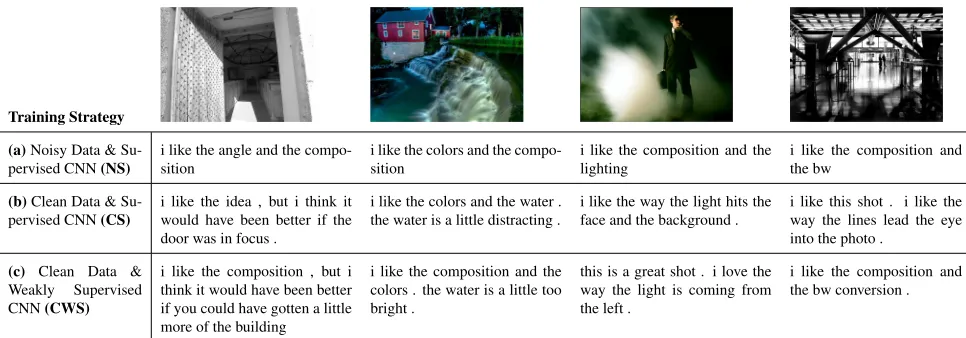
Training Strategy
(a)Noisy Data & Su-pervised CNN(NS)
i like the angle and the compo-sition
i like the colors and the compo-sition
i like the composition and the lighting
i like the composition and the bw
(b)Clean Data & Su-pervised CNN(CS)
i like the idea , but i think it would have been better if the door was in focus .
i like the colors and the water . the water is a little distracting .
i like the way the light hits the face and the background .
i like this shot . i like the way the lines lead the eye into the photo .
(c) Clean Data & Weakly Supervised CNN(CWS)
i like the composition , but i think it would have been better if you could have gotten a little more of the building
i like the composition and the colors . the water is a little too bright .
this is a great shot . i love the way the light is coming from the left .
[image:2.612.66.549.69.238.2]i like the composition and the bw conversion .
Figure 1. Aesthetic image captions. We show candidates generated by three different frameworks discussed in this paper:(a)For NS, we use an ImageNet trained CNN and LSTM trained on noisy comments(b)For CS, we use an ImageNet trained CNN and LSTM trained on compiled AVA-Captions dataset(c)For CWS, we use a weakly-supervised CNN and LSTM trained on AVA-Captions
grammatically inconsistent statements, and also containing a large number of comments occurring frequently without useful information. Previous work in AIC [11] acknowl-edges the difficulty of dealing with the highly noisy captions available in AVA.
In this work, we propose to clean the raw captions from AVA by proposing a probabilistic n-gram based filtering strategy. Based on word-composition and frequency of occurrence of n-grams, we propose to assign an informa-tiveness score to each comment, where comments with a little or vague information are discarded. Our resulting clean dataset, AVA-Captionscontains∼ 230,000images and ∼ 1.5M captions with an average of∼ 5comments per image and can be used to train the Long and Short Term Memory (LSTM) network in the image captioning pipeline in the traditional way. Our subjective study veri-fies that the proposed automatic strategy is consistent with human judgement regarding the informativeness of a cap-tion. Our quantitative experiments and subjective studies also suggest that models trained on AVA-Captions are more diverse and accurate than those trained on the original noisy AVA-Comments. It is important to note that our strategy to choose the large-scale AVA raw-caption is motivated from the widely used image analysis benchmarking dataset, MS-COCO, which is now used as an unified benchmark for di-verse tasks such as object detection, segmentation, caption-ing,etc. We hope that our cleaned dataset will serve as a new benchmarking dataset for various creative studies and aesthetics-based applications such as aesthetics based im-age enhancement, smarter photography cameras,etc.
Our second contribution in this work is a weakly super-vised approach for training a CNN, as an alternative to the standard practice. The standard approach for most image captioning pipelines is to train a CNN on large annotated
datasetse.g. ImageNet [15], where rich and discriminative visual features are extracted corresponding to the physical properties of objects such as cars, dogs etc. These features are provided as input to an LSTM for generating captions. Although trained for classification, these ImageNet-based features have been shown to translate well to other tasks such as segmentation [42], style-transfer [22], NIC. In fact, due to the unavailability of large-scale, task-specific CNN annotations, these ImageNet features have been used for other variants of NIC such as aesthetic captioning [11], styl-ized captioning [56], product descriptions [82],etc.
However, for many commercial/practical applications, availability of such datasets or models is unclear due to copyright restrictions [24, 37, 83]. On the other hand, col-lecting task-specific manual annotations for a CNN is ex-pensive and time intensive. Thus the question remains open if we can achieve better or at least comparable performance by utilizing easily available weak annotations from the web (as found in AVA) and use them for training the visual fea-ture extractor in AIC. To this end, motivated from weakly supervised learning methods [18, 69], we propose a strategy which exploits the large pool of unstructured raw-comments from AVA and discovers latent structures corresponding to meaningful photographic concepts using Latent Dirichlet Allocation (LDA) [10]. We experimentally observe that the weakly-supervised approach is effective and its perfor-mance is comparable to the standard ImageNet trained su-pervised features.
In essence, our contributions are as follows:
1. We propose a caption filtering strategy and compile AVA-Captions, a large-scale and clean dataset for aes-thetic image captioning (Sec 3).
the CNN of a standard CNN-LSTM framework (Sec 4)
3. We showcase the analysis of the AIC pipeline based on the standard automated metrics (such as BLEU, CIDEr, SPICEetc. [2, 62, 78]), diversity of captions and subjective evaluations which are publicly available for further explorations (Section 6).
2. Related Work
Due to the multi-modal nature of the task, the problem spans into many different areas of image and text analysis and thus related literature abound. However, based on the primary theme we roughly divide this section into four areas as follows:
Natural Image Captioning: While early captioning methods [21, 27, 29, 61, 75] followed a dictionary look-up approach, recent parametric methods [1, 4, 9, 19, 20, 23, 30, 31, 35, 50, 52–54, 77] are generative in the sense that they learn a mapping from visual to textual modality. Typ-ically in these frameworks, a CNN is followed by a RNN or LSTM [4, 19, 20, 31, 35, 52–54, 81], although fully con-volutional systems have been proposed by Anejaet al. [3] recently.
Image Aesthetics: Research in understanding the per-ceptual and aesthetic concepts in images can be divided into the model-based [6, 14, 16, 32, 36, 47, 60, 72] and the data-driven [34, 44, 45, 48, 49, 51] approaches. While model-based approaches rely on manually hard-coding the aspects such as the Rule of Thirds, depth of field, colour har-mony, etc., the data driven approaches usually train CNNs on large-scale datasets and either predict an overall aesthetic rating [44, 45, 49] or a distribution over photographic at-tributes [25, 34, 44, 45].
Learning from Weakly-Annotated / Noisy Data:Data dependency of very deep neural nets and the high cost of human supervision has led to a natural interest towards ex-ploring the easily available web-based big data. Typically in these approaches, web-crawlers collect easily available noisy multi-modal data [8, 12, 79] or e-books [17] which is jointly processed for labelling and knowledge extraction. The features are used for diverse applications such as clas-sification and retrieval [68, 76] or product description gen-eration [82].
Aesthetic Image Captioning:To the best of our knowl-edge, the problem of aesthetic image captioning has been first and only addressed by Chang et al. in [11]. The au-thors propose a framework which extracts features covering seven different aspects such as general impression, compo-sition and perspective, color and lighting, etc. and generate meaningful captions by fusing them together. They compile the photo critique captioning dataset (PCCD) with ∼ 4K images and∼30Kcaptions. While their method is purely
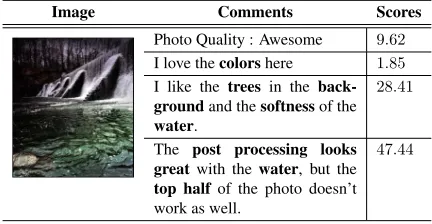
Image Comments Scores
Photo Quality : Awesome 9.62
I love thecolorshere 1.85
I like the trees in the back-groundand thesoftnessof the
water.
28.41
The post processing looks greatwith thewater, but the
top halfof the photo doesn’t work as well.
[image:3.612.324.540.73.185.2]47.44
Figure 2. Informativeness of captions. We suggest the readers to check the supplementary material for more comments and the cor-responding scores.
supervised and the network is trained using strong labels, we adopt a weakly-supervised approach to train our net-work with indirect labels. Additionally, AVA-Captions is a significantly bigger (∼60times) dataset with∼240Kand ∼ 1.3M images and captions, respectively. The scale of AVA allows training deeper and more complex architectures which can be generalized to PCCD as well. We demonstrate this later in Table 1b.
3. Caption Filtering Strategy
In AVA raw-caption, we observe two main types of unde-sirable captions. First, there are captions which suffer from generic noise frequently observed in most text corpora, es-pecially those compiled from social media. They include typing errors, non-English comments, colloquial acronyms, exclamatory words (such as “woooow”), extra punctuation (such as “!!!!”), etc. Such noise can be handled using stan-dard natural language processing techniques [43].
Second, we refer to thesafecomments, which carry a little or no useful information about the photograph. For example, in Figure 2, comments such as “Photo Quality : Awesome” or “I love the colors here” provide a valid but less informative description of the photograph . It is impor-tant to filter these comments, otherwise the network ends up learning these less-informative,safecaptions by ignor-ing the more informative and discriminative ones such as “The post processing looks great with the water, but the top half of the photo doesn’t work as well.” [11].
To this end, we propose a probabilistic strategy for cap-tion filtering based on the informativeness of a capcap-tion. Iformativeness is measured by the presence of certain n-grams. The approach draws motivation from two techniques frequently used in vision-language problems — word com-position and term-frequency - inverse document frequency (TF-IDF).
half” convey more information than “processing” or “half”. On the other hand, the descriptors alone may not always be sufficient to describe a complete concept and its mean-ing is often closely tied to the object [59]. For example, “sharp“ could be used in two entirely different contexts such as “sharp contrast” and “sharp eyes”. This pattern is also observed in the 200 bigrams (or ugly and beauti-ful attributes) discovered from AVA by Marchesotti et al. [58] such as “nice colors”, “beautiful scene”, “too small”, “distracting background”, etc. Similar n-gram modelling is found in natural language processing as adjective-noun [57, 73, 75] or verb-object [71, 84] compositions.
TF-IDF:The other motivation is based on the intuition that the key information in a comment is stored in certain n-grams which occur less frequently in the comment cor-pus such as “softness”, “post processing”, “top half” etc. A sentence composed of frequently occurring n-grams such as “colors” or “awesome” is less likely to contain useful information. The intuition follows from the motivation of commonly used TF-IDF metric in document classification, which states that more frequent words of a vocabulary are less discriminative for document classification [66]. Such hypothesis also forms a basis in the CIDEr evaluation met-ric [78] widely used for tasks such as image captioning, ma-chine translation,etc.
Proposed “Informativeness” Score: Based on these two criteria, we start by constructing two vocabularies as follows: for unigrams we choose only the nouns and for bi-grams we select “descriptor-object” patternsi.e. where the first term is a noun, adjective or adverb and the second term is a noun or an adjective. Each n-gramωis assigned a cor-pus probabilityP as:
P(ω) = DCω
i=1Ci
(1)
where the denominator sums the frequency of each n-gram ω such thatDi=1P(ωi) = 1, whereDis the vocabulary size, and Cω is the corpus frequency of n-gramω. Cor-pus frequency of an n-gram refers to the number of times it occurs in the comments from all the images combined. This formulation assigns high probabilities for more fre-quent words in the comment corpus.
Then, we represent a comment as the union of its un-igrams and bun-igrams i.e., S = (Su ∪Sb) , where Su =
(u1u2. . . uN)andSb= (b1b2. . . bM)are the sequences of unigrams and bigrams, respectively. A comment is assigned an informativeness scoreρas follows:
ρs=−
1 2[log
N
i
P(ui) + log M
j
P(bj)] (2)
whereP(u)andP(b)are the probabilities of a unigram or bigram given by Equation 1. Equation 2 is the average of the negative log probabilities ofSuandSb.
Essentially, the score of a comment is modelled as the joint probability of n-grams in it, following the simplest Markov assumptioni.e. all n-grams are independent [33]. If the n-grams in a sentence have higher corpus probabilities then the corresponding score ρis low due to the negative logarithm, and vice-versa.
Note that the score is the negative logarithm of the prod-uct of probabilities and longer captions tend to receive higher scores. However, our approach does not always favour long comments, but does so only if they consist of “meanigful” n-grams conforming to the “descriptor-object” composition. In other words, randomly long sentences without useful information are discarded. On the other hand, long and informative comments are kept. This is also desirable as longer comments in AVA tend to be richer in in-formation as expert users are specifically asked to provide detailed assessment which is referred to ascritique club ef-fectin [55].
We label a comment as informative or less-informative by thresholding (experimentally kept20) the scoreρ. Some sample scores are provided in Figure 2. The proposed strat-egy discards about1.5M (55%) comments from the entire corpus. Subsequently, we remove the images which are left with no informative comments. Finally, we are left with 240,060images and1,318,359comments, with an average of5.58comments per image. We call this cleaner subset as AVA-CaptionsThe proposed approach is evaluated by hu-man subjects and the results are discussed in Figure 6 and Section 6.3.4.
4. Weakly Supervised CNN
Although the comments in AVA-Captions are cleaner than the raw comments, they cannot be directly used for training the CNN i.e. the visual feature extractor. As dis-cussed in Sec 1, the standard approach followed in NIC and its variants is to use an ImageNet trained model for the task. In this section, we propose an alternative weakly supervised strategy for training the CNN from scratch by exploiting the latentaesthetic information within the AVA-Captions. Our approach is motivated from two different areas: visual at-tribute learning and text document clustering.
4.1. Visual and Aesthetic Attributes
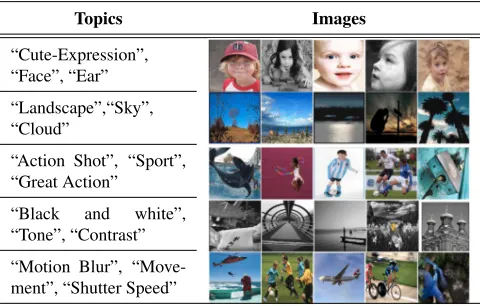
Topics Images
“Cute-Expression”, “Face”, “Ear”
“Landscape”,“Sky”, “Cloud”
“Action Shot”, “Sport”, “Great Action”
“Black and white”, “Tone”, “Contrast”
[image:5.612.55.295.72.225.2]“Motion Blur”, “Move-ment”, “Shutter Speed”
Figure 3. Some topics / labels discovered from AVA-Captions us-ing LDA.
problems with this approach: Firstly, the set of n-grams is huge (∼ 25K) and thus training the CNN directly using them as labels is not scalable. Secondly, several n-grams such as “grayscale”, “black and white”, “bw” refer to the same concept and carry redundant information.
Therefore, we apply a clustering of semantically similar n-grams and thereby grouping the images which share simi-lar n-grams in their corresponding comments. For example, portraits are more likely to contain attributes such as “cute expression”, “face”etc. and landscape shots are more likely to share attributes such as “tilted horizon”, “sky”, “over-exposed clouds”etc. Essentially, the intuition behind our approach is to discover clusters of photographic attributes or topics from the comment corpus and use them as labels for training the CNN. In text document analysis, it is a com-mon practice to achieve such grouping of topics from a text corpus using a technique called Latent Dirichlet Allocation [10].
4.2. Latent Dirichlet Allocation (LDA)
LDA is an unsupervised generative probabilistic model, widely used for topic modelling in text corpora. It repre-sents text documents as a probabilistic mixture of topics, and each topic as a probabilistic mixture of words. The words which co-occur frequently in the corpus are grouped together by LDA to form a topic. For example, by run-ning LDA on a large corpus of news articles, it is possible to discover topics such as “sports”, “government policies”, “terrorism” etc [39].
Formally stated, given a set of documents Di = {D1, D2...DN}, and a vocabulary of words ωi = {ω1, ω2...ωM}, the task is to infer K latent topics Ti = {T1,T2,. . . TK}, where each topic can be represented as a collection of words (term-topic matrix) and each document can be represented as a collection of topics (document-topic matrix). The term-topic matrix represents the probabilities
of each word associated with a topic and the document-topic matrix refers to the distribution of a document over theK latent topics. The inference is achieved using a variational Bayes approximation [10] or Gibb’s sampling [65]. A more detailed explanation can be found in [10].
4.3. Relabelling AVA Images
We regard all the comments corresponding to a given image as a document. The vocabulary is constructed by combining the unigrams and bigrams extracted from the AVA-Captions as described in Section 3. In our case: N = 230,698 and M = 25,000, and K is experimen-tally fixed to200. By running LDA with these parameters on AVA-Captions, we discover200latent topics, composed of n-grams which co-occur frequently. The method is based on the assumption that the visual aesthetic attributes in the image are correlated with the corresponding comments and images possessing similar aesthetic properties are described using similar words.
Even after the caption cleaning procedure, we observe that n-grams such as “nice composition” or “great shot” still occur more frequently than others. But, they occur mostly as independent clauses in bigger comments such as “I like the way how the lines lead the eyes to the subject. Nice shot!”. In order to avoid inferring topics consisting of these less discriminative words, we consider only those n-grams in the vocabulary which occur in less than10%comments.
In Figure 3, we select5topics thus inferred and some of the corresponding images whose captions belong to these topics. It can be observed that the images and the words corresponding to each topic are fairly consistent and suit-able to be used as labels for training the CNN.
4.4. Training the CNN
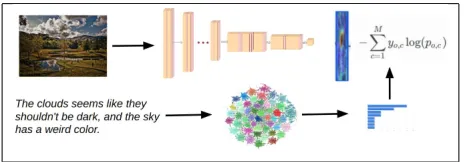
Given an image and its corresponding captions, we esti-mate the topic distributionDT of the comments. The CNN is trained usingDT as the ground-truth label. We adopt the ResNet101 [26] architecture and replace the last fully con-nected layer withKoutputs, and train the framework using cross-entropy loss [70] as shown in Figure 4a.
5. The Final Framework
(a) Weakly-supervised training of the CNN: Images and comments are provided as input. The image is fed to the CNN and the comment is fed to the inferred topic model. The topic model predicts a distribution over the topics which is used as a label for computing the loss for the CNN.
[image:6.612.66.298.71.152.2](b) Training the LSTM: Visual features extracted using the CNN and the comment is fed as an input to the LSTM which predicts a candidate caption.
Figure 4.Proposed pipeline
trained using the clean and informative comments from the AVA-Captions dataset (See Figure 4b).
6. Experiments
The experiments are designed to evaluate the two pri-mary contributions: First, the caption cleaning strategy and second, the weakly-supervised training of the CNN. Specif-ically, we investigate: (a)the effect of caption filtering and the weakly supervised approach on the quality of captions generated in terms of accuracy (Sec 6.3.1) and diversity (Sec 6.3.2), (b)the generalizability of the captions learnt from AVA, when tested on other image-caption datasets (Sec 6.3.3),(c)subjective or human opinion about the per-formance of the proposed framework (Sec 6.3.4).
6.1. Datasets
AVA-Captions: The compiled AVA-Captions dataset is discussed in detail in Section 3. We use230,698images and 1,318,359 comments for training; and9,362images for validation.
AVA raw-caption: The original AVA dataset provided by Murrayet al. [58] and the raw unfiltered comments are used to train the framework in order to observe the effects of caption filtering.
Photo Critique Captioning Dataset (PCCD): This dataset was introduced by [11] and is based on www.gurushots.com. Professional photographers provide comments for the uploaded photos on seven aspects:
gen-eral impression, composition and perspective, color and lighting, subject of photo, depth of field, focus and use of camera, exposure and speed. In order to verify whether the proposed framework can generate aesthetic captions for images beyond the AVA dataset we trained it with AVA-Captions and tested it with PCCD. For a fair comparison, we use the same validation set provided in the original pa-per.
6.2. Baselines
We compare three implementations: (a) Noisy - Su-pervised (NS): NeuralTalk2 [46] framework trained on AVA-Original. It has an ImageNet trained CNN, followed by LSTM trained on raw, unfiltered AVA comments. Neu-ralTalk2 is also used as a baseline for AIC in [11]. (b) Clean - Supervised (CS): The LSTM of the NeuralTalk2 is trained on AVA-Captionsi.e. filtered comments. The CNN is same as NSi.e. Imagenet trained. (c) Clean and weakly-supervised (CWS): NeuralTalk2 framework, where the CNN is trained with weak-supervision using LDA and the language model is trained on AVA-Captions.
6.3. Results and Analysis
6.3.1 Accuracy
Most of the existing standards for evaluating image caption-ing such as BLEU (B) [62], METEOR (M) [7], ROGUE (R) [40], CIDEr (C) [78] etc. are mainly more accurate ex-tensions of the brute-force method [13]i.e. comparing the n-gram overlap between candidate and reference captions. Recently introduced metric SPICE (S) [2] instead compares scene graphs computed from the candidate and reference captions. It has been shown that SPICE captures seman-tic similarity better and is closer to human judgement more than the rest. Traditionally, SPICE is computed between the candidate and all the reference captions. A variant of SPICE (which we refer to as S-1) is used in [11] where the authors compute SPICE between the candidate and each of the reference captions and choose the best. In this paper, we report both S and S-1.
Method B1 B2 B3 B4 M R C S S-1 NS 0.379 0.219 0.122 0.061 0.079 0.233 0.038 0.044 0.135 CS 0.500 0.280 0.149 0.073 0.105 0.253 0.060 0.062 0.144 CWS 0.535 0.282 0.150 0.074 0.107 0.254 0.059 0.061 0.144
Method Train Val S-1 P R
CNN-LSTM-WD PCCD PCCD 0.136 0.181 0.156
AO PCCD PCCD 0.127 0.201 0.121
AF PCCD PCCD 0.150 0.212 0.157
CS AVA-C PCCD 0.144 0.166 0.166
CWS AVA-C PCCD 0.142 0.162 0.161
(a) Accuracy (b) Generalizability
Table 1. (a)Results on AVA-Captions:Both CS and CWS, trained on AVA-Captions perform significantly better than NS, which is trained on nosiy data. Also, the performance of CWS and CS is comparable, which proves the effectiveness of the weakly supervised approach (b)
Generalization results on PCCD:Models trained on AVA-C perform well on PCCD validation set, when compared with models trained on PCCD directly. We argue that this impressive generalizability is achieved by training on a larger and diverse dataset.
6.3.2 Diversity
Image Captioning pipelines often suffer from monotonicity of captionsi.e. similar captions are generated for the valida-tion images. This is attributed to the fact that the commonly used cross-entropy loss function trains the LSTM by reduc-ing the entropy of the output word distribution and thus giv-inga peakyposterior probability distribution [3]. As men-tioned earlier in Section 1, this is more pronounced in AIC due to the vast presence of theeasycomments in the web. Diversity of the captions is usually measured by overlap be-tween the candidate and the reference captions. We evaluate diversity following two state-of-the-art approaches [3, 11]. In [11], the authors define that two captions are different if the ratio of common words between them is smaller than a threshold (3%used in the paper). In [3], from the set of all the candidate captions, the authors compute the number of unique n-grams (1,2,4) at each position starting from the beginning up to position 13.
We plot diversity using [11] in Figure 5d. We compute using the alternative approach of [3] in Figure 5(a-c) but up to 25 positions since on an average the AVA captions are longer than the COCO captions. From both, we notice that diversity of NS is significantly lesser than CS or CWS. We observe that NS ends up generating a large number of “safe” captions such as “I like the composition and colours” or “nice shot”etc. We argue, that our caption filtering strat-egy reduces the number of useless captions from the data and thus the network learns more accurate and informative components.
6.3.3 Generalizability
We wanted to test whether the knowledge gained by train-ing on a large-scale but weakly annotated dataset is generic i.e. transferable to other image distributions. To do so, we train our frameworks on AVA-Captions and compare them with the models from [11], trained on PCCD. Everything is tested on the PCCD validation set. The models used by [11] are: (a) CNN-LSTM-WD is the NeuralTalk2 framework trained on PCCD. (b) Aspect oriented (AO) and (c)
As-pect fusion (AF) are supervised methods, trained on PCCD. Note, that all the models are based on the NeuralTalk2 framework [46] and hence comparable in terms of archi-tecture.
In Table 1(b), we observe that both CS and CWS outper-form CNN-LSTM-WD and AO in S-1 scores. AF is still the best strategy for the PCCD dataset. Please note, both AO and AF are supervised strategies and require well defined “aspects” for training the network. Hence, as also pointed out in [11], it is not possible to train these frameworks on AVA as such aspect-level annotations are unavailable. How-ever, we observe that both CS and proposed CWS, trained on AVA-Captions score reasonably well on PCCD. They are also generic strategies which can be easily mapped to other captioning tasks with weak supervision. We argue that the observed generalization capacity is due to training with a large and diverse dataset.
6.3.4 Subjective (Human) Evaluation
Human judgement is still the touchstone for evaluating im-age captioning, and all the previously mentioned metrics are evaluated based on how well they correlate with the same. Therefore, we perform quality assessment of the generated captions by a subjective study. Our experimental procedure is similar to Chang et al. [11]. We found 15participants with varying degree of expertise in photography (4experts and11non-experts) to evaluate our framework. In order to familiarize the participants with the grading process, a brief training with20trials was provided beforehand. The sub-jective evaluation was intended to assess: (a) whether the caption scoring strategy (Equation 2) is consistent with hu-man judgement regarding the same (b) the effect of cleaning on the quality of generated captions.
[image:7.612.64.544.74.148.2]con-(a) 1-gram (b) 2-gram (c) 4-gram (d) Overall
Figure 5.Diversity:Figures (a) - (c) report diversity of captions following [3]. Thex-axes correspond to n-gram positions in a sentence.
They-axes correspond to the number of unique n-grams at each position, for the entire validation set. Figure (d) plots the overall diversity,
as reported in [11]. We observe that the diversity of the captions increase significantly when the framework is trained on cleaner ground-truthi.e. AVA-Captions (CS or CWS) instead of AVA-Original (NS).
(a) Experts (b) Non Experts
Figure 6.Subjective evaluation of caption filtering: The matrix compares our scoring strategy and human judgement for distin-guishing agoodand abadcaption. The rows stand for our out-put, and the columns represent what humans thought. We observe that the proposed caption filtering strategy is fairly consistent with what humans think about the informativeness of a caption.
sistent with what humans think as a good or a bad caption. Interestingly, with the experts, our strategy produces more false positives for bad captions. This is probably due to the fact that our strategy scores long captions higher, which may not always be the case and is a limitation.
(b) Effect of Caption Filtering: Similarly,25random images were chosen from the validation set. Each image had 3 captions, the candidates generated by NS, CS and CWS frameworks. During each trial, the subject was shown an image and one of the captions and asked to rate it into one of the categories - Good, Average and Bad. These cat-egories follow from [11] and the participants were asked to rate a caption based on whether it conveyed enough in-formation about a photograph. We observe in Table 2 the percentage of good, common and bad captions generated by each method.
We observe that humans did not find any caption from NS to be good. Most of them were common or bad. This is due to its high tendency to generate the short, safe and com-mon captions. Humans find CS to be performing slightly better than CWS which can probably be attributed to the lack of supervision during training the CNN. But as men-tioned in Section 1, semi-supervised training is effective in practical scenarios due the easy availability of data and it
Experts Non-Experts Method Good
(3)
Com
(2)
Bad
(1)
Avg Good
(3)
Com
(2)
Bad
(1)
Avg
NS 0 80 20 1.80 0 84 16 1.84
CS 8 84 8 2.0 28 68 4 2.24
[image:8.612.319.548.214.289.2]CWS 4 80 16 1.88 20 72 8 2.12
Table 2.Subjective comparison of baselines: We observe that human subjects find CS and CWS to be comparable but both sig-nificantly better than NS. This underpins the hypothesis derived from the quantitative results that filtering improves the quality of generated captions and the weakly supervised features are compa-rable with the ImageNet trained features
might be worth investigating whether it is possible to im-prove its performance using more data and more complex representations. Additional qualitative results are provided in Figure 1 and also the supplementary material.
7. Conclusion
In this work, we studied aesthetic image captioning which is a variant of natural image captioning. The task is challenging not only due to its inherent subjective nature but also due to the absence of a suitable dataset. To this end, we propose a strategy to clean the weakly annotated data easily available from the web and compile AVA-Captions, the first large-scale dataset for aesthetic image captioning. Also, we propose a new weakly-supervised approach to train the CNN. We validated the proposed framework thoroughly, us-ing automatic metrics and subjective studies.
As future work, it could be interesting to explore al-ternatives for utilizing the weak-labels and exploring other weakly-supervised strategies for extracting rich aesthetic at-tributes from AVA. It could also be interesting to extend this generic approach to other forms of captioning such as visual storytelling [38] or stylized captioning [56] by utilizing the easily available and weakly labelled data from the web.1
[image:8.612.76.293.215.321.2]References
[1] Aishwarya Agrawal, Dhruv Batra, Devi Parikh, and Anirud-dha Kembhavi. Dont just assume; look and answer: Over-coming priors for visual question answering. In Proceed-ings of the IEEE Conference on Computer Vision and Pattern Recognition, pages 4971–4980, 2018.
[2] Peter Anderson, Basura Fernando, Mark Johnson, and Stephen Gould. Spice: Semantic propositional image cap-tion evaluacap-tion. InEuropean Conference on Computer Vi-sion, pages 382–398. Springer, 2016.
[3] Jyoti Aneja, Aditya Deshpande, and Alexander G Schwing. Convolutional image captioning. InProceedings of the IEEE Conference on Computer Vision and Pattern Recognition, pages 5561–5570, 2018.
[4] Lisa Anne Hendricks, Subhashini Venugopalan, Marcus Rohrbach, Raymond Mooney, Kate Saenko, and Trevor Dar-rell. Deep compositional captioning: Describing novel ob-ject categories without paired training data. InProceedings of the IEEE Conference on Computer Vision and Pattern Recognition, pages 1–10, 2016.
[5] Stanislaw Antol, Aishwarya Agrawal, Jiasen Lu, Margaret Mitchell, Dhruv Batra, C Lawrence Zitnick, and Devi Parikh. Vqa: Visual question answering. InProceedings of the IEEE International Conference on Computer Vision, pages 2425– 2433, 2015.
[6] Tunc¸ Ozan Aydın, Aljoscha Smolic, and Markus Gross. Automated aesthetic analysis of photographic images.
IEEE transactions on visualization and computer graphics, 21(1):31–42, 2015.
[7] Satanjeev Banerjee and Alon Lavie. Meteor: An automatic metric for mt evaluation with improved correlation with hu-man judgments. InProceedings of the acl workshop on in-trinsic and exin-trinsic evaluation measures for machine trans-lation and/or summarization, pages 65–72, 2005.
[8] Tamara L Berg, Alexander C Berg, and Jonathan Shih. Au-tomatic attribute discovery and characterization from noisy web data. InEuropean Conference on Computer Vision, pages 663–676. Springer, 2010.
[9] Jeffrey P Bigham, Chandrika Jayant, Hanjie Ji, Greg Lit-tle, Andrew Miller, Robert C Miller, Robin Miller, Aubrey Tatarowicz, Brandyn White, Samual White, et al. Vizwiz: nearly real-time answers to visual questions. InProceedings of the 23nd annual ACM symposium on User interface soft-ware and technology, pages 333–342. ACM, 2010. [10] David M Blei, Andrew Y Ng, and Michael I Jordan. Latent
dirichlet allocation. Journal of machine Learning research, 3(Jan):993–1022, 2003.
[11] Kuang-Yu Chang, Kung-Hung Lu, and Chu-Song Chen. Aesthetic critiques generation for photos. InProceedings of the IEEE International Conference on Computer Vision, pages 3514–3523, 2017.
[12] Xinlei Chen, Abhinav Shrivastava, and Abhinav Gupta. Neil: Extracting visual knowledge from web data. InProceedings of the IEEE International Conference on Computer Vision, pages 1409–1416, 2013.
[13] Yin Cui, Guandao Yang, Andreas Veit, Xun Huang, and Serge Belongie. Learning to evaluate image captioning. In
Proceedings of the IEEE Conference on Computer Vision
and Pattern Recognition, pages 5804–5812, 2018.
[14] Ritendra Datta, Dhiraj Joshi, Jia Li, and James Wang. Study-ing aesthetics in photographic images usStudy-ing a computational approach. Computer Vision–ECCV 2006, pages 288–301, 2006.
[15] Jia Deng, Wei Dong, Richard Socher, Li-Jia Li, Kai Li, and Li Fei-Fei. Imagenet: A large-scale hierarchical im-age database. InComputer Vision and Pattern Recognition, 2009. CVPR 2009. IEEE Conference on, pages 248–255. IEEE, 2009.
[16] Sagnik Dhar, Vicente Ordonez, and Tamara L Berg. High level describable attributes for predicting aesthetics and in-terestingness. In Computer Vision and Pattern Recogni-tion (CVPR), 2011 IEEE Conference on, pages 1657–1664. IEEE, 2011.
[17] Santosh K Divvala, Ali Farhadi, and Carlos Guestrin. Learn-ing everythLearn-ing about anythLearn-ing: Webly-supervised visual con-cept learning. In Proceedings of the IEEE Conference on Computer Vision and Pattern Recognition, pages 3270– 3277, 2014.
[18] Carl Doersch and Andrew Zisserman. Multi-task self-supervised visual learning. InProceedings of the IEEE Inter-national Conference on Computer Vision, pages 2051–2060, 2017.
[19] Jeffrey Donahue, Lisa Anne Hendricks, Sergio Guadarrama, Marcus Rohrbach, Subhashini Venugopalan, Kate Saenko, and Trevor Darrell. Long-term recurrent convolutional net-works for visual recognition and description. In Proceed-ings of the IEEE conference on computer vision and pattern recognition, pages 2625–2634, 2015.
[20] Hao Fang, Saurabh Gupta, Forrest Iandola, Rupesh K Sri-vastava, Li Deng, Piotr Doll´ar, Jianfeng Gao, Xiaodong He, Margaret Mitchell, John C Platt, et al. From captions to vi-sual concepts and back. InProceedings of the IEEE con-ference on computer vision and pattern recognition, pages 1473–1482, 2015.
[21] Ali Farhadi, Mohsen Hejrati, Mohammad Amin Sadeghi, Pe-ter Young, Cyrus Rashtchian, Julia Hockenmaier, and David Forsyth. Every picture tells a story: Generating sentences from images. InEuropean conference on computer vision, pages 15–29. Springer, 2010.
[22] Leon A Gatys, Alexander S Ecker, and Matthias Bethge. Im-age style transfer using convolutional neural networks. In
Proceedings of the IEEE Conference on Computer Vision and Pattern Recognition, pages 2414–2423, 2016.
[23] Donald Geman, Stuart Geman, Neil Hallonquist, and Lau-rent Younes. Visual turing test for computer vision sys-tems. Proceedings of the National Academy of Sciences, page 201422953, 2015.
[24] Dave Gershgorn. The data that transformed ai researchand possibly the world, 2017.
[25] Koustav Ghosal, Mukta Prasad, and Aljosa Smolic. A geometry-sensitive approach for photographic style classifi-cation. 2018.
[26] Kaiming He, Xiangyu Zhang, Shaoqing Ren, and Jian Sun. Deep residual learning for image recognition. In Proceed-ings of the IEEE conference on computer vision and pattern recognition, pages 770–778, 2016.
Fram-ing image description as a rankFram-ing task: Data, models and evaluation metrics. Journal of Artificial Intelligence Re-search, 47:853–899, 2013.
[28] Sheng Huang, Mohamed Elhoseiny, Ahmed Elgammal, and Dan Yang. Learning hypergraph-regularized attribute predic-tors. InProceedings of the IEEE Conference on Computer Vision and Pattern Recognition, pages 409–417, 2015. [29] Yangqing Jia, Mathieu Salzmann, and Trevor Darrell.
Learn-ing cross-modality similarity for multinomial data. In Com-puter Vision (ICCV), 2011 IEEE International Conference on, pages 2407–2414. IEEE, 2011.
[30] Junqi Jin, Kun Fu, Runpeng Cui, Fei Sha, and Changshui Zhang. Aligning where to see and what to tell: image caption with region-based attention and scene factorization. arXiv preprint arXiv:1506.06272, 2015.
[31] Justin Johnson, Andrej Karpathy, and Li Fei-Fei. Densecap: Fully convolutional localization networks for dense caption-ing. InProceedings of the IEEE Conference on Computer Vision and Pattern Recognition, pages 4565–4574, 2016. [32] Dhiraj Joshi, Ritendra Datta, Elena Fedorovskaya,
Quang-Tuan Luong, James Z Wang, Jia Li, and Jiebo Luo. Aesthet-ics and emotions in images. IEEE Signal Processing Maga-zine, 28(5):94–115, 2011.
[33] Dan Jurafsky.Speech & language processing. Pearson Edu-cation India, 2000.
[34] Sergey Karayev, Aaron Hertzmann, Holger Winnemoeller, Aseem Agarwala, and Trevor Darrell. Recognizing image style. InBMVC 2014, 2014.
[35] Andrej Karpathy and Li Fei-Fei. Deep visual-semantic align-ments for generating image descriptions. InProceedings of the IEEE conference on computer vision and pattern recog-nition, pages 3128–3137, 2015.
[36] Yan Ke, Xiaoou Tang, and Feng Jing. The design of high-level features for photo quality assessment. InComputer Vi-sion and Pattern Recognition, 2006 IEEE Computer Society Conference on, volume 1, pages 419–426. IEEE, 2006. [37] Adam Kell. Where does data come from?, 2018. [38] Ryan Kiros. neural-storyteller, 2015.
[39] Susan Li. Topic modeling and latent dirichlet allocation (lda) in python, 2018.
[40] Chin-Yew Lin. Rouge: A package for automatic evaluation of summaries.Text Summarization Branches Out, 2004. [41] Tsung-Yi Lin, Michael Maire, Serge Belongie, James Hays,
Pietro Perona, Deva Ramanan, Piotr Doll´ar, and C Lawrence Zitnick. Microsoft coco: Common objects in context. In
European conference on computer vision, pages 740–755. Springer, 2014.
[42] Jonathan Long, Evan Shelhamer, and Trevor Darrell. Fully convolutional networks for semantic segmentation. In Pro-ceedings of the IEEE conference on computer vision and pat-tern recognition, pages 3431–3440, 2015.
[43] Edward Loper and Steven Bird. Nltk: The natural language toolkit. In Proceedings of the ACL-02 Workshop on Ef-fective Tools and Methodologies for Teaching Natural Lan-guage Processing and Computational Linguistics - Volume 1, ETMTNLP ’02, pages 63–70, Stroudsburg, PA, USA, 2002. Association for Computational Linguistics.
[44] Xin Lu, Zhe Lin, Hailin Jin, Jianchao Yang, and James Z Wang. Rapid: Rating pictorial aesthetics using deep
learn-ing. InProceedings of the 22nd ACM international confer-ence on Multimedia, pages 457–466. ACM, 2014.
[45] Xin Lu, Zhe Lin, Xiaohui Shen, Radomir Mech, and James Z Wang. Deep multi-patch aggregation network for image style, aesthetics, and quality estimation. In Proceedings of the IEEE International Conference on Computer Vision, pages 990–998, 2015.
[46] Ruotian Luo. An image captioning codebase in pytorch, 2017.
[47] Yiwen Luo and Xiaoou Tang. Photo and video quality eval-uation: Focusing on the subject. Computer Vision–ECCV 2008, pages 386–399, 2008.
[48] Shuang Ma, Jing Liu, and Chang Wen Chen. A-lamp: Adap-tive layout-aware multi-patch deep convolutional neural net-work for photo aesthetic assessment. InThe IEEE Confer-ence on Computer Vision and Pattern Recognition (CVPR), July 2017.
[49] Long Mai, Hailin Jin, and Feng Liu. Composition-preserving deep photo aesthetics assessment. In Proceedings of the IEEE Conference on Computer Vision and Pattern Recog-nition, pages 497–506, 2016.
[50] Mateusz Malinowski, Marcus Rohrbach, and Mario Fritz. Ask your neurons: A neural-based approach to answering questions about images. InProceedings of the IEEE interna-tional conference on computer vision, pages 1–9, 2015. [51] Gautam Malu, Raju S. Bapi, and Bipin Indurkhya. Learning
photography aesthetics with deep cnns, 2017.
[52] Junhua Mao, Jonathan Huang, Alexander Toshev, Oana Camburu, Alan L Yuille, and Kevin Murphy. Generation and comprehension of unambiguous object descriptions. In
Proceedings of the IEEE conference on computer vision and pattern recognition, pages 11–20, 2016.
[53] Junhua Mao, Xu Wei, Yi Yang, Jiang Wang, Zhiheng Huang, and Alan L Yuille. Learning like a child: Fast novel visual concept learning from sentence descriptions of images. In
Proceedings of the IEEE International Conference on Com-puter Vision, pages 2533–2541, 2015.
[54] Junhua Mao, Wei Xu, Yi Yang, Jiang Wang, Zhiheng Huang, and Alan Yuille. Deep captioning with multimodal recurrent neural networks (m-rnn). arXiv preprint arXiv:1412.6632, 2014.
[55] Luca Marchesotti, Naila Murray, and Florent Perronnin. Dis-covering beautiful attributes for aesthetic image analysis.
International journal of computer vision, 113(3):246–266, 2015.
[56] Alexander Mathews, Lexing Xie, and Xuming He. Semstyle: Learning to generate stylised image captions using unaligned text. InProceedings of the IEEE Conference on Computer Vision and Pattern Recognition, pages 8591–8600, 2018. [57] Ishan Misra, Abhinav Gupta, and Martial Hebert. From red
wine to red tomato: Composition with context. In Proceed-ings of the IEEE Conference on Computer Vision and Pattern Recognition, pages 1792–1801, 2017.
[58] Naila Murray, Luca Marchesotti, and Florent Perronnin. Ava: A large-scale database for aesthetic visual analysis. InComputer Vision and Pattern Recognition (CVPR), 2012 IEEE Conference on, pages 2408–2415. IEEE, 2012. [59] Tushar Nagarajan and Kristen Grauman. Attributes as
Proceedings of the European Conference on Computer Vi-sion (ECCV), pages 169–185, 2018.
[60] Pere Obrador, Michele A Saad, Poonam Suryanarayan, and Nuria Oliver. Towards category-based aesthetic models of photographs. In International Conference on Multimedia Modeling, pages 63–76. Springer, 2012.
[61] Vicente Ordonez, Girish Kulkarni, and Tamara L Berg. Im2text: Describing images using 1 million captioned pho-tographs. InAdvances in neural information processing sys-tems, pages 1143–1151, 2011.
[62] Kishore Papineni, Salim Roukos, Todd Ward, and Wei-Jing Zhu. Bleu: a method for automatic evaluation of machine translation. InProceedings of the 40th annual meeting on as-sociation for computational linguistics, pages 311–318. As-sociation for Computational Linguistics, 2002.
[63] Devi Parikh and Kristen Grauman. Relative attributes. In
2011 International Conference on Computer Vision, pages 503–510. IEEE, 2011.
[64] Bryan A Plummer, Liwei Wang, Chris M Cervantes, Juan C Caicedo, Julia Hockenmaier, and Svetlana Lazeb-nik. Flickr30k entities: Collecting region-to-phrase corre-spondences for richer image-to-sentence models. In Pro-ceedings of the IEEE international conference on computer vision, pages 2641–2649, 2015.
[65] Ian Porteous, David Newman, Alexander Ihler, Arthur Asun-cion, Padhraic Smyth, and Max Welling. Fast collapsed gibbs sampling for latent dirichlet allocation. In Proceed-ings of the 14th ACM SIGKDD international conference on Knowledge discovery and data mining, pages 569–577. ACM, 2008.
[66] Juan Ramos et al. Using tf-idf to determine word relevance in document queries. InProceedings of the first instructional conference on machine learning, volume 242, pages 133– 142, 2003.
[67] Aakanksha Rana, Praveer Singh, Giuseppe Valenzise, Fred-eric Dufaux, Nikos Komodakis, and Aljosa Smolic. Deep tone mapping operator for high dynamic range images.
Transaction of Image Processing, 2019.
[68] Aakanksha Rana, Joaquin Zepeda, and Patrick Perez. Fea-ture learning for the image retrieval task. InAsian Confer-ence on Computer Vision (ACCV), pages 152–165. Springer, 2014.
[69] Zhongzheng Ren and Yong Jae Lee. Cross-domain self-supervised multi-task feature learning using synthetic im-agery. InProceedings of the IEEE Conference on Computer Vision and Pattern Recognition, pages 762–771, 2018. [70] Reuven Y Rubinstein and Dirk P Kroese.The cross-entropy
method: a unified approach to combinatorial optimization, Monte-Carlo simulation and machine learning. Springer Science & Business Media, 2013.
[71] Mohammad Amin Sadeghi and Ali Farhadi. Recognition us-ing visual phrases. InCVPR 2011, pages 1745–1752. IEEE, 2011.
[72] Jose San Pedro, Tom Yeh, and Nuria Oliver. Leveraging user comments for aesthetic aware image search reranking. In
Proceedings of the 21st international conference on World Wide Web, pages 439–448. ACM, 2012.
[73] Rodrigo Santa Cruz, Basura Fernando, Anoop Cherian, and Stephen Gould. Neural algebra of classifiers. In 2018
IEEE Winter Conference on Applications of Computer Vision (WACV), pages 729–737. IEEE, 2018.
[74] Piyush Sharma, Nan Ding, Sebastian Goodman, and Radu Soricut. Conceptual captions: A cleaned, hypernymed, im-age alt-text dataset for automatic imim-age captioning. In Pro-ceedings of the 56th Annual Meeting of the Association for Computational Linguistics (Volume 1: Long Papers), vol-ume 1, pages 2556–2565, 2018.
[75] Richard Socher, Andrej Karpathy, Quoc V Le, Christopher D Manning, and Andrew Y Ng. Grounded compositional se-mantics for finding and describing images with sentences.
Transactions of the Association of Computational Linguis-tics, 2(1):207–218, 2014.
[76] Chen Sun, Chuang Gan, and Ram Nevatia. Automatic con-cept discovery from parallel text and visual corpora. In Pro-ceedings of the IEEE international conference on computer vision, pages 2596–2604, 2015.
[77] Kewei Tu, Meng Meng, Mun Wai Lee, Tae Eun Choe, and Song-Chun Zhu. Joint video and text parsing for under-standing events and answering queries. IEEE MultiMedia, 21(2):42–70, 2014.
[78] Ramakrishna Vedantam, C Lawrence Zitnick, and Devi Parikh. Cider: Consensus-based image description evalua-tion. InProceedings of the IEEE conference on computer vision and pattern recognition, pages 4566–4575, 2015. [79] Sirion Vittayakorn, Takayuki Umeda, Kazuhiko Murasaki,
Kyoko Sudo, Takayuki Okatani, and Kota Yamaguchi. Au-tomatic attribute discovery with neural activations. In Eu-ropean Conference on Computer Vision, pages 252–268. Springer, 2016.
[80] Jing Wang, Yu Cheng, and Rogerio Schmidt Feris. Walk and learn: Facial attribute representation learning from ego-centric video and contextual data. In Proceedings of the IEEE conference on computer vision and pattern recogni-tion, pages 2295–2304, 2016.
[81] Kelvin Xu, Jimmy Ba, Ryan Kiros, Kyunghyun Cho, Aaron Courville, Ruslan Salakhudinov, Rich Zemel, and Yoshua Bengio. Show, attend and tell: Neural image caption gen-eration with visual attention. InInternational conference on machine learning, pages 2048–2057, 2015.
[82] Takuya Yashima, Naoaki Okazaki, Kentaro Inui, Kota Ya-maguchi, and Takayuki Okatani. Learning to describe e-commerce images from noisy online data. InAsian Con-ference on Computer Vision, pages 85–100. Springer, 2016. [83] Emin Zerman, Aakanksha Rana, and Aljosa Smolic.
Color-net - estimating colorfulness in natural images. InThe Inter-national Conference on Image Processing (ICIP), 2019. [84] Hanwang Zhang, Zawlin Kyaw, Shih-Fu Chang, and
Tat-Seng Chua. Visual translation embedding network for visual relation detection. InProceedings of the IEEE conference on computer vision and pattern recognition, pages 5532–5540, 2017.

![Figure 5. Diversity: Figures (a) - (c) report diversity of captions following [3]. The x-axes correspond to n-gram positions in a sentence.The y-axes correspond to the number of unique n-grams at each position, for the entire validation set](https://thumb-us.123doks.com/thumbv2/123dok_us/896314.602081/8.612.76.293.215.321/diversity-figures-diversity-following-correspond-positions-correspond-validation.webp)
