MENTAL MATURITY AND SELF
OF SECOND YEAR D.T.ED STUDENTS
*,1
Jayagandhi
1
Research Scholar, Lecturer, DIET, Madurai
2Assistant Professor, Alagappa University College of Education,
ARTICLE INFO ABSTRACT
This study has been conducted to examine the mental maturity and self competency of second year D.T.Ed
Institute of Education and Training in Madurai district. The random sampling technique was used in this study. Self
and teaching competency questionnaire prepared by the investigators were used in this study. Survey method was employed in this study. The data was analyzed statistically by using mean, standard deviation,‘t’ test and correlation coefficient.
have moderate level of mental maturity, self
revealed that there is significant difference between the mean scores of self
year D.T.Ed. students with respect to locality, but there is no significant difference in the mean scores of mental maturity and teaching competency with reference to locality. Also, there is no significant difference in the mean scores of self
second year D
qualification, parents annual income and newspaper reading. Researchers found that “there is a positive
year D.T.Ed. students but mental maturity and teaching competency have low correlation between them. From the findings of this research, researchers concluded that it
maturity, self
the duty of our teacher educators nurtures the teacher trainees to improve their mental maturity and self-actualization whi
Copyright©2017, Jayagandhi and Dr. Suganthi. This
unrestricted use, distribution, and reproduction in any medium, provided the original work is properly cited.
INTRODUCTION
The teacher education programme plays an important role in shaping and moulding the habits, manner and character of student teachers. The quality of any teacher is determined on the basis of his professional excellence. Elementary education is the foundation on which the superstructure of the entire educational system is built. Its contribution to nation building and process of development and growth has been universally recognized. Teachers working at the elementary stage may be well versed by the pedagogical principles that form the base of teaching at elementary education. So the student teachers must develop the teaching skills and the capacity to solve social, interpersonal and emotional problems of learners.
mental maturity and self-actualization that facilitate teaching competency among student teachers, which is the important goals of our society in preparation for the future.
*Corresponding author: Jayagandhi, T.
Research Scholar, Lecturer, DIET, Madurai
ISSN: 0975-833X
Article History: Received 15th May, 2017
Received in revised form 18th June, 2017
Accepted 23rd July, 2017
Published online 31st August, 2017
Citation: Jayagandhi, T. and Dr. Suganthi, M. 2017.
International Journal of Current Research, 9, (08), 56
Key words:
Mental maturity, Self-actualization, Teaching competency, Teacher trainees.
RESEARCH ARTICLE
MENTAL MATURITY AND SELF-ACTUALIZATION ON TEACHING COMPETENCY
OF SECOND YEAR D.T.ED STUDENTS
Jayagandhi, T. and
2Dr. Suganthi, M.
Research Scholar, Lecturer, DIET, Madurai
Assistant Professor, Alagappa University College of Education, Karaikudi
ABSTRACT
This study has been conducted to examine the mental maturity and self
competency of second year D.T.Ed., students. Totally 72 teacher trainees has been taken from District Institute of Education and Training in Madurai district. The random sampling technique was used in this study. Self-actualization inventory was developed by Wilsow and Kneisl, (1983), me
and teaching competency questionnaire prepared by the investigators were used in this study. Survey method was employed in this study. The data was analyzed statistically by using mean, standard deviation,‘t’ test and correlation coefficient. This study revealed that “most of the students in DIET have moderate level of mental maturity, self-actualization and teaching competency. Also this study revealed that there is significant difference between the mean scores of self
year D.T.Ed. students with respect to locality, but there is no significant difference in the mean scores of mental maturity and teaching competency with reference to locality. Also, there is no significant difference in the mean scores of self-actualization, mental maturity and teaching competency of second year D.T.Ed., students with respect to gender, age, marital status, staying, parents educational qualification, parents annual income and newspaper reading. Researchers found that “there is a positive correlation among mental maturity, self-actualization and teaching competency of second year D.T.Ed. students but mental maturity and teaching competency have low correlation between them. From the findings of this research, researchers concluded that it
maturity, self-actualization and teaching competency among second year D.T.Ed., students. Also, it is the duty of our teacher educators nurtures the teacher trainees to improve their mental maturity and
actualization which influences teaching competency.
This is an open access article distributed under the Creative Commons Att use, distribution, and reproduction in any medium, provided the original work is properly cited.
The teacher education programme plays an important role in the habits, manner and character of student teachers. The quality of any teacher is determined on Elementary education is the foundation on which the superstructure of the entire ontribution to nation building and process of development and growth has been universally recognized. Teachers working at the elementary stage may be well versed by the pedagogical principles that form the base of tudent teachers must develop the teaching skills and the capacity to solve social, interpersonal and emotional problems of learners. Developing actualization that facilitate teaching among student teachers, which is the most important goals of our society in preparation for the future.
Awareness and reflective technologies can be instrumental in developing a meta-cognitive ability to make conscious and unconscious decisions about engagement that will ultimately enhance the skills of teaching competency, expertise, mental maturity and self-actualization. This study will review diverse perspectives from psychology, engineering, education, and computer science to present opportunities to enhance the skills of teaching competency, mental maturity and self
in teaching profession. Therefore, this study aims at finding out the influence of mental maturity and self
teaching competency of second year D.T.Ed. students.
Significance of the study
In the present generation most of the teacher trainees are selected on merits of mark in which they scored. Even though, how many of them are really scored marks after understanding the subjects is a million dollar question and these pupils have mugged up the subject and scored high marks and they opt for
International Journal of Current Research Vol. 9, Issue, 08, pp.56822-56826, August, 2017
2017. “Mental maturity and self-actualization on teaching competency of second year D.T.Ed students
56822-56826.
ACTUALIZATION ON TEACHING COMPETENCY
Karaikudi – 630 003
This study has been conducted to examine the mental maturity and self-actualization on teaching ., students. Totally 72 teacher trainees has been taken from District Institute of Education and Training in Madurai district. The random sampling technique was used in actualization inventory was developed by Wilsow and Kneisl, (1983), mental maturity and teaching competency questionnaire prepared by the investigators were used in this study. Survey method was employed in this study. The data was analyzed statistically by using mean, standard This study revealed that “most of the students in DIET actualization and teaching competency. Also this study revealed that there is significant difference between the mean scores of self-actualization of second year D.T.Ed. students with respect to locality, but there is no significant difference in the mean scores of mental maturity and teaching competency with reference to locality. Also, there is no significant tion, mental maturity and teaching competency of .T.Ed., students with respect to gender, age, marital status, staying, parents educational qualification, parents annual income and newspaper reading. Researchers found that “there is a actualization and teaching competency of second year D.T.Ed. students but mental maturity and teaching competency have low correlation between them. From the findings of this research, researchers concluded that it is necessary to develop mental actualization and teaching competency among second year D.T.Ed., students. Also, it is the duty of our teacher educators nurtures the teacher trainees to improve their mental maturity and
is an open access article distributed under the Creative Commons Attribution License, which permits
Awareness and reflective technologies can be instrumental in cognitive ability to make conscious and unconscious decisions about engagement that will ultimately enhance the skills of teaching competency, expertise, mental actualization. This study will review diverse perspectives from psychology, engineering, education, and computer science to present opportunities to enhance the skills of teaching competency, mental maturity and self-actualization Therefore, this study aims at finding out the influence of mental maturity and self-actualization on teaching competency of second year D.T.Ed. students.
In the present generation most of the teacher trainees are selected on merits of mark in which they scored. Even though, how many of them are really scored marks after understanding the subjects is a million dollar question and these pupils have the subject and scored high marks and they opt for
INTERNATIONAL JOURNAL OF CURRENT RESEARCH
teacher training. When they come to the class they really feel difficult in handling classes and in practice teaching schools and peer teaching also. We could find the difference of competency between the students. Those students who scored high marks after understanding the subject can easily handle the classes. Whereas the students who mugged up and scored high marks are finding difficulties in teaching. This is the real problem of many teacher trainees. Hence whatever the subject is taught by the teacher trainee to the student should be through in understanding then only the student can understand the same and he can be a successful student. Self-actualization creates a desire for self fulfillment. Self-actualization makes the students to solve problems in any situation. This tendency might be phrased as the desire to become more and more, what one is, to become everything that one is capable of becoming. In the present situation, students come from different families and different backgrounds. They have to adjust with the fast changing environmental conditions and they have to show better competency. There are many factors to show their teaching competency. The investigator has selected mental maturity and self actualization on teaching competency of second year D.T.Ed. students.
Review literature
Studies related to mental maturity
Gupta, O.A., (1977) studied intelligence as a function of class achievement and found that (i) intelligence grew up to fifteen years and declined thereafter in high scholastic achievement adolescents and low scholastic achievement girls. Intelligence declined up to fifteen years and grew thereafter in low scholastic achievement boys and high scholastic achievement girls.
Behai (1982) studied the relationship of intelligence with achievement at two Piagetian stages of concrete and formal thinking and found positive and significant correlations between intelligence and achievement in social studies, science and first language at both stages.
Studies related to Self-Actualization
Ebtesam Pajouhandeh (2013), conducted a study on “Personal Development and Self-Actualization of students in the new environment”. This study assessed the correlation of personal development with self-actualization in non-domestic students. The research population included 100 students composed of two groups : main group 50 students (25 girls and 25 boys) and 50 local students for control group (25 girls and 25 boys). They all were selected randomly from student’s dormitories and university. They were evaluated by Kettle’s 16 factor test and self actualization Inventory (SAI). The data was analysed by correlation coefficient. In both groups, there is a positive correlation between personality development and self-actualization. There was significant difference at the 0.05 level between the scores earned by main and control groups.
Allan Okech, Crystal Renee Chambers (2012), conducted a study on “Gender Differences in self-actualization among a sample of Black University students was assessed using the short index of self-actualization. The eta square index indicated that a medium amount of the variance of the self actualization variable in Black University students was accounted for by gender. Specifically, Black female University students reported more self-actualization than Black males. However, greater relative self-actualization achievement to
their same raced male peers does not address relative achievement to other peers or abolish the need for challenges and concerns of black women college students to be considered.
Studies related to teaching competency
Naseema, C and Ayishai, TC (1995) investigated “Satisfaction as a predictor of perceived teaching competence”. To find out whether job satisfaction can predict perceived teaching competence. 130 physical science teachers in secondary schools in Kerala were selected. Teaching competence rating scale and job satisfaction questionnaire. Multiple correlation analysis, ‘R’ interms of beta co-efficient and zero order ‘r’ were used. Major finding is perceived teaching competence was found to be significant. Madhusudan and Yeli (2004) studied, about the effect of teacher competency on students achievement at minimum levels of learning, and found teaching competency to be significant determining factor in students achievement in MLL in Mathematics and Kannada of IV class children.
Objectives of the study
The present study intends to find out the influence of mental maturity and self-actualization on teaching competency of teacher trainees.
1. To find out the level of mental maturity,
self-actualization and teaching competency of second year D.T.Ed. students.
2. To find out the difference in the mean scores of mental
maturity, self-actualization and teaching competency of second year D.T.Ed. students with respect to gender, age, locale, marital status, staying, parents educational qualification, parents annual income and newspaper reading.
3. To find out the significant relationship between mental
maturity, self-actualization and teaching competency of second year D.T.Ed. students.
Hypothesis
On the basis of the objectives of the study, the following hypothesis is formulated.
1. The level of mental maturity, self-actualization and
teaching competency of second year D.T.Ed. students is high.
2. There is no significant difference in the mean scores of
mental maturity, self-actualization and teaching competency of second year D.T.Ed. students with respect to gender, age, locale, marital status, staying, parents educational qualification, parents annual income and newspaper reading.
3. There is no significant relationship between mental
maturity, self actualization and teaching competency.
MATERIALS AND METHDOS
Sample
Totally 72 second year teacher trainees were selected from District Institute of Education and training in Madurai district.
Tool
1. Self-actualization inventory was developed by (Wilsow
and Kneisl, 1983).
2. Mental maturity and teaching competency questionnaire
were prepared by the investigator.
Data interpretation
Data were collected using the questionnaire of mental maturity, self-actualization and teaching competency and analyses were done by using SPSS.
Data Analysis
The collected data were analyzed using mean, standard deviation, significance test and correlation.
Hypothesis
[image:3.595.130.466.329.382.2]From the above table, the mental maturity of second year teacher trainees (72) were categorized under three levels such as low, moderate and high. Out of 72 teacher trainees 12 (16.67%) falls under low level mental maturity, 45 (62.50%) of them are in moderate level and 15 (20.83%) teacher trainees exhibited high level mental maturity. The self-actualization of second year teacher trainees (72) were categorized under three levels such as low, moderate and high. Out of 72 teacher trainees 11 (155.28%) falls under low level self-actualization, 49 (68.05%) of them are in moderate level and 12 (16.67%) teacher trainees exhibited high level self-actualization. The teaching competency of second year teacher trainees (72) were categorized under three levels such as low, moderate and high. Out of 72 teacher trainees 8 (11.11%) falls under low level teaching competency, 60 (83.33%) of them are in moderate level and 4 (5.55%) teacher trainees exhibited high level teaching competency.
Table 1. Level of mental maturity, self-actualization and teaching competency of second year D.T.Ed. students in District Institute of Education and training
S. No. Variables Low Moderate High
No % No % No %
1. Mental maturity 12 16.67 45 62.50 15 20.83
2. Self-actualization 11 15.28 49 68.05 12 16.67
[image:3.595.72.534.409.592.2]3. Teaching competency 8 11.11 60 83.33 4 5.55
Table 2. Mean scores of mental maturity with respect to demographic variables
S.No Category Group N Mean S.D. ‘t’ value Level of significance at 5% level
1. Gender Male
Female
16 55
188 209
0.500 0.646
1.231 NS
2. Age 17 - 19
19 & above
44 26
209 196
0.603 0.662
0.836 NS
3. Locale Rural
Urban
53 18
206 200
0.602 0.686
0.333 NS
4. Marital Status Married Unmarried
11 60
218 202
0.603 0.624
0.811 NS
5. Residence Hostel
Day’s scholar
30 41
210 200
0.607 0.632
0.669 NS
6. Father’s qualification Illiterate Educated
23 48
204 204
0.706 0.582
0.011 NS
7. Mother’s qualification Illiterate Educated
33 38
200 208
0.707 0.539
0.533 NS
8. Annual income Below 25000 Above 25000 50 21
210 190
0.580 0.700
1.216 NS
9. Newspaper reading Regularly Rarely
33 38
206 203
0.659 0.592
0.231 NS
NS - Non significant, S – Significant
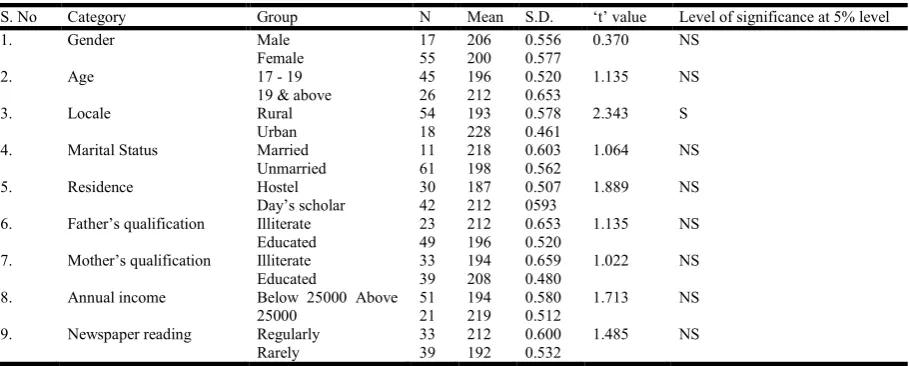
Table 3. Mean scores of self-actualization with respect to demographic variables
S. No Category Group N Mean S.D. ‘t’ value Level of significance at 5% level
1. Gender Male
Female
17 55
206 200
0.556 0.577
0.370 NS
2. Age 17 - 19
19 & above
45 26
196 212
0.520 0.653
1.135 NS
3. Locale Rural
Urban
54 18
193 228
0.578 0.461
2.343 S
4. Marital Status Married
Unmarried
11 61
218 198
0.603 0.562
1.064 NS
5. Residence Hostel
Day’s scholar
30 42
187 212
0.507 0593
1.889 NS
6. Father’s qualification Illiterate Educated
23 49
212 196
0.653 0.520
1.135 NS
7. Mother’s qualification Illiterate Educated
33 39
194 208
0.659 0.480
1.022 NS
8. Annual income Below 25000 Above 25000
51 21
194 219
0.580 0.512
1.713 NS
9. Newspaper reading Regularly Rarely
33 39
212 192
0.600 0.532
1.485 NS
[image:3.595.74.529.623.806.2]Based on the results of statistical analysis as shown briefly in Table 1 above, above 45% of students have moderate level in mental maturity, self-actualization and teaching competency. From the above table shows that the calculated ‘t’ values (1.231, 0.836, 0.333, 0.811, 0.669, 0.011, 0.533, 1.216, 0.231) are lesser than the table value (1.96). Hence the null hypothesis, “There is no significant difference in the mean scores of mental maturity of second year D.T.Ed. students with respect to gender, age, locality, marital status, staying, father’s educational qualification, mother’s educational qualification, parents annual income and newspaper reading” are accepted.
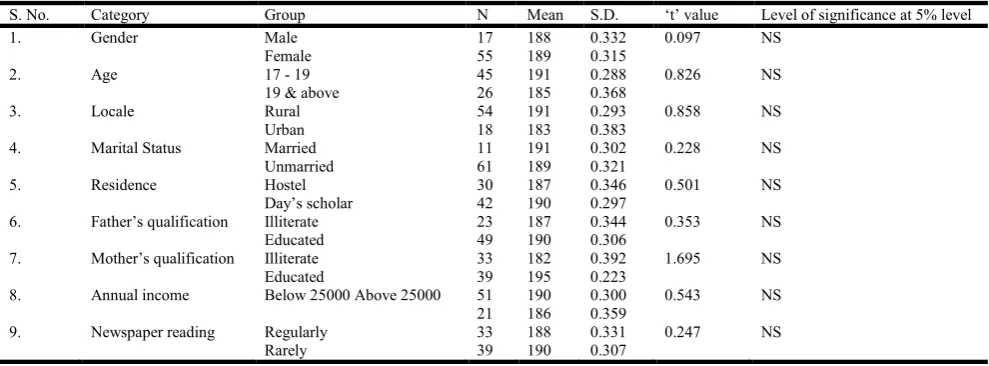
From the above table shows that the calculated ‘t’ value (2.343) with respect to locale of students is greater than the table value (1.96). Hence the null hypothesis, “There is no significant difference in the mean scores of self-actualization of second year D.T.Ed. students with respect to locale” is rejected. From the above table shows that the calculated ‘t’ values of other demo graphic variables (0.370, 1.135, 1.064, 1.889, 1.135, 1.022, 1.713, 1.485) are lesser than the table value (1.96). Hence the null hypothesis, “There is no significant difference in the mean scores of self-actualization of second year D.T.Ed. students with respect to gender, age, marital status, staying, mother’s educational qualification, father’s educational qualification, parents annual income and newspaper reading” are accepted. From the above table shows that the calculated ‘t’ values of all demographic variables (0.097, 0.826, 0.858, 0.228, 0.501, 0.353, 1.695, 0.543, 0.247) are lesser than the table value (1.96). Hence the null hypothesis, “There is no significant difference in the mean scores of teaching competency of second year D.T.Ed. students with respect to gender, age, locality, marital status, staying, father’s educational qualification, mother’s educational qualification, parents annual income and newspaper reading” are accepted. There is a positive relationship among mental maturity, self-actualization and teaching competency of second year of D.T.Ed. students. But mental maturity and self-actualization have low correlation with teaching competency.
RESULTS
Most of the second year D.T.Ed. students have
moderate level of mental maturity, self-actualization and teaching competency.
There is no significant difference in the mean scores of
mental maturity and teaching competency of second year D.T.Ed. students with respect to gender, age, locale, marital status, staying, parents educational qualification, parents annual income and newspaper reading.
There is no significant difference in the mean scores of
self-actualization of second year D.T.Ed. students with respect to gender, age, marital status, staying, parents educational qualification, parents annual income and newspaper reading except locale variable.
There is a positive correlation among mental maturity,
self-actualization and teaching competency of second year D.T.Ed. students. But mental maturity and teaching competency have low correlation between them.
DISCUSSION
[image:4.595.51.546.211.394.2]The mean score (193) of rural teacher trainees is below and the mean score (228) of urban is above. Comparing both, the rural teacher trainees are lesser than the urban teacher trainees. This reveals that the teacher trainees of locality of urban teacher trainees got all the facilities available at home. For example they can be provided with system, newspaper, television and internet facilities. Those teacher trainees get the knowledge of browsing and updating their knowledge. They can easily get an opportunity to attend seminar and conference. So they can be able to acquire mental maturity, self-actualization and teaching competency in a better manner. The mean scores of mental maturity, self-actualization and teaching competency of second year D.T.Ed students with respect to Gender, Age, Locality,
Table 4. Mean scores of teaching competency with respect to demographic variables
S. No. Category Group N Mean S.D. ‘t’ value Level of significance at 5% level
1. Gender Male
Female
17 55
188 189
0.332 0.315
0.097 NS
2. Age 17 - 19
19 & above
45 26
191 185
0.288 0.368
0.826 NS
3. Locale Rural
Urban
54 18
191 183
0.293 0.383
0.858 NS
4. Marital Status Married
Unmarried
11 61
191 189
0.302 0.321
0.228 NS
5. Residence Hostel
Day’s scholar
30 42
187 190
0.346 0.297
0.501 NS
6. Father’s qualification Illiterate Educated
23 49
187 190
0.344 0.306
0.353 NS
7. Mother’s qualification Illiterate Educated
33 39
182 195
0.392 0.223
1.695 NS
8. Annual income Below 25000 Above 25000 51
21 190 186
0.300 0.359
0.543 NS
9. Newspaper reading Regularly Rarely
33 39
188 190
0.331 0.307
0.247 NS
[image:4.595.132.458.433.474.2]NS - Non significant, S – Significant
Table 5. Relationship between Mental maturity, Self-actualization and Teaching competency
Variables Mental maturity Self-actualization Teaching competency
Mental maturity 1 0.512** 0.062
Self-actualization 0.512** 1 0.087
Teaching competency 0.062 0.087 1
Marital status, Staying, Father’s educational qualification and Mother’s educational qualification are not significant. This is because all the students always want to enrich their knowledge to develop themselves. Further, they may like to become effective teachers and they may attempt to empower themselves with proper knowledge and methodology methods in their subject for promoting the status. Further they may be spend much time in strengthen their level of teaching ability through wider participation in individual practice.
Educational implications
Based on the analysis and findings, the investigator gives the following educational implications.
The present investigation has clearly indicated and
thrown much light on mental maturity, self-actualization and teaching competency of D.T.Ed. students of DIET, Madurai district.
Need based and psychology based programme for
teacher trainees is the need of the hour. This has policy implications.
There is need to improving self-actualization and
mental maturity of teacher trainees by the teacher educators.
There is a need to include psychology based curriculum
for D.T.Ed. students.
Conclusion
The results of the study proved, that the locality of teacher trainees has a significant influence in improving teaching competency. The results showed that the other selected variables such as Gender, Age, Locality, Marital status, Staying, Father’s educational qualification and Mother’s educational qualification together have no significant effect in
teaching competency of teacher trainees. These findings also contributed to the concept of Mc Clelland (1993) that competence is the basis of a personal characteristic that is the deciding factor in the success or failure of a person doing a job in a given situation. Based on the findings, mental maturity, self-actualization and teaching competency have a positive correlation between them. So self-actualization and mental maturity directly helps to develop teaching competency of teacher trainees. So the teacher education institutions are necessarily to incorporate mental maturity, self-actualization related activities to develop teaching competency.
REFERENCES
Aarti Bansal. 2004. Teacher education: principle, theory and practice. Jaipur-302006; Sublime Publications.
Dandapani, S. 2004. A textbook of Advanced educational Psychology. New Delhi-110002; Anmol publications Pvt.Ltd.
Mangal, S.K. 2001. General Psychology. New Delhi-110016: Sterling Publishers Pvt.Ltd.
McCllelland, D.C. 1993. The concept of competence in spencer, L.M. and Spencer, B.C. 1993. Competence at work, John wiley and son, New York.
RaghunathSafaya., & Shaidaj, 1994. Development of educational theory and practice. Jalandhar, New Delhi: DhanapatRai and Sons.
Reddy, R.S. 1998. Teacher education: principles and practices. Delhi-110031; Rajat Publications.
Sinha, B.L. 2002. Educational Psychology-An introduction. New Delhi-110002; Anmol publications Pvt.Ltd.
Taneja, V.R. 1998. Educational thought and practice. New Delhi-16: Sterling Publishers Pvt.Ltd.
Verghese, B.V. 2002. Management of teaching skills in primary schools. New Delhi-110002; Anmol publications Pvt.Ltd.