SHAPE MEMORY ALLOYS AND THEIR POTENTIAL APPLICATION: A REVIEW
*Juhi Mishra and Dr. Tejeet
1
Department of Mechanical
ARTICLE INFO ABSTRACT
In the manufacturing world now we need some ‘Intelligent’ or Smart materials which can change their property according to our requirement. Smart materials are one of the unique material and the genera
can be altered, reversed or controlled under the influence of external impetus. Their smartness can be characterized by its self
In the list of these kind of materials, we are about to brief studyof the application of Shape Memory Alloys. Shape memory alloys are the material that have property to regain its original shape when subjected to external stimulisuch as stress, temperature, electric field, magnetic field. Due to its unique and excellent mechanical properties these material has drawn a massive attention of the researchers and the scientists which brings it into a wide com
have focused on the brief introduction and potential application of the shape memory alloys.
Copyright©2017, Juhi Mishra and Dr. Tejeet singh.This
unrestricted use, distribution, and reproduction in any medium, provided the original work is properly cited.
INTRODUCTION
In the production world, the high technologies push towards the ‘Smart’ system in which we need some intelligent or smart material which can alter their properties according to our requirement. In simple words ‘Smart Materials’ may be defined as the material which react to its environment on its own ,the reaction may exhibit itself as a change in volume, color, viscosity, odour and this may occur in response to a change in temperature, stress, electric current, pH or magnetic field. Smart materials have a stupendous effect on variety of fields since its discovery to its present day and also its impact is visible in our day to day life through its application in smart infrastructure to smart sensors as well as smart gadgets and vehicles. Among these materials, the composites do not cease evolving towards new products which are,either theleast expensive possible, or the most powerful, or both at the same time (Dehart, 1990). This concept of “Smart materials” or intelligent materials are used to characterize the
are able to answer in the suitable way to the surrounding and changes in it. Different types of Smart materials have been used in the new area of technologies (
Murotsu, 1990). These materials have the qualities to fit in th surrounding and in order to response the physical changes, they can modifytheir form, their dimensions or even their mechanical properties (Young modulus).
*Corresponding author: Juhi Mishra,
Department of Mechanical Engineering, Shaheed Bhagat campus, Ferozepur 152004, Punjab, India.
ISSN: 0975-833X
Article History:
Received 28th July, 2017
Received in revised form
17th August, 2017
Accepted 23rd September, 2017
Published online 31st October, 2017
Citation: Juhi Mishra and Dr. Tejeet Singh. 2017.
Research, 9, (10), 59186-59192.
Key words:
Smart materials, Shape memory alloys, Pseudo elasticity, Applications.
REVIEW ARTICLE
SHAPE MEMORY ALLOYS AND THEIR POTENTIAL APPLICATION: A REVIEW
Juhi Mishra and Dr. Tejeet Singh
Department of Mechanical Engineering, Shaheed Bhagat Singh state Technical
Ferozepur 152004, Punjab, India
ABSTRACT
In the manufacturing world now we need some ‘Intelligent’ or Smart materials which can change their property according to our requirement. Smart materials are one of the unique material and the general characteristics of all these materials are common that is their behaviour or significant property can be altered, reversed or controlled under the influence of external impetus. Their smartness can be characterized by its self-adaptability, self-sensing and self-healing in response to any external stimuli. In the list of these kind of materials, we are about to brief studyof the application of Shape Memory Alloys. Shape memory alloys are the material that have property to regain its original shape when bjected to external stimulisuch as stress, temperature, electric field, magnetic field. Due to its unique and excellent mechanical properties these material has drawn a massive attention of the researchers and the scientists which brings it into a wide commercial use. In this review paper we have focused on the brief introduction and potential application of the shape memory alloys.
This is an open access article distributed under the Creative Commons Att use, distribution, and reproduction in any medium, provided the original work is properly cited.
In the production world, the high technologies push towards the ‘Smart’ system in which we need some intelligent or smart material which can alter their properties according to our requirement. In simple words ‘Smart Materials’ may be al which react to its environment on its own ,the reaction may exhibit itself as a change in volume, color, viscosity, odour and this may occur in response to a change in temperature, stress, electric current, pH or magnetic tupendous effect on variety of fields since its discovery to its present day and also its impact is visible in our day to day life through its application in smart infrastructure to smart sensors as well as smart gadgets and , the composites do not cease evolving towards new products which are,either theleast expensive possible, or the most powerful, or both at the same . This concept of “Smart materials” or intelligent materials are used to characterize the material those are able to answer in the suitable way to the surrounding and changes in it. Different types of Smart materials have been (Sirlin, 1990 and These materials have the qualities to fit in the surrounding and in order to response the physical changes, they can modifytheir form, their dimensions or even their
Department of Mechanical Engineering, Shaheed Bhagat Singh state Technical
In fact, a material able to answer to its environment presents a very interesting profile for industrial applications; and actually the materials the most frequently used because of their in remarkable properties, are the piezoelectric materials and memory shape alloys (Japan, 1991;
1991). According to their properties smart materials have so many types such as (i) Piezoelectric materials, (ii) Shape memory alloys, (iii) Thermo chromic materials, (iv)Thermo responsive materials (v) Magneto restrictive materials (vi) PH sensitive materials (vii) Polymer gels (viii) Photo mechanical properties. Distinction between Smart materials and smart system should be understand. A Smart structure is made up off some form of actuator and sensor with control hardware and software to form a system which reacts to its environment.
Shape Memory Alloy
Shape memory alloy (SMA) or ‘‘smart alloy’’ was first discovered by Arne Ölander in 1932
term ‘‘shape-memory’’ was first described by Vernon in 1941 (Vernon, 1941), for his polymeric dental material. Shape Memory Alloys are that type of smart alloys that has tendency to memorize its shape when subjected to ext
from thermal and magnetic effect. This phenomena is known
as Shape memory effect. Since the invention of SMA, the
demand for SMAs for engineering and technical applications has been increasing in numerous commercial fields; such as in consumer products and industrial applications
Zider, 1998 and Hautcoeur, 1997
International Journal of Current Research Vol. 9, Issue, 10, pp.59186-59192, October, 2017
2017. “Shape memory alloys and their potential application: A review
SHAPE MEMORY ALLOYS AND THEIR POTENTIAL APPLICATION: A REVIEW
Technical campus,
In the manufacturing world now we need some ‘Intelligent’ or Smart materials which can change their property according to our requirement. Smart materials are one of the unique material and the l characteristics of all these materials are common that is their behaviour or significant property can be altered, reversed or controlled under the influence of external impetus. Their smartness can be healing in response to any external stimuli. In the list of these kind of materials, we are about to brief studyof the application of Shape Memory Alloys. Shape memory alloys are the material that have property to regain its original shape when bjected to external stimulisuch as stress, temperature, electric field, magnetic field. Due to its unique and excellent mechanical properties these material has drawn a massive attention of the mercial use. In this review paper we have focused on the brief introduction and potential application of the shape memory alloys.
is an open access article distributed under the Creative Commons Attribution License, which permits
In fact, a material able to answer to its environment presents a very interesting profile for industrial applications; and actually the materials the most frequently used because of their intrinsic remarkable properties, are the piezoelectric materials and , 1991; Modi, 1991 and Miura, . According to their properties smart materials have so many types such as (i) Piezoelectric materials, (ii) Shape , (iii) Thermo chromic materials, (iv)Thermo responsive materials (v) Magneto restrictive materials (vi) PH-sensitive materials (vii) Polymer gels (viii) Photo mechanical properties. Distinction between Smart materials and smart . A Smart structure is made up off some form of actuator and sensor with control hardware and software to form a system which reacts to its environment.
Shape memory alloy (SMA) or ‘‘smart alloy’’ was first in 1932 (Ölander, 1932), and the memory’’ was first described by Vernon in 1941 for his polymeric dental material. Shape Memory Alloys are that type of smart alloys that has tendency to memorize its shape when subjected to external impetus, free from thermal and magnetic effect. This phenomena is known . Since the invention of SMA, the demand for SMAs for engineering and technical applications has been increasing in numerous commercial fields; such as in consumer products and industrial applications (Wu, 2000; , 1997), structures and composites
INTERNATIONAL JOURNAL OF CURRENT RESEARCH
(Furuya, 1996), automotive (Butera, 2007; Leo, 1998; Stoeckel, 1990), aerospace (Bil, 2013; Hartl, 2007; Humbeeck, 1999 and McDonald Schetky, 1991), mini actuators and micro-electromechanical systems (MEMS) (Humbeeck, 1999; Sun, 2012; Kohl, 2010; Kahny, 1998 and Fujita, 1998), robotics (Kheirikhah, 2011; Sreekumar, 2007 and Furuya, 1991) biomedical (Humbeeck, 1999; Sun, 2012; Petrini, 2011 and Duerig, 1999), and even in fashion (Langenhove, 2004). Although iron-based and copper-based SMAs, such as Fe– Mn–Si, Cu–Zn–Al and Cu–Al–Ni, are low-cost and
commercially available, due to their instability,
impracticability (e.g. brittleness) (Wilkes, 2000 Cederström, 1995 and Hodgson, 1990), and poor thermo-mechanic performance (Huang, 2002), NiTi-based SMAs are much more preferable for most applications.
Shape memory effect or Pseudoelasticity
[image:2.595.314.547.58.199.2]Practically, SMAs can exist in two different phases with three different crystal structures (i.e. twinned martensite, detwinned martensite and austenite) and six possible transformations (Sun, 2009; Mihálcz, 2001) (see Fig. 1). The martensite structure is stable at low temperature and the austenite structure is stable at high temperature. When SMA is heated then there is phase change occurs from martensite to austenite. The starting temperature of austenite state is (As) and the finish temperature of austenite state is (Af) at which this transformation completion will take place. When SMA is heated beyond (As) it begins to contract and transform into the austenite structure, i.e. to recover into its original form. This transformation is possible even under high applied loads, and therefore, results in high actuation energy densities (Mihálcz, 2001). During the cooling process, the transformation starts to revert to the martensite at martensite-start-temperature (Ms) and is complete when it reaches the martensite-finish-temperature (Mf) (Lagoudas, 2010) (see Fig. 2). The highest temperature at which martensite can no longer be stress induced is called Md, and above this temperature the SMA is permanently deformed like any ordinary metallic material (Duerig, 1994). These shape changes effect is known as Shape changes effect is known as Shape Memory Effect or Pseudoelastisity.
[image:2.595.369.498.337.466.2]Fig. 1. SMA phase and crystal structures
Fig. 2. Flexinol NiTi SMA (HT) phase transformation
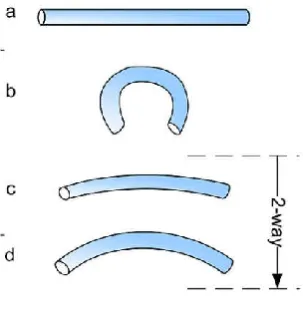
On the basis of these effects Shape memory alloys can be categorized into three categories:
One-way shape memory effect (OWSME)
[image:2.595.54.282.547.750.2]In this kind of shape memory effect, SMA regaina deformed state after the removal of an external force, and then recovers to its original shape upon heating.
Fig. 3. One way shape memory alloy
Two-way shape memory effect (TWSME) or reversible
SME: In two way shape memory effect, SMA remember their
original shape at lower temperature as well as higher temperature.
Fig. 4. two way shape memory alloy
However, TWSMA is less applied commercially due to the ‘training’ requirements and to the fact that it usually produces about half of the recovery strain provided by OWSMA for the same material (Huang, 2000; Perkins, 1990 and Schroeder, 1977), and it strain tends to deteriorate quickly, especially at
[image:2.595.352.504.558.714.2]high temperatures (Ma, 2010). Therefore, OWSMA provides more reliable and economical solution (Stöckel, 1995). Various training methods have been proposed (Schroeder, 1977; Huang, 1999 and Funakubo, 1987) and two of them are: Spontaneous and externalload-assisted induction (Brailovski, 2003).
Pseudoelasticity (PE) or Superelasticity (SE)
The tendency of SMA to regain its original shape after applying mechanical loading at temperatures between (Af) and (Md), without the need for any thermal activation.
Other type of shape memory Alloy
Other form of SMA has been explore due to some advantages and disadvantages, such as high manufacturing cost, limited recoverable deformation, limited operating temperature and low bandwidth.
High temperature Shape memory alloy
Extensive research for HTSMAs with other ternary additions to the NiTi SMA (e.g. Au, Hf, Pd, Pt and Zr) has been undertaken (Ma, 2010; Firstov, 2006; Beyer, 1994) due to the increasing demands for high temperature applications. Practically, HTSMAs are defined as SMAs that are operating at temperatures above 100 _C, and can be categorized into three groups based on their martensitic transformation ranges (Ma, 2010). But due to limited ductilityor poor fatigue resistance at room temperature, they are difficult to fabricate. Moreover their fabrication is very costly.
Magnetic Shape Memory Alloy
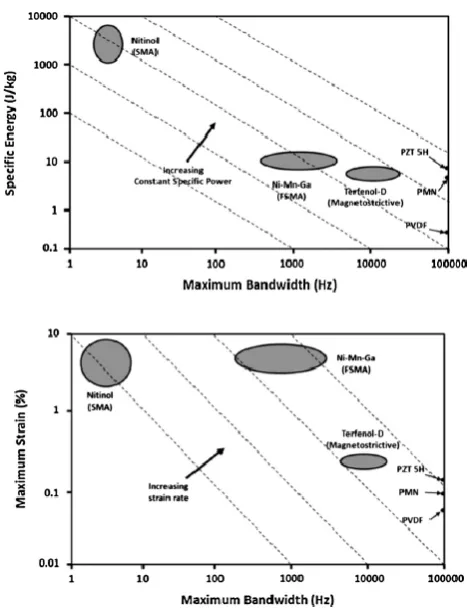
Magnetic shape memory alloy is also known as Ferromagnetic Shape memory Alloy. Because of martensite phase transformation, it exhibit large strains under the influence of an applied magnetic field. FSMA strain rate is quite comparable to magneto-strictive and piezoelectrics active elements, but at strains as large as SMAs (see Fig 5) (Ma, 2010). FSMA can also provide the same specific power as SMAs, but deliver it at higher frequencies (see Fig 5) (Ma, 2010).
Shape memory material thin film
SMM thin films evolved from the advancement of fabrication technology, where SMMs are deposited directly onto micro-machined materials or as stand-alone thin films to become micro- actuators (Winzek, 2004; Johnson, 2009; Fu, 2004; Miyazaki, 1999; Krulevitch, 1996 and Gabriel, 1989).
Shape Memory Polymers
Shape memory polymers can eaily manufactured and brings in the commercial application with the cost effectiveness comparatively to other type of shape memory alloys. SMPs are claimed to be a superior alternative to SMAs for their lower cost (at least 10% cheaper than SMAs), better efficiency, biodegradable and probably by far surpass SMAs in their mechanical properties (Voit, 2010; Ochonski, 2010; Liu, 2007; Witold, 2007 and Lendlein, 2002). SMPs can sustain two or more shape changes (Hu, 2012; Xie, 2010; Bellin, 2006), when triggered by thermal (heating (Huang, 2012) or cooling (Wang,
[image:3.595.317.551.131.437.2]2012), Electricity (Liu, 2009), Magnetic field (Mohr, 2006), light (Mohr, 2006) or solutions (Mohr, 2005) (e.g. chemical (Lv, 2008) or water (Leng, 2005 and Huang, 2005) Generally, there are three categories of SMPs (Otsuka, 1998), and most of them are naturally either thermo- or chemo-responsive (Huang, 2012).
Fig. 5. Maximum strain and specific energy versus maximum bandwidth for different classes of active materials
Application of Shape Memory Alloys
The unique behavior of SMA has opened vast opportunity in aerospace, automotive, automation and control, appliance, energy, chemical processing, heating and ventilation, safety and security, and electronics (MEMS devices) industries. Some of these applications apply similar methods, concepts or techniques,\ which are also applicable for other areas; such as the Ni-Ti thermovariable rate (TVR) springs, which are used to control the opening door in the self-cleaning oven, is also used to offer smooth gear shifting for Mercedez-Benz automatic transmissions,for domestic safety devices to control the hot water flow (e.g. Memrysafe_ antiscald valves from Memry Corporation), and for industrial safety valves to prevent flammable and dangerous gasses from flowing (e.g. Firechek_ from Memry Corporation) (Stöckel, 1995; Duerig, 1990; Wu, 2000; Stoeckel, 1992) (see Fig 6). More interesting, these actuators can act as both a sensor and an actuator in these applications (Wu, 2000).
Automotive Industries
80]. The existing and potential SMA applications for passenger vehicles are presented in fig 6, which categorizes them according to vehicle functional areas (Butera, 2008). Most of the selected components are occasionally functioning as linear actuators (e.g. rear-view mirror folding, climate control flaps adjustment and lock/latch controls) and as active thermal actuators (e.g. engine temperature control, carburetion and engine lubrication, and powertrain clutches) (Stoeckel, 1990 and Stoeckel, 1991). Although there are many application of SMA is suggested or mention in patent literature but in that there are just few are implemented because of their limitation such as lifetime, hysteresis width and stability.
Fig. 6. Existing and potential SMA applications in the automotive domain
Aerospace industries
[image:4.595.45.289.202.346.2]Since the success of the SMA coupling for hydraulic lines in the F-14 fighter jets in the 1970s (Melton, 1999), the unique properties of SMAs have gathered greater interest in aerospace applications (Humbeeck, 1999; McDonald Schetky, 1991; Godard, 2003; Singh, 2002), which are subjected to high dynamic loads and geometric space constraints. A few examples of these applications are actuators (Hartl, 2007 and Baumbick, 2000) structural connectors, vibration dampers, sealers, release or deployment mechanisms (Cleveland, 2008; Carpenter, 2001 Huettl, 2000; Long, 1998 and Lortz, 1998), inflatable structures (Fujun, 2005 and Roh, 2005), manipulators [93,94] and the pathfinder application (Melton, 1999 and Landis, 1997). Moreover there are many research going on in rotor technology. SMA is using from many years in the aircrafts for shock absorbers as well as for reducing vibration.
[image:4.595.311.555.334.441.2]Fig. 7. Existing and potential SMA applications in the aerospace domain
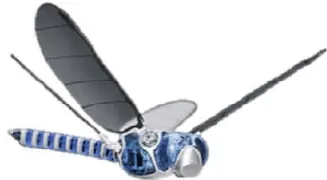
Fig. 8. Festo Bionic Opter – inspiration dragonfly flight
In the field of robotics
Due to tremendous properties of SMA it has been using in the field of robotics since many years especially as micro-actuators and artificial muscles. In present time researchers and scientists are trying to make them more biological but the main problem which are coming in this field: to increase their artificial intelligence as well as to increase their performance. To increase the efficiency of these kind of machinewe need more developed SMA to solve the problems. Moreover many flying robots have been developed with the help of SMA and smart system (actuators and sensors): such as the BATMAVand Bat Robot.
Fig. 8. Existing and potential SMA applications in the robotics domain
In the field of biomedical
After the invention of SMA in nitinol by Buehler et al. in 1962, he suggested to use SMA to implant in Dentistry. After this first superelastic braces introduce by Andreasen in 1971. SMA made a significant breakthrough into biomedical domain after its introduction in minimally invasive surgery (MIS) (Song, 2010). And more biomedical application are developed. Moreover SMA possess excellent physical properties which replicate those of human tissues and bones (Morgan, 2004) (Morgan, 2004) (see Fig 7), and can be manufactured to respond and change at the temperature of the human body (Machado, 2003).
Fig. 9. Existing and potential SMA applications in the biomedical domain
[image:4.595.41.286.606.761.2] [image:4.595.329.533.625.785.2]Conclusion
Many potential area of researches and application has been proposed throughout the discovery of SMA. All of these researches has been focused on metallurgical properties and lesser on the design perspective. Thus to increase the potential application of SMA’s researchers and scientists has to focus on the design properties. Besides this they also need to focus on to increase its commercial application in every fields which are just proposed in the patent literatures and make it more feasible and cost effective for human being. In a present scenario SMA just have limited application focused on some particular fields such as aerospace industries, automotive, robotics and in biomedical. Basically we are not lacking by ideas we are just lacking by to make its more suitable for commercials and to make it more commercials we will have to make Smart strategies.
REFRENCES
Baumbick RJ. Shape memory alloy actuator. In: US Patents 6151897. The USA as represented by the Administrator of NASA, Washington DC, USA; 2000. p.7.
Bellin I, Kelch S, Langer R, Lendlein A. Polymeric triple-shape materials. Proc Nat Acad Sci 2006;103:18043–7. Beyer J, Mulder JH. Recent developments in high temperature
shape memory alloys. In: MRS proceedings. Cambridge Univ Press; 1994.
Bil C, Massey K, Abdullah EJ. Wing morphing control with shape memoryalloy actuators. J Intell Mater Syst Struct 2013;24:879–98.
Birman V. Review of mechanics of shape memory alloy structures. Appl Mech Rev 1997;50:629.
Brailovski V, Prokoshkin S, Terriault P, Trochu F. Shape
memory alloys: fundamentals, modeling and
applications:Universtié du Québec. École de Technologie Supérieure; 2003.
Butera F, Coda A, Vergani G. Shape memory actuators for automotive applications. In: Nanotec IT newsletter. Roma: AIRI/nanotec IT; 2007. p. 12–6.
Butera F. Shape memory actuators for automotive applications. Adv Mater Processes 2008;166:37.
Carpenter B, Lyons J. EO-1 technology validation report. In: Lightweight flexible solar array experiment. NASA/GSFC Last updated: August; 2001. p. 8.
Cederström J, Van Humbeeck J. Relationship between shape memorymaterial properties and applications. J Phys IV France 1995;05. C2-335-C2-41.
Cleveland MA. Apparatus and method for releaseably joining elements. In: US Patent 7367738B2. The Boeing Co.; 2008.
Dehart, D.& Griffin, S.1990. Astronautics Laboratory Smart Structures/skins Overviews, Ed wards AFB, CA the 93523 USA, First Joint U.S./Japan Adaptive Conference one Structures, Nov. 13-15, 1990, Hawaii, USA.
Duerig T, Pelton A, Stöckel D. An overview of nitinol medical applications.Mater Sci Eng, A 1999;273–275:149–60. Duerig T. Applications of shape memory. In: Materials science
forum. Switzerland: Trans Tech Publication; 1990. p. 679– 92.
Duerig TW, Pelton AR. Ti–Ni shape memory alloys. Materials Properties Handbook, Titanium Alloys, Materials Park, OH: American Society for Metals; 1994. p. 1035–48.
Firstov GS, Van Humbeeck J, Koval YN. High temperature shape memory alloys problems and prospects. J Intell Mater Syst Struct 2006;17:1041–7.
Fu Y, Du H, Huang W, Zhang S, Hu M. TiNi-based thin films in MEMS applications: a review. Sens Actuators, A 2004; 112:395–408.
Fujita H, Toshiyoshi H. Micro actuators and their applications. Microelectron J1998;29:637–40.
Fujun P, Xin-Xiang J, Yan-Ru H, Ng A. Application of shape memory alloyactuators in active shape control of inflatable space structures. In: Aerospace conference, 2005. IEEE; 2005. p. 1–10.
Funakubo H, Kennedy JB. Shape memory alloys. In: Gordon and breach, xii+275, 15 _ 22 cm, illustrated; 1987.
Furuya Y, Shimada H. Shape memory actuators for robotic applications. MaterDes 1991;12:21–8.
Furuya Y. Design and material evaluation of shape memory composites. IntellMater Syst Struct 1996;7:321–30. Gabriel KJ, Mehregany M, Walker JA. Thin film shape
memory alloy and method for producing. US Patents 4864824. AT&T Bell Laboratories, Murray Hill, NJ, USA; 1989.
Godard OJ, Lagoudas MZ, Lagoudas DC. Design of space systems using shape memory alloys. In: Smart structures and materials: international society for optics and photonics; 2003. p. 545–58
Hartl DJ, Lagoudas DC. Aerospace applications of shape memory alloys. ProcInst Mech Eng, Part G: J Aerospace Eng. 2007;221:535–52.
Hautcoeur A, Eberthardt A. Eyeglass frame with very high recoverabledeformability. In: US Patents 5640217. Fergaflex, Inc., Montreal, Canada;1997.
Hodgson DE, Wu MH, Biermann RJ. Shape memory alloys. ASM Handbook:ASM International 1990:897–902. Hu J, Zhu Y, Huang H, Lu J. Recent advances in shape–
memory polymers: structure, mechanism, functionality, modeling and applications. Prog Polym Sci 2012;37:1720– 63.
Huang W, Toh W. Training two-way shape memory alloy by reheat treatment. Mater Sci Lett 2000;19:1549–50.
Huang W. On the selection of shape memory alloys for actuators. Mater Des2002;23:11–9.
Huang W. Two-way behaviour of a nitinol torsion bar. Smart structures and materials 1999: 3–4 March, 1999, Newport Beach, California Smart materials technologies, vol. 3675. 1999. p. 284.
Huang WM, Yang B, An L, Li C, Chan YS. Water-driven programmable polyurethane shape memory polymer: demonstration and mechanism. Appl Phys Lett 2005;86. 114105-.
Huang WM, Zhao Y, Wang CC, Ding Z, Purnawali H, Tang C, et al. Thermo chemo-responsive shape memory effect in polymers: a sketch of working mechanisms, fundamentals and optimization. J Polym Res 2012;19:1–34.
Huettl B, Willey C. Design and development of miniature mechanisms for small spacecraft. In: 14th AIAA/USU small satellite conference. North Logan, UT, USA: Utah State University Research Foundation; 2000. p. 1–14. Humbeeck JV. Non-medical applications of shape memory
alloys. Mater SciEng, A 1999:134–48.
International conference on shape memory and superelastic
technologies, 1st ed. Pacific Grove, California, USA; 2000.
p. 171–82.
Japan. ] Breitbach, E.J. Research Status one
Aeroelasticity Germany, 2nd Japan/U.S Joint.
Adaptiveconference one Structures Nov. 12-14, 1991, Nagoya.
Johnson AD. Shape memory alloy thin film, method of fabrication, and articles of manufacture. US Patents 7540899B1. TiNi Alloy Company; 2009.
Kahny H, Huffz MA, Heuer AH. The TiNi shape-memory alloy and itsapplications for MEMS. Micromech Microeng 1998;8:213-21.
Kheirikhah M, Rabiee S, Edalat M. A review of shape memory alloy actuatorsin robotics. In: Ruiz-del-Solar J, Chown E, Plöger P, editors. RoboCup 2010:Robot Soccer World Cup XIV. Berlin Heidelberg: Springer; 2011. p. 206–17. Kohl M. Shape memory microactuators (microtechnology and
MEMS). 1ed. Heidelberg: Springer-Verlag Berlin; 2010. Krulevitch P, Lee AP, Ramsey PB, Trevino JC, Hamilton J,
Northrup MA. Thin film shape memory alloy
microactuators. J f Microelectromech Syst 1996;5:270–82. Lagoudas DC. Shape memory alloys: modeling and
engineering applications. 1st ed. New York: Springer; 2010.
Landis GA, Jenkins PP. Dust on mars: materials adherence experiment resultsfrom mars pathfinder. In: Conference record of the twenty-sixth photovoltaic specialists conference, 1997. IEEE; 1997. p. 865–9.
Langenhove LV, Hertleer C. Smart clothing: a new life. Int J
Clothing SciTechnol 2004;16:63–72.
Lendlein A, Jiang H, Jünger O, Langer R. Light-induced shape-memory polymers. Nature 2005;434:879–82. Lendlein A, Kelch S. Shape-memory polymers. Angew Chem
Int Ed 2002;41:2034–57.
Leng J, Lv H, Liu Y, Du S. Comment on ‘‘Water-driven programmable polyurethane shape memory polymer: Demonstration and mechanism’’ [Appl. Phys. Lett. 86, 114105 (2005)]. Appl Phys Lett 2008;92. 206105-.
Leo DJ, Weddle C, Naganathan G, Buckley SJ. Vehicular applications of smartmaterial systems. 1998:106–16. Liu C, Qin H, Mather PT. Review of progress in
shape-memory polymers. J Mater Chem 2007;17:1543–58. Liu Y, Lv H, Lan X, Leng J, Du S. Review of electro-active
shape-memory polymer composite. Compos Sci Technol 2009; 69:2064–8.
Long CFL, Vezain GAP. Single actuation pushing device driven by a material with form memory. In: US Patents 5829253: Societe Nationale Industrielle et Aerospatiale, Paris Cedex, France; 1998. p. 12.
Lortz BK, Tang A. Separation device using a shape memory alloy retainer. In:US Patents 5722709. Hughes Electronics, LA, California, USA; 1998.
Lv H, Leng J, Liu Y, Du S. Shape-memory polymer in response to solution. Adv Eng Mater 2008;10:592–5. Ma J, Karaman I, Noebe RD. High temperature shape memory
alloys. Int Mater Rev 2010;55:257–315.
Machado LG, Savi MA. Medical applications of shape memory alloys. Braz J Med Biol Res 2003;36:683–91. Mantovani D. Shape memory alloys: properties and biomedical
applications.JOM 2000;52:36–44.
McDonald Schetky L. Shape memory alloy applications in space systems.Mater Des 1991;12:29–32.
Melton KN. General applications of shape memory alloys and smartmaterials. In: Otsuka K, Wayman CM, editors. Shape memory materials. Cambridge University Press; 1999. p. 220–39
Mihálcz I. Fundamental characteristics and design method for nickeltitanium shape memory alloy. Periodica Polytechnica Ser Mech Eng 2001;45:75–86.
Miura, K. & Naton, M.C.1991. Aerospace Research Status one Adaptive Structures in Japan, Institute Institute of Space
and Aeronautical Japan Sciences, Second Japan/U.S Joint.
Adaptive conference oneStructures, Nov. 12-14, 1991,
Nagoya, Japan
Miyazaki S, Ishida A. Martensitic transformation and shape memory behavior in sputter-deposited TiNi-base thin films. Mater Sci Eng, A 1999;273–275:106–33.
Modi,V.J & Ohan, J.K.1991. In Formulation for has Class of
Adaptive Structures with Applications, Department of
Mechanical Engineering University Columbia, Canada,
Second Japan/ U.S Joint.Adaptive conference one
Structures, Nov. 12-14, 1991, Nagoya, Japan.
Mohr R, Kratz K, Weigel T, Lucka-Gabor M, Moneke M, Lendlein A. Initiation of shape-memory effect by inductive heating of magnetic nanoparticles in thermoplastic polymers. Proc Nat Acad Sci USA 2006; 103:3540–5. Morgan NB. Medical shape memory alloy applications – the
market and itsproducts. Mater Sci Eng, A 2004;378:16–23.
Murotsu, Y. Senda, K. & Hisaji, K.1990.Optimal
Configuration Control of Intelligent year Truss Structure,
Department of Aeronautical Engineering University Osaka
Japan, First JointU.S./Japan Adaptive Conference one
Structures, Nov.13-15, 1990,Hawaii USA.
Ochonski W. Application of shape memory materials in fluid sealing technology. Ind Lubr Tribology 2010;62:99 110. Ölander A. An electrochemical investigation of solid
cadmium-gold alloys. Am Chem Soc 1932;54: 3819–33. Otsuka K, Wayman C. Shape memory materials. Cambridge:
Cambridge University Press; 1998.
Perkins J, Hodgson D, Duerig TW, Melton KN, Stockel D, Wayman CM. Engineering aspects of shape memory alloys. British Library; 1990. 195.
Perkins J, Hodgson D. The two-way shape memory effect. Butterworth- Heinemann, Engineering Aspects of Shape, Memory Alloys (UK), 1990; 1990. p. 195–206.
Petrini L, Migliavacca F. Biomedical applications of shape memory alloys. J Metall 2011;2011.
Prahlad H, Chopra I. Design of a variable twist tilt-rotor blade using shape memory alloy (SMA) actuators. In: 8th Annual international symposium on smart structures and materials. International Society for Optics and Photonics; 2001. p. 46–59.
Roh J-H, Han J-H, Lee I. Finite element analysis of adaptive inflatable structures with SMA strip actuator. In: Smart structures and materials 2005: smart structures and integrated systems. SPIE; 2005. p. 460–71.
Schroeder TA, Wayman CM. The two-way shape memory effect and other ‘‘training’’ phenomena in Cu–Zn single crystals. Scr Metall 1977;11:225–30
Singh K, Chopra I. Design of an improved shape memory alloy actuator for rotor blade tracking. In: Smart structures and materials. SPIE; 2002. p. 244–66.
Sirlin, S.W. & Laskin, R.A.1990. Sizing of Active Piezoelectric Struts for Vibration suppression one has Space-Based Interferometer, Jet Laboratory propulsion, California Institute of Technology the USA, 1st Joint U.S./Japan Conference one Adaptive Structures, Nov.13-15, 1990, Hawaii, the USA.
Song C. History and current situation of shape memory alloys devices forminimally invasive surgery. Open Med Dev J 2010;2:24–31.
Sreekumar M, Nagarajan T, Singaperumal M, Zoppi M, Molfino R. Criticalreview of current trends in shape memory alloy actuators for intelligentrobots. Ind Rob.: Int J 2007;34:285–94.
Stalmans R, Van Humbeeck J, Delaey L. Training and the 2 way memory effect in copper based shape memory alloys. J Phys IV 1991;1:403–8.
Stöckel D. The shape memory effect: phenomenon, alloys, applications. In: Shape memory alloys for power systems (EPRI); 1995. p. 1–13.
Stoeckel D, Tinschert F. Temperature compensation with thermovariable rate springs in automatic transmissions. SAE technical paper series: SAE; 1991.
Stoeckel D, Waram T. Use of Ni–Ti shape memory alloys for thermal sensoractuators. In: Active and adaptive optical components. San Diego, CA, USA: SPIE; 1992. p. 382–7. Stoeckel D. Shape memory actuators for automotive
applications. Mater Des1990;11:302–7.
Sun L, Huang WM, Ding Z, Zhao Y, Wang CC, Purnawali H, et al. Stimulusresponsiveshape memory materials: a review. Mater Des 2012;33:577–640.
Sun L, Huang WM. Nature of the multistage transformation in shape memory Alloys upon heating. Met Sci Heat Treat 2009;51:573–8.
Vernon LB, Vernon HM. Process of manufacturing articles of thermoplastic synthetic resins. In: US Patent 2234993; 1941
Voit W, Ware T, Dasari RR, Smith P, Danz L, Simon D, et al. High-strain shapememory polymers. Adv Funct Mater 2010;20:162–71.
Wang CC, Huang WM, Ding Z, Zhao Y, Purnawali H. Cooling-/waterresponsive shape memory hybrids. Compos Sci Technol 2012;72:1178–82.
Wilkes K, Liaw P, Wilkes K. The fatigue behavior of shape-memory alloys.JOM 2000;52:45–51.
Winzek B, Schmitz S, Rumpf H, Sterzl T, Ralf Hassdorf, Thienhaus S, et al. Recent developments in shape memory thin film technology. Mater Sci Eng: A. 2004;378:40–6. Witold S, Annick M, Shunichi H, L’Hocine Y, Jean R.
Medical applications of shape memory polymers. Biomed Mater 2007; 2:S23.
Wu MH, Schetky LM. Industrial applications for shape memory alloys. In:International conference on shape memory and superelastic technologies.Pacific Grove, California, USA; 2000. p. 171–82.
Wu MH, Schetky LM. Industrial applications for shape memory alloys. In:
Xie T. Tunable polymer multi-shape memory effect. Nature 2010;464:267–70.
Zider RB, Krumme JF. Eyeglass frame including shape-memory elements. In:US Patents 4772112. Menlo Park, California, USA: CVI/Beta Ventures, Inc.;1988.